

EN 1186-3:2022
(Main)Materials and articles in contact with foodstuffs - Plastics - Part 3: Test methods for overall migration in evaporable simulants
- Abstract
This document specifies methods for measuring overall migration of plastic materials and articles intended to come into contact with foodstuffs by contacting test specimens with evaporable food simulants at temperatures greater than or equal to 4 °C and not exceeding the reflux temperature.
The overall migration from a sample of the plastics is determined as the loss in mass of non-volatile substances expressed:
- per unit surface area; or
- per kg of food simulant; or
- per article
after contact with a food simulant under defined conditions.
According to the type of materials or shape of articles, contact with the food simulant is carried out on a single surface (pouch, cell, filling) or by immersion.
This document does not cover the interpretation of the results which is expected to account for regulatory requirements.
- Status
- Published
- Publication Date
- 16-Aug-2022
- Technical Committee
- CEN/TC 194 - Utensils in contact with food
- Drafting Committee
- CEN/TC 194/WG 8 - Overall migration
- Current Stage
- 6060 - Definitive text made available (DAV) - Publishing
- Start Date
- 17-Aug-2022
- Due Date
- 02-Apr-2022
- Completion Date
- 17-Aug-2022



Overview
EN 1186-3:2022 (CEN) specifies test methods for measuring overall migration from plastic materials and articles intended to be in contact with foodstuffs when exposed to evaporable food simulants. The standard covers tests carried out at temperatures ≥ 4 °C and up to the simulant’s reflux temperature. Overall migration is determined as the loss in mass of non‑volatile substances and reported per unit surface area, per kg of food simulant, or per article. EN 1186-3:2022 consolidates and updates earlier parts of EN 1186 that used evaporable simulants.
Key topics and technical requirements
- Scope & principle
- Measures overall migration from plastics by contacting test specimens with evaporable simulants and weighing the dry residue after evaporation.
- Test temperatures from 4 °C up to boiling/reflux temperature of simulant.
- Contact methods
- Method 1: Total immersion (1a in conventional oven; 1b at reflux).
- Method 2: Cell (one-sided contact for films/multi-layer materials).
- Method 3: Fillable pouch.
- Method 4: Reverse pouch (immersed; recommended above ~70 °C).
- Method 5: Filling a container.
- Reagents and simulants
- Purified water, 3 % acetic acid (w/V), hydroalcoholic solutions (10, 20, 50, 95 % V/V), iso‑octane.
- Evaporable simulants must leave < 5 mg/L non‑volatile residue when evaporated and desiccated.
- Apparatus & limits
- Analytical balance readable to at least 0.1 mg; thermostatically controlled ovens; evaporation dishes (50–90 mm); desiccators.
- Equipment and blanks must not contribute > 5 mg/L to measured mass transfer.
- Results
- Report mass loss as mg/dm², mg/kg simulant or per article.
- Interpretation of results is outside the standard and must follow applicable regulatory requirements (e.g., Commission regulations).
Applications and users
- Useful for food packaging manufacturers, converters and plastic producers validating compliance of films, containers, pouches and multi-layer laminates.
- Adopted by testing laboratories, conformity assessment bodies, quality assurance teams and regulatory authorities performing migration testing of food contact materials (FCM).
- Supports risk assessment, material selection, and formulation changes where migration into food simulants (volatile solvents) needs measurement.
Related standards
- Part of the EN 1186 series for materials and articles in contact with foodstuffs - plastics.
- EN 1186-3:2022 supersedes earlier related parts: EN 1186-3:2002, EN 1186-5:2002, EN 1186-7:2002, EN 1186-9:2002, EN 1186-14:2002, EN 1186-15:2002.
- Users should consult the latest European Commission regulations and other EN 1186 parts for complementary test methods and legal limits.
Relations
- Effective Date
- 24-Aug-2022
- Effective Date
- 24-Aug-2022
- Effective Date
- 24-Aug-2022
- Effective Date
- 24-Jan-2018
- Effective Date
- 24-Jan-2018
- Effective Date
- 24-Jan-2018
- Effective Date
- 09-Feb-2026
- Effective Date
- 28-Jan-2026
- Effective Date
- 28-Jan-2026
- Effective Date
- 28-Jan-2026
- Effective Date
- 28-Jan-2026
- Effective Date
- 24-Jan-2018
- Effective Date
- 24-Jan-2018
- Effective Date
- 24-Jan-2018
- Effective Date
- 24-Jan-2018
Get Certified
Connect with accredited certification bodies for this standard

BSI Group
BSI (British Standards Institution) is the business standards company that helps organizations make excellence a habit.

Bureau Veritas
Bureau Veritas is a world leader in laboratory testing, inspection and certification services.

DNV
DNV is an independent assurance and risk management provider.
Sponsored listings
Frequently Asked Questions
EN 1186-3:2022 is a standard published by the European Committee for Standardization (CEN). Its full title is "Materials and articles in contact with foodstuffs - Plastics - Part 3: Test methods for overall migration in evaporable simulants". This standard covers: This document specifies methods for measuring overall migration of plastic materials and articles intended to come into contact with foodstuffs by contacting test specimens with evaporable food simulants at temperatures greater than or equal to 4 °C and not exceeding the reflux temperature. The overall migration from a sample of the plastics is determined as the loss in mass of non-volatile substances expressed: - per unit surface area; or - per kg of food simulant; or - per article after contact with a food simulant under defined conditions. According to the type of materials or shape of articles, contact with the food simulant is carried out on a single surface (pouch, cell, filling) or by immersion. This document does not cover the interpretation of the results which is expected to account for regulatory requirements.
This document specifies methods for measuring overall migration of plastic materials and articles intended to come into contact with foodstuffs by contacting test specimens with evaporable food simulants at temperatures greater than or equal to 4 °C and not exceeding the reflux temperature. The overall migration from a sample of the plastics is determined as the loss in mass of non-volatile substances expressed: - per unit surface area; or - per kg of food simulant; or - per article after contact with a food simulant under defined conditions. According to the type of materials or shape of articles, contact with the food simulant is carried out on a single surface (pouch, cell, filling) or by immersion. This document does not cover the interpretation of the results which is expected to account for regulatory requirements.
EN 1186-3:2022 is classified under the following ICS (International Classification for Standards) categories: 67.250 - Materials and articles in contact with foodstuffs. The ICS classification helps identify the subject area and facilitates finding related standards.
EN 1186-3:2022 has the following relationships with other standards: It is inter standard links to EN 1186-3:2002, EN 1186-14:2002, EN 1186-7:2002, EN 1186-5:2002, EN 1186-15:2002, EN 1186-9:2002, ISO 648:2008, CEN/TS 14235:2002, EN 1186-1:2002, EN 14867:2005, CEN/TS 17287:2019, EN 1186-13:2002, EN 1186-4:2002, EN 1186-2:2002, EN 1186-6:2002. Understanding these relationships helps ensure you are using the most current and applicable version of the standard.
EN 1186-3:2022 is associated with the following European legislation: EU Directives/Regulations: 10/2011. When a standard is cited in the Official Journal of the European Union, products manufactured in conformity with it benefit from a presumption of conformity with the essential requirements of the corresponding EU directive or regulation.
EN 1186-3:2022 is available in PDF format for immediate download after purchase. The document can be added to your cart and obtained through the secure checkout process. Digital delivery ensures instant access to the complete standard document.
Standards Content (Sample)
SLOVENSKI STANDARD
01-december-2022
Nadomešča:
SIST EN 1186-14:2003
SIST EN 1186-15:2003
SIST EN 1186-3:2002
SIST EN 1186-5:2002
SIST EN 1186-7:2002
SIST EN 1186-9:2002
Materiali in predmeti v stiku z živili - Plastika - 3. del: Preskusne metode za celotno
migracijo v modelno izparljivo raztopino
Materials and articles in contact with foodstuffs - Plastics - Part 3: Test methods for
overall migration in evaporable simulants
Werkstoffe und Gegenstände in Kontakt mit Lebensmitteln - Kunststoffe - Teil 3:
Prüfverfahren für die Gesamtmigration in verdampfbaren Simulanzien
Matériaux et objets en contact avec les denrées alimentaires - Matière plastique - Partie
3 : Méthodes d’essai pour la migration globale dans les simulants évaporables
Ta slovenski standard je istoveten z: EN 1186-3:2022
ICS:
67.250 Materiali in predmeti v stiku z Materials and articles in
živili contact with foodstuffs
83.080.01 Polimerni materiali na Plastics in general
splošno
2003-01.Slovenski inštitut za standardizacijo. Razmnoževanje celote ali delov tega standarda ni dovoljeno.
EN 1186-3
EUROPEAN STANDARD
NORME EUROPÉENNE
August 2022
EUROPÄISCHE NORM
ICS 67.250 Supersedes EN 1186-14:2002, EN 1186-15:2002, EN
1186-3:2002, EN 1186-5:2002, EN 1186-7:2002, EN
1186-9:2002
English Version
Materials and articles in contact with foodstuffs - Plastics -
Part 3: Test methods for overall migration in evaporable
simulants
Matériaux et objets en contact avec les denrées Werkstoffe und Gegenstände in Kontakt mit
alimentaires - Matière plastique - Partie 3 : Méthodes Lebensmitteln - Kunststoffe - Teil 3: Prüfverfahren für
d'essai pour la migration globale dans les simulants die Gesamtmigration in verdampfbaren Simulanzien
évaporables
This European Standard was approved by CEN on 20 June 2022.
CEN members are bound to comply with the CEN/CENELEC Internal Regulations which stipulate the conditions for giving this
European Standard the status of a national standard without any alteration. Up-to-date lists and bibliographical references
concerning such national standards may be obtained on application to the CEN-CENELEC Management Centre or to any CEN
member.
This European Standard exists in three official versions (English, French, German). A version in any other language made by
translation under the responsibility of a CEN member into its own language and notified to the CEN-CENELEC Management
Centre has the same status as the official versions.
CEN members are the national standards bodies of Austria, Belgium, Bulgaria, Croatia, Cyprus, Czech Republic, Denmark, Estonia,
Finland, France, Germany, Greece, Hungary, Iceland, Ireland, Italy, Latvia, Lithuania, Luxembourg, Malta, Netherlands, Norway,
Poland, Portugal, Republic of North Macedonia, Romania, Serbia, Slovakia, Slovenia, Spain, Sweden, Switzerland, Türkiye and
United Kingdom.
EUROPEAN COMMITTEE FOR STANDARDIZATION
COMITÉ EUROPÉEN DE NORMALISATION
EUROPÄISCHES KOMITEE FÜR NORMUNG
CEN-CENELEC Management Centre: Rue de la Science 23, B-1040 Brussels
© 2022 CEN All rights of exploitation in any form and by any means reserved Ref. No. EN 1186-3:2022 E
worldwide for CEN national Members.
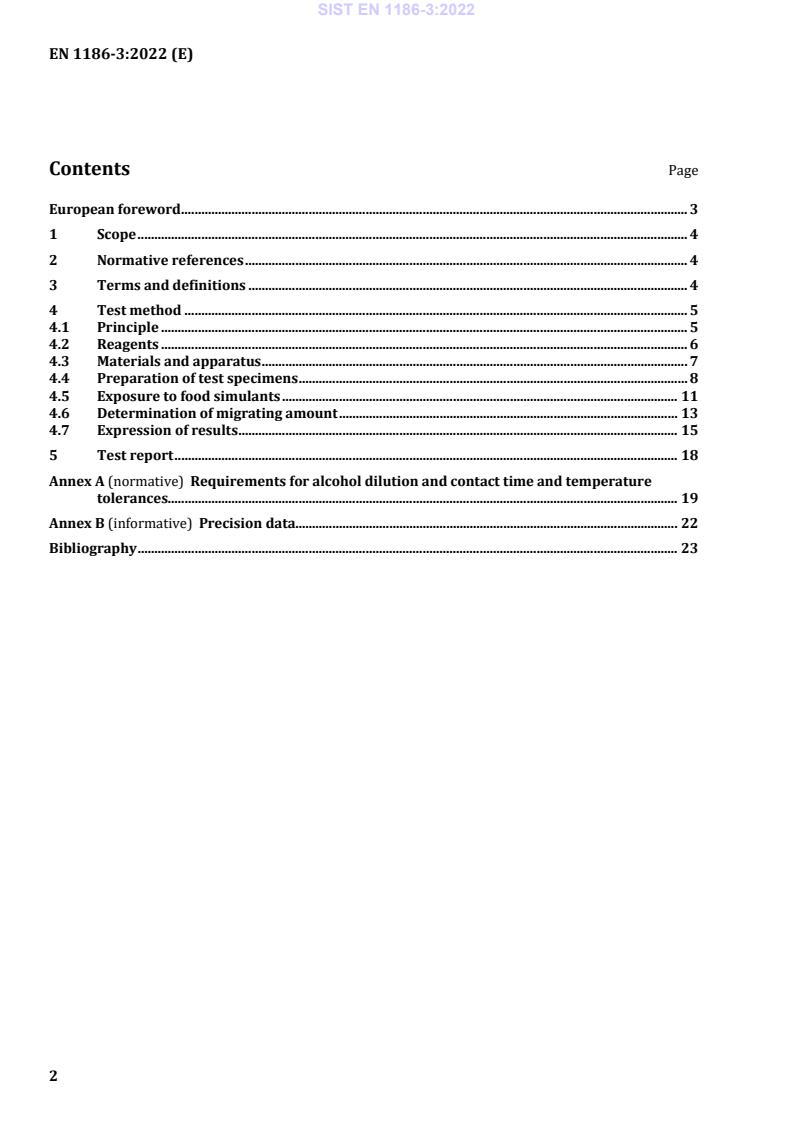
Contents Page
European foreword . 3
1 Scope . 4
2 Normative references . 4
3 Terms and definitions . 4
4 Test method . 5
4.1 Principle . 5
4.2 Reagents . 6
4.3 Materials and apparatus . 7
4.4 Preparation of test specimens . 8
4.5 Exposure to food simulants . 11
4.6 Determination of migrating amount . 13
4.7 Expression of results . 15
5 Test report . 18
Annex A (normative) Requirements for alcohol dilution and contact time and temperature
tolerances. 19
Annex B (informative) Precision data. 22
Bibliography . 23
European foreword
This document (EN 1186-3:2022) has been prepared by Technical Committee CEN/TC 194 “Utensils in
contact with food”, the secretariat of which is held by AFNOR.
This European Standard shall be given the status of a national standard, either by publication of an
identical text or by endorsement, at the latest by February 2023, and conflicting national standards shall
be withdrawn at the latest by February 2023.
Attention is drawn to the possibility that some of the elements of this document may be the subject of
patent rights. CEN shall not be held responsible for identifying any or all such patent rights.
This document supersedes EN 1186-3:2002, EN 1186-5:2002, EN 1186-7:2002, EN 1186-9:2002,
EN 1186-14:2002 and EN 1186-15:2002.
This document implements European Commission Regulation on plastic materials and articles intended
to come into contact with food with regards to the determination of the overall migration in food
simulants. This regulatory text is subject to change; therefore, it is strongly recommended that users of
this document refer to the latest relevant published regulatory texts (to be found on the European
Commission website) before commencement of any of the tests described in this document.
In comparison with the previous editions, the following technical modifications have been made:
— removed the regulatory provisions put in the document to avoid the document being obsolete after
an update of regulation;
— adapted the method of test to the new conditions defined in the regulation;
— combined in one document the 6 previous standards that use evaporable simulants and which are
based on the same principle of measuring.
Any feedback and questions on this document should be directed to the users’ national standards body.
A complete listing of these bodies can be found on the CEN website.
According to the CEN-CENELEC Internal Regulations, the national standards organisations of the
following countries are bound to implement this European Standard: Austria, Belgium, Bulgaria, Croatia,
Cyprus, Czech Republic, Denmark, Estonia, Finland, France, Germany, Greece, Hungary, Iceland, Ireland,
Italy, Latvia, Lithuania, Luxembourg, Malta, Netherlands, Norway, Poland, Portugal, Republic of North
Macedonia, Romania, Serbia, Slovakia, Slovenia, Spain, Sweden, Switzerland, Türkiye and the United
Kingdom.
1 Scope
This document specifies methods for measuring overall migration of plastic materials and articles
intended to come into contact with foodstuffs by contacting test specimens with evaporable food
simulants at temperatures greater than or equal to 4 °C and not exceeding the reflux temperature.
The overall migration from a sample of the plastics is determined as the loss in mass of non-volatile
substances expressed:
— per unit surface area; or
— per kg of food simulant; or
— per article
after contact with a food simulant under defined conditions.
According to the type of materials or shape of articles, contact with the food simulant is carried out on a
single surface (pouch, cell, filling) or by immersion.
This document does not cover the interpretation of the results which is expected to account for regulatory
requirements.
2 Normative references
The following documents are referred to in the text in such a way that some or all of their content
constitutes requirements of this document. For dated references, only the edition cited applies. For
undated references, the latest edition of the referenced document (including any amendments) applies.
ISO 648, Laboratory glassware — Single-volume pipettes
3 Terms and definitions
For the purposes of this document, the following terms and definitions apply.
ISO and IEC maintain terminological databases for use in standardization at the following addresses:
— ISO Online browsing platform: available at https://www.iso.org/obp
— IEC Electropedia: available at https://www.electropedia.org/
3.1
ready-to-use article
article as sold that can be used with minimal if any preparation
3.2
sample
material or article under test
3.3
test specimen
part of the sample undergoing a measurement during the test
3.4
piece
portion of a test specimen
3.5
conventional oven
thermostatically controlled heat chamber where the air within is heated and this heat is then transferred
to the food through the plastic, as opposed to a microwave oven where the food itself is heated directly
by the microwave’s irradiation
3.6
fillable pouch
receptacle of a defined size, manufactured in the film under test and which, once filled with food simulant,
exposes the side of the film to be in contact with foodstuffs to such a food simulant or to a test medium
3.7
reverse pouch
pouch manufactured such that the surface to be in contact with foodstuffs is the outer surface
Note 1 to entry: All sides are sealed to prevent inner surfaces from coming into contact with the food simulant.
The reverse pouch is to be completely immersed in the food simulant or in the test medium.
3.8
cell
device in which the film under test can be mounted and which, when assembled and filled with food
simulant, exposes the side of the film to be in contact with foodstuffs to such a food simulant or to a test
medium
3.9
food simulant
test medium imitating food, in its behaviour food simulant mimics migration for food contact materials
3.10
evaporable simulants
alternative and screening simulants/solvents, e.g. isooctane and 95 % ethanol
Note 1 to entry: Aqueous food simulants defined in the regulation.
4 Test method
4.1 Principle
4.1.1 General
The overall migration of a material or a ready-to-use article made of plastic in contact with foods, is
determined by putting test specimens in contact with evaporable food simulants in test conditions chosen
on the basis of the worst-case scenario of use and by weighing the dry residue of the evaporated food
simulant.
The conditions of exposure of the test specimens are between 4 °C up to 100 °C or to the reflux
temperature.
According to the type of sample, the tests are conducted based on one of the contacting methods given in
4.1.2 to 4.1.6.
4.1.2 Method 1: total immersion (in conventional oven or at reflux)
4.1.2.1 General
Test specimens of known surface are immersed in the food simulant. This method is most suitable for
samples in the form of films and sheets, but can also be applied to a wide range of articles or containers
from which test specimens of suitable size can be cut.
4.1.2.2 Method 1a: total immersion in conventional oven
This method is suitable for tests between 4 °C up to 100 °C or to reflux temperature.
4.1.2.3 Method 1b: total immersion at reflux
This method is only suitable for tests at the boiling point of the food simulant and generally for short
periods of time (for example, up to 4 h).
4.1.3 Method 2: cell
Test specimens of known surface are placed in contact with the food simulant in a cell. This method is
most suitable for plastics in the form of films or sheets in which only one side is to be in contact with
foodstuffs (printed multi-layer materials, etc.).
4.1.4 Method 3: fillable pouch
Test specimens of known surface and in the form of pouches are filled with the food simulant; this method
is suitable for plastics in the form of films or sheets in which the surface to be in contact with foodstuffs
(printed, multi-layer materials) can be sealed by applying heat or pressure, to form a pouch.
4.1.5 Method 4: reverse pouch
Test specimens of known surface and in the form of reverse pouches are immersed in the food simulant;
this method is suitable for plastics in the form of films or sheets in which the surfaces can be sealed by
applying heat or pressure to form reverse pouches. If the sample material allows, the reverse pouches
shall be used instead of the fillable pouches when the temperature of the food simulant is greater than or
equal to 70 °C, because of the pressure of the food simulant that can break the sealing of the pouches at
high temperatures.
4.1.6 Method 5: filling a container
Test specimens of known surface are filled in with the food simulant; this method is most suitable for
plastics in the form of fillable containers and articles.
4.2 Reagents
The reagents specified hereinafter shall be evaporable at atmospheric pressure and at a temperature less
than or equal to 105 °C. The non-volatile residue of a food simulant shall be less than 5 mg/l when
evaporated to dryness and desiccated until a constant mass is obtained at a temperature between 105 °C
and 110 °C.
— Purified water: distilled water or water treated by ions exchange resin;
— 3 % acetic acid (w/V) in aqueous solution: The solution is prepared by diluting 30 g of glacial acetic
acid (28,6 ml with ρ = 1,05) and completed with purified water to obtain one litre of solution of 3 %
acetic acid(w/V);
— Hydroalcoholic solutions (10 %, 20 %, 50 % and 95 % (V/V)) are prepared according to Annex A,
Table A.1;
— Iso-octane.
Other kinds of evaporable liquids can be used as simulants of foods if permitted by the regulation.
4.3 Materials and apparatus
4.3.1 General
Equipment used for testing shall not have properties which interfere with the measurements. The total
mass transfers by the equipment including the mass residue coming from the simulant shall be less than
5 mg/l of food simulant. The equipment shall be suitably cleaned.
4.3.2 Common materials and apparatus for all methods
4.3.2.1 Analytical balance where it can be read at least 0,1 mg.
4.3.2.2 Thermostatically controlled oven, incubator or refrigerator, capable of maintaining the
temperature within the tolerance limits specified in A.2.
4.3.2.3 Glass, glass ceramic, ceramic, stainless steel, nickel, aluminium, platinum, platinum alloy, gold
dishes, 50 mm to 90 mm diameter and maximum mass 100 g, for evaporation of food simulants and
weighing of residues. Glass, glass ceramic or ceramic dishes may be used provided that the surface
characteristics are such that the masses of the dishes after evaporation of any specified food simulants
followed by conditioning in the desiccator used are stable within ±0,5 mg.
NOTE Not all materials are suitable for all evaporable simulants.
4.3.2.4 Steam bath, hot plate, distillation apparatus or rotary evaporator for evaporation of food
simulant at the end of test period.
4.3.2.5 Desiccator with, for example, anhydrous calcium chloride or silica gel.
4.3.2.6 Lint-free cloth or soft brush or pure compressed air generator.
4.3.3 Common materials for methods other than filling a container
4.3.3.1 Cutting slab, clean smooth glass, metal or plastic slab of suitable area to prepare test
specimens.
4.3.3.2 Blunt-nosed tweezers, for example made of stainless steel.
4.3.3.3 Cutting implement: scalpel, scissors, sharp knife or other suitable implement.
4.3.3.4 Cutting templates measuring (100 mm ± 0,2 mm) × (100 mm ± 0,2 mm).
4.3.3.5 Tool for measuring length, when it can be read 1 mm.
4.3.3.6 Glass containers for containing the food simulant and test specimens, for example test
containers, ground neck, with an internal diameter of approximately 35 mm and length in the range of
100 mm to 200 mm, excluding the ground neck or ground-necked flasks of suitable size.
4.3.3.7 Pipettes, 50 ml and 100 ml, conforming to the requirements of ISO 648 Class B or automatic
pipettes of equivalent performances or measuring cylinders.
4.3.4 Materials for method 1a (total immersion in conventional oven)
4.3.4.1 Specimen supports, for example made of stainless steel, capable of holding and keeping the
test pieces apart and at the same time ensuring complete contact with the food simulant.
4.3.4.2 Gauze, for example, fine stainless steel gauze, mesh size 1 mm, approximately
25 mm x 100 mm in size.
4.3.4.3 Glass rods, for example 2 mm to 3 mm in diameter and approximately 100 mm long, for
insertion between the test pieces.
4.3.4.4 Glass beads, for example 2 mm to 3 mm in diameter.
4.3.5 Materials for method 1b (total immersion at reflux)
4.3.5.1 Ground-necked flasks of suitable size.
4.3.5.2 Condensers to fit the flasks.
4.3.5.3 Heating device for maintaining the food simulants at reflux temperature during exposure.
4.3.5.4 Glass filter, pore size 100 µm to 160 µm.
4.3.5.5 Device to prevent the test specimen to come in contact with the heated glass flask.
4.3.6 Materials for method 2 (cell)
Appropriate cells have the following requirements:
— minimum of 0,4 dm of contact area for the test specimen;
-1
— surface to volume ratio shall be between (1 to 2) cm for the test specimen;
— blank value shall be less than 5 mg/l.
4.3.7 Materials for method 3 (fillable pouch) and method 4 (reverse pouch)
4.3.7.1 Heat or pressure sealing device, for use in forming pouches.
4.3.7.2 Pouch holder.
4.3.8 Materials for method 5 (filling a container)
Glass containers of suitable size.
4.4 Preparation of test specimens
4.4.1 General
The test specimens shall be clean and free from surface contamination (many plastics can readily attract
dust due to static charges). Before preparing test specimens, remove any surface contamination from the
sample by gently wiping it with a lint-free cloth, or by brushing with a soft brush or with a compressed
air stream.
As a general rule, do not wash the test specimens with water or solvent. However, if the articles are
accompanied by instructions for use intended for the user advising cleaning before use, these instructions
should be followed for the test, unless they advise rubbing the article with oil: in this case, the instructions
should not be followed insofar as the oil would be included in the overall migration.
Minimize handling of the samples and where necessary, wear cotton gloves.
For one measurement, use a sufficient number of materials or articles to provide a surface area of 1 dm .
A surface area of 1 dm and volume of 100 ml are recommended.
Use a sufficient number of test specimens to get a valid result. Three replicates are recommended.
Determine the surface area of each test specimen to the nearest 0,01 dm and record.
If the result is to be expressed in mg/kg, determine the contact surface area and the volume of the article
and record.
4.4.2 Preparation of test specimens and determination of the area in contact
4.4.2.1 Method 1: total immersion in conventional oven or at reflux
4.4.2.1.1 General
2 2
Cut out test specimens of 1 dm ± 0,01 dm using a cutting template. If this is not possible, cut out pieces
suitable for obtaining test specimens having a surface area of approximately 1 dm .
Ensure that the test pieces are well separated and that their surfaces are freely exposed to the food
simulant during the test, using gauze, glass rods and/or specimen holders as required.
If the area of the edges of the test specimen exceeds 10 % of the area of the test specimen measured, this
is incorporated in the area calculation.
4.4.2.1.2 Films and sheets
For the method in a conventional oven, cut each test specimen into four pieces (or into an appropriate
number) measuring approximately 25 mm × 100 mm by using the tool of 4.3.3.3. For the method at reflux,
if necessary, cut each test specimen into smaller pieces.
4.4.2.1.3 Containers and other articles
Cut pieces from the walls of the container or article to give test specimens each approximately 1 dm in
surface area. For articles with individual surface areas less than 1 dm , use a sufficient number of articles
to provide a surface of 1dm . Measure the dimensions of each test specimen to the nearest 1 mm, by using
the tool of 4.3.3.5.
Calculate the surface area of each test specimen to the nearest 0,01 dm and record. If necessary, cut each
test specimen into smaller pieces to enable them to fit into the glass test containers. The test specimens
or pieces are placed on the specimen holders or, if the test specimens are sufficiently rigid, they can be
tested unsupported.
The number of cuttings should be as low as possible.
4.4.2.1.4 Articles of irregular shape
Select representative portions of the article, or multiples of the article for small articles, to give sufficient
area of material to obtain test specimen (s). Surface area of each test specimen should be at least 1 dm .
Measure only the surface area of the test specimens intended to come into contact with foodstuffs to the
nearest 0,05 dm using the Schlegel Method [5], the method described by Mieth and Hoekstra [6] or any
other suitable method [7]. Record the surface area of each test specimen.
4.4.2.2 Method 2: cell
Lay the sample on the cutting slab with the surface to be in contact with the food simulant uppermost.
Cut out a test specimen of suitable dimensions for the cell using the cutting implement.
4.4.2.3 Method 3: fillable pouch
Prepare a pouch suitable for obtaining an internal contact area of 2 dm and containing a volume of
approximately 100 ml of food simulant.
For example, fold over a sheet measuring 120 mm x 240 mm, with the surface under test facing inward,
and seal the 3 other sides such that the area inside the seals defines a square measuring 100 mm by
100 mm, then cut one corner of the pouch in order to be able to fill it with food simulant (after filling, the
corner of the pouch may be sealed).
An alternative method consists of only sealing 2 sides and sealing the final side after filling with food
simulant.
In any case, remove any air bubbles when sealing the filling pouch for the final time.
Measure and record the surface area of the pouch which will be in contact with the food simulant.
Remove excess film from the sealed area (to reduce the area of film not directly exposed to food simulant),
whilst leaving enough to withstand the test conditions without leaking.
For multilayer films in which the external side is sealable, the reverse pouch method may be used to test
the internal surface by immersion.
Pouches of dimensions other than 100 mm × 100 mm can be used for this test. These pouches shall have,
wherever possible, a contact area greater than or equal to 1 dm .
4.4.2.4 Method 4: reverse pouch
Prepare pouches so that the surface area intended to come into contact with the food simulants is the
outer face. The pouches shall have a contact surface area of 2 dm , for example by folding over a sheet
measuring 120 mm x 240 mm, with the side under test facing inward and by sealing the 2 parallel edges
such that the inside area shall define a square measuring 100 mm by 100 mm. Then, reverse the pouch,
and seal the 4th side.
An alternative method consists of taking two sheets measuring 120 mm x 120 mm, creating 3 seals,
reversing the pouch and sealing the 4th side.
Measure the external dimensions of the pouches prepared and calculate the exposed areas to the nearest
0,01 dm .
To test for leaks, it is possible to put into the reverse pouches, a piece of filter paper of an adequate size.
If the pouches are leaking, the paper will absorb the food simulant and thus the leaks are visible.
4.4.2.5 Method 5: filling a container
4.4.2.5.1 Number of test specimens
4.4.2.5.1.1 Articles with a nominal volume of more than 100 ml
One article per replicate plus articles for determination of surface area.
4.4.2.5.1.2 Articles with a nominal volume of less than 100 ml
The number of articles required to provide a test specimen is dependent on their volume. A test specimen
shall be made up of sufficient articles to contain a minimum of 100 ml of the food simulant.
Record the number of articles used to make up a test specimen.
4.4.2.5.2 Surface area of test specimen exposed to food simulant
Determine the surface area to be in contact with the food simulant when filled to the nominal volume.
If the nominal volume is not used, determine the surface area to be in contact with the food simulant
when filled to a defined volume keeping the surface at least 1 dm and volume at least 100 ml.
2 2
In the case of articles with a surface area less than 1 dm , use a number of articles to get 1 dm .
4.5 Exposure to food simulants
4.5.1 Method 1a: total immersion in conventional oven
Mark the glass containers for identification for each test specimen and for each blank. Measure, using a
100 ml measuring cylinder, 100 ml of the food simulant into each container. Insert a thermometer or
thermocouple in one of the containers and stopper all containers. Place the containers in the
thermostatically controlled heat chamber set at the test temperature, and leave until the test temperature
has been attained. Preheat the food simulant and the glass containers (without the test specimen) to a
temperature as close as possible to the testing temperature.
Place a test specimen into t
...