

CEN/TR 18160:2025
(Main)Plastics recycling - Classification of plastic recyclates as post-consumer recyclates (PCR) and post-industrial recyclates (PIR)
- Abstract
This document has been developed to ensure transparency regarding the input stream for
recycling and to assist all plastic industry stakeholders in the development of new and improved
standards for plastic recycling.
The aim of this report is to present the current state of the debate on how to distinguish waste
materials that are suitable for the production of plastic recyclates from those that cannot be used
for recycling
- Status
- Published
- Publication Date
- 15-Apr-2025
- Technical Committee
- CEN/TC 249 - Plastics
- Drafting Committee
- CEN/TC 249/WG 11 - Plastics recycling
- Current Stage
- 6060 - Definitive text made available (DAV) - Publishing
- Start Date
- 16-Apr-2025
- Due Date
- 30-Jun-2024
- Completion Date
- 16-Apr-2025

Overview
CEN/TR 18160:2025 - "Plastics recycling - Classification of plastic recyclates as post‑consumer recyclates (PCR) and post‑industrial recyclates (PIR)" is a CEN Technical Report that clarifies how plastic waste streams should be classified as inputs for recyclates. The report harmonises legal and normative definitions to increase transparency in plastics recycling supply chains and to support consistent implementation of recycled content targets in the circular economy.
Key topics and requirements
- Harmonised definitions for terms such as post‑consumer plastic waste, pre‑consumer/post‑industrial plastic waste, in‑house scrap, by‑product, and recyclate.
- Classification matrix that differentiates PIR and PCR based on the decisive moment of placing on the market, the source of the waste stream, the production/process line where waste is generated, and re‑use pathways.
- Concretisation of ambiguous terms in existing standards (for example, what constitutes “the same process” or “in‑house scrap”) to reduce interpretation gaps across industries.
- Scope and limitations: focused specifically on definitions and classification of inputs for recyclates; it does not modify broader legal definitions of “waste” but references them for context.
- Discussion of unresolved topics where consensus is lacking across sectors and where industry‑specific considerations may affect classification.
Practical applications - who uses this standard
CEN/TR 18160:2025 is intended for stakeholders across the plastics value chain:
- Plastic producers, compounders and converters - to determine when residues qualify as PIR versus PCR for recycled-content claims.
- Plastics recyclers and material suppliers - to document and certify feedstock provenance and support supply‑chain transparency.
- Product designers and OEMs - to select appropriate recyclates that meet regulatory recycled content targets.
- Standards developers, regulators and policymakers - to align technical specifications and legislation with harmonised classifications.
- Procurement and sustainability teams - to validate supplier claims on PCR/PIR content and to support circular-economy reporting.
Practical benefits include clearer recycled‑content calculations, improved traceability of input streams, and reduced disputes about whether a material is eligible as PCR or PIR.
Related standards and references
- EU Waste Framework Directive 2008/98/EC (by‑product vs. waste concepts)
- The Blue Guide on implementation of EU product rules (placing on the market)
- EN 17615, EN ISO 14021, EN ISO 472 (existing normative definitions referenced in the report)
Keywords: CEN/TR 18160:2025, plastics recycling, PCR, PIR, recyclates, post‑consumer recyclates, post‑industrial recyclates, recycled content, circular economy.
Get Certified
Connect with accredited certification bodies for this standard

DIN CERTCO
DIN Group product certification.
CIS Institut d.o.o.
Personal Protective Equipment (PPE) certification body. Notified Body NB-2890 for EU Regulation 2016/425 PPE.

Kiwa BDA Testing
Building and construction product certification.
Sponsored listings
Frequently Asked Questions
CEN/TR 18160:2025 is a technical report published by the European Committee for Standardization (CEN). Its full title is "Plastics recycling - Classification of plastic recyclates as post-consumer recyclates (PCR) and post-industrial recyclates (PIR)". This standard covers: This document has been developed to ensure transparency regarding the input stream for recycling and to assist all plastic industry stakeholders in the development of new and improved standards for plastic recycling. The aim of this report is to present the current state of the debate on how to distinguish waste materials that are suitable for the production of plastic recyclates from those that cannot be used for recycling
This document has been developed to ensure transparency regarding the input stream for recycling and to assist all plastic industry stakeholders in the development of new and improved standards for plastic recycling. The aim of this report is to present the current state of the debate on how to distinguish waste materials that are suitable for the production of plastic recyclates from those that cannot be used for recycling
CEN/TR 18160:2025 is classified under the following ICS (International Classification for Standards) categories: 13.030.50 - Recycling; 83.140.01 - Rubber and plastics products in general. The ICS classification helps identify the subject area and facilitates finding related standards.
CEN/TR 18160:2025 is available in PDF format for immediate download after purchase. The document can be added to your cart and obtained through the secure checkout process. Digital delivery ensures instant access to the complete standard document.
Standards Content (Sample)
SLOVENSKI STANDARD
01-junij-2025
Recikliranje plastike - Razvrstitev plastičnih reciklatov na reciklate po porabi
(PCR) in postindustrijske reciklate (PIR)
Plastics recycling - Classification of plastic recyclates as postconsumer recyclates (PCR)
and postindustrial recyclates (PIR)
Recycling von Kunststoffen - Klassifizierung von Kunststoffrezyklaten als Post-
Consumer-Rezyklate (PCR) und Post-Industrial-Rezyklate (PIR)
Recyclage des plastiques - Classification des recyclats de plastiques comme recyclats
post-consommation (PCR) et recyclats pré-consommation/post-industriels (PIR)
Ta slovenski standard je istoveten z: CEN/TR 18160:2025
ICS:
13.030.50 Recikliranje Recycling
83.140.01 Izdelki iz gume in polimernih Rubber and plastics products
materialov na splošno in general
2003-01.Slovenski inštitut za standardizacijo. Razmnoževanje celote ali delov tega standarda ni dovoljeno.
CEN/TR 18160
TECHNICAL REPORT
RAPPORT TECHNIQUE
April 2025
TECHNISCHER REPORT
ICS 13.030.50; 83.140.01
English Version
Plastics recycling - Classification of plastic recyclates as
post-consumer recyclates (PCR) and post-industrial
recyclates (PIR)
Recyclage des plastiques - Classification des recyclats Recycling von Kunststoffen - Klassifizierung von
de plastiques comme recyclats post-consommation Kunststoffrezyklaten als Post-Consumer-Rezyklate
(PCR) et recyclats post-industriels (PIR) (PCR) und Post-Industrial-Rezyklate (PIR)
This Technical Report was approved by CEN on 28 March 2025. It has been drawn up by the Technical Committee CEN/TC 249.
CEN members are the national standards bodies of Austria, Belgium, Bulgaria, Croatia, Cyprus, Czech Republic, Denmark, Estonia,
Finland, France, Germany, Greece, Hungary, Iceland, Ireland, Italy, Latvia, Lithuania, Luxembourg, Malta, Netherlands, Norway,
Poland, Portugal, Republic of North Macedonia, Romania, Serbia, Slovakia, Slovenia, Spain, Sweden, Switzerland, Türkiye and
United Kingdom.
EUROPEAN COMMITTEE FOR STANDARDIZATION
COMITÉ EUROPÉEN DE NORMALISATION
EUROPÄISCHES KOMITEE FÜR NORMUNG
CEN-CENELEC Management Centre: Rue de la Science 23, B-1040 Brussels
© 2025 CEN All rights of exploitation in any form and by any means reserved Ref. No. CEN/TR 18160:2025 E
worldwide for CEN national Members.
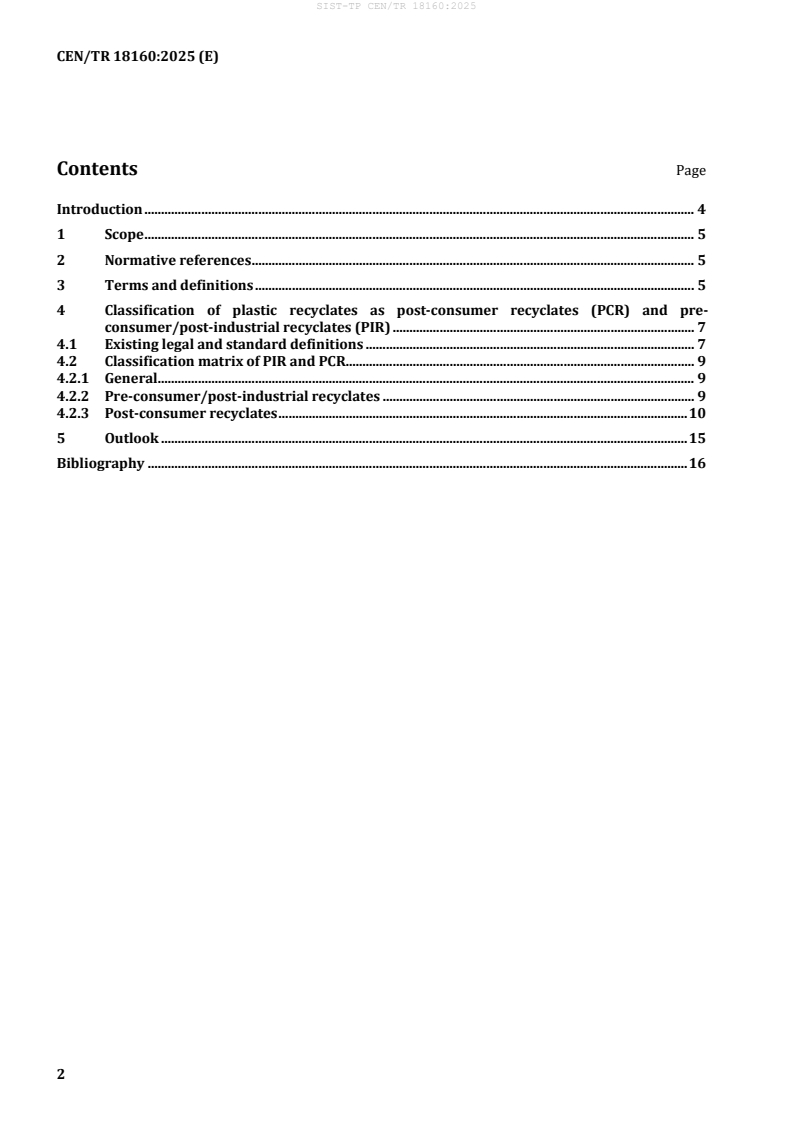
Contents Page
Introduction . 4
1 Scope . 5
2 Normative references . 5
3 Terms and definitions . 5
4 Classification of plastic recyclates as post-consumer recyclates (PCR) and pre-
consumer/post-industrial recyclates (PIR) . 7
4.1 Existing legal and standard definitions . 7
4.2 Classification matrix of PIR and PCR. 9
4.2.1 General. 9
4.2.2 Pre-consumer/post-industrial recyclates . 9
4.2.3 Post-consumer recyclates . 10
5 Outlook . 15
Bibliography . 16
European foreword
This document (CEN/TR 18160:2025) has been prepared by Technical Committee CEN/TC 249
“Plastics”, the secretariat of which is held by SIS.
Attention is drawn to the possibility that some of the elements of this document may be the subject of
patent rights. CEN shall not be held responsible for identifying any or all such patent rights.
Any feedback and questions on this document should be directed to the users’ national standards body.
A complete listing of these bodies can be found on the CEN website.
Introduction
In order to promote the uptake of plastic recycled material, the European Commission has already set
minimum recycled plastic content targets for example for beverage bottles made from plastics, especially
PET bottles. Similarly, recycled content targets are planned for further key products such as packaging,
vehicles and construction materials. [1-3]
Plastic recyclates are plastics materials resulting from the recycling of plastic waste. Both legal and
normative definitions of the term ‘waste’ leave room for interpretation. Taking into account the specifics
of individual industries and applications, as well as differences in regional waste management systems
and national legislations, this interpretation room has a major impact on the effective and transparent
implementation of the circular economy model. In this context, a more precise and generally applicable
classification of pre-consumer/post-industrial and post-consumer plastic waste as an input for the
manufacture of pre-consumer/post-industrial recyclates (PIR) and post-consumer recyclates (PCR) is
required. This classification is important in order to reflect the recycling effort required for the
production of PIR and PCR and to concretise the material flow in the recycling of processing waste.
The main aim of this document is to harmonise and concretise the currently existing legal and normative
definitions for PIR and PCR as far as possible. This document is intended to help to ensure that all
stakeholders in various industries have the same understanding of the PIR and PCR and use definitions
which are as universal as possible. The followed definitional approach is applicable to various plastic
industries and applications that are currently at different stages of implementing a circular economy
model. To enable this, the scope of the document has been narrowed to a very specific topic dealing with
the definitions of PIR and PCR. All further related topics dealing with, for example, definitions like ‘waste’,
‘product’, ‘by-product’, etc. refer to the relevant legal documents and/or standards, which are currently
being revised and adapted in the context of the circular economy model.
Furthermore, this document mentions some discussion points regarding PIR and PCR definitions where
there is currently no consensus across various industries and applications. The reason for this is that due
to the wide variety of plastic products and the corresponding waste streams, some of the plastic waste
streams can have certain material, logistical or other advantages or disadvantages with regard to
recycling. Thus, in certain cases, a universal definition can disadvantage or favour a particular industry
or a plastic waste stream.
1 Scope
This document has been developed to ensure transparency regarding the input stream for recycling and
to assist all plastic industry stakeholders in the development of new and improved standards for plastic
recycling.
The aim of this document is to present the current state of the debate on the distinction between plastic
waste that is suitable as an input for plastic recyclates and plastic waste that cannot be used as an input
for plastic recyclates, and on the distinction between pre-consumer/post-industrial (PIR) and post-
consumer plastic recyclates (PCR).
2 Normative references
There are no normative references in this document.
3 Terms and definitions
For the purposes of this document, the following terms and definitions apply.
ISO and IEC maintain terminological databases for use in standardization at the following addresses:
• IEC Electropedia: available at https://www.electropedia.org/
• ISO Online browsing platform: available at https://www.iso.org/obp
3.1
by-product
co-product from a process that is incidental or not intentionally produced and which cannot be avoided,
but which will certainly be further used without any further processing other than normal industrial
practice
Note 1 to entry: A by-product is not a waste.
Note 2 to entry: In-house scrap is a by-product.
Note 3 to entry: For legal definition refer to the European Waste Framework Directive 2008/98/EC article 5.
[SOURCE: EN 17615:2022, 3.209, modified, Note 1 paraphrased from “Waste is not a by-product.” to “A
by product is not a waste.”]
3.2
converter
specialized company or a company unit capable of shaping plastics raw material to make a usable semi-
finished or finished product
Note 1 to entry: Typically used processes are for example, extrusion, injection moulding, film or filament
manufacturing, vacuum forming, blow molding, etc.
[SOURCE: EN 17615:2022, 3.69, modified, “operator” was exchanged with “company or a company unit”,
added “Typically used processes are for example, injection molding, film or filament manufacturing,
vacuum forming, blow molding, etc.”]
3.3
fabricator
specialized company or a company unit capable of final processing and assembling a product made of or
containing plastic, if required
Note 1 to entry: Typical processes include cutting, punching, folding, threading with perforation, etc. For example,
cutting and assembling films for a specific packaging application or pipes for a specific building or assembling
various semi-finished plastic products into a final product, etc.
3.4
in-house scrap
materials recovered by industry within the original manufacturing process
Note 1 to entry: Recovery of in-house scrap is not considered as recycling.
Note 2 to entry: In-house scrap is a by-product.
[SOURCE: EN 17615:2022, 3.133]
3.5
plastic
material which contains as an essential ingredient a polymer and which at some stage in its processing
into finished products can be shaped by flow
Note 1 to entry: Elastomeric materials, which also are shaped by flow, are not considered as plastics.
Note 2 to entry: Additives or other substances may have been added, and which can function as a main structural
component of final products.
[SOURCE: EN 17615:2022, 3.184]
3.6
plastic producer
specialized company or a company unit capable of manufacture (synthesis) of plastic
3.7
plastic processor
specialized company or a company unit capable of modifying plastic raw material to improve its
processing, storage and/or product properties for its use phase or thereafter.
Note 1 to entry: Typically, compounders transforming plastic raw material into an application-specific semi-
finished product by using various compounding processes like melt blending or mixing of polymers and additives.
3.8
product
resins, material or objects/articles resulting from a production process
Note 1 to entry: The product can be a material, semi-finished or final product, for example polyethylene resin
derived from petroleum or biomass, PE film from biomass, PET resins, PET bottles, monomers, plasticizers.
[SOURCE: EN 17615:2022, 3.199, modified, “bioPE film” replaced with “PE film from biomass”]
3.9
recyclate
recycled plastic
secondary raw material
plastics material resulting from recycling of plastic waste, that ceased to be waste and can be used for the
manufacturing of new articles or products
Note 1 to entry: Recyclates may be reformulated using additives.
[SOURCE: EN 17615:2022, 3.209]
3.10
waste
any material or object which the holder discards, or intends to discard, or is required to discard
Note 1 to entry: The term waste is also defined in Directive 2008/98/EC, article 3 (1).
[SOURCE: EN 17615:2022, 3.257]
4 Classification of plastic recyclates as post-consumer recyclates (PCR) and pre-
consumer/post-industrial recyclates (PIR)
4.1 Existing legal and standard definitions
According to the legal definition, plastic waste generated from plastic products that have been placed on
the market is defined as post-consumer plastic waste, which is a suitable input for the manufacture of
PCR. [1, 4, 5, 6] The concept of ‘placing on the market (and/or putting into service)’ is defined in the ‘Blue
Guide on the implementation of EU product rules’ and refers to the moment when the plastic products
“are first supplied for distribution, consumption or use on the market”. [7] At the same time, the plastic
product is not placed on the market, if it is in the stocks of the manufacturer or the importer and is not
yet made available for distribution, consumption or use, unless otherwise provided for in the applicable
harmonisation legislation. For a more detailed legal information on the product regulations and specific
cases, see the ‘Blue Guide’. [7]
Based on this definition it can be deduced that PIR can be manufactured from a plastic waste generated
from the plastic products that have not yet been placed on the market.
The legal definition of ‘waste’ and ‘by-product’ is provided by European Waste Framework Directive
2008/98/EC, article 5 as follows: the ‘by-product’ is defined as a substance or object, resulting from a
production process, the primary aim of which is not the production of that item, is considered not to be
waste, but to be a by-product if the following conditions are met:
a) further use of the substance or object is certain;
b) the substance or object can be used directly without any further processing other than normal
industrial practice;
c) the substance or object is produced as an integral part of a production process; and
d) further use is lawful, i. e. the substance or object fulfils all relevant product, environmental and health
protection requirements for the specific use and will not lead to overall adverse environmental or
human health impacts. [8]
The existing standards EN ISO 14021, EN ISO 472 and EN 17615 define post-consumer and post-
industrial (waste materials) as follows:
pre-consumer Material diverted from the waste stream during a manufacturing process.
material Excluded is reutilization of materials such as rework, regrind or scrap generated
in a process and capable of being reclaimed within the same process that
generated it.
[SOURCE: EN ISO 14021:2016]
pre-consumer plastic material or product which the holder discards or intends or is required
plastic waste to discard before it has been put in use
post-industrial Note 1 to entry: This term excludes in-house-scrap.
plastic waste
Note 2 to entry: Discarded material can still be recycled in-house.
[SOURCE: EN 17615:2022]
Pre-consumer / a descriptive term covering materials diverted during a manufacturing process
post-industrial
Note 1 to entry: This term excludes re-utilized material, such as rework, regrind
or scrap that has been generated in a given process and is capable or being
reclaimed within that same process.
Note 2 to entry: The term “post-industrial material” is sometimes used
synonymously.
[SOURCE: EN ISO 472:2013]
post-consumer Material generated by households or by commercial, industrial and institutional
material facilities in their role as end-users of the product which can no longer be used for
its intended purpose. This includes returns of material from the distribution
chain.
[SOURCE: EN ISO 14021:2016]
post-consumer plastic waste, generated by the end-users of products, that has fulfilled its
plastic waste intended purpose and can no longer be used for its intended purpose
Note 1 to entry: The term “post-use” is sometimes used synonymously.
[SOURCE: EN 17615:2022]
post-consumer descriptive term covering material, generated by the end-users of products, that
has fulfilled its intended purpose or can no longer be used (including material
returned from within the distribution chain)
Note 1 to entry: The term "post-use" is sometimes used synonymously.
[SOURCE: EN ISO 472:2013]
In the case of the pre-consumer/post-industrial plastic waste the ISO 14021 and ISO 472 do not include
a clear definition of the terms ‘a given process’ and ‘that same process’.
Similarly, the EN 17615 excluding in-house scrap, defines the in-house scrap as ‘materials recovered by
industry within the original manufacturing process’. Particularly, it is not clear whether the same
production line, same company, same processing technology or the same product is meant.
As a result, it is not possible to precisely differentiate between pre-consumer/post-industrial waste,
which can be used as an input for PIR and the re-utilized plastic residue material, which cannot be used
as an input for PIR.
Consequently, to ensure transparency in recycling supply chains, a concretised classification of waste
materials as an input for the PIR and PCR is required.
4.2 Classification matrix of PIR and PCR
4.2.1 General
The definition for PIR and PCR proposed in this document harmonises the above-mentioned existing legal
definition with the existing normative definitions and concretizes them further with regard to the plastic
waste source, plastic product to be manufactured, and the processing line used for the manufacture of
the product.
A
...