

FprEN 13383-1
(Main)Armourstone - Part 1: Product standard
- Abstract
This document specifies the characteristics of aggregates obtained by processing natural, manufactured or recycled materials and mixtures of these materials for use as armourstone.
Assessment and Verification of Constancy of Performance (AVCP) of armourstone to this document are given in EN 16236.
Armourstone used in construction is meant to comply with the characteristics of this document. The document includes specific characteristics for natural armourstone, ferrous and steel making slag and recycled armourstone.
Finer aggregates than specified in this document are used in hydraulic structures. For such aggregates European Standards for other end uses of aggregates should be applied.
- Status
- Not Published
- Publication Date
- 18-Nov-2018
- Withdrawal Date
- 19-May-2019
- Technical Committee
- CEN/TC 154 - Aggregates
- Drafting Committee
- CEN/TC 154/WG 10 - Armourstone
- Current Stage
- 5098 - Decision to abandon - Formal Approval
- Start Date
- 25-Mar-2020
- Completion Date
- 07-Oct-2026

Overview
The European Standard FprEN 13383-1: Armourstone - Part 1: Product Standard defines the essential characteristics and requirements for armourstone aggregates used in construction, particularly for hydraulic structures and protective works. Developed by the Technical Committee CEN/TC 154 under the CEN framework, this standard covers natural, manufactured, and recycled materials processed into armourstone. It harmonizes terminology and specifications crucial for quality assurance and construction safety compliance within the European Union, supporting the Construction Products Regulation (EU) No. 305/2001.
The standard replaces the earlier EN 13383-1:2002 and introduces updated grading, physical, chemical, and durability requirements. It also sets the regulatory basis for Assessment and Verification of Constancy of Performance (AVCP) of armourstone, detailed further in EN 16236.
Key Topics
Scope and Material Types
FprEN 13383-1 applies to aggregates destined for armourstone, including natural stone, ferrous and steel-making slags, and recycled materials. It excludes finer aggregates, which fall under other aggregate standards.Geometrical Requirements
Specifications define gradings into coarse, light, and heavy gradings, detailing particle size ranges, shapes, and proportions of crushed or broken surfaces. The newly added coarse grading (32/90 mm) and light grading categories (15 kg to 120 kg) allow precise selection tailored to engineering needs.Physical Properties
Parameters such as particle density, resistance to breakage and wear, and specific testing regarding grouting suitability are specified. The standard introduces a new category (MDE15) for wear resistance, recognizing varied quality levels among sources.Chemical and Durability Criteria
Armourstone must meet limits on impurities and water-soluble constituents to prevent harmful effects. Special focus is on durability against freezing and thawing cycles and salt crystallization, essential for the long-term performance of structures exposed to harsh environments.Assessment and Verification
The document aligns with AVCP systems ensuring conformity and consistency in armourstone quality through factory production control and type testing. It mandates proper marking and labelling for traceability.Additional Guidance and Annexes
Normative and informative annexes provide detailed procedures for grading, block integrity, petrographic examination, freeze-thaw resistance evaluation, and incorporation of new source materials.
Applications
FprEN 13383-1 is critical for:
- Hydraulic Constructions: Protection of riverbanks, sea defenses, breakwaters, and dams using robust armourstone materials.
- Civil Engineering: Road embankments, erosion prevention layers, and foundations requiring durable, well-graded aggregates.
- Marine Structures: Durable armourstone resisting salt crystallization and harsh marine weathering.
- Sustainable Construction: Use of recycled aggregates meeting safety and durability standards in infrastructural projects.
Complying with this product standard ensures that armourstone materials offer the strength, shape, durability, and chemical stability necessary for long-lasting, effective protective structures.
Related Standards
- EN 16236 - Evaluation of conformity of aggregates; detailed methods for AVCP of armourstone.
- EN 12620 - Aggregates for concrete, often including finer grains not covered by this armourstone standard.
- EN 13043 - Aggregates for bituminous mixtures and surface dressings, applicable where armourstone grading may differ.
- EN 13055 - Lightweight aggregates, for specific engineering uses outside heavy armourstone applications.
- EN 13139 - Aggregates for mortar, relevant for finer aggregate requirements in construction.
- EN 13242 - Aggregates for unbound and hydraulically bound materials in civil engineering and road works.
- EN 13450 - Aggregates used in railway ballast, differing from armourstone specifications.
Conclusion
FprEN 13383-1 is a comprehensive, up-to-date European product standard providing strict guidance on the properties and testing of armourstone aggregates. It ensures that natural, manufactured, and recycled materials used in critical hydraulic and civil engineering applications meet safety, durability, and performance requirements. By following this standard, manufacturers, engineers, and constructors can guarantee the reliable use of armourstone compliant with EU regulations and industry best practices.
Relations
- Effective Date
- 13-Feb-2013
- Effective Date
- 08-Jun-2022
Get Certified
Connect with accredited certification bodies for this standard

DIBt (Deutsches Institut für Bautechnik)
German Institute for Building Technology.
DIN CERTCO
DIN Group product certification.

Aboma Certification B.V.
Specialized in construction, metal, and transport sectors.
Sponsored listings
Frequently Asked Questions
FprEN 13383-1 is a draft published by the European Committee for Standardization (CEN). Its full title is "Armourstone - Part 1: Product standard". This standard covers: This document specifies the characteristics of aggregates obtained by processing natural, manufactured or recycled materials and mixtures of these materials for use as armourstone. Assessment and Verification of Constancy of Performance (AVCP) of armourstone to this document are given in EN 16236. Armourstone used in construction is meant to comply with the characteristics of this document. The document includes specific characteristics for natural armourstone, ferrous and steel making slag and recycled armourstone. Finer aggregates than specified in this document are used in hydraulic structures. For such aggregates European Standards for other end uses of aggregates should be applied.
This document specifies the characteristics of aggregates obtained by processing natural, manufactured or recycled materials and mixtures of these materials for use as armourstone. Assessment and Verification of Constancy of Performance (AVCP) of armourstone to this document are given in EN 16236. Armourstone used in construction is meant to comply with the characteristics of this document. The document includes specific characteristics for natural armourstone, ferrous and steel making slag and recycled armourstone. Finer aggregates than specified in this document are used in hydraulic structures. For such aggregates European Standards for other end uses of aggregates should be applied.
FprEN 13383-1 is classified under the following ICS (International Classification for Standards) categories: 91.100.15 - Mineral materials and products. The ICS classification helps identify the subject area and facilitates finding related standards.
FprEN 13383-1 has the following relationships with other standards: It is inter standard links to EN 13383-1:2013, EN 13383-1:2002. Understanding these relationships helps ensure you are using the most current and applicable version of the standard.
FprEN 13383-1 is associated with the following European legislation: EU Directives/Regulations: 305/2011; Standardization Mandates: M/125. When a standard is cited in the Official Journal of the European Union, products manufactured in conformity with it benefit from a presumption of conformity with the essential requirements of the corresponding EU directive or regulation.
FprEN 13383-1 is available in PDF format for immediate download after purchase. The document can be added to your cart and obtained through the secure checkout process. Digital delivery ensures instant access to the complete standard document.
Standards Content (Sample)
SLOVENSKI STANDARD
oSIST prEN 13383-1:2015
01-julij-2015
Kamen za obloge pri vodnih zgradbah in drugih gradbenih delih - 1. del:
Specifikacija
Armourstone - Part 1: Specification
Wasserbausteine - Teil 1:Anforderungen
Enrochements - Partie 1: Spécifications
Ta slovenski standard je istoveten z: prEN 13383-1
ICS:
91.100.15 Mineralni materiali in izdelki Mineral materials and
products
oSIST prEN 13383-1:2015 en,fr,de
2003-01.Slovenski inštitut za standardizacijo. Razmnoževanje celote ali delov tega standarda ni dovoljeno.
oSIST prEN 13383-1:2015
oSIST prEN 13383-1:2015
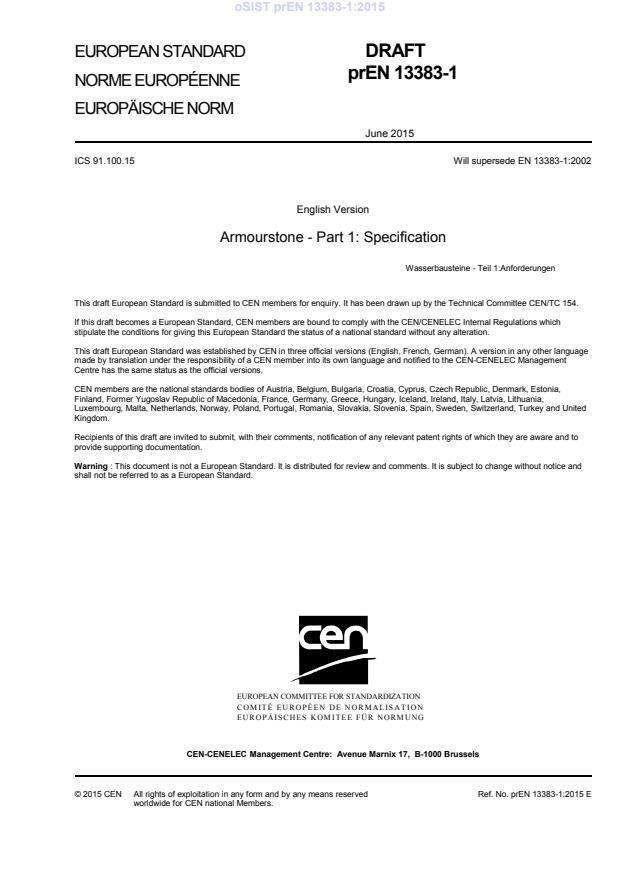
EUROPEAN STANDARD
DRAFT
prEN 13383-1
NORME EUROPÉENNE
EUROPÄISCHE NORM
June 2015
ICS 91.100.15 Will supersede EN 13383-1:2002
English Version
Armourstone - Part 1: Specification
Wasserbausteine - Teil 1:Anforderungen
This draft European Standard is submitted to CEN members for enquiry. It has been drawn up by the Technical Committee CEN/TC 154.
If this draft becomes a European Standard, CEN members are bound to comply with the CEN/CENELEC Internal Regulations which
stipulate the conditions for giving this European Standard the status of a national standard without any alteration.
This draft European Standard was established by CEN in three official versions (English, French, German). A version in any other language
made by translation under the responsibility of a CEN member into its own language and notified to the CEN-CENELEC Management
Centre has the same status as the official versions.
CEN members are the national standards bodies of Austria, Belgium, Bulgaria, Croatia, Cyprus, Czech Republic, Denmark, Estonia,
Finland, Former Yugoslav Republic of Macedonia, France, Germany, Greece, Hungary, Iceland, Ireland, Italy, Latvia, Lithuania,
Luxembourg, Malta, Netherlands, Norway, Poland, Portugal, Romania, Slovakia, Slovenia, Spain, Sweden, Switzerland, Turkey and United
Kingdom.
Recipients of this draft are invited to submit, with their comments, notification of any relevant patent rights of which they are aware and to
provide supporting documentation.
Warning : This document is not a European Standard. It is distributed for review and comments. It is subject to change without notice and
shall not be referred to as a European Standard.
EUROPEAN COMMITTEE FOR STANDARDIZATION
COMITÉ EUROPÉEN DE NORMALISATION
EUROPÄISCHES KOMITEE FÜR NORMUNG
CEN-CENELEC Management Centre: Avenue Marnix 17, B-1000 Brussels
© 2015 CEN All rights of exploitation in any form and by any means reserved Ref. No. prEN 13383-1:2015 E
worldwide for CEN national Members.
oSIST prEN 13383-1:2015
prEN 13383-1:2015 (E)
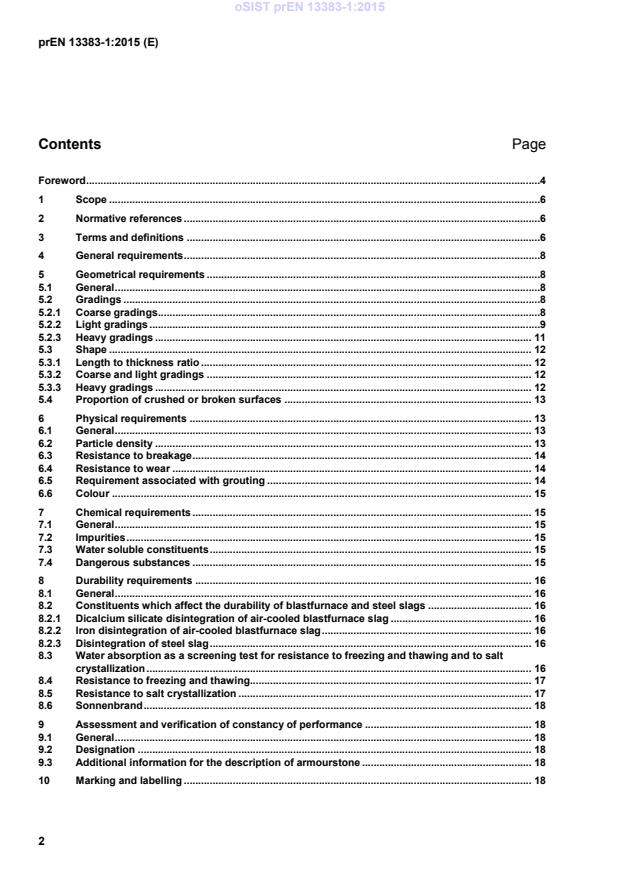
Contents Page
Foreword .4
1 Scope .6
2 Normative references .6
3 Terms and definitions .6
4 General requirements .8
5 Geometrical requirements .8
5.1 General .8
5.2 Gradings .8
5.2.1 Coarse gradings.8
5.2.2 Light gradings .9
5.2.3 Heavy gradings . 11
5.3 Shape . 12
5.3.1 Length to thickness ratio . 12
5.3.2 Coarse and light gradings . 12
5.3.3 Heavy gradings . 12
5.4 Proportion of crushed or broken surfaces . 13
6 Physical requirements . 13
6.1 General . 13
6.2 Particle density . 13
6.3 Resistance to breakage . 14
6.4 Resistance to wear . 14
6.5 Requirement associated with grouting . 14
6.6 Colour . 15
7 Chemical requirements . 15
7.1 General . 15
7.2 Impurities . 15
7.3 Water soluble constituents . 15
7.4 Dangerous substances . 15
8 Durability requirements . 16
8.1 General . 16
8.2 Constituents which affect the durability of blastfurnace and steel slags . 16
8.2.1 Dicalcium silicate disintegration of air-cooled blastfurnace slag . 16
8.2.2 Iron disintegration of air-cooled blastfurnace slag . 16
8.2.3 Disintegration of steel slag . 16
8.3 Water absorption as a screening test for resistance to freezing and thawing and to salt
crystallization . 16
8.4 Resistance to freezing and thawing. 17
8.5 Resistance to salt crystallization . 17
8.6 Sonnenbrand . 18
9 Assessment and verification of constancy of performance . 18
9.1 General . 18
9.2 Designation . 18
9.3 Additional information for the description of armourstone . 18
10 Marking and labelling . 18
oSIST prEN 13383-1:2015
prEN 13383-1:2015 (E)
Annex A (normative) Source materials considered in the development of EN 13383-1 and their
status in respect of the scope of this European Standard . 20
Annex B (informative) Guidance on gradings . 23
B.1 Limits of coarse, light and heavy gradings . 23
B.2 Declaration of non-standard heavy gradings . 24
B.2.1 General . 24
B.2.2 Category B heavy gradings . 24
B.2.3 Category A heavy gradings . 25
Annex C (informative) Guidance on block integrity . 26
C.1 General . 26
C.2 Tests . 26
Annex D (informative) Guidance on the resistance of armourstone to freezing and thawing and to
salt crystallization . 28
D.1 General . 28
D.2 Climate . 28
D.3 Petrographic type . 28
D.4 Testing and selection of specification requirements . 29
D.4.1 Service record . 29
D.4.2 Petrographic examination . 29
D.4.3 Water absorption, freeze-thaw and magnesium sulfate tests . 29
Annex E (informative) Properties and information which comprise the description of armourstone . 31
E.1 Essential information . 31
E.2 Other information . 31
Annex F (informative) Additional information explanatory of main text of standard . 32
F.1 Grading 90/180 . 32
F.2 Crushed and broken surfaces . 32
F.3 Resistance to attrition . 32
F.4 Particle density . 32
F.5 Shape . 32
Annex G (informative) Procedure for the incorporation of new source materials . 34
G.1 General procedure . 34
G.2 Format . 34
Annex ZA (informative) Clauses of this European Standard addressing the provisions of the EU
Construction Products Regulation . 35
ZA.1 Scope and relevant characteristics . 35
ZA.2 Procedure for AVCP of armourstone . 36
ZA.2.1 Systems of AVCP . 36
ZA.2.2 Declaration of performance (DoP) . 38
ZA.2.2.1 General . 38
ZA.2.2.2 Content. 38
ZA.2.2.3 Example of DoP . 39
ZA.3 CE marking and labelling. 41
Bibliography . 45
oSIST prEN 13383-1:2015
prEN 13383-1:2015 (E)
Foreword
This document (prEN 13383-1:2015) has been prepared by Technical Committee CEN/TC 154 “Aggregates”,
the secretariat of which is held by BSI.
This document is currently submitted to the CEN Enquiry.
This document will supersede EN 13381-1:2002.
This European Standard has been prepared under a mandate given to CEN by the European Commission
and the European Free Trade Association, and supports essential requirements of Construction Products
Regulation (EU) No. 305/2001.
For relationship with EU Regulation, see informative Annex ZA, which is an integral part of this document.
Attention is drawn to the possibility that some of the elements of this document may be the subject of patent
rights. CEN shall not be held responsible for identifying any or all such patent rights.
The most significant technical changes compared to the previous edition include:
a) Harmonization of vocabulary and Annex ZA to be consistent with Construction Products Regulations
b) Description of assessment and verification of conformity of performance of aggregates (AVCP) – type
testing and factory production control in a separate new standard prEN 16236;
c) Inclusion of general sentences on dangerous substances and adding a new normative Annex A dealing
with all source materials considered;
d) The removal of the previous minimum density requirement and a change in the method of declaring
density;
e) Inclusion of a new coarse grading (32/90 mm) and a new light grading (15 kg to 120 kg) and guidance on
the declaration of non-standard heavy gradings;
f) Inclusion of a new category for resistance to wear MDE15, to take account of the fact that very few
armourstone sources meet the highest quality category MDE10;
g) Removal of procedures for sample preparation for the Micro-Deval test (now found in EN 13383-2);
In this document the terms ‘property’ and ‘characteristic’ have the same meaning.
Requirements for assessment and verification of constancy of performance are given in prEN 16236 on
Evaluation of conformity of aggregates.
EN 13383 Armourstone consists of the following parts:
— Part 1: Specifications
— Part 2: Test methods
Requirements for other end uses of aggregates are specified in the following European Standards:
— EN 12620, Aggregates for concrete
oSIST prEN 13383-1:2015
prEN 13383-1:2015 (E)
— EN 13043, Aggregates for bituminous mixtures and surface dressings for roads, airfields and other
trafficked areas
— EN 13055, Lightweight aggregates
— EN 13139, Aggregates for mortar
— EN 13242, Aggregates for unbound and hydraulically bound materials for use in civil engineering work
and road construction
— EN 13450, Aggregates for railway ballast
oSIST prEN 13383-1:2015
prEN 13383-1:2015 (E)
1 Scope
This European Standard specifies the properties of aggregates obtained by processing natural, manufactured
or recycled materials and mixtures of these materials for use as armourstone.
A list of the source materials that have been considered and are within the scope of this European Standard is
given in Annex A (normative).
Requirements for the Assessment and Verification of the Constancy of Performance (AVCP) of armourstone
to this European Standard are given in prEN 16236.
Armourstone used in construction shouldl conform with all the requirements of this European Standard. The
standard includes specific requirements for natural armourstone, ferrous and steel making slag and recycled
armourstone.
Finer aggregates than specified in this European Standard are used in hydraulic structures. For such
aggregates European Standards for other end uses of aggregates should be applied.
2 Normative references
The following documents, in whole or in part, are normatively referenced in this document and are
indispensable for its application. For dated references, only the edition cited applies. For undated references,
the latest edition of the referenced document (including any amendments) applies.
EN 932-3, Tests for general properties of aggregates - Part 3: Procedure and terminology for simplified
petrographic description
EN 1097-1:2011, Tests for mechanical and physical properties of aggregates - Part 1: Determination of the
resistance to wear (micro-Deval)
EN 1367-2:2009, Tests for thermal and weathering properties of aggregates - Part 2: Magnesium sulfate test
EN 1744-1:2009+A1:2012, Tests for chemical properties of aggregates - Part 1: Chemical analysis
EN 1744-3, Tests for chemical properties of aggregates - Part 3: Preparation of eluates by leaching of
aggregates
EN 1926:2006, Natural stone test methods - Determination of uniaxial compressive strength
prEN 13383-2, Armourstone - Part 2: Test methods
prEN 16236, Assessment and Verification of the Constancy of Performance (AVCP) of aggregates —Type
Testing and Factory Production Control
3 Terms and definitions
For the purposes of this document, the following terms and definitions apply.
3.1
armourstone
coarse aggregates used in hydraulic structures and other civil engineering works
Note 1 to entry: Armourstone can be natural, manufactured or recycled.
oSIST prEN 13383-1:2015
prEN 13383-1:2015 (E)
3.2
natural armourstone
armourstone from mineral sources which has been subjected to nothing more than mechanical processing
3.3
manufactured armourstone
armourstone of mineral origin resulting from an industrial process involving thermal or other modification
excluding concrete armour units
3.4
recycled armourstone
armourstone resulting from the processing of inorganic or mineral material previously used in construction
3.5
armourstone grading
armourstone designation with a nominal lower and upper limit
Note 1 to entry: This designation accepts the presence of undersize and oversize pieces of armourstone.
3.6
nominal lower limit
mass or sieve size in a grading below which the armourstone pieces are considered to be undersized
3.7
nominal upper limit
mass or sieve size in a grading above which the armourstone pieces are considered to be oversized
3.8
coarse grading
designation of grading with a nominal upper limit defined by a sieve size between and including 90 mm and
250 mm
3.9
light grading
designation of grading with a nominal upper limit defined by a mass between and including 25 kg and 500 kg
3.10
heavy grading
designation of grading with a nominal upper limit defined by a mass of more than 500 kg
3.11
fragment
armourstone piece in the finest fraction of coarse gradings or the lightest fraction of light and heavy gradings
for which the particle size distribution or mass distribution requirements apply
Note 1 to entry: Fragments are all armourstone pieces falling below the extreme lower limit (see Annex B.1)
3.12
effective mean mass
M
em
average mass of armourstone, excluding fragments
3.13
level
the result of the assessment of the performance of an armourstone in relation to its essential characteristics,
expressed as a numerical value
EXAMPLE M = 32
DE Declared
oSIST prEN 13383-1:2015
prEN 13383-1:2015 (E)
3.14
class
a range of levels, delimited by a minimum and a maximum value, of performance of an armourstone
EXAMPLE CP 45/125
3.15
category
level or class of a property of an armourstone expressed as a range of values (class) or a limiting value (level
for individual value or declared category)
Note 1 to entry: There is no relationship between the categories of different properties.
EXAMPLES LMA 60/300, MS 25, MS 28 (Declared category)
3.16
declared value
level of a property declared by the manufacturer
EXAMPLE CS 50 (Declared value)
Declared
4 General requirements
Where conformity with a category is based on a value of a property being less than or equal to a given value,
conformity with a more severe category (lower value) automatically confers conformity with all less severe
categories (higher values). Similarly for categories based on the value of a property being greater than or
equal to a given value, conformity with a more severe (higher value) automatically confers conformity with all
less severe categories (lower values).
When the value of a property is required but not defined by specified limits the value should be declared by
category, e.g. in Table 7 the percentage by number of pieces of armourstone
the manufacturer as an XX
Declared
with less than 50 % crushed or broken surfaces of say 7 corresponds to RO .
When a property is not required, a “No requirement” category may be used.
Sampling shall be carried out as specified in prEN 13383-2:2015, Clause 4.
5 Geometrical requirements
5.1 General
The necessity for testing and declaring all properties in this clause is limited according to the particular
application at end use or origin of the armourstone. When required, the tests specified in Clause 5 shall be
carried out to determine appropriate geometrical properties.
5.2 Gradings
5.2.1 Coarse gradings
The particle size distribution of coarse gradings shall be determined in accordance with prEN 13383-2:2015,
Clause 5 and shall conform to:
a) Table 1 for categories CP 32/90, CP 45/125, CP 63/180, CP 90/250, CP 45/180, and CP 90/180 ; or
oSIST prEN 13383-1:2015
prEN 13383-1:2015 (E)
b) as declared by the manufacturer for category CP .
Declared
Table 1 — Requirements for the particle size distribution of standard coarse gradings
c
Grading 32/90 45/125 63/180 90/250 45/180 90/180
mm
Category CP 32/90 CP 45/125 CP 63/180 CP 90/250 CP 45/180 CP 90/180
Sieve size Cumulative percentage passing (by mass)
mm
360 — — — 98 to 100 — —
250 — — 98 to 100 90 to 100 98 to 100 98 to 100
a
180 — 98 to 100 90 to 100 — 90 to 100 80 to 100
125 98 to 100 90 to 100 — 0 to 50 — —
a
90 90 to 100 — 0 to 50 0 to 15 — 0 to 20
63 — 0 to 50 0 to 15 — 0 to 50 —
b b
45 0 to 50 0 to 15 — 0 to 5 0 to 15 0 to 5
b
31,5 0 to 15 — 0 to 5 — — —
b b
22,4 — 0 to 5 — — 0 to 5 —
b
16 0 to 5 — — — — —
a
The fraction between the 90 mm and 180 mm sieves of the 90/180 mm grading shall be ≥ 80 % by mass.
b
Fragments.
c
See Annex F.
5.2.2 Light gradings
The mass distribution of light gradings shall be determined in accordance with prEN 13383-2:2015, Clause 6.
The mass distribution shall conform to:
a) Table 2 for categories LMA 15/120, LMA 5/40, LMA 10/60, LMA 40/200, LMA 60/300 and LMA 15/300; or
b) Table 3 for categories LMB 15/120, LMB 5/40, LMB 10/60, LMB 40/200, LMB 60/300 and LMB 15/300; or
c) the mass distribution and, where appropriate, the average mass (excluding fragments) as declared by the
manufacturer for category LM .
Declared
oSIST prEN 13383-1:2015
prEN 13383-1:2015 (E)
Table 2 — Requirements for average mass (excluding fragments) and mass distribution of category A
standard light gradings
Grading 5 to 40 10 to 60 15 to 120 40 to 200 60 to 300 15 to 300
kg
Category LMA 5/40 LMA 10/60 LMA 15/120 LMA 40/200 LMA 60/300 LMA 15/300
Average 10 to 20 20 to 35 35 to 60 80 to 120 120 to 190 45 to 135
mass
(excluding
fragments),
M
em
kg
Reference Cumulative percentage (by mass) of stones lighter than reference mass
mass
kg
450 — — — — 97 to 100 97 to 100
300 — — — 97 to 100 70 to 100 70 to 100
200 — — 97 to 100 70 to 100 — —
120 — 97 to 100 70 to 100 — — —
80 97 to 100 — — — — —
60 — 70 to 100 — — 0 to 10 —
40 70 to 100 — — 0 to 10 — —
a
30 — — — — 0 to 2 —
a
15 — — 0 to 10 0 to 2 — 0 to 10
10 — 0 to 10 — — — —
a
5 0 to 10 — 0 to 2 — — —
a
3 — — — — — 0 to 2
a
2 — 0 to 2 — — — —
a
1,5 0 to 2 — — — — —
a
Fragments.
Table 3 — Requirements for mass distribution of category B standard light gradings
Grading 5 to 40 10 to 60 15 to 120 40 to 200 60 to 300 15 to 300
kg
Category LMB 5/40 LMB 10/60 LMB 15/120 LMB 40/200 LMB 60/300 LMB 15/300
Reference Cumulative percentage (by mass) of stones lighter than reference mass
mass
kg
450 — — — — 97 to 100 97 to 100
300 — — — 97 to 100 70 to 100 70 to 100
200 — — 97 to 100 70 to 100 — —
120 — 97 to 100 70 to 100 — — —
80 97 to 100 — — — — —
60 — 70 to 100 — — 0 to 10 —
40 70 to 100 — — 0 to 10 — —
a
30 — — — — 0 to 2 —
a
15 — — 0 to 10 0 to 2 — 0 to 10
oSIST prEN 13383-1:2015
prEN 13383-1:2015 (E)
10 — 0 to 10 — — — —
a
5 0 to 10 — 0 to 2 — — —
a
3 — — — — — 0 to 2
a
2 — 0 to 2 — — — —
a
1,5 0 to 2 — — — — —
a
Fragments.
5.2.3 Heavy gradings
The mass distribution of heavy gradings shall be determined in accordance with prEN 13383-2:2015, Clause 6
and shall conform to:
a) Table 4 for categories HMA 300/1000, HMA 1000/3000, HMA 3000/6000, HMA 6000/10000, and HMA
10000/15000; or
b) Table 5 for categories HMB 300/1000, HMB 1000/3000, HMB 3000/6000, HMB 6000/10000, and HMB
10000/15000; or
c) the mass distribution and, where appropriate, the average mass (excluding fragments) as declared by the
manufacturer for category HM .
Declared
Table 4 — Requirements for average mass (excluding fragments) and mass distribution of category A
standard heavy gradings
Grading 300 to 1 000 1 000 to 3 000 3 000 to 6 000 6 000 to 10 000 10 000 to 15 000
kg
Category HMA 300/1000 HMA 1000/3000 HMA 3000/6000 HMA 6000/10000 HMA 10000/15000
Average mass 540 to 690 1 700 to 2 100 4 200 to 4 800 7 500 to 8 500 12 000 to 13 000
(excluding
fragments),
M
em
kg
Reference Cumulative percentage (by mass) of stones lighter than reference mass
mass
kg
22 500 — — — — 97 to 100
15 000 — — — 97 to 100 70 to 100
10 000 — — — 70 to 100 0 to 10
9 000 — — 97 to 100 — —
a
6 500 — — — — 0 to 5
6 000 — — 70 to 100 0 to 10 —
4 500 — 97 to 100 — — —
a
4 000 — — — 0 to 5 —
3 000 — 70 to 100 0 to 10 — —
a
2 000 — — 0 to 5 — —
1 500 97 to 100 — — — —
1 000 70 to 100 0 to 10 — — —
a
650 — 0 to 5 — — —
300 0 to 10 — — — —
a
200 0 to 5 — — —
a
Fragments.
oSIST prEN 13383-1:2015
prEN 13383-1:2015 (E)
Table 5 — Requirements for mass distribution of category B standard heavy gradings
Grading 300 to 1 000 1 000 to 3 000 3 000 to 6 000 6 000 to 10 000 10 000 to 15 000
kg
Category HMB 300/1000 HMB 1000/3000 HMB 3000/6000 HMB 6000/10000 HMB 10000/15000
Reference Cumulative percentage (by mass) of stones lighter than reference mass
mass
kg
22 500 — — — — 97 to 100
15 000 — — — 97 to 100 70 to 100
10 000 — — — 70 to 100 0 to 10
9 000 — — 97 to 100 — —
a
6 500 — — — — 0 to 5
6 000 — — 70 to 100 0 to 10 —
4 500 — 97 to 100 — — —
a
4 000 — — — 0 to 5 —
3 000 — 70 to 100 0 to 10 — —
a
2 000 — — 0 to 5 — —
1 500 97 to 100 — — — —
1 000 70 to 100 0 to 10 — — —
a
650 — 0 to 5 — — —
300 0 to 10 — — — —
a
200 0 to 5 — — —
a
Fragments.
5.3 Shape
5.3.1 Length to thickness ratio
The percentage of pieces of armourstone with a length to thickness ratio greater than 3 shall be determined in
accordance with prEN 13383-2:2015, Clause 7.
NOTE Guidance on the determination of shape information required for design is given in Annex F.
5.3.2 Coarse and light gradings
The percentage of pieces of armourstone with a length to thickness ratio greater than 3 shall conform to the
relevant requirements (or the manufacturer's declaration for category LTDeclared) specified in Table 6 for the
selected category, when tested as specified in prEN 13383-2 4.3.1.
5.3.3 Heavy gradings
The percentage of pieces of armourstone with a length to thickness ratio greater than 3 shall conform to the
relevant requirements (or the manufacturer's declaration for category LTDeclared) specified in Table 6 for the
selected category, when tested as specified in prEN 13383-2 4.3.1.
oSIST prEN 13383-1:2015
prEN 13383-1:2015 (E)
Table 6 — Category for shape
Length to thickness ratio greater than 3 Category
LT
Percentage by mass Percentage by number
Coarse gradings Light gradings Heavy gradings
≤ 20 ≤ 20 ≤ 5 LT
A
> 20 > 20 > 5 LT
Declared
No requirement No requirement No requirement LT
NR
5.4 Proportion of crushed or broken surfaces
When required, the proportion of pieces of armourstone (excluding fragments), with less than 50 % crushed or
broken surfaces (rounded pieces) shall conform to the relevant requirement (or the manufacturer's declaration
for category RODeclared) specified in Table 7 for the selected category. The sample tested shall be the
sample used for the determination of shape, see EN 13383-2 clause 4.3. The sample shall be examined by
visual inspection and counting of pieces of armourstone. When examining pieces of armourstone, surfaces
arising from discontinuities in the rock formation such as bedding planes or joints shall be included in the
percentage of broken surfaces.
Table 7 — Categories for crushed or broken surfaces
Pieces of armourstone with less than Category
50 % crushed or broken surfaces RO
(Percentage by number)
≤ 5 RO 5
> 5 RO
Declared
No requirement RO
NR
NOTE Guidance on the selection of RO category is given in Annex F.
6 Physical requirements
6.1 General
The necessity for testing and declaring all properties in this clause is limited according to the particular
application at end use or origin of the armourstone. When required, the tests specified in Clause 6 shall be
carried out to determine appropriate physical properties.
6.2 Particle density
The particle density of at least 10 pieces of armourstone (excluding fragments), shall be determined in
accordance with prEN 13383-2:2015, Clause 8.
Using the results, the average particle density (in Mg/m3) of the pieces of armourstone tested shall be
declared to 2 decimal places.
Using the results, the minimum particle density (in Mg/m3) of any piece of armourstone shall be declared to 2
decimal places.
oSIST prEN 13383-1:2015
prEN 13383-1:2015 (E)
6.3 Resistance to breakage
The resistance to breakage of armourstone (excluding fragments) shall be determined by testing compressive
strength in accordance with EN 1926:2006, Annex A.
Each specimen shall be prepared from a separate piece of armourstone.
The number of specimens to be tested and the test results shall conform to the relevant requirements (or the
manufacturer's declaration for category CSDeclared) specified in Table 8 for the selected category.
Table 8 — Categories of resistance to breakage requirements
Mean compressive strength of 9 Compressive strength of no more Category
specimens after striking out the than 2 specimens out of 10 CS
lowest value from 10 specimens
MPa MPa
≥ 80 < 60 CS 80
≥ 60 < 40 CS 60
< 60 No requirement CS
Declared
No requirement No requirement CS
NR
NOTE Block integrity is also of particular importance. Guidance on block integrity is given in Annex C.
6.4 Resistance to wear
When required, the resistance to wear of armourstone (excluding fragments), determined in accordance with
EN 1097-1:2011, Clause 7, shall conform to the relevant requirement (or the manufacturer's declaration for
category MDEDeclared) specified in Table 9 for the selected category.
Table 9 — Categories for resistance to wear requirements
Micro-Deval coefficient Category
M
DE
≤ 10 ≤ 15 M 10 M 15
DE DE
≤ 20 M 20
DE
≤ 30 M 30
DE
> 30 M
DE Declared
No requirement M NR
DE
NOTE Guidance on the selection of wear categories is given in Annex F.
The test portion shall be prepared in accordance with EN 1097-1:2011, Clause 6. Where suitable aggregate
from a source representative of the armourstone is not available, the test portion shall be prepared in
accordance with prEN 13383-2:2015, 4.7.
6.5 Requirement associated with grouting
Armourstone intended for use in a layer to be grouted with bituminous or cement mortar shall not be covered
with observable clayey or other adhesive soil.
oSIST prEN 13383-1:2015
prEN 13383-1:2015 (E)
6.6 Colour
Natural variation in colour supplied from a quarry (or distinct part of a quarry) with an established pattern of
supply shall not be grounds for rejection of any material.
The purchaser should advise the supplier of any preference for a particular general colour for the
armourstone.
7 Chemical requirements
7.1 General
The necessity for testing and declaring all properties in this clause shall be limited according to the particular
application at end use or origin of the aggregate. When required, the tests specified in Clause 7 shall be
carried out to determine appropriate chemical properties.
NOTE This clause generally applies to natural and manufactured armourstone. However, some recycled materials
could have other chemical characteristics that do not apply to the generality of armourstone with an established pattern of
use and when required, provisions valid at the place of use can be used to assess its suitability.
Sampling shall be carried out as specified in prEN 13383-2:2015, Clause 4.
7.2 Impurities
Armourstone shall not contain any foreign matter such as scrap metal, wood and plastic in a quantity that will
cause damage to the structure or the environment in which it is used (see EN 16236:2013, Table 3).
7.3 Water soluble constituents
When a determination of water soluble constituents is required, an eluate shall be prepared from a
representative sample of armourstone as specified in EN 1744-3. Where suitable aggregate representative of
the armourstone is not available, the test portion shall be obtained by crushing, using a laboratory jaw crusher,
at least six separate pieces of armourstone for which the masses do not differ by more than 25 %.
7.4 Dangerous substances
National regulations on dangerous substances may require verification and declaration on release, and
sometimes content, when construction products covered by this standard are placed on those markets.
In the absence of European harmonized test methods, verification and declaration on release/content should
be done taking into account national provisions in the place of use.
NOTE: An informative database covering European and national provisions on dangerous substances is available
at the Construction web site on EUROPA accessed through:
http://ec.europa.eu/enterprise/construction/cpd-ds/
oSIST prEN 13383-1:2015
prEN 13383-1:2015 (E)
8 Durability requirements
8.1 General
The necessity for testing for all properties in this clause is limited according to the particular application at end
use or origin of the armourstone. When required, the tests specified in Clause 8 shall be carried out to
determine appropriate durability properties.
8.2 Constituents which affect the durability of blastfurnace and steel slags
8.2.1 Dicalcium silicate disintegration of air-cooled blastfurnace slag
When required, air-cooled blast-furnace slag armourstone (excluding fragments) tested in accordance with
EN 1744-1:2009+A1:2012, 19.1, shall be free from dicalcium silicate disintegration.
8.2.2 Iron disintegration of air-cooled blastfurnace slag
When required, air-cooled blastfurnace slag armourstone (excluding fragments) tested in accordance with
EN 1744-1:2009+A1:2012, 19.2, shall be free from iron disintegration.
8.2.3 Disintegration of steel slag
When required, the disintegration of steel slag armourstone shall be tested in accordance with EN 13383-
2:2013, Clause 10.
The sample for testing shall consist of 20 pieces of slag (excluding fragments).
The disintegration of steel slags shall conform to the relevant requirements (or the manufacturer's declaration
for category DS ) specified in Table 10 for the selected category.
Declared
Table 10 — Categories for disintegration of steel slag
Disintegration of steel slag Category
Loss of mass or formation of cracks DS
Maximum four pieces show > 0,5 % loss of mass and maximum DS
A
one piece shows > 20 % loss of mass or cracks
Maximum four pieces show > 1,0 % loss of mass and maximum DS
B
one piece shows > 20 % loss of mass or cracks
Other values declared by the manufacturer DS
Declared
No requirement DS
NR
For categories DS and DS of Table 10, if one of the 20 pieces shows either cracks or more than 20 % loss
A B
of mass, another 20 pieces of steel slag shall be tested. None of these additional pieces shall show either
cracks or more than 20 % loss of mass.
8.3 Water absorption as a screening test for resistance to freezing and thawing and to salt
crystallization
When required, the water absorption of armourstone (excluding fragments) shall be determined in accordance
with prEN 13383-2:2015, Clause 8. At least 10 Pieces of armourstone shall be tested and the average
absorption declared.
oSIST prEN 13383-1:2015
prEN 13383-1:2015 (E)
If the average water absorption is not greater than the value selected as category WA specified in Table 11,
0,5
the armourstone shall be assumed to be resistant to freezing and thawing and to salt crystallization.
Table 11 — Categories for water absorption
Water absorption Category
(Percentage by mass) WA
Average absorption ≤ 0,5 WA 0,5
8.4 Resistance to freezing and thawing
When required, and if the declared value of water absorption exceeds the value selected as category WA0,5
specified in Table 11, the resistance to freezing and thawing of armourstone (excluding fragments) shall be
determined in accordance with prEN 13383-2:2015, Clause 9. The resistance to freezing and thawing shall
conform to the relevant requirements (or the manufacturer's declaration for category FT ) specified in
Declared
Table 12 for the selected category. Initially 10 pieces of armourstone shall be tested.
If one of the tested pieces shows more than 0,5 % loss of mass or formation of open cracks, another 10
pieces of armourstone shall be tested.
NOTE 1 The pieces tested in conformity with 7.3 and showing maximum 0,5 % water absorption are excluded from
further testing.
NOTE 2 Guidance on how to specify the resistance of armourstone to freezing and thawing is given in Annex D.
Table 12 — Categories for resistance to freezing and thawing
Freezing and thawing Category
Loss of mass or formation of open cracks
FT
Maximum of one of the initially tested pieces FT
A
and none of the additionally tested pieces
shows more than 0,5 % loss of mass or
formation of open cracks.
Other value declared by the manufacturer FT
Declared
No requirement FT
NR
8.5 Resistance to salt crystallization
When required, and if the declared value of water absorption exceeds the value selected as category WA
0,5
specified in Table 11, the resistance to salt crystallization of armourstone (excluding fragments) shall be
determined in accordance with EN 1367-2:2009, Clause 9. The resistance to salt crystallization shall conform
to the relevant requirement (or the manufacturer's declaration for category MS ) specified in Table 13 for
Declared
the selected category. Where suitable aggregate representative of the armourstone is not available, the test
portion shall be obtained by crushing, using a laboratory jaw crusher, at least six separate pieces of
armourstone for which the masses do not differ by more than 25 %.
Table 13 — Categories for resistance to salt crystallization
Magnesium sulfate value Category
(Percentage loss of mass) MS
≤ 25 MS
> 25 MS
Declared
No requirement MS
NR
NOTE Guidance on how to specify the resistance of armourstone to salt crystallization is given in Annex D.
oSIST prEN 13383-1:2015
prEN 13383-1:2015 (E)
8.6 Sonnenbrand
When required, the presence of signs of Sonnenbrand in armourstone (excluding fragments) from volcanic
rock sources like some basalts, shall be determined in accordance with prEN 13383-2:2015, Clause 10. The
presence of signs of Sonnenbrand shall conform to the relevant requirement (or the manufacturer's
declaration for category SB ) specified in Table 14 for the selected category.
Declared
Initially 20 pieces of armourstone shall be tested. If one piece shows signs of Sonnenbrand, another 20 pieces
of armourstone shall be tested.
Table 14 — Categories for signs of Sonnenbrand
Signs of Sonnenbrand Category
SB
Maximum of one piece of the initially tested pieces and SB
A
none of the additionally tested pieces shows signs of
Sonnenbrand
Other value declared by the manufacturer SB
Declared
No requirement SB
NR
9 Assessment and verification of constancy of performance
9.1 General
The conformity of the product with the requirements of this standard shall be demonstrated by product type
determination and fact
...