

EN 1745:2020
(Main)Masonry and masonry products - Methods for determining thermal properties
- Abstract
This document specifies methods for the determination of thermal properties of masonry and masonry products.
- Status
- Published
- Publication Date
- 21-Jul-2020
- Withdrawal Date
- 30-Jan-2021
- Technical Committee
- CEN/TC 125 - Masonry
- Drafting Committee
- CEN/TC 125/WG 6 - EN 1745
- Current Stage
- 9060 - Closure of 2 Year Review Enquiry - Review Enquiry
- Start Date
- 04-Mar-2026
- Completion Date
- 04-Mar-2026



Overview - EN 1745:2020 (Masonry thermal properties)
EN 1745:2020 (identical to EN 1745:2020) specifies standardized methods for determining thermal properties of masonry and masonry products. It replaces EN 1745:2012 and covers procedures to obtain dry-state and design thermal values used for energy calculations, component design and regulatory compliance across Europe. The standard applies to solid masonry units, masonry units with formed voids and composite masonry units, and addresses thermal conductivity (λ), thermal resistance (R), thermal transmittance (U) and specific heat capacity.
Key technical topics and requirements
- Target properties: determination of dry thermal conductivity (λ10,dry for units and mortars), design thermal conductivity (λdesign), thermal resistance (Rdesign) and thermal transmittance (U).
- Methods overview: multiple accepted approaches - use of tabulated data, direct measurement, numerical calculations, or masonry testing (U-value measurements). Methods are identified as S1–S4 (solid units) and P1–P6 (units with voids/composite).
- Moisture correction: Clause 6 defines procedures (A, B, C) to convert dry-state λ-values into design values accounting for realistic moisture content.
- Calculation and software: Annex D sets requirements for numerical calculation procedures and verification tests for program accuracy (reference cases included).
- Supporting data and tables: Annex A provides tabulated λ-values for common materials; Annex B and C assist with masonry units containing formed voids; Annexes E–G cover performance verification and alternative moisture procedures.
- Testing and sampling: the standard cross-references EN test methods for density, porosity and related sample preparation requirements.
Practical applications and users
EN 1745:2020 is essential for:
- Structural and building engineers calculating heat flow through masonry assemblies.
- Architects assessing energy performance and detailing to avoid thermal bridges or surface condensation.
- Manufacturers of masonry units and mortars for product data sheets and CE marking/performance declarations.
- Testing laboratories implementing standard test programs for thermal characterization.
- Regulators and compliance bodies verifying conformity with national building regulations and energy codes.
Common uses include energy consumption modelling, HVAC sizing, surface temperature checks (condensation/comfort), and non-steady-state thermal assessments.
Related standards and references
- EN 772 series (methods for masonry units: density, porosity, volume)
- National implementations of EN 1745 via CEN member bodies (SIST for Slovenia)
- Refer to Annex D for validated numerical procedure requirements and Annex A–C for tabulated/illustrative data.
Keywords: EN 1745:2020, masonry thermal properties, thermal conductivity λ, thermal resistance R, U-value, masonry units, moisture correction, EN 1745:2020.
Relations
- Effective Date
- 29-Jul-2020
- Effective Date
- 28-Jan-2026
- Effective Date
- 28-Jan-2026
- Effective Date
- 28-Jan-2026
- Effective Date
- 28-Jan-2026
- Effective Date
- 28-Jan-2026
- Effective Date
- 28-Jan-2026
- Effective Date
- 28-Jan-2026
- Effective Date
- 28-Jan-2026
- Effective Date
- 28-Jan-2026
- Effective Date
- 28-Jan-2026
- Effective Date
- 28-Jan-2026
- Effective Date
- 28-Jan-2026
- Effective Date
- 07-Oct-2026
- Effective Date
- 28-Jan-2026
Get Certified
Connect with accredited certification bodies for this standard

DIBt (Deutsches Institut für Bautechnik)
German Institute for Building Technology.
DIN CERTCO
DIN Group product certification.

Aboma Certification B.V.
Specialized in construction, metal, and transport sectors.
Sponsored listings
Frequently Asked Questions
EN 1745:2020 is a standard published by the European Committee for Standardization (CEN). Its full title is "Masonry and masonry products - Methods for determining thermal properties". This standard covers: This document specifies methods for the determination of thermal properties of masonry and masonry products.
This document specifies methods for the determination of thermal properties of masonry and masonry products.
EN 1745:2020 is classified under the following ICS (International Classification for Standards) categories: 91.080.30 - Masonry; 91.120.10 - Thermal insulation of buildings. The ICS classification helps identify the subject area and facilitates finding related standards.
EN 1745:2020 has the following relationships with other standards: It is inter standard links to EN 1745:2012, EN ISO 10211:2017, EN 772-4:1998, EN 12664:2001, EN ISO 7345:2018, EN 12667:2001, EN 1936:2006, EN 772-16:2011, EN 1934:1998, EN 772-3:1998, EN ISO 6946:2017, EN ISO 10456:2007, EN 1015-10:1999, EN 1520:2026, EN 15037-3:2009+A1:2011. Understanding these relationships helps ensure you are using the most current and applicable version of the standard.
EN 1745:2020 is associated with the following European legislation: EU Directives/Regulations: 305/2011; Standardization Mandates: M/116. When a standard is cited in the Official Journal of the European Union, products manufactured in conformity with it benefit from a presumption of conformity with the essential requirements of the corresponding EU directive or regulation.
EN 1745:2020 is available in PDF format for immediate download after purchase. The document can be added to your cart and obtained through the secure checkout process. Digital delivery ensures instant access to the complete standard document.
Standards Content (Sample)
SLOVENSKI STANDARD
01-december-2020
Nadomešča:
SIST EN 1745:2012
Zidovje in zidarski proizvodi - Metode za ugotavljanje toplotnih lastnosti
Masonry and masonry products - Methods for determining thermal properties
Mauerwerk und Mauerwerksprodukte - Verfahren zur Bestimmung von
wärmeschutztechnischen Eigenschaften
Maçonnerie et éléments de maçonnerie - Méthodes pour la détermination des propriétés
thermiques
Ta slovenski standard je istoveten z: EN 1745:2020
ICS:
91.080.30 Zidane konstrukcije Masonry
91.120.10 Toplotna izolacija stavb Thermal insulation of
buildings
2003-01.Slovenski inštitut za standardizacijo. Razmnoževanje celote ali delov tega standarda ni dovoljeno.
EN 1745
EUROPEAN STANDARD
NORME EUROPÉENNE
July 2020
EUROPÄISCHE NORM
ICS 91.080.30; 91.120.10 Supersedes EN 1745:2012
English Version
Masonry and masonry products - Methods for determining
thermal properties
Maçonnerie et éléments de maçonnerie - Méthodes Mauerwerk und Mauerwerksprodukte - Verfahren zur
pour la détermination des propriétés thermiques Bestimmung von wärmeschutztechnischen
Eigenschaften
This European Standard was approved by CEN on 17 May 2020.
CEN members are bound to comply with the CEN/CENELEC Internal Regulations which stipulate the conditions for giving this
European Standard the status of a national standard without any alteration. Up-to-date lists and bibliographical references
concerning such national standards may be obtained on application to the CEN-CENELEC Management Centre or to any CEN
member.
This European Standard exists in three official versions (English, French, German). A version in any other language made by
translation under the responsibility of a CEN member into its own language and notified to the CEN-CENELEC Management
Centre has the same status as the official versions.
CEN members are the national standards bodies of Austria, Belgium, Bulgaria, Croatia, Cyprus, Czech Republic, Denmark, Estonia,
Finland, France, Germany, Greece, Hungary, Iceland, Ireland, Italy, Latvia, Lithuania, Luxembourg, Malta, Netherlands, Norway,
Poland, Portugal, Republic of North Macedonia, Romania, Serbia, Slovakia, Slovenia, Spain, Sweden, Switzerland, Turkey and
United Kingdom.
EUROPEAN COMMITTEE FOR STANDARDIZATION
COMITÉ EUROPÉEN DE NORMALISATION
EUROPÄISCHES KOMITEE FÜR NORMUNG
CEN-CENELEC Management Centre: Rue de la Science 23, B-1040 Brussels
© 2020 CEN All rights of exploitation in any form and by any means reserved Ref. No. EN 1745:2020 E
worldwide for CEN national Members.
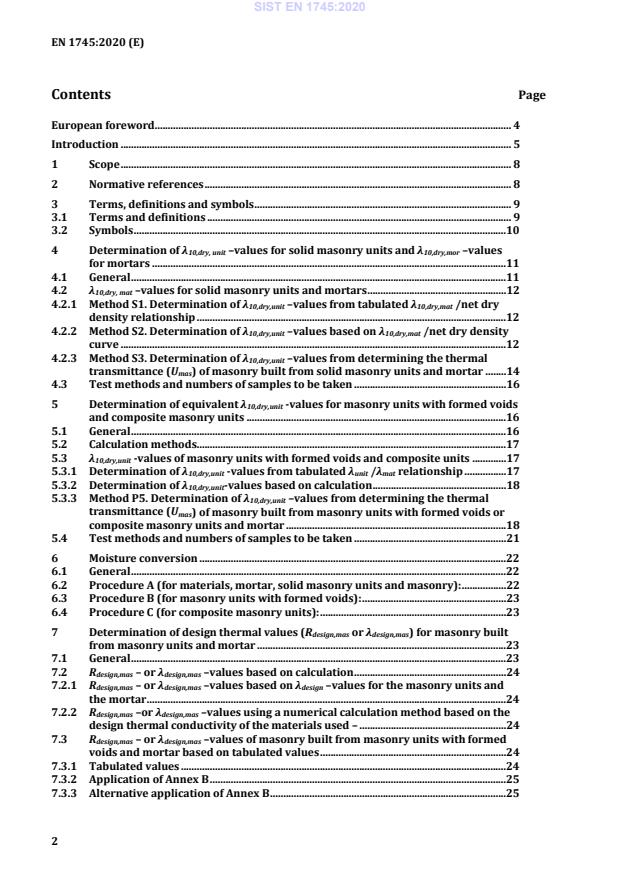
Contents Page
European foreword. 4
Introduction . 5
1 Scope . 8
2 Normative references . 8
3 Terms, definitions and symbols . 9
3.1 Terms and definitions . 9
3.2 Symbols .10
4 Determination of λ10,dry, unit –values for solid masonry units and λ10,dry,mor –values
for mortars .11
4.1 General .11
4.2 λ –values for solid masonry units and mortars .12
10,dry, mat
4.2.1 Method S1. Determination of λ –values from tabulated λ /net dry
10,dry,unit 10,dry,mat
density relationship .12
4.2.2 Method S2. Determination of λ –values based on λ /net dry density
10,dry,unit 10,dry,mat
curve .12
4.2.3 Method S3. Determination of λ –values from determining the thermal
10,dry,unit
transmittance (U ) of masonry built from solid masonry units and mortar .14
mas
4.3 Test methods and numbers of samples to be taken .16
5 Determination of equivalent λ -values for masonry units with formed voids
10,dry,unit
and composite masonry units .16
5.1 General .16
5.2 Calculation methods.17
5.3 λ -values of masonry units with formed voids and composite units .17
10,dry,unit
5.3.1 Determination of λ -values from tabulated λ /λ relationship .17
10,dry,unit unit mat
5.3.2 Determination of λ -values based on calculation .18
10,dry,unit
5.3.3 Method P5. Determination of λ –values from determining the thermal
10,dry,unit
transmittance (U ) of masonry built from masonry units with formed voids or
mas
composite masonry units and mortar .18
5.4 Test methods and numbers of samples to be taken .21
6 Moisture conversion .22
6.1 General .22
6.2 Procedure A (for materials, mortar, solid masonry units and masonry): .22
6.3 Procedure B (for masonry units with formed voids): .23
6.4 Procedure C (for composite masonry units): .23
7 Determination of design thermal values (R or λ ) for masonry built
design,mas design,mas
from masonry units and mortar .23
7.1 General .23
7.2 R – or λ –values based on calculation .24
design,mas design,mas
7.2.1 R – or λ –values based on λ –values for the masonry units and
design,mas design,mas design
the mortar .24
7.2.2 R –or λ –values using a numerical calculation method based on the
design,mas design,mas
design thermal conductivity of the materials used – .24
7.3 R – or λ –values of masonry built from masonry units with formed
design,mas design,mas
voids and mortar based on tabulated values .24
7.3.1 Tabulated values .24
7.3.2 Application of Annex B .25
7.3.3 Alternative application of Annex B .25
7.4 Method S4/P6 R – or λ –values of masonry based on masonry
design,mas design,mas
testing . 26
8 Determination of the thermal transmittance of masonry . 26
9 Specific heat capacity . 27
10 Rounding rules for λ-values for masonry units and masonry . 27
Annex A (normative) Tabulated λ -values of materials used for masonry
10,dry,mat
products . 28
Annex B (informative) R - or λ -values of masonry built from a range of
dry,mas 10,dry,mas
masonry units containing formed voids. 38
Annex C (informative) Example of how to use the tables in Annex B . 78
Annex D (normative) Requirements for appropriate calculation procedures . 80
D.1 Capabilities of the program . 80
D.2 Input data and results . 80
D.3 Testing of the program accuracy. 81
D.4 Reference cases . 81
D.4.1 Case 1: Calculation of thermal resistance R and thermal conductivity λ of a
10,dry,unit
masonry unit (vertically perforated unit) . 81
D.4.2 Case 2: Calculation of thermal resistance R of masonry consisting of
dry,mas
vertically perforated masonry units, bed joints with mortar layers and internal/
external plaster layers . 83
D.4.3 CASE 3: Calculation of thermal resistance R of masonry consisting of masonry
t
units, horizontal mortar layers, vertical mortar pockets and additional external
insulation layer . 85
Annex E (informative) Assessment and verification of constancy of performance . 89
Annex F (informative) Alternative procedure for the moisture correction of units with
formed voids . 91
Annex G (informative) Simplified methodology for determining design moisture content
of composite masonry units . 92
European foreword
This document (EN 1745:2020) has been prepared by Technical Committee CEN/TC 125 “Masonry”,
the secretariat of which is held by BSI.
This European Standard shall be given the status of a national standard, either by publication of an
identical text or by endorsement, at the latest by January 2021, and conflicting national standards shall
be withdrawn at the latest by January 2021.
Attention is drawn to the possibility that some of the elements of this document may be the subject of
patent rights. CEN shall not be held responsible for identifying any or all such patent rights.
This document supersedes EN 1745:2012.
The following is a list of significant technical changes since the last edition EN 1745:2012:
— replacement of Figure 1 by Tables 1 a and 1 b;
— editorial improvement;
— changes in the definitions 3.1.5 and 3.1.10;
— correction of term in Annex A;
— amendment heading of column in Annex A;
— addition of Annex G.
According to the CEN-CENELEC Internal Regulations, the national standards organisations of the
following countries are bound to implement this European Standard: Austria, Belgium, Bulgaria,
Croatia, Cyprus, Czech Republic, Denmark, Estonia, Finland, France, Germany, Greece, Hungary,
Iceland, Ireland, Italy, Latvia, Lithuania, Luxembourg, Malta, Netherlands, Norway, Poland, Portugal,
Republic of North Macedonia, Romania, Serbia, Slovakia, Slovenia, Spain, Sweden, Switzerland, Turkey
and the United Kingdom.
Introduction
This document provides methods for the determination of dry and design thermal conductivity and
thermal resistance values of masonry products and masonry.
The following types of masonry unit are covered by this document:
— solid masonry units;
— masonry units with formed voids;
— composite masonry units.
Methods are described for the determination of the dry thermal conductivity of solid masonry units
(λ10,dry,unit) and of mortar (λ10,dry,mor) and for the determination of equivalent dry thermal conductivity of
masonry units with formed voids and composite masonry units (λ ). Procedures are also
10,dry,unit
described for the determination of the design thermal values of masonry units and masonry. The
different methods are illustrated in Table 1.
The value in dry state is a characteristic of a masonry material, masonry unit or of masonry.
The determination of thermal values can be based on tabulated data, measurements, calculations or a
combination of these.
Design thermal values may be determined according to procedures given in this European standard
according to the intended application, environmental and climatic conditions, bearing in mind the
purpose of this determination, such as:
— energy consumption;
— design of heating and cooling equipment;
— surface temperature determination;
— compliance with national building regulations;
— consideration of non-steady-state thermal conditions in buildings.
Table 1 a — Determination of thermal properties of masonry units and masonry
Overview of methods to determine λ
10,dry,unit
Method Masonry
a b
Determination of λ Required parameters
10,dry,unit
(Clause) units
using tabulated value from Annex A
S1 Net dry density of
solid for the λ / net dry density
10,dry,mat
a
(4.2.1) unit/material
relationship
based on determination of dry
Net dry density and thermal
S2 thermal conductivity by measurement
solid conductivity of unit/material
(4.2.2) and of the masonry unit material / dry
a
density curve
based on determination of the thermal Net dry density and
S3 transmittance (U ) of masonry, then percentage area of units;
mas
solid
(4.2.3) adjusting for the influence of the thermal conductivity and
mortar percentage area of mortar
Net dry density and thermal
based on determination of dry
P1 with formed conductivity of unit/material
thermal conductivity of the masonry
(5.3.1.3) voids and configuration of the
unit material, then using Annex B
units
Net dry density of
P2 with formed using tabulated values from Annex A,
unit/material and
(5.3.1.4) voids then using Annex B
configuration of the units
with formed by calculation according to 5.2, using Net dry density and thermal
P3 voids dry thermal conductivity by conductivity of unit/infill
(5.3.2.2) and measurement of the masonry unit material and configuration of
composite material and any infill the units
by calculation according to 5.2 using
Net dry density and thermal
with formed tabulated thermal conductivity of the
P4 conductivity of unit/infill
voids and masonry unit material from Annex A
(5.3.2.3) material and configuration of
composite and thermal conductivity of any infill
the units
material
based on determination of the thermal Gross dry density and
with formed
P5 transmittance (U ) of masonry, then percentage area of units,
mas
voids and
(5.3.3) adjusting for the influence of the thermal conductivity and
composite
mortar percentage area of mortar
a
Methods S1 and S2 are also applicable for the determination of λ10,dry,mor .
b
If necessary, moisture correction according to Clause 6.
Table 1 b — Determination of thermal properties of masonry units and masonry
a b
Overview of methods to determine λ and λ
design,unit design,mas
a b a
λ Masonry Determination of λ / Required parameters
design design,unit
b
(Clause) units λ
design,mas
λ solid, by applying moisture correction Thermal conductivity in dry
design,unit
(6) with formed according to Clause 6 upon λ state and moisture conversion
10,dry,unit
voids and factor of unit
composite
λ solid, by using a simplified calculation Design thermal conductivity
design,mas
(7.2.1) with formed based of unit and mortar and
voids and on λ and λ percentage area of mortar
design,unit design,mor
composite joints
λ solid, by numerical calculation based Design thermal conductivity
design,mas
(7.2.2) with formed on λ of materials and configuration
design,mat
voids and
composite
λ with formed using of Annex B and application of Net dry density and thermal
design,mas
(7.3) voids the correction according to 6.3 conductivity of unit/material
and respective moisture
conversion factors
S4/P6 solid, by applying moisture correction Thermal transmission of
with formed according to Clause 6 onto the masonry and moisture
λdesign,mas
voids and thermal transmittance (U ) of conversion factor
mas
(7.4)
composite masonry
a
Or alternatively the design thermal resistance of the unit Rdesign,unit .
b
Or alternatively the design thermal resistance of the masonry R .
design,mas
1 Scope
This document specifies methods for the determination of thermal properties of masonry and masonry
products.
2 Normative references
The following documents are referred to in the text in such a way that some or all of their content
constitutes requirements of this document. For dated references, only the edition cited applies. For
undated references, the latest edition of the referenced document (including any amendments)
applies.
EN 772-3, Methods of test for masonry units — Part 3: Determination of net volume and percentage of
voids of clay masonry units by hydrostatic weighing
EN 772-4, Methods of test for masonry units — Part 4: Determination of real and bulk density and of total
and open porosity for natural stone masonry units
EN 772-13, Methods of test for masonry units — Part 13: Determination of net and gross dry density of
masonry units (except for natural stone)
EN 772-16, Methods of test for masonry units — Part 16: Determination of dimensions
EN 1015-10, Methods of test for mortar for masonry — Part 10: Determination of dry bulk density of
hardened mortar
EN 1934, Thermal performance of buildings — Determination of thermal resistance by hot box method
using heat flow meter — Masonry
EN 1936, Natural stone test methods — Determination of real density and apparent density, and of total
and open porosity
EN 12664, Thermal performances of building materials and products — Determination of thermal
resistance by means of guarded hot plate and heat flow meter methods — Dry and moist products of
medium and low thermal resistance
EN 12667, Thermal performance of building materials and products- Determination of thermal
resistance by means of guarded hot plate and heat flow meter methods – Products of high and medium
thermal resistance
EN ISO 6946, Building components and building elements — Thermal resistance and thermal
transmittance — Calculation methods (ISO 6946)
EN ISO 7345, Thermal performance of buildings and building components — Physical quantities and
definitions (ISO 7345)
EN ISO 10211, Thermal bridges in building construction — Heat flows and surface temperatures —
Detailed calculations (ISO 10211)
EN ISO 10456:2007, Building materials and products — Hygrothermal properties — Tabulated design
values and procedures for determining declared and design thermal values (ISO 10456:2007)
3 Terms, definitions and symbols
For the purposes of this document, the following terms, definitions and symbols and those given in
EN ISO 7345 apply.
ISO and IEC maintain terminological databases for use in standardization at the following addresses:
— IEC Electropedia: available at http://www.electropedia.org/
— ISO Online browsing platform: available at http://www.iso.org/obp
3.1 Terms and definitions
3.1.1
masonry
assemblage of masonry units laid in a specified pattern and joined together with masonry mortar
3.1.2
masonry product
masonry units, masonry mortars, rendering and plastering mortars
3.1.3
solid masonry unit
masonry unit containing no perforations except external indentations such as grip holes, grooves, etc.
3.1.4
masonry unit with formed voids
masonry unit with a system of intentionally formed voids
3.1.5
composite masonry unit
masonry unit incorporating additional material
3.1.6
thermal value
common term for either the thermal conductivity (W/(m K)) or the thermal resistance (m ·K/W)
3.1.7
dry state
state after drying under conditions stated in the relevant standards
3.1.8
thermal value in dry state
value of a thermal property of a building material or product in a dry state determined according to
this European Standard as a basis for the calculation of design thermal values
Note 1 to entry: The dry thermal value can be expressed as thermal conductivity or thermal resistance.
As impacted by EN ISO 10456:2007/AC:2009.
3.1.9
design thermal value
value of a thermal property of a building material or product under specific external and internal
conditions which can be considered as typical of the performance of that material or product when
incorporated in a building component or building
3.1.10
equivalent thermal conductivity of masonry unit
value derived by dividing the width of a masonry unit with formed voids or a composite masonry unit
by its thermal resistance excluding surface resistance
3.1.11
equivalent masonry thermal conductivity
value derived by dividing the thickness of a given masonry by its thermal resistance excluding surface
resistance
3.1.12
reference conditions
set of conditions identifying a state of equilibrium selected as the base to which the thermal values of
building materials and products are referred
3.2 Symbols
The order of the indices for thermal values is temperature, condition and subject.
Symbol Quantity Unit
λ thermal conductivity at an average temperature of 10 °C in dry state W/(m·K)
10,dry,mat
for a masonry unit material and/or infill material
λ10,dry,mas thermal conductivity at an average temperature of 10 °C in dry state W/(m·K)
for the masonry
λ thermal conductivity at an average temperature of 10 °C in dry state W/(m·K)
10,dry,mor
for the mortar
λ thermal conductivity at an average temperature of 10 °C in dry state W/(m·K)
10,dry,unit
for the unit. For solid units the λ is the same as λ and
10,dry, unit 10,dry, mat
for units with formed voids and composite units the λ is the
10,dry, unit
equivalent thermal conductivity.
λ design thermal conductivity for the masonry W/(m·K)
design,mas
λ design thermal conductivity for the mortar W/(m·K)
design,mor
λdesign,unit design thermal conductivity for the unit W/(m·K)
λ equivalent thermal conductivity of voids W/(m·K)
g
λ individually determined thermal conductivity W/(m·K)
i
R thermal resistance of voids m ·K/W
g
R individually determined thermal resistance m ·K/W
i
R thermal resistance of masonry m ·K/W
dry,mas
R design thermal resistance of masonry m ·K/W
design,mas
R , R internal and external surface resistance m ·K/W
si se
R total thermal resistance of masonry m ·K/W
tot,mas
a percentage area of mortar joint in the measured masonry %
mor
a percentage area of units in the measured masonry %
unit
d thickness of the masonry m
T Temperature K
μ water vapour resistance factor
c specific heat capacity J/(kg·K)
p
l length of a masonry unit mm
w width of a masonry unit mm
h height of a masonry unit mm
unit
h thickness of a mortar joint mm
mor
F moisture conversion factor
m
f moisture conversion coefficient by mass kg/kg
u
3 3
f moisture conversion coefficient by volume m /m
ψ
u moisture content mass by mass kg/kg
3 3
ψ moisture content volume by volume m /m
U thermal transmittance of the masonry at an average temperature of W/(m ·K)
10,dry,mas
10 °C in dry state
U thermal transmittance of the masonry W/(m ·K)
mas
U thermal transmittance of the mortar W/(m ·K)
mor
U thermal transmittance of the units W/(m ·K)
unit
P fractile of population %
ρ gross dry density kg/m
g,dry
ρ net dry density kg/m
n,dry
v percentage of voids %
4 Determination of λ –values for solid masonry units and λ –
10,dry, unit 10,dry,mor
values for mortars
4.1 General
λ10,dry,unit –values for solid masonry units and λ10,dry,mor –values for mortars are identical to the λ10,dry,mat –
values. The λ –values of solid masonry units and of mortars can be determined from tests
10,dry,mat
carried out on samples of the material or from tables or graphs which relate λ to density or from
10,dry,mat
determining the thermal transmittance (U ) of masonry built from masonry units and mortar. In all
mas
cases the λ –value is to be representative of the material.
10,dry,mat
NOTE For the determination of the λ -value, λ -value and λ -value, with fractile X and
10,dry,unit 10,dry,mor 10,dry,mat
confidence level Y, the basis is the corresponding gross dry density or net dry density and configuration.
4.2 λ10,dry, mat –values for solid masonry units and mortars
4.2.1 Method S1. Determination of λ –values from tabulated λ /net dry density
10,dry,unit 10,dry,mat
relationship
Tabulated λ –values for different materials used for masonry products are given in Annex A,
10,dry,mat
differentiated by material and dry density. This annex also contains values for the water vapour
resistance factor, the specific heat capacity and the moisture conversion coefficient.
These tabulated values are valid for materials where there is factory production control of the net dry
density but no directly determined λ -values. λ –values are given as 50 % and 90 % fractiles (P).
10,dry,mat
4.2.2 Method S2. Determination of λ –values based on λ /net dry density curve
10,dry,unit 10,dry,mat
4.2.2.1 General
To determine the λ –value from a λ /net dry density relationship the following procedure
10,dry,mat 10,dry,mat
shall be used:
4.2.2.2 Test specimens
Test specimens shall be in accordance with the requirements of EN 12664. Care should be taken that
the test specimens are representative of the masonry product itself.
NOTE An appropriate way to ensure this, is to cut specimens from masonry units.
4.2.2.3 Conditioning of specimens
Normally masonry materials are tested in a dry condition. It is also possible to carry out tests in a moist
condition (e.g. conditioned to constant mass in an environment of (23 ± 2) °C and 50 % ± 5 % relative
humidity), in which case the measured value has to be converted to the dry state following one of the
procedures given in 6.2.
4.2.2.4 Test measurement
The reference test method is given in EN 12664. The test shall be carried out at a mean temperature
of 10 °C.
Alternative test methods, which may require different test specimens and different conditioning
methods, may be used, if the correlation between the reference test method and the alternative method
can be given.
4.2.2.5 Establishing a product related λ /net dry density-curve
10,dry,mat
Three items of information are necessary for this determination procedure:
1) the tabulated λ /net dry density-correlation for the given material (see Annex A);
10,dry,mat
2) the product net dry density range, which can be derived either from the production history or
from the net dry density tolerances which are given in the relevant product standards;
3) at least three individual test measurements of the net dry density and λ , on material which is
i
representative for the current material produced. The measurements of net dry density and λ shall
be carried out on the same specimens. The three tests have to be carried out on specimens from
different production batches to represent the manufactured product net dry density range. These
three measurements are used to determine the distance of the individual λ /net dry density-
10,dry,mat
curve, for a defined production, from the tabulated λ /net dry density curve.
10,dry,mat
Determine the λ –value as described in 4.2.2.1 to 4.2.2.3 and calculate the arithmetic mean value of the
I
3 λ –results.
i
Measure the net dry density of each of the three samples following the procedure described in
EN 772-4, EN 1936 or EN 772-13 or EN 1015-10 and calculate the arithmetic mean value of the 3
results.
Then use the following procedure.
Through the point A representing mean thermal conductivity and mean net dry density draw a λ/net
dry density-curve parallel to the general λ /net dry density-curve obtained from plotting the
10,dry,mat
tabulated λ–value and net dry density-values for the product (material) given in Annex A.
Derive the mean λ-value of the product from the average net dry density. Derive the upper and lower
limit values as the values that represent 90 % and 10 % of the manufactured product under
consideration density range with a confidence level of 90 % according to EN ISO 10456.
Use the product related λ /net dry density-curve to determine the λ –value related to the
10,dry, mat 10,dry,mat
mean net dry density the manufacturer is confident to achieve.
Express the λ –values for solid masonry units or the λ –values for mortars as the mean
10,dry,unit 10,dry mor
λ –value together with the difference between the limit and the mean value.
10,dry mat
Figure 1 shows this process in the form of a graph.
Key
1 λ 10,dry,mat (W/m·K)
2 upper limit λ -value
3 mean λ -value
4 lower limit λ -value
5 curve resulting from tabulated values (Annex A)
6 parallel curve drawn through point A (mean of the single values a, b, c)
7 10 % of production of the product under consideration
8 mean net dry density
9 90 % of production of the product under consideration
10 product density range
11 net dry density (kg/m )
Figure 1 — Derivation of the material λ -value
10,dry,mat
For factory production control purposes, thermal conductivity may be controlled from the net dry
density of the material, see Annex E.
4.2.3 Method S3. Determination of λ –values from determining the thermal
10,dry,unit
transmittance (U ) of masonry built from solid masonry units and mortar
mas
4.2.3.1 General
To determine the λ -value based on test measurements of the thermal transmittance of masonry
10,dry unit
built from solid masonry units and mortars, the following procedure shall be used.
4.2.3.2 Testing procedure
— Select test samples from 3 different production batches for the product under consideration.
Determine their mean net dry density.
— From each of these batches erect one wall.
— Measure the thermal transmittance on each of those walls following EN 1934. If the measured wall
is not in a dry state, the measured value has to be converted to the dry state following the
procedure given in 6.2.
4.2.3.3 The determination of the λ10,dry,unit –value
Calculate the λ –value using the formula:
10,dry, mas
d
λ =
10,,dry mas
− RR−
si se
U
10,,dry mas
where
U is the thermal transmittance of the masonry in dry state, in W/m K;
10,dry,mas
R , R are the internal and external surface resistance in m ·K/W according to EN ISO 6946;
si se
d is the thickness of the masonry in m;
λ is the thermal conductivity of the masonry in dry state in W/(m·K).
10,dry,mas
Calculate the λ –value using the formula:
10,dry unit
100 × λ −×a λ
10,,dry mas mor 10,,dry mor
λ =
10,,dry unit
a
unit
where
a is the percentage area of mortar joint in the measured masonry, in %;
mor
a is the percentage area of units in the measured masonry, in %;
unit
λ is the thermal conductivity of the actual mortar joint in W/(m·K);
10,dry,mor
λ is the thermal conductivity of the units in W/(m·K).
10,dry,unit
The thermal conductivity of the mortar joints shall take into account mortar pockets and strip bedding
and the use of insulating material between the strips.
The thermal conductivity of the mortar may be taken from tabulated values as described in Clause 4
method S1, from measured values as described in method S2 or taken from a declaration of
performance.
If the units are intended to be used with unfilled vertical mortar joints the masonry tested shall also
be with unfilled joints and the λ –values for the units will take into account the effect of the
10,dry,unit
unfilled joints calculated according to EN ISO 6946.
Take the 3 individual calculated λ –values and calculate the arithmetic mean value.
10,dry,unit
Measure the net dry density of each of the three samples taken from each batch of masonry units and
mortar following the procedure prescribed in EN 772-4, EN 1936 or EN 772-13 or EN 1015-10 and
calculate the arithmetic mean value of the 3 results.
NOTE The density of the mortar can be used to establish a tabulated λ –value.
10,dry,mat
Having determined a mean λ –value and the mean net dry density from solid unit masonry use
10,dry,unit
procedure in 4.2.2.5 to establish a product related λ /net dry density-curve.
10,dry,unit
Use 4.2.2.5 procedure assuming the mean λ –value derived from the aforementioned tests in
10,dry,unit
4.2.3.2 and subsequent calculation is equivalent to the mean value derived from the arithmetic mean
value of the 3 λ –results. The corresponding net dry density values to be used to obtain the curve are
i
obtained from three samples taken from each batch of masonry units as described above. The curve 5
in Figure 1 is still the λ /net dry density-correlation for the masonry unit material (see Annex A).
10,dry,mat
4.3 Test methods and numbers of samples to be taken
The minimum number of test specimens to be used for each test method shall be as specified in Table 2.
Table 2 — Test methods and minimum numbers of test specimens
Test methods Minimum
numbers of
specimens
Method S1:
Material density, EN 772-13, EN 772-4 or EN 1936 (natural 6
stone units)
Method S2:
Material density, EN 772-13, EN 1015-10, EN 772-4 or 3
EN 1936 (natural stone units)
Thermal conductivity, EN 12664 3
Method S3:
Net dry density, EN 772-13, EN 1015-10, EN 772-4 or 3 × 6
EN 1936 (natural stone units)
Thermal transmittance, EN 1934 3
5 Determination of equivalent λ -values for masonry units with formed
10,dry,unit
voids and composite masonry units
5.1 General
The thermal properties of such masonry units are influenced by shape and geometry of the voids and
any material in the voids.
The λ –values of masonry units with formed voids can be determined (Table 1):
10,dry,unit
— from tables;
— from calculations;
— from test measurements carried out on masonry samples.
The λ –values of composite masonry units can be determined (Table 1):
10,dry,unit
— from calculations;
— from test measurements carried out on masonry samples.
The λ –value of any material shall be determined according to EN ISO 10456, EN 12664,
10,dry,mat
EN 12667 or taken from the declaration of performance of any infill material or mortar or from
Annex A.
NOTE For the determination of the λ10,dry,unit –value, λ10,dry,mor –value or λ10,dry,mat –value, with fractile X and
confidence level Y, the basis is the corresponding gross dry density or net dry density and configuration.
5.2 Calculation methods
There are several different numerical methods in use (e.g. Finite Difference, Finite Element) for the
calculation of the thermal properties of masonry units with formed voids or composite masonry units.
The thermal conductivities of the materials and the configuration of the units are necessary input
parameters for such calculations.
The requirements for appropriate calculation programs (accuracy, boundary conditions, etc.) are
given in Annex D.
The simplified method described in EN ISO 6946 may also be used.
5.3 λ10,dry,unit -values of masonry units with formed voids and composite units
5.3.1 Determination of λ -values from tabulated λ /λ relationship
10,dry,unit unit mat
5.3.1.1 General
The λ -values used for masonry units with different void patterns are given in Annex B. Annex C
10,dry,unit
provides an example of how to use Annex B.
No tabulated values for composite masonry units are given in Annex B.
5.3.1.2 Application of Annex B
Examples for λ -values of masonry units with formed voids given in Annex B, are differentiated
10,dry,unit
by:
— material;
— geometry of the units and geometry of formed voids;
— λ-value of the material of the masonry units;
Linear interpolation may be used for material conductivities between the values given in the tables in
Annex B.
5.3.1.3 Method P1. Determination of λ -values using Annex B using measured thermal
10,dry,unit
conductivity of the masonry unit material
To determine the λ -value using Annex B using measured thermal conductivity of the masonry
10,dry,unit
unit material, the following procedure shall be used:
Select the table relevant for the actual units. Express the λ -value as the value given in the
10,dry,unit
relevant table for the λ -value the manufacturer is confident to achieve. The λ -value is
10,dry,mat 10,dry,mat
based on a thermal conductivity of the masonry unit material as specified in 4.2.2.
5.3.1.4 Method P2. Determination of λ -values using Annex B using tabulated value from
10,dry,unit
Annex A
To determine the λ10,dry,unit -value from using Annex B using tabulated value from Annex A, the following
procedure shall be used:
Select the table relevant for the actual units. Express the λ -value as the value given in the
10,dry, unit
relevant table for the λ -value the manufacturer is confident to achieve. The λ -value is a
10,dry,mat 10,dry,mat
tabulated value from Annex A.
5.3.2 Determination of λ10,dry,unit-values based on calculation
5.3.2.1 General
To determine the λ -value for a masonry unit by calculation methods following 5.2, the following
10,dry,unit
procedure shall be used:
Based on:
— the geometry of the units;
— the geometry of formed voids;
— the λ -values;
10,dry,mat
— the orientation of the unit in use
a numerical simulation of the unit can be established and the thermal transmittance can be
approximated. Any calculation method shall be in accordance with Annex D.
5.3.2.2 Method P3. Determination of λ –values using measured thermal conductivity of
10,dry,unit
the masonry unit materials
Express the λ –value as the result of the calculation using the λ –value the manufacturer
10,dry,unit 10,dry,mat
is confident to achieve for unit and infill material. The λ -value is determined as specified in
10,dry,mat
4.2.2.2, 4.2.2.3 and 4.2.2.4.
5.3.2.3 Method P4. Determination of λ –values using tabulated value from Annex A
10,dry,unit
Express the λ –value as the result of the calculation using the λ –value the manufacturer
10,dry,unit 10,dry,mat
is confident to achieve for the unit body in Annex A and the infill material.
5.3.3 Method P5. Determination of λ –values from determining the thermal
10,dry,unit
transmittance (U ) of masonry built from masonry units with formed voids or composite
mas
masonry units and mortar
5.3.3.1 General
To determine the λ -value based on test measurements of thermal transmittance of masonry
10,dry unit
built from masonry units and mortar, the following procedure shall be used.
5.3.3.2 Testing procedure
— Select test samples from 3 different production batches for the product under consideration.
Determine their mean gross dry density.
— From each of these batches erect one wall.
— Measure the thermal transmittance on each of those walls following EN 1934. If the measured wall
is not in a dry state, the measured value has to be converted to the dry state following the
procedure given in 6.4.
5.3.3.3 The determination of the λ –value
10,dry,unit
— Calculate the λ –value using the formula:
10,dry, mas
d
λ =
10,,dry mas
− RR−
si se
U
10,,dry mas
where
U is the thermal transmittance of the masonry in dry state, in W/m K;
10,dry,mas
R , R are the internal and external surface resistance in m ·K/W according to
si se
EN ISO 6946;
d is the thickness of the masonry in m;
λ is the thermal conductivity of the masonry in dry state in W/(m·K).
10,dry,mas
— Calculate the λ –value using the formula:
10,dry unit
100 × λ −×a λ
10,,dry mas mor 10,,dry mor
λ =
10,,dry unit
a
unit
where
a is the percentage area of mortar joint in the measured masonry, in%;
mor
a is the percentage area of units in the measured masonry, in %;
unit
λ is the thermal conductivity of the actual mortar joint in W/(m·K);
10,dry,mor
λ is the thermal conductivity of the units in W/(m·K).
10,dry,unit
The thermal conductivity of the mortar joints shall take into account mortar pockets and strip bedding
and the use of insulating material between the strips.
If the units are intended to be used with unfilled vertical mortar joints the masonry tested shall also
be with unfilled joints and the λ –values for the units will take into account the effect of the
10,dry,unit
unfilled joints calculated according to EN ISO 6946.
Take the 3 individual calculated λ –values and calculate the arithmetic mean value.
10,dry,unit
Measure the gross dry density of each of the three samples taken from each batch of masonry units
and mortar following the procedure prescribed in EN 772-4 or EN 772-13 or EN 1015-10 and calculate
the arithmetic mean value of the 3 results.
To the given λ –values in the relevant table in Annex B find the corresponding net dry densities
10,dry,mat
values in Annex A. From the corresponding net dry density values calculate the related gross dry
density values using the following formula:
100 − v
ρ = ρ
g,,dry n dry
where
ρ is the gross dry density in kg/m ;
g,dry
ρ is the net dry density in kg/m ;
n,dry
v is the percentage of voids taken from the r
...