

EN ISO 13032:2024
(Main)Petroleum and related products - Determination of low concentration of sulfur in automotive fuels - Energy-dispersive X-ray fluorescence spectrometric method (ISO 13032:2024)
- Abstract
This document specifies an energy dispersive X-ray fluorescence (EDXRF) test method for the determination of sulfur content in automotive fuels. This document is applicable to:
— gasoline containing up to 3,7 % oxygen by mass (including those blended with ethanol up to 10 % by volume) having sulfur contents in the range of 6,9 mg/kg to 56,7 mg/kg,
— diesel fuels including those containing up to about 30 % fatty acid methyl ester (FAME) by volume, paraffinic diesel fuel, and neat FAME, having sulfur contents in the range of 5,0 mg/kg to 60,2 mg/kg.
The sulfur content in other products can be determined according to the test method specified in this document; however, no precision data for products other than automotive fuels and for results outside the specified range have been established for this document.
For reasons of spectral overlap, this document is not applicable to leaded automotive gasoline, gasoline having a content of greater than 8 mg/kg lead or to product and feedstock containing lead, silicon, phosphorus, calcium, potassium or halides at concentrations greater than one tenth of the concentration of sulfur measured, or more than 10 mg/kg, whichever is the greater.
- Status
- Published
- Publication Date
- 27-Aug-2024
- Technical Committee
- CEN/TC 19 - Petroleum products, lubricants and related products
- Drafting Committee
- CEN/TC 19/WG 27 - Elemental analysis of petroleum and related products
- Current Stage
- 6060 - Definitive text made available (DAV) - Publishing
- Start Date
- 28-Aug-2024
- Completion Date
- 28-Aug-2024

Overview
EN ISO 13032:2024 - "Petroleum and related products - Determination of low concentration of sulfur in automotive fuels - Energy‑dispersive X‑ray fluorescence spectrometric method" - specifies an EDXRF test method for measuring low levels of sulfur in automotive fuels. This 2024 edition supersedes EN ISO 13032:2012 and extends scope to include paraffinic diesel and neat FAME. The method targets the lower concentration range of sulfur and is intended to provide reliable, repeatable sulfur analysis for regulatory compliance and quality control.
Key topics and technical requirements
- Measurement principle: Energy‑dispersive X‑ray fluorescence (EDXRF), optimized for sulfur K‑L emission.
- Scope and limits:
- Gasoline (≤ 3.7% oxygen by mass; ethanol blends up to 10% v/v): 6.9 mg/kg to 56.7 mg/kg sulfur.
- Diesel, paraffinic diesel, neat FAME and diesel with ~30% FAME: 5.0 mg/kg to 60.2 mg/kg sulfur.
- Other matrices can be measured but precision data are not established outside automotive fuels and specified ranges.
- Exclusions: Not applicable to leaded gasoline, gasoline with > 8 mg/kg lead, or samples where lead, silicon, phosphorus, calcium, potassium or halides exceed one‑tenth of measured sulfur or > 10 mg/kg (spectral overlap issues).
- Document content areas: sampling and sample handling, apparatus preparation, calibration (primary and calibration standards), procedure, calculation, expression of results, precision (repeatability and reproducibility), and test reporting.
- Practical guidance: includes annexes on matrix effects and instructions for measuring low sulfur concentrations; emphasizes knowing sample matrix for best results.
Applications
- Routine fuel quality testing in production and distribution (refineries, fuel terminals).
- Regulatory and environmental compliance testing where low sulfur limits apply.
- Incoming/outgoing product control for fuel blending plants and biodiesel (FAME) producers.
- Reference method adoption by testing laboratories for accreditation and interlaboratory studies.
- Instrument manufacturers and method developers implementing EDXRF solutions for sulfur analysis.
Who should use this standard
- Analytical and quality control laboratories analyzing automotive fuels.
- Fuel producers, blenders, and distributors ensuring product spec compliance.
- Regulatory agencies and certification bodies setting or verifying sulfur limits.
- Instrument vendors developing or validating EDXRF analyzers for petroleum products.
Related standards
- ISO 20847 is referenced as covering a broader concentration range; EN ISO 13032:2024 is targeted at the low‑end sulfur determination. Users should consult other ISO/CEN fuel testing standards for complementary methods and ranges.
Keywords: EN ISO 13032:2024, EDXRF, sulfur determination, low sulfur, automotive fuels, gasoline, diesel, FAME, fuel quality testing.
Relations
- Effective Date
- 19-Jan-2023
- Effective Date
- 25-Aug-2026
- Effective Date
- 25-Aug-2026
- Effective Date
- 28-Jan-2026
- Effective Date
- 28-Jan-2026
- Effective Date
- 28-Jan-2026
- Effective Date
- 28-Jan-2026
- Effective Date
- 28-Jan-2026
- Effective Date
- 28-Jan-2026
- Effective Date
- 12-Feb-2026
Get Certified
Connect with accredited certification bodies for this standard

Element Materials Technology
Materials testing and product certification.

ABS Group Brazil
ABS Group certification services in Brazil.

ABS Quality Evaluations Inc.
American Bureau of Shipping quality certification.
Sponsored listings
Frequently Asked Questions
EN ISO 13032:2024 is a standard published by the European Committee for Standardization (CEN). Its full title is "Petroleum and related products - Determination of low concentration of sulfur in automotive fuels - Energy-dispersive X-ray fluorescence spectrometric method (ISO 13032:2024)". This standard covers: This document specifies an energy dispersive X-ray fluorescence (EDXRF) test method for the determination of sulfur content in automotive fuels. This document is applicable to: — gasoline containing up to 3,7 % oxygen by mass (including those blended with ethanol up to 10 % by volume) having sulfur contents in the range of 6,9 mg/kg to 56,7 mg/kg, — diesel fuels including those containing up to about 30 % fatty acid methyl ester (FAME) by volume, paraffinic diesel fuel, and neat FAME, having sulfur contents in the range of 5,0 mg/kg to 60,2 mg/kg. The sulfur content in other products can be determined according to the test method specified in this document; however, no precision data for products other than automotive fuels and for results outside the specified range have been established for this document. For reasons of spectral overlap, this document is not applicable to leaded automotive gasoline, gasoline having a content of greater than 8 mg/kg lead or to product and feedstock containing lead, silicon, phosphorus, calcium, potassium or halides at concentrations greater than one tenth of the concentration of sulfur measured, or more than 10 mg/kg, whichever is the greater.
This document specifies an energy dispersive X-ray fluorescence (EDXRF) test method for the determination of sulfur content in automotive fuels. This document is applicable to: — gasoline containing up to 3,7 % oxygen by mass (including those blended with ethanol up to 10 % by volume) having sulfur contents in the range of 6,9 mg/kg to 56,7 mg/kg, — diesel fuels including those containing up to about 30 % fatty acid methyl ester (FAME) by volume, paraffinic diesel fuel, and neat FAME, having sulfur contents in the range of 5,0 mg/kg to 60,2 mg/kg. The sulfur content in other products can be determined according to the test method specified in this document; however, no precision data for products other than automotive fuels and for results outside the specified range have been established for this document. For reasons of spectral overlap, this document is not applicable to leaded automotive gasoline, gasoline having a content of greater than 8 mg/kg lead or to product and feedstock containing lead, silicon, phosphorus, calcium, potassium or halides at concentrations greater than one tenth of the concentration of sulfur measured, or more than 10 mg/kg, whichever is the greater.
EN ISO 13032:2024 is classified under the following ICS (International Classification for Standards) categories: 75.160.20 - Liquid fuels. The ICS classification helps identify the subject area and facilitates finding related standards.
EN ISO 13032:2024 has the following relationships with other standards: It is inter standard links to EN ISO 13032:2012, ISO 3170:2004, ISO 3171:1988, EN ISO 15792-3:2008, EN 1661:1997, EN 16709:2024, EN 590:2025, EN 228:2025, CEN/TS 18227:2025, ISO 13032:2024. Understanding these relationships helps ensure you are using the most current and applicable version of the standard.
EN ISO 13032:2024 is available in PDF format for immediate download after purchase. The document can be added to your cart and obtained through the secure checkout process. Digital delivery ensures instant access to the complete standard document.
Standards Content (Sample)
SLOVENSKI STANDARD
01-november-2024
Nadomešča:
SIST EN ISO 13032:2012
Naftni proizvodi - Določevanje nizke koncentracije žvepla v gorivih za motorna
vozila - Metoda z energijsko-disperzivno rentgensko fluorescenčno spektrometrijo
(ISO 13032:2024)
Petroleum products - Determination of low concentration of sulfur in automotive fuels -
Energy-dispersive X-ray fluorescence spectrometric method (ISO 13032:2024)
Mineralölerzeugnisse - Bestimmung niedriger Schwefelgehalte in Kraftstoffen -
Energiedispersives Röntgenfluoreszenzspektrometrieverfahren (ISO 13032:2024)
Produits pétroliers et connexes - Détermination de la teneur en soufre en faible
concentration dans les carburants pour automobiles - Méthode spectrométrique de
fluorescence de rayons X dispersive en énergie (ISO 13032:2024)
Ta slovenski standard je istoveten z: EN ISO 13032:2024
ICS:
75.160.20 Tekoča goriva Liquid fuels
2003-01.Slovenski inštitut za standardizacijo. Razmnoževanje celote ali delov tega standarda ni dovoljeno.
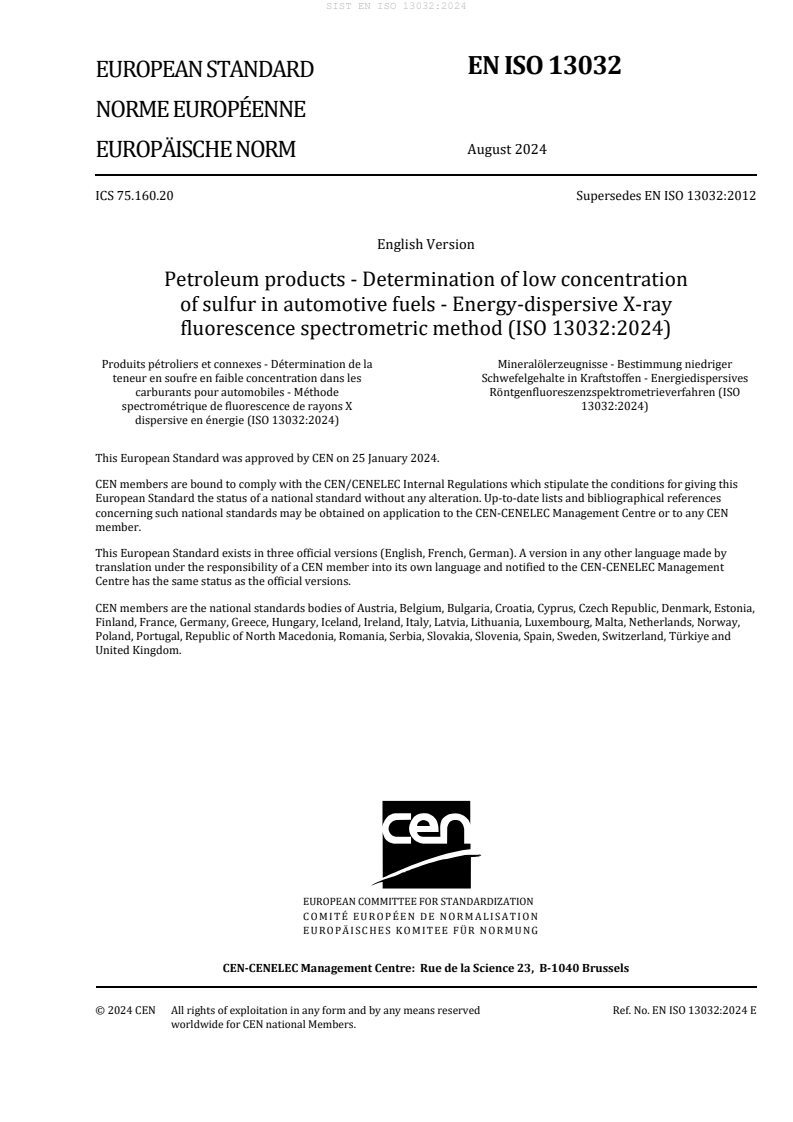
EN ISO 13032
EUROPEAN STANDARD
NORME EUROPÉENNE
August 2024
EUROPÄISCHE NORM
ICS 75.160.20 Supersedes EN ISO 13032:2012
English Version
Petroleum products - Determination of low concentration
of sulfur in automotive fuels - Energy-dispersive X-ray
fluorescence spectrometric method (ISO 13032:2024)
Produits pétroliers et connexes - Détermination de la Mineralölerzeugnisse - Bestimmung niedriger
teneur en soufre en faible concentration dans les Schwefelgehalte in Kraftstoffen - Energiedispersives
carburants pour automobiles - Méthode Röntgenfluoreszenzspektrometrieverfahren (ISO
spectrométrique de fluorescence de rayons X 13032:2024)
dispersive en énergie (ISO 13032:2024)
This European Standard was approved by CEN on 25 January 2024.
CEN members are bound to comply with the CEN/CENELEC Internal Regulations which stipulate the conditions for giving this
European Standard the status of a national standard without any alteration. Up-to-date lists and bibliographical references
concerning such national standards may be obtained on application to the CEN-CENELEC Management Centre or to any CEN
member.
This European Standard exists in three official versions (English, French, German). A version in any other language made by
translation under the responsibility of a CEN member into its own language and notified to the CEN-CENELEC Management
Centre has the same status as the official versions.
CEN members are the national standards bodies of Austria, Belgium, Bulgaria, Croatia, Cyprus, Czech Republic, Denmark, Estonia,
Finland, France, Germany, Greece, Hungary, Iceland, Ireland, Italy, Latvia, Lithuania, Luxembourg, Malta, Netherlands, Norway,
Poland, Portugal, Republic of North Macedonia, Romania, Serbia, Slovakia, Slovenia, Spain, Sweden, Switzerland, Türkiye and
United Kingdom.
EUROPEAN COMMITTEE FOR STANDARDIZATION
COMITÉ EUROPÉEN DE NORMALISATION
EUROPÄISCHES KOMITEE FÜR NORMUNG
CEN-CENELEC Management Centre: Rue de la Science 23, B-1040 Brussels
© 2024 CEN All rights of exploitation in any form and by any means reserved Ref. No. EN ISO 13032:2024 E
worldwide for CEN national Members.
Contents Page
European foreword . 3
European foreword
This document (EN ISO 13032:2024) has been prepared by Technical Committee ISO/TC 28 "Petroleum
and related products, fuels and lubricants from natural or synthetic sources" in collaboration with
Technical Committee CEN/TC 19 “Gaseous and liquid fuels, lubricants and related products of
petroleum, synthetic and biological origin” the secretariat of which is held by NEN.
This European Standard shall be given the status of a national standard, either by publication of an
identical text or by endorsement, at the latest by February 2025, and conflicting national standards
shall be withdrawn at the latest by February 2025.
Attention is drawn to the possibility that some of the elements of this document may be the subject of
patent rights. CEN shall not be held responsible for identifying any or all such patent rights.
This document supersedes EN ISO 13032:2012.
Any feedback and questions on this document should be directed to the users’ national standards
body/national committee. A complete listing of these bodies can be found on the CEN website.
According to the CEN-CENELEC Internal Regulations, the national standards organizations of the
following countries are bound to implement this European Standard: Austria, Belgium, Bulgaria,
Croatia, Cyprus, Czech Republic, Denmark, Estonia, Finland, France, Germany, Greece, Hungary, Iceland,
Ireland, Italy, Latvia, Lithuania, Luxembourg, Malta, Netherlands, Norway, Poland, Portugal, Republic of
North Macedonia, Romania, Serbia, Slovakia, Slovenia, Spain, Sweden, Switzerland, Türkiye and the
United Kingdom.
Endorsement notice
The text of ISO 13032:2024 has been approved by CEN as EN ISO 13032:2024 without any modification.
International
Standard
ISO 13032
Second edition
Petroleum and related products —
2024-08
Determination of low concentration
of sulfur in automotive fuels
— Energy-dispersive X-ray
fluorescence spectrometric method
Produits pétroliers et connexes — Détermination de la teneur
en soufre en faible concentration dans les carburants pour
automobiles — Méthode spectrométrique de fluorescence de
rayons X dispersive en énergie
Reference number
ISO 13032:2024(en) © ISO 2024
ISO 13032:2024(en)
© ISO 2024
All rights reserved. Unless otherwise specified, or required in the context of its implementation, no part of this publication may
be reproduced or utilized otherwise in any form or by any means, electronic or mechanical, including photocopying, or posting on
the internet or an intranet, without prior written permission. Permission can be requested from either ISO at the address below
or ISO’s member body in the country of the requester.
ISO copyright office
CP 401 • Ch. de Blandonnet 8
CH-1214 Vernier, Geneva
Phone: +41 22 749 01 11
Email: copyright@iso.org
Website: www.iso.org
Published in Switzerland
ii
ISO 13032:2024(en)
Contents Page
Foreword .iv
Introduction .v
1 Scope . 1
2 Normative references . 1
3 Terms and definitions . 1
4 Principle . 2
5 Reagents and materials . 2
5.1 Diluent oil .2
5.2 Sulfur compounds .2
5.3 Reference materials .3
5.4 Quality control samples .3
6 Apparatus . 3
7 Sampling and sample handling . 4
8 Apparatus preparation . 4
8.1 Analyser .4
8.2 Sample cups .4
9 Calibration . 5
9.1 General .5
9.2 Preparation of primary standard solutions .5
9.3 Calibration standard solutions .6
9.4 Calibration procedure .7
10 Procedure . 8
11 Calculation . 8
12 Expression of results . 8
13 Precision . 9
13.1 General .9
13.2 Repeatability, r.9
13.3 Reproducibility, R .9
14 Test report . 9
Annex A (informative) Matrix effects . 10
Annex B (normative) Instructions for measuring low sulfur concentrations .12
Bibliography . 14
iii
ISO 13032:2024(en)
Foreword
ISO (the International Organization for Standardization) is a worldwide federation of national standards
bodies (ISO member bodies). The work of preparing International Standards is normally carried out through
ISO technical committees. Each member body interested in a subject for which a technical committee
has been established has the right to be represented on that committee. International organizations,
governmental and non-governmental, in liaison with ISO, also take part in the work. ISO collaborates closely
with the International Electrotechnical Commission (IEC) on all matters of electrotechnical standardization.
The procedures used to develop this document and those intended for its further maintenance are described
in the ISO/IEC Directives, Part 1. In particular, the different approval criteria needed for the different types
of ISO document should be noted. This document was drafted in accordance with the editorial rules of the
ISO/IEC Directives, Part 2 (see www.iso.org/directives).
ISO draws attention to the possibility that the implementation of this document may involve the use of (a)
patent(s). ISO takes no position concerning the evidence, validity or applicability of any claimed patent
rights in respect thereof. As of the date of publication of this document, ISO had not received notice of (a)
patent(s) which may be required to implement this document. However, implementers are cautioned that
this may not represent the latest information, which may be obtained from the patent database available at
www.iso.org/patents. ISO shall not be held responsible for identifying any or all such patent rights.
Any trade name used in this document is information given for the convenience of users and does not
constitute an endorsement.
For an explanation of the voluntary nature of standards, the meaning of ISO specific terms and expressions
related to conformity assessment, as well as information about ISO's adherence to the World Trade
Organization (WTO) principles in the Technical Barriers to Trade (TBT), see www.iso.org/iso/foreword.html.
This document was prepared by Technical Committee ISO/TC 28, Petroleum and related products, fuels and
lubricants from natural or synthetic sources, in collaboration with the European Committee for Standardization
(CEN) Technical Committee CEN/TC 19, Gaseous and liquid fuels, lubricants and related products of petroleum,
synthetic and biological origin, in accordance with the Agreement on technical cooperation between ISO and
CEN (Vienna Agreement).
This second edition cancels and replaces the first edition (ISO 13032:2012), which has been technically
revised.
The main changes are as follows:
— extension of the Scope to include paraffinic diesel fuel and neat fatty acid methyl ester (FAME);
— update of precision statements as well as the concentration range which are based on results of a new
interlaboratory study, for gasoline and diesel type fuels, and FAME type samples.
Any feedback or questions on this document should be directed to the user’s national standards body. A
complete listing of these bodies can be found at www.iso.org/members.html.
iv
ISO 13032:2024(en)
Introduction
This document is directed specifically at the lower end of the concentration range covered in ISO 20847. By
selecting the instrument type, a better signal-to-background ratio for sulfur K-L emission is ensured. A
2,3
knowledge of the general composition of the sample for analysis is advantageous in obtaining the best test result.
NOTE IUPAC X-ray line notation (S K-L ) is used in this document; the corresponding Siegbahn X-ray line
2,3
notation (S Kα or S Kα ) is being phased out.
1,2
v
International Standard ISO 13032:2024(en)
Petroleum and related products — Determination of low
concentration of sulfur in automotive fuels — Energy-
dispersive X-ray fluorescence spectrometric method
WARNING — The use of this document can involve hazardous materials, operations and equipment.
This document does not purport to address all of the safety problems associated with its use. It is
the responsibility of users of this document to take appropriate measures to ensure the safety and
health of personnel prior to application of the document and to fulfil other applicable requirements
for this purpose.
1 Scope
This document specifies an energy dispersive X-ray fluorescence (EDXRF) test method for the determination
of sulfur content in automotive fuels. This document is applicable to:
— gasoline containing up to 3,7 % oxygen by mass (including those blended with ethanol up to 10 % by
volume) having sulfur contents in the range of 6,9 mg/kg to 56,7 mg/kg,
— diesel fuels including those containing up to about 30 % fatty acid methyl ester (FAME) by volume,
paraffinic diesel fuel, and neat FAME, having sulfur contents in the range of 5,0 mg/kg to 60,2 mg/kg.
The sulfur content in other products can be determined according to the test method specified in this
document; however, no precision data for products other than automotive fuels and for results outside the
specified range have been established for this document.
For reasons of spectral overlap, this document is not applicable to leaded automotive gasoline, gasoline
having a content of greater than 8 mg/kg lead or to product and feedstock containing lead, silicon,
phosphorus, calcium, potassium or halides at concentrations greater than one tenth of the concentration of
sulfur measured, or more than 10 mg/kg, whichever is the greater.
2 Normative references
The following documents are referred to in the text in such a way that some or all of their content constitutes
requirements of this document. For dated references, only the edition cited applies. For undated references,
the latest edition of the referenced document (including any amendments) applies.
ISO 3170, Petroleum liquids — Manual sampling
ISO 3171, Petroleum liquids — Automatic pipeline sampling
3 Terms and definitions
No terms and definitions are listed in this document.
ISO and IEC maintain terminology databases for use in standardization at the following addresses:
— ISO Online browsing platform: available at https:// www .iso .org/ obp
— IEC Electropedia: available at https:// www .electropedia .org/
ISO 13032:2024(en)
4 Principle
The test portion, in a cup fitted with an X-ray transparent window, is placed in a beam of exciting radiation
from an X-ray tube. The intensity of the sulfur K-L characteristic X-radiation is measured. The accumulated
2,3
number of counts in a given time or count rate is compared with a calibration curve constructed from sulfur
standard solutions covering the range of sulfur contents under examination.
NOTE The excitation radiation can be either direct or indirect via a polarizing or secondary target.
5 Reagents and materials
5.1 Diluent oil
The reference diluent oil is white oil (light paraffin oil) of high purity grade, with a maximum sulfur content
of 0,5 mg/kg. However, if only one type of matrix is required to be analysed (e.g. motor gasoline), the accuracy
of results can be improved by using a matrix-matched diluent. These should match, approximately, the
aromatic and oxygen contents of the material to be analysed and should consist of high-purity components
of less than 0,5 mg/kg sulfur content.
For the analysis of FAME, the oxygen content shall be adjusted to the sample matrix. The use of a mixture of
white oil with methyl oleate (see 5.2.6) or organic acid (see 5.2.7) is recommended as a diluent oil.
NOTE 1 Suitable components for the matched matrix diluent include n-heptane, 2,2,4-trimethylpentane, toluene,
xylenes, ethanol, methyl tertiary butyl ether (MTBE), ethyl tertiary butyl ether (ETBE) and tertiary amyl methyl
ether (TAME).
NOTE 2 For the analysis of diesel fuels containing FAME, the accuracy of results can be improved by use of a
matched matrix composed of a mixture of white oil and methyl oleate (see 5.2.6) or organic acid, to adjust the oxygen
content and the sample matrix.
5.2 Sulfur compounds
5.2.1 Sulfur compounds of known sulfur content. These shall be used for the preparation of the primary
standards. The compounds given in 5.2.2 to 5.2.5 are suitable and their nominal sulfur contents are given.
Where the purity of these compounds is less than 99 % by mass, either the concentrations and nature of all
impurities shall be known, or certified reference materials (CRMs) (5.3) shall be used instead.
5.2.2 Dibenzothiophene (DBT), with a nominal sulfur content of 17,399 % by mass.
5.2.3 Dibutylsulfide (DBS), with a nominal sulfur content of 21,915 % by mass.
5.2.4 Thionaphthene (Benzothiophene) (TNA), with a nominal sulfur content of 23,890 % by mass.
5.2.5 Dibutyldisulfide (DBDS), with a nominal sulfur content of 35,950 % by mass.
5.2.6 Methyl oleate, for use as a blank solution with a sulfur content of less than 1 mg/kg when FAME
is analysed. Check the blank solution prior to use with the spectrometer (6.1). A signal for sulfur shall not
be detectable (i.e. the intensity shall be lower that the intensity equivalent to 1 mg/kg). Other oxygen-
containing and sulfur-free blank solutions, such as octanol, may also be used. Methyl oleate may also be
used in combination with white oil to make a matrix-matched base for diesel fuels containing FAME.
5.2.7 Organic acid, for use as a blank solution with a sulfur content of less than 1 mg/kg when FAME
is analysed. Check the blank solution prior to use with the spectrometer (6.1). A signal for sulfur shall not
be detectable (i.e. the intensity shall be lower that the intensity equivalent to 1 mg/kg). Other oxygen-
containing and sulfur-free blank solutions, such as octanol, may also be used. Organic acid may also be used
in combination with white oil to make a matrix-matched base for diesel fuels containing FAME.
ISO 13032:2024(en)
5.3 Reference materials
Certified reference materials (CRMs) from suppliers complying with ISO 17034, containing a range of sulfur
concentrations, are suitable alternatives to the calibration standard solutions based on compounds listed in
5.2.2 to 5.2.5 for use as calibration standards.
5.4 Quality control samples
Quality control samples are stable samples representative of the materials being analysed, which have
a sulfur content that is known by this test method over a substantial period of time or are supplied
commercially with a certified value. Before use, ensure that the material is within its shelf-life.
6 Apparatus
6.1 Energy-dispersive X-ray fluorescence instrument, with the following performance characteristics.
a) For a 10 mg/kg sulfur standard (see 9.3), the instrument shall be capable of meeting the performance
characteristics as described by Formulae (1) and (2):
RR− R ≥1,3 (1)
()
sb b
and
CR()<5% (2)
V s
where
R is the gross count rate (expressed in counts per second) for the sulfur region of interest for a
s
10 mg/kg sulfur standard;
R is the gross count rate (expressed in counts per second) for the same region of interest for a blank
b
sample [diluent oil (5.1, 5.2.6, 5.2.7, or a mixture of either 5.2.6 or 5.2.7 with 5.1)];
C is the coefficient of variation (relative standard deviation) based on 10 individual measurements
V
of the calibration standard.
NOTE The term “relative standard deviation” is d
...