

EN 15469:2007
(Main)Petroleum products - Test method for free water in liquefied petroleum gas by visual inspection
- Abstract
This test method covers the use of a pressure cylinder to determine the presence of free water in liquefied petroleum gas (LPG) by visual inspection below 0 °C.
- Status
- Published
- Publication Date
- 13-Nov-2007
- Withdrawal Date
- 30-May-2008
- Technical Committee
- CEN/TC 19 - Petroleum products, lubricants and related products
- Current Stage
- 9093 - Decision to confirm - Review Enquiry
- Start Date
- 04-Sep-2023
- Completion Date
- 14-Oct-2026

Overview
EN 15469:2007 is a European standard developed by CEN for testing the presence of free water in liquefied petroleum gas (LPG) through visual inspection. This standard defines a precise method using a pressure transparent cylinder to detect free water in LPG samples at temperatures below 0 °C. It helps ensure product quality and equipment safety by identifying water contamination in LPG, which can cause corrosion and operational blockages.
Key Topics
Scope and Purpose
The standard covers a visual inspection test method to identify free water in LPG using a pressure cylinder. This test is applied below 0 °C to detect ice formation, which indicates free water presence.Terminology
LPG is defined as petroleum gas stored or handled in liquid phase under moderate pressure and temperature, mainly consisting of propane, butanes, and small amounts of propene, butenes, and pentanes/pentenes.Principle
A sample is collected in a transparent pressure cylinder filled to 50% capacity, cooled for at least one hour below 0 °C, and visually inspected for ice lumps representing frozen free water.Significance
Detecting free water is critical because water in LPG can cause corrosion and freeze to block valves, pumps, and regulators, impacting safety and operations.Apparatus Requirements
- Transparent pressure container (~250 ml) fitted with bottom and vent valves
- Suitable thermometer in contact with the liquid
- Freezer capable of maintaining below 0 °C temperatures
- Proper cleaning solvents (e.g., ethanol or isopropanol) for apparatus preparation
Testing Procedure
- Pre-cool the test cylinder before sample introduction
- Transfer LPG sample carefully avoiding water entrapment
- Cool sample in freezer horizontally for at least one hour
- Observe immediately for ice lumps on the cylinder surface
- Record pass/fail results based on ice presence
Report Format
Results are reported as pass if no ice is observed (no free water) or fail if ice lumps appear (free water detected).Precision
The test is qualitative with a pass/fail outcome; therefore, quantitative precision is not specified.
Applications
EN 15469:2007 is essential for industries involved in the production, storage, transportation, and distribution of liquefied petroleum gas. Practical applications include:
Quality Control
Ensuring LPG batches meet water content requirements before release or further processing.Safety Assurance
Preventing corrosion-related equipment damage and operational failures caused by ice blockages.Maintenance Planning
Scheduling cleaning or filtration if free water is detected to maintain system integrity.
This test method supports safe handling of LPG in residential, commercial, and industrial settings by minimizing water-induced risks.
Related Standards
- EN ISO 3993 – Determination of density or relative density of LPG and light hydrocarbons using the pressure hydrometer method.
- EN ISO 4257 – Method of sampling liquefied petroleum gases.
These complementary standards assist in broader analytical procedures for LPG quality assessment and sampling protocols, supporting comprehensive fuel testing and safety management.
Keywords: EN 15469:2007, free water test, liquefied petroleum gas, LPG visual inspection, petroleum product testing, water contamination in LPG, LPG quality control, lubricants and fuels, CEN standard, LPG safety, pressure cylinder test, LPG freezing test.
Relations
- Referred By
EN ISO 6975:2005 - Natural gas - Extended analysis - Gas-chromatographic method (ISO 6975:1997) - Effective Date
- 28-Jan-2026
- Effective Date
- 28-Jan-2026
- Effective Date
- 28-Jan-2026
- Effective Date
- 28-Jan-2026
- Effective Date
- 28-Jan-2026
- Effective Date
- 28-Jan-2026
Get Certified
Connect with accredited certification bodies for this standard

Element Materials Technology
Materials testing and product certification.

ABS Group Brazil
ABS Group certification services in Brazil.

ABS Quality Evaluations Inc.
American Bureau of Shipping quality certification.
Sponsored listings
Frequently Asked Questions
EN 15469:2007 is a standard published by the European Committee for Standardization (CEN). Its full title is "Petroleum products - Test method for free water in liquefied petroleum gas by visual inspection". This standard covers: This test method covers the use of a pressure cylinder to determine the presence of free water in liquefied petroleum gas (LPG) by visual inspection below 0 °C.
This test method covers the use of a pressure cylinder to determine the presence of free water in liquefied petroleum gas (LPG) by visual inspection below 0 °C.
EN 15469:2007 is classified under the following ICS (International Classification for Standards) categories: 75.160.20 - Liquid fuels. The ICS classification helps identify the subject area and facilitates finding related standards.
EN 15469:2007 has the following relationships with other standards: It is inter standard links to EN ISO 6975:2005, CEN ISO/TR 24094:2007, EN 589:2018, EN 589:2024, EN 589:2018+A1:2022, EN 589:2008+A1:2012. Understanding these relationships helps ensure you are using the most current and applicable version of the standard.
EN 15469:2007 is available in PDF format for immediate download after purchase. The document can be added to your cart and obtained through the secure checkout process. Digital delivery ensures instant access to the complete standard document.
Standards Content (Sample)
2003-01.Slovenski inštitut za standardizacijo. Razmnoževanje celote ali delov tega standarda ni dovoljeno.Petroleum products - Test method for free water in liquefied petroleum gas by visual inspectionXWHNRþLQMHQHPProduits pétroliers - Détermination de l'eau libre en gaz de pétrole liquéfié par inspection visuelleMineralölerzeugnisse - Bestimmung von freiem Wasser in Flüssiggas durch visuelle BegutachtungTa slovenski standard je istoveten z:EN 15469:2007SIST EN 15469:2008en,fr,de75.160.30ICS:SLOVENSKI
STANDARDSIST EN 15469:200801-februar-2008
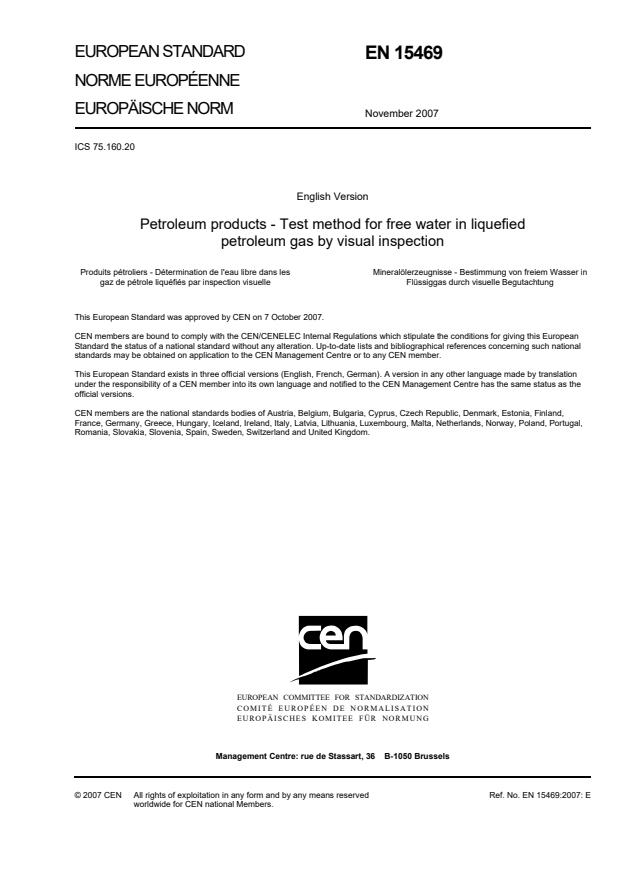
EUROPEAN STANDARDNORME EUROPÉENNEEUROPÄISCHE NORMEN 15469November 2007ICS 75.160.20 English VersionPetroleum products - Test method for free water in liquefiedpetroleum gas by visual inspectionProduits pétroliers - Détermination de l'eau libre dans lesgaz de pétrole liquéfiés par inspection visuelleMineralölerzeugnisse - Bestimmung von freiem Wasser inFlüssiggas durch visuelle BegutachtungThis European Standard was approved by CEN on 7 October 2007.CEN members are bound to comply with the CEN/CENELEC Internal Regulations which stipulate the conditions for giving this EuropeanStandard the status of a national standard without any alteration. Up-to-date lists and bibliographical references concerning such nationalstandards may be obtained on application to the CEN Management Centre or to any CEN member.This European Standard exists in three official versions (English, French, German). A version in any other language made by translationunder the responsibility of a CEN member into its own language and notified to the CEN Management Centre has the same status as theofficial versions.CEN members are the national standards bodies of Austria, Belgium, Bulgaria, Cyprus, Czech Republic, Denmark, Estonia, Finland,France, Germany, Greece, Hungary, Iceland, Ireland, Italy, Latvia, Lithuania, Luxembourg, Malta, Netherlands, Norway, Poland, Portugal,Romania, Slovakia, Slovenia, Spain, Sweden, Switzerland and United Kingdom.EUROPEAN COMMITTEE FOR STANDARDIZATIONCOMITÉ EUROPÉEN DE NORMALISATIONEUROPÄISCHES KOMITEE FÜR NORMUNGManagement Centre: rue de Stassart, 36
B-1050 Brussels© 2007 CENAll rights of exploitation in any form and by any means reservedworldwide for CEN national Members.Ref. No. EN 15469:2007: E
...