

CEN/TR 17904:2022
(Main)Cabin air quality on civil aircraft – Chemical compounds
- Abstract
This document defines recommendations dealing with the quality of the air on civil aircraft concerning chemical compounds potentially originating from, but not limited, to, the ventilation air supplied to the cabin and flight deck.
A special emphasis is on the engine and APU bleed air contaminants potentially brought into the cabin through the air conditioning, pressurization and ventilation systems.
The document is applicable to civil aircraft in operation from the period that is defined as when the first person enters the aircraft until the last person leaves the aircraft.
The document recommends means to prevent exposure to certain types of chemical compounds, including those that could cause adverse effects, taking into account the Precautionary Principle.
- Status
- Published
- Publication Date
- 01-Nov-2022
- Current Stage
- 6060 - Definitive text made available (DAV) - Publishing
- Start Date
- 02-Nov-2022
- Due Date
- 26-Oct-2023
- Completion Date
- 02-Nov-2022



Standard reference
CEN/TR 17904:2022 - Cabin air quality on civil aircraft – Chemical compounds (CEN)
Overview
CEN/TR 17904:2022 provides recommendations for managing cabin air quality on civil aircraft with a focus on chemical compounds that may originate from ventilation supply air, especially contaminants introduced via engine and APU bleed air. The Technical Report covers the operational period from first boarding to final disembarkation and recommends measures to prevent or mitigate exposure to chemical contaminants (including those with potential adverse effects) using the Precautionary Principle.
Key topics and technical requirements
- Sources & marker compounds
- Identification of chemical compounds in cabin air and their likely sources (outside air, on-board materials, engine/bleed air, hydraulic/oil fluids).
- Use of marker compounds to indicate specific contamination sources (Annex B, G).
- Fume events
- Definitions, detection indicators and reporting expectations for suspected contamination episodes.
- Precautionary Principle & hierarchy of controls
- Guidance on elimination, engineering controls, administrative controls and personal protection to reduce exposure.
- Environmental Control Systems (ECS)
- Overview of bleed air and bleed-free ECS architectures and their implication for contaminant pathways (Annex A).
- Filtration & catalytic conversion
- Recommendations for recirculation filtration and catalytic filters as mitigation measures.
- Air monitoring
- Planning and methodology for real-time and time-integrated monitoring, sampling locations, and flight-phase considerations (Annexes D & E).
- Operational procedures
- Preventative/corrective actions pre-flight, in-flight and post-flight; maintenance response including Aircraft Maintenance Manual (AMM) integration.
- Data, reporting & training
- Compilation, analysis and reporting of monitoring and incident data; recommended education and training programs for pilots, cabin crew and maintenance personnel.
- Supporting annexes
- Best-practice examples, sources of oil leakage into bleed air, monitoring studies and reference measurement methods.
Applications & users
This Technical Report is intended for:
- Airline operators and Safety Management Systems (SMS) teams - to adopt prevention, monitoring and reporting practices.
- Aircraft manufacturers and ECS suppliers - to inform design and filtration strategies.
- Maintenance organizations - to guide diagnostics, AMM procedures and corrective maintenance.
- Regulators, occupational health professionals and investigators - as a reference for monitoring approaches, training and precautionary controls.
Keywords: cabin air quality, chemical compounds, bleed air, APU, ECS, fume event, marker compounds, air monitoring, filtration, Precautionary Principle.
Related standards and guidance
- Complementary guidance from aviation regulators and international bodies (e.g., ICAO) and national aviation authorities; consult CEN national members for implementation details and any related normative standards.
Get Certified
Connect with accredited certification bodies for this standard

BUREAU VERITAS Certification Germany
Bureau Veritas certification in Germany.

Element Materials Technology
Materials testing and product certification.

AQMS Ltd.
AQMS provides ISO certification to SMEs across the UK.
Sponsored listings
Frequently Asked Questions
CEN/TR 17904:2022 is a technical report published by the European Committee for Standardization (CEN). Its full title is "Cabin air quality on civil aircraft – Chemical compounds". This standard covers: This document defines recommendations dealing with the quality of the air on civil aircraft concerning chemical compounds potentially originating from, but not limited, to, the ventilation air supplied to the cabin and flight deck. A special emphasis is on the engine and APU bleed air contaminants potentially brought into the cabin through the air conditioning, pressurization and ventilation systems. The document is applicable to civil aircraft in operation from the period that is defined as when the first person enters the aircraft until the last person leaves the aircraft. The document recommends means to prevent exposure to certain types of chemical compounds, including those that could cause adverse effects, taking into account the Precautionary Principle.
This document defines recommendations dealing with the quality of the air on civil aircraft concerning chemical compounds potentially originating from, but not limited, to, the ventilation air supplied to the cabin and flight deck. A special emphasis is on the engine and APU bleed air contaminants potentially brought into the cabin through the air conditioning, pressurization and ventilation systems. The document is applicable to civil aircraft in operation from the period that is defined as when the first person enters the aircraft until the last person leaves the aircraft. The document recommends means to prevent exposure to certain types of chemical compounds, including those that could cause adverse effects, taking into account the Precautionary Principle.
CEN/TR 17904:2022 is classified under the following ICS (International Classification for Standards) categories: 49.095 - Passenger and cabin equipment. The ICS classification helps identify the subject area and facilitates finding related standards.
CEN/TR 17904:2022 is available in PDF format for immediate download after purchase. The document can be added to your cart and obtained through the secure checkout process. Digital delivery ensures instant access to the complete standard document.
Standards Content (Sample)
SLOVENSKI STANDARD
01-januar-2023
Kakovost zraka v kabini civilnih letal - Kemijske spojine
Cabin air quality on civil aircraft - Chemical compounds
Kabinenluftqualität in Verkehrsflugzeugen - Chemische Parameter
Qualité de l'air en cabine d'avions civils - Composés chimiques
Ta slovenski standard je istoveten z: CEN/TR 17904:2022
ICS:
13.040.01 Kakovost zraka na splošno Air quality in general
49.095 Oprema za potnike in Passenger and cabin
oprema kabin equipment
2003-01.Slovenski inštitut za standardizacijo. Razmnoževanje celote ali delov tega standarda ni dovoljeno.
CEN/TR 17904
TECHNICAL REPORT
RAPPORT TECHNIQUE
November 2022
TECHNISCHER REPORT
ICS 49.095
English Version
Cabin air quality on civil aircraft - Chemical compounds
Qualité de l'air en cabine d'avions civils ¿ Composés Kabinenluftqualität in Verkehrsflugzeugen - Chemische
chimiques Parameter
This Technical Report was approved by CEN on 30 October 2022. It has been drawn up by the Technical Committee CEN/TC 436.
CEN members are the national standards bodies of Austria, Belgium, Bulgaria, Croatia, Cyprus, Czech Republic, Denmark, Estonia,
Finland, France, Germany, Greece, Hungary, Iceland, Ireland, Italy, Latvia, Lithuania, Luxembourg, Malta, Netherlands, Norway,
Poland, Portugal, Republic of North Macedonia, Romania, Serbia, Slovakia, Slovenia, Spain, Sweden, Switzerland, Türkiye and
United Kingdom.
EUROPEAN COMMITTEE FOR STANDARDIZATION
COMITÉ EUROPÉEN DE NORMALISATION
EUROPÄISCHES KOMITEE FÜR NORMUNG
CEN-CENELEC Management Centre: Rue de la Science 23, B-1040 Brussels
© 2022 CEN All rights of exploitation in any form and by any means reserved Ref. No. CEN/TR 17904:2022 E
worldwide for CEN national Members.
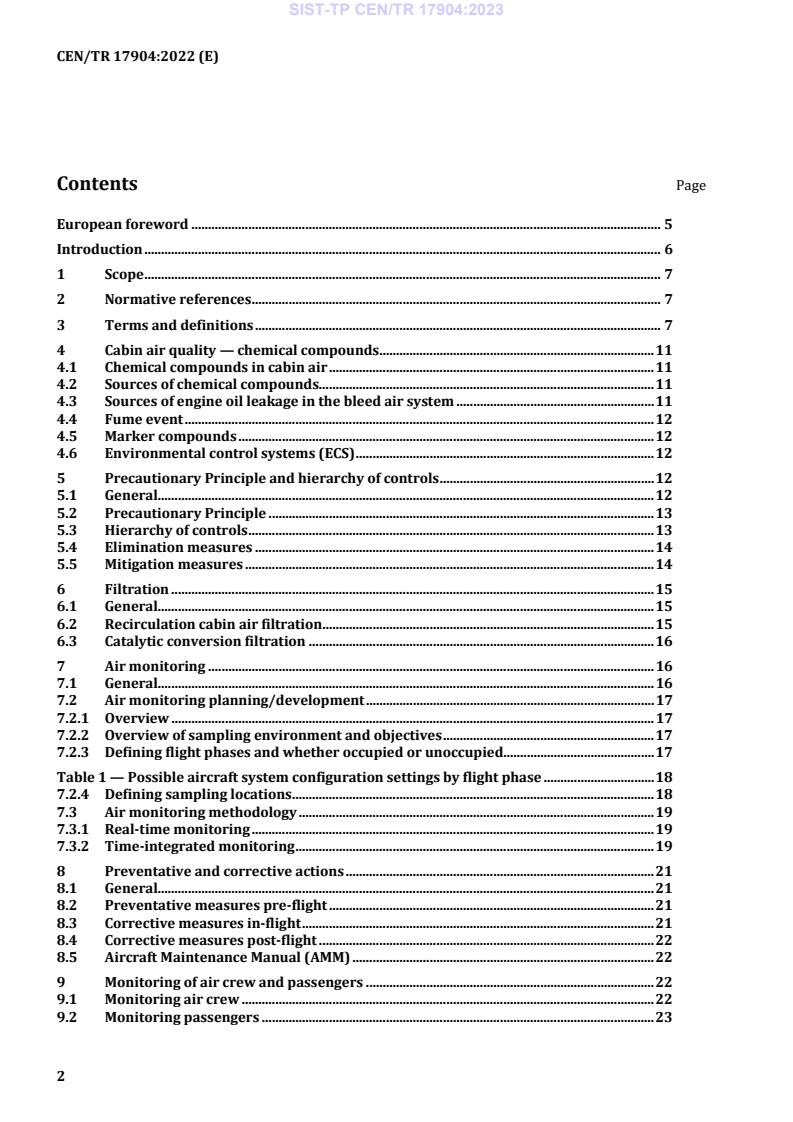
Contents Page
European foreword . 5
Introduction . 6
1 Scope . 7
2 Normative references . 7
3 Terms and definitions . 7
4 Cabin air quality — chemical compounds . 11
4.1 Chemical compounds in cabin air . 11
4.2 Sources of chemical compounds. 11
4.3 Sources of engine oil leakage in the bleed air system . 11
4.4 Fume event . 12
4.5 Marker compounds . 12
4.6 Environmental control systems (ECS) . 12
5 Precautionary Principle and hierarchy of controls . 12
5.1 General. 12
5.2 Precautionary Principle . 13
5.3 Hierarchy of controls . 13
5.4 Elimination measures . 14
5.5 Mitigation measures . 14
6 Filtration . 15
6.1 General. 15
6.2 Recirculation cabin air filtration. 15
6.3 Catalytic conversion filtration . 16
7 Air monitoring . 16
7.1 General. 16
7.2 Air monitoring planning/development . 17
7.2.1 Overview . 17
7.2.2 Overview of sampling environment and objectives . 17
7.2.3 Defining flight phases and whether occupied or unoccupied . 17
Table 1 — Possible aircraft system configuration settings by flight phase . 18
7.2.4 Defining sampling locations. 18
7.3 Air monitoring methodology . 19
7.3.1 Real-time monitoring . 19
7.3.2 Time-integrated monitoring . 19
8 Preventative and corrective actions . 21
8.1 General. 21
8.2 Preventative measures pre-flight . 21
8.3 Corrective measures in-flight . 21
8.4 Corrective measures post-flight . 22
8.5 Aircraft Maintenance Manual (AMM) . 22
9 Monitoring of air crew and passengers . 22
9.1 Monitoring air crew . 22
9.2 Monitoring passengers . 23
10 Data compilation, analysis and reporting . 23
10.1 General . 23
10.2 Data compilation . 24
10.2.1 Relevant airline operator reports . 24
10.2.2 Air crew fume event reports . 25
10.3 Analysis and reporting . 26
10.3.1 Analysis . 26
11 Airline worker education and training . 27
11.1 General . 27
11.2 Recommended programme elements, by work group . 27
11.2.1 Programme provisions applicable to pilots, cabin crew and maintenance workers 27
11.2.2 Pilot-specific training and education . 27
11.2.3 Cabin crew-specific training and education . 28
11.2.4 Maintenance worker-specific training and education . 28
Annex A (informative) Environmental Control Systems (ECS) . 29
A.1 General . 29
A.2 Bleed air environmental control systems (ECS) . 29
Figure A.1 — Typical schematic for a bleed air ECS . 30
A.3 Bleed-free environmental control system . 30
Figure A.2 — Typical bleed-free ECS architecture . 31
Annex B (normative) Chemical marker compounds . 32
Table B.1 — Sources of airborne contaminants and their associated chemical marker
compounds . 32
Table B.2 — Reliability ratings for the presence of chemical marker compounds, according
to each source of contamination . 34
Annex C (informative) Precautionary Principle . 37
C.1 Precautionary Principle . 37
C.2 Precautionary Principle considerations: background information . 38
Annex D (informative) Approaches for online monitoring . 40
D.1 General . 40
D.2 Indicative chemical marker compounds . 40
D.3 Pattern recognition . 40
D.4 Differential measurement . 40
Annex E (informative) Reference method for real-time and time-integrated measurement of
chemical marker compounds and (ultra) fine particles . 41
Table E.1 — Examples of standardized methods for real-time and time-integrated
measurements . 41
Table E.2 — Examples of possible methods for real-time measurement of chemical marker
compounds and ultrafine particles . 51
Annex F (informative) Examples of best practice intended to prevent or minimize
contamination . 53
Table F.1 — Examples of best practice for manufacturers, airline operators, pilots and
maintenance operations to prevent or minimize contamination of the aircraft
ventilation supply air system . 53
Annex G (informative) Chemical marker compounds introduced into the cabin . 55
Table G.1 — Chemical marker compounds introduced into the cabin via the outside air to the
ventilation system . 55
Table G.2 — Chemical marker compounds generated within the aircraft cabin environment
................................................................................................................................................................... 57
Annex H (informative) Sources of engine oil leakage into the bleed air system and ventilation
supply air . 58
H.1 Description of oil lubrication system . 58
Figure H.1 — Typical oil-bearing pump . 58
H.2 Description of seal technology . 59
H.3 Oil path into bleed air system and ventilation supply air . 59
H.4 Maintenance response to oil fumes sourced to bleed air system (renumber H.4) . 60
Annex I (informative) Overview of aircraft cabin air and bleed air monitoring studies . 61
I.1 Introduction . 61
Table I.1 — Overview of aircraft cabin air and bleed air monitoring studies. 61
I.2 References cited in Table I.1 . 70
Bibliography . 73
European foreword
This document (CEN/TR 17904:2022) has been prepared by Technical Committee CEN/TC 436 “Cabin
air quality”, the secretariat of which is held by AFNOR.
Attention is drawn to the possibility that some of the elements of this document may be the subject of
patent rights. CEN shall not be held responsible for identifying any or all such patent rights.
Any feedback and questions on this document should be directed to the users’ national standards body.
A complete listing of these bodies can be found on the CEN website.
Introduction
Air quality on civil aircraft requires particular attention, given the characteristics of the cabin
environment.
An environmental control system (ECS) is used to regulate the aircraft cabin pressure, temperature and
ventilation supply air to provide a safe and comfortable environment for the passengers and air crew.
The aircraft cabin by design and operation is enclosed and is a densely occupied environment (with only
a small amount of per person dilution volume), creating the potential for elevated levels of bio-effluents
in the cabin, such as carbon dioxide (see Annex A). ECS architecture on civil passenger aircraft can be
broadly separated in two categories: bleed air ECS systems and bleed free ECS systems (see Annex A).
Most aircraft manufactured today, and nearly all aircraft in service, have bleed air ECS.
This document focuses on the chemical compounds potentially present in cabin air. It sets out
recommendations and supporting annexes to enable airline operators, manufacturers and suppliers to
identify - and either prevent or mitigate - exposure to contaminants in the cabin air, with particular
emphasis on bleed air contaminants sourced to or generated from engine oil and hydraulic fluid. This
includes some limited measures intended to protect workers assigned to troubleshoot and service the
aircraft ventilation supply air systems.
NOTE Aircraft accident investigation agencies, aviation regulators from the EU and US, and the International
Civil Aviation Organization (ICAO) have recognized that bleed air contamination can compromise flight safety.
The recommendations in this document take into account that the fluids used in aviation (including jet
engine oils) and their pyrolysis products are complex mixtures. Some of these mixtures contain
organophosphates, ultra-fine particles, and other chemical compounds.
The recommendations in the document take into account current and developing legal frameworks in
order to enable the industry to meet their legal obligation to provide a safe environment for air crew and
passengers. This document also acknowledges, at the European Commission level, the value of using the
Precautionary Principle in relation to risk management, and the use of risk assessment in this industry to
protect workers and the environment.
Within this document, emphasis is placed upon exposure prevention, sensor technology, worker training,
reporting systems, and collation of data and information from air crew and passengers. Safety
Management Systems (SMS) can be a useful tool to enable operators to apply these measures to monitor
and respond to system degradation.
This document does not define acceptability/suitability for health, comfort, safety, or airworthiness of
the cabin air.
Annex I contains a summary of maximum levels of the marker compounds listed in Annex B that have
been published.
1 Scope
This document defines recommendations dealing with the quality of the air on civil aircraft concerning
chemical compounds potentially originating from, but not limited, to, the ventilation air supplied to the
cabin and flight deck.
A special emphasis is on the engine and APU bleed air contaminants potentially brought into the cabin
through the air conditioning, pressurization and ventilation systems.
This document is applicable to civil aircraft in operation from the period that is defined as when the first
person enters the aircraft until the last person leaves the aircraft.
This document recommends means to prevent exposure to certain type of chemical compounds,
including those that could cause adverse effects, taking into account the Precautionary Principle.
2 Normative references
There are no normative references in this document.
3 Terms and definitions
For the purposes of this document, the following terms and definitions apply.
ISO and IEC maintain terminological databases for use in standardization at the following addresses:
• ISO Online browsing platform: available at http://www.iso.org/obp
• IEC Electropedia: available at http://www.electropedia.org/
3.1
adverse effect
change in morphology, physiology, growth, development or lifespan of an organism which results in
impairment of its functional capacity or impairment of its capacity to compensate for additional stress or
increased susceptibility to the harmful effects of other environmental influences
[SOURCE: ISO 13073-3:2016, 2.1]
3.2
aerosol
system of solid particles and/or liquid droplets suspended in gas
3.3
air crew
people working on an aircraft in the period that is defined as when the first person boards the aircraft
until the last person leaves the aircraft, including pilots and cabin crew
3.4
airline operator
entity authorized by an Air carrier Operator Certificate (AOC) from its national Civil Aviation Authority
to operate civil transport aircraft flights for commercial carriage of passengers, cargo or mail
Note 1 to entry: The airline operator holds responsibility for compliance with civil aviation authority regulations
on its flights, including when the relevant tasks are performed by sub-contractors.
[SOURCE: ISO 16412:2005, 3.3, modified — The terms originally defined were “operator”, “airline” and
“carrier”.][2]
3.5
auxiliary power unit
APU
gas turbine-powered unit delivering rotating shaft power, compressor air, or both, which is not intended
for direct propulsion of an aircraft
[SOURCE: EASA CS Definitions] [3]
3.6
best available technology
BAT
most effective and advanced stage in the development of activities and their methods of operation which
indicate the practical suitability of particular technologies for providing, in principle, the basis to mitigate,
or eliminate exposure to contaminants in cabin air
[SOURCE: Council Directive 2008/1/EC, modified] [4]
3.7
bleed air
air bled off the compressor stages of the aircraft engines or APU, prior to the combustion chamber; source
of ventilation air
3.8
cabin air
air within the section of an aircraft in which passengers and/or air crew travel (including the cabin and
flight deck)
3.9
cabin material
cabin interior which includes seats, flooring, walls, cabinets and overhead bins
3.10
chemical compound
chemical element or compound on its own or admixed as it occurs in the natural state or as produced,
used, or released, including release as waste, by any work activity, whether or not produced intentionally
and whether or not placed on the market
[SOURCE: Council Directive 98/24/EC Art. 2(a)][5]
3.11
contaminant
substance emitted into the air adversely affecting air quality
[SOURCE: ISO 4225:2020] [6]
3.12
early warning system
system or a procedure to detect the presence of contaminants that may require intervention
3.13
electrical-environmental control system
E-ECS
bleed-free ECS
3.14
environment control system
ECS
system of an aircraft which provides ventilation supply air, temperature control, and cabin pressurization
for the crew and passengers
3.15
fresh air (see also: outside air)
air taken from outside the vehicle
Note 1 to entry: In this document, the vehicle is the aircraft.
3.16
fumes
odorous, gaseous emission of compound(s) and/or aerosols which may be sourced to the cabin/flight
deck ventilation supply air vents and is not visible
3.17
hazardous
substance or mixture fulfilling the criteria relating to physical hazards, health hazards, or environmental
hazards
[SOURCE: Regulation (EC) No 1272/2008 “CLP”, Article 3] [7]
Note 1 to entry: (i) any chemical agent which meets the criteria for classification as hazardous within any physical
and/or health hazard classes laid down in Regulation (EC) No 1272/2008 of the European Parliament and of the
Council, whether or not that chemical agent is classified under that Regulation; and(ii) any chemical agent which,
whilst not meeting the criteria for classification as hazardous in accordance with point (i) may, because of its
physico-chemical, chemical or toxicological properties and the way it is used or is present in the workplace, present
a risk to the safety and health of workers, including any chemical agent that is assigned an occupational exposure
limit value under Article 3.
[SOURCE: Directive (EC) No 98/24, Article 2]
Note 2 to entry: This definition of hazardous is different to the definition applied in the airworthiness context.
3.18
marker compound
chemical compound representing/indicating specific/potential sources of airborne contaminants in the
cabin air
3.19
outside air (see also: fresh air)
air taken from outside the vehicle
[SOURCE: ISO 19659-1:2017, 3.4.1] [8]
Note 1 to entry: In this document, the vehicle is the aircraft.
3.20
real-time sampling
use of online monitoring using instrumental analysers with sensors; the output describes the change in
concentration of the analyte(s) as a function of time during the sampling period
3.21
risk analysis
systematic use of available information to identify hazards and to estimate the risk
[SOURCE: ISO/IEC Guide 51:2014, 3.10] [9]
3.22
safety management system
SMS
administrative framework that is designed to manage safety risks in workplaces and is applied to enable
the operator to systematically monitor and respond to fume events
3.23
sensor
electronic device that senses a physical condition or chemical compound and delivers an electronic signal
proportional to the observed characteristic
[SOURCE: ISO/IEC TR 29181-9:2017,3.14] [10]
3.24
soot
particulate matter with a particle size of 0 nanometres (nm) to 10 nm produced and deposited during or
after combustion
[SOURCE: EN ISO 472:2013, 2.1278 modified] [11]
3.25
steady state
condition during single engine power setting characterized by stable temperature and bleed pressure
[SOURCE: SAE (2018)] [12]
3.26
supply air
air introduced into an enclosure by mechanical means including engines, APU, onboard electric
compressors, or ground supply units
3.27
time-integrated sampling
either passive or active sampling methodology, followed by analysis of the collected sample in dedicated
equipment or a laboratory; the output describes the average concentration of the analyte(s) during the
sampling period
3.28
transient operating condition
condition other than steady state engine power setting characterized by unstable temperature and/or
changing pressure; examples include engine start, take-off top-of-descent and changes in engine regime
including changing the power setting from idle to take off power and back
3.29
ultra-fine particles
ultra-fine particles (UFP) or ultrafine dust are the most commonly used definitions of airborne particles
with a diameter between 1 and 100 nanometres (nm)
[SOURCE: ISO 2007] [13]
4 Cabin air quality — chemical compounds
4.1 Chemical compounds in cabin air
The presence and concentration of many chemical compounds have been measured in the cabin air and
are reported in numerous studies, providing a large database of chemical compounds. Most of these data
were collected in the cabin or flight deck during normal operating conditions and not during a reported
“fume event” (see 4.4). Some of these data were collected directly from a bleed air source.
Monitoring the cabin air for the presence of appropriate chemical marker compounds is a method to
indicate the source(s) of contamination, rather than to assess any health effects of exposure.
4.2 Sources of chemical compounds
Chemical compounds can be sourced to the outside environment and can also originate from the aircraft
itself. These may include, but are not limited to the following:
— engine oil;
— hydraulic fluid;
— engine exhaust;
— fuel (unburned and vapours);
— de-icing fluid;
— chemical products used to wash engines or turbines;
— occupants;
— cabin materials and cleaning products;
— air conditioning equipment; and
— faulty/failed electrical items.
An overview of a subset of the chemical compounds associated with some of these sources that may be
introduced to the cabin air is provided in Annex G.
4.3 Sources of engine oil leakage in the bleed air system
The presence of oil fumes in the cabin air can, in some instances, be linked to the oil lubrication system.
A description of the oil lubrication system, the seal technology, and possible contamination of the cabin
air with engine oil are discussed in Annex H.
4.4 Fume event
A fume event is characterized by the presence of fumes in the cabin, emanating from the ventilation
supply air vents which can indicate the presence of a specific contamination of the ventilation supply air
(e.g., engine oil, hydraulic fluid, de-icing fluid) that has originated from or entered the engine or APU.
Alternatively, the presence of fumes and/or aerosols in cabin may emanate from a source within the cabin
(e.g., galley ovens, electrical faults).
4.5 Marker compounds
A subset of marker compounds that can be present in cabin air is listed in Annex B, Table B.1. These
marker compounds are associated with major contaminant sources from bleed air and outside air.
They are deemed to be useful markers for these specific sources of air contamination in the aircraft
environment.
Table B.2 lists “reliability ratings” (A through C) for each marker compound, intended to assist the reader
in determining which combination of compounds to monitor for each source of contamination listed in
4.2.
Annex I lists published studies that, together, include measurement data for 14 of the 16 marker
compounds in Annex B. The maximum value of each measured compound was commonly reported so is
provided in Table I.1 for comparison purposes.
4.6 Environmental control systems (ECS)
The purpose of the ECS is to provide ventilation supply air and regulate the aircraft cabin pressure and
temperature in order to provide a safe and comfortable environment for the passengers and crew.
Most commercial passenger aircraft are equipped with an ECS that processes bleed air from engine
compressors, whilst some ECS process air from electrical compressors. Airborne chemical compounds
can be introduced into the cabin air through the aircraft ventilation supply air system. Further details on
these two types of ECS are provided in Annex A.
5 Precautionary Principle and hierarchy of controls
5.1 General
Airborne chemical agents can be sourced to the ventilation supply air (e.g., engine oil, hydraulic fluid, de-
icing fluid, and exhaust fumes) and the aircraft cabin surfaces, equipment, and occupants (see Clause 4).
Exposure to these chemical agents can be prevented/minimized through the application of the design
and maintenance measures in this document, all of which should be planned and implemented according
to the Precautionary Principle (see 5.2) and the hierarchy of controls (see 5.3).
The objective of these design and maintenance measures is to prevent/minimize onboard exposure to
airborne contaminants, with a special emphasis on the ventilation supply air. This can be accomplished
by:
a) implementing an onboard monitoring system that gives, at the earliest possible time, an indication
of a system degradation or change in the cabin air quality (see Clause 7). This allows for appropriate
operational and/or maintenance actions intended to enhance flight safety and protect the health of
crew and passengers;
b) using portable monitoring equipment (see 7.3) based on the presence of selected chemical marker
compounds (see Annex B) as an additional maintenance monitoring and troubleshooting tool; and
c) adopting other design, operational, and maintenance measures (see Clause 8 and Annex F).
The chemical marker compounds listed in Annex B (see Table B.1) are deemed to be the most reliably
associated with the primary contaminant sources (see 4.2) and are, thus, an appropriate basis for
onboard and portable monitoring equipment (see Clause 7). However, alternative methods could be also
applied to indicate the presence of a specific contaminant source (e.g. by pattern recognition; see 7.1 and
Annex D).
In addition to these design and maintenance measures, recommended administrative measures (i.e.,
medical monitoring, standardized reporting, airline worker training/education) are described in
Clauses 9, 10 and 11.
Also, examples of “best practice” exposure control measures are described in Annex F, and supplemental
information on relevant aircraft systems and contaminant sources is provided in the remaining annexes.
5.2 Precautionary Principle
Airline operators, maintenance organisations and manufacturers should apply the Precautionary
Principle while performing a risk assessment to characterize the risks of exposure to the main
contamination sources listed in Clause 4.
As a part of this risk assessment for aircraft engines and APUs that supply bleed air, manufacturers should
measure engine and APU-generated contaminants over the full range of engine power settings expected
to occur in service, including on-wing testing and transient power settings, and should assess the
potential for fluid loss during normal operation, as well as accidental leaks, spillage, and overfills.
Airline operators should perform a risk assessment on cabin air contamination, including risks that
cannot be avoided. For most carcinogens and mutagens, it is not feasible to identify levels below which
exposure cannot lead to adverse effects.
Based on these risk assessments, airline operators, maintenance organisations, and manufacturers
should apply the Precautionary Principle and the hierarchy of controls (see 5.3) to mitigate the risks of
onboard exposure to airborne contaminants. This should include designing systems to minimize fluid
emissions during the full range of normal operations.
For additional information on the Precautionary Principle, see Annex C.
5.3 Hierarchy of controls
Airline operators, maintenance organisations and manufacturers should apply the hierarchy of controls
to prevent occupant exposure to airborne chemical agents, as follows:
— avoid risks;
— evaluate risks that cannot be avoided;
— control risks at the source;
— eliminate or reduce hazardous chemical exposures by the design and organization of system;
— adapt to technical progress;
— replace the dangerous by the non-dangerous, less dangerous, or safe;
— develop a coherent overall prevention policy which covers technology, organization of work,
working conditions, and the influence of factors related to the working environment;
— give appropriate instructions to the workers; and
— give collective protective measures priority over individual protective measures.
Airline operators, maintenance organisations and manufacturers should address potential hazards at the
source by the application of Best Available Technology (BAT), such as filters, to minimize the presence of
outside air and engine/APU-generated contaminants in the ventilation supply air.
NOTE 1 BAT has been used successfully as a mean to prevent or reduce/minimize exposure to chemical agents.
NOTE 2 Examples of elimination of oil-contaminated bleed air sourced to a mechanical failure, malfunction, or
fluctuations in the efficiency of engine seals could be the inclusion of a bleed free architecture, and/or oil free
bearing systems.
NOTE 3 See Directive 89/391/EEC [14] (OSH Framework directive) for further information on the hierarchy of
controls. Aircraft-specific applications of the hierarchy of controls are listed in the next two sections.
5.4 Elimination measures
Aircraft manufacturers should take into account the Precautionary Principle and the hierarchy of controls
in the design of the ventilation supply air system to eliminate occupant exposure to the airborne chemical
agents sourced to the ventilation supply air system listed in 4.2, as follows:
a) ensure breathing air conducive to a safe and comfortable environment for air crew and passengers
in all phases of flight, without design features that experience has shown to be hazardous;
b) not cause harm, ill-health, or adverse effects (impairment or incapacitation) to air crew;
c) not cause harm, ill-health or adverse effects (impairment or incapacitation) to passengers;
d) provide monitoring and notification systems (see Clause 7) to provide an alert regarding system
degradation or a change in the cabin air quality (per EASA CS 25.1309) [15] which could require
maintenance or pilot intervention; and
e) be assessed using a risk analysis which includes normal and accidental leaks, fluid contamination,
spillage, overfills, the effects on occupants, and an assessment of the mixture of potential
contaminants.
Aircraft manufacturers should also design the ventilation supply air system to facilitate maintainability
of the system by cleaning or replacement of parts.
NOTE Existing airworthiness requirements describe how to analyse the potential for degraded or impaired
crew performance or incapacitation due to contamination of the ventilation supply air with engine oil and other
aircraft fluids, and to apply an SMS that reflects the full range of operating conditions.
Manufacturers should review service data from airline operators and reporting systems when assessing
the frequency of cabin air contamination events.
5.5 Mitigation measures
When elimination by design is not possible, airline operators, aircraft and engine manufacturers, and
maintenance organisations, where applicable, should apply the Precautionary Principle (see 5.2) and
hierarchy of controls (see 5.3) to prevent/minimize exposure to chemical compounds, particularly those
sourced from the aircraft ventilation supply air system, as follows:
— applying designs with mitigation measures such as filters (see Clause 6) and air monitoring
(see Clause 7);
— applying preventive and corrective maintenance measures (see Clause 8); and
— implementing administrative mitigation measures such as medical monitoring (see Clause 9),
reporting and analysis (see Clause 10), and airline worker training (see Clause 11).
Airline operators and manufacturers should give priority to collective protective measures over
individual protective measures, as set out in the hierarchy of controls.
Airline operators and manufacturers should apply the principle of substitution to reduce hazards in
relation to products utilized in aviation and engineering solutions. The dangerous should be substituted
by the non-dangerous or the less dangerous, according to manufacturing specifications.
Airline operators and manufacturers should document procedures to prevent and mitigate cabin air
contamination, including in the aircraft maintenance manual (AMM) and troubleshooting manual (TSM)
(see Clause 8).
Aircraft and engine manufacturers, maintenance organisations, and airline operators should also apply
the “best practice” measures listed in Annex F, as they impact design, maintenance, and operation.
6 Filtration
6.1 General
Aircraft manufacturers and suppliers should design and install any ventilation supply air filtration
systems to remove airborne contaminants (particulate, aerosol, and gaseous) associated with the sources
listed in 4.2 in order to prevent/minimize occupant exposure in the occupied zones of the aircraft. Airline
operators should operate maintain and replace the filtrations systems, per aircraft manufacturer
requirements. Filtration systems can process contaminants in the outside air stream, the recirculated air
stream, or both.
NOTE The terms “filter” and “filtration” are understood to include (a) devices intended to capture
particles/gases in the air stream; (b) air cleaning technologies designed to remove impurities from air through
chemical reactions; (c) or both.
6.2 Recirculation cabin air filtration
Aircraft manufacturers should design ventilation supply air systems to ensure that recirculated
ventilation supply air is passed through a high-efficiency particulate air (HEPA) filter, or equivalent,
before it is supplied to the cabin in order to prevent the recirculation of particles through the ventilation
system.
NOTE 1 Particles can contain chemical compounds and pathogens.
NOTE 2 For certain ECS architecture, recirculation filtration may not be an option during certain operations.
Aircraft manufacturers should design the filters and their mountings to prevent unintentional bypassing
of unfiltered air and to prevent filter overloading. HEPA filters should meet one or more of the following
standards, or equivalent:
— IEST-RP-CC001; Type A or higher (99,97 % collection efficiency for 0.3-micron particles);
— EN 1822-1; Type H13 (99,95 % overall collection efficiency at the most penetrating particle size
MPPS); and
— ISO 29463-1; Type ISO 35 H (99,95 % overall collection efficiency at the most penetrating particle
size MPPS).
When recirculation fans are turned on, airline operators should operate and replace these filters and their
mountings, all according to manufacturer recommendations.
Alternative technologies and test methods may be used if they provide equivalent or better removal
efficiency and the test methods are approved by a cognizant authority.
6.3 Catalytic conversion filtration
If an aircraft is equipped with catalytic converters to remove ozone gas from the outside air stream
inflight, then the manufacturer and airline operator should ensure that the devices are designed and
maintained according to the relevant regulations.
Devices that utilize catalytic conversion can be used to prevent/reduce exposure to/recirculation of
certain gaseous compounds, including but not limited to some of the sources of contaminants in the
ventilation supply air and cabin air, as defined in Annex B.
NOTE For more information on the standard to which aircraft ventilation systems must be designed regarding
allowed ozone concentrations as a function of cabin altitude, see EASA CS 25.832 [16].
7 Air monitoring
7.1 General
Airline manufacturers should install, and airline operators should operate and maintain, air monitoring
equipment intended to identify the presence of at least the following contaminant sources: engine oil,
hydraulic fluid, engine exhaust/fuel, and de-icing fluid (see Annex B). When available technology allows,
the monitoring data should also distinguish between these contaminant sources. The monitoring
recommendations in Clause 7 also apply to maintenance organisations, where applicable.
The primary monitoring objective is to distinguish between normal conditions and system degradation,
such as fume events (see 4.4) that may require pilot and/or maintenance intervention. Monitoring the air
for those contaminant sources is intended to prevent/reduce onboard exposure.
All air monitoring should be planned and conducted consistent with defined objectives (
...