

EN 17650:2022
(Main)A framework for digital preservation of cinematographic works - The Cinema Preservation Package
- Abstract
This document specifies the Cinema Preservation Package (CPP) to facilitate the digital preservation of cinematographic works. It specifies methods to describe the relationship of components of a cinematographic work and delivers a syntax to describe the package content. The document itself specifies the structure of the package and the constraints that are necessary to enable compliance and interoperability.
Versions of the content using different encoding formats can be preserved in a layered structure where the lowest level is describing the physical file. The files can carry data representing moving images, sound, metadata or ancillary information like quality control (QC) reports or film posters.
The Cinema Preservation Package also contains hash values on different levels to ensure data integrity and version control. The syntax for this description and the methods for the hash value generation are specified in this document. Various types of packages are described as reference for practical implementations.
The Cinema Preservation Package is designed to serve as a Submission Information Package (SIP) in an OAIS compliant preservation system, and it may be used as a self-contained exchange format between media archives (as Distribution Information Package DIP). Based on the requirements of an archive, it can also be used as complete Archival Information Package (AIP) if the constraints set out in this document for such use are adhered to.
A CPP does not necessarily contain a complete cinematographic work, it can also be used for the exchange of parts of a work.
- Status
- Published
- Publication Date
- 30-Aug-2022
- Technical Committee
- CEN/TC 457 - Preservation of digital cinema movies
- Drafting Committee
- CEN/TC 457 - Preservation of digital cinema movies
- Current Stage
- 6060 - Definitive text made available (DAV) - Publishing
- Start Date
- 31-Aug-2022
- Due Date
- 21-Dec-2021
- Completion Date
- 31-Aug-2022



Overview
EN 17650:2022 - A framework for digital preservation of cinematographic works (Cinema Preservation Package, CPP)
Published by CEN, this European standard specifies the structure, syntax and constraints for the Cinema Preservation Package (CPP) to support long-term digital preservation and exchange of cinematographic works. The CPP defines how to describe relationships between components (image, sound, metadata, ancillary files), how to represent multiple encoding layers, and how to include integrity checks (hash values, UUIDs) so packages are interoperable and verifiable.
Key topics and technical requirements
- Package structure and syntax
- Root folder and named subpackage layout (e.g., Image Package, Sound Package, Metadata, Ancillary Data, Playlists, Checker Reports).
- Layered preservation model: multiple encoding formats preserved in layers where the lowest level describes the physical file.
- Metadata and descriptive files
- Descriptive and provenance metadata containers at root and subpackage levels to document content and history.
- Integrity and version control
- Inclusion of hash values and UUIDs on different levels to ensure data integrity, detect corruption and enable versioning; syntax and methods for hash generation are specified by the standard.
- Packing lists and manifests
- Packing List files (Preservation Packing List, Subpackage Packing List) that enumerate package contents with constraints for conformance checking.
- Subpackage specifications
- Detailed constraints for Image Package and Sound Package (filenames, sequence continuity, homogeneity, technical metadata) and for other subpackages.
- Profiles and compliance
- Profiles and constraints to enable consistent implementations and interoperability across archives and systems.
- OAIS alignment
- Designed to act as a Submission Information Package (SIP) in OAIS-compliant preservation systems; may also serve as Distribution Information Package (DIP) or, when meeting additional constraints, as an Archival Information Package (AIP).
Applications and who uses it
- Film and media archives seeking standardized, verifiable digital preservation workflows.
- National and cultural heritage institutions preserving cinematic collections.
- Broadcast organizations, post‑production houses and digitization vendors exchanging preservation-quality files between organizations.
- Software developers and systems integrators building archival ingest, validation, and preservation systems that support OAIS workflows.
- Conservation professionals and metadata specialists responsible for long-term access and provenance tracking.
Practical benefits include improved interoperability between archives, consistent validation and integrity checks, and a clear container model for preserving full works or parts of cinematic content.
Related standards
- OAIS (ISO 14721) - for archival information system models and SIP/AIP/DIP concepts.
- CEN guidance and institutional metadata standards commonly used alongside EN 17650:2022 for implementation.
Keywords: EN 17650:2022, Cinema Preservation Package, CPP, digital preservation, cinematographic works, OAIS, SIP, AIP, DIP, film archive, hash values, metadata, CEN.
Relations
- Effective Date
- 25-Aug-2026
- Effective Date
- 09-Feb-2026
- Effective Date
- 28-Jan-2026
Get Certified
Connect with accredited certification bodies for this standard

BSI Group
BSI (British Standards Institution) is the business standards company that helps organizations make excellence a habit.

NYCE
Mexican standards and certification body.
Sponsored listings
Frequently Asked Questions
EN 17650:2022 is a standard published by the European Committee for Standardization (CEN). Its full title is "A framework for digital preservation of cinematographic works - The Cinema Preservation Package". This standard covers: This document specifies the Cinema Preservation Package (CPP) to facilitate the digital preservation of cinematographic works. It specifies methods to describe the relationship of components of a cinematographic work and delivers a syntax to describe the package content. The document itself specifies the structure of the package and the constraints that are necessary to enable compliance and interoperability. Versions of the content using different encoding formats can be preserved in a layered structure where the lowest level is describing the physical file. The files can carry data representing moving images, sound, metadata or ancillary information like quality control (QC) reports or film posters. The Cinema Preservation Package also contains hash values on different levels to ensure data integrity and version control. The syntax for this description and the methods for the hash value generation are specified in this document. Various types of packages are described as reference for practical implementations. The Cinema Preservation Package is designed to serve as a Submission Information Package (SIP) in an OAIS compliant preservation system, and it may be used as a self-contained exchange format between media archives (as Distribution Information Package DIP). Based on the requirements of an archive, it can also be used as complete Archival Information Package (AIP) if the constraints set out in this document for such use are adhered to. A CPP does not necessarily contain a complete cinematographic work, it can also be used for the exchange of parts of a work.
This document specifies the Cinema Preservation Package (CPP) to facilitate the digital preservation of cinematographic works. It specifies methods to describe the relationship of components of a cinematographic work and delivers a syntax to describe the package content. The document itself specifies the structure of the package and the constraints that are necessary to enable compliance and interoperability. Versions of the content using different encoding formats can be preserved in a layered structure where the lowest level is describing the physical file. The files can carry data representing moving images, sound, metadata or ancillary information like quality control (QC) reports or film posters. The Cinema Preservation Package also contains hash values on different levels to ensure data integrity and version control. The syntax for this description and the methods for the hash value generation are specified in this document. Various types of packages are described as reference for practical implementations. The Cinema Preservation Package is designed to serve as a Submission Information Package (SIP) in an OAIS compliant preservation system, and it may be used as a self-contained exchange format between media archives (as Distribution Information Package DIP). Based on the requirements of an archive, it can also be used as complete Archival Information Package (AIP) if the constraints set out in this document for such use are adhered to. A CPP does not necessarily contain a complete cinematographic work, it can also be used for the exchange of parts of a work.
EN 17650:2022 is classified under the following ICS (International Classification for Standards) categories: 35.240.30 - IT applications in information, documentation and publishing; 37.060.99 - Other standards related to cinematography. The ICS classification helps identify the subject area and facilitates finding related standards.
EN 17650:2022 has the following relationships with other standards: It is inter standard links to ISO/IEC 10646:2020, ISO 19005-4:2020, EN 15744:2009. Understanding these relationships helps ensure you are using the most current and applicable version of the standard.
EN 17650:2022 is available in PDF format for immediate download after purchase. The document can be added to your cart and obtained through the secure checkout process. Digital delivery ensures instant access to the complete standard document.
Standards Content (Sample)
SLOVENSKI STANDARD
01-oktober-2022
Krovne določbe za digitalno varstvo kinematografskih del - Paket za varstvo filmov
A framework for digital preservation of cinematographic works - The Cinema
Preservation Package
Ein Rahmenwerk für die digitale Erhaltung von kinematografischen Werken - Das
Cinema Preservation Package
Un cadre pour la conservation numérique des œuvres cinématographiques - Le
paquetage de conservation cinéma
Ta slovenski standard je istoveten z: EN 17650:2022
ICS:
35.240.30 Uporabniške rešitve IT v IT applications in information,
informatiki, dokumentiranju in documentation and
založništvu publishing
37.060.99 Drugi standardi v zvezi s Other standards related to
kinematografijo cinematography
2003-01.Slovenski inštitut za standardizacijo. Razmnoževanje celote ali delov tega standarda ni dovoljeno.
EN 17650
EUROPEAN STANDARD
NORME EUROPÉENNE
August 2022
EUROPÄISCHE NORM
ICS 35.240.30; 37.060.99
English Version
A framework for digital preservation of cinematographic
works - The Cinema Preservation Package
Un cadre pour la conservation numérique des œuvres Ein Rahmenwerk für die digitale Erhaltung von
cinématographiques - Le paquetage de conservation kinematografischen Werken - Das Cinema Preservation
cinéma Package
This European Standard was approved by CEN on 17 July 2022.
CEN members are bound to comply with the CEN/CENELEC Internal Regulations which stipulate the conditions for giving this
European Standard the status of a national standard without any alteration. Up-to-date lists and bibliographical references
concerning such national standards may be obtained on application to the CEN-CENELEC Management Centre or to any CEN
member.
This European Standard exists in three official versions (English, French, German). A version in any other language made by
translation under the responsibility of a CEN member into its own language and notified to the CEN-CENELEC Management
Centre has the same status as the official versions.
CEN members are the national standards bodies of Austria, Belgium, Bulgaria, Croatia, Cyprus, Czech Republic, Denmark, Estonia,
Finland, France, Germany, Greece, Hungary, Iceland, Ireland, Italy, Latvia, Lithuania, Luxembourg, Malta, Netherlands, Norway,
Poland, Portugal, Republic of North Macedonia, Romania, Serbia, Slovakia, Slovenia, Spain, Sweden, Switzerland, Türkiye and
United Kingdom.
EUROPEAN COMMITTEE FOR STANDARDIZATION
COMITÉ EUROPÉEN DE NORMALISATION
EUROPÄISCHES KOMITEE FÜR NORMUNG
CEN-CENELEC Management Centre: Rue de la Science 23, B-1040 Brussels
© 2022 CEN All rights of exploitation in any form and by any means reserved Ref. No. EN 17650:2022 E
worldwide for CEN national Members.
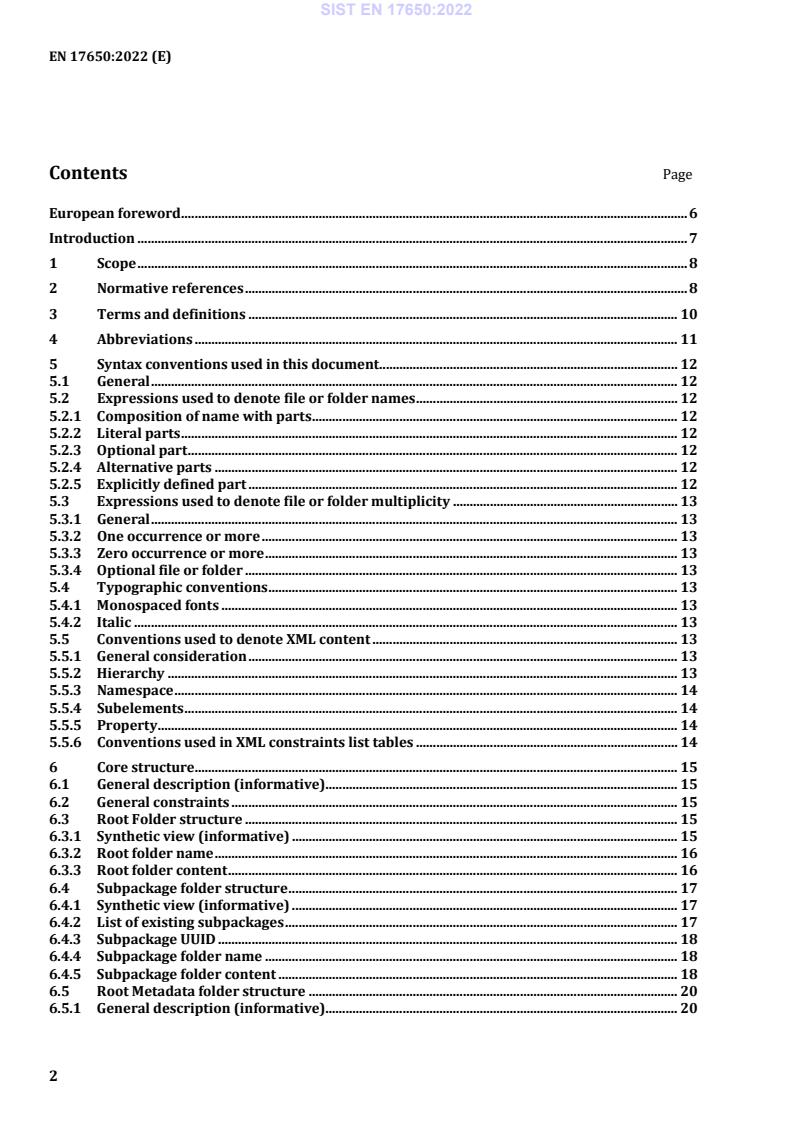
Contents Page
European foreword . 6
Introduction . 7
1 Scope . 8
2 Normative references . 8
3 Terms and definitions . 10
4 Abbreviations . 11
5 Syntax conventions used in this document . 12
5.1 General . 12
5.2 Expressions used to denote file or folder names . 12
5.2.1 Composition of name with parts . 12
5.2.2 Literal parts . 12
5.2.3 Optional part . 12
5.2.4 Alternative parts . 12
5.2.5 Explicitly defined part . 12
5.3 Expressions used to denote file or folder multiplicity . 13
5.3.1 General . 13
5.3.2 One occurrence or more . 13
5.3.3 Zero occurrence or more . 13
5.3.4 Optional file or folder . 13
5.4 Typographic conventions . 13
5.4.1 Monospaced fonts . 13
5.4.2 Italic . 13
5.5 Conventions used to denote XML content . 13
5.5.1 General consideration . 13
5.5.2 Hierarchy . 13
5.5.3 Namespace . 14
5.5.4 Subelements . 14
5.5.5 Property . 14
5.5.6 Conventions used in XML constraints list tables . 14
6 Core structure. 15
6.1 General description (informative). 15
6.2 General constraints . 15
6.3 Root Folder structure . 15
6.3.1 Synthetic view (informative) . 15
6.3.2 Root folder name . 16
6.3.3 Root folder content . 16
6.4 Subpackage folder structure . 17
6.4.1 Synthetic view (informative) . 17
6.4.2 List of existing subpackages . 17
6.4.3 Subpackage UUID . 18
6.4.4 Subpackage folder name . 18
6.4.5 Subpackage folder content . 18
6.5 Root Metadata folder structure . 20
6.5.1 General description (informative). 20
6.5.2 Synthetic view (informative) . 20
6.5.3 Root Metadata folder content . 20
6.5.4 Descriptive metadata files . 20
6.5.5 Provenance metadata files . 20
6.6 Root Ancillary Data folder structure . 21
6.6.1 General description (informative) . 21
6.6.2 Synthetic view (informative) . 21
6.6.3 Root Ancillary Data folder content . 21
6.6.4 Root Ancillary Data filename. 21
6.7 Playlists folder structure . 21
6.7.1 General description (informative) . 21
6.7.2 Synthetic view (informative) . 21
6.7.3 Playlists folder content . 22
6.7.4 Playlist UUID . 22
6.7.5 Playlist filename. 22
6.8 Root Checker Report folder structure . 22
6.8.1 General description (informative) . 22
6.8.2 Synthetic view . 22
6.8.3 Root Checker Reports folder content . 22
6.8.4 Content of the Report subfolder . 23
6.8.5 Reports filename . 23
6.9 Preservation Package UUID . 23
6.9.1 UUID generation . 23
6.9.2 UUID presentation . 23
6.9.3 UUID uniqueness . 23
7 Profiles . 23
7.1 General description (informative) . 23
7.2 Profile attribution . 23
8 Content of Packing List files . 24
8.1 Synthetic view (informative) . 24
8.2 Packing List . 25
8.2.1 General description (informative) . 25
8.2.2 File conformance . 25
8.2.3 Common constraints on Packing List . 25
8.3 Preservation Packing List . 27
8.3.1 General description (informative) . 27
8.3.2 Files to be referenced . 27
8.3.3 Preservation Package Unique Identifier uniqueness . 28
8.3.4 Specific constraints on the Preservation Packing List . 28
8.4 Subpackage Packing List . 35
8.4.1 General description (informative) . 35
8.4.2 Files to be referenced . 35
8.4.3 Subpackage Unique Identifier uniqueness . 35
8.4.4 Constraints on the Subpackage Packing List . 35
9 Specification of the subpackages . 40
9.1 Image Package . 40
9.1.1 General description . 40
9.1.2 General provisions . 40
9.1.3 Data folder content . 40
9.1.4 Sequence homogeneity . 40
9.1.5 Sequence continuity . 40
9.1.6 Image filenames . 40
9.1.7 Image numbering . 40
9.1.8 Image Package standard conformance . 40
9.1.9 Technical Metadata . 41
9.2 Sound Package. 42
9.2.1 General description . 42
9.2.2 General provisions . 42
9.2.3 Data folder content . 42
9.2.4 Soundfield consistency . 42
9.2.5 Homogeneity . 42
9.2.6 Time representation consistency . 42
9.2.7 Sound file names . 42
9.2.8 Sound Package Standard conformance . 42
9.2.9 Technical Metadata . 43
9.3 Timed Text Package . 43
9.3.1 General description . 43
9.3.2 General provisions . 43
9.3.3 Data folder content . 43
9.3.4 Timed text filename . 43
9.3.5 Technical Metadata . 44
9.3.6 Constraints . 44
9.3.7 Timed Text Package Standard conformance . 44
9.4 Audiovisual Package . 44
9.4.1 General description . 44
9.4.2 General provisions . 44
9.4.3 Data folder content . 44
9.4.4 Audiovisual filename . 44
9.4.5 Audiovisual Packages standard conformance . 45
9.4.6 Technical Metadata . 46
9.5 Componentized Package. 46
9.5.1 General description (informative). 46
9.5.2 General provisions . 46
9.5.3 Data folder content . 46
9.5.4 Componentized Packages standard conformance . 47
9.5.5 Technical Metadata . 47
9.6 Extra Package . 47
9.6.1 General description . 47
9.6.2 General provisions . 47
9.6.3 Data folder content . 48
9.6.4 Extra Package filename . 48
9.6.5 Technical Metadata . 48
10 Ancillary Data . 48
10.1 General description (informative). 48
10.2 Root Ancillary Data . 48
10.2.1 General description (informative). 48
10.2.2 File conformance . 48
10.2.3 Constraints on text files . 49
10.3 Subpackage Ancillary Data . 49
10.3.1 General description (informative). 49
10.3.2 File conformance . 49
11 Metadata . 49
11.1 General metadata files description . 49
11.1.1 General description (informative) . 49
11.1.2 Languages . 49
11.1.3 Character encoding . 49
11.2 Root Metadata . 49
11.2.1 Descriptive metadata . 49
11.2.2 Provenance metadata . 55
11.3 Subpackage metadata . 55
11.3.1 Technical metadata . 55
11.3.2 Provenance metadata . 78
12 Specification of the playlist . 78
12.1 File content . 78
12.2 File conformance . 78
12.3 Constraints on the Playlist XML file . 79
12.3.1 EssenceDescriptor elements . 79
12.3.2 Resource elements . 79
12.3.3 Sequence elements . 79
12.4 File revision . 79
13 Checker reports . 79
13.1 General description (informative) . 79
13.2 Constraints on the XML Checker Reports List files . 79
13.2.1 General description (informative) . 79
13.2.2 General constraints . 79
13.2.3 Constraints on the checkerDescription element . 80
13.2.4 Constraints on the checkerProcessDescription element . 80
13.2.5 Constraints on the checkerFileDescription element . 80
Annex A (normative) XML Schema for the Packing List . 82
Annex B (normative) XML Schema for the Playlist . 83
Annex C (normative) XML Schema for the Checker Reports List . 84
Annex D (normative) Tables from ISO/IEC 21122-3:2022 . 86
D.1 Interlaced modes . 86
D.2 Sampling structure . 86
Annex E (informative) Synthetic package view . 87
Bibliography . 88
European foreword
This document (EN 17650:2022) has been prepared by Technical Committee CEN/TC 457 “Digital
preservation of cinematographic works”, the secretariat of which is held by DIN.
This European Standard shall be given the status of a national standard, either by publication of an
identical text or by endorsement, at the latest by February 2023, and conflicting national standards
shall be withdrawn at the latest by February 2023.
Attention is drawn to the possibility that some of the elements of this document may be the subject of
patent rights. CEN shall not be held responsible for identifying any or all such patent rights.
This document is complemented by CEN/TR 17862:2022.
Any feedback and questions on this document should be directed to the users’ national standards body.
A complete listing of these bodies can be found on the CEN website.
According to the CEN-CENELEC Internal Regulations, the national standards organisations of the
following countries are bound to implement this European Standard: Austria, Belgium, Bulgaria,
Croatia, Cyprus, Czech Republic, Denmark, Estonia, Finland, France, Germany, Greece, Hungary, Iceland,
Ireland, Italy, Latvia, Lithuania, Luxembourg, Malta, Netherlands, Norway, Poland, Portugal, Republic of
North Macedonia, Romania, Serbia, Slovakia, Slovenia, Spain, Sweden, Switzerland, Türkiye and the
United Kingdom.
Introduction
This document is part of a series of standards and technical recommendations for the digital
preservation of cinematographic works. It gives European film archives and producers a guideline for
storing and managing films in the digital age. The document references many existing formats and
elements and serves as a super-format which includes other existing sub-formats like DCPs or IMPs for
movies, XML-files for packing-lists or subtitles, AV files and metadata files. In addition, methods are
defined to ensure data integrity and quality by calculating hash and fingerprinting-values.
This document reuses describing tools and archiving formats from the cinema archiving community as
much as possible.
1 Scope
This document specifies the Cinema Preservation Package (CPP) to facilitate the digital preservation of
cinematographic works. It specifies methods to describe the relationship of components of a
cinematographic work and delivers a syntax to describe the package content. The document itself
specifies the structure of the package and the constraints that are necessary to enable compliance and
interoperability.
Versions of the content using different encoding formats can be preserved in a layered structure where
the lowest level is describing the physical file. The files can carry data representing moving images,
sound, metadata or ancillary information like quality control (QC) reports or film posters.
The Cinema Preservation Package also contains hash values on different levels to ensure data integrity
and version control. The syntax for this description and the methods for the hash value generation are
specified in this document. Various types of packages are described as reference for practical
implementations.
The Cinema Preservation Package is designed to serve as a Submission Information Package (SIP) in an
OAIS compliant preservation system, and it may be used as a self-contained exchange format between
media archives (as Distribution Information Package DIP). Based on the requirements of an archive, it
can also be used as complete Archival Information Package (AIP) if the constraints set out in this
document for such use are adhered to.
A CPP does not necessarily contain a complete cinematographic work, it can also be used for the
exchange of parts of a work.
2 Normative references
The following documents are referred to in the text in such a way that some or all of their content
constitutes requirements of this document. For dated references, only the edition cited applies. For
undated references, the latest edition of the referenced document (including any amendments) applies.
EN 15744, Film identification — Minimum set of metadata for cinematographic works
EBU Tech 3264-E, Specification of the EBU Subtitling data exchange format
EBU Tech 3285, Specification of the Broadcast Wave Format (BWF), Geneva, May 2011
EBU Tech 3293 , EBU Core Metadata Set (EBUCore), Specification v. 1.10, Geneva, April 2020
EBU Tech 3350, EBU-TT, part 1 subtitling format definition, Geneva, May 2017
ETSI TS 102 366, Digital Audio Compression (AC-3, Enhanced AC-3) Standard, September 2017
IEEE/Open Group 1003.1-2017, IEEE Standard for Information Technology — Portable Operating System
Interface (POSIX(TM)) Base Specifications, Issue 7
IETF RFC 9043, FFV1 Video Coding Format Versions 0, 1, and 3
ISO 639-3:2007, Codes for the representation of names of languages — Part 3: Alpha-3 code for
comprehensive coverage of languages
ISO 8601-1, Date and time — Representations for information interchange — Part 1: Basic rules
Referred to as EBUCore throughout the text.
ISO 8601-2, Date and time — Representations for information interchange — Part 2: Extensions
ISO 12234-2, Electronic still-picture imaging — Removable memory — Part 2: TIFF/EP image data
format
ISO 19005-1, Document management — Electronic document file format for long-term preservation —
Part 1: Use of PDF 1.4 (PDF/A-1)
ISO 19005-2, Document management — Electronic document file format for long-term preservation —
Part 2: Use of ISO 32000-1 (PDF/A-2)
ISO 19005-4, Document management — Electronic document file format for long-term preservation —
Part 4: Use of ISO 32000-2 (PDF/A-4)
ISO 26429 (all parts), Digital cinema (D-cinema) packaging
ISO/IEC 9834-8, Information technology — Procedures for the operation of object identifier registration
authorities — Part 8: Generation of universally unique identifiers (UUIDs) and their use in object
identifiers
ISO/IEC 10646, Information technology — Universal Coded Character Set (UCS)
ISO/IEC 10918 (series), Information technology — Digital compression and coding of continuous-tone
still images
ISO/IEC 13818-2, Information technology — Generic coding of moving pictures and associated audio
information — Part 2: Video
ISO/IEC 13818-3, Information technology — Generic coding of moving pictures and associated audio
information — Part 3: Audio
ISO/IEC 14496-3, Information technology — Coding of audio-visual objects — Part 3: Audio
ISO/IEC 14496-10, Information technology — Coding of audio-visual objects — Part 10: Advanced Video
Coding
ISO/IEC 14496-12, Information technology — Coding of audio-visual objects — Part 12: ISO base media
file format
ISO/IEC 14496-14, Information technology — Coding of audio-visual objects — Part 14: MP4 file format
ISO/IEC 15444-1, Information technology — JPEG 2000 image coding system — Part 1: Core coding
system
ISO/IEC 15948, Information technology — Computer graphics and image processing — Portable Network
Graphics (PNG): Functional specification
ISO/IEC 23091-3:2018, Information technology — Coding-independent code points — Part 3: Audio
ITU-T H.273:2021, Coding-independent code points for video signal type identification
ITU-R BS.1352-3, File format for the exchange of audio programme materials with metadata on
information technology media
SMPTE ST 12-1, SMPTE Standard — For Television — Time and Control Code
SMPTE ST 268, SMPTE Standard — File Format for Digital Moving-Picture Exchange (DPX)
SMPTE ST 428-7, SMPTE Standard — Digital Cinema Distribution Master — Subtitle
SMPTE ST 429 (all parts), SMPTE Standard - D-Cinema Packaging
SMPTE ST 2019-1, SMPTE Standard — VC-3 Picture Compression and Data Stream Format
SMPTE ST 2065-4, SMPTE Standard — ACES Image Container File Layout
SMPTE ST 2067-3:2020, SMPTE Standard — Interoperable Master Format — Composition Playlist
SMPTE ST 2067-21, SMPTE Standard — Interoperable Master Format — Application #2E
SMPTE ST 2067-40, SMPTE Standard — Interoperable Master Format — Application #4 Cinema
Mezzanine
SMPTE ST 2067-50, SMPTE Standard — Interoperable Master Format — Application #5 ACES
W3C - TTML Profiles for Internet Media Subtitles and Captions 1.1
Matroska MKV format specification. Available from: https://www.matroska.org
METS Metadata Encoding & Transmission Standard. Version 1.12.1. [online]. Library of Congress, 2019.
Available from: https://www.loc.gov/standards/mets/
PREMIS Data Dictionary for Preservation Metadata. Version 3.0. [online]. Library of Congress, 2015.
Available from: https://www.loc.gov/standards/premis/
SCHEMA P.R.E.M.I.S. 3.0 [online]. Library of Congress, 2015. Available from:
https://www.loc.gov/standards/premis/v3/premis-v3-0.xsd
Xiph FLAC format specification. Available from: https://xiph.org/flac/format.html
3 Terms and definitions
For the purposes of this document, the following terms and definitions apply.
ISO and IEC maintain terminological databases for use in standardization at the following addresses:
— ISO Online browsing platform: available at https://www.iso.org/obp
— IEC Electropedia: available at https://www.electropedia.org/
3.1
audio channel
sequence of data representing a single audio signal
3.2
audio track
part of a sound file containing one or more audio channels or multiple single audio channels files
forming one sound sequence
3.3
cinema preservation package
package containing digital data of a cinematographic work
3.4
container
file containing one or more data objects wrapped in a specific way
3.5
package
set of files or folders belonging together
3.6
provenance
metadata related to the origin, modification and the ownership history of a work
3.7
soundfield
three-dimensional pressure distribution produced by transmitted sound energy
NOTE A soundfield can be represented as a discrete set of signals, monophonic or multichannel, or other
representation.
3.8
sound sequence
continuous group of sound samples related to a specific period of time
3.9
submission information package
package sent from the data producer to the archive
NOTE The submission information package is specified in the ISO 14721:2012 OAIS Model.
3.10
subpackage
set of data in a Cinema Preservation Package containing part of a cinematographic work with data and
supplemental data separately stored in a folder
3.11
subpicture
picture to be overlayed on the main picture
4 Abbreviations
ACES Academy Color Encoding System
ASCII American Standard Code for Information Interchange
BMFF Base Media File format
CPP Cinema Preservation Package
DCP Digital Cinema Package
DPX Digital Picture Exchange
FLAC Free Lossless Audio Codec
IMF Interoperable Master Format
JPEG Joint Photographic Experts Group
LoC Library of Congress, see https://www.loc.gov/
MPEG Moving Pictures Experts Group
OAIS Open Archive Information System
PCM Pulse code modulation
PDF Portable Document Format
PNG Portable Network Graphics
SIP Submission Information Package
TIFF Tagged Image File Format
UUID Universal Unique Identifier
XML Extensible Markup Language
5 Syntax conventions used in this document
5.1 General
For the file and folder name descriptions the following conventions are used.
5.2 Expressions used to denote file or folder names
5.2.1 Composition of name with parts
A name may be composed of one or several parts.
5.2.2 Literal parts
A literal part appearing between quotes shall appear as is.
EXAMPLE “LiteralPart” designates a part which is exactly “LiteralPart”.
5.2.3 Optional part
A part appearing between brackets shall appear zero or one time.
EXAMPLE [“OptionalPart”]“Radical” designates a name which is either “OptionalPartRadical” or “Radical”.
5.2.4 Alternative parts
Exactly one of the items in parentheses, separated by a vertical line ‘|’, shall appear in the result.
EXAMPLE (“Prefix1”|“Prefix2”|“Prefix3”)“Radical” designates a name which is either “Prefix1Radical”,
“Prefix2Radical” or “Prefix3Radical”.
5.2.5 Explicitly defined part
is a placeholder text and shall be replaced as specified by the prose.
EXAMPLE “Name_” designates a name which could be “Name_0123456789”, supposing
“0123456789” is defined as a valid custom identifier.
5.3 Expressions used
...