

EN 17282:2020
(Main)Railway applications - Infrastructure - Under ballast mats
- Abstract
This document is applicable to under ballast mats used in ballasted track and defines the test procedures and their evaluation criteria.
This document provides particular information in the following areas:
- test methods, test arrangements and evaluation criteria of under ballast mats;
- data supplied by the purchaser and by the supplier;
- definition of general process of design approval tests;
- definition of routine tests.
This document defines the specific test procedures for under ballast mats:
- stiffness tests;
- fatigue tests;
- tests for severe environmental conditions.
This document also sets out procedures for testing fitness for purpose and provides information on quality monitoring as part of quality assurance procedures. This document does not, however, contain requirements pertaining to the functions of under ballast mats. It is the responsibility of the purchaser to define these requirements and to choose the optional tests.
- Status
- Published
- Publication Date
- 06-Oct-2020
- Withdrawal Date
- 29-Apr-2021
- Technical Committee
- CEN/TC 256 - Railway applications
- Drafting Committee
- CEN/TC 256/SC 1/WG 16 - Sleepers and bearers
- Current Stage
- 9060 - Closure of 2 Year Review Enquiry - Review Enquiry
- Start Date
- 04-Jun-2026
- Completion Date
- 04-Jun-2026

Overview
EN 17282:2020 - published by CEN - is the European standard that defines test procedures and evaluation criteria for under ballast mats (UBM) used in ballasted railway track. It covers performance-related test methods (stiffness, fatigue and severe-environment testing), data exchange between purchaser and supplier, design approval and routine testing, and quality monitoring and labelling. The standard applies to UBMs placed between the substructure and ballast layer and is intended to support consistent verification of product performance for railway infrastructure projects.
Key topics and requirements
- Scope and responsibility
- Applies to UBMs in ballasted track; the purchaser must define functional requirements and select optional tests - the standard does not prescribe functional performance limits.
- Test procedures
- Stiffness tests: static bedding modulus, low-frequency dynamic bedding modulus and higher-frequency stiffness measurements used as inputs for track deformation and vibration calculations.
- Fatigue tests: laboratory procedures (ballast-box and GBP-based methods) to assess long-term mechanical performance under cyclic loading.
- Severe environmental tests: water resistance, freeze–thaw, and high-temperature ageing procedures to verify durability.
- Test arrangements and evaluation
- Use of a Geometric Ballast Plate (GBP) for repeatable contact conditions (see Annex A).
- Defined test reports and acceptance criteria for design approval and routine production checks.
- Data and quality
- Data to be supplied by purchaser and supplier (product details, intended use, test parameters).
- Rules for storage, installation and ensuring UBM functionality.
- Guidance on quality control, marking, labelling and packaging.
Practical applications
- Used by railway infrastructure engineers and track designers to:
- Specify UBMs for vibration mitigation and improved load distribution in ballasted track.
- Verify UBM mechanical and environmental performance before installation (design approval testing).
- Establish factory routine tests and quality assurance for mass production.
- Informs vibration and track-structure interaction modelling by providing standardised stiffness and dynamic parameters (bedding modulus values).
Who should use this standard
- Railway infrastructure owners and operators (purchasers)
- UBM manufacturers and suppliers (for design approval and routine testing)
- Independent testing laboratories and certification bodies
- Track designers, vibration consultants and procurement/specification engineers
Related standards
Normative references included in EN 17282:2020 (examples):
- EN 13450 (Aggregates for railway ballast)
- EN 13674-1 (Rail specifications)
- EN ISO 1856 (compression set)
- EN ISO 7500-1 / EN ISO 9513 (testing machine and extensometer calibration)
Keywords: EN 17282:2020, under ballast mats, UBM, railway infrastructure, stiffness tests, fatigue tests, bedding modulus, design approval, routine tests, CEN.
Get Certified
Connect with accredited certification bodies for this standard

Zavod za gradbeništvo Slovenije (ZAG) - Inšpekcija
ZAG inspection body for construction products, structures, and materials.
Sponsored listings
Frequently Asked Questions
EN 17282:2020 is a standard published by the European Committee for Standardization (CEN). Its full title is "Railway applications - Infrastructure - Under ballast mats". This standard covers: This document is applicable to under ballast mats used in ballasted track and defines the test procedures and their evaluation criteria. This document provides particular information in the following areas: - test methods, test arrangements and evaluation criteria of under ballast mats; - data supplied by the purchaser and by the supplier; - definition of general process of design approval tests; - definition of routine tests. This document defines the specific test procedures for under ballast mats: - stiffness tests; - fatigue tests; - tests for severe environmental conditions. This document also sets out procedures for testing fitness for purpose and provides information on quality monitoring as part of quality assurance procedures. This document does not, however, contain requirements pertaining to the functions of under ballast mats. It is the responsibility of the purchaser to define these requirements and to choose the optional tests.
This document is applicable to under ballast mats used in ballasted track and defines the test procedures and their evaluation criteria. This document provides particular information in the following areas: - test methods, test arrangements and evaluation criteria of under ballast mats; - data supplied by the purchaser and by the supplier; - definition of general process of design approval tests; - definition of routine tests. This document defines the specific test procedures for under ballast mats: - stiffness tests; - fatigue tests; - tests for severe environmental conditions. This document also sets out procedures for testing fitness for purpose and provides information on quality monitoring as part of quality assurance procedures. This document does not, however, contain requirements pertaining to the functions of under ballast mats. It is the responsibility of the purchaser to define these requirements and to choose the optional tests.
EN 17282:2020 is classified under the following ICS (International Classification for Standards) categories: 93.100 - Construction of railways. The ICS classification helps identify the subject area and facilitates finding related standards.
EN 17282:2020 is associated with the following European legislation: EU Directives/Regulations: 2008/57/EC; Standardization Mandates: M/483. When a standard is cited in the Official Journal of the European Union, products manufactured in conformity with it benefit from a presumption of conformity with the essential requirements of the corresponding EU directive or regulation.
EN 17282:2020 is available in PDF format for immediate download after purchase. The document can be added to your cart and obtained through the secure checkout process. Digital delivery ensures instant access to the complete standard document.
Standards Content (Sample)
SLOVENSKI STANDARD
01-december-2020
Železniške naprave - Infrastruktura - Pod balastnimi preprogami
Railway applications - Infrastructure - Under ballast mats
Bahnanwendungen - Infrastruktur - Unterschottermatten
Applications ferroviaires - Infrastructure - Tapis sous ballast
Ta slovenski standard je istoveten z: EN 17282:2020
ICS:
93.100 Gradnja železnic Construction of railways
2003-01.Slovenski inštitut za standardizacijo. Razmnoževanje celote ali delov tega standarda ni dovoljeno.
EN 17282
EUROPEAN STANDARD
NORME EUROPÉENNE
October 2020
EUROPÄISCHE NORM
ICS 93.100
English Version
Railway applications - Infrastructure - Under ballast mats
Applications ferroviaires - Infrastructure - Tapis sous Bahnanwendungen - Infrastruktur -
ballast Unterschottermatten
This European Standard was approved by CEN on 29 June 2020.
CEN members are bound to comply with the CEN/CENELEC Internal Regulations which stipulate the conditions for giving this
European Standard the status of a national standard without any alteration. Up-to-date lists and bibliographical references
concerning such national standards may be obtained on application to the CEN-CENELEC Management Centre or to any CEN
member.
This European Standard exists in three official versions (English, French, German). A version in any other language made by
translation under the responsibility of a CEN member into its own language and notified to the CEN-CENELEC Management
Centre has the same status as the official versions.
CEN members are the national standards bodies of Austria, Belgium, Bulgaria, Croatia, Cyprus, Czech Republic, Denmark, Estonia,
Finland, France, Germany, Greece, Hungary, Iceland, Ireland, Italy, Latvia, Lithuania, Luxembourg, Malta, Netherlands, Norway,
Poland, Portugal, Republic of North Macedonia, Romania, Serbia, Slovakia, Slovenia, Spain, Sweden, Switzerland, Turkey and
United Kingdom.
EUROPEAN COMMITTEE FOR STANDARDIZATION
COMITÉ EUROPÉEN DE NORMALISATION
EUROPÄISCHES KOMITEE FÜR NORMUNG
CEN-CENELEC Management Centre: Rue de la Science 23, B-1040 Brussels
© 2020 CEN All rights of exploitation in any form and by any means reserved Ref. No. EN 17282:2020 E
worldwide for CEN national Members.
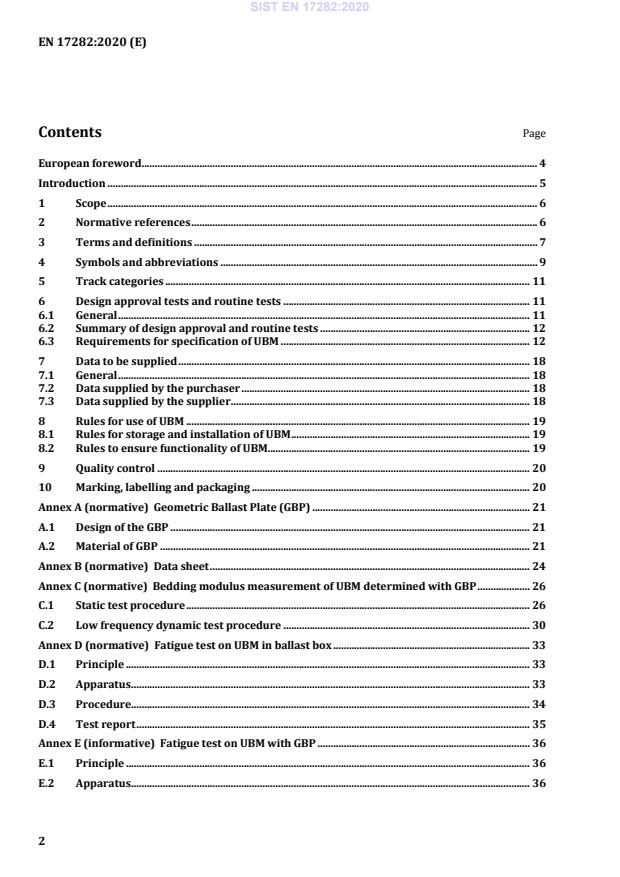
Contents Page
European foreword . 4
Introduction . 5
1 Scope . 6
2 Normative references . 6
3 Terms and definitions . 7
4 Symbols and abbreviations . 9
5 Track categories . 11
6 Design approval tests and routine tests . 11
6.1 General . 11
6.2 Summary of design approval and routine tests . 12
6.3 Requirements for specification of UBM . 12
7 Data to be supplied . 18
7.1 General . 18
7.2 Data supplied by the purchaser . 18
7.3 Data supplied by the supplier . 18
8 Rules for use of UBM . 19
8.1 Rules for storage and installation of UBM . 19
8.2 Rules to ensure functionality of UBM. 19
9 Quality control . 20
10 Marking, labelling and packaging . 20
Annex A (normative) Geometric Ballast Plate (GBP) . 21
A.1 Design of the GBP . 21
A.2 Material of GBP . 21
Annex B (normative) Data sheet . 24
Annex C (normative) Bedding modulus measurement of UBM determined with GBP . 26
C.1 Static test procedure . 26
C.2 Low frequency dynamic test procedure . 30
Annex D (normative) Fatigue test on UBM in ballast box . 33
D.1 Principle . 33
D.2 Apparatus . 33
D.3 Procedure. 34
D.4 Test report . 35
Annex E (informative) Fatigue test on UBM with GBP . 36
E.1 Principle . 36
E.2 Apparatus . 36
E.3 Procedure . 37
E.4 Test report . 38
Annex F (informative) Measurement of higher frequency vertical bedding modulus of UBM . 39
F.1 Principle . 39
F.2 Test parameters . 39
F.3 Procedure . 41
F.4 Test report . 42
Annex G (informative) Static horizontal bedding modulus of UBM . 43
G.1 Principle . 43
G.2 Apparatus . 43
G.3 Procedure . 44
G.4 Test report . 46
Annex H (informative) Water resistance and freeze–thaw resistance of UBM . 47
H.1 Principle . 47
H.2 Apparatus . 47
H.3 Procedure . 48
H.4 Test report . 50
Annex I (informative) Ageing test with high temperatures of UBM . 51
I.1 Principle . 51
I.2 Apparatus . 51
I.3 Procedure . 51
I.4 Test report . 52
Bibliography . 53
European foreword
This document (EN 17282:2020) has been prepared by Technical Committee CEN/TC 256 “Railway
applications”, the secretariat of which is held by DIN.
This European Standard shall be given the status of a national standard, either by publication of an
identical text or by endorsement, at the latest by April 2021, and conflicting national standards shall be
withdrawn at the latest by April 2021.
Attention is drawn to the possibility that some of the elements of this document may be the subject of
patent rights. CEN shall not be held responsible for identifying any or all such patent rights.
According to the CEN-CENELEC Internal Regulations, the national standards organisations of the
following countries are bound to implement this European Standard: Austria, Belgium, Bulgaria,
Croatia, Cyprus, Czech Republic, Denmark, Estonia, Finland, France, Germany, Greece, Hungary, Iceland,
Ireland, Italy, Latvia, Lithuania, Luxembourg, Malta, Netherlands, Norway, Poland, Portugal, Republic of
North Macedonia, Romania, Serbia, Slovakia, Slovenia, Spain, Sweden, Switzerland, Turkey and the
United Kingdom.
Introduction
In a track for railway vehicles, the under ballast mat (UBM) is a structural element which is placed
between the substructure and the ballast layer. This document applies to the performance-related
properties of this mat.
1 Scope
This document is applicable to under ballast mats used in ballasted track and defines the test
procedures and their evaluation criteria.
This document provides particular information in the following areas:
— test methods, test arrangements and evaluation criteria of under ballast mats;
— data supplied by the purchaser and by the supplier;
— definition of general process of design approval tests;
— definition of routine tests.
This document defines the specific test procedures for under ballast mats:
— stiffness tests;
— fatigue tests;
— tests for severe environmental conditions.
This document also sets out procedures for testing fitness for purpose and provides information on
quality monitoring as part of quality assurance procedures. This document does not, however, contain
requirements pertaining to the functions of under ballast mats. It is the responsibility of the purchaser
to define these requirements and to choose the optional tests.
2 Normative references
The following documents are referred to in the text in such a way that some or all of their content
constitutes requirements of this document. For dated references, only the edition cited applies. For
undated references, the latest edition of the referenced document (including any amendments) applies.
EN 10027 (all parts), Designation systems for steels
EN 13450, Aggregates for railway ballast
EN 13674-1, Railway applications - Track - Rail - Part 1: Vignole railway rails 46 kg/m and above
EN ISO 1856, Flexible cellular polymeric materials - Determination of compression set (ISO 1856)
EN ISO 7500-1, Metallic materials - Calibration and verification of static uniaxial testing machines - Part
1: Tension/compression testing machines - Calibration and verification of the force-measuring system (ISO
7500-1)
EN ISO 9513:2012, Metallic materials - Calibration of extensometer systems used in uniaxial testing
(ISO 9513:2012)
EN 22768 (all parts), General tolerances (ISO 2768, all parts)
3 Terms and definitions
For the purposes of this document, the following terms and definitions apply.
ISO and IEC maintain terminological databases for use in standardization at the following addresses:
• ISO Online browsing platform: available at https://www.iso.org/obp
• IEC Electropedia: available at http://www.electropedia.org/
3.1
ballasted track
track in which the sleepers or bearers are supported by ballast
3.2
under ballast mat (UBM)
product of elastic material installed in track between substructure and ballast layer including all
integral parts of the product
Note 1 to entry: The main objectives of the application of under ballast mats are to reduce stiffness in the track
in order to improve the load distribution and/or to reduce vibrations transmitted to the surroundings and, by
doing so, provide vibration mitigation.
3.3
stiffness
force per unit deflection, measured under a uniaxial load
3.4
bedding modulus
pressure (force per surface) per unit deflection, measured under a uniaxial load
3.5
static stiffness or bedding modulus
force or pressure per unit deflection measured under a uniaxial static load
3.6
low frequency dynamic stiffness or bedding modulus
force or pressure per unit deflection measured under a uniaxial load which acts periodically at a
frequency of (5 to 20) Hz between specific force or pressure levels
Note 1 to entry: This value is determined mainly for calculation of dynamic deformation of tracks.
3.7
higher frequency dynamic stiffness or bedding modulus
force or pressure per unit deflection measured under a uniaxial load or displacement, which acts
periodically at a defined test frequency of (10 to 160) Hz at a specific pressure level
Note 1 to entry: This value will be determined as an input characteristic for vibration calculations. In contrast to
the determination of low frequency dynamic stiffness or bedding modulus, this test will be determined under
static preloading.
3.8
noise mitigation
reduction of secondary air-borne noise radiated by a construction (e.g. bridge)
Note 1 to entry: UBMs do not provide mitigation of airborne noise from the wheel and rail system.
3.9
vibration mitigation
reduction of emission of mechanical vibration and/or structure-borne noise into the surroundings
3.10
geometric ballast plate (GBP)
rigid steel plate with a geometrically structured surface simulating ballast contact
Note 1 to entry: See Annex A.
3.11
design approval test
test performed to demonstrate the compliance of the product properties to the requirements, set by the
purchaser
3.12
routine test
test performed to demonstrate the compliance of the product properties to the quality plan, set by the
supplier
3.13
purchaser
operator or user of the equipment, or the customer of the material on the user’s behalf
3.14
supplier
company / body responsible for the execution of purchaser’s requirements
Note 1 to entry: This can be the manufacturer or his designated representative, stockist, distributer, or agent.
The supplier is responsible for the use of the EN in response to the purchaser’s requirements and will ensure all
local conditions of purchase requirements are satisfied.
3.15
manufacturer
organization responsible for blending and processing material constituents, integrating them in the
manufacturing process and subsequently cutting, stamping or moulding to final dimensions
4 Symbols and abbreviations
Table 1 — Symbols
Symbols Characterization Units
A area mm
a acceleration in measurement of higher frequency stiffness m/s
C bedding modulus N/mm
d displacement mm
Δ variation -
F force kN
f frequency in measurement Hz
k stiffness N/mm
dB re
L point stiffness level for higher frequency stiffness
1 N/m
m mass kg
η loss factor -
N number of cycles -
p pressure N/mm
stiffening ratio between dynamic bedding modulus and static bedding
κ -
modulus
σ stress (compressive or tensile) N/mm
−1
ω angular frequency = 2π · f (for higher frequency stiffness) s
Table 2 — Indices of the symbols
Indices Characterization
0 for frequency, definition of natural frequency
i Hz value of frequency in measurement
af after
av average
be before
dyn low frequency dynamic
H higher frequency
h horizontal
max maximum
min minimum
'number' or i sequential number in order to differentiate types of measurements
pre preload
stat static
tend tendency
test test load
v vertical
5 Track categories
For track categories, see Table 3.
Table 3 — Definition of track categories (TC) for tracks using under ballast mats according to
their typical specifications and application
Distance of
sleeper
Rail profile
Axle load Speed supports
as defined in Typical application
[kN] [km/h] or rail
EN 13674-1
fastenings
[mm]
≥ 100 650 Urban rail or industrial
TC1 ≤ 100 49E1
and ≤ 130 (maximum 750) tracks
Urban rail or industrial
TC2 ≤ 160 ≤ 140 54E1 650
tracks
≤ 225 ≤ 200 60E1 600 Conventional main lines
High-speed lines and tracks
TC3 ≤ 200 ≤ 320 60E1 600
with large radius
≤ 250 ≤ 120 60E1 600 Freight lines
Freight with heavy axle loads
TC4 ≤ 300 ≤ 120 60E1 600
including Mixed traffic (TC3)
6 Design approval tests and routine tests
6.1 General
This clause defines the objectives of tests and of demanded information about the UBM.
The purchaser may define the test laboratory or validate the one proposed by the supplier.
The purchaser decides the way to choose the test sample units.
In order to be able to identify the UBM at a later date, the following values shall be indicated:
— the mass per area (kg/m ) of the product and all its components, see 6.3.1;
— the results of a suitable material analysis as selected by the manufacturer and approved by the
purchaser.
The supplier shall provide sufficient data to satisfy the objectives of the tests and/or the provision of
requested information in respect of the UBM including:
— the data sheet as described in Annex B;
— any transportation, storage and installation recommendations and procedures to preserve the
material characteristics and original performance.
Compliance with a given TC implies compliance with all lower TC except for results of the bedding
modulus measurements.
6.2 Summary of design approval tests and routine tests
The design approval tests and the routine tests are stated in Table 4.
The values determined in product qualification testing shall act as the reference values for quality
assurance and quality monitoring procedures.
The frequency of routine tests is defined according to the quality plan of the supplier (see Clause 9).
Table 4 — Tests for UBM
Tests Clause Design approval tests Routine tests
Dimensions and mass 6.3.1 Mandatory Mandatory
Static and low frequency dynamic 6.3.2 Mandatory for static, 5 and 10 Hz, Mandatory for static
vertical bedding modulus optional for 20 Hz and 5 Hz at
determined with GBP (23 ± 5)°C
Higher frequency dynamic vertical 6.3.3 Optional (but recommended if Not Applicable
bedding modulus UBM is used for noise and
vibration mitigation)
Fatigue test with ballast 6.3.4 Mandatory Not Applicable
Fatigue test with GBP 6.3.5 Optional (but recommended if Not Applicable
UBM is used for noise and
vibration mitigation)
Compression set test 6.3.6 Optional Not Applicable
Static horizontal bedding modulus 6.3.7 Optional Not Applicable
Water resistance and freeze–thaw 6.3.8 Optional Not Applicable
resistance
Ageing test with high 6.3.9 Optional Not Applicable
temperatures
Resistance to chemical agents 6.3.10 Optional Not Applicable
Resistance to hydrocarbon 6.3.10 Optional Not Applicable
Resistance to ozone 6.3.10 Optional Not Applicable
Resistance to fire 6.3.10 Optional Not Applicable
Environment and end of life 6.3.11 Optional Not Applicable
6.3 Requirements for specification of UBM
6.3.1 Dimensions and mass
The supplier shall indicate the range of available dimensions with tolerances of the UBM and type of
joint (joint closing method as per supplier recommendation).
The thickness and mass per area (kg/m ) of UBM shall be indicated in order to enable identification.
Test arrangement:
Thickness and mass are measured with suitable instruments.
Design approval:
All the UBM samples for design approval shall be checked according to technical documentations on
thickness and mass.
The purchaser shall approve the technical documentation on thickness and mass given by supplier.
The values determined in design approval tests shall be the reference values for routine tests.
6.3.2 Static and low frequency dynamic vertical bedding modulus determined with GBP
The static and the low frequency dynamic vertical bedding modulus determined with the GBP are
considered as key performance properties of the UBM.
Test arrangement:
The static and low frequency dynamic vertical bedding modulus of UBM with GBP shall be measured in
accordance with Annex C.
The low frequency dynamic bedding modulus is measured at (5 ± 1) Hz and (10 ± 1) Hz (and optional
frequency tests at (20 ± 2) Hz).
Design approval:
The test method shall be applied on three UBM samples. For profiled UBM with geometric elements (e.g.
dimples, cones, grooves, tubes) reasonable deviations from the standard sample size
(300 mm × 300 mm) are permitted, but shall be duly justified by the supplier and accepted by the
purchaser.
The alternative sample size shall not exceed the size of the testing area (300 mm × 300 mm) of the GBP,
in order to enable execution of all relevant GBP tests.
If the difference between the static bedding modulus with alternative size and sample of
(300 mm × 300 mm) is ≤ 5 %, the further tests shall be performed with the same amount and size of
samples as non-profiled UBM (300 mm × 300 mm).
The same UBM samples shall be tested for the static and for the low-frequency dynamic bedding
modulus.
If this test is performed at other temperatures than (23 ± 5) °C, then the median value sample (C )
dyn-5Hz
obtained at (23 ± 5) °C shall be selected for performing this test.
The purchaser shall define the following evaluation criteria for the design approval test for a track
category:
— minimum value ≤ C ≤ maximum value;
stat
— minimum value ≤ C or C ≤ maximum value.
dyn 5Hz dyn 10Hz
NOTE 1 Cdyn 20Hz is an informative value.
The supplier shall provide the reference values for the static and the low frequency dynamic bedding
modulus for routine test, based on the values of the design approval tests, in the range of the purchaser
acceptance criteria.
NOTE 2 The relationship between values measured between flat plates (FP) and Geometrical Ballast Plate
(GBP) is not linear and differs for static and dynamic bedding modulus values. Therefore, a direct comparison
between the values measured using the flat plates and geometric ballast plates GBP is not possible.
6.3.3 Higher frequency dynamic vertical bedding modulus
This parameter is used to calculate and characterize the performance of noise and vibration mitigation
of UBM.
Test arrangement:
The higher frequency dynamic vertical bedding modulus of UBM with GBP shall be measured in
accordance with Annex F.
The testing routine and equipment are different from those for the determination of low frequency
dynamic bedding modulus. In contrast to the test of the low frequency dynamic bedding modulus C
dyn,
the test procedure to measure the higher frequency dynamic bedding modulus C is carried out with
H
static preloading and with smaller vibration amplitude. For this reason the values of the two moduli
may not be the same when measured at the same frequency, e.g. at 20 Hz, (see Figure 1).
Key
a curve for higher frequency dynamic bedding modulus (C )
H
b curve for low frequency dynamic bedding modulus (C )
dyn
C bedding modulus (CH, Cstat and Cdyn)
X frequency (Hz)
Y bedding modulus (N/mm )
Figure 1 — Example of a frequency-dependent bedding modulus curve
Design approval:
The test method shall be applied on the same three UBM samples already tested as in 6.3.2.
The purchaser shall define the evaluation criteria for the design approval test for a track category.
6.3.4 Fatigue test in ballast
This test, which is carried out as a pulsed-load fatigue test, serves to verify fatigue strength in contact
with ballast under laboratory conditions by simulating vertical service loading in a ballast trough.
Test arrangement:
The fatigue test of UBM shall be measured in accordance with Annex D.
Design approval:
The test method shall be applied on one UBM sample.
The results of visual inspection shall comply with the purchaser's evaluation criteria for the design
approval test for a track category.
NOTE The variation of the characteristics can be determined with the fatigue test with GBP.
6.3.5 Fatigue test with GBP (long term variation of bedding modulus)
This test is intended to verify the stability of the static and low frequency dynamic bedding modulus.
Test arrangement:
The fatigue performance of UBM shall be measured in accordance with Annex E.
Design approval:
The test method shall be applied on one UBM sample.
The purchaser shall define the following evaluation criteria for the design approval test for a track
category:
— ΔC ≤ maximum value;
dyn,test
— ΔC ≤ maximum value;
stat
— ΔC ≤ maximum value.
dyn 5Hz
6.3.6 Compression set test
This test is intended to verify the behaviour (effect on thickness and on static and low frequency
bedding modulus) of the UBM’s elastic part under long-term compression.
Test arrangement:
The test method refers to EN ISO 1856 with method C with the following parameters:
— dimension of samples: 300 × 300 mm without protection layer (prepared by supplier);
— measurement of the static and low frequency dynamic (5 Hz) bedding modulus according Annex C
with the highest category used for this UBM without protection layer;
— measurement of the thickness;
— duration: 72 hours;
— temperature: 23 °C;
— compression: 25 %.
The thickness and the static and low frequency dynamic (5 Hz) bedding moduli according to Annex C
are measured:
— before the compression set test;
— (30 ± 10) minutes after the compression set test;
— (7 ± 1) days after the compression set test.
Design approval:
The test method shall be applied on one UBM sample without protection layer.
The purchaser shall define the evaluation criteria for the design approval test.
6.3.7 Static horizontal bedding modulus of UBM
The static horizontal bedding modulus of UBM is used to describe the load distribution of the track,
regarding to the track behaviour in the longitudinal direction.
Test arrangement:
The test of UBM shall be performed in accordance with Annex G.
Design approval:
The test method shall be applied on three UBM samples.
The purchaser shall define the following evaluation criterion for the design approval test:
— average of C of the three sample tested ≥ minimum value.
stat,h
6.3.8 Water resistance and freeze–thaw resistance of UBM
This test is used to verify the resistance to water, to freeze and thaw cycles for UBM which are used
outdoors and under sub-zero conditions.
Test arrangement:
Water resistance and freeze-thaw resistance of UBM shall be tested in accordance with Annex H.
Design approval:
The test method shall be applied on one UBM sample.
The purchaser shall define the following evaluation criteria for the design approval test for a track
category:
— on visual inspection;
— ΔC ≤ maximum value;
stat
— ΔCdyn 5 Hz ≤ maximum value.
6.3.9 Ageing test with high temperatures
This test simulates ageing to analyse a possible change of mechanical properties.
Test arrangement:
The ageing test of UBM shall be performed in accordance with Annex I.
Design approval:
The test method shall be applied on one UBM sample.
The purchaser shall define the following evaluation criteria for the design approval test:
— on visual inspection;
— ΔC ≤ maximum value;
stat
— ΔC ≤ maximum value;
dyn 5 Hz
— Δm ≤ maximum value.
6.3.10 Resistance to other environmental parameters
The UBM shall not be affected in its performance by hydrocarbons, ozone and chemical agents defined
by the purchaser.
The UBM should not contribute to the propagation of fire or the creation of toxic fumes. Requirements
can differ between tunnel, station and open track.
Test arrangements:
The supplier shall define test methods, which shall be approved by the purchaser.
Design approval:
The purchaser shall define the evaluation criteria and the number of UBM samples for:
a) resistance to chemical agents;
b) resistance to hydrocarbons;
c) resistance to ozone;
d) resistance to fire.
6.3.11 Environment and end of life
If there are national regulations concerning environment and end-of-life, the UBM should follow these
regulations.
The UBM should not be an element of the track which pollutes the environment.
7 Data to be supplied
7.1 General
The purchaser can require data according to 7.3.1 from the supplier before the design approval tests.
7.2 Data supplied by the purchaser
The purchaser shall specify the following items, and provide adequate data to the supplier prior to
design approval tests:
a) track category;
b) drawings and specifications necessary to define the critical dimensions of the UBM including
tolerance (length – width – etc.) (see 6.3.1);
c) requirement for static and low frequency dynamic vertical bedding modulus with GBP (see 6.3.2);
d) requirement for fatigue test in ballast (see 6.3.4).
The purchaser may optionally specify the following items, and provide additional adequate data to the
supplier prior to design approval tests:
e) requirement for higher frequency dynamic vertical bedding modulus (see 6.3.3);
f) requirement for fatigue test with GBP (see 6.3.5);
g) requirement for compression set test (see 6.3.6);
h) requirement for static horizontal bedding modulus (see 6.3.7);
i) requirement for water resistance and freeze–thaw resistance (see 6.3.8);
j) requirement for ageing test with high temperatures (see 6.3.9);
k) requirement for resistance to chemicals, hydrocarbons and ozone (see 6.3.10);
l) requirement for resistance to fire (see 6.3.10);
m) requirement for environment and end-of-life conditions (see 6.3.11).
7.3 Data supplied by the supplier
7.3.1 Prior to the design approval tests
The supplier shall provide to the purchaser the following documentation prior to design approval tests:
a) a technical datasheet of the UBM, including the references to the applied standards, e.g. comprising
the items listed in Annex B, all such at the discretion of the supplier;
b) a detailed drawing of the cross section of the UBM, all such at the discretion of the supplier.
7.3.2 After the design approval tests and prior to first start-up of production
The supplier shall provide to the purchaser the following documentation after design approval tests and
prior to first start-up of production:
a) a design approval test report of the UBM;
b) a technical datasheet of the UBM, comprising the items listed in Annex B, all such as specified by the
purchaser;
c) a quality manual for routine testing, including the list of tests and values plus tolerances applicable
to the routine tests results;
d) a document defining the handling, stacking, storage (including on site) and transport of UBM;
e) a document describing the installation code of UBM.
8 Rules for use of UBM
8.1 Rules for storage and installation of UBM
The essential rules to be complied with for the on-site storage and installation (i.e. handling, laying and
joining) of UBM shall be stated in a document drawn up by the supplier and validated by the purchaser.
Proper storage and handling of UBM is intended to prevent damage from construction as well as ensure
the safety of the staff and surrounding infrastructures. In particular, attention shall be given to the
following:
— storage conditions;
— risks of damage by vehicles (e.g. heavy vehicles, narrow-wheeled vehicles, turning vehicles).
8.2 Rules to ensure functionality of UBM
The following guidelines are intended to ensure that the installation of UBM ensures full efficiency of
the product (protection or vibration isolation), and shall be stated in a document drawn up by the
supplier and validated by the purchaser:
— substructure preparation may be needed before laying UBM: refer to supplier and purchaser
recommendations according to the product material;
— in order to avoid any vibration bridges, the supplier shall provide a jointing solution, approved by
the purchaser, between the different mats;
— UBM shall not be fastened to a rigid substructure, or a wall, with means likely to reduce or negate
its vibration isolation efficiency (e.g. screws, nails);
— gluing systems are accepted.
9 Quality control
The supplier shall operate a quality system which is defined and maintained in a quality manual. This
manual shall address all actions, functions and resources, procedures and practices concerned with
achieving, and providing documentary evidence that, the quality of the delivered UBM and services that
the supplier provides are to the agreed requirements. The supplier shall provide a quality plan
developed from the specification and quality manual.
The purchaser shall have access to the quality manual at the premises of the supplier.
NOTE 1 Guidance on quality systems is given in EN ISO 9001.
NOTE 2 A quality manual applies to the activity in general; a quality plan applies to the production of UBM
specifically.
10 Marking, labelling and packaging
Each UBM and its packaging shall be legibly marked. The marking or labelling shall be specified by the
supplier and made known to the purchaser. The marking of each UBM shall contain at least the
following items:
— product name;
— supplier or manufacturer;
— batch number, or date of manufacturing.
The marking on each of the UBM shall hold at least until the moment of installation.
Annex A
(normative)
Geometric Ballast Plate (GBP)
A.1 Design of the GBP
The design of the GBP shall be according to Figures A.1 and A.2.
The general tolerances are fine according to the EN 22768 series.
A.2 Material of GBP
The steel material is 1.4301 according to the EN 10027 series.
Dimensions in millimetres
Figure A.1 — Drawing of GBP
Dimensions in millimetres
Key
D detail of the outer small pyramids
E detail of the inner small pyramids between the inner big pyramids
F detail of the inner big pyramids
1 original reference of GBP drawing (SK 899 – sequential number)
Figure A.2 — Details and isometric view of GBP
Annex B
(normative)
Data sheet
Table B.1 — Data sheet
Parameter Symbol Value Unit Test Procedure Remark
Material Short description
Thickness mm
Design Figure
Mass per area m kg/m
Static and low C , C and N/mm According to the Additional indication
stat tend
frequency dynamic Cdyn 5Hz, present of ptest1, ptest2, pmin
vertical bedding standard for
C Additional indication
dyn 10Hz
modulus determined (23 ± 5) °C
of p , p
test min
with GBP
Load-deflection curve According to the
present
Graph C , C and C ,
stat tend dyn 5Hz
standard for
C
dyn 10Hz
(23 ± 5) °C
Higher frequency Graph C (f), According to the Optional (but
H
dynamic vertical η present recommended if UBM
bedding modulus κ standard is used for vibration
H(20 Hz)
attenuation)
Fatigue test with Results of the visual inspection According to the
ballast present
standard
Fatigue test with GBP ΔC % According to the Optional (but
dyn,test
present recommended if UBM
ΔC and
stat
standard is used for vibration
ΔC
dyn 5 Hz
attenuation)
Compression set test Variation of % According to the Optional
the thickness present
standard
ΔC and
stat
ΔC
dyn 5 Hz
Static horizontal C N/mm According to the Optional
stat,h
bedding modulus present
standard
Water and freeze-thaw Results of the % According to the Optional
resistance test visual present
inspection standard
ΔC and
stat
ΔC
dyn 5 Hz
Parameter Symbol Value Unit Test Procedure Remark
Ageing test with high Results of the % According to the Optional
temperatures visual present
inspection standard
ΔC , ΔC
stat dyn 5 Hz
and Δm
Resistance to chemical Purchaser Optional
agents defines the test
method
Resistance to Purchaser Optional
hydrocarbon defines the test
method
Resistance to ozone Purchaser Optional
defines the test
method
Resistance to fire Purchaser Optional (but could be
defines the test mandatory according
method to national laws)
Environment and end Purchaser Optional
of life defines the test
method
NOTE The optional tests can be deleted from the Data sheet if tests are not required.
Annex C
(normative)
Bedding modulus measurement of UBM determined with GBP
C.1 Static test procedure
C.1.1 Principle
A force is applied normal to the UBM and the displacement is measured.
C.1.2 Apparatus
Concerning the controlled temperature, all components (UBM, GBP and load plate) shall be at a
temperature of (23 ± 5) °C or another specified temperature prior to starting the test.
Another specified temperature means that the test should be performed at one or more of the following
temperatures: (−20 ± 3) °C, (0 ± 3) °C and (40 ± 3) °C.
C.1.2.1 GBP (geometric ballast plate)
The GBP (see Annex A) is connected to the actuator and therefore, the effect of weight is included in the
force F.
C.1.2.2 UBM test sample
Dimensions of the dedicated test sample: 300 mm × 300 mm so the area is A = 90 000 mm .
The tolerances of the dedicated test sample: (300 −0/+5 mm × 300 −0/+5 mm).
C.1.2.3 Abrasive cloth
Sheets of abrasive cloth P240 or P220 (according to ISO 6344 series) in unworn condition. Each sheet
being not less than the full area of the sample to be tested.
C.1.2.4 Support plate
A rigid steel plate (minimum dimension 320 mm × 320 mm). The support plate is connected with non-
deformable support (key 1 of Figure C.1).
C.1.2.5 Actuator
Actuator capable of applying a force of 1,1 · F .
max
Actuator capable of applying a force of up 1,1 · F at the required test frequencies for dynamic bedding
test
modulus test.
NOTE Typically the maximum static force is 22,5 kN; the typical maximum dynamic force is 13,9 kN.
Instruments complying with EN ISO 9513:2012, Table 2, class 1. When non-contact instruments are
used they shall be calibrated to ensure the accuracy of measurement complies with the following
requirements.
The instruments shall be capable of measuring the vertical displacement of the GBP relative to the non-
deformable support within ± 0,02 mm.
C.1.2.6 Force measuring instruments
Instruments complying with EN ISO 7500-1, class 2 over the required range of force.
C.1.2.7 Recording equipment
Equipment to make a digital recording and print out of the displacement and applied force at the
required test frequencies with a sampling frequency of at least 20 times the loading frequency.
Key
1 non-deformable support
2 support plate (necessary if the non-deformable support (key 1) has holes, grooves or others irregularities)
3 abrasive cloth (abrasive side in contact with UBM test sample)
4 UB
...