EN 14077:2003
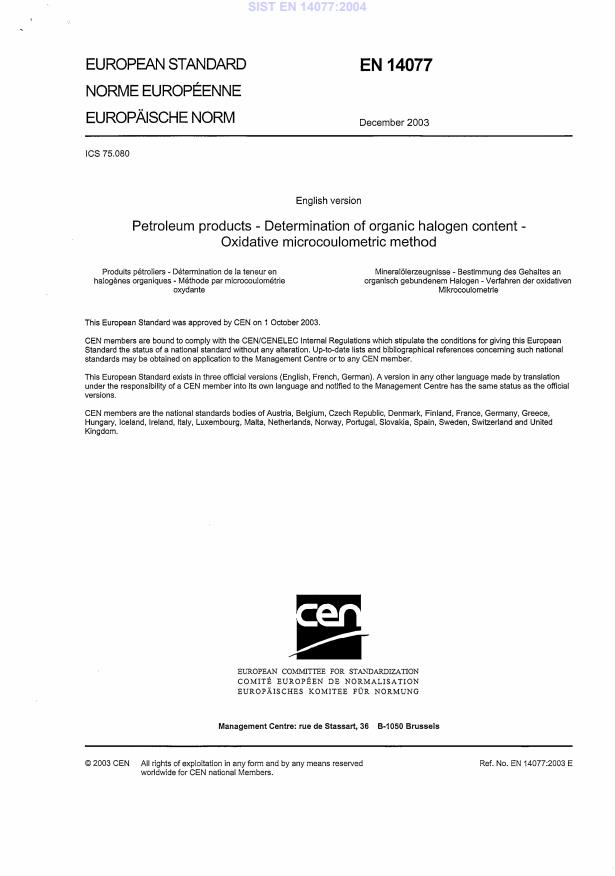
(Main)Petroleum products - Determination of organic halogen content - Oxidative microcoulometric method
Petroleum products - Determination of organic halogen content - Oxidative microcoulometric method
The method is directly applicable to the determination of low concentrations (2 mg/kg to 100 mg/kg) of organic halogen in petroleum products such as gasolines, middle distillates and residual fuels. Except for fluorine (F); the organic halogens chlorine (C), bromine (Br) and iodine (J) that may be present in the sample are determined quantitatively. The halogen is reported as the equivalent number of chloride ions. A procedure is described for the removal of inorganic halides from residual fluids.
Mineralölerzeugnisse - Bestimmung des Gehaltes an organisch gebundenem Halogen - Verfahren der oxidativen Mikrocoulometrie
Diese Europäische Norm legt ein Verfahren fest zur direkten Bestimmung niedriger Gehalte (2 mg/kg bis 100 mg/kg) von organisch gebundenem Halogen in Mineralölprodukten, wie z. B. in Ottokraftstoffen, Mitteldestillaten und Rückstandsölen. Das Prüfverfahren kann auch für Rohöle eingesetzt werden, jedoch sind für diese zusätzlichen Produkttypen keine Präzisionsangaben vorhanden. Mit Ausnahme von Fluor (F) werden die in der Probe möglicherweise vorhandenen, organisch gebundenen Halogene Chlor (Cl), Brom (Br) und Iod (I) quantitativ bestimmt. Die Halogene werden dabei als die äquivalente Zahl an Chlor-Ionen angegeben. Eine Probenaufbereitung, vor der Bestimmung des Gehaltes an organisch gebundenem Halogen, zur Entfernung der anorganischen Halogenverbindungen aus Rückstandsölen wird beschrieben. Dieses Probenauf-bereitungsverfahren ist Voraussetzung, um als Ergebnis ausschließlich das organisch gebundene Halogen zu erhalten.
ANMERKUNG Der Gehalt an Gesamt-Halogen kann auch nach ISO 15597 Mineralöl und verwandte Produkte - Bestimmung des Chlor- und Brom-Gehaltes - Verfahren mittels wellenlängendispersiver Röntgenfluoreszenzspektrometrie", bestimmt werden. Nach dieser Methode ist ein Verbrennungsschritt nicht notwendig; erforderlich ist jedoch ebenfalls eine Probenvorbereitung nach Abschnitt 7 dieser Norm, um ausschließlich den Gehalt an organisch gebundenen Halogenen zu bestimmen.
WARNUNG - Die Anwendung dieser Europäischen Norm kann den Einsatz gefährlicher Stoffe, Arbeitsgänge und Geräte mit sich bringen. Diese Norm gibt nicht vor, alle mit ihrer Anwendung verbundenen Sicherheitsprobleme anzusprechen. Der Anwender dieser Norm ist dafür verantwortlich, vorher angemessene Maßnahmen zu ergreifen und die Anwendbarkeit einschränkender Vorschriften zu ermitteln.
Produits pétroliers - Détermination de la teneur en halogènes organiques - Méthode par microcoulométrie oxydante
La présente Norme européenne décrit une méthode de détermination des halogènes organiques présents en faible teneur (2 mg/kg à 100 mg/kg) dans les produits pétroliers tels que les essences, distillats moyens et combustibles résiduels. A l'exception du fluor (F), les halogènes organiques - Chlore (Cl), brome (Br) et iode (I) - présents dans l'échantillon sont dosés de façon quantitative. La teneur en halogènes est exprimée sous forme du nombre équivalent en ions chlorure. Une préparation préalable de l'échantillon visant à éliminer les éventuels halogénures minéraux des combustibles résiduels est décrite. Cette préparation est essentielle pour obtenir un résultat en halogènes organiques uniquement.
NOTE La teneur totale en halogènes peut être déterminée selon l'ISO 15597 "Produits pétroliers et produits connexes - Détermination de la teneur en chlore et en brome - Méthode par spectrométrie de fluorescence X dispersive en longueur d'onde". Cette méthode n'implique pas d'étape de combustion, mais nécessite une préparation de l'échantillon conformément à l'article 7 de la présente norme pour permettre la détermination de la teneur en halogènes organiques.
AVERTISSEMENT - L'utilisation de la présente Norme européenne peut impliquer l'intervention de produits, d'opérations et d'équipements à caractère dangereux. La présente Norme européenne n'est pas censée aborder tous les problèmes de sécurité concernés par son usage. Il est de la responsabilité de l'utilisateur de consulter et d'établir des règles de sécurité et d'hygiène appropriées et de déterminer l'applicabilité des restrictions réglementaires avant utilisation.
Naftni proizvodi - Določevanje organskih halogenidov - Mikrokulometrična oksidativna metoda
General Information
- Status
- Published
- Publication Date
- 09-Dec-2003
- Withdrawal Date
- 29-Jun-2004
- Technical Committee
- CEN/TC 19 - Petroleum products, lubricants and related products
- Drafting Committee
- CEN/TC 19/WG 27 - Elemental analysis of petroleum and related products
- Current Stage
- 9093 - Decision to confirm - Review Enquiry
- Start Date
- 04-Jul-2024
- Completion Date
- 14-Apr-2025
Overview
EN 14077:2003 (CEN) specifies an oxidative microcoulometric method for the determination of organic halogen content in petroleum products. The standard is intended for low-level concentrations (2 mg/kg to 100 mg/kg) and covers common fuel types such as gasolines, middle distillates and residual fuels. Fluorine is excluded; chlorine (Cl), bromine (Br) and iodine (I) present as organic halogens are determined quantitatively and reported as the equivalent number of chloride ions. The standard also describes a procedure for the removal of inorganic halides from residual fluids prior to measurement.
Key Topics
- Scope and applicability
- Measurement range: 2–100 mg/kg organic halogen.
- Applicable sample types: gasolines, middle distillates, residual fuels.
- Analytes covered
- Quantitative determination of organic Cl, Br, I (fluorine excluded).
- Results expressed as chloride-ion equivalents to provide a single reporting metric.
- Analytical technique
- Uses an oxidative microcoulometric approach (oxidation of organohalogen compounds and coulometric detection of resulting halide ions).
- Matrix preparation
- Includes a procedure for removal of inorganic halides from residual fluids to prevent interference and ensure selective measurement of organic-bound halogen.
- Classification
- ICS code: 75.080 (Petroleum products in general).
Applications
- Refinery and fuel quality control
- Monitoring organic halogen levels to protect downstream catalysts, treat corrosion risk, and meet product specifications.
- Commercial fuel suppliers
- Verifying compliance with fuel quality limits and contractual requirements for halogen content.
- Independent testing laboratories
- Routine screening and certification of petroleum streams and blended fuels.
- Regulatory and environmental testing
- Assessing halogenated organics in fuels where low-level contamination is relevant to emissions or environmental risk.
- Research and development
- Evaluating feedstock and additive effects on halogen content in new fuel formulations.
Related Standards
- EN 14077:2003 is part of the suite of CEN standards addressing petroleum product testing. For comprehensive test programs, laboratories commonly consult other CEN/ISO/ASTM standards for complementary parameters (boiling range, sulfur, water content, etc.).
Keywords: EN 14077:2003, organic halogen, petroleum products, microcoulometric, halogen content determination, chlorine, bromine, iodine, residual fuels, gasoline, middle distillates, inorganic halide removal.
Frequently Asked Questions
EN 14077:2003 is a standard published by the European Committee for Standardization (CEN). Its full title is "Petroleum products - Determination of organic halogen content - Oxidative microcoulometric method". This standard covers: The method is directly applicable to the determination of low concentrations (2 mg/kg to 100 mg/kg) of organic halogen in petroleum products such as gasolines, middle distillates and residual fuels. Except for fluorine (F); the organic halogens chlorine (C), bromine (Br) and iodine (J) that may be present in the sample are determined quantitatively. The halogen is reported as the equivalent number of chloride ions. A procedure is described for the removal of inorganic halides from residual fluids.
The method is directly applicable to the determination of low concentrations (2 mg/kg to 100 mg/kg) of organic halogen in petroleum products such as gasolines, middle distillates and residual fuels. Except for fluorine (F); the organic halogens chlorine (C), bromine (Br) and iodine (J) that may be present in the sample are determined quantitatively. The halogen is reported as the equivalent number of chloride ions. A procedure is described for the removal of inorganic halides from residual fluids.
EN 14077:2003 is classified under the following ICS (International Classification for Standards) categories: 75.080 - Petroleum products in general. The ICS classification helps identify the subject area and facilitates finding related standards.
You can purchase EN 14077:2003 directly from iTeh Standards. The document is available in PDF format and is delivered instantly after payment. Add the standard to your cart and complete the secure checkout process. iTeh Standards is an authorized distributor of CEN standards.
Standards Content (Sample)
2003-01.Slovenski inštitut za standardizacijo. Razmnoževanje celote ali delov tega standarda ni dovoljeno.HWULþQDMineralölerzeugnisse - Bestimmung des Gehaltes an organisch gebundenem Halogen - Verfahren der oxidativen MikrocoulometrieProduits pétroliers - Détermination de la teneur en halogenes organiques - Méthode par microcoulométrie oxydantePetroleum products - Determination of organic halogen content - Oxidative microcoulometric method75.080Naftni proizvodi na splošnoPetroleum products in generalICS:T
...
The EN 14077:2003 standard provides a critical framework for the determination of organic halogen content in petroleum products, specifically targeting low concentrations ranging from 2 mg/kg to 100 mg/kg. This standard is particularly relevant for professionals in the petroleum industry who need to ensure compliance with environmental regulations and safety standards. One of the strengths of EN 14077:2003 is its robustness in quantifying organic halogens, specifically chlorine, bromine, and iodine, which are pivotal for assessing the quality and safety of petroleum products such as gasolines, middle distillates, and residual fuels. The method’s capability to report halogen content as equivalent chloride ions is particularly advantageous for clarity and consistency in reporting. Additionally, this standard includes a procedure for removing inorganic halides from residual fluids, which enhances the accuracy of the organic halogen analysis and minimizes potential interference during testing. This methodological rigor ensures that users of the standard can achieve reliable and reproducible results, which are essential for maintaining product quality and compliance. Overall, EN 14077:2003 stands out as a vital standard for those involved in petroleum product analysis, offering a highly relevant and effective method for determining organic halogen content, thus contributing to better environmental management and safety practices in the petroleum sector.
EN 14077:2003 표준 문서는 석유 제품에서 유기 할로겐 함량을 결정하기 위한 산화 미세전류 방법에 대해 상세히 설명하고 있습니다. 이 표준의 범위는 가솔린, 중유 및 잔여 연료와 같은 석유 제품에서 낮은 농도(2 mg/kg에서 100 mg/kg)의 유기 할로겐을 직접적으로 측정하는 데 적용됩니다. 특히 클로린(Cl), 브로민(Br), 요오드(J)와 같은 유기 할로겐의 정량적 결정이 가능하며, 불소(F)는 제외됩니다. 이 표준의 강점 중 하나는 유기 할로겐을 염화 이온의 동등 수로 보고하는 체계적인 방법을 제공한다는 점입니다. 이는 사용자에게 명확하고 일관된 결과를 보장합니다. 또한, 표준은 잔여 액체에서 무기 할로겐을 제거하기 위한 절차를 자세히 설명하고 있어, 분석의 정확성을 더욱 향상시키는 데 기여합니다. EN 14077:2003 표준은 석유 화학 산업에서 매우 중요한 역할을 하며, 환경 규제 및 품질 관리 기준에 부합하는 제품 개발에 필수적입니다. 이 표준의 적용은 유기 할로겐의 정량적 분석을 통해 석유 제품의 품질 향상과 안전성을 확보하는 데 기여하고 있습니다. 따라서 석유 제품의 분석 및 평가에 대한 이 표준의 적절성과 유용성은 매우 높다고 할 수 있습니다.
Die Norm EN 14077:2003 behandelt die Bestimmung des Gehalts an organischen Halogenen in Erdölprodukten mittels eines oxidativen mikroelektrochemischen Verfahrens. Sie ist speziell darauf ausgelegt, geringe Konzentrationen von organischen Halogenen (zwischen 2 mg/kg und 100 mg/kg) in verschiedenen Erdölprodukten wie Benzinen, Mitteldestillaten und Restölen verlässlich zu messen. Ein wesentlicher Vorteil dieser Norm ist ihre Anwendbarkeit auf die häufigsten organischen Halogene, insbesondere Chlor (Cl), Brom (Br) und Jod (J), wobei Fluor (F) ausgeschlossen ist. Die präzisen quantitativen Bestimmungen erlauben es, den Gehalt an organischen Halogenen effizient zu evaluieren und diesen als äquivalente Anzahl von Chloridionen zu rapportieren. Dies ist besonders relevant für die Qualitätskontrolle und Sicherheitsuntersuchungen von Erdölprodukten, da Halogene oft negative Auswirkungen auf die Umwelt und die menschliche Gesundheit haben können. Ein weiterer Pluspunkt der Norm ist das Verfahren zur Entfernung von anorganischen Haliden aus Restflüssigkeiten, das sicherstellt, dass die Analyse nicht durch unerwünschte Verunreinigungen beeinflusst wird. Dadurch wird die Genauigkeit und Zuverlässigkeit der Ergebnisse gesteigert, was insbesondere für Laboratorien von großer Bedeutung ist. Insgesamt ist die EN 14077:2003 sowohl in der praktischen Anwendung als auch in der Forschung von hoher Relevanz, da sie eine standardisierte Methode zur präzisen Bestimmung von organischen Halogenen in Erdölprodukten bereitstellt. Ihre Stärken liegen in der spezifischen Anpassung an verschiedene Erdölprodukte und der Effizienz der verwendeten Analysemethoden.
La norme EN 14077:2003, intitulée « Produits pétroliers - Détermination de la teneur en halogènes organiques - Méthode microcoulométrique oxydative », offre une approche méthodique pour la détermination des halogènes organiques dans divers produits pétroliers. Le champ d'application de cette norme est particulièrement pertinent pour les industries pétrolières, car elle permet de mesurer des concentrations faibles d'halogènes organiques, allant de 2 mg/kg à 100 mg/kg, dans des produits comme l'essence, les distillats intermédiaires et les combustibles résiduels. L'un des points forts de cette norme réside dans sa capacité à traiter quantitativement les halogènes, à l'exception de l'fluor (F), tels que le chlore (Cl), le brome (Br) et l'iode (I), souvent présents dans les échantillons de pétrole. La norme précise également que la quantité d'halogène est rapportée en équivalent de ions chlorure, ce qui facilite l'interprétation des résultats pour les laboratoires. De plus, un aspect important de la norme EN 14077:2003 est la procédure décrite pour l'élimination des halogénures inorganiques des fluides résiduels. Cela assure que les résultats obtenus sont fiables et précis, minimisant les interférences qui pourraient fausser l'analyse des halogènes organiques. La pertinence de cette norme s'étend au-delà de la simple analyse chimique ; elle fournit un cadre essentiel pour la conformité environnementale et la sécurité des produits pétroliers, soutenant ainsi des pratiques industrielles durables. En adoptant cette norme, les laboratoires garantissent la qualité et la sécurité des produits qu'ils analysent, ce qui est fondamental dans un secteur où la réglementation et les préoccupations environnementales sont de plus en plus strictes.
EN 14077:2003 は、石油製品に含まれる有機ハロゲンの定量についての国際的な標準化文書であり、特に酸化性マイクロクーロメトリック法に基づいています。この標準の適用範囲は、ガソリン、中間留分、および残渣燃料などの石油製品における有機ハロゲンの低濃度(2 mg/kgから100 mg/kg)を直接的に測定するためのものです。 この標準の強みとして、非常に低い濃度の有機ハロゲンの定量が可能であり、特に塩素(Cl)、臭素(Br)、およびヨウ素(I)といった有機ハロゲンの定量を含んでいる点が挙げられます。フルオリン(F)は対象外ですが、この標準は他のハロゲンに関して正確な結果を提示します。ハロゲンの測定結果は、塩化物イオンの同等数として報告されるため、実用的なデータが得られます。 さらに、残渣液から無機ハロゲンを除去する手順が詳細に説明されており、これにより測定の正確性を高めています。このように、EN 14077:2003 は、石油製品の品質管理やそれに関連する環境基準に対する重要な指針となるものであり、業界にとっての不可欠なリソースとなっています。また、この標準は、環境保護や公衆衛生の観点からも非常に重要で、業界関係者が遵守すべき基準を提供します。


Questions, Comments and Discussion
Ask us and Technical Secretary will try to provide an answer. You can facilitate discussion about the standard in here.
Loading comments...