

EN 81-71:2022
(Main)Safety rules for the construction and installation of lifts - Particular applications to passenger lifts and goods passenger lifts - Part 71: Vandal resistant lifts
- Abstract
This document defines requirements addressing the significant hazards related to lifts, which are subject to different expected levels of vandalism (see Annex A and Annex D for further information).
Those requirements are supplementary (additional and/or modified) to the requirements of EN 81-20:2020, intended to mitigate the effect of vandalism.
This document is not applicable to lifts installed before the date of its publication.
- Status
- Published
- Publication Date
- 24-May-2022
- Technical Committee
- CEN/TC 10 - Passenger, goods and service lifts
- Drafting Committee
- CEN/TC 10/WG 1 - Lifts and service lifts
- Current Stage
- 6060 - Definitive text made available (DAV) - Publishing
- Start Date
- 25-May-2022
- Due Date
- 06-May-2022
- Completion Date
- 25-May-2022

Overview
EN 81-71:2022 - "Safety rules for the construction and installation of lifts - Particular applications to passenger lifts and goods passenger lifts - Part 71: Vandal resistant lifts" - is a CEN European standard published in 2022. It specifies supplementary requirements to EN 81-20:2020 to mitigate the effects of vandalism on lift installations. The standard applies to new lifts designed and installed after its publication and replaces EN 81-71:2018+AC:2019.
Key topics and technical requirements
This standard focuses on hazards and protective measures where lifts face deliberate damage or misuse. Major technical topics include:
- Risk-based lift categorization (see Annex A) to select measures according to expected levels of vandalism (Category 1 and Category 2 are referenced).
- Structural protection of the lift well, car bodywork, finishes and steelwork to resist manual impacts and common vandalism items (see Annex E).
- Door security and locking systems for landing and car doors, including guidance for landing door security systems and coupling/ reversal mechanisms.
- Machinery spaces and cabinets protection, ventilation and access control to reduce tampering risk.
- Car interior requirements: robust fixings, lighting, ventilation and emergency access provisions.
- Control stations, position indicators and alarm sounders: anti-manipulation considerations and secure mounting.
- Verification and testing methods, including an impact test (Annex B) and fire test provisions (Annex F) for relevant components.
- Information for use and signage (Annex C) for systems like landing door security.
- References to protection ratings and fire classification standards (e.g., EN 60529, EN 13501-1) and conformity with EN ISO 12100 principles.
Applications and users
EN 81-71:2022 is intended for stakeholders designing, manufacturing, installing, certifying and maintaining lifts in environments where vandalism risk is significant. Typical applications:
- Public transport hubs, underground stations and transit interchanges
- Social and multi‑residential housing
- Hospitals, schools and public buildings
- Remote or 24-hour access facilities, parking garages
- Secure facilities requiring tamper-resistant lift installations
Primary users:
- Lift manufacturers and OEMs
- Lift installers and contractors
- Building owners, facility managers and asset owners
- Regulatory bodies, inspection and maintenance organizations
Related standards
- EN 81-20:2020 (basic safety rules for passenger and goods passenger lifts)
- EN 81-28:2022 (remote alarm)
- EN 81-72:2020 / EN 81-73:2020 (firefighter lifts / behaviour in fire)
- EN 13501-1, EN 60529, EN ISO 12100
EN 81-71:2022 supports conformity with EU Directive 2014/33/EU and is part of the EN 81 series addressing lift safety.
Relations
- Effective Date
- 27-Nov-2019
- Effective Date
- 09-Feb-2026
- Effective Date
- 09-Feb-2026
- Effective Date
- 09-Feb-2026
- Effective Date
- 28-Jan-2026
- Effective Date
- 28-Jan-2026
- Effective Date
- 28-Jan-2026
- Effective Date
- 28-Jan-2026
- Effective Date
- 28-Jan-2026
- Effective Date
- 28-Jan-2026
- Effective Date
- 09-Feb-2026
- Effective Date
- 28-Jan-2026
- Effective Date
- 28-Jan-2026
- Effective Date
- 28-Jan-2026
- Effective Date
- 28-Jan-2026
Get Certified
Connect with accredited certification bodies for this standard

DIBt (Deutsches Institut für Bautechnik)
German Institute for Building Technology.
DIN CERTCO
DIN Group product certification.

Aboma Certification B.V.
Specialized in construction, metal, and transport sectors.
Sponsored listings
Frequently Asked Questions
EN 81-71:2022 is a standard published by the European Committee for Standardization (CEN). Its full title is "Safety rules for the construction and installation of lifts - Particular applications to passenger lifts and goods passenger lifts - Part 71: Vandal resistant lifts". This standard covers: This document defines requirements addressing the significant hazards related to lifts, which are subject to different expected levels of vandalism (see Annex A and Annex D for further information). Those requirements are supplementary (additional and/or modified) to the requirements of EN 81-20:2020, intended to mitigate the effect of vandalism. This document is not applicable to lifts installed before the date of its publication.
This document defines requirements addressing the significant hazards related to lifts, which are subject to different expected levels of vandalism (see Annex A and Annex D for further information). Those requirements are supplementary (additional and/or modified) to the requirements of EN 81-20:2020, intended to mitigate the effect of vandalism. This document is not applicable to lifts installed before the date of its publication.
EN 81-71:2022 is classified under the following ICS (International Classification for Standards) categories: 91.140.90 - Lifts. Escalators. The ICS classification helps identify the subject area and facilitates finding related standards.
EN 81-71:2022 has the following relationships with other standards: It is inter standard links to EN 81-71:2018+AC:2019, EN 60529:1991/A2:2013, EN 60529:1991/A1:2000, EN 60529:1991, EN ISO 12100:2010, EN 81-20:2020, EN 81-28:2022, EN 13501-1:2018, EN 81-73:2020, EN 81-72:2020, EN 50600-2-1:2021, EN 12015:2004, EN 81-72:2015, EN 81-80:2003, EN 81-83:2025. Understanding these relationships helps ensure you are using the most current and applicable version of the standard.
EN 81-71:2022 is associated with the following European legislation: EU Directives/Regulations: 2014/33/EU; Standardization Mandates: M/549. When a standard is cited in the Official Journal of the European Union, products manufactured in conformity with it benefit from a presumption of conformity with the essential requirements of the corresponding EU directive or regulation.
EN 81-71:2022 is available in PDF format for immediate download after purchase. The document can be added to your cart and obtained through the secure checkout process. Digital delivery ensures instant access to the complete standard document.
Standards Content (Sample)
SLOVENSKI STANDARD
01-september-2022
Nadomešča:
SIST EN 81-71:2018+AC:2019
Varnostna pravila za konstruiranje in vgradnjo dvigal (liftov) - Posebne izvedbe
osebnih in osebno-tovornih dvigal - 71. del: Dvigala, odporna proti vandalizmu
Safety rules for the construction and installation of lifts - Particular applications to
passenger lifts and goods passenger lifts - Part 71: Vandal resistant lifts
Sicherheitsregeln für die Konstruktion und den Einbau von Aufzügen - Besondere
Anwendungen für Personen- und Lastenaufzüge - Teil 71: Schutzmaßnahmen gegen
mutwillige Zerstörung
Règles de sécurité pour la construction et l'installation des élévateurs - Applications
particulières pour les ascenseurs et ascenseurs de charge - Partie 71 : Ascenseurs
résistants aux actes de vandalisme
Ta slovenski standard je istoveten z: EN 81-71:2022
ICS:
13.310 Varstvo pred kriminalom Protection against crime
91.140.90 Dvigala. Tekoče stopnice Lifts. Escalators
2003-01.Slovenski inštitut za standardizacijo. Razmnoževanje celote ali delov tega standarda ni dovoljeno.
EN 81-71
EUROPEAN STANDARD
NORME EUROPÉENNE
May 2022
EUROPÄISCHE NORM
ICS 91.140.90 Supersedes EN 81-71:2018+AC:2019
English Version
Safety rules for the construction and installation of lifts -
Particular applications to passenger lifts and goods
passenger lifts - Part 71: Vandal resistant lifts
Règles de sécurité pour la construction et l'installation Sicherheitsregeln für die Konstruktion und den Einbau
des élévateurs - Applications particulières pour les von Aufzügen - Besondere Anwendungen für
ascenseurs et les ascenseurs de charge - Partie 71 : Personen- und Lastenaufzüge - Teil 71:
Ascenseurs résistant aux actes de vandalisme Schutzmaßnahmen gegen mutwillige Zerstörung
This European Standard was approved by CEN on 20 April 2022.
CEN members are bound to comply with the CEN/CENELEC Internal Regulations which stipulate the conditions for giving this
European Standard the status of a national standard without any alteration. Up-to-date lists and bibliographical references
concerning such national standards may be obtained on application to the CEN-CENELEC Management Centre or to any CEN
member.
This European Standard exists in three official versions (English, French, German). A version in any other language made by
translation under the responsibility of a CEN member into its own language and notified to the CEN-CENELEC Management
Centre has the same status as the official versions.
CEN members are the national standards bodies of Austria, Belgium, Bulgaria, Croatia, Cyprus, Czech Republic, Denmark, Estonia,
Finland, France, Germany, Greece, Hungary, Iceland, Ireland, Italy, Latvia, Lithuania, Luxembourg, Malta, Netherlands, Norway,
Poland, Portugal, Republic of North Macedonia, Romania, Serbia, Slovakia, Slovenia, Spain, Sweden, Switzerland, Turkey and
United Kingdom.
EUROPEAN COMMITTEE FOR STANDARDIZATION
COMITÉ EUROPÉEN DE NORMALISATION
EUROPÄISCHES KOMITEE FÜR NORMUNG
CEN-CENELEC Management Centre: Rue de la Science 23, B-1040 Brussels
© 2022 CEN All rights of exploitation in any form and by any means reserved Ref. No. EN 81-71:2022 E
worldwide for CEN national Members.
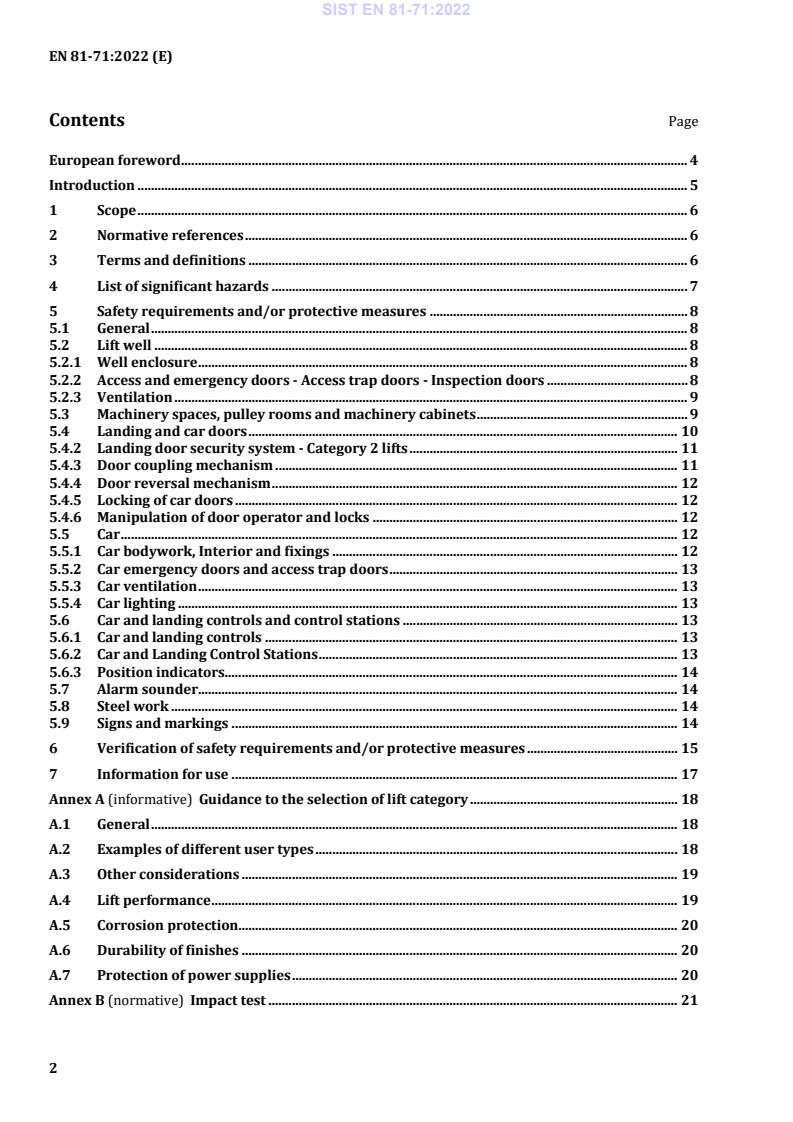
Contents Page
European foreword . 4
Introduction . 5
1 Scope . 6
2 Normative references . 6
3 Terms and definitions . 6
4 List of significant hazards . 7
5 Safety requirements and/or protective measures . 8
5.1 General . 8
5.2 Lift well . 8
5.2.1 Well enclosure . 8
5.2.2 Access and emergency doors - Access trap doors - Inspection doors . 8
5.2.3 Ventilation . 9
5.3 Machinery spaces, pulley rooms and machinery cabinets . 9
5.4 Landing and car doors . 10
5.4.2 Landing door security system - Category 2 lifts . 11
5.4.3 Door coupling mechanism . 11
5.4.4 Door reversal mechanism . 12
5.4.5 Locking of car doors . 12
5.4.6 Manipulation of door operator and locks . 12
5.5 Car . 12
5.5.1 Car bodywork, Interior and fixings . 12
5.5.2 Car emergency doors and access trap doors . 13
5.5.3 Car ventilation . 13
5.5.4 Car lighting . 13
5.6 Car and landing controls and control stations . 13
5.6.1 Car and landing controls . 13
5.6.2 Car and Landing Control Stations . 13
5.6.3 Position indicators . 14
5.7 Alarm sounder . 14
5.8 Steel work . 14
5.9 Signs and markings . 14
6 Verification of safety requirements and/or protective measures . 15
7 Information for use . 17
Annex A (informative) Guidance to the selection of lift category . 18
A.1 General . 18
A.2 Examples of different user types . 18
A.3 Other considerations . 19
A.4 Lift performance . 19
A.5 Corrosion protection. 20
A.6 Durability of finishes . 20
A.7 Protection of power supplies . 20
Annex B (normative) Impact test . 21
B.1 Equipment . 21
B.2 Samples . 21
B.3 Method . 21
B.4 Result . 21
Annex C (normative) Information sign for landing door security system . 22
Annex D (informative) Additional advice for dealing with vandalism . 23
Annex E (normative) Typical items used in vandalism . 24
Annex F (normative) Fire tests . 26
F.1 Equipment . 26
F.2 Samples . 26
F.3 Method . 26
F.4 Results . 26
Annex ZA (informative) Relationship between this European Standard and the essential
requirements of Directive 2014/33/EU aimed to be covered . 28
Bibliography . 30
European foreword
This document (EN 81-71:2022) has been prepared by Technical Committee CEN/TC 10 “Lifts, escalators
and moving walks”, the secretariat of which is held by AFNOR.
This European Standard shall be given the status of a national standard, either by publication of an
identical text or by endorsement, at the latest by November 2022, and conflicting national standards shall
be withdrawn at the latest by May 2024.
Attention is drawn to the possibility that some of the elements of this document may be the subject of
patent rights. CEN shall not be held responsible for identifying any or all such patent rights.
This document supersedes EN 81-71:2018+AC:2019.
In comparison with the previous edition, the following significant changes have been made:
— reference to Category 0 has been removed;
— normative references have been updated;
— Annex ZA has been modified.
No technical changes have been made in Clause 5 during this revision.
This document is intended to be used in conjunction with EN 81-20:2020, which gives the basic
requirements for passenger and goods passenger lifts.
This document is part of the EN 81 series of standards. The structure of the EN 81 series is described in
CEN/TR 81-10:2008.
This document has been prepared under a Standardization Request given to CEN by the European
Commission and the European Free Trade Association, and supports essential requirements of EU
Directive(s) / Regulation(s).
For relationship with EU Directive(s) / Regulation(s), see informative Annex ZA, which is an integral part
of this document.
Any feedback and questions on this document should be directed to the users’ national standards body.
A complete listing of these bodies can be found on the CEN website.
According to the CEN-CENELEC Internal Regulations, the national standards organisations of the
following countries are bound to implement this European Standard: Austria, Belgium, Bulgaria, Croatia,
Cyprus, Czech Republic, Denmark, Estonia, Finland, France, Germany, Greece, Hungary, Iceland, Ireland,
Italy, Latvia, Lithuania, Luxembourg, Malta, Netherlands, Norway, Poland, Portugal, Republic of North
Macedonia, Romania, Serbia, Slovakia, Slovenia, Spain, Sweden, Switzerland, Turkey and the United
Kingdom.
Introduction
This document is a type-C standard as stated in EN ISO 12100.
This document is of relevance, in particular, for the following stakeholder groups representing the market
players with regard to machinery safety:
— machine manufacturers (small, medium and large enterprises);
— health and safety bodies (regulators, accident prevention organizations, market surveillance, etc.).
Others can be affected by the level of machinery safety achieved with the means of the document by the
above-mentioned stakeholder groups:
— machine users/employers (small, medium and large enterprises);
— machine users/employees (e.g. trade unions, organizations for people with special needs);
— service providers, e.g. for maintenance (small, medium and large enterprises);
— consumers (in case of machinery intended for use by consumers).
The above-mentioned stakeholder groups have been given the possibility to participate in the drafting
process of this document.
The machinery concerned and the extent to which hazards, hazardous situations or hazardous events are
covered are indicated in the Scope of this document.
When requirements of this type-C standard are different from those which are stated in type-A or type-B
standards, the requirements of this type-C standard take precedence over the requirements of the other
standards for machines that have been designed and built according to the requirements of this type-C
standard.
This document provides requirements for the design of lifts where it is considered that additional
measures are required in order to protect against the risk of vandalism. Every lift is subject to some
amount of careless and rough use. Additional protective measures against deliberate acts that may result
in equipment damage or injury to persons are referred to in this document as Category 1 or Category 2.
The following assumptions were made whilst writing this document:
— The potential for vandalism of lifts depends on the following factors:
— access to the lift installation;
— the surrounding area;
— observation of the lift by others in the vicinity;
— the extent of building security and surveillance of the lift;
— period of access to the building, including the lift (24 h);
— vulnerability of lift.
— The forces exerted on the lift and its equipment will be as a result of manual effort or by item(s) such
as those listed in Annex E.
1 Scope
This document defines requirements addressing the significant hazards related to lifts, which are subject
to different expected levels of vandalism (see Annex A and Annex D for further information).
Those requirements are supplementary (additional and/or modified) to the requirements of EN 81-
20:2020, intended to mitigate the effect of vandalism.
This document is not applicable to lifts installed before the date of its publication.
2 Normative references
The following documents are referred to in the text in such a way that some or all of their content
constitutes requirements of this document. For dated references, only the edition cited applies. For
undated references, the latest edition of the referenced document (including any amendments) applies.
EN 81-20:2020, Safety rules for the construction and installation of lifts — Lifts for the transport of persons
and goods — Part 20: Passenger and goods passenger lifts
EN 81-28:2022, Safety rules for the construction and installation of lifts — Lifts for the transport of persons
and goods — Part 28: Remote alarm on passenger and goods passenger lifts
EN 81-72:2020, Safety rules for the construction and installation of lifts — Particular applications for
passenger and goods passenger lifts — Part 72: Firefighters lifts
EN 81-73:2020, Safety rules for the construction and installation of lifts — Particular applications for
passenger and goods passenger lifts — Part 73: Behaviour of lifts in the event of fire
EN 13501-1:2018, Fire classification of construction products and building elements — Part 1:
Classification using data from reaction to fire tests
EN 60529:1991, Degrees of protection provided by enclosures (IP Code) (IEC 60529:1989)
EN ISO 12100:2010, Safety of machinery — General principles for design — Risk assessment and risk
reduction (ISO 12100:2010)
3 Terms and definitions
For the purposes of this document, the terms and definitions given in EN ISO 12100:2010, EN 81-20:2020
and the following apply.
ISO and IEC maintain terminological databases for use in standardization at the following addresses:
— ISO Online browsing platform: available at https://www.iso.org/obp
— IEC Electropedia: available at https://www.electropedia.org/
3.1
car ceiling
parts of the car roof accessible from inside the car
As impacted by EN 60529:1991/A1:2000, EN 60529:1991/A2:2013 and EN 60529:1991/A2:2013/AC:2019-02.
3.2
category 1 lift
lift which is protected against limited act of vandalism
Note 1 to entry: For guidance on selection of the relevant category see Annex A.
3.3
category 2 lift
lift which is protected against strong act of vandalism
Note 1 to entry: For guidance on selection of the relevant category see Annex A.
4 List of significant hazards
This clause contains all the significant hazards, hazardous situations and events, as far as they are dealt
with in this document, identified by risk assessment as significant for this type of lift and which require
action to eliminate or reduce the risk (see Table 1).
Table 1 — List of significant hazards
Hazards as listed in EN ISO 12100:2010, Relevant clauses
Annex B
Mechanical hazards due to:
− Crushing 5.2.1.2, 5.2.1.3, 5.2.2.1, 5.2.2.2, 5.3.5, 5.4.2.1, 5.4.2.4
and 5.5.2
− Shearing 5.2.1.1, 5.2.1.2, 5.2.1.3, 5.2.2.1, 5.2.2.2, 5.2.3, 5.3.1,
5.3.2, 5.3.3, 5.3.4, 5.3.5, 5.4.1.2, 5.4.1.3, 5.4.1.4,
5.4.1.6, 5.4.2.1, 5.4.2.4, 5.5.1.1 and 5.5.2
− Cutting 5.4.1.2, 5.5.1.8, 5.5.4, 5.6.1.3 and 5.6.2.1
− Trapping 5.4.2.3, 5.4.2.4, 5.4.2.5, 5.4.5 and 5.7
− Impact hazard 5.4.4
− Slipping, tripping and falling 5.2.1.1, 5.2.2.2, 5.2.3, 5.3.3, 5.3.4, 5.3.5, 5.3.6, 5.4.1.2,
5.4.1.3, 5.4.2.1, 5.4.2.3, 5.4.2.4, 5.4.6, 5.5.1.1, 5.5.1.6,
5.5.2 and 5.8
Electrical hazards due to live parts 5.5.1.9, 5.5.4, 5.6.1.1, 5.6.1.3, 5.6.1.4 and 5.6.2.1
Thermal hazards due to flame 5.2.1.1, 5.3.1, 5.3.7, 5.4.1.1, 5.5.1.4, 5.5.4, 5.6.1.1,
5.6.1.5 and 5.9
Hazards due to human behaviour 5.2.1.1, 5.2.1.2, 5.2.1.3, 5.2.2.1, 5.2.2.2, 5.2.3, 5.3.1,
5.3.2, 5.3.3, 5.3.4, 5.3.5, 5.3.6, 5.4.1.5, 5.4.1.6, 5.4.1.7,
5.4.1.8, 5.4.2.1, 5.4.2.3, 5.4.3, 5.4.4, 5.4.5, 5.4.6,
5.5.1.1, 5.5.1.2, 5.5.1.3, 5.5.1.5, 5.5.1.7, 5.5.1.8,
5.5.1.9, 5.5.2, 5.5.3, 5.5.4, 5.6.1.2, 5.6.1.3, 5.6.1.4,
5.6.2.1, 5.6.2.2, 5.7 and 5.9
5 Safety requirements and/or protective measures
5.1 General
Category 1 and Category 2 lifts shall comply with the safety requirements and/or protective measures of
the following clauses. Where a category is specified, the subclause applies to that category only. In
addition, lifts shall be designed according to the principles of EN ISO 12100:2010 for hazards relevant
but not significant that are not dealt with by this document.
5.2 Lift well
5.2.1 Well enclosure
5.2.1.1 Well enclosures shall be imperforate. The walls, floor and ceiling shall be made of materials
such as steel, brick, concrete, etc. with a mechanical strength such that when a force of 2 500 N being
evenly distributed over an area of 100 cm in round or square section is applied at right angles to the
surface at any point on either face they shall resist without:
a) permanent deformation;
b) elastic deformation greater than 15 mm.
The materials used for the well enclosure shall be non-combustible, e.g. according to Class A1 of
EN 13501-1:2018.
If the material used is glass, it shall be of an equivalent strength to the glass used for landing doors –
see 5.4.1.
5.2.1.2 For Category 1 lifts with a partially enclosed well the height of the enclosure according
to EN 81-20:2020, 5.2.5.2.3 b) shall be a minimum of 5,0 m.
5.2.1.3 Category 2 lifts shall be provided with a totally enclosed well.
5.2.2 Access and emergency doors - Access trap doors - Inspection doors
5.2.2.1 Access and emergency doors, access trap doors and inspection doors shall be of such a
construction that it is not possible to open them with any of the items as listed in Table E.1.
5.2.2.2 Access and emergency doors, access trap doors and inspection doors in their locked position
shall withstand a force of 2 500 N applied:
— from the side which is normally accessible to persons,
— at right angles to the panel,
— at any point on the exposed face,
— evenly distributed over an area of 100 cm of round or square section;
they shall:
a) resist the force without permanent deformation;
b) resist without elastic deformation greater than 15 mm;
c) not have their safety function affected during and after such a test;
d) operate afterwards.
5.2.3 Ventilation
Ventilation openings shall be in accordance with 5.3.3 and 5.3.4.
5.3 Machinery spaces, pulley rooms and machinery cabinets
5.3.1 The materials used in the construction of any machinery space, pulley room or machinery cabinet
outside of the well shall comply with 5.2.1.1.
5.3.2 Windows, if provided and accessible to persons, shall:
a) be of a strength as specified in 5.2.2.2;
b) have laminated glass panel(s).
Windows are not recommended.
5.3.3 If ventilation openings are accessible to persons from the outside, individual openings shall:
a) not be greater than 250 mm × 250 mm;
b) be provided with a means of protection so that a straight rod of any cross section, shall not pass
through.
5.3.4 The means of protection in 5.3.3 shall be of a strength as specified in 5.2.1.1.
5.3.5 Doors and access trap doors with their locks shall meet the requirements of 5.2.2.2.
5.3.6 For Category 2 lifts, an intruder alarm system shall operate if any of the following doors are
opened:
— machine room and/or pulley room door;
— inspection doors, emergency doors and access trap doors;
— machinery cabinet doors.
The intruder alarm system shall operate an audible alarm within 30 s after opening any of the above
doors.
The audible alarm shall:
a) be audible at both the point of intrusion and at the main access floor, with an adjustable sound level
between 70 dB(A) and 85 dB(A);
b) stop automatically after an adjustable period between 5 min and 15 min.
It shall be possible to deactivate and re-activate the alarm system by the device referred to in 5.4.2.2.
In the event of loss of the electrical supply, the alarm system shall remain operative for at least two hours.
5.3.7 In the case of a Category 2 lift, machinery located in the pit, e.g. machine, tank, controller, shall be
covered with a metallic enclosure. This enclosure is to prevent rubbish from entering the equipment and
causing dangerous malfunctions or the ignition of the material or the creation of smoke.
5.4 Landing and car doors
5.4.1 Landing and car doors shall be of the automatically horizontally sliding power operated type.
5.4.1.1 Materials used for car and landing doors shall comply with the following:
a) with the exception of decorative finishes, the materials used for door panels and frames/architraves
shall be non-combustible according to Class A1 or A2 of EN 13501-1:2018;
b) for Category 2 lifts the materials used for decorative finishes shall be non-combustible according to
Class A1 or A2 of EN 13501-1:2018.
5.4.1.2 Independently of their material, landing and car door assemblies, together with their frames
and fixings shall withstand the soft pendulum shock test as specified in EN 81-20:2020, 5.3.5.3.4 a)
without component failure or permanent deformation which would affect the proper function of the
doors, but with the pendulum fall height as:
a) for Category 1 lifts: 700 mm;
b) for Category 2 lifts: 1 000 mm.
The door assemblies shall remain operative after the test.
5.4.1.3 Door panels with their retainers shall withstand the soft pendulum shock test as specified in
EN 81-20:2020, 5.3.5.3.2 with a falling height increased to 1 400 mm.
5.4.1.4 For Category 2 lifts glass panels shall not be used.
5.4.1.5 For Category 2 lifts, the distance between each landing door panel, or its attachments at the
leading edge, and the car door(s) panel(s), or its attachments at the leading edge, shall not exceed 35 mm.
This distance shall be maintained back from the leading edge over a length of not less than 75 mm and
returned at an angle not exceeding 45° to the rear of the door panel. This return angle may be omitted
over a length not exceeding 200 mm at the top and/or bottom of the door panel to allow the fixing of door
equipment. Where the distance is maintained back for a length of 200 mm or more, then the return angle
is not required (see Figure 1).
Dimensions in millimetres
Key
1 direction of closing
2 return angle: maximum 45°
Figure 1 — Plan view of door panel with angled return
5.4.1.6 For Category 2 lifts, in addition to the requirements of EN 81-20:2020, 5.3.5.3.3, it shall not
be possible to pass a rod of 10 mm diameter directly from the landing side of the entrance into the well.
5.4.1.7 For Category 2 lifts, where panels are mechanically linked, the linkage shall be so designed or
located that it cannot be disengaged by a user, with an item as described in Annex E within a period of
60 s.
5.4.1.8 For Category 2 lifts, the leading-edge profile of the car and landing door panels shall be
formed as an integral part of the door panels.
5.4.2 Landing door security system - Category 2 lifts
5.4.2.1 At any floor where the car is not present, a security system shall prevent opening the landing
door with an emergency unlocking key as stated in EN 81-20:2020, 5.3.9.3.1 or by using an item as
described in Annex E, unless this system has been de-activated.
5.4.2.2 A device to manually activate and de-activate the system shall be in at least one of the
following locations:
a) the machine room;
b) control cabinet;
c) emergency and inspection panel.
The device shall be clearly marked with a pictogram as shown in Annex C. The pictogram shall also be
located on or adjacent to the lift entrance at the main entry/exit floor of the building.
5.4.2.3 After manual de-activation, the system shall be automatically re-activated after a period of
between 30 min and 60 min, to prevent the doors being left without the security system operative.
However, when the lift is switched to inspection operation according to EN 81-20:2020, 5.12.1.5, or a
stopping device to EN 81-20:2020, 5.12.1.11 is operated, this time sequence shall stop. Once the lift is
re
...