

CEN/TR 15278:2006
(Main)Workplace exposure - Strategy for the evaluation of dermal exposure
- Abstract
This Technical Report gives guidance on approaches for awareness and evaluation of dermal exposure in workplaces.
This Technical Report describes strategies to evaluate exposure of the skin to chemical and biological agents qualitatively and quantitatively, e.g. to analyse exposure, as part of the risk assessment process, to investigate associations between exposure and diseases, and to evaluate control measures.
The definitions and procedures given in this document are primarily related to dermal exposure to chemical substances.
The specifications given in this Technical Report are not applicable to microbiological skin contaminants.
- Status
- Published
- Publication Date
- 14-Mar-2006
- Technical Committee
- CEN/TC 137 - Assessment of workplace exposure
- Drafting Committee
- CEN/TC 137/WG 6 - Dermal Exposure
- Current Stage
- 9093 - Decision to confirm - Review Enquiry
- Start Date
- 12-Jun-2015
- Completion Date
- 14-Oct-2026



Overview
CEN/TR 15278:2006 - Workplace exposure: Strategy for the evaluation of dermal exposure is a CEN Technical Report that provides guidance on recognizing, evaluating and measuring skin contact with chemical (and some biological) agents in the workplace. The report presents a harmonised strategy for dermal exposure assessment - from conceptual modelling and terminology to practical sampling and measurement approaches - primarily focused on chemical substances. It explicitly excludes specifications for microbiological skin contaminants.
Key Topics
- Scope and definitions: Clear terminology for dermal exposure concepts such as dermal contact volume, exposure mass, exposure loading, exposure surface and skin contaminant layer.
- Conceptual model: A transport-based model describing contaminant movement from source → environmental compartments (air, surface, source) → personal compartments (outer/inner clothing, skin). This model supports structured assessment and method selection.
- Assessment objectives: Five main objectives are covered - understanding exposure pathways, evaluating control measures, risk assessment, epidemiological studies, and compliance sampling.
- Tiered assessment methods:
- Semi-quantitative models such as EASE (Estimation and Assessment of Substance Exposure) and DREAM (DeRmal Exposure Assessment Method) for initial or screening-level estimates.
- Use of DEO-units and RISKOFDERM toolkit concepts for sector-specific scenario description and default exposure loadings.
- Sampling strategy & measurement principles: Guidance on designing sampling (agent selection, workplace selection, jobs/tasks, timing, body sites, sample size) and choosing measurement principles:
- Interception techniques (collection media replacing or placed on skin/clothing) - estimates exposure mass.
- Removal techniques (wipes, washes) - estimate exposure loading.
- Direct/in situ methods (imaging, tracers) - provide surface-level detection.
- Use of measurements: Relating sampled parameters (mass, loading, concentration/time profile) to specific objectives such as control evaluation or risk assessment.
Applications
CEN/TR 15278:2006 is practical for:
- Occupational hygienists and safety professionals designing dermal exposure surveys.
- Industrial employers and EHS managers evaluating control measures and workplace risk.
- Regulators and auditors developing compliance approaches or interpreting exposure data.
- Researchers and epidemiologists needing standardised exposure metrics and sampling strategies.
- Consultants implementing semi-quantitative screening (EASE, DREAM) before detailed measurements.
This report helps users select appropriate sampling methods, interpret dermal contamination data, and prioritise exposure controls - supporting safer workplaces and informed risk management.
Related Standards
- EN 1540 (terminology) and EN 689 (tiered approach for airborne exposure) are referenced for harmonisation with airborne exposure assessment approaches.
Get Certified
Connect with accredited certification bodies for this standard

BSI Group
BSI (British Standards Institution) is the business standards company that helps organizations make excellence a habit.

Bureau Veritas
Bureau Veritas is a world leader in laboratory testing, inspection and certification services.

DNV
DNV is an independent assurance and risk management provider.
Sponsored listings
Frequently Asked Questions
CEN/TR 15278:2006 is a technical report published by the European Committee for Standardization (CEN). Its full title is "Workplace exposure - Strategy for the evaluation of dermal exposure". This standard covers: This Technical Report gives guidance on approaches for awareness and evaluation of dermal exposure in workplaces. This Technical Report describes strategies to evaluate exposure of the skin to chemical and biological agents qualitatively and quantitatively, e.g. to analyse exposure, as part of the risk assessment process, to investigate associations between exposure and diseases, and to evaluate control measures. The definitions and procedures given in this document are primarily related to dermal exposure to chemical substances. The specifications given in this Technical Report are not applicable to microbiological skin contaminants.
This Technical Report gives guidance on approaches for awareness and evaluation of dermal exposure in workplaces. This Technical Report describes strategies to evaluate exposure of the skin to chemical and biological agents qualitatively and quantitatively, e.g. to analyse exposure, as part of the risk assessment process, to investigate associations between exposure and diseases, and to evaluate control measures. The definitions and procedures given in this document are primarily related to dermal exposure to chemical substances. The specifications given in this Technical Report are not applicable to microbiological skin contaminants.
CEN/TR 15278:2006 is classified under the following ICS (International Classification for Standards) categories: 13.100 - Occupational safety. Industrial hygiene. The ICS classification helps identify the subject area and facilitates finding related standards.
CEN/TR 15278:2006 is available in PDF format for immediate download after purchase. The document can be added to your cart and obtained through the secure checkout process. Digital delivery ensures instant access to the complete standard document.
Standards Content (Sample)
SLOVENSKI STANDARD
01-maj-2006
Izpostavljenost na delovnem mestu – Strategija vrednotenja dermalne
izpostavljenosti kože
Workplace exposure - Strategy for the evaluation of dermal exposure
Exposition am Arbeitsplatz - Strategie zur Beurteilung der Hautbelastung
Exposition sur les lieux de travail - Stratégie pour l'évaluation de l'exposition dermique
Ta slovenski standard je istoveten z: CEN/TR 15278:2006
ICS:
13.100 Varnost pri delu. Industrijska Occupational safety.
higiena Industrial hygiene
2003-01.Slovenski inštitut za standardizacijo. Razmnoževanje celote ali delov tega standarda ni dovoljeno.
TECHNICAL REPORT
CEN/TR 15278
RAPPORT TECHNIQUE
TECHNISCHER BERICHT
March 2006
ICS 13.100
English Version
Workplace exposure - Strategy for the evaluation of dermal
exposure
Exposition sur les lieux de travail - Stratégie pour Exposition am Arbeitsplatz - Strategie zur Beurteilung der
l'évaluation de l'exposition dermique Hautbelastung
This Technical Report was approved by CEN on 20 September 2005. It has been drawn up by the Technical Committee CEN/TC 137.
CEN members are the national standards bodies of Austria, Belgium, Cyprus, Czech Republic, Denmark, Estonia, Finland, France,
Germany, Greece, Hungary, Iceland, Ireland, Italy, Latvia, Lithuania, Luxembourg, Malta, Netherlands, Norway, Poland, Portugal, Romania,
Slovakia, Slovenia, Spain, Sweden, Switzerland and United Kingdom.
EUROPEAN COMMITTEE FOR STANDARDIZATION
COMITÉ EUROPÉEN DE NORMALISATION
EUROPÄISCHES KOMITEE FÜR NORMUNG
Management Centre: rue de Stassart, 36 B-1050 Brussels
© 2006 CEN All rights of exploitation in any form and by any means reserved Ref. No. CEN/TR 15278:2006: E
worldwide for CEN national Members.
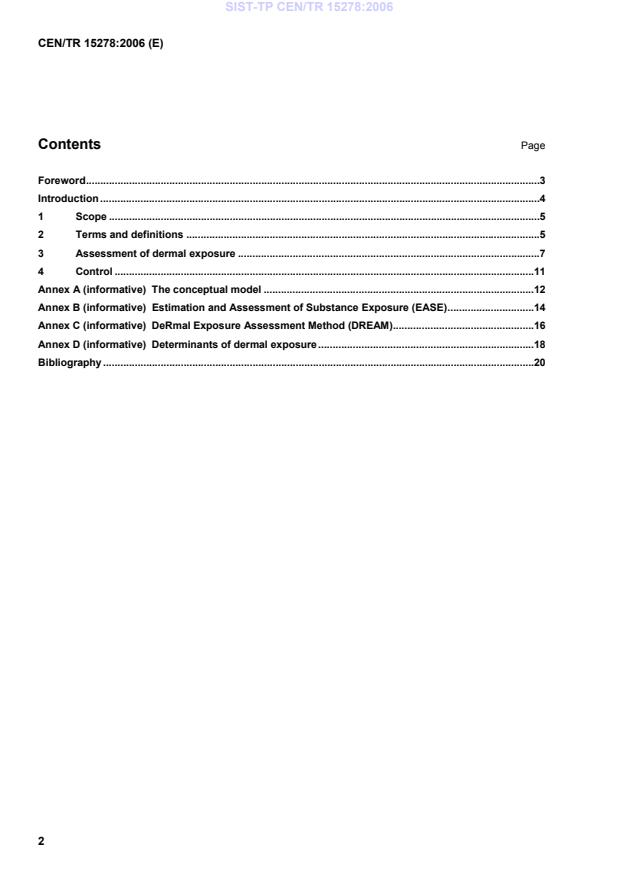
Contents Page
Foreword.3
Introduction .4
1 Scope .5
2 Terms and definitions .5
3 Assessment of dermal exposure .7
4 Control .11
Annex A (informative) The conceptual model .12
Annex B (informative) Estimation and Assessment of Substance Exposure (EASE).14
Annex C (informative) DeRmal Exposure Assessment Method (DREAM).16
Annex D (informative) Determinants of dermal exposure.18
Bibliography .20
Foreword
This Technical Report (CEN/TR 15278:2006) has been prepared by Technical Committee CEN/TC 137
“Assessment of workplace exposure to chemical and biological agents”, the secretariat of which is held by DIN.
Attention is drawn to the possibility that some of the elements of this document may be the subject of patent
rights. CEN shall not be held responsible for identifying any or all such patent rights.
Introduction
Dermal exposure assessment explores the dynamic interaction between environmental contaminants and the
skin. In contrast to inhalation exposure assessment, the assessment of dermal exposure remained a nascent
field of scientific research and applied occupational hygiene for most of the twentieth century, although
multiple fatalities and occupational skin diseases due to dermal exposure have been described in literature.
During the last decade, dermal exposure has received more attention, and one of the important results was
the development of a conceptual model for dermal exposure (see [1]). The model systematically describes the
transport of contaminant mass from exposure sources to the surface of the skin. The model provides a
structure for evaluating dermal exposure both qualitatively and quantitatively.
The purpose of evaluating dermal exposure can differ substantially, as exposure analysis (to give guidance to
control), risk assessment, and evaluation of exposure control can all be objectives to undertake assessments.
In order to give guidance and to harmonise basic concepts and actions a strategy for evaluation of dermal
exposure is proposed.
1 Scope
This Technical Report gives guidance on approaches for awareness and evaluation of dermal exposure in
workplaces.
This Technical Report describes strategies to evaluate exposure of the skin to chemical and biological agents
qualitatively and quantitatively, e.g. to analyse exposure, as part of the risk assessment process, to
investigate associations between exposure and diseases, and to evaluate control measures.
The definitions and procedures given in this document are primarily related to dermal exposure to chemical
substances.
The specifications given in this Technical Report are not applicable to microbiological skin contaminants.
2 Terms and definitions
For the purposes of this Technical Report, the following terms and definitions apply.
NOTE The definitions are based on the implementation of exposure terminology by IPCS (see [2]) and the
conceptual model (see [1]), see also Annex A.
2.1
agent
any chemical or biological entity on its own or admixed as it occurs in the natural state or as produced by any
work activity, whether or not produced intentionally and whether or not placed on the market
NOTE Adapted from EN 1540.
2.2
dermal contact volume
volume containing the mass of the agent that contacts the exposure surface
NOTE 1 The dermal contact volume is given in litres (l).
NOTE 2 The dermal contact volume is equivalent to the volume of the skin contaminant layer, and for practical reasons
it is defined by the mass in kilograms (kg) of all substances contained in this compartment.
2.3
dermal exposure
process of contact between an agent and human skin at an exposure surface over an exposure period
2.4
dermal exposure concentration
exposure mass divided by the dermal contact volume or the exposure mass divided by the mass contained in
the skin contaminant layer
NOTE The dermal exposure concentration is expressed in grams per liter (g/l) or grams per kilogram (g/kg)
respectively.
2.5
dermal exposure loading
exposure mass divided by the exposure surface
NOTE For practical reasons it can be expressed as the time-averaged mass divided by area-averaged skin
contaminant layer surface area in grams per square centimetre (g/cm ).
2.6
dermal exposure mass
mass of agent present in the dermal contact volume
NOTE 1 For practical reasons it is defined by the amount of agent in grams (g) present in the skin contaminant layer.
NOTE 2 The outcome of the process of dermal exposure, i.e. the contact, can be expressed by different parameters of
exposure.
2.7
dermal exposure surface
skin surface area where an agent is present
NOTE For practical reasons this is represented by a two dimensional representation of the skin contaminant layer in
square centimetres (cm ).
2.8
exposure period
time the agent is present in the skin contaminant layer, i.e. contact time
NOTE 1 The process by which an agent crosses an outer exposure surface of a target is called intake. In case of the
concentration driven transport from the skin contaminant layer into the skin, i.e. crossing the (exposure surface) interface
between skin contaminant layer and the stratum corneum as an absorption barrier, the process is called uptake. Therefore,
relevant for uptake would be the time- exposure concentration profile for an identified area of the skin contaminant layer
over a defined period of time.
NOTE 2 Other relevant types of time intervals, e.g. sampling time (B-C), immission or loading time (A-D), and post
emission time (D-E), are illustrated in Figure 1.
Key
X time
Y exposure loading
A-E exposure/contact time
A-D immission/loading time
D-E post immission time
B-C sampling time
Figure 1 — Different types of time intervals relevant in view of dermal exposure
2.9
immission
transport of an agent from a defined source to the skin or outer clothing contaminant layer compartment
2.10
potential dermal exposure mass
mass retrieved from (outer and inner clothing contaminant layer and exposure mass, i.e. mass retrieved from
the covered and uncovered by clothing) parts of the skin contaminant layer compartment
NOTE For practical reasons related to sampling methodology and strategy the term potential exposure mass has
been introduced. It refers to the agent mass that has the potential the reach the skin (contaminant layer) since it has
landed on the clothing and the agent mass that has actually reached the skin. The conceptual model distinguishes
between outer and inner clothing contaminant layer compartment, respectively, and characterises the clothing itself as a
buffer layer.
2.11
skin contaminant layer compartment
compartment on top of the stratum corneum of the human skin
NOTE The skin contaminant layer compartment is formed by sebum lipids, sweat and additional water from
transepidermal water loss, rest products from cornification and unshed corneocytes, and is given by its three dimensional
volume.
2.12
workplace
the defined area or areas in which the work activities are carried out
[EN 1540:1998, 3.36]
3 Assessment of dermal exposure
3.1 General
Sampling strategies provide general guidelines to approach dermal exposure issues systematically. This
approach is according to the conceptual model illustrated in Figure A.1. The conceptual model structures the
process of dermal exposure to chemicals and assists in evaluating the performance of sampling methods.
Basically, the model systematically describes the transport of contaminant mass from the source onto the
surface of the skin. Six compartments, i.e. three environmental compartments (air, surface and source) and
three personal compartments (outer and inner clothing, and skin contaminant layer) and eight mass transport
processes onwards and from the compartments are distinguished and their mutual relationship is outlined.
3.2 Objectives
In general, five objectives for assessing dermal exposure can be distinguished:
a) evaluation of exposure processes and pathways
Evaluation of exposure processes and pathways is an important tool for selecting an adequate sampling
strategy and for effective risk management.
b) evaluation of exposure control measures or interventions
Evaluation of control measures is relevant in view of effectiveness of exposure reduction and post-intervention
surveillance.
c) risk assessment
Results for risk assessment purposes should be linked to results of hazard assessment. Hazardous agents
that show local effects are distinguished from hazardous agents that show systemic health effects after uptake
(see [3]). For the first group of agents, quantitative exposure assessment seems to be very difficult, however
some data are available on effect and dosage and duration.
d) epidemiological investigations
To investigate possible associations between exposure and health effects by epidemiological investigations
estimates of relevant parameters of exposure are needed.
e) compliance
Compliance sampling is relevant in case exposure limits have been set. At the present time no such limits
have been set by National Authorities or other International Bodies. However, in-company exposure limits are
used as action levels or references for compliance. Such limits may be at the level of any parameter of dermal
exposure, i.e. exposure mass, exposure loading, exposure surface area, or at the level of determinants of
exposure, e.g. surface contamination in case of transfer, or at the level of intake by aggregated exposure
routes including the dermal route, e.g. biological monitoring limit values. The last two types of limit values,
however, are beyond the scope of this document.
3.3 Models and semi quantitative estimates
3.3.1 Objectives
Most models provide estimates of the likelihood of skin exposure or skin contamination that can be used as a
first tier in exposure assessment processes. Application of the models is analogous to the first two steps, i.e.
initial appraisal and basic survey, of a tiered approach as given for airborne contamination by EN 689. The
estimates provided by the models can be used for an initial evaluation of the exposure process, initial
exposure assessment in view of risk assessment processes, and estimation of exposure levels for
epidemiological studies. Moreover, the results will be helpful to select an appropriate sampling strategy for
quantitative exposure assessment and to prioritise control measures.
3.3.2 Methods
Categorical estimates, e.g. ever-never, yes-no or exposure classes (low, medium, high) can result from
human expert approaches. More structured approaches in combination with computer or human expert
systems can provide semi-quantitative estimates of dermal contamination. Basically, structured approaches
use identified or assumed determinants of exposure (or contamination). Examples of such approaches are
EASE (Estimation and Assessment of Substance Exposure, see [4]) and the semi-quantitative DREAM
(DeRmal Exposure Assessment Method, see [5]).
The decision logic of EASE is outlined in Annex B. According to EASE three key selections are made:
a) compound-specification physical state;
b) pattern-of-use one (range from non to wide dispersive use;
c) selection of level of contact.
The end-points of the decision logic (five boxes) are linked to ranges of exposure levels (see [6]).
DREAM consists of an inventory and an evaluation part. The inventory part comprises a hierarchically
structured questionnaire with six modules: company, department, agent, job, task and exposure (see Table
C.1). Information is obtained by observations and interviews. The modules address general information as
well as possible determinants of exposure as identified by the conceptual model and by evaluating literature.
In the DREAM model evaluation of exposure takes place on the level of tasks. A summary of the evaluation
module is given in Figure C.1. Examples of determinants of dermal exposure are identified (see [7]) and given
in Annex D.
For an initial systematically description of dermal exposure situations in different industry sectors, so called
dermal operation (DEO)-units can be used, as developed by the RISKOFDERM project (see [8]). The DEO-
units handling of contaminated objects, manual dispersion, hand tool dispersion, spray dispersion, immersion,
and mechanical treatment include several task-groups or scenarios.
In the RISKOFDERM project a so-called toolkit for dermal exposure assessment and management has been
developed (see [9]). The toolkit provides some first estimates to determine the risk associated to dermal
exposure to hazardous substances. Default values for potential exposure loading per unit time for hands and
body for the DEO-units were derived from literature (see [10]). In addition, the magnitude of the effect of
determinants or modifiers of exposure was estimated (see [11]).
Semi-deterministic models or mixed subjective (semi-) deterministic models have been developed for specific
exposure scenario’s, e.g. paint spraying (see [12] and [13]), and non-industrial pesticide application, and re-
entry work (see [14]), and biocides (see [15]).
3.4 Measurements to quantify dermal exposure
3.4.1 Objectives and sampling strategy
For the objectives for assessing dermal exposure (see 3.2), the following should be taken into consideration:
a) for evaluating exposure processes and pathways and in view of the conceptual model it is relevant to
know mass transport rates from different compartments to the skin contaminant layer and how the
different transports contribute to total contamination;
b) to evaluate exposure control measures it would be appropriate to measure compartment agent
(contaminant) mass;
c) for risk assessment it would be relevant to measure the concentration/time profile in the skin contaminant
layer;
d) for compliance measurements the definition of the exposure limit would prescribe what should be
measured;
e) for epidemiological investigations the mechanisms of the health effect or other considerations will
determine the relevant parameters of exposure.
Developing an appropriate sampling strategy related to the sampling objectives should include the selection of
the relevant:
agent;
workplace;
population/ jobs/ tasks;
sample size;
time of sampling;
sampling duration;
frequency of sampling;
body locations;
sampling method(s).
3.4.2 Measurement principles
Selection of the measurement principle depends very much on the sampling objective and is a key issue in
designing a measurement strategy. Measurement methods for dermal exposure assessment, i.e. taking a
substance and identify and quantify an agent, can be grouped into three major principles:
sampling: interception of agent mass transport by the use of collection media placed at the skin surface or
replacing work clothing during the sampling time, i.e. interception techniques. Detection e.g. chemical
analysis of extracts from the collection matrix;
sampling: removal of the agent mass from the skin contaminant layer at any given time or the end of the
sampling period, i.e. removal techniques. Detection e.g. chemical analysis of extracts from the removal
matrix such as wash liquid, wipe fabrics;
direct assessment: In situ detection of the agent or a tracer at the skin surface, e.g. by image acquisition
and processing systems, at a given time.
The different sampling and measurement principles estimate different quantities:
interception techniques estimate exposure mass;
removal and in situ (direct) techniques estimate exposure loading;
Furthermore the results obtained by different sampling principles
...