


EN 16618:2015
(Main)Food analysis - Determination of acrylamide in food by liquid chromatography tandem mass spectrometry (LC-ESI-MS/MS)
Food analysis - Determination of acrylamide in food by liquid chromatography tandem mass spectrometry (LC-ESI-MS/MS)
This European Standard specifies a method for the determination of acrylamide in bakery ware such as bread, toasted bread, crisp bread, butter cookies, and biscuits, as well as potato products such as potato chips, potato crisps, and potato pan cake and roasted coffee, by liquid chromatography in combination with electrospray ionization and tandem mass spectrometry (LC-ESI-MS/MS). This method has been validated in an interlaboratory study via the analysis of both naturally contaminated and spiked samples, ranging from 14,3 µg/kg to 9 083 µg/kg. It was developed at the Swedish National Food Administration and validated in a study organized by the Directorate General Joint Research Centre (DG JRC), Swedish National Food Administration and the Nordic Committee on Food Analysis (NMKL), see [1] and [2].
The limit of quantification (LOQ) depends on the type of instrument used and on the actual performance of the instrument. The majority of the laboratories participating in the validation study were able to determine acrylamide in a butter cookie sample at a level of 14,3 µg/kg. Thus, the validation by interlaboratory study showed that LOQ can be expected to be in the range between below 15 µg/kg and 30 µg/kg.
Lebensmittelanalytik - Bestimmung von Acrylamid in Lebensmitteln mit Flüssigchromatographie und Tandem-Massenspektrometrie (LC-ESI-MS/MS)
Diese Europäische Norm legt ein Verfahren zur Bestimmung von Acrylamid in Backwaren, wie z. B. Brot, getoastetem (geröstetem) Brot, Knäckebrot, Butterkeksen und Keksen, sowie in Kartoffelprodukten, wie z. B. Pommes frites, Kartoffelchips und Kartoffelpuffern, und Röstkaffee durch Flüssigchromatographie in Kombination mit Elektrospray-Ionisation und Tandem-Massenspektrometrie (LC-ESI-MS/MS) fest. Dieses Verfahren wurde in einem Ringversuch mit sowohl natürlich kontaminierten als auch aufgestockten Proben im Bereich von 14,3 µg/kg bis 9 083 µg/kg validiert. Es wurde von der Schwedischen Behörde für Lebensmittelsicherheit (Swedish National Food Administration) entwickelt und in einer Studie validiert, die von der Generaldirektion Gemeinsame Forschungsstelle (Directorate General Joint Research Centre, DG JRC), der Schwedischen Behörde für Lebensmittelsicherheit und dem Nordischen Komitee für Lebensmittelanalytik (Nordic Committee on Food Analysis, NMKL) organisiert wurde, siehe [1] und [2].
Die Bestimmungsgrenze (en: LOQ, limit of quantification) hängt von der Art des eingesetzten Gerätes und dessen tatsächlichem Leistungsvermögen ab. Die Mehrheit der an der Validierungsstudie teilnehmenden Laboratorien war in der Lage, Acrylamid in einer Butterkeksprobe bei einer Konzentration von 14,3 µg/kg zu bestimmen. Die Validierung durch den Ringversuch zeigte daher, dass die Bestimmungsgrenze im Bereich von weniger als 15 µg/kg bis 30 µg/kg erwartet werden kann.
Analyse des produits alimentaires - Dosage de l'acrylamide dans les produits alimentaires par chromatographie en phase liquide couplée à la spectrométrie de masse en tandem (CL-ESI-SM-SM)
Le présent document spécifie une méthode de dosage, par chromatographie en phase liquide en mode ionisation par électrovaporisation couplée à la spectrométrie de masse en tandem (CL-ESI-SM/SM), de l’acrylamide dans les produits de boulangerie tels que le pain, le pain grillé, le pain suédois, les biscuits au beurre et les biscuits épicés, ainsi que dans les produits à base de pomme de terre tels que les frites, les chips et les galettes de pomme de terre et le café torréfié. Cette méthode a été validée lors d’un essai interlaboratoires impliquant l’analyse d’échantillons naturellement contaminés et d’échantillons enrichis, sur une plage de 14,3 µg/kg à 9 083 µg/kg. Elle a été développée au sein de l’Agence suédoise des aliments et validée lors d’un essai organisé par le Centre commun de recherche de la Direction générale (DG JRC), l’Agence suédoise des aliments et le Comité nordique sur l’analyse des aliments (NMKL), voir [1] et [2].La limite de quantification (LOQ) dépend du type d’instrument utilisé et de la performance réelle de l’instrument. La majorité des laboratoires participant à l’essai de validation a pu doser l’acrylamide dans un échantillon de biscuit au beurre à un niveau de 14,3 µg/kg. La validation effectuée lors de l’essai interlaboratoires a montré que ce niveau devait se situer entre une valeur inférieure à 15 µg/kg et 30 µg/kg.
Analize živil - Določevanje akrilamida v živilih s tekočinsko kromatografijo s tandemsko masno spektrometrijo (LC-ESI-MS-MS)
General Information
- Status
- Published
- Publication Date
- 21-Apr-2015
- Withdrawal Date
- 30-Oct-2015
- Technical Committee
- CEN/TC 275 - Food analysis - Horizontal methods
- Drafting Committee
- CEN/TC 275/WG 13 - Neoformed contaminants
- Current Stage
- 9020 - Submission to 2 Year Review Enquiry - Review Enquiry
- Start Date
- 15-Apr-2026
- Completion Date
- 15-Apr-2026
Relations
- Effective Date
- 28-Jan-2026
- Effective Date
- 28-Jan-2026
- Effective Date
- 28-Jan-2026
Overview
EN 16618:2015 - Food analysis: Determination of acrylamide in food by liquid chromatography tandem mass spectrometry (LC-ESI-MS/MS) - is a CEN European Standard specifying a validated LC-ESI-MS/MS method for quantifying acrylamide in food. The standard targets bakery products (bread, toasted bread, crisp bread, butter cookies, biscuits), potato products (chips, crisps, pancakes), and roasted coffee. Developed at the Swedish National Food Administration and validated in an interlaboratory study organized by DG JRC, SNFA and NMKL, the method is validated across a concentration range from 14.3 µg/kg to 9 083 µg/kg. Reported limits of quantification (LOQ) depend on instrumentation but were generally between below 15 µg/kg and 30 µg/kg in the validation study.
Key topics and technical requirements
- Analytical technique: Liquid chromatography with electrospray ionization tandem mass spectrometry (LC-ESI-MS/MS) using triple‑quadrupole MS in positive electrospray and selected reaction monitoring (SRM) mode.
- Internal standard: Use of isotopically labelled acrylamide (acrylamide-2,3,3-D3 or 13C-labelled) for accurate quantification.
- Sample preparation: Water extraction (example: 2 g sample with 40 ml water), addition of internal standard, centrifugation and two-step solid phase extraction (SPE) cleanup:
- SPE 1: multimode (C18 + strong anion/cation exchange) as a chemical filter to remove matrix components.
- SPE 2: polymeric (crosslinked polystyrene‑divinylbenzene) phase to retain and concentrate acrylamide.
- Chromatography: HPLC column with graphitized carbon stationary phase recommended for robust retention of acrylamide.
- Performance & validation: Interlaboratory-validated method across a broad working range; calibration on multiple concentration levels; LOQ instrument-dependent (majority achieving ~14.3 µg/kg).
- Safety and quality: Acrylamide is classified as probably carcinogenic - use appropriate PPE and fume hood. Include procedural blanks to monitor contamination and artefact formation. Avoid temperatures > 40 °C during extraction and work-up.
Applications
- Routine monitoring and compliance testing of acrylamide in food for regulatory, quality assurance and research laboratories.
- Product development and mitigation studies to assess processing effects on acrylamide formation (baking, frying, roasting).
- Surveillance programs by food safety authorities and interlaboratory method validation exercises.
Who should use this standard
- Food testing and analytical chemistry laboratories (public and private)
- National food control agencies and regulatory bodies
- Food industry QA/QC and R&D teams concerned with acrylamide reduction
- Contract testing laboratories performing LC-MS/MS analyses
Related standards
- EN ISO 3696:1995 - Water for analytical laboratory use
- EN ISO 1042:1999 - Laboratory glassware (volumetric flasks)
Keywords: EN 16618:2015, acrylamide, LC-ESI-MS/MS, food analysis, SPE cleanup, graphitized carbon column, limit of quantification, interlaboratory validation.

Get Certified
Connect with accredited certification bodies for this standard

BSI Group
BSI (British Standards Institution) is the business standards company that helps organizations make excellence a habit.

Bureau Veritas
Bureau Veritas is a world leader in laboratory testing, inspection and certification services.

DNV
DNV is an independent assurance and risk management provider.
Sponsored listings
Frequently Asked Questions
EN 16618:2015 is a standard published by the European Committee for Standardization (CEN). Its full title is "Food analysis - Determination of acrylamide in food by liquid chromatography tandem mass spectrometry (LC-ESI-MS/MS)". This standard covers: This European Standard specifies a method for the determination of acrylamide in bakery ware such as bread, toasted bread, crisp bread, butter cookies, and biscuits, as well as potato products such as potato chips, potato crisps, and potato pan cake and roasted coffee, by liquid chromatography in combination with electrospray ionization and tandem mass spectrometry (LC-ESI-MS/MS). This method has been validated in an interlaboratory study via the analysis of both naturally contaminated and spiked samples, ranging from 14,3 µg/kg to 9 083 µg/kg. It was developed at the Swedish National Food Administration and validated in a study organized by the Directorate General Joint Research Centre (DG JRC), Swedish National Food Administration and the Nordic Committee on Food Analysis (NMKL), see [1] and [2]. The limit of quantification (LOQ) depends on the type of instrument used and on the actual performance of the instrument. The majority of the laboratories participating in the validation study were able to determine acrylamide in a butter cookie sample at a level of 14,3 µg/kg. Thus, the validation by interlaboratory study showed that LOQ can be expected to be in the range between below 15 µg/kg and 30 µg/kg.
This European Standard specifies a method for the determination of acrylamide in bakery ware such as bread, toasted bread, crisp bread, butter cookies, and biscuits, as well as potato products such as potato chips, potato crisps, and potato pan cake and roasted coffee, by liquid chromatography in combination with electrospray ionization and tandem mass spectrometry (LC-ESI-MS/MS). This method has been validated in an interlaboratory study via the analysis of both naturally contaminated and spiked samples, ranging from 14,3 µg/kg to 9 083 µg/kg. It was developed at the Swedish National Food Administration and validated in a study organized by the Directorate General Joint Research Centre (DG JRC), Swedish National Food Administration and the Nordic Committee on Food Analysis (NMKL), see [1] and [2]. The limit of quantification (LOQ) depends on the type of instrument used and on the actual performance of the instrument. The majority of the laboratories participating in the validation study were able to determine acrylamide in a butter cookie sample at a level of 14,3 µg/kg. Thus, the validation by interlaboratory study showed that LOQ can be expected to be in the range between below 15 µg/kg and 30 µg/kg.
EN 16618:2015 is classified under the following ICS (International Classification for Standards) categories: 67.050 - General methods of tests and analysis for food products; 67.060 - Cereals, pulses and derived products; 67.080.20 - Vegetables and derived products; 67.140.20 - Coffee and coffee substitutes. The ICS classification helps identify the subject area and facilitates finding related standards.
EN 16618:2015 has the following relationships with other standards: It is inter standard links to EN ISO 1042:1999, EN ISO 3696:1995, EN ISO 21549-6:2008. Understanding these relationships helps ensure you are using the most current and applicable version of the standard.
EN 16618:2015 is associated with the following European legislation: EU Directives/Regulations: 882/2004; Standardization Mandates: M/463. When a standard is cited in the Official Journal of the European Union, products manufactured in conformity with it benefit from a presumption of conformity with the essential requirements of the corresponding EU directive or regulation.
EN 16618:2015 is available in PDF format for immediate download after purchase. The document can be added to your cart and obtained through the secure checkout process. Digital delivery ensures instant access to the complete standard document.
Standards Content (Sample)
2003-01.Slovenski inštitut za standardizacijo. Razmnoževanje celote ali delov tega standarda ni dovoljeno.Lebensmittelanalytik - Bestimmung von Acrylamid in Lebensmitteln mit Flüssigkeitschromatographie und Tandem-Massenspektrometrie (LC-ESI-MS/MS)Analyse des produits alimentaires - Dosage de l'acrylamide dans les produits alimentaires par chromatographie en phase liquide couplée à la spectrométrie de masse en tandem (CL-ESI-SM-SM)Food analysis - Determination of acrylamide in food by liquid chromatography tandem mass spectrometry (LC-ESI-MS/MS)67.050Splošne preskusne in analizne metode za živilske proizvodeGeneral methods of tests and analysis for food productsICS:Ta slovenski standard je istoveten z:EN 16618:2015SIST EN 16618:2015en,fr,de01-julij-2015SIST EN 16618:2015SLOVENSKI
STANDARD
EUROPEAN STANDARD NORME EUROPÉENNE EUROPÄISCHE NORM
EN 16618
April 2015 ICS 67.050; 67.060; 67.080.20; 67.140.20 English Version
Food analysis - Determination of acrylamide in food by liquid chromatography tandem mass spectrometry (LC-ESI-MS/MS)
Analyse des produits alimentaires - Dosage de l'acrylamide dans les produits alimentaires par chromatographie en phase liquide couplée à la spectrométrie de masse en tandem (CL-ESI-SM-SM)
Lebensmittelanalytik - Bestimmung von Acrylamid in Lebensmitteln mit Flüssigchromatographie und Tandem-Massenspektrometrie (LC-ESI-MS/MS) This European Standard was approved by CEN on 7 February 2015.
CEN members are bound to comply with the CEN/CENELEC Internal Regulations which stipulate the conditions for giving this European Standard the status of a national standard without any alteration. Up-to-date lists and bibliographical references concerning such national standards may be obtained on application to the CEN-CENELEC Management Centre or to any CEN member.
This European Standard exists in three official versions (English, French, German). A version in any other language made by translation under the responsibility of a CEN member into its own language and notified to the CEN-CENELEC Management Centre has the same status as the official versions.
CEN members are the national standards bodies of Austria, Belgium, Bulgaria, Croatia, Cyprus, Czech Republic, Denmark, Estonia, Finland, Former Yugoslav Republic of Macedonia, France, Germany, Greece, Hungary, Iceland, Ireland, Italy, Latvia, Lithuania, Luxembourg, Malta, Netherlands, Norway, Poland, Portugal, Romania, Slovakia, Slovenia, Spain, Sweden, Switzerland, Turkey and United Kingdom.
EUROPEAN COMMITTEE FOR STANDARDIZATION
COMITÉ EUROPÉEN DE NORMALISATION EUROPÄISCHES KOMITEE FÜR NORMUNG
CEN-CENELEC Management Centre:
Avenue Marnix 17,
B-1000 Brussels © 2015 CEN All rights of exploitation in any form and by any means reserved worldwide for CEN national Members. Ref. No. EN 16618:2015 ESIST EN 16618:2015
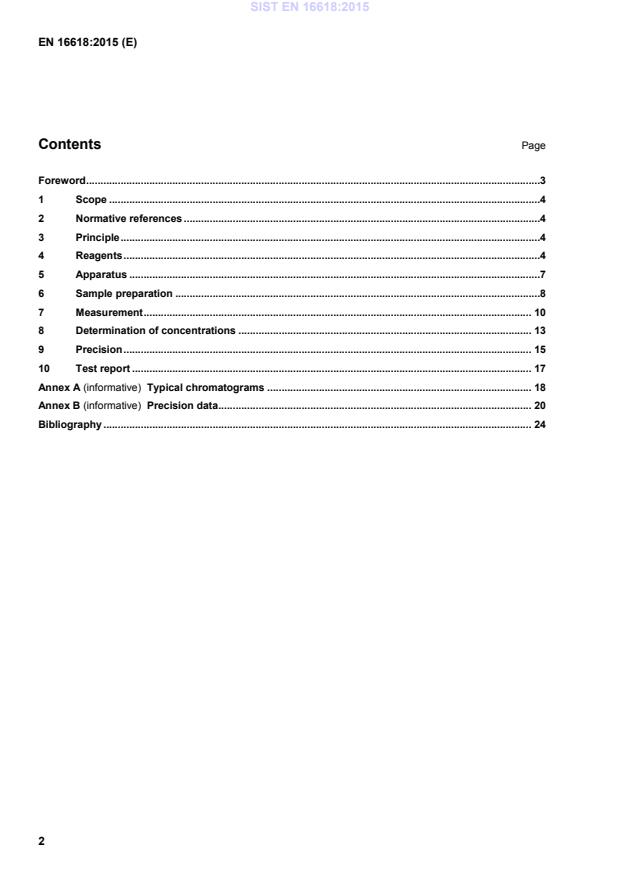
Typical chromatograms . 18 Annex B (informative)
Precision data . 20 Bibliography . 24
Figure 1 — Acrylamide WARNING — Acrylamide has been classified by the International Agency for Research on Cancer (IARC) as probably carcinogenic to humans. Protective equipment as laboratory coat, disposable gloves and safety glasses shall be used. All handlings of acrylamide and organic solvents shall be performed in a fume cupboard with adequate air flow. 4.2 Deuterium-labelled acrylamide – acrylamide-2,3,3-D3 (CAS 122775-19-3). The chemical structure is:
Figure 2 — Deuterium-labelled acrylamide Alternatively, 13C-labelled acrylamide (acrylamide-13C3, CAS 287399-26-2) may be used. 4.3 Methanol (CAS 67-56-1). 4.4 Glacial acetic acid (CAS 64-19-7). 4.5 n-Hexane (CAS 110-54-3). Alternatively, cyclohexane (CAS 110-82-7) may be used. 4.6 Eluent for SPE column 2 (5.2.3) Mix 60 parts per volume of methanol (4.3) with 40 parts per volume of water. 4.7 HPLC mobile phase Mix 1 part per volume of glacial acetic acid (4.4) with 1 000 parts per volume of water. 4.8 Stock solutions of acrylamide and acrylamide-2,3,3-D3, mass concentration
= 1 000
Weigh, to the nearest 0,05 mg, approximately 100 mg of acrylamide and acrylamide-2,3,3-D3 respectively into separate 100 ml volumetric flasks, dissolve in water and dilute to 100 ml. Solutions can be stored at 4 °C for at least 3 months. 4.9 Internal standard solution 1,
= 10
Transfer 1 000 -2,3,3-D3 (4.8) to a 100 ml volumetric flask and dilute to the mark with water. SIST EN 16618:2015
= 1 000 ng/ml. Transfer 5 000
internal standard solution 1 (4.9) to a 50 ml volumetric flask and dilute to the mark with water. 4.11 Acrylamide standard solution 1,
= 100
Transfer 5 000 4.8) to a 50 ml volumetric flask and dilute to the mark with water. 4.12 Acrylamide standard solution 2,
= 10
Transfer 5 000
1 (4.11) to a 50 ml volumetric flask and dilute to the mark with water. 4.13 Acrylamide standard solution 3,
= 100 ng/ml. Transfer 1 000
2 (4.12) to a 100 ml volumetric flask and dilute to the mark with water. 4.14 LC-MS calibration solutions Dilute aliquots from standard solutions (4.9), (4.11), (4.12) and (4.13) with water to give calibration solutions of e.g. 0 ng/ml, 5 ng/ml, 10 ng/ml, 20 ng/ml, 50 ng/ml, 100 ng/ml, 250 ng/ml, 500 ng/ml, 1 000 ng/ml, 2 000 ng/ml, 5 000 ng/ml and 10 000 ng/ml respectively of acrylamide, all containing 400 ng/ml of acrylamide-2,3,3-D3. Examples for the preparation of calibration solutions are given in Table 1. Table 2 indicates the relation between calibration solution concentrations and acrylamide contents of food samples. Calibration shall be performed on at least six concentration levels distributed properly over the working range. The analysis of an even higher number of calibration solutions should be analysed if such a broad range of concentrations (0
Table 1 — Preparation of LC-MS calibration solutions Calibration solution ng/ml Volumetric flask ml Internal standard solution (4.9)
Acrylamide standard solution
0 100 4 000 0 5 100 4 000 5 000 of (4.13) 10 100 4 000 10 000 of (4.13) 20 100 4 000 200 of (4.12) 50 100 4 000 500 of (4.12) 100 100 4 000 1 000 of (4.12) 250 100 4 000 2 500 of (4.12) 500 100 4 000 5 000 of (4.12) 1 000 100 4 000 1 000 of (4.11) 2 000 100 4 000 2 000 of (4.11) 5 000 100 4 000 5 000 of (4.11) 10 000 50 4 000 5 000 of (4.11) SIST EN 16618:2015
Roasted coffee
10 10 50 5 Apparatus Usual laboratory glassware and equipment and, in particular, the following: 5.1 LC-MS/MS system 5.1.1 HPLC apparatus, comprising the following: 5.1.1.1 Thermostated column compartment. 5.1.1.2 Injection system, capable of injecting 10
5.1.1.3 Mobile phase pump, capable of maintaining a mobile phase flow of 0,4 ml/min. 5.1.2 HPLC column The stationary phase of the column is graphitized carbon1a), particle size 5
mm x 2,1 mm with a guard column1a), particle size 5
mm x 2 mm. Alternative columns/stationary phases may be applied provided that similar performance to the graphitized carbon column can be demonstrated. 5.1.3 Mass spectrometer Triple quadrupole mass spectrometer operating in positive electrospray and, selected reaction monitoring mode (SRM), set to obtain unit resolution. 5.1.4 Data acquisition and analysis system Suitable data collection and evaluation software. 5.1.5 Divert valve (optional) HPLC valve installed between HPLC column and mass spectrometer in order to direct the HPLC effluent either to waste or to the mass spectrometer, see 7.1.1. 5.2 Solid phase extraction system 5.2.1 Vacuum manifold for solid phase extraction
1) a) Hypercarb™ column, Thermo Hypersil-Keystone® column, b) ISOLUTE ® Multimode SPE column and c) ISOLUTE ® ENV+ SPE column from Biotage® are examples of suitable products available commercially. This information is given for the convenience of users of this European Standard and does not constitute an endorsement by CEN of these products. Equivalent products may be used if they can be shown to lead to the same results. SIST EN 16618:2015
5.6 Centrifuge tubes, volume of 50 ml, polypropylene, disposable. 5.7 Mechanical shaker, e.g. wrist arm shaker, allowing well mixing of different phases, capable of holding 50 ml centrifuge tubes. 5.8 Vortex mixer. 5.9 Cooled centrifuge, capable of a centrifugal force of 3 600 g for 50 ml centrifuge tubes. 5.10 Volumetric flasks, volume of 50 ml, 100 ml, etc. according to EN ISO 1042:1999. 5.11 Glass vials, volume of at least 4 ml, suitable for the evaporation equipment. 5.12 Amber glass autosampler vials, suitable for the HPLC autosampler. 5.13 Evaporation equipment, based on vacuum or a stream of inert gas. The evaporation temperature shall not exceed 40 °C. 6 Sample preparation 6.1 General Residues of acrylamide have sometimes been found in laboratory ware as e.g. filters. Make sure the laboratory ware does not contain any measureable amounts of acrylamide, and include procedural blank samples as controls in each series of samples. Acrylamide has been found to be formed as an artefact in some analytical procedures for acrylamide, e.g. during extraction or in the injection port of GC instruments. Even if this is not a problem for HPLC analysis, make sure to never exceed 40 °C during extraction or the work-up process. It has been proven that acrylamide is efficiently extracted from various types of food by shaking with water if the particles of the samples are small enough. Make sure that the particles are < 1 mm before extraction and use, if necessary, a mechanical device for preparation of homogenous slurry2).
2) Ultra Turrax® and Waring blender® are examples of suitable products available commercially. This information is given for the convenience of the users of this European Standard and does not constitute an endorsement by CEN of these products. Equivalent products may be used if they can be shown to lead to the same results. SIST EN 16618:2015
2, c = 1 000 ng/ml (4.10). Shake intensively for 15 s to 30 s by hand and 10 s to 15 s with a vortex mixer (5.8), and then for 60 min on a mechanical shaker (5.7) adjusted to maximum sample-extractant agitation. Centrifuge in a cooled centrifuge (5.9) at 10 °C, 3 600 x g for 20 min and take off 10 ml of the aqueous phase to a clean test tube. Avoid to transfer parts of the fat layer that will be formed and found on the top, depending of the fat content of the sample. Take care that a homogenous slurry is formed and that the whole sample is in contact with the extractant. If the described procedure is for any reason not sufficient to produce a homogenous slurry, additional mechanical forces shall be applied by e.g. application of a device for preparation of homogenous slurry. 6.2.2 Extraction procedure for coffee samples Weigh, to the nearest 0,01 g, a 2,0 g test portion into a 50 ml centrifuge tube (5.6). Add 5 ml of n-hexane (alternatively cyclohexane). Add 40 ml of water. Add 400
2, c = 1 000 ng/ml (4.10). Shake intensively for 15 s to 30 s by hand and 10 s to 15 s with a vortex mixer (5.8), and then for 60 min on a mechanical shaker (5.7), adjusted to maximum sample-extractant agitation. Centrifuge in a cooled centrifuge (5.9) at 10 °C, 3 600 x g for 20 min. Check for proper phase separation of n-hexane (or cyclohexane), aqueous and solid phase. Remove and discard the organic solvent phase (n-hexane or cyclohexane), and transfer 10 ml of the aqueous phase to a clean test tube. Take care that a homogenous slurry is formed and that the whole sample is in contact with the extractant. If the described procedure is for any reason not sufficient to produce a homogenous slurry, additional mechanical forces shall be applied by, e.g. application of a device for preparation of homogenous slurry. NOTE Cyclohexane is a suitable alternative for n-hexane. 6.3 Cleanup 6.3.1 Cleanup for bakery and potato product sample For all steps adjust the flow of the SPE columns to let the liquid elute drop wise (about 30 drops per min). Check the completeness of elution of acrylamide from the SPE column 2 (5.2.3) by recording the elution profile, at least for each new batch of columns. Fit SPE column 1 (5.2.2) to the vacuum manifold (5.2.1). Condition the column with 3 ml of methanol and 2 times with 6 ml of water. Pass 10 ml of the aqueous extract (6.2.1) through the column and collect the eluate. Fit SPE column 2 (5.2.3) to the vacuum manifold (5.2.1). Condition the column with 5 ml of methanol and 5 ml of water. Load the extract (approximately 10 ml) from the previous column and discard the eluate. Rinse the column once with 4 ml of water and discard the rinsing solvent. Assure that no eluate is left in the valves or flow channels of the vacuum manifold by e.g. placing the column on another (dry) position of the vacuum manifold. Rinsing solvent that is left in the valves could contain co-extracts that could interfere with the internal standard peak. After rinsing, elute acrylamide with 2 ml of 60 % methanol in water (4.6). Collect the elution SIST EN 16618:2015
...
Questions, Comments and Discussion
Ask us and Technical Secretary will try to provide an answer. You can facilitate discussion about the standard in here.
Loading comments...