

EN 474-9:2022
(Main)Earth-moving machinery - Safety - Part 9: Requirements for pipelayers
- Abstract
This document, together with EN 474 1:2022, deals with all significant hazards, hazardous situations and events relevant to pipelayers as defined in 3.1, when used as intended and under the conditions of misuse which are reasonably foreseeable by the manufacturer (see Annex A) associated with the whole lifetime of the machine as described in EN ISO 12100:2010, 5.4.
The requirements of this document are complementary to the common requirements formulated in EN 474 1:2022. This document does not repeat the requirements of EN 474 1:2022 but supplements or modifies the requirements for pipelayers.
This document also specifies additional requirements for rear mounted winches.
This document does not provide performance requirements for safety related functions of control system(s).
The following significant and relevant hazards are not covered in this document:
— Transmission of power between self-propelled machinery (or tractor) and recipient machinery;
— Laser;
— Lightning.
Pipelayers with rotating upper structure are excluded from the scope of this document.
This document is not applicable to pipelayers manufactured before the date of publication of this document by CEN.
- Status
- Published
- Publication Date
- 29-Mar-2022
- Technical Committee
- CEN/TC 151 - Construction equipment and building material machines - Safety
- Drafting Committee
- CEN/TC 151/WG 1 - Earth-moving machinery - Safety
- Current Stage
- 6060 - Definitive text made available (DAV) - Publishing
- Start Date
- 30-Mar-2022
- Due Date
- 25-May-2019
- Completion Date
- 30-Mar-2022
- Directive
- 2006/42/EC - Directive 2006/42/EC of the European Parliament and of the Council of 17 May 2006 on machinery, and amending Directive 95/16/EC (recast)OJ Ref: OJ L 194 OJ Date: 02-Aug-2023



Overview
EN 474-9:2022 - "Earth-moving machinery - Safety - Part 9: Requirements for pipelayers" (CEN) is the type‑C safety standard that supplements the general requirements in EN 474-1:2022. It defines machine-specific safety requirements for self‑propelled pipelayers (crawler or wheeled) across their lifetime when used as intended or under reasonably foreseeable misuse. The standard excludes pipelayers with a rotating upper structure and certain hazards (power transmission between machines, laser, lightning). It also does not set performance requirements for safety‑related control system functions.
Key topics and technical requirements
- Scope and complementarity: Works together with EN 474-1:2022; does not repeat common requirements but modifies or adds pipelayer‑specific provisions.
- Operator protection: Pipelayers must be supplied with a cab and appropriate rollover/top protection (ROPS/TOPS).
- Visibility and ergonomics: Means to ensure clear operator visibility of the pipe area during lifting and translation (e.g., swivelling/turning seats) and motorised wipers/washer for windows in travelling and lifting directions.
- Vibration control: Machines exceeding the standard’s vibration threshold must be fitted with a suspended operator seat compliant with EN ISO 7096:2020 (class EM6); alternatively, a compliant suspended seat may be supplied without testing.
- Lifting and hoisting safety: Lifting equipment to meet ISO 8813; devices to control lowering speed; load capacity indicators and warning devices are required and must account for ground slope and display load weight and rated capacity. A lowering limiter is required for hoists (minimum rope turns on drum specified).
- Rear‑mounted winch: Additional design guidance referenced (ISO 19472:2006).
- Documentation and verification: Machine marking, operator’s manual, safety labels and verification/validation methods are specified to support safe use and conformity.
Practical applications
- Ensures safer design and operation of pipelayers used in pipeline construction, utilities installation, and trenchless operations.
- Reduces risk of tipping, uncontrolled lowering, operator vibration exposure, and poor visibility during pipe handling.
- Helps manufacturers demonstrate conformity with EU machinery directives and national adoption through CEN members.
Who should use this standard
- Manufacturers and designers of pipelayers and attachments.
- Safety engineers, compliance officers and conformity assessors verifying machinery against EN and EU requirements.
- Fleet owners, operators and maintenance providers seeking guidance on safe operation, maintenance, labeling and information for use.
Related standards
- EN 474-1:2022 (general requirements)
- ISO 8813 (lift capacity for pipelayers)
- EN ISO 7096:2020 (operator seat vibration)
- ISO 19472:2006 (rear winch guidance)
Keywords: EN 474-9:2022, pipelayers safety, earth-moving machinery, load capacity indicator, rear mounted winch, operator visibility, ROPS TOPS, EN 474-1.
Relations
- Replaces
EN 474-9:2006+A1:2009 - Earth-moving machinery - Safety - Part 9: Requirements for pipelayers - Effective Date
- 08-Jun-2022
- Effective Date
- 18-Mar-2026
- Effective Date
- 18-Mar-2026
- Effective Date
- 18-Mar-2026
- Effective Date
- 18-Mar-2026
- Effective Date
- 09-Feb-2026
- Effective Date
- 09-Feb-2026
- Effective Date
- 28-Jan-2026
- Effective Date
- 28-Jan-2026
- Effective Date
- 28-Jan-2026
- Effective Date
- 28-Jan-2026
- Effective Date
- 28-Jan-2026
- Refers
CEN/TR 16721:2014 - Bio-based products - Overview of methods to determine the bio-based content - Effective Date
- 28-Jan-2026
- Refers
EN 1677-1:2000+A1:2008 - Components for slings - Safety - Part 1: Forged steel components, Grade 8 - Effective Date
- 28-Jan-2026
- Effective Date
- 28-Jan-2026
Frequently Asked Questions
EN 474-9:2022 is a standard published by the European Committee for Standardization (CEN). Its full title is "Earth-moving machinery - Safety - Part 9: Requirements for pipelayers". This standard covers: This document, together with EN 474 1:2022, deals with all significant hazards, hazardous situations and events relevant to pipelayers as defined in 3.1, when used as intended and under the conditions of misuse which are reasonably foreseeable by the manufacturer (see Annex A) associated with the whole lifetime of the machine as described in EN ISO 12100:2010, 5.4. The requirements of this document are complementary to the common requirements formulated in EN 474 1:2022. This document does not repeat the requirements of EN 474 1:2022 but supplements or modifies the requirements for pipelayers. This document also specifies additional requirements for rear mounted winches. This document does not provide performance requirements for safety related functions of control system(s). The following significant and relevant hazards are not covered in this document: — Transmission of power between self-propelled machinery (or tractor) and recipient machinery; — Laser; — Lightning. Pipelayers with rotating upper structure are excluded from the scope of this document. This document is not applicable to pipelayers manufactured before the date of publication of this document by CEN.
This document, together with EN 474 1:2022, deals with all significant hazards, hazardous situations and events relevant to pipelayers as defined in 3.1, when used as intended and under the conditions of misuse which are reasonably foreseeable by the manufacturer (see Annex A) associated with the whole lifetime of the machine as described in EN ISO 12100:2010, 5.4. The requirements of this document are complementary to the common requirements formulated in EN 474 1:2022. This document does not repeat the requirements of EN 474 1:2022 but supplements or modifies the requirements for pipelayers. This document also specifies additional requirements for rear mounted winches. This document does not provide performance requirements for safety related functions of control system(s). The following significant and relevant hazards are not covered in this document: — Transmission of power between self-propelled machinery (or tractor) and recipient machinery; — Laser; — Lightning. Pipelayers with rotating upper structure are excluded from the scope of this document. This document is not applicable to pipelayers manufactured before the date of publication of this document by CEN.
EN 474-9:2022 is classified under the following ICS (International Classification for Standards) categories: 53.100 - Earth-moving machinery. The ICS classification helps identify the subject area and facilitates finding related standards.
EN 474-9:2022 has the following relationships with other standards: It is inter standard links to EN 474-9:2006+A1:2009, ISO 8813:1992, ISO 6394:2008, ISO 10968:2020, ISO 6393:2008, ISO 6405-2:2017, ISO 16625:2013, EN 1677-2:2000+A1:2008, EN 17016-2:2026, EN 474-1:2022, EN ISO 6682:2008, EN ISO 3411:2007, CEN/TR 16721:2014, EN 1677-1:2000+A1:2008, EN 16575:2014. Understanding these relationships helps ensure you are using the most current and applicable version of the standard.
EN 474-9:2022 is associated with the following European legislation: EU Directives/Regulations: 2006/42/EC; Standardization Mandates: M/396. When a standard is cited in the Official Journal of the European Union, products manufactured in conformity with it benefit from a presumption of conformity with the essential requirements of the corresponding EU directive or regulation.
EN 474-9:2022 is available in PDF format for immediate download after purchase. The document can be added to your cart and obtained through the secure checkout process. Digital delivery ensures instant access to the complete standard document.
Standards Content (Sample)
SLOVENSKI STANDARD
01-maj-2022
Nadomešča:
SIST EN 474-9:2007+A1:2009
Stroji za zemeljska dela - Varnost - 9. del: Zahteve za stroje za polaganje cevi
Earth-moving machinery - Safety - Part 9: Requirements for pipelayers
Erdbaumaschinen - Sicherheit - Teil 9: Anforderungen für Rohrverleger
Engins de terrassement - Sécurité - Partie 9 : Prescriptions applicables aux poseurs de
canalisations
Ta slovenski standard je istoveten z: EN 474-9:2022
ICS:
53.100 Stroji za zemeljska dela Earth-moving machinery
2003-01.Slovenski inštitut za standardizacijo. Razmnoževanje celote ali delov tega standarda ni dovoljeno.
EN 474-9
EUROPEAN STANDARD
NORME EUROPÉENNE
March 2022
EUROPÄISCHE NORM
ICS 53.100 Supersedes EN 474-9:2006+A1:2009
English Version
Earth-moving machinery - Safety - Part 9: Requirements
for pipelayers
Engins de terrassement - Sécurité - Partie 9 : Erdbaumaschinen - Sicherheit - Teil 9: Anforderungen
Prescriptions applicables aux poseurs de canalisations für Rohrverleger
This European Standard was approved by CEN on 14 February 2022.
CEN members are bound to comply with the CEN/CENELEC Internal Regulations which stipulate the conditions for giving this
European Standard the status of a national standard without any alteration. Up-to-date lists and bibliographical references
concerning such national standards may be obtained on application to the CEN-CENELEC Management Centre or to any CEN
member.
This European Standard exists in three official versions (English, French, German). A version in any other language made by
translation under the responsibility of a CEN member into its own language and notified to the CEN-CENELEC Management
Centre has the same status as the official versions.
CEN members are the national standards bodies of Austria, Belgium, Bulgaria, Croatia, Cyprus, Czech Republic, Denmark, Estonia,
Finland, France, Germany, Greece, Hungary, Iceland, Ireland, Italy, Latvia, Lithuania, Luxembourg, Malta, Netherlands, Norway,
Poland, Portugal, Republic of North Macedonia, Romania, Serbia, Slovakia, Slovenia, Spain, Sweden, Switzerland, Turkey and
United Kingdom.
EUROPEAN COMMITTEE FOR STANDARDIZATION
COMITÉ EUROPÉEN DE NORMALISATION
EUROPÄISCHES KOMITEE FÜR NORMUNG
CEN-CENELEC Management Centre: Rue de la Science 23, B-1040 Brussels
© 2022 CEN All rights of exploitation in any form and by any means reserved Ref. No. EN 474-9:2022 E
worldwide for CEN national Members.
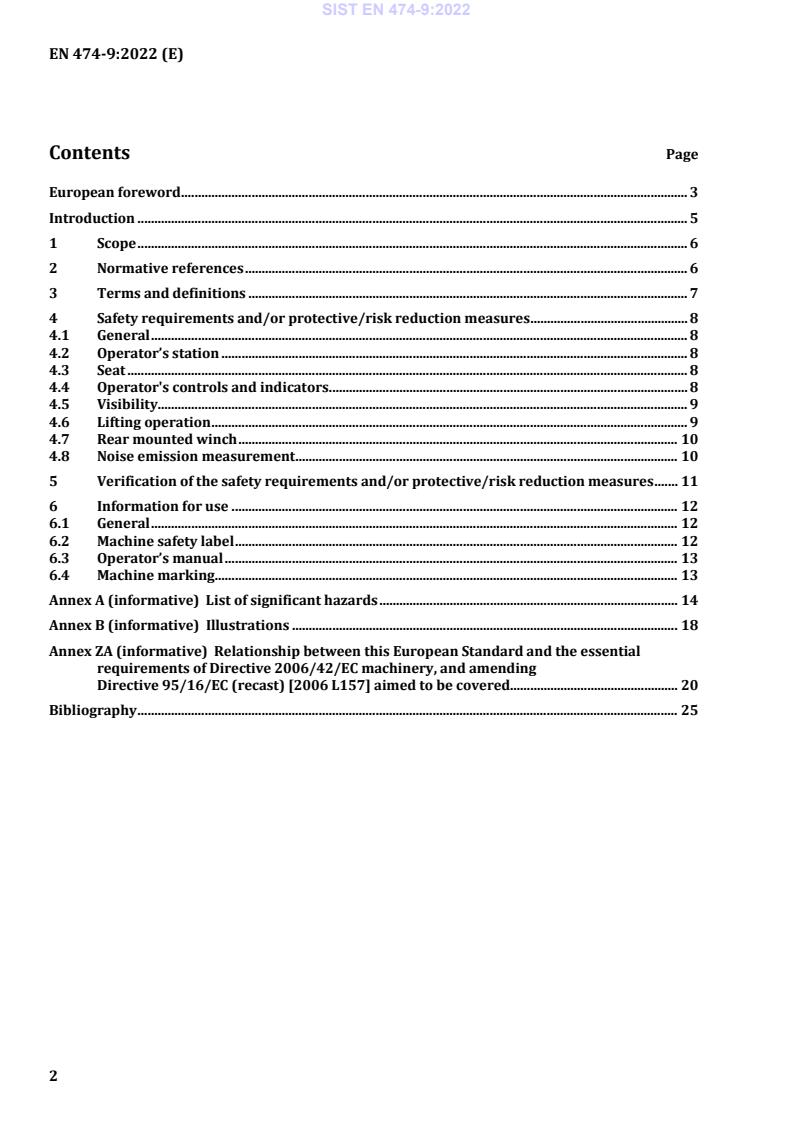
Contents Page
European foreword . 3
Introduction . 5
1 Scope . 6
2 Normative references . 6
3 Terms and definitions . 7
4 Safety requirements and/or protective/risk reduction measures . 8
4.1 General . 8
4.2 Operator’s station . 8
4.3 Seat . 8
4.4 Operator's controls and indicators . 8
4.5 Visibility. 9
4.6 Lifting operation . 9
4.7 Rear mounted winch . 10
4.8 Noise emission measurement . 10
5 Verification of the safety requirements and/or protective/risk reduction measures . 11
6 Information for use . 12
6.1 General . 12
6.2 Machine safety label . 12
6.3 Operator’s manual . 13
6.4 Machine marking . 13
Annex A (informative) List of significant hazards . 14
Annex B (informative) Illustrations . 18
Annex ZA (informative) Relationship between this European Standard and the essential
requirements of Directive 2006/42/EC machinery, and amending
Directive 95/16/EC (recast) [2006 L157] aimed to be covered. 20
Bibliography . 25
European foreword
This document (EN 474-9:2022) has been prepared by Technical Committee CEN/TC 151 “Construction
equipment and building material machines - Safety”, the secretariat of which is held by DIN.
This European Standard shall be given the status of a national standard, either by publication of an
identical text or by endorsement, at the latest by September 2022, and conflicting national standards shall
be withdrawn at the latest by March 2024.
Attention is drawn to the possibility that some of the elements of this document may be the subject of
patent rights. CEN shall not be held responsible for identifying any or all such patent rights.
This document supersedes EN 474-9:2006+A1:2009.
This document has been prepared under a standardization request given to CEN by the European
Commission and the European Free Trade Association, and supports essential requirements of
EU Directive(s).
For relationship with EU Directive(s), see informative Annex ZA, which is an integral part of this
document.
For bibliographic references, see EN 474-1:2022.
EN 474 “Earth-moving machinery — Safety” comprises the following parts:
— Part 1: General requirements
— Part 2: Requirements for tractor-dozers
— Part 3: Requirements for loaders
— Part 4: Requirements for backhoe-loaders
— Part 5: Requirements for hydraulic excavators
— Part 6: Requirements for dumpers
— Part 7: Requirements for scrapers
— Part 8: Requirements for graders
— Part 9: Requirements for pipelayers
— Part 10: Requirements for trenchers
— Part 11: Requirements for earth and landfill compactors
— Part 12: Requirements for cable excavators
— Part 13: Requirements for rollers
This document is intended for use in combination with part 1 of the series.
The main differences between this document and EN 474-9:2006+A1:2009 are as follows:
a) the normative references (Clause 2) (updated);
b) safety related functions of control systems (excluded);
c) pipelayers shall be equipped with cab, and ROPS, TOPS (4.2) (added);
d) windows shall be provided with motorised wiper(s) and washer in the travelling and lifting (e.g. side
boom application) directions (4.2.2) (added);
e) means shall be provided to ensure operator visibility to the pipe area from the operator station
during the lifting, translation operations and combination of both (4.5) (added);
f) pipelayers are equipped with Load capacity indicator and warning device, Rated capacity limiting,
Hoisting limiter device and Lowering limiter (4.6) (added);
g) the load capacity indicator shall take in account the ground slope condition and provide information
about weight of load and weight rated capacity (4.6.7) (added);
h) pipelayers with a lifting hoist shall be fitted with a lowering limiter. As a minimum, the lowering
limiter shall ensure three turns of rope on the drum. (4.6.10) (added);
i) if a pipelayer is equipped with a rear mounted winch, ISO 19472:2006 shall be used as guidance for
design. (4.7.1) (added);
j) verification methods table (Clause 5) (added);
k) list of significant hazards (Annex A) (updated);
l) Annex ZA (updated).
Any feedback and questions on this document should be directed to the users’ national standards body.
A complete listing of these bodies can be found on the CEN website.
According to the CEN-CENELEC Internal Regulations, the national standards organisations of the
following countries are bound to implement this European Standard: Austria, Belgium, Bulgaria, Croatia,
Cyprus, Czech Republic, Denmark, Estonia, Finland, France, Germany, Greece, Hungary, Iceland, Ireland,
Italy, Latvia, Lithuania, Luxembourg, Malta, Netherlands, Norway, Poland, Portugal, Republic of North
Macedonia, Romania, Serbia, Slovakia, Slovenia, Spain, Sweden, Switzerland, Turkey and the United
Kingdom.
Introduction
This document is a type-C standard as stated in EN ISO 12100.
This document is of relevance, in particular, for the following stakeholder groups representing the market
players with regard to machinery safety:
— machine manufacturers (small, medium and large enterprises);
— health and safety bodies (regulators, accident prevention organizations, market surveillance, etc.).
Others can be affected by the level of machinery safety achieved with the means of the document by the
above-mentioned stakeholder groups:
— machine users/employers (small, medium and large enterprises);
— machine users/employees (e.g. trade unions, organizations for people with special needs);
— service providers, e.g. for maintenance (small, medium and large enterprises);
— consumers (in case of machinery intended for use by consumers).
The above-mentioned stakeholder groups have been given the possibility to participate at the drafting
process of this document.
The machinery concerned and the extent to which hazards, hazardous situations or hazardous events are
covered are indicated in the Scope of this document.
When requirements of this type-C standard are different from those which are stated in type-A or type-B
standards, the requirements of this type-C standard take precedence over the requirements of the other
standards for machines that have been designed and built according to the requirements of this type-C
standard.
1 Scope
This document, together with EN 474-1:2022, deals with all significant hazards, hazardous situations and
events relevant to pipelayers as defined in 3.1, when used as intended and under the conditions of misuse
which are reasonably foreseeable by the manufacturer (see Annex A) associated with the whole lifetime
of the machine as described in EN ISO 12100:2010, 5.4.
The requirements of this document are complementary to the common requirements formulated in
EN 474-1:2022. This document does not repeat the requirements of EN 474-1:2022 but supplements or
modifies the requirements for pipelayers.
This document also specifies additional requirements for rear mounted winches.
This document does not provide performance requirements for safety related functions of control
system(s).
The following significant and relevant hazards are not covered in this document:
— Transmission of power between self-propelled machinery (or tractor) and recipient machinery;
— Laser;
— Lightning.
Pipelayers with rotating upper structure are excluded from the scope of this document.
This document is not applicable to pipelayers manufactured before the date of publication of this
document by CEN.
2 Normative references
The following documents are referred to in the text in such a way that some or all of their content
constitutes requirements of this document. For dated references, only the edition cited applies. For
undated references, the latest edition of the referenced document (including any amendments) applies.
EN 474-1:2022, Earth-moving machinery — Safety — Part 1: General requirements
EN 1032:2003+A1:2008, Mechanical vibration — Testing of mobile machinery in order to determine the
vibration emission value
EN 1677-1:2000+A1:2008, Components for slings — Safety — Part 1: Forged steel components, Grade 8
EN 1677-2:2000+A1:2008, Components for slings — Safety — Part 2: Forged steel lifting hooks with
latch, Grade 8
EN 13000:2010+A1:2014, Cranes — Mobile cranes
EN ISO 3411:2007, Earth-moving machinery — Physical dimensions of operators and minimum operator
space envelope (ISO 3411:2007)
EN ISO 6682:2008, Earth-moving machinery — Zones of comfort and reach for controls (ISO 6682:1986,
including Amd 1:1989)
EN ISO 7096:2020, Earth-moving machinery — Laboratory evaluation of operator seat vibration
(ISO 7096:2020)
EN ISO 12100:2010, Safety of machinery — General principles for design — Risk assessment and risk
reduction (ISO 12100:2010)
ISO 6393:2008, Earth-moving machinery — Determination of sound power level — Stationary test
conditions
ISO 6394:2008, Earth-moving machinery — Determination of emission sound pressure level at operator’s
position — Stationary test conditions
ISO 6394:2008/Cor 1:2009, Earth-moving machinery — Determination of emission sound pressure level
at operator’s position — Stationary test conditions — Technical Corrigendum 1
ISO 6405-2:2017, Earth-moving machinery — Symbols for operator controls and other displays — Part 2:
Symbols for specific machines, equipment and accessories
ISO 8813:1992, Earth-moving machinery — Lift capacity of pipelayers and wheeled tractors or loaders
equipped with side boom
ISO 10968:2020, Earth-moving machinery — Operator’s controls
ISO 16625:2013, Cranes and hoists — Selection of wire ropes, drums and sheaves
3 Terms and definitions
For the purposes of this document, the terms and definitions given in EN 474-1:2022, EN ISO 12100:2010
and the following apply.
NOTE Terminology for pipelayers is specified in ISO 7136:2006 and illustrated in Annex B of this document.
ISO and IEC maintain terminological databases for use in standardization at the following addresses:
— IEC Electropedia: available at https://www.electropedia.org/
— ISO Online browsing platform: available at https://www.iso.org/obp
3.1
pipelayer
self-propelled crawler or wheeled machine, having pipe-laying equipment with main frame, a load-hoist
mechanism, vertically pivotable side boom, and counterweight, primarily designed to handle and lay
pipes
[Source: EN ISO 6165:2012]
3.2
hoisting limiter
hoist mechanism
positive locking device to prevent inadvertent lowering of the boom and an automatic means to stop the
boom motion when the maximum permissible height is reached shall both be provided, as defined in
ISO 8813:1992
4 Safety requirements and/or protective/risk reduction measures
4.1 General
4.1.1 Context
Pipelayers shall comply with the safety requirements and/or protective/risk reduction measures of this
clause. In addition, the machines shall be designed according to the principles of EN ISO 12100:2010 for
relevant but not significant hazards which are not dealt with by this document.
4.1.2 Specific relation to EN 474-1
Pipelayers shall comply with the requirements of EN 474-1:2022, as far as not modified or replaced by
the requirements of this part.
There are general requirements specified in EN 474-1:2022 that are not applicable because the risk
assessment has shown that for pipelayers the corresponding hazard does not exist. For pipelayers 4.2.2,
4.4.2, 4.5.10, 4.7.3, 4.10, 4.14.2.3, 4.22.5, 4.23, 4.24, Annex B and Annex D in EN 474-1:2022, are not
applicable.
4.2 Operator’s station
4.2.1 General
EN 474-1:2022, 4.3 shall apply with the addition stated in 4.2.2 below.
4.2.2 Window(s)
EN 474-1:2022, 4.3.2.5 shall apply with the addition that pipelayers shall be provided with motorised
wiper(s) and washer in the travelling and lifting (e.g. side boom application) directions.
4.3 Seat
4.3.1 General
EN 474-1:2022, 4.4.1.4 shall apply with the addition stated in 4.3.2 below.
4.3.2 Vibration
Pipelayers with measured RMS-values on Z-axis, in accordance with EN 1032:2003+A1:2008, higher than
0,5 m/s shall be equipped with a suspended seat complying with EN ISO 7096:2020 class EM6. As an
alternative without testing the machine, the pipelayers shall be equipped with a suspended seat
complying with EN ISO 7096:2020 class EM6.
NOTE RMS means root mean square.
4.4 Operator's controls and indicators
4.4.1 General
EN 474-1:2022, 4.5 applies with the following modifications in 4.4.2 below.
4.4.2 Emergency attachment lowering (Free fall function)
The emergency device to release the load shall be reachable by the operator within the cabin, according
to EN ISO 6682:2008.
The free fall function should be used only for emergency purposes and not for normal working purposes
(e.g. fast lowering).
4.5 Visibility
EN 474-1:2022, 4.8 applies with the following additions:
Means shall be provided to ensure operator visibility to the pipe area from the operator station during
the lifting, translation operations and combination of both.
This requirement may be fulfilled either e.g.:
— by providing a seat turned to the direction of the boom, or
— by providing a slewable and lockable seat to the direction of the boom.
4.6 Lifting operation
4.6.1 General
EN 474-1:2022, 4.12 shall apply with the additions stated in 4.6 of this document.
4.6.2 Lifting capacity
Lifting equipment shall meet all the requirements in ISO 8813:1992.
4.6.3 Load lowering speed
A device to control the lowering speed of the boom and the hook shall be fitted so that the operator can
control movement of the load with modulation and is able to stop the load at all load conditions up to and
including rated lift capacity during normal operating conditions.
NOTE Emergency attachment lowering is covered in 4.4.2 of this document.
4.6.4 Pipe laying brakes
The pipe laying system shall be fitted with brakes which can be released by controls and automatically
applied when the operator stops actuating or when the power source fails. The brakes shall be designed
to withstand 1,5 times the rated lift capacity under conditions
...