

prEN 1865-3
(Main)Patient handling equipment used in ambulances - Part 3: Heavy duty stretcher
- Abstract
This document specifies minimum requirements for the design and performance of heavy duty stretchers used in road ambulances for the treatment and transportation of patients. It aims to ensure patient safety and minimize the physical effort required by staff operating the equipment.
- Status
- Not Published
- Publication Date
- 18-Mar-2025
- Technical Committee
- CEN/TC 239 - Rescue systems
- Current Stage
- 4060 - Closure of enquiry - Enquiry
- Start Date
- 20-Aug-2026
- Due Date
- 30-May-2023
- Completion Date
- 20-Aug-2026

prEN 1865-3 is a CEN draft European Standard for heavy duty stretchers used in road ambulances. It specifies minimum design and performance requirements for patient treatment and transport equipment intended for larger or heavier patients, with the goals of patient safety and lower physical effort for the crew.
What does prEN 1865-3 specify?
prEN 1865-3 covers the heavy duty stretcher used in road ambulances and sets the minimum requirements for its design, performance and verification. The document is organized into scope, normative references, terms and definitions, requirements, Annex ZA and bibliography.
| Annex | What it covers |
|---|---|
| Annex ZA | Relationship between this European standard and the General Safety and Performance Requirements of Regulation (EU) 2017/745 |
The requirements chapter is the core of the document. It moves from general safety to detailed construction points such as dimensions, mass, loading capacity, frame, power source, lying part, restraint system and verification tests.
What are the key requirements of prEN 1865-3?
Safety and human factors
prEN 1865-3 requires heavy duty stretchers to be safe in normal use, to minimize risk as far as possible, and to be either mechanical assisted or power operated. In practice, manufacturers have to design for controlled handling, safe patient restraint and reduced strain on staff.
The design must follow usability engineering in EN 62366-1:2015 for ergonomics and user interfaces. That matters because controls, handling and patient access have to work in real ambulance conditions, not only on paper.
Size, mass and loading
Clause 4.2.2 sets dimensional limits for the stretcher part and the undercarriage, including provisions for a longer or wider lying area. Clause 4.2.3 limits mass depending on whether the system is monoblock, detachable or combined with loading functions.
Clause 4.2.4 sets a minimum loading capacity of 250 kg and requires the maximum loading capacity to be stated on the stretcher. For buyers and operators, this is the key check for matching the stretcher to patient population and handling method.
Structure, restraint and verification
The frame and undercarriage requirements in 4.2.5 and 4.2.6 focus on secure locking, safe movement, wheel arrangement, braking, corrosion resistance and backup power. The power source clause also requires protection against collapse if a lifting mechanism fails, and a second battery in case of power loss.
The lying part in 4.2.7 must support cardiopulmonary resuscitation, be easy to clean and resist disinfectants. The restraint system in 4.2.8 must use a harness with quick-release patient restraints and meet the test requirements of EN 1789:2020+A1:2023.
Verification clauses 4.2.9 to 4.2.14 cover flammability, deformation of the frame, fixation, deformation of the lying area, torsion resistance and wheel splaying. These tests tell manufacturers and test labs how to prove the stretcher survives loaded use without permanent damage or unsafe movement.
What terms does prEN 1865-3 define?
- Heavy duty stretcher - a stretcher for patients whose weight and/or size exceed the operating capability of the defined stretcher in prEN 1865-1:2026 and EN 1865-2:2024.
- Undercarriage - the wheeled support arrangement that can be integrated with the stretcher or used as a detachable part.
- Monoblock undercarriage - a stretcher and undercarriage system built as one complete unit.
- Loading capacity - the maximum patient load the stretcher is intended to carry.
- Patient restraint-system - the harness and quick-release restraints used to secure the patient during transport.
- Backrest - the adjustable upper part of the lying area used to raise the patient’s torso.
- Footrest - the adjustable lower part of the lying area used to support the legs or shock position.
Who uses prEN 1865-3?
Manufacturers of ambulance equipment use prEN 1865-3 to design and validate heavy duty stretchers. Ambulance operators, procurement teams and quality managers use it to specify what they need and to check delivered equipment.
Test laboratories use it for mechanical, flammability and loading verification. Regulatory and compliance teams use it with the medical device framework in Annex ZA when assessing ambulance patient-handling equipment.
What changed in prEN 1865-3 from the previous edition?
prEN 1865-3 will supersede EN 1865-3:2012+A1:2015. The foreword states these main changes:
- the series title was broadened from “road ambulances” to “ambulances”
- normative references were updated
- Annex ZA was revised for the Medical Device Regulations (MDR) instead of the Medical Device Directive (MDD)
- mass distribution was specified in 4.2.3
- the word label was removed from the loading-capacity requirement
- the maximum height of the undercarriage for loading and unloading was removed
- a second battery is now mandatory in case of power loss
- the restraint system requirements were revised
- the requirements were aligned with the other parts of the series
- clause numbering was updated throughout
- the “Flammability - Toxicity of Burning Gasses” title was changed to “Flammability”
- verification methods from Clause 5 were moved into Clause 4 requirements
- the former “Marking” clause was deleted
Which standards are used with prEN 1865-3?
- EN 597-1:2015 - provides the flammability test for the mattress material.
- EN 1789:2020+A1:2023 - gives the road ambulance context and the restraint and fixation test requirements used by prEN 1865-3.
- prEN 1865-1:2026 - defines the general stretcher system that prEN 1865-3 compares against.
- EN 1865-2:2024 - covers the power assisted stretcher and sets the comparison point for operating capability.
- EN 62366-1:2015 - provides the usability engineering method used for design, ergonomics and user interfaces.
What does the prEN 1865-3 document contain?
The document contains detailed requirements and verification methods for dimensions, mass, loading capacity, frame strength, power source, lying area, restraint systems and flammability. It also includes three figure-based test set-ups for deformation, torsion and wheel splaying.
Annex ZA maps selected clauses to Regulation (EU) 2017/745. That makes the document useful not only for product design and testing, but also for medical-device compliance work and conformity assessment.
Relations
- Effective Date
- 20-Apr-2022
Get Certified
Connect with accredited certification bodies for this standard

BSI Group
BSI (British Standards Institution) is the business standards company that helps organizations make excellence a habit.

TÜV Rheinland
TÜV Rheinland is a leading international provider of technical services.

TÜV SÜD
TÜV SÜD is a trusted partner of choice for safety, security and sustainability solutions.
Sponsored listings
Frequently Asked Questions
prEN 1865-3 is a draft published by the European Committee for Standardization (CEN). Its full title is "Patient handling equipment used in ambulances - Part 3: Heavy duty stretcher". This standard covers: This document specifies minimum requirements for the design and performance of heavy duty stretchers used in road ambulances for the treatment and transportation of patients. It aims to ensure patient safety and minimize the physical effort required by staff operating the equipment.
This document specifies minimum requirements for the design and performance of heavy duty stretchers used in road ambulances for the treatment and transportation of patients. It aims to ensure patient safety and minimize the physical effort required by staff operating the equipment.
prEN 1865-3 is classified under the following ICS (International Classification for Standards) categories: 11.160 - First aid. The ICS classification helps identify the subject area and facilitates finding related standards.
prEN 1865-3 has the following relationships with other standards: It is inter standard links to EN 1865-3:2012+A1:2015. Understanding these relationships helps ensure you are using the most current and applicable version of the standard.
prEN 1865-3 is associated with the following European legislation: EU Directives/Regulations: 2017/745; Standardization Mandates: M/575, M/575 Amd 2. When a standard is cited in the Official Journal of the European Union, products manufactured in conformity with it benefit from a presumption of conformity with the essential requirements of the corresponding EU directive or regulation.
prEN 1865-3 is available in PDF format for immediate download after purchase. The document can be added to your cart and obtained through the secure checkout process. Digital delivery ensures instant access to the complete standard document.
Standards Content (Sample)
SLOVENSKI STANDARD
01-julij-2026
Oprema za ravnanje s pacienti v reševalnih vozilih - 3. del: Bolniška nosila za večje
obremenitve
Patient handling equipment used in ambulances - Part 3: Heavy duty stretcher
Krankentransportmittel in Rettungsdienstfahrzeugen - Teil 3: Schwerlastkrankentrage
Équipements pour le transport de patients dans les ambulances - Partie 3 : Brancard
bariatrique
Ta slovenski standard je istoveten z: prEN 1865-3
ICS:
11.160 Prva pomoč First aid
43.160 Vozila za posebne namene Special purpose vehicles
2003-01.Slovenski inštitut za standardizacijo. Razmnoževanje celote ali delov tega standarda ni dovoljeno.
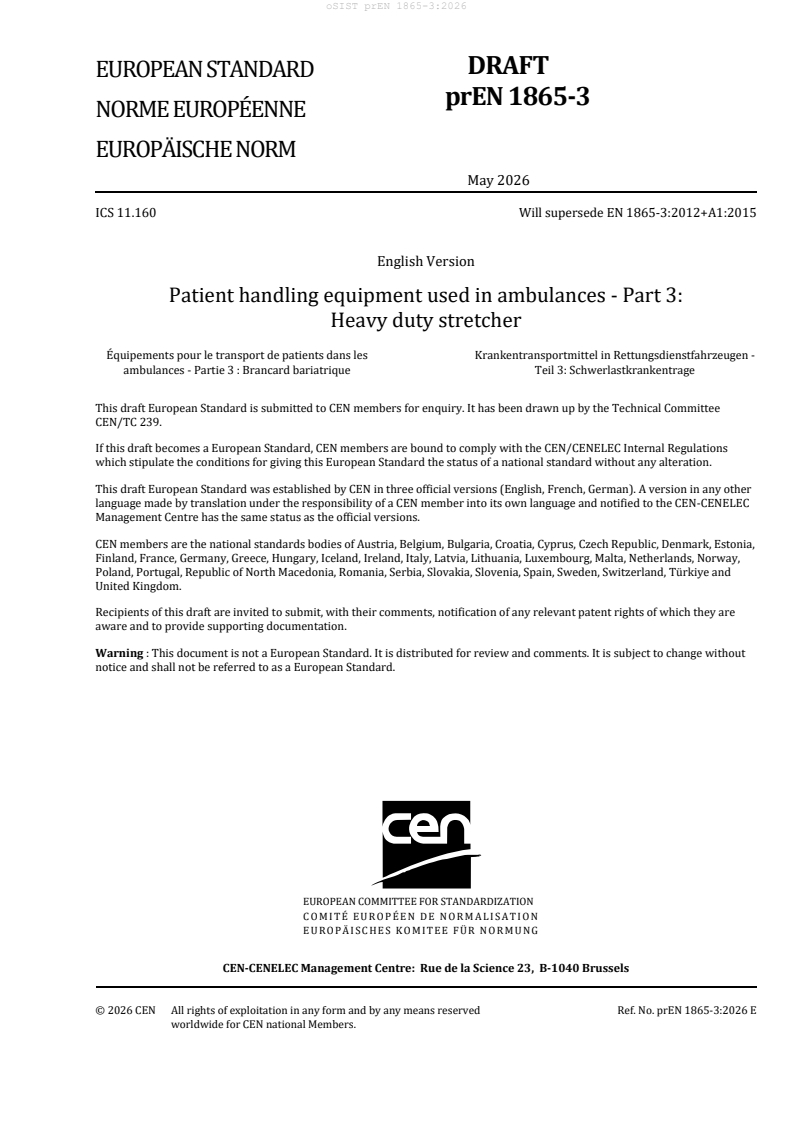
DRAFT
EUROPEAN STANDARD
NORME EUROPÉENNE
EUROPÄISCHE NORM
May 2026
ICS 11.160 Will supersede EN 1865-3:2012+A1:2015
English Version
Patient handling equipment used in ambulances - Part 3:
Heavy duty stretcher
Équipements pour le transport de patients dans les Krankentransportmittel in Rettungsdienstfahrzeugen -
ambulances - Partie 3 : Brancard bariatrique Teil 3: Schwerlastkrankentrage
This draft European Standard is submitted to CEN members for enquiry. It has been drawn up by the Technical Committee
CEN/TC 239.
If this draft becomes a European Standard, CEN members are bound to comply with the CEN/CENELEC Internal Regulations
which stipulate the conditions for giving this European Standard the status of a national standard without any alteration.
This draft European Standard was established by CEN in three official versions (English, French, German). A version in any other
language made by translation under the responsibility of a CEN member into its own language and notified to the CEN-CENELEC
Management Centre has the same status as the official versions.
CEN members are the national standards bodies of Austria, Belgium, Bulgaria, Croatia, Cyprus, Czech Republic, Denmark, Estonia,
Finland, France, Germany, Greece, Hungary, Iceland, Ireland, Italy, Latvia, Lithuania, Luxembourg, Malta, Netherlands, Norway,
Poland, Portugal, Republic of North Macedonia, Romania, Serbia, Slovakia, Slovenia, Spain, Sweden, Switzerland, Türkiye and
United Kingdom.
Recipients of this draft are invited to submit, with their comments, notification of any relevant patent rights of which they are
aware and to provide supporting documentation.
Warning : This document is not a European Standard. It is distributed for review and comments. It is subject to change without
notice and shall not be referred to as a European Standard.
EUROPEAN COMMITTEE FOR STANDARDIZATION
COMITÉ EUROPÉEN DE NORMALISATION
EUROPÄISCHES KOMITEE FÜR NORMUNG
CEN-CENELEC Management Centre: Rue de la Science 23, B-1040 Brussels
© 2026 CEN All rights of exploitation in any form and by any means reserved Ref. No. prEN 1865-3:2026 E
worldwide for CEN national Members.
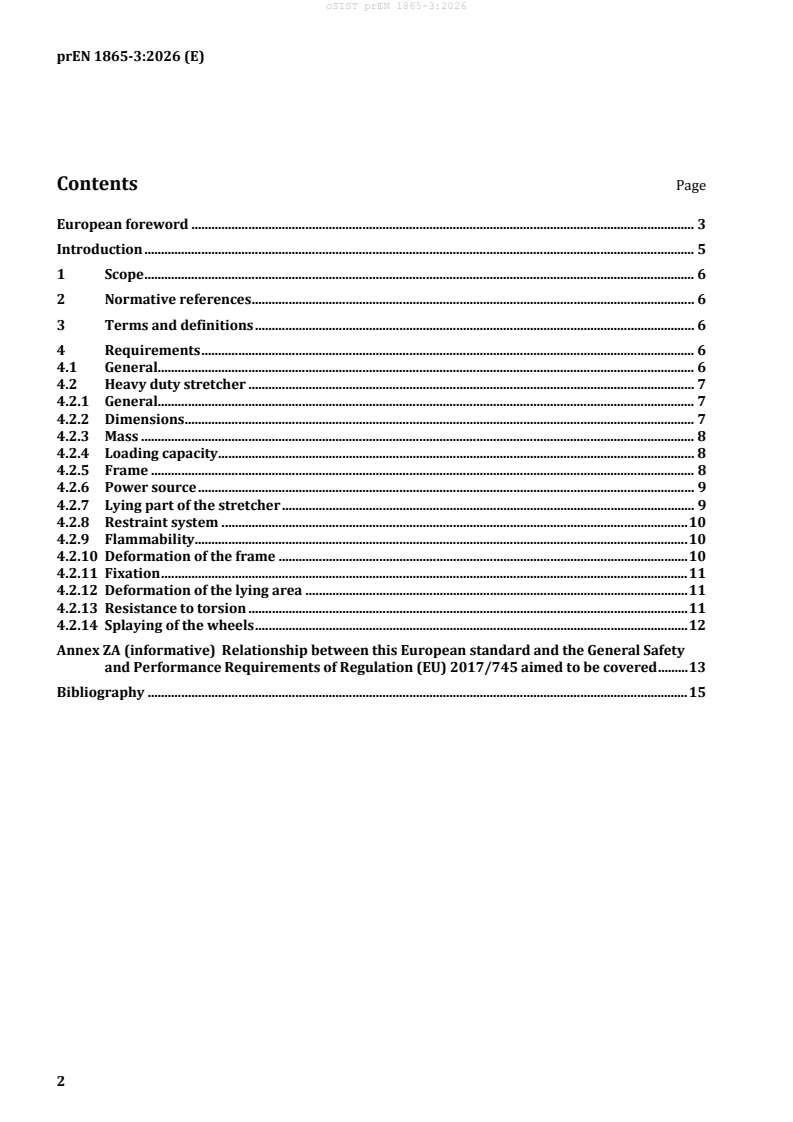
Contents Page
European foreword . 3
Introduction . 5
1 Scope . 6
2 Normative references . 6
3 Terms and definitions . 6
4 Requirements . 6
4.1 General. 6
4.2 Heavy duty stretcher . 7
4.2.1 General. 7
4.2.2 Dimensions. 7
4.2.3 Mass . 8
4.2.4 Loading capacity . 8
4.2.5 Frame . 8
4.2.6 Power source . 9
4.2.7 Lying part of the stretcher . 9
4.2.8 Restraint system . 10
4.2.9 Flammability . 10
4.2.10 Deformation of the frame . 10
4.2.11 Fixation . 11
4.2.12 Deformation of the lying area . 11
4.2.13 Resistance to torsion . 11
4.2.14 Splaying of the wheels . 12
Annex ZA (informative) Relationship between this European standard and the General Safety
and Performance Requirements of Regulation (EU) 2017/745 aimed to be covered . 13
Bibliography . 15
European foreword
This document (prEN 1865-3:2026) has been prepared by Technical Committee CEN/TC 239 “Rescue
systems”, the secretariat of which is held by DIN.
This document is currently submitted to the CEN Enquiry.
This document will supersede EN 1865-3:2012+A1:2015.
Compared to EN 1865-3:2012+A1:2015, the following main technical changes were made:
a) Main title of EN 1865 series changed from “Patient handling equipment used in road ambulances” to
“Patient handling equipment used in ambulances”;
b) Normative references updated;
c) Annex ZA revised to show relationship to Medical Device Regulations (MDR) instead of Medical
Device Directive (MDD);
d) Distribution of mass (4.2.3) specified;
e) The use of the word label removed, intent of requirement remains unchanged (4.2.4);
f) Maximum height of undercarriage for loading and unloading removed (4.2.5.3);
g) A second battery is now mandatory in case of power loss (4.2.6);
h) Requirements for the restraint system (4.2.8) revised;
i) Requirements aligned with other parts of this standard series;
j) Clause numbering updated throughout the whole document;
k) Contents updated to change titles of “Flammability – Toxicity of Burning Gasses” to “Flammability
l) Verification methods in Clause 5 moved into Clause 4 requirements that previously referenced them.
In these cases, the requirement and test methods were combined to form the following: 5.1 now in
4.2.10, 5.3 now 4.2.12, 5.4 is now 4.2.13, 5.5 now 4.2.14;
m) Clause on “Marking” (5) deleted.
This document has been prepared under a standardization request addressed to CEN by the European
Commission. The Standing Committee of the EFTA States subsequently approves these requests for its
Member States.
For the relationship with EU Legislation, see informative Annex ZA, which is an integral part of this
document.
This document is a part of EN 1865, Patient handling equipment used in ambulances, which consists of the
following parts:
— Part 1: Specification for general stretcher systems and patient handling equipment;
— Part 2: Power assisted stretcher;
— Part 3: Heavy duty stretcher (this document);
— Part 4: Foldable patient transfer chair;
— Part 5: Stretcher support;
— Part 6: Powered chairs;
— Part 7: Isolation transport system (preliminary work item under development).
Introduction
In this document, reference is made to EN 1789:2020+A1:2023, which specifies design requirements and
test methods for road ambulances which are relevant for checking requirements for such handling
equipment.
1 Scope
This document specifies minimum requirements for the design and performance of heavy duty stretchers
used in road ambulances for the treatment and transportation of patients. It aims to ensure patient safety
and minimize the physical effort required by staff operating the equipment.
2 Normative references
The following documents are referred to in the text in such a way that some or all of their content
constitutes requirements of this document. For dated references, only the edition cited applies. For
undated references, the latest edition of the referenced document (including any amendments) applies.
EN 597-1:2015, Furniture — Assessment of the ignitability of mattresses and upholstered bed bases —
Part 1: Ignition source smouldering cigarette
EN 1789:2020+A1:2023, Medical vehicles and their equipment — Road ambulances
prEN 1865-1:2026, Patient handling equipment used in ambulances — Part 1: Specification for general
stretcher systems and patient handling equipment
EN 1865-2:2024, Patient handling equipment used in ambulances — Part 2: Power assisted stretcher
EN 62366-1:2015, Medical devices — Part 1: Application of usability engineering to medical devices (IEC
62366-1:2015)
3 Terms and definitions
For the purposes of this document, the following terms and definitions apply.
ISO and IEC maintain terminology databases for use in standardization at the following addresses:
— IEC Electropedia: available at https://www.electropedia.org/
— ISO Online browsing platform: available at https://www.iso.org/obp/
3.1
heavy duty stretcher
stretcher designed for the treatment and transportation of patients where the weight and/or dimensions
of the patient exceed those of the operating capability of the defined stretcher in prEN 1865-1:2026 and
EN 1865-2:2024
4 Requirements
4.1 General
When operated and maintained in accordance with the instructions for use, heavy duty stretchers shall
not present any high level of risk. Any identified risk shall be reduced as far as possible.
Heavy duty stretchers shall also:
— be mechanical assisted or power operated;
— allow patients to be secured so that any movement during ambulance transport is minimized;
As impacted by EN 62366-1:2015/AC:2015, EN 62366-1:2015/AC:2016-09 and EN 62366-1:2015/A1:2020.
— be free of sharp edges that could cause injury to persons or damage to other equipment on board.
The minimum radius should be 0,5 mm.
For all patients transported in the patient compartment, patient restraint-systems shall be available. All
patient restraint-systems shall have quick release systems.
Patient restraint-systems for all patient handling equipment shall secure the patient, but at the same time
shall permit treatment of the patient.
The lying-sitting part shall be made of a strong material which is bacterial resistant, fungal resistant, stain
resistant, putrid resistant, easy to clean, washable, waterproof and petrol-oil resistant.
EN 62366-1:2015 shall be followed in the design, ergonomics, and user interfaces implemented.
The heavy duty stretcher shall be designed to transport patients with a weight that exceeds the load
capacity of the main stretcher in prEN 1865-1:2026 and EN 1865-2:2024.
4.2 Heavy duty stretcher
4.2.1 General
The heavy duty stretcher shall consist of a stretcher part that can be used either alone or in combination
with an integrated or detachable undercarriage.
For assisting the loading and unloading process, the stretcher shall be compatible with a loading system
device installed on the vehicle and / or on the stretcher device itself.
The heavy duty stretcher and its loading system shall be compatible. It physically shall support the crew,
so no manual lifting should be done to load and unload the stretcher under normal daily use.
4.2.2 Dimensions
Dimensions shall be measured from the outermost edges.
+120
— Stretcher part: length:
(1 950 ) mm;
−50
To accommodate tall patients, it may be possible to increase
the length of the stretcher by a further 200 mm.
+60
width:
(550 ) mm;
−20
It shall be possible to increase the width of the lying part to a
minimum of 750 mm at least in the side rail area.
height: Maximum 300 mm from loading holding assembly to unloaded
lying part. This height dimension does not apply to stretchers
with monoblock undercarriages. If a monoblock is not
available, the stretcher shall be constructed such that it is
detachable from the undercarriage. Where a stretcher support
is used the measurement shall be taken from the top surface of
the stretcher support to the lying part of the stretcher.
— Undercarriage: Length and width of the frame of the undercarr
...