

EN 16307-1:2020
(Main)Industrial trucks - Safety requirements and verification - Part 1: Supplementary requirements for self-propelled industrial trucks, other than driverless trucks, variable-reach trucks and burden-carrier trucks
- Abstract
This document gives requirements for the types of industrial trucks specified in the scope of EN ISO 3691-1.
This document is intended to be used in conjunction with EN ISO 3691-1. These requirements are supplementary to those stated in EN ISO 3691-1 with the addition of hazards, which can occur when operating in potentially explosive atmospheres.
This document covers the following requirements:
- electrical requirements;
- noise emissions;
- vibration;
- visibility;
- electromagnetic compatibility (EMC).
This Edocument defines supplementary requirements to EN ISO 3691-1:
- travel speed;
- brakes;
- travel and breaking controls - Additional operation from alongside pedestrian-controlled and stand-on trucks;
- lift chains;
- mast tilt and carriage isolation;
- operator's seat;
- operator restraint device;
- protection against crushing, shearing and trapping;
- information for use (instruction handbook and marking).
Annex A (informative) contains the list of significant hazards covered by this document.
- Status
- Published
- Publication Date
- 25-Aug-2020
- Technical Committee
- CEN/TC 150 - Industrial trucks - Safety
- Current Stage
- 6060 - Definitive text made available (DAV) - Publishing
- Start Date
- 26-Aug-2020
- Due Date
- 23-Jun-2020
- Completion Date
- 26-Aug-2020
- Directive
- 2006/42/EC - Directive 2006/42/EC of the European Parliament and of the Council of 17 May 2006 on machinery, and amending Directive 95/16/EC (recast)OJ Ref: L, L 366 OJ Date: 15-Oct-2021



Overview
EN 16307-1:2020 - published by CEN - defines supplementary safety requirements and verification for self-propelled industrial trucks (excluding driverless trucks, variable-reach trucks and burden‑carrier trucks). It is intended to be used together with EN ISO 3691-1 and covers additional hazards (including those that can occur in potentially explosive atmospheres). EN 16307-1:2020 supersedes the 2013/2015 edition and introduces updated requirements such as improved visibility rules and added operator restraint system provisions.
Key topics and technical requirements
This standard addresses safety aspects that supplement EN ISO 3691-1. Major technical topics include:
- Electrical requirements - conformity with relevant parts of EN 1175 series for battery and ICE powered trucks.
- Noise emissions - design and test requirements to reduce sound levels (references include EN 12053 and EN ISO 11688).
- Vibration - operator-seat and machine vibration considerations and testing (EN 13059, EN 13490).
- Visibility - test methods and verification for operator field of view (EN 16842 series).
- Electromagnetic compatibility (EMC) - EMC requirements and testing (EN 12895).
- Travel speed and brakes - supplementary limits and performance expectations for safe operation.
- Travel and braking controls - additional requirements for operation from alongside pedestrian-controlled and stand-on trucks.
- Lift chains, mast tilt and carriage isolation - mechanical safety for mast and load handling systems.
- Operator’s seat and restraint systems - seating ergonomics, safety belts and devices to keep the operator within protective structures.
- Protection against crushing, shearing and trapping - guarding, design and marking to reduce entrapment risks.
- Information for use - mandatory instruction handbook content and machine marking.
- Verification - procedures for testing and demonstrating compliance.
- Annex A (informative) - list of significant hazards covered by the standard.
Practical applications and users
EN 16307-1:2020 is used by:
- Industrial truck manufacturers to design and certify safe machines for the European market.
- Product designers and safety engineers implementing electrical, EMC, noise and visibility controls.
- Compliance and conformity assessors, test labs and notified bodies verifying EN ISO 3691-1 plus EN 16307-1 requirements.
- Purchasing and fleet managers specifying safe trucks for warehouses, logistics centres and factories.
- Health & safety regulators, market surveillance and maintenance teams for inspection, risk assessment and guidance.
Using this standard helps reduce operator injury, improve machine ergonomics, meet EU machinery directive requirements and demonstrate conformity during market entry.
Related standards
EN 16307-1:2020 is explicitly intended to be used with:
- EN ISO 3691-1 (self-propelled industrial trucks)
- EN 1175 series (electrical requirements)
- EN 12053 (noise), EN 13059 / EN 13490 (vibration)
- EN 12895 (EMC), EN 16842 (visibility)
- EN ISO 12100 (risk assessment/design principles)
Keywords: EN 16307-1:2020, industrial trucks, safety requirements, EN ISO 3691-1, visibility, EMC, noise emissions, vibration, operator restraint.
Relations
- Effective Date
- 02-Sep-2020
- Refers
ISO 6292:2020 - Powered industrial trucks and tractors — Brake performance and component strength - Effective Date
- 25-Aug-2026
- Effective Date
- 09-Feb-2026
- Effective Date
- 28-Jan-2026
- Effective Date
- 28-Jan-2026
- Effective Date
- 28-Jan-2026
- Effective Date
- 28-Jan-2026
- Effective Date
- 28-Jan-2026
- Effective Date
- 28-Jan-2026
- Effective Date
- 28-Jan-2026
- Effective Date
- 28-Jan-2026
- Effective Date
- 28-Jan-2026
- Effective Date
- 28-Jan-2026
- Effective Date
- 28-Jan-2026
- Refers
EN 12053:2001+A1:2008 - Safety of industrial trucks - Test methods for measuring noise emissions - Effective Date
- 28-Jan-2026
Frequently Asked Questions
EN 16307-1:2020 is a standard published by the European Committee for Standardization (CEN). Its full title is "Industrial trucks - Safety requirements and verification - Part 1: Supplementary requirements for self-propelled industrial trucks, other than driverless trucks, variable-reach trucks and burden-carrier trucks". This standard covers: This document gives requirements for the types of industrial trucks specified in the scope of EN ISO 3691-1. This document is intended to be used in conjunction with EN ISO 3691-1. These requirements are supplementary to those stated in EN ISO 3691-1 with the addition of hazards, which can occur when operating in potentially explosive atmospheres. This document covers the following requirements: - electrical requirements; - noise emissions; - vibration; - visibility; - electromagnetic compatibility (EMC). This Edocument defines supplementary requirements to EN ISO 3691-1: - travel speed; - brakes; - travel and breaking controls - Additional operation from alongside pedestrian-controlled and stand-on trucks; - lift chains; - mast tilt and carriage isolation; - operator's seat; - operator restraint device; - protection against crushing, shearing and trapping; - information for use (instruction handbook and marking). Annex A (informative) contains the list of significant hazards covered by this document.
This document gives requirements for the types of industrial trucks specified in the scope of EN ISO 3691-1. This document is intended to be used in conjunction with EN ISO 3691-1. These requirements are supplementary to those stated in EN ISO 3691-1 with the addition of hazards, which can occur when operating in potentially explosive atmospheres. This document covers the following requirements: - electrical requirements; - noise emissions; - vibration; - visibility; - electromagnetic compatibility (EMC). This Edocument defines supplementary requirements to EN ISO 3691-1: - travel speed; - brakes; - travel and breaking controls - Additional operation from alongside pedestrian-controlled and stand-on trucks; - lift chains; - mast tilt and carriage isolation; - operator's seat; - operator restraint device; - protection against crushing, shearing and trapping; - information for use (instruction handbook and marking). Annex A (informative) contains the list of significant hazards covered by this document.
EN 16307-1:2020 is classified under the following ICS (International Classification for Standards) categories: 53.060 - Industrial trucks. The ICS classification helps identify the subject area and facilitates finding related standards.
EN 16307-1:2020 has the following relationships with other standards: It is inter standard links to EN 16307-1:2013+A1:2015, ISO 6292:2020, ISO 5053-1:2020, EN 12895:2015+A1:2019, EN 458:2025, EN 16842-1:2018, EN 16842-2:2018, EN ISO 3691-1:2015/A1:2020, EN 16842-6:2018, EN 16203:2014, EN ISO 14120:2015, EN 16842-3:2018, EN ISO 3691-1:2015, EN ISO 12100:2010, EN 12053:2001+A1:2008. Understanding these relationships helps ensure you are using the most current and applicable version of the standard.
EN 16307-1:2020 is associated with the following European legislation: EU Directives/Regulations: 2006/42/EC; Standardization Mandates: M/396. When a standard is cited in the Official Journal of the European Union, products manufactured in conformity with it benefit from a presumption of conformity with the essential requirements of the corresponding EU directive or regulation.
EN 16307-1:2020 is available in PDF format for immediate download after purchase. The document can be added to your cart and obtained through the secure checkout process. Digital delivery ensures instant access to the complete standard document.
Standards Content (Sample)
SLOVENSKI STANDARD
01-december-2020
Nadomešča:
SIST EN 16307-1:2013+A1:2015
Vozila za talni transport - Varnostne zahteve in preverjanje - 1. del: Dodatne
zahteve za vozila za talni transport z lastnim pogonom, razen za vozila brez
voznika, vozila s spremenljivim dosegom ter tovorna in osebna vozila
Industrial trucks - Safety requirements and verification - Part 1: Supplementary
requirements for self-propelled industrial trucks, other than driverless trucks, variable-
reach trucks and burden-carrier trucks
Sicherheit von Flurförderzeugen - Sicherheitsanforderungen und Verifizierung - Teil 1:
Zusätzliche Anforderungen für motorkraftbetriebene Flurförderzeuge mit Ausnahme von
fahrerlosen Flurförderzeugen, Staplern mit veränderlicher Reichweite und Lasten- und
Personentransportfahrzeugen
Chariots de manutention - Exigence de sécurité et vérifications - Partie 1 : Exigences
supplémentaires pour les chariots autres que les chariots sans conducteur, les chariots à
portée variable et les chariots porteurs de charge
Ta slovenski standard je istoveten z: EN 16307-1:2020
ICS:
53.060 Industrijski tovornjaki Industrial trucks
2003-01.Slovenski inštitut za standardizacijo. Razmnoževanje celote ali delov tega standarda ni dovoljeno.
EN 16307-1
EUROPEAN STANDARD
NORME EUROPÉENNE
August 2020
EUROPÄISCHE NORM
ICS 53.060 Supersedes EN 16307-1:2013+A1:2015
English Version
Industrial trucks - Safety requirements and verification -
Part 1: Supplementary requirements for self-propelled
industrial trucks, other than driverless trucks, variable-
reach trucks and burden-carrier trucks
Chariots de manutention - Exigence de sécurité et Sicherheit von Flurförderzeugen -
vérifications - Partie 1 : Exigences supplémentaires Sicherheitsanforderungen und Verifizierung - Teil 1:
pour les chariots autres que les chariots sans Zusätzliche Anforderungen für motorkraftbetriebene
conducteur, les chariots à portée variable et les Flurförderzeuge mit Ausnahme von fahrerlosen
chariots porteurs de charge Flurförderzeugen, Staplern mit veränderlicher
Reichweite und Lasten- und
Personentransportfahrzeugen
This European Standard was approved by CEN on 12 July 2020.
CEN members are bound to comply with the CEN/CENELEC Internal Regulations which stipulate the conditions for giving this
European Standard the status of a national standard without any alteration. Up-to-date lists and bibliographical references
concerning such national standards may be obtained on application to the CEN-CENELEC Management Centre or to any CEN
member.
This European Standard exists in three official versions (English, French, German). A version in any other language made by
translation under the responsibility of a CEN member into its own language and notified to the CEN-CENELEC Management
Centre has the same status as the official versions.
CEN members are the national standards bodies of Austria, Belgium, Bulgaria, Croatia, Cyprus, Czech Republic, Denmark, Estonia,
Finland, France, Germany, Greece, Hungary, Iceland, Ireland, Italy, Latvia, Lithuania, Luxembourg, Malta, Netherlands, Norway,
Poland, Portugal, Republic of North Macedonia, Romania, Serbia, Slovakia, Slovenia, Spain, Sweden, Switzerland, Turkey and
United Kingdom.
EUROPEAN COMMITTEE FOR STANDARDIZATION
COMITÉ EUROPÉEN DE NORMALISATION
EUROPÄISCHES KOMITEE FÜR NORMUNG
CEN-CENELEC Management Centre: Rue de la Science 23, B-1040 Brussels
© 2020 CEN All rights of exploitation in any form and by any means reserved Ref. No. EN 16307-1:2020 E
worldwide for CEN national Members.
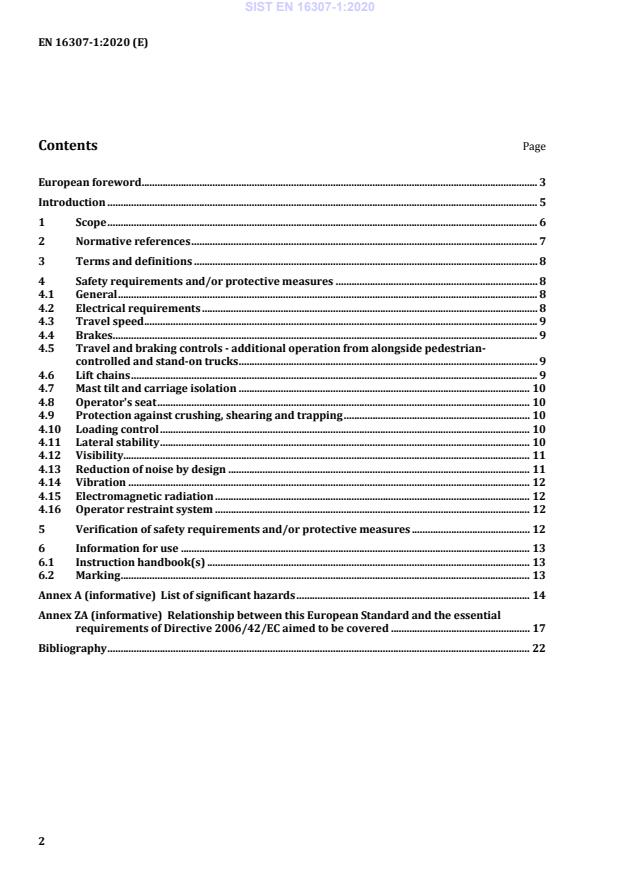
Contents Page
European foreword . 3
Introduction . 5
1 Scope . 6
2 Normative references . 7
3 Terms and definitions . 8
4 Safety requirements and/or protective measures . 8
4.1 General . 8
4.2 Electrical requirements . 8
4.3 Travel speed . 9
4.4 Brakes. 9
4.5 Travel and braking controls - additional operation from alongside pedestrian-
controlled and stand-on trucks . 9
4.6 Lift chains . 9
4.7 Mast tilt and carriage isolation . 10
4.8 Operator's seat . 10
4.9 Protection against crushing, shearing and trapping . 10
4.10 Loading control . 10
4.11 Lateral stability . 10
4.12 Visibility. 11
4.13 Reduction of noise by design . 11
4.14 Vibration . 12
4.15 Electromagnetic radiation . 12
4.16 Operator restraint system . 12
5 Verification of safety requirements and/or protective measures . 12
6 Information for use . 13
6.1 Instruction handbook(s) . 13
6.2 Marking . 13
Annex A (informative) List of significant hazards . 14
Annex ZA (informative) Relationship between this European Standard and the essential
requirements of Directive 2006/42/EC aimed to be covered . 17
Bibliography . 22
European foreword
This document (EN 16307-1:2020) has been prepared by Technical Committee CEN/TC 150 “Industrial
trucks - Safety”, the secretariat of which is held by BSI.
This European Standard shall be given the status of a national standard, either by publication of an
identical text or by endorsement, at the latest by February 2021, and conflicting national standards
shall be withdrawn at the latest by February 2021.
Attention is drawn to the possibility that some of the elements of this document may be the subject of
patent rights. CEN shall not be held responsible for identifying any or all such patent rights.
This document supersedes EN 16307-1:2013+A1:2015.
The main changes with respect to the first edition are as follows:
a) requirements in respect to visibility (see 4.12) have been changed;
b) requirements for the operator restraint system (see 4.16) have been added.
This document has been prepared under a mandate given to CEN by the European Commission and the
European Free Trade Association, and supports essential requirements of EU Directive(s).
For relationship with EU Directive(s), see informative Annex ZA, which is an integral part of this
document.
This document is based on ISO/TS 3691-7, Industrial trucks — Safety requirements and verification —
Part 7: Regional requirements for countries within the European Community and is limited to self-
propelled industrial trucks.
EN 16307 consists of the following parts, under the general title Industrial trucks — Safety requirements
and verification:
— Part 1: Supplementary requirements for self-propelled industrial trucks, other than driverless trucks,
variable-reach trucks and burden-carrier trucks
— Part 2: Supplementary requirements for self-propelled variable-reach trucks
— Part 3: Supplementary requirements for trucks with elevating operator position and trucks specifically
designed to travel with elevated loads (additional requirements to EN 16307-1)
— Part 5: Supplementary requirements for pedestrian-propelled trucks
— Part 6: Supplementary requirements for burden and personnel carriers
This document is intended to be used with EN ISO 3691-1, Industrial trucks — Safety requirements and
verification — Part 1: Self-propelled industrial trucks, other than driverless trucks, variable-reach trucks
and burden-carrier trucks.
According to the CEN-CENELEC Internal Regulations, the national standards organisations of the
following countries are bound to implement this European Standard: Austria, Belgium, Bulgaria,
Croatia, Cyprus, Czech Republic, Denmark, Estonia, Finland, France, Germany, Greece, Hungary, Iceland,
Ireland, Italy, Latvia, Lithuania, Luxembourg, Malta, Netherlands, Norway, Poland, Portugal, Republic of
North Macedonia, Romania, Serbia, Slovakia, Slovenia, Spain, Sweden, Switzerland, Turkey and the
United Kingdom.
Introduction
This document is a type-C standard as stated in EN ISO 12100:2010.
This document is of relevance, in particular, for the following stakeholder groups representing the
market players with regard to machinery safety:
— machine manufacturers (small, medium and large enterprises);
— health and safety bodies (regulators, accident prevention organizations, market surveillance etc.).
Others can be affected by the level of machinery safety achieved with the means of the document by the
above-mentioned stakeholder groups:
— machine users/employers (small, medium and large enterprises);
— machine users/employees (e.g. trade unions, organizations for people with special needs);
— service providers, e.g. for maintenance (small, medium and large enterprises).
The above-mentioned stakeholder groups have been given the possibility to participate at the drafting
process of this document.
The machines concerned and the extent to which hazards, hazardous situations or hazardous events are
covered are indicated in the Scope of this document.
When requirements of this type-C standard are different from those which are stated in type-A or
type-B standards, the requirements of this type-C standard take precedence over the requirements of
the other standards for machines that have been designed and built according to the requirements of
this type-C standard.
The EN 16307 series of standards covers safety requirements and their verification for industrial trucks
as defined in ISO 5053-1 that are not covered exhaustively by the EN ISO 3691 series.
1 Scope
This document gives requirements for the types of industrial trucks specified in the scope of
1)
.
EN ISO 3691-1:2015
This document is intended to be used in conjunction with EN ISO 3691-1:2015. These requirements are
supplementary to those stated in EN ISO 3691-1:2015.
This document deals with the following significant hazards, hazardous situations or hazardous events
relevant, when it is used as intended and under conditions of misuse which are reasonably foreseeable
by the manufacturer:
— electrical requirements;
— noise emissions;
— vibration;
— visibility;
— electromagnetic radiation.
This document defines supplementary requirements to EN ISO 3691-1:2015:
— travel speed;
— brakes;
— travel and braking controls - additional operation from alongside pedestrian-controlled and stand-
on trucks;
— lift chains;
— mast tilt and carriage isolation;
— operator's seat;
— operator restraint system;
— protection against crushing, shearing and trapping;
— information for use (instruction handbook and marking).
Annex A (informative) contains the list of significant hazards covered by this document.
1) This document is impacted by the corrigendum EN ISO 3691-1:2015/AC:2016 and the amendment
EN ISO 3691-1:2015/A1:2020.
2 Normative references
The following documents are referred to in the text in such a way that some or all of their content
constitutes requirements of this document. For dated references, only the edition cited applies. For
undated references, the latest edition of the referenced document (including any amendments) applies.
EN 1175-1:1998+A1:2010, Safety of industrial trucks — Electrical requirements — Part 1: General
requirements for battery powered trucks
EN 1175-2:1998+A1:2010, Safety of industrial trucks — Electrical requirements — Part 2: General
requirements of internal combustion engine powered trucks
EN 1175-3:1998+A1:2010, Safety of industrial trucks — Electrical requirements — Part 3: Specific
requirements for the electric power transmission systems of internal combustion engine powered trucks
EN 12053:2001+A1:2008, Safety of industrial trucks — Test methods for measuring noise emissions
EN ISO 12100:2010, Safety of machinery — General principles for design — Risk assessment and risk
reduction (ISO 12100)
EN 12895:2015+A1:2019, Industrial trucks — Electromagnetic compatibility
EN 13059:2002+A1:2008, Safety of industrial trucks — Test methods for measuring vibration
EN 13490:2001+A1:2008, Mechanical vibration — Industrial trucks — Laboratory evaluation and
specification of operator seat vibration
EN 16203:2014, Safety of Industrial Trucks — Dynamic tests for verification of lateral stability —
Counterbalanced Trucks
EN 16842-1:2018, Powered industrial trucks — Visibility — Test methods and verification — Part 1:
General requirements
EN 16842-2:2018, Powered industrial trucks — Visibility — Test methods and verification — Part 2: Sit-
on counterbalance trucks and rough terrain masted trucks up to and including 10 000 kg capacity
EN 16842-3:2018, Powered industrial trucks — Visibility — Test methods and verification — Part 3:
Reach trucks up to and including 10 000 kg capacity
EN 16842-6:2018, Powered industrial trucks — Visibility — Test methods and verification — Part 6: Sit-
on counterbalance trucks and rough terrain masted trucks greater than 10000 kg capacity
EN 16842-7:2018, Powered industrial trucks — Visibility — Test methods and verification — Part 7:
Variable-reach and masted container trucks handling freight containers of 6 m (20 ft) length and longer
2)
EN ISO 3691-1:2015 , Industrial trucks — Safety requirements and verification — Part 1: Self-propelled
industrial trucks, other than driverless trucks, variable-reach trucks and burden-carrier trucks (ISO 3691-
1:2011)
2) This document is impacted by the corrigendum EN ISO 3691-1:2015/AC:2016 and the amendment
EN ISO 3691-1:2015/A1:2020.
EN ISO 11688-1:2009, Acoustics — Recommended practice for the design of low-noise machinery and
equipment — Part 1: Planning (ISO/TR 11688-1:1995)
EN ISO 14120:2015, Safety of machinery — Guards — General requirements for the design and
construction of fixed and movable guards (ISO 14120:2015)
ISO 5053-1:2020, Industrial trucks — Vocabulary — Part 1: Types of industrial trucks
ISO 6292:2020, Powered industrial trucks and tractors — Brake performance and component strength
3 Terms and definitions
For the purposes of this document, the terms and definitions given in EN ISO 12100:2010,
ISO 5053-1:2020 and EN ISO 3691-1:2015 and the following apply.
ISO and IEC maintain terminological databases for use in standardization at the following addresses:
— IEC Electropedia: available at http://www.electropedia.org/
— ISO Online browsing platform: available at https://www.iso.org/obp/ui
3.1
operator restraint system
device or system that is permanently installed to keep the operator within the protective structure of
the truck
EXAMPLE Seat belt, cabin door.
[SOURCE: EN 17314:2020, 3.1, modified – Note 1 “The restraint system can be composed of several
parts” replaced with “EXAMPLE: Seat belt, cabin door” and Note 2 deleted.]
4 Safety requirements and/or protective measures
4.1 General
Machinery shall comply with the safety requirements and/or protective measures of 4.2 to 4.16. In
addition, the machine shall be designed according to the principles of EN ISO 12100:2010 for relevant
but not significant hazards which are not dealt with by this document.
The following applies to the self-propelled industrial trucks, other than driverless trucks, variable-reach
trucks and burden-carrier trucks, dealt with in EN ISO 3691-1:2015. These are additional to the
requirements of EN ISO 3691-1:2015 and, in certain instances, replace them.
4.2 Electrical requirements
Electrical systems and equipment shall be in accordance with the relevant part(s) of
EN 1175:1998+A1:2010.
4.3 Travel speed
The requirements of EN ISO 3691-1:2015, 4.2.3 shall apply, except the reference to ISO/TS 3691-8, with
the following addition:
The travel speed of variable-speed pedestrian-controlled trucks operating on level ground shall not
exceed 6 km/h.
The maximum speed on level ground of stand-on trucks and pedestrian-controlled trucks fitted with a
foldable platform when the operator is on the platform shall not exceed 16 km/h.
4.4 Brakes
The requirements of EN ISO 3691-1:2015, 4.3.1 shall apply, except the reference to ISO/TS 3691-8, with
the following addition:
The parking and service brakes of trucks that can travel with an elevated operator position and/or
elevated load above 500 mm, and up to and including 1 200 mm, are subject to the following
requirements:
— for travel speeds up to and including 9 km/h, parking brakes shall be in accordance with
ISO 6292:2020, 6.2.2 a), and service brakes shall comply with the specifications of ISO 6292:2020,
Table 2, Group C;
— for travel speeds above 9 km/h, parking brakes shall be in accordance with ISO 6292:2020, 6.2.2 b)
and service brakes shall comply with the specifications of ISO 6292:2020, Table 2, Group A1.
4.5 Travel and braking controls - additional operation from alongside pedestrian-
controlled and stand-on trucks
The requirements of EN ISO 3691-1:2015, 4.4.2.7 shall apply, except the reference to ISO/TS 3691-8,
with the following addition:
Low-lift order-picking trucks provided with a system that allows operating while walking alongside the
truck are subject to the following requirements:
— activation of the travel control device from outside of the truck shall only be possible when the
truck is stationary;
— the travel control shall be a hold-to-run control and the speed shall not exceed 4 km/h while
operating the travel
...