

EN ISO 660:2020
(Main)Animal and vegetable fats and oils - Determination of acid value and acidity (ISO 660:2020)
- Abstract
This document specifies three methods (two titrimetric and one potentiometric) for the determination of acidity in animal and vegetable fats and oils, hereinafter referred to as "fats". The acidity is expressed preferably as acid value or, alternatively, as acidity calculated conventionally.
This document is applicable to refined and crude vegetable or animal fats and oils, soap stock fatty acids or technical fatty acids. It does not apply to waxes.
Since the methods are completely non-specific, they do not apply to differentiating between mineral acids, free fatty acids and other organic acids. The acid value, therefore, includes any mineral acids that are present.
Milk and milk products (or fat coming from milk and milk products) are excluded from the Scope of this document.
- Status
- Published
- Publication Date
- 29-Sep-2020
- Withdrawal Date
- 30-Mar-2021
- Current Stage
- 6060 - Definitive text made available (DAV) - Publishing
- Start Date
- 30-Sep-2020
- Completion Date
- 30-Sep-2020


Overview
EN ISO 660:2020 - "Animal and vegetable fats and oils - Determination of acid value and acidity" (CEN adoption of ISO 660:2020) specifies standardized laboratory procedures to measure the acid value and acidity of fats and oils. The document defines three analytical methods (two titrimetric and one potentiometric) for refined and crude vegetable and animal fats and oils, including soapstock and technical fatty acids. Waxes and milk/milk‑derived fats are excluded. Results are reported preferably as acid value (mg KOH/g) or alternatively as acidity (percent free fatty acids, conventionally as oleic acid).
Key topics and technical requirements
- Methods specified
- Two titrimetric methods (cold solvent with indicator; hot ethanol with indicator).
- One potentiometric titration (cold solvent) - potentiometric method included as a reference.
- Scope and limitations
- Applicable to refined and crude animal/vegetable fats and oils and soapstock; does not apply to waxes or milk fats.
- Methods are non‑specific: they measure total acidity and cannot distinguish free fatty acids from mineral or other organic acids (acid value therefore includes any mineral acid present).
- Reagents and solvents
- Solvent mixture typically ethanol (≈96%) and diethyl ether (peroxide‑free) or approved alternatives (e.g., tert‑butyl methyl ether, toluene); neutralization before titration is required.
- Standard NaOH or KOH solutions (ethanolic or methanolic) with known concentration are used as titrants.
- Indicators and safety
- Colour indicators: thymolphthalein or Alkali Blue 6B preferred; phenolphthalein may only be used if no alternative is available (phenolphthalein has CMR classification).
- Apparatus, sampling and precision
- References to ISO laboratory glassware standards (ISO 385, ISO 1042), sample preparation (ISO 661) and water quality (ISO 3696).
- Precision data, repeatability and reproducibility are provided in the standard.
Applications and users
- Quality control laboratories in edible oil processing, rendering and refining industries
- Food analysts and regulatory testing bodies verifying compliance and labeling
- Traders and commodity inspectors assessing oil/fat quality for purchase/sale
- Research labs studying oil degradation, storage stability or refining efficiency
EN ISO 660:2020 provides a harmonized, reproducible approach for determining acidity and acid value - essential for product specification, shelf‑life assessment, process control and regulatory compliance in the fats and oils sector.
Related standards
- ISO 661 - Preparation of test sample (fats and oils)
- ISO 385, ISO 1042 - Laboratory glassware (burettes, volumetric flasks)
- ISO 3696 - Water for analytical laboratory use
- ISO 1740 - (relevant for milk fats; milk products excluded from ISO 660:2020)
Relations
- Effective Date
- 16-Jan-2019
- Effective Date
- 25-Aug-2026
- Effective Date
- 25-Aug-2026
- Effective Date
- 25-Aug-2026
- Effective Date
- 09-Feb-2026
- Effective Date
- 28-Jan-2026
- Consolidated By
ISO 660:2020 - Animal and vegetable fats and oils — Determination of acid value and acidity - Effective Date
- 12-Feb-2026
Get Certified
Connect with accredited certification bodies for this standard

BSI Group
BSI (British Standards Institution) is the business standards company that helps organizations make excellence a habit.

Bureau Veritas
Bureau Veritas is a world leader in laboratory testing, inspection and certification services.

DNV
DNV is an independent assurance and risk management provider.
Sponsored listings
Frequently Asked Questions
EN ISO 660:2020 is a standard published by the European Committee for Standardization (CEN). Its full title is "Animal and vegetable fats and oils - Determination of acid value and acidity (ISO 660:2020)". This standard covers: This document specifies three methods (two titrimetric and one potentiometric) for the determination of acidity in animal and vegetable fats and oils, hereinafter referred to as "fats". The acidity is expressed preferably as acid value or, alternatively, as acidity calculated conventionally. This document is applicable to refined and crude vegetable or animal fats and oils, soap stock fatty acids or technical fatty acids. It does not apply to waxes. Since the methods are completely non-specific, they do not apply to differentiating between mineral acids, free fatty acids and other organic acids. The acid value, therefore, includes any mineral acids that are present. Milk and milk products (or fat coming from milk and milk products) are excluded from the Scope of this document.
This document specifies three methods (two titrimetric and one potentiometric) for the determination of acidity in animal and vegetable fats and oils, hereinafter referred to as "fats". The acidity is expressed preferably as acid value or, alternatively, as acidity calculated conventionally. This document is applicable to refined and crude vegetable or animal fats and oils, soap stock fatty acids or technical fatty acids. It does not apply to waxes. Since the methods are completely non-specific, they do not apply to differentiating between mineral acids, free fatty acids and other organic acids. The acid value, therefore, includes any mineral acids that are present. Milk and milk products (or fat coming from milk and milk products) are excluded from the Scope of this document.
EN ISO 660:2020 is classified under the following ICS (International Classification for Standards) categories: 67.200.10 - Animal and vegetable fats and oils. The ICS classification helps identify the subject area and facilitates finding related standards.
EN ISO 660:2020 has the following relationships with other standards: It is inter standard links to EN ISO 660:2009, ISO 661:2003, ISO 1042:1998, ISO 385:2005, ISO 3696:1987, EN 15649-3:2009, ISO 660:2020. Understanding these relationships helps ensure you are using the most current and applicable version of the standard.
EN ISO 660:2020 is available in PDF format for immediate download after purchase. The document can be added to your cart and obtained through the secure checkout process. Digital delivery ensures instant access to the complete standard document.
Standards Content (Sample)
SLOVENSKI STANDARD
01-november-2020
Nadomešča:
SIST EN ISO 660:2009
Rastlinske in živalske maščobe in olja - Določevanje kislinskega števila in kislosti
(ISO 660:2020)
Animal and vegetable fats and oils - Determination of acid value and acidity (ISO
660:2020)
Tierische und pflanzliche Fette und Öle - Bestimmung der Säurezahl und der Azidität
(ISO 660:2020)
Corps gras d'origines animale et végétale - Détermination de l'indice d'acide et de
l'acidité (ISO 660:2020)
Ta slovenski standard je istoveten z: EN ISO 660:2020
ICS:
67.200.10 Rastlinske in živalske Animal and vegetable fats
maščobe in olja and oils
2003-01.Slovenski inštitut za standardizacijo. Razmnoževanje celote ali delov tega standarda ni dovoljeno.
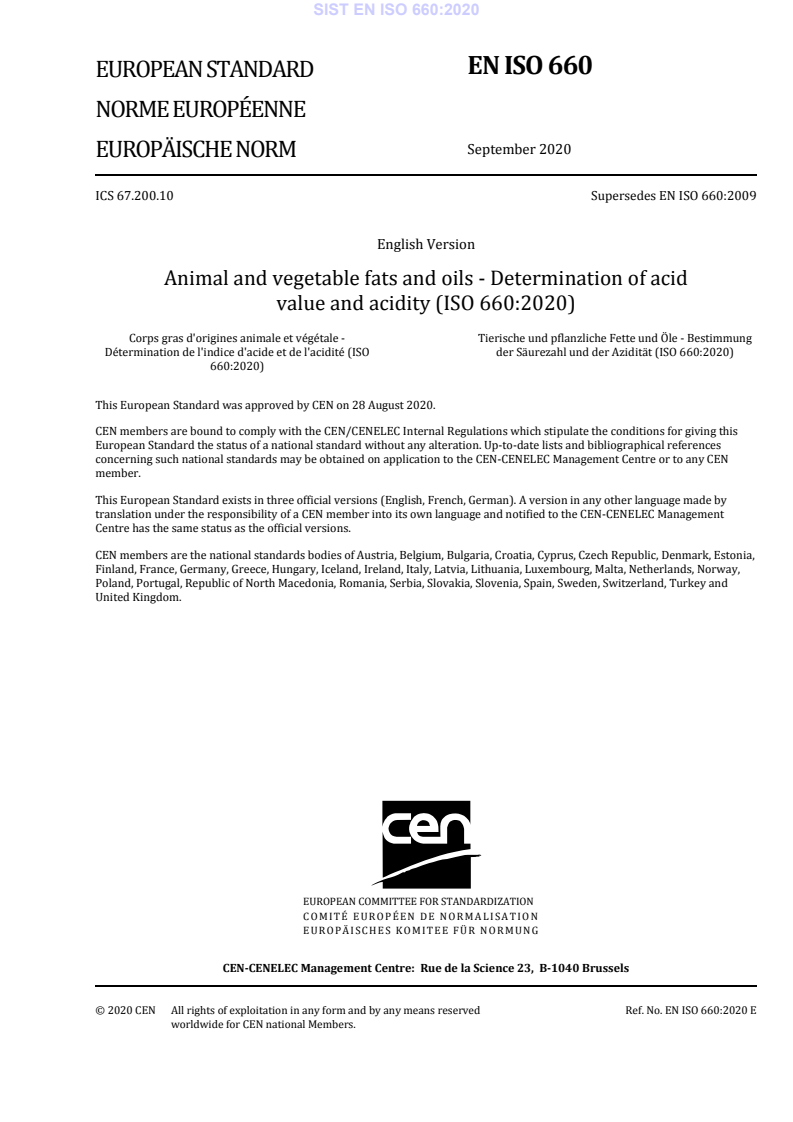
EN ISO 660
EUROPEAN STANDARD
NORME EUROPÉENNE
September 2020
EUROPÄISCHE NORM
ICS 67.200.10 Supersedes EN ISO 660:2009
English Version
Animal and vegetable fats and oils - Determination of acid
value and acidity (ISO 660:2020)
Corps gras d'origines animale et végétale - Tierische und pflanzliche Fette und Öle - Bestimmung
Détermination de l'indice d'acide et de l'acidité (ISO der Säurezahl und der Azidität (ISO 660:2020)
660:2020)
This European Standard was approved by CEN on 28 August 2020.
CEN members are bound to comply with the CEN/CENELEC Internal Regulations which stipulate the conditions for giving this
European Standard the status of a national standard without any alteration. Up-to-date lists and bibliographical references
concerning such national standards may be obtained on application to the CEN-CENELEC Management Centre or to any CEN
member.
This European Standard exists in three official versions (English, French, German). A version in any other language made by
translation under the responsibility of a CEN member into its own language and notified to the CEN-CENELEC Management
Centre has the same status as the official versions.
CEN members are the national standards bodies of Austria, Belgium, Bulgaria, Croatia, Cyprus, Czech Republic, Denmark, Estonia,
Finland, France, Germany, Greece, Hungary, Iceland, Ireland, Italy, Latvia, Lithuania, Luxembourg, Malta, Netherlands, Norway,
Poland, Portugal, Republic of North Macedonia, Romania, Serbia, Slovakia, Slovenia, Spain, Sweden, Switzerland, Turkey and
United Kingdom.
EUROPEAN COMMITTEE FOR STANDARDIZATION
COMITÉ EUROPÉEN DE NORMALISATION
EUROPÄISCHES KOMITEE FÜR NORMUNG
CEN-CENELEC Management Centre: Rue de la Science 23, B-1040 Brussels
© 2020 CEN All rights of exploitation in any form and by any means reserved Ref. No. EN ISO 660:2020 E
worldwide for CEN national Members.
Contents Page
European foreword . 3
European foreword
This document (EN ISO 660:2020) has been prepared by Technical Committee ISO/TC 34 "Food
products" in collaboration with Technical Committee CEN/TC 307 “Oilseeds, vegetable and animal fats
and oils and their by-products - Methods of sampling and analysis” the secretariat of which is held by
AFNOR.
This European Standard shall be given the status of a national standard, either by publication of an
identical text or by endorsement, at the latest by March 2021, and conflicting national standards shall
be withdrawn at the latest by March 2021.
Attention is drawn to the possibility that some of the elements of this document may be the subject of
patent rights. CEN shall not be held responsible for identifying any or all such patent rights.
This document supersedes EN ISO 660:2009.
According to the CEN-CENELEC Internal Regulations, the national standards organizations of the
following countries are bound to implement this European Standard: Austria, Belgium, Bulgaria,
Croatia, Cyprus, Czech Republic, Denmark, Estonia, Finland, France, Germany, Greece, Hungary, Iceland,
Ireland, Italy, Latvia, Lithuania, Luxembourg, Malta, Netherlands, Norway, Poland, Portugal, Republic of
North Macedonia, Romania, Serbia, Slovakia, Slovenia, Spain, Sweden, Switzerland, Turkey and the
United Kingdom.
Endorsement notice
The text of ISO 660:2020 has been approved by CEN as EN ISO 660:2020 without any modification.
INTERNATIONAL ISO
STANDARD 660
Fourth edition
2020-03
Animal and vegetable fats and oils —
Determination of acid value and acidity
Corps gras d'origines animale et végétale — Détermination de l'indice
d'acide et de l'acidité
Reference number
ISO 660:2020(E)
©
ISO 2020
ISO 660:2020(E)
© ISO 2020
All rights reserved. Unless otherwise specified, or required in the context of its implementation, no part of this publication may
be reproduced or utilized otherwise in any form or by any means, electronic or mechanical, including photocopying, or posting
on the internet or an intranet, without prior written permission. Permission can be requested from either ISO at the address
below or ISO’s member body in the country of the requester.
ISO copyright office
CP 401 • Ch. de Blandonnet 8
CH-1214 Vernier, Geneva
Phone: +41 22 749 01 11
Fax: +41 22 749 09 47
Email: copyright@iso.org
Website: www.iso.org
Published in Switzerland
ii © ISO 2020 – All rights reserved
ISO 660:2020(E)
Contents Page
Foreword .iv
1 Scope . 1
2 Normative references . 1
3 Terms and definitions . 1
4 Principle . 2
5 Reagents . 2
6 Apparatus . 3
7 Sampling . 3
8 Preparation of test sample . 3
9 Procedure. 3
9.1 Cold solvent method using indicator (reference method) . 3
9.2 Cold solvent method using potentiometric titration (reference method) . 4
9.3 Hot ethanol method using indicator . 4
10 Calculation . 5
10.1 General . 5
10.2 Acid value. 5
10.3 Acidity or free fatty acid content . 5
11 Precision . 6
11.1 Repeatability . 6
11.2 Reproducibility . 6
12 Test report . 6
Annex A (informative) Results of interlaboratory tests. 7
Annex B (informative) Comparison of three coloured indicators .10
Bibliography .12
ISO 660:2020(E)
Foreword
ISO (the International Organization for Standardization) is a worldwide federation of national standards
bodies (ISO member bodies). The work of preparing International Standards is normally carried out
through ISO technical committees. Each member body interested in a subject for which a technical
committee has been established has the right to be represented on that committee. International
organizations, governmental and non-governmental, in liaison with ISO, also take part in the work.
ISO collaborates closely with the International Electrotechnical Commission (IEC) on all matters of
electrotechnical standardization.
The procedures used to develop this document and those intended for its further maintenance are
described in the ISO/IEC Directives, Part 1. In particular, the different approval criteria needed for the
different types of ISO documents should be noted. This document was drafted in accordance with the
editorial rules of the ISO/IEC Directives, Part 2 (see www .iso .org/ directives).
Attention is drawn to the possibility that some of the elements of this document may be the subject of
patent rights. ISO shall not be held responsible for identifying any or all such patent rights. Details of
any patent rights identified during the development of the document will be in the Introduction and/or
on the ISO list of patent declarations received (see www .iso .org/ patents).
Any trade name used in this document is information given for the convenience of users and does not
constitute an endorsement.
For an explanation of the voluntary nature of standards, the meaning of ISO specific terms and
expressions related to conformity assessment, as well as information about ISO’s adherence to the
World Trade Organization (WTO) principles in the Technical Barriers to Trade (TBT) see www .iso .org/
iso/ foreword .html.
This document was prepared by Technical Committee ISO/TC 34, Food products, Subcommittee SC 11,
Animal and vegetable fats and oils, , in collaboration with the European Committee for Standardization
(CEN) Technical Committee CEN/TC 307, Oilseeds, vegetable and animal fats and oils and their by-
products — Methods of sampling and analysis, in accordance with the Agreement on technical cooperation
between ISO and CEN (Vienna Agreement).
This fourth edition cancels and replaces the third edition (ISO 660:2009), which has been technically
revised. The main changes compared with the previous edition are as follows:
— a non-applicability statement for milk and milk products has been added to the Scope because
ISO 1740 applies in these cases;
— details of a CMR classification on coloured indicators have been added;
— data from the collaborative trial carried out to support this modification have been added in
Annex B.
Any feedback or questions on this document should be directed to the user’s national standards body. A
complete listing of these bodies can be found at www .iso .org/ members .html.
iv © ISO 2020 – All rights reserved
INTERNATIONAL STANDARD ISO 660:2020(E)
Animal and vegetable fats and oils — Determination of acid
value and acidity
1 Scope
This document specifies three methods (two titrimetric and one potentiometric) for the determination
of acidity in animal and vegetable fats and oils, hereinafter referred to as “fats”. The acidity is expressed
preferably as acid value or, alternatively, as acidity calculated conventionally.
This document is applicable to refined and crude vegetable or animal fats and oils, soap stock fatty
acids or technical fatty acids. It does not apply to waxes.
Since the methods are completely non-specific, they do not apply to differentiating between mineral
acids, free fatty acids and other organic acids. The acid value, therefore, includes any mineral acids that
are present.
Milk and milk products (or fat coming from milk and milk products) are excluded from the Scope of this
document.
2 Normative references
The following documents are referred to in the text in such a way that some or all of their content
constitutes requirements of this document. For dated references, only the edition cited applies. For
undated references, the latest edition of the referenced document (including any amendments) applies.
ISO 385, Laboratory glassware — Burettes
ISO 661, Animal and vegetable fats and oils — Preparation of test sample
ISO 1042, Laboratory glassware — One-mark volumetric flasks
ISO 3696, Water for analytical laboratory use — Specification and test methods
3 Terms and definitions
For the purposes of this document, the following terms and definitions apply.
ISO and IEC maintain terminological databases for use in standardization at the following addresses:
— ISO Online browsing platform: available at https:// www .iso .org/ obp
— IEC Electropedia: available at http:// www .electropedia .org/
3.1
acid value
number of milligrams of potassium hydroxide required to neutralize the free fatty acids present in 1 g
of fat, when determined in accordance with the procedure specified in this document
Note 1 to entry: The acid value is expressed in milligrams per gram.
3.2
acidity
content of free fatty acids determined according to the procedure specified in this document
Note 1 to entry: The acidity is expressed as a percentage by mass. If the result of the determination is reported as
acidity without further explanation, this is, by convention, the acidity based on the oleic acid content.
ISO 660:2020(E)
4 Principle
The sample is dissolved in a suitable solvent mixture, and the acids present are titrated with an
ethanolic or methanolic solution of sodium or potassium hydroxide.
The methods specified in 9.1 and 9.2 are reference methods.
5 Reagents
WARNING — Attention is drawn to regulations that specify the handling of hazardous substances.
Technical, organizational and personal safety measures shall be followed.
Use only reagents of recognized analytical grade, unless otherwise specified.
5.1 Solvent A for the solvent mixture (5.3), ethanol, volume fraction, φ ≈ 96 %.
As a replacement, propan-2-ol, volume fraction, φ ≈ 99 %, may be used.
5.2 Solvent
...