

EN ISO 21043-5:2025
(Main)Forensic sciences - Part 5: Reporting (ISO 21043-5:2025)
- Abstract
This document specifies requirements and provides recommendations for reporting of forensic work.
This document is applicable to the reporting of forensic work performed at a scene and within a facility. The requirements facilitate the preparation and issuing of reports that are accurate, clear, transparent, complete, unambiguous, impartial and suitable for their intended use.
This document also includes requirements relating to the review of case records and reports, the issuance and control of reports, and requirements related to testimony.
- Status
- Published
- Publication Date
- 17-Jun-2025
- Technical Committee
- CEN/TC 419 - Project Committee - Forensic science services
- Drafting Committee
- CEN/TC 419 - Project Committee - Forensic science services
- Current Stage
- 6060 - Definitive text made available (DAV) - Publishing
- Start Date
- 18-Jun-2025
- Completion Date
- 18-Jun-2025

Overview
EN ISO 21043-5:2025, titled Forensic sciences – Part 5: Reporting, is an international standard developed by the European Committee for Standardization (CEN) in collaboration with ISO. This standard provides comprehensive requirements and recommendations for the reporting of forensic work, both at crime scenes and within forensic facilities. Its objective is to ensure that forensic reports are accurate, clear, transparent, complete, unambiguous, impartial, and suitable for their intended use.
The standard also addresses the review of case records and reports, the issuance and control of reports, and requirements related to testimony in legal settings. Effective forensic reporting is essential for maintaining the integrity and reliability of forensic evidence in justice systems and investigative processes.
Key Topics
EN ISO 21043-5:2025 covers several crucial areas for forensic reporting, including:
- Content of Reports: Details the mandatory and recommended information to be included, such as item descriptions, examination details, results, responsible persons, and administrative details like dates, case numbers, and pagination.
- Accuracy and Impartiality: Outlines steps to avoid overstating or understating findings, ensuring opinions are supported by data and clearly differentiated from observations.
- Declaration of Limitations: Emphasizes declaring known limitations of methods, procedures, and findings, and mandates transparency if deviations from standard protocols occur.
- Case Review Procedures: Defines processes for technical and administrative review of case files and reports, specifying when and how reviews should be conducted based on risk assessment.
- Issuance and Control of Reports: Provides systematic requirements for issuing, referencing, amending, supplementing, withdrawing, and securely managing reports.
- Preliminary Communications: Recognizes the need for timely information exchange and the conditions under which informal communications or preliminary findings are provided.
- Testimony: Sets guidelines for forensic personnel when providing testimony, including required training, competence assessment, and clarity in courtroom communication.
Applications
Implementation of EN ISO 21043-5:2025 brings practical benefits to a broad range of forensic and legal stakeholders:
- Forensic Laboratories and Service Providers: Ensures standardized and defensible reporting practices. Facilitates high-quality, consistent communication of forensic findings to clients and courts.
- Legal Professionals and Law Enforcement: Provides transparent, reliable, and easily interpretable forensic evidence, essential for legal proceedings and decision-making.
- Accreditation and Quality Assurance Bodies: Offers measurable criteria for evaluating the quality and completeness of forensic reports and related processes.
- Training and Competency Development: Supports the development of training and assessment protocols for both forensic report drafting and testimony, strengthening overall professional competence and court presentation skills.
- International Collaboration: Harmonizes reporting standards across countries, fostering trust, consistency, and cooperation in cross-border investigations and judicial processes.
Related Standards
EN ISO 21043-5:2025 is part of the broader ISO 21043 series on forensic sciences. Relevant standards include:
- ISO 21043-1: Forensic sciences - Vocabulary: Defines key terms and concepts used throughout forensic processes.
- ISO 21043-2: Recognition, recording, collecting, transport, and storage of items: Covers best practices for handling physical evidence.
- ISO 21043-3: Analysis: Addresses analytical processes applied to forensic items.
- ISO 21043-4: Interpretation: Provides frameworks for interpreting forensic findings, closely linked to reporting opinions in Part 5.
These standards together provide a comprehensive foundation for all phases of forensic science, from initial evidence recognition to reporting and testimony.
By adhering to EN ISO 21043-5:2025, forensic institutions and professionals can assure the quality, reliability, and credibility of their reports and testimony, reinforcing the trust of stakeholders throughout the criminal justice system. For additional guidance, users are encouraged to consult other relevant parts of the ISO 21043 series and regularly review updated practices.
Relations
- Effective Date
- 09-Feb-2026
- Effective Date
- 09-Feb-2026
- Consolidated By
ISO 21043-5:2025 - Forensic sciences — Part 5: Reporting - Effective Date
- 12-Feb-2026
Frequently Asked Questions
EN ISO 21043-5:2025 is a standard published by the European Committee for Standardization (CEN). Its full title is "Forensic sciences - Part 5: Reporting (ISO 21043-5:2025)". This standard covers: This document specifies requirements and provides recommendations for reporting of forensic work. This document is applicable to the reporting of forensic work performed at a scene and within a facility. The requirements facilitate the preparation and issuing of reports that are accurate, clear, transparent, complete, unambiguous, impartial and suitable for their intended use. This document also includes requirements relating to the review of case records and reports, the issuance and control of reports, and requirements related to testimony.
This document specifies requirements and provides recommendations for reporting of forensic work. This document is applicable to the reporting of forensic work performed at a scene and within a facility. The requirements facilitate the preparation and issuing of reports that are accurate, clear, transparent, complete, unambiguous, impartial and suitable for their intended use. This document also includes requirements relating to the review of case records and reports, the issuance and control of reports, and requirements related to testimony.
EN ISO 21043-5:2025 is classified under the following ICS (International Classification for Standards) categories: 07.140 - Forensic science. The ICS classification helps identify the subject area and facilitates finding related standards.
EN ISO 21043-5:2025 has the following relationships with other standards: It is inter standard links to ISO 21043-4:2025, ISO 21043-1:2025, ISO 21043-5:2025. Understanding these relationships helps ensure you are using the most current and applicable version of the standard.
EN ISO 21043-5:2025 is available in PDF format for immediate download after purchase. The document can be added to your cart and obtained through the secure checkout process. Digital delivery ensures instant access to the complete standard document.
Standards Content (Sample)
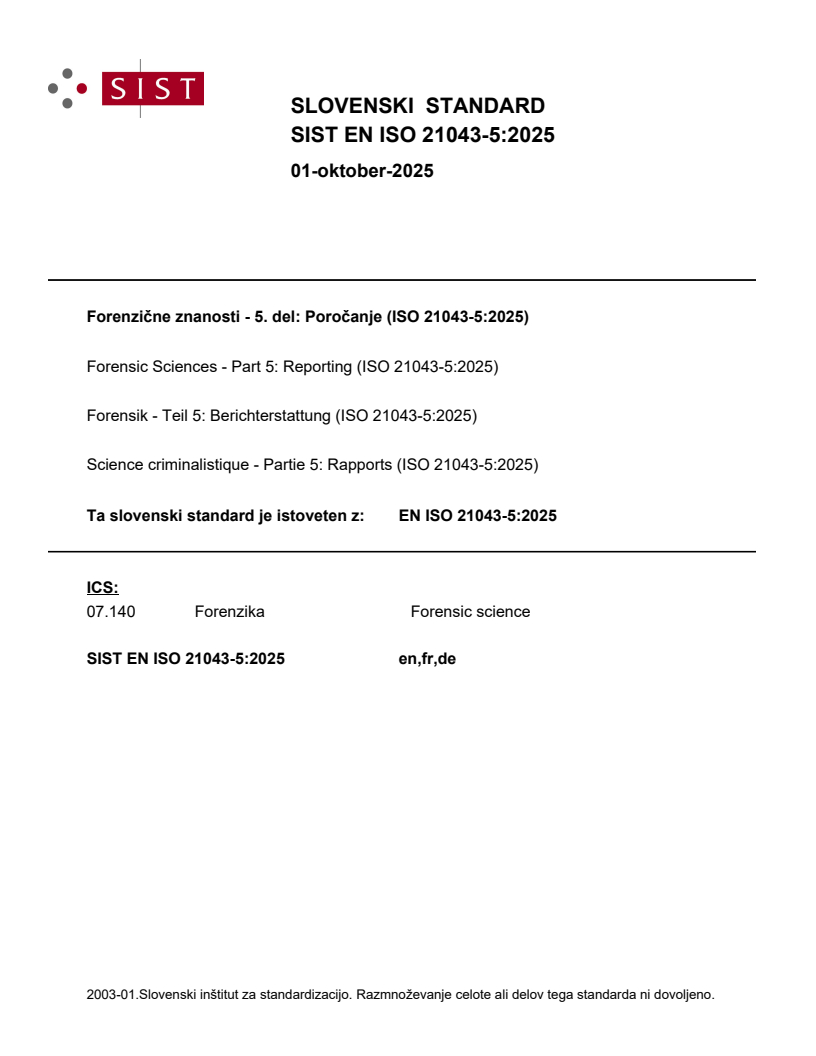
SLOVENSKI STANDARD
01-oktober-2025
Forenzične znanosti - 5. del: Poročanje (ISO 21043-5:2025)
Forensic Sciences - Part 5: Reporting (ISO 21043-5:2025)
Forensik - Teil 5: Berichterstattung (ISO 21043-5:2025)
Science criminalistique - Partie 5: Rapports (ISO 21043-5:2025)
Ta slovenski standard je istoveten z: EN ISO 21043-5:2025
ICS:
07.140 Forenzika Forensic science
2003-01.Slovenski inštitut za standardizacijo. Razmnoževanje celote ali delov tega standarda ni dovoljeno.
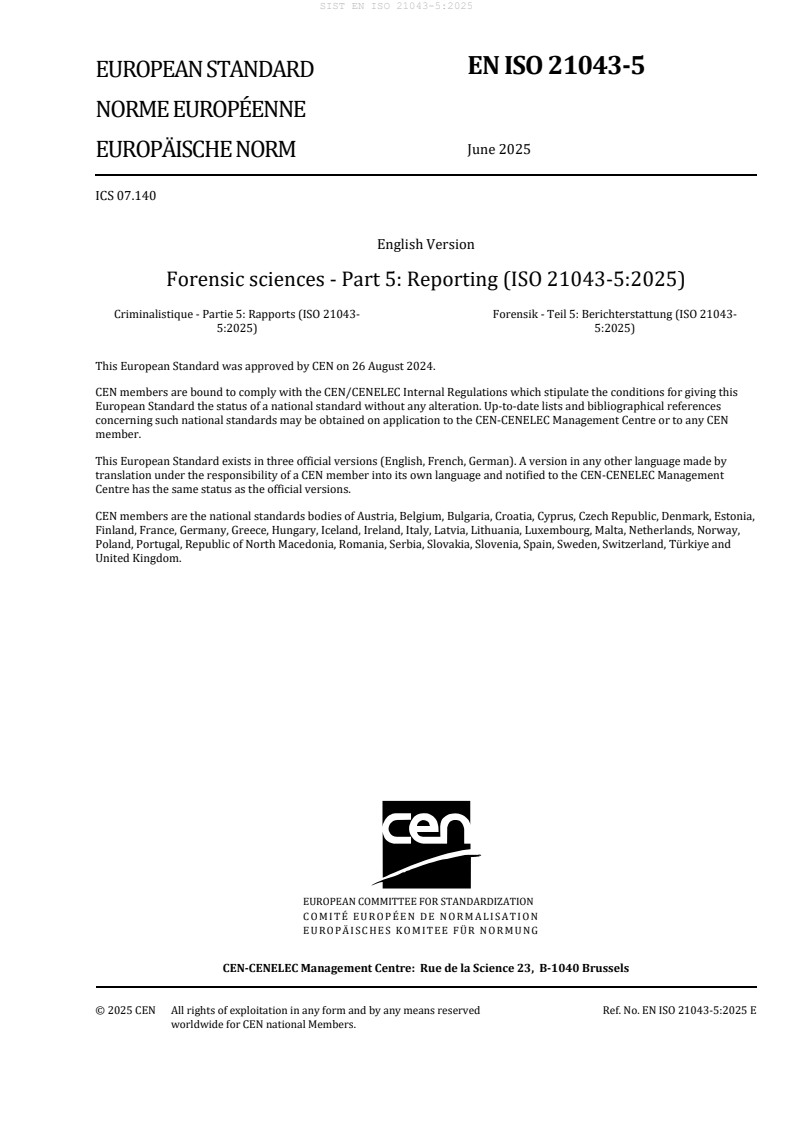
EN ISO 21043-5
EUROPEAN STANDARD
NORME EUROPÉENNE
June 2025
EUROPÄISCHE NORM
ICS 07.140
English Version
Forensic sciences - Part 5: Reporting (ISO 21043-5:2025)
Criminalistique - Partie 5: Rapports (ISO 21043- Forensik - Teil 5: Berichterstattung (ISO 21043-
5:2025) 5:2025)
This European Standard was approved by CEN on 26 August 2024.
CEN members are bound to comply with the CEN/CENELEC Internal Regulations which stipulate the conditions for giving this
European Standard the status of a national standard without any alteration. Up-to-date lists and bibliographical references
concerning such national standards may be obtained on application to the CEN-CENELEC Management Centre or to any CEN
member.
This European Standard exists in three official versions (English, French, German). A version in any other language made by
translation under the responsibility of a CEN member into its own language and notified to the CEN-CENELEC Management
Centre has the same status as the official versions.
CEN members are the national standards bodies of Austria, Belgium, Bulgaria, Croatia, Cyprus, Czech Republic, Denmark, Estonia,
Finland, France, Germany, Greece, Hungary, Iceland, Ireland, Italy, Latvia, Lithuania, Luxembourg, Malta, Netherlands, Norway,
Poland, Portugal, Republic of North Macedonia, Romania, Serbia, Slovakia, Slovenia, Spain, Sweden, Switzerland, Türkiye and
United Kingdom.
EUROPEAN COMMITTEE FOR STANDARDIZATION
COMITÉ EUROPÉEN DE NORMALISATION
EUROPÄISCHES KOMITEE FÜR NORMUNG
CEN-CENELEC Management Centre: Rue de la Science 23, B-1040 Brussels
© 2025 CEN All rights of exploitation in any form and by any means reserved Ref. No. EN ISO 21043-5:2025 E
worldwide for CEN national Members.
Contents Page
European foreword . 3
European foreword
This document (EN ISO 21043-5:2025) has been prepared by Technical Committee ISO/TC 272
"Forensic sciences" in collaboration with Technical Committee CEN/TC 419 “Forensic Science
Processes” the secretariat of which is held by NEN.
This European Standard shall be given the status of a national standard, either by publication of an
identical text or by endorsement, at the latest by December 2025, and conflicting national standards
shall be withdrawn at the latest by December 2025.
Attention is drawn to the possibility that some of the elements of this document may be the subject of
patent rights. CEN shall not be held responsible for identifying any or all such patent rights.
Any feedback and questions on this document should be directed to the users’ national standards
body/national committee. A complete listing of these bodies can be found on the CEN website.
According to the CEN-CENELEC Internal Regulations, the national standards organizations of the
following countries are bound to implement this European Standard: Austria, Belgium, Bulgaria,
Croatia, Cyprus, Czech Republic, Denmark, Estonia, Finland, France, Germany, Greece, Hungary, Iceland,
Ireland, Italy, Latvia, Lithuania, Luxembourg, Malta, Netherlands, Norway, Poland, Portugal, Republic of
North Macedonia, Romania, Serbia, Slovakia, Slovenia, Spain, Sweden, Switzerland, Türkiye and the
United Kingdom.
Endorsement notice
The text of ISO 21043-5:2025 has been approved by CEN as EN ISO 21043-5:2025 without any
modification.
International
Standard
ISO 21043-5
First edition
Forensic sciences —
2025-06
Part 5:
Reporting
Criminalistique —
Partie 5: Rapports
Reference number
ISO 21043-5:2025(en) © ISO 2025
ISO 21043-5:2025(en)
© ISO 2025
All rights reserved. Unless otherwise specified, or required in the context of its implementation, no part of this publication may
be reproduced or utilized otherwise in any form or by any means, electronic or mechanical, including photocopying, or posting on
the internet or an intranet, without prior written permission. Permission can be requested from either ISO at the address below
or ISO’s member body in the country of the requester.
ISO copyright office
CP 401 • Ch. de Blandonnet 8
CH-1214 Vernier, Geneva
Phone: +41 22 749 01 11
Email: copyright@iso.org
Website: www.iso.org
Published in Switzerland
ii
ISO 21043-5:2025(en)
Contents Page
Foreword .iv
Introduction .v
1 Scope . 1
2 Normative references . 1
3 Terms and definitions . 1
4 General requirements . 1
5 Report contents . 2
5.1 General .2
5.2 Administrative requirements .2
5.3 Item integrity .3
5.4 Measurement uncertainty and significant figures.3
5.5 Reporting opinions .3
5.5.1 General .3
5.5.2 Reporting probabilities .4
5.5.3 Reporting likelihood ratios .4
5.5.4 Reporting estimations . .4
6 Case file review . 4
6.1 General .4
6.2 Technical review .5
6.3 Administrative review .5
7 Issue and control of reports . 6
7.1 Issuing reports .6
7.2 Supplementing, amending and withdrawing reports .6
7.3 Controlling reports .6
7.4 Communications of observations or opinions other than by way of a report .6
8 Testimony . 7
8.1 General .7
8.2 Testimony training and evaluation .7
Annex A (informative) Reports and other communication of information . 9
Bibliography .10
iii
ISO 21043-5:2025(en)
Foreword
ISO (the International Organization for Standardization) is a worldwide federation of national standards
bodies (ISO member bodies). The work of preparing International Standards is normally carried out through
ISO technical committees. Each member body interested in a subject for which a technical committee
has been established has the right to be represented on that committee. International organizations,
governmental and non-governmental, in liaison with ISO, also take part in the work. ISO collaborates closely
with the International Electrotechnical Commission (IEC) on all matters of electrotechnical standardization.
The procedures used to develop this document and those intended for its further maintenance are described
in the ISO/IEC Directives, Part 1. In particular, the different approval criteria needed for the different types
of ISO document should be noted. This document was drafted in accordance with the editorial rules of the
ISO/IEC Directives, Part 2 (see www.iso.org/directives).
ISO draws attention to the possibility that the implementation of this document may involve the use of (a)
patent(s). ISO takes no position concerning the evidence, validity or applicability of any claimed patent
rights in respect thereof. As of the date of publication of this document, ISO had not received notice of (a)
patent(s) which may be required to implement this document. However, implementers are cautioned that
this may not represent the latest information, which may be obtained from the patent database available at
www.iso.org/patents. ISO shall not be held responsible for identifying any or all such patent rights.
Any trade name used in this document is information given for the convenience of users and does not
constitute an endorsement.
For an explanation of the voluntary nature of standards, the meaning of ISO specific terms and expressions
related to conformity assessment, as well as information about ISO's adherence to the World Trade
Organization (WTO) principles in the Technical Barriers to Trade (TBT), see www.iso.org/iso/foreword.html.
This document was prepared by Technical Committee ISO/TC 272, Forensic sciences, in collaboration with
the European Committee for Standardization (CEN) Technical Committee CEN/TC 419, Forensic science
processes, in accordance with the Agreement on technical cooperation between ISO and CEN (Vienna
Agreement).
A list of all parts in the ISO 21043 series can be found on the ISO website.
Any feedback or questions on this document should be directed to the user’s national standards body. A
complete listing of these bodies can be found at www.iso.org/members.html.
iv
ISO 21043-5:2025(en)
Introduction
This document is part of a series that includes the different components of the forensic process from scene
to courtroom. Other parts of the ISO 21043 series are:
— ISO 21043-1;
— ISO 21043-2;
— ISO 21043-3;
— ISO 21043-4.
The information on reports and other communication of information given in Annex A is provided for
information only.
v
International Standard ISO 21043-5:2025(en)
Forensic sciences —
Part 5:
Reporting
1 Scope
This document specifies requirements and provides recommendations for reporting of forensic work.
This document is applicable to the reporting of forensic work performed at a scene and within a facility.
The requirements facilitate the preparation and issuing of reports that are accurate, clear, transparent,
complete, unambiguous, impartial and suitable for their intended use.
This document also includes requirements relating to the review of case records and reports, the issuance
and control of reports, and requirements related to testimony.
2 Normative references
The following documents are referred to in the text in such a way that some or all of their content constitutes
requirements of this document. For dated references, only the edition cited applies. For undated references,
the latest edition of the referenced document (including any amendments) applies.
ISO 21043-1, Forensic sciences — Part 1: Vocabulary
ISO 21043-4, Forensic sciences — Part 4: Interpretation
3 Terms and definitions
For the purposes of this document, the terms and definitions given in ISO 21043-1 apply.
ISO and IEC maintain terminology databases for use in standardization at the following addresses:
— ISO Online browsing platform: available at https:// www .iso .org/ obp
— IEC Electropedia: available at https:// www .electropedia .org/
4 General requirements
Reports shall be accurate, clear, transparent, complete, unambiguous, impartial and suitable for their
intended use.
The forensic service provider shall have a documented procedure for formally authorizing examiners to
issue reports.
Examiners shall not report beyond their area of expertise.
Examiners shall not report beyond what can be based on the available information.
Known limitations of methods, procedures, observations and opinions should be stated clearly in the report
or in an appendix attached to the report. If the known limitations are not stated in the report or in an
appendix to the report:
a) the report shall state that the information on the limitations is available; and
ISO 21043-5:2025(en)
b) information about the known limitations shall be provided upon request.
Descriptions of any deviation from documented methods or procedures shall be included in the report if the
deviation can have a substantial impact on the observations or opinions. The reason for any such deviation
shall be explained in the report or in an appendix attached to the report.
Any terms that are not in common usage, or for whic
...