

EN 14652:2005+A1:2007
(Main + Amendment)Water conditioning equipment inside buildings - Membrane separation devices - Requirements for performance, safety and testing
- Abstract
This European Standard specifies requirements relating to the construction, performance and methods of testing for membrane separation systems with a particle rating below 1 m, namely microfiltration (MF), ultrafiltration (UF), nanofiltration (NF) and reverse osmosis (RO) for drinking water installations inside buildings, intended to remove from the drinking water marginal concentrations of suspended and colloidal solids, microorganisms, organic molecules and/or to reduce the dissolved solids concentration and applies to systems with a minimum pressure of PN 10, connections between DN 15 and DN 100 and a maximum working temperature of at least 30 °C.
This European Standard applies to membrane separation systems, whose elements may be partly or entirely cleanable or disposable in accordance with the type of system. It only concerns units which are permanently connected to the mains supply at the point-of-entry or the point-of-use.
A membrane separation system may include, together with the separation device pre- and /or post-treatment devices.
For the scope of this European Standard:
- separation device shall comply with this European Standard, i.e. without pre-and/or post-treatments;
- where pre-and/or post-treatment devices are incorporated in the system, each of them shall conform to the relevant standard. If this is the case, the complete system shall be considered as conforming as a whole.
- Status
- Published
- Publication Date
- 12-Jun-2007
- Technical Committee
- CEN/TC 164 - Water supply
- Drafting Committee
- CEN/TC 164/WG 13 - Water conditioning equipment inside buildings
- Current Stage
- 9093 - Decision to confirm - Review Enquiry
- Start Date
- 10-Sep-2021
- Completion Date
- 14-Oct-2026



EN 14652:2005+A1:2007 - Overview
EN 14652:2005+A1:2007 is the CEN European Standard for membrane separation devices used inside buildings for drinking water conditioning. It specifies requirements for construction, performance, safety and testing of membrane systems with a particle rating below 1 µm - covering microfiltration (MF), ultrafiltration (UF), nanofiltration (NF) and reverse osmosis (RO). The standard applies to permanently mains‑connected point‑of‑entry and point‑of‑use units with a minimum pressure rating of PN 10, connections DN 15–DN 100, and a maximum working temperature of at least 30 °C. Systems may be partly or wholly cleanable or disposable and can include pre‑/post‑treatment where those components conform to their relevant standards.
Key topics and technical requirements
- Scope and classifications for MF, UF, NF and RO membrane types and intended uses (filtrate/permeate characteristics).
- Construction and materials requirements, including material suitability for drinking water and component accessibility for maintenance.
- Mechanical and hydraulic performance: membrane flux, permeability, nominal flow rate, recovery rate and rejection rate definitions and test conditions.
- Pressure and temperature resistance (hydrostatic, cyclic pressure) for vessels and modules.
- Operational modes: cross‑flow (permeate + reject) and dead‑end (filtrate only) and implications for cleaning/disposal.
- Safety features: backflow prevention, drain and end connections, air vents, electrical safety, noise limits.
- Serviceability: component replacement, back‑washable module requirements (MF/UF) and lifecycle considerations.
- Documentation & marking: installation, operation and maintenance manual, performance data sheet, marking/data plate.
- Test methods and annexes: normative test methods (Annex A), membrane types (Annex B), example test reports (Annex C) and installation/maintenance guidance (Annex D).
Practical applications and users
EN 14652 is essential for:
- Manufacturers and designers of membrane filtration systems (MF, UF, NF, RO) for buildings
- Water treatment specifiers, consulting engineers and plumbing contractors assessing point‑of‑use / point‑of‑entry systems
- Testing and certification bodies verifying performance, safety and compliance
- Facility managers and procurement teams selecting membrane units for drinking water treatment in residential, commercial and institutional buildings
Typical applications include removal of suspended solids, microorganisms and organic molecules, or reduction of dissolved solids in tap water where membrane separation is required.
Related standards
Normative references cited include standards on flange/connectors, backflow protection and laboratory test methods - for example EN 1717 (backflow protection) and relevant EN/ISO test and thread standards. Consult the standard’s normative references for full conformity requirements.
Keywords: EN 14652, membrane separation, MF, UF, NF, RO, drinking water, membrane filtration, performance testing, point-of-use, point-of-entry.
Relations
- Effective Date
- 19-Jan-2023
- Effective Date
- 17-Jun-2026
- Refers
ISO 12103-1:1997 - Road vehicles — Test dust for filter evaluation — Part 1: Arizona test dust - Effective Date
- 17-Jun-2026
- Refers
ISO 304:1985 - Surface active agents — Determination of surface tension by drawing up liquid films - Effective Date
- 17-Jun-2026
- Effective Date
- 09-Feb-2026
- Refers
prEN 15116 - Ventilation in buildings - Chilled beams - Testing and rating of active chilled beams - Effective Date
- 28-Jan-2026
- Effective Date
- 28-Jan-2026
- Effective Date
- 28-Jan-2026
- Effective Date
- 28-Jan-2026
- Effective Date
- 28-Jan-2026
- Effective Date
- 28-Jan-2026
- Effective Date
- 28-Jan-2026
- Effective Date
- 28-Jan-2026
- Effective Date
- 28-Jan-2026
- Effective Date
- 28-Jan-2026
Get Certified
Connect with accredited certification bodies for this standard

DIBt (Deutsches Institut für Bautechnik)
German Institute for Building Technology.
DIN CERTCO
DIN Group product certification.

Kiwa BDA Testing
Building and construction product certification.
Sponsored listings
Frequently Asked Questions
EN 14652:2005+A1:2007 is a standard published by the European Committee for Standardization (CEN). Its full title is "Water conditioning equipment inside buildings - Membrane separation devices - Requirements for performance, safety and testing". This standard covers: This European Standard specifies requirements relating to the construction, performance and methods of testing for membrane separation systems with a particle rating below 1 m, namely microfiltration (MF), ultrafiltration (UF), nanofiltration (NF) and reverse osmosis (RO) for drinking water installations inside buildings, intended to remove from the drinking water marginal concentrations of suspended and colloidal solids, microorganisms, organic molecules and/or to reduce the dissolved solids concentration and applies to systems with a minimum pressure of PN 10, connections between DN 15 and DN 100 and a maximum working temperature of at least 30 °C. This European Standard applies to membrane separation systems, whose elements may be partly or entirely cleanable or disposable in accordance with the type of system. It only concerns units which are permanently connected to the mains supply at the point-of-entry or the point-of-use. A membrane separation system may include, together with the separation device pre- and /or post-treatment devices. For the scope of this European Standard: - separation device shall comply with this European Standard, i.e. without pre-and/or post-treatments; - where pre-and/or post-treatment devices are incorporated in the system, each of them shall conform to the relevant standard. If this is the case, the complete system shall be considered as conforming as a whole.
This European Standard specifies requirements relating to the construction, performance and methods of testing for membrane separation systems with a particle rating below 1 m, namely microfiltration (MF), ultrafiltration (UF), nanofiltration (NF) and reverse osmosis (RO) for drinking water installations inside buildings, intended to remove from the drinking water marginal concentrations of suspended and colloidal solids, microorganisms, organic molecules and/or to reduce the dissolved solids concentration and applies to systems with a minimum pressure of PN 10, connections between DN 15 and DN 100 and a maximum working temperature of at least 30 °C. This European Standard applies to membrane separation systems, whose elements may be partly or entirely cleanable or disposable in accordance with the type of system. It only concerns units which are permanently connected to the mains supply at the point-of-entry or the point-of-use. A membrane separation system may include, together with the separation device pre- and /or post-treatment devices. For the scope of this European Standard: - separation device shall comply with this European Standard, i.e. without pre-and/or post-treatments; - where pre-and/or post-treatment devices are incorporated in the system, each of them shall conform to the relevant standard. If this is the case, the complete system shall be considered as conforming as a whole.
EN 14652:2005+A1:2007 is classified under the following ICS (International Classification for Standards) categories: 13.060.20 - Drinking water; 91.140.60 - Water supply systems. The ICS classification helps identify the subject area and facilitates finding related standards.
EN 14652:2005+A1:2007 has the following relationships with other standards: It is inter standard links to EN 14652:2005, ISO 7-1:1994, ISO 12103-1:1997, ISO 304:1985, ISO 1219-1:2006, prEN 15116, EN 1715-4:1997, EN 1092-1:2018, EN ISO 3822-1:1999/A1:2008, EN 1254-1:2021, EN ISO 3822-2:1995, EN 1092-2:2023, EN 15861:2012, EN ISO 228-1:2003, EN 1717:2000. Understanding these relationships helps ensure you are using the most current and applicable version of the standard.
EN 14652:2005+A1:2007 is associated with the following European legislation: EU Directives/Regulations: 305/2011, 89/106/EEC, 98/83/EC. When a standard is cited in the Official Journal of the European Union, products manufactured in conformity with it benefit from a presumption of conformity with the essential requirements of the corresponding EU directive or regulation.
EN 14652:2005+A1:2007 is available in PDF format for immediate download after purchase. The document can be added to your cart and obtained through the secure checkout process. Digital delivery ensures instant access to the complete standard document.
Standards Content (Sample)
2003-01.Slovenski inštitut za standardizacijo. Razmnoževanje celote ali delov tega standarda ni dovoljeno.Water conditioning equipment inside buildings - Membrane separation devices - Requirements for performance, safety and testingOprema, ki se uporablja za pripravo pitne vode v stavbah - Oprema za membransko filtracijo - Zahteve za delovanje, varnost in preskušanjeAppareils de traitement d'eau a l'intérieur des bâtiments - Dispositifs de séparation membranaire - Exigences de performance, de sécurité et essaisAnlagen zur Behandlung von Trinkwasser innerhalb von Gebäuden - Membranfilteranlagen - Anforderungen an Funktion, Sicherheit und PrüfungTa slovenski standard je istoveten z:EN 14652:2005+A1:2007SIST EN 14652:2006+A1:2007en,fr,de91.140.60Sistemi za oskrbo z vodoWater supply systems13.060.20Pitna vodaDrinking waterICS:SLOVENSKI
STANDARDSIST EN 14652:2006+A1:200701-september-2007
EUROPEAN STANDARD NORME EUROPÉENNE EUROPÄISCHE NORM
EN 14652:2005+A1
June 2007 ICS 13.060.20; 91.140.60 SupersedesEN 14652:2005English Version
Water conditioning equipment inside buildings - Membrane separation devices - Requirements for performance, safety and testing
Appareils de traitement d'eau à l'intérieur des bâtiments - Dispositifs de séparation membranaire - Exigences de performance, de sécurité et essais
Anlagen zur Behandlung von Trinkwasser innerhalb von Gebäuden - Membranfilteranlagen - Anforderungen an Funktion, Sicherheit und Prüfung This European Standard was approved by CEN on 8 July 2005 and includes Amendment 1 approved by CEN on 10 May 2007.
CEN members are bound to comply with the CEN/CENELEC Internal Regulations which stipulate the conditions for giving this European Standard the status of a national standard without any alteration. Up-to-date lists and bibliographical references concerning such national standards may be obtained on application to the CEN Management Centre or to any CEN member.
This European Standard exists in three official versions (English, French, German). A version in any other language made by translation under the responsibility of a CEN member into its own language and notified to the CEN Management Centre has the same status as the official versions.
CEN members are the national standards bodies of Austria, Belgium, Bulgaria, Cyprus, Czech Republic, Denmark, Estonia, Finland, France, Germany, Greece, Hungary, Iceland, Ireland, Italy, Latvia, Lithuania, Luxembourg, Malta, Netherlands, Norway, Poland, Portugal, Romania, Slovakia, Slovenia, Spain, Sweden, Switzerland and United Kingdom.
EUROPEAN COMMITTEE FOR STANDARDIZATION
COMITÉ EUROPÉEN DE NORMALISATION EUROPÄISCHES KOMITEE FÜR NORMUNG
Management Centre: rue de Stassart, 36
B-1050 Brussels © 2007 CEN All rights of exploitation in any form and by any means reserved worldwide for CEN national Members. Ref. No. EN 14652:2005+A1:2007: E
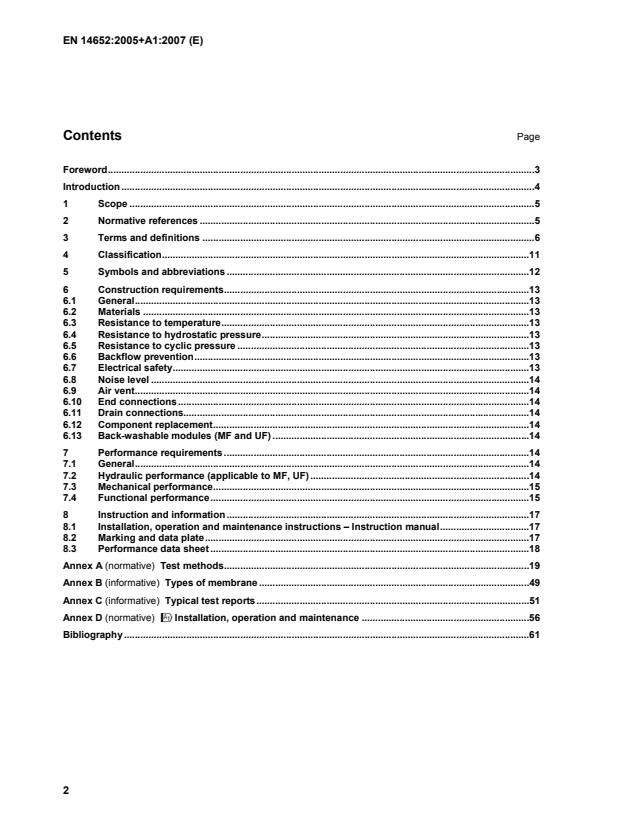
Test methods.19 Annex B (informative)
Types of membrane.49 Annex C (informative)
Typical test reports.51 Annex D (normative)
!Installation, operation and maintenance.56 Bibliography.61
is the recovery rate, in %; Qp is the product water flow rate, in m3/h; Qf is the influent water flow rate, in m3/h. 3.36 rejection rate mean percentage of the un-dissolved particles and of the ionic and molecular (organic) substances removed by the membrane depending on the operating condition as well as on the type of membrane used The rejection rate is calculated in accordance with Equation (2): 100)fp1(CCR−= (2) where R is the rejection rate, in %; Cf is the feed solution concentration of the considered substance; Cp is the filtrate/permeate solution concentration of the considered substance. 3.37 reject water portion of the influent water which is drained to waste 3.38 reference filtration rating dimension, in micrometers, of particles at which the overall average cumulative filtration efficiency of a membrane module tested in accordance with the procedure described in A.3.1, is greater than or equal to 99,8 %
(3) where Ptm
is the transmembrane differential pressure; Pi
is the pressure at the inlet of the module; Po
is the pressure at the outlet of the module; Pp
is the pressure of the permeate solution. 3.44 turbidity condition caused by the presence of suspended matter, or colloidal matter, or both, which results in the scattering and absorption of light rays 3.45 ultra-filtration process which removes dissolved large organic molecules in the size range of approximately 20 000 g/mol to 200 000 g/mol (1 g/mol = 1 Dalton) NOTE The nominal efficiency is referred as cut-off range. 3.46 unit void volume total water holding volume of a treatment system with the replaceable treatment components and disposable components in place
Tγ Surface tension at T °C N/m
20γ Surface tension at 20 °C N/m ∆P Differential pressure kPa
Conductivity ms/m
The graphic symbols used shall conform to the requirements of ISO 1219-1.
post-treatment excluded) and the challenge water shall contain only the contaminant(s) which the device is intended to remove (i.e. the challenge water shall not contain contaminants which would normally be removed by pre-treatment or post-treatment). 7.2 Hydraulic performance (applicable to MF, UF) The manufacturer shall declare the maximum pressure drop through the membrane module at the recommended flow rate. The claim shall be tested in accordance with the test method defined in A.1.1.
7.3 Mechanical performance 7.3.1 Housing resistance to static pressure When subjected to a static pressure test as defined A.2.1, the module housing shall show no permanent, visible signs of leakage, permanent deformation, cracks or breaks. 7.3.2 Cyclic pressure test of housing When tested in accordance with A.2.2, the filter housing shall satisfy the requirement of resistance cyclic pressure variations without showing permanent deformation or leakage. 7.3.3 Module resistance to differential pressure (collapse pressure) When tested in accordance with A.2.3 and the module is subject to continuous and progressive blinding up to a pressure drop equivalent to 80 % of the nominal pressure rating of the housing, there shall be no discontinuity in the pressure rise, nor, after careful removal and cleaning, any visible damage to the module and module housing. 7.3.4 Module cyclic differential pressure resistance (applicable to MF, UF membranes operating in dead-end mode) When subjected to a cyclic flow of water sufficient to generate a peak pressure drop of 200 kPa, or greater, at a cycle frequency of 0,05 Hz, for 500 cycles in accordance with A.2.4: pressure drop at the peak flow rate shall not fall off during the test; there shall be no visible evidence of damage to the module; bubble point for the module after the test shall not differ from that measured before the test, by more than 15 %. 7.4 Functional performance 7.4.1 Grade of filtration (particles rating) 7.4.1.1 General Each membrane is claimed by the manufacturer to reject specific substances (e.g. particles of given size, organic molecules, different ions) to a specified extent (percentage or log-reduction). The test procedure shall be appropriate to the manufacturer’s claims and the relevant test methods could need to be adapted for the specific performance being claimed. The following performance requirements are the ones commonly adopted for evaluating different types of membranes. NOTE Most MF membrane manufacturers do not currently use the test method described in A.3.1 for testing the membrane efficiency at a claimed particle rating. They more commonly use test methods for testing the membrane integrity, i.e. the degree to which a membrane device rejects particles of interest. The integrity tests are mostly based on the First Bubble Point principle, i.e. the surface tension of the water filling the pores of a membrane opposes the air to pass through the membrane when air pressure is applied to one side of the membrane. The Bubble Point is the minimum pressure required to overcome this surface tension which is inversely proportional to the
proper connection to the installation system as required by national regulations; operation and maintenance requirements, including user responsibility recommended spare parts, removal and disposal of consumables, etc., and where that maintenance and servicing are provided by a third party; diagram showing proper air gap installation to drainage system as stated in EN 1717:2000, Clause 9; statement describing the amount of water discharged as reject water, if applicable. 8.2 Marking and data plate The direction of the water flow through the device shall be indicated by a clear and durable marking and shall be visible after installation. A permanent plate or label shall be affixed to the system in a readily accessible location and shall contain at least the following information: model number of system; name and address of manufacturer; name and address of the after sales service of the provider. Where applicable and appropriate an additional label shall be put in place, with name and address, by the third party charged with maintenance and servicing; maximum operating temperature in °C; maximum and minimum working pressure in kPa.
operating temperature in °C; general installation conditions and needs; general operation and maintenance requirements including, but not limited to: user responsibility; replacement elements; parts and service availability; suggested frequency of element and cartridge(s) replacement or service; manufacturer's limited warranty. Where applicable and appropriate, the following information shall be included: explanation of performance indicator; electrical requirements; model number of replaceable treatment components.
Test methods A.1 Hydraulic performance A.1.1 General Testing the differential pressure is applicable to MF and UF membranes operating in dead-end mode. NOTE The following test should be performed after having tested the compliance of the module (with or without its housing) with the relevant performance test. A.1.2 Principle The test consists of imposing an increasing flow rate of water through the device with the membrane module and measuring the corresponding differential pressure. A.1.3 Test equipment The basic components of this test rig (see Figure A.1) are: a) source of pressurised water capable of supplying a flow rate 20 % greater than the maximum test flow rate. A suitable control device shall allow continuous variation of flow rate from zero to the desired value; b) tank that prevents air entrapment and air particle ingression; c) temperature gauge and regulator at (25 ± 2) °C; d) clean-up filter with threshold smaller than 0,2 µm; e) pressure tappings installed on a straight pipe on both sides of the filter at a distance equal to approximately 6 times the inside diameter upstream and 4 times the downstream diameter; f) test liquid: permeate from RO unit, freshly prepared (< 24 h before testing); g) measuring instruments with the precision as follows: flow rate: ± 2 % of actual value; pressure: ± 2 % of actual value; temperature: ± 0,5°C.
Key 1 Tank with test liquid (RO permeate) 2 Pump 3 Clean-up filter (0,2 µm) 4 Temperature controller 5 Thermometer 6 Device to be tested 7 Differential pressure gauge 8 Pressure gauge 9 Flow meter Figure A.1 — Typical layout of a rig for determination of the differential pressure of a filter element versus flow rate
Key 1 Pressurising device 2 Stop valve/solenoid valve 3 Drain valve 4 Pressure gauge 5 Test specimen Figure A.2 — Cyclic water pressure test of housing b) Flush with water to purge air from the circuit. c) Increase the pressure to 3 times the nominal pressure PN and maintain the pressure for 10 20+ min. d) Examine the housing for visible evidence of leakage or damage. A.2.2 Cyclic water pressure test of housing (applicable to MF and UF membranes operating in dead-end mode) A.2.2.1 Principle The housing shall be capable of withstanding not less than 100 000 load cycles with a pressure cycling between 150 kPa and 1,3 times the nominal pressure PN, at a frequency of (15 ± 2) min-1. A.2.2.2 Procedure a) Position the separation device in the test rig shown in Figure A.2. b) With both solenoid valves (2) fully open, adjust inlet solenoid opening stop to give an inlet pressure of 1,3 times the nominal pressure PN. c) Then close the inlet valve and adjust closing stop to give an inlet pressure of 150 kPa !deleted text". d) Apply 100 000 load cycles with the water pressure cycling between 150 kPa and 1,3 times the nominal pressure PN, at a frequency of (15 ± 2) min-1 (see Figure A.3). The duration of the pressure increase, pressure hold and pressure decrease shall each be (1 ± 0,2) s. e) Examine the housing for visible evidence of leakage or damage. The housing used for the present test shall not be used for subsequent testing.
Key Y Pressure in kPa/100 X Time in s Figure A.3 — Cyclic pressure test A.2.3 Module resistance to differential pressure (collapse pressure) (applicable to MF and UF membranes operating in dead-end mode) A.2.3.1 Principle The purpose of this test is to check the capability of the membrane module to withstand the specified differential pressure of liquid in the normal dir
...