


EN 13867:2002
(Main)Concentrates for haemodialysis and related therapies
Concentrates for haemodialysis and related therapies
This European Standard applies to dry and liquid concentrates to be diluted for use as dialysing fluids in haemodialysis or related therapies. It addresses chemical and microbiological quality and purity, handling and labelling of concentrates, the requirements for containers and the tests to monitor chemical and microbiological contents and quality of such concentrates. This Standard does not address the final mixing and use of these concentrates or the treated water used in connection with haemodialysis and related therapies. This European Standard does not apply to dialysing fluid regeneration systems.
Konzentrate für die Hämodialyse und verwandte Therapien
Anwendungsbereich
Diese Europäische Norm legt Anforderungen für trockene und flüssige Konzentrate fest, die für die Verdünnung zur Verwendung als Dialysierflüssigkeit in der Hämodialyse oder ähnlichen Therapien bestimmt sind. Sie behandelt die chemische und mikrobiologische Qualität und Reinheit, die Handhabung und Kennzeichnung der Konzentrate, die Anforderungen an Behälter und die Prüfungen zur chemischen und mikrobiologischen Überwachung der Inhaltsstoffe sowie die Qualität solcher Konzentrate.
Diese Europäische Norm behandelt nicht die endgültige Mischung und die Anwendung dieser Konzentrate oder das im Zusammenhang mit der Hämodialyse und ähnlichen Therapien verwendete aufbereitete Wasser.
Diese Europäische Norm gilt nicht für Systeme zur Regeneration von Dialysierflüssigkeiten.
Concentrés pour hémodialyse et thérapies associées
La présente norme européenne s'applique aux concentrés secs et liquides à diluer pour être utilisés comme liquides de dialyse pour l'hémodialyse ou les thérapies associées. Elle traite de la qualité et de la pureté chimique et microbiologique, de la manutention et de l'étiquetage des concentrés et prescrit les exigences relatives aux conteneurs et les essais à effectuer pour contrôler la teneur et la qualité chimique et microbiologique de ces concentrés. La présente norme ne traite ni des mélanges finaux, ni de l'utilisation de ces concentrés, ni de l'eau traitée utilisée pour l'hémodialyse et les thérapies associées.
Koncentrati za hemodializo in podobne terapije
General Information
- Status
- Withdrawn
- Publication Date
- 22-Oct-2002
- Withdrawal Date
- 16-Jun-2009
- Technical Committee
- CEN/TC 205 - Non-active medical devices
- Drafting Committee
- CEN/TC 205/WG 11 - Transfusion, infusion and injection equipment
- Current Stage
- 9960 - Withdrawal effective - Withdrawal
- Start Date
- 17-Jun-2009
- Completion Date
- 17-Jun-2009
- Directive
- 93/42/EEC - Medical devices
Relations
- Effective Date
- 29-Apr-2009
- Effective Date
- 22-Dec-2008

Get Certified
Connect with accredited certification bodies for this standard

BSI Group
BSI (British Standards Institution) is the business standards company that helps organizations make excellence a habit.

TÜV Rheinland
TÜV Rheinland is a leading international provider of technical services.

TÜV SÜD
TÜV SÜD is a trusted partner of choice for safety, security and sustainability solutions.
Sponsored listings
Frequently Asked Questions
EN 13867:2002 is a standard published by the European Committee for Standardization (CEN). Its full title is "Concentrates for haemodialysis and related therapies". This standard covers: This European Standard applies to dry and liquid concentrates to be diluted for use as dialysing fluids in haemodialysis or related therapies. It addresses chemical and microbiological quality and purity, handling and labelling of concentrates, the requirements for containers and the tests to monitor chemical and microbiological contents and quality of such concentrates. This Standard does not address the final mixing and use of these concentrates or the treated water used in connection with haemodialysis and related therapies. This European Standard does not apply to dialysing fluid regeneration systems.
This European Standard applies to dry and liquid concentrates to be diluted for use as dialysing fluids in haemodialysis or related therapies. It addresses chemical and microbiological quality and purity, handling and labelling of concentrates, the requirements for containers and the tests to monitor chemical and microbiological contents and quality of such concentrates. This Standard does not address the final mixing and use of these concentrates or the treated water used in connection with haemodialysis and related therapies. This European Standard does not apply to dialysing fluid regeneration systems.
EN 13867:2002 is classified under the following ICS (International Classification for Standards) categories: 11.120.99 - Other standards related to pharmaceutics. The ICS classification helps identify the subject area and facilitates finding related standards.
EN 13867:2002 has the following relationships with other standards: It is inter standard links to EN 13867:2002+A1:2009, EN 13867:2002/prA1. Understanding these relationships helps ensure you are using the most current and applicable version of the standard.
EN 13867:2002 is associated with the following European legislation: EU Directives/Regulations: 93/42/EEC; Standardization Mandates: M/023. When a standard is cited in the Official Journal of the European Union, products manufactured in conformity with it benefit from a presumption of conformity with the essential requirements of the corresponding EU directive or regulation.
EN 13867:2002 is available in PDF format for immediate download after purchase. The document can be added to your cart and obtained through the secure checkout process. Digital delivery ensures instant access to the complete standard document.
Standards Content (Sample)
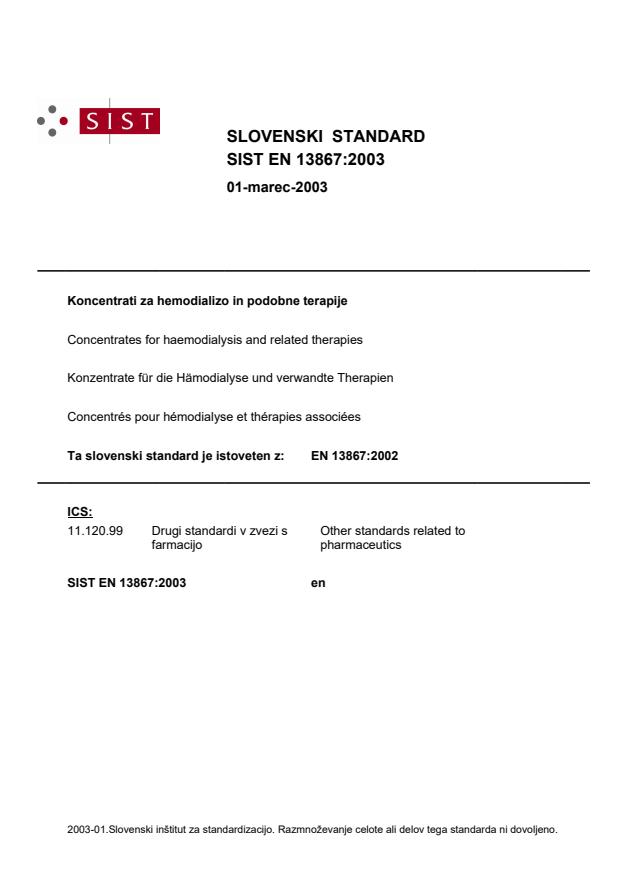
SLOVENSKI STANDARD
01-marec-2003
Koncentrati za hemodializo in podobne terapije
Concentrates for haemodialysis and related therapies
Konzentrate für die Hämodialyse und verwandte Therapien
Concentrés pour hémodialyse et thérapies associées
Ta slovenski standard je istoveten z: EN 13867:2002
ICS:
11.120.99 Drugi standardi v zvezi s Other standards related to
farmacijo pharmaceutics
2003-01.Slovenski inštitut za standardizacijo. Razmnoževanje celote ali delov tega standarda ni dovoljeno.
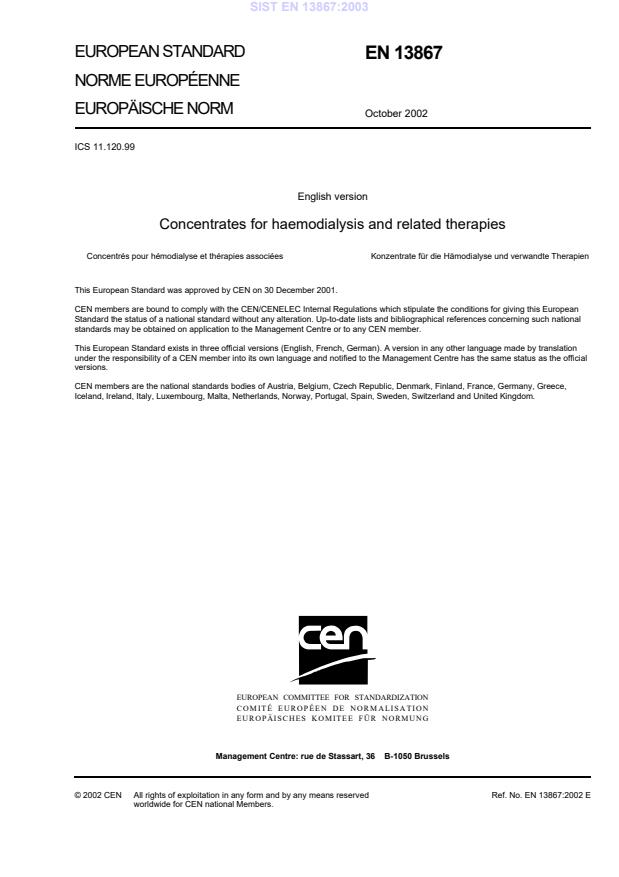
EUROPEAN STANDARD
EN 13867
NORME EUROPÉENNE
EUROPÄISCHE NORM
October 2002
ICS 11.120.99
English version
Concentrates for haemodialysis and related therapies
Concentrés pour hémodialyse et thérapies associées Konzentrate für die Hämodialyse und verwandte Therapien
This European Standard was approved by CEN on 30 December 2001.
CEN members are bound to comply with the CEN/CENELEC Internal Regulations which stipulate the conditions for giving this European
Standard the status of a national standard without any alteration. Up-to-date lists and bibliographical references concerning such national
standards may be obtained on application to the Management Centre or to any CEN member.
This European Standard exists in three official versions (English, French, German). A version in any other language made by translation
under the responsibility of a CEN member into its own language and notified to the Management Centre has the same status as the official
versions.
CEN members are the national standards bodies of Austria, Belgium, Czech Republic, Denmark, Finland, France, Germany, Greece,
Iceland, Ireland, Italy, Luxembourg, Malta, Netherlands, Norway, Portugal, Spain, Sweden, Switzerland and United Kingdom.
EUROPEAN COMMITTEE FOR STANDARDIZATION
COMITÉ EUROPÉEN DE NORMALISATION
EUROPÄISCHES KOMITEE FÜR NORMUNG
Management Centre: rue de Stassart, 36 B-1050 Brussels
© 2002 CEN All rights of exploitation in any form and by any means reserved Ref. No. EN 13867:2002 E
worldwide for CEN national Members.
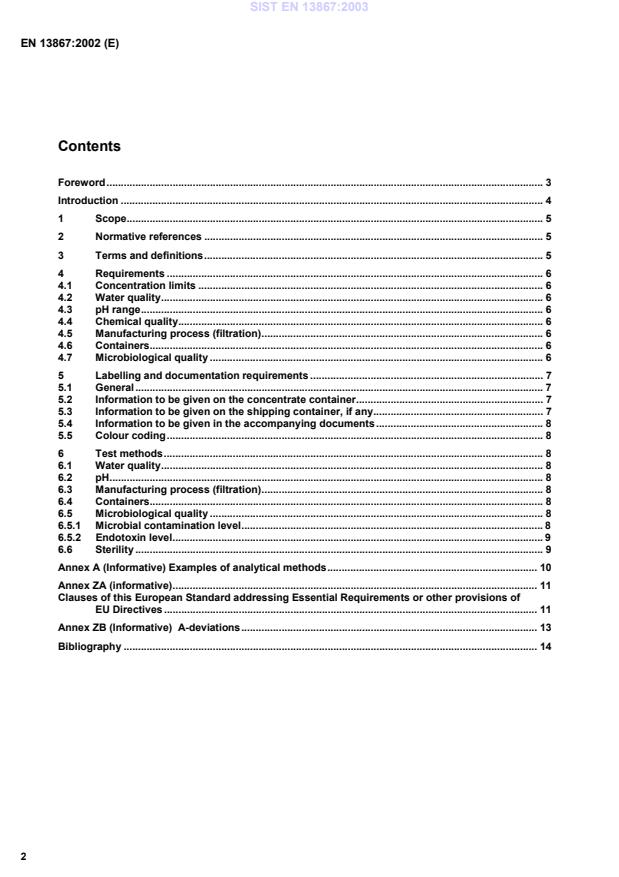
Contents
Foreword. 3
Introduction . 4
1 Scope. 5
2 Normative references . 5
3 Terms and definitions. 5
4 Requirements . 6
4.1 Concentration limits . 6
4.2 Water quality. 6
4.3 pH range. 6
4.4 Chemical quality. 6
4.5 Manufacturing process (filtration). 6
4.6 Containers. 6
4.7 Microbiological quality . 6
5 Labelling and documentation requirements . 7
5.1 General. 7
5.2 Information to be given on the concentrate container. 7
5.3 Information to be given on the shipping container, if any. 7
5.4 Information to be given in the accompanying documents. 8
5.5 Colour coding. 8
6 Test methods. 8
6.1 Water quality. 8
6.2 pH. 8
6.3 Manufacturing process (filtration). 8
6.4 Containers. 8
6.5 Microbiological quality . 8
6.5.1 Microbial contamination level. 8
6.5.2 Endotoxin level. 9
6.6 Sterility . 9
Annex A (Informative) Examples of analytical methods. 10
Annex ZA (informative). 11
Clauses of this European Standard addressing Essential Requirements or other provisions of
EU Directives . 11
Annex ZB (Informative) A-deviations. 13
Bibliography . 14
Foreword
This document (EN 13867:2002) has been prepared by Technical Committee CEN /TC 205, "Non-active medical
devices", the secretariat of which is held by BSI.
This European Standard shall be given the status of a national standard, either by publication of an identical text or
by endorsement, at the latest by April 2003, and conflicting national standards shall be withdrawn at the latest by
April 2003.
For relationship with EU Directive(s), see informative annex ZA, which is an integral part of this document.
For A-deviations, see annex ZB.
This document has been prepared under a mandate given to CEN by the European Commission and the European
Free Trade Association, and supports essential requirements of EU Directive(s).
Annexes A, ZA and ZB are for information only.
According to the CEN/CENELEC Internal Regulations, the national standards organizations of the following
countries are bound to implement this document: Austria, Belgium, the Czech Republic, Denmark, Finland, France,
Germany, Greece, Iceland, Ireland, Italy, Luxembourg, Malta, Netherlands, Norway, Portugal, Spain, Sweden,
Switzerland and the United Kingdom.
Introduction
Dialysing fluids contain electrolytes in concentrations approaching that of the composition of
normal extra-cellular body fluid. They can also contain non-electrolytes such as dextrose. Dialysing
fluid quality plays a key role in the safety and biocompatibility of the dialysis treatment. Because of
the large volumes employed, dialysing fluids are generally prepared by diluting concentrates with
water of suitable quality.
The manufacturer of concentrates should utilize raw materials and techniques to minimize
microbial contamination (a low bioburden). The concentrates should be stored in conditions that
assure the maintenance of this low level.
During the dilution and use of these concentrates it is essential to take precautions to minimize any
microbial contamination.
The dialysing fluid is prepared from concentrates manufactured, packaged and labelled according
to this standard, mixed with defined large proportions of water meeting national requirements on
water for dialysis. Operation of water treatment equipment, selection and handling of concentrates
after delivery to the hospital or clinic, and operation of the dialysis equipment are the responsibility
of the dialysis facility.
The properties of the final mixed dialysing fluids are not within the control of concentrate
manufacturers. This standard does not address the important clinical and technical processes
connected with the selection of concentrates and preparation of dialysing fluids. Dialysis professionals
make choices about the various applications (e.g. haemodialysis, haemodiafiltration, haemofiltration)
and it is essential they understand the corresponding risks and the requirements for safety of fluids
used for each therapy.
1 Scope
This European Standard specifies requirements for dry and liquid concentrates to be diluted for use as
dialysing fluids in haemodialysis or related therapies. It addresses chemical and microbiological quality and
purity, handling and labelling of concentrates, the requirements for containers and the tests to monitor
chemical and microbiological contents and quality of such concentrates.
This European standard does not address the final mixing and use of these concentrates or the treated
water used in connection with haemodialysis and related therapies.
This European standard does not apply to dialysing fluid regeneration systems.
2 Normative references
This European Standard incorporates by dated or undated reference, provisions from other publications.
These normative references are cited at the appropriate places in the text and the publications are listed
hereafter. For dated references, subsequent amendments to or revisions of any of these publications apply
to this European Standard only when incorporated in it by amendment or revision. For undated references
the latest edition of the publication referred to applies (including amendments).
EN 556 Sterilization of medical devices - Requirements for medical devices to be labelled “Sterile”
EN 980 Graphical symbols for use in the labelling of medical devices
EN 1174-1 Sterilization of medical devices - Estimation of the population of micro-organisms on product – Part
1: Requirements
EN 1174-2 Sterilization of medical devices - Estimation of the population of micro-organisms on product – Part
2: Guidance
EN 1174-3 Sterilization of medical devices - Estimation of the population of micro-organisms on product – Part
3: Guide to the methods for validation of microbiological techniques
European Pharmacopoeia 3rd edition: 1999 (including supplements 2000 and 2001)
3 Terms and definitions
For the purpose of this European standard, the following terms and definitions apply:
3.1
acetate dialysing fluid
dialysing fl
...
Questions, Comments and Discussion
Ask us and Technical Secretary will try to provide an answer. You can facilitate discussion about the standard in here.
Loading comments...