

CEN/TS 17011-1:2025
(Main)Electronic Public Procurement - Architecture - Part 1: Reference Architecture Overview
- Abstract
The purpose of this deliverable is to specify and describe the reference architecture applied as the basis for the development of Business Interoperability Interface specifications in the eProcurement domain by the CEN/TC 440 Technical Committee.
- Status
- Published
- Publication Date
- 28-Oct-2025
- Technical Committee
- CEN/TC 440 - Project Committee - Electronic Public Procurement
- Drafting Committee
- CEN/TC 440/WG 1 - Architecture
- Current Stage
- 6060 - Definitive text made available (DAV) - Publishing
- Start Date
- 29-Oct-2025
- Due Date
- 10-Nov-2024
- Completion Date
- 29-Oct-2025


Overview
CEN/TS 17011-1:2025 - Electronic Public Procurement - Architecture - Part 1: Reference Architecture Overview - is a CEN Technical Committee (CEN/TC 440) deliverable that defines the reference architecture used as the basis for developing Business Interoperability Interface (BII) specifications in the eProcurement domain. Published as a draft in 2025, it provides an architectural foundation for interoperable eProcurement solutions across pre‑award and post‑award processes and aligns work with the European Interoperability Reference Architecture (EIRA).
Key topics and technical scope
The document provides a structured overview rather than low‑level bindings. Major technical topics and requirements covered include:
- Positioning of BII components within EIRA and how the eProcurement architecture maps to broader interoperability frameworks.
- BII choreography specification: templates and rules for defining message flows and business interactions (BPMN guidance is provided in an annex).
- BII transaction specification: how transactions are defined, documented and positioned in the reference architecture.
- BII syntax binding: guidance for binding business transactions to technical syntaxes and transport mechanisms.
- Extensions to EIRA for eProcurement-specific business services and an eProcurement data model.
- Semantic data types (Amount, Quantity, Identifier, Date, Code, Document Reference, Binary Object, Boolean, etc.) to standardize data semantics across implementations.
- eProcurement ontology: mapping business terms (including CEN WS/BII terms) to ontology concepts and resolving semantic gaps.
- Conformance and derivative use: how implementers can claim conformance and reuse the architecture for related deliverables.
Practical applications and target users
This reference architecture is intended for organizations and professionals involved in public procurement digitization:
- Public authorities and contracting bodies designing interoperable procurement platforms.
- Software vendors and solution architects building eTendering, eCatalogue, eOrdering and eFulfilment systems.
- Integration specialists and IT teams implementing BII choreography, transactions and syntax bindings.
- National standards bodies and policy makers aligning local eProcurement services with pan‑European interoperability frameworks.
- Consultants and system integrators migrating from existing CEN BII deliverables to EIRA‑aligned specifications.
Practical benefits include consistent message flows, reduced integration costs, clearer semantic interoperability, and alignment with CEN/TC 440 deliverables (17014, 17015, 17016, 17017 series).
Related standards
- CEN/TC 440 series: 17014 (eTendering BII), 17015 (eCatalogue BII), 17016 (eOrdering BII), 17017 (eFulfilment BII)
- EIRA (European Interoperability Reference Architecture)
- CEN WS/BII artefacts and business terms
Keywords: eProcurement, reference architecture, Business Interoperability Interface (BII), EIRA, choreography, transaction specification, syntax binding, semantic data types, eProcurement ontology, CEN/TC 440.
Relations
- Refers
ISO 8601-1:2019 - Date and time — Representations for information interchange — Part 1: Basic rules - Effective Date
- 11-Mar-2026
- Effective Date
- 28-Jan-2026
Get Certified
Connect with accredited certification bodies for this standard

BSI Group
BSI (British Standards Institution) is the business standards company that helps organizations make excellence a habit.

NYCE
Mexican standards and certification body.
Sponsored listings
Frequently Asked Questions
CEN/TS 17011-1:2025 is a technical specification published by the European Committee for Standardization (CEN). Its full title is "Electronic Public Procurement - Architecture - Part 1: Reference Architecture Overview". This standard covers: The purpose of this deliverable is to specify and describe the reference architecture applied as the basis for the development of Business Interoperability Interface specifications in the eProcurement domain by the CEN/TC 440 Technical Committee.
The purpose of this deliverable is to specify and describe the reference architecture applied as the basis for the development of Business Interoperability Interface specifications in the eProcurement domain by the CEN/TC 440 Technical Committee.
CEN/TS 17011-1:2025 is classified under the following ICS (International Classification for Standards) categories: 35.240.20 - IT applications in office work; 35.240.63 - IT applications in trade. The ICS classification helps identify the subject area and facilitates finding related standards.
CEN/TS 17011-1:2025 has the following relationships with other standards: It is inter standard links to ISO 8601-1:2019, EN ISO 15877-3:2009/A2:2021. Understanding these relationships helps ensure you are using the most current and applicable version of the standard.
CEN/TS 17011-1:2025 is available in PDF format for immediate download after purchase. The document can be added to your cart and obtained through the secure checkout process. Digital delivery ensures instant access to the complete standard document.
Standards Content (Sample)
SLOVENSKI STANDARD
01-februar-2026
Elektronska javna naročila - Arhitektura - 1. del: Pregled referenčne arhitekture
Electronic Public Procurement - Architecture - Part 1: Reference Architecture Overview
Elektronische öffentliche Auftragsvergabe - Architektur - Teil 1: Überblick über die
Referenzarchitektur
Marchés publics électroniques - Architecture - Partie 1 : Aperçu de l'architecture de
référence
Ta slovenski standard je istoveten z: CEN/TS 17011-1:2025
ICS:
35.240.20 Uporabniške rešitve IT pri IT applications in office work
pisarniškem delu
35.240.63 Uporabniške rešitve IT v IT applications in trade
trgovini
2003-01.Slovenski inštitut za standardizacijo. Razmnoževanje celote ali delov tega standarda ni dovoljeno.
CEN/TS 17011-1
TECHNICAL SPECIFICATION
SPÉCIFICATION TECHNIQUE
October 2025
TECHNISCHE SPEZIFIKATION
ICS 35.240.20; 35.240.63
English Version
Electronic Public Procurement - Architecture - Part 1:
Reference Architecture Overview
Marchés publics électroniques - Architecture - Partie 1 Elektronische öffentliche Auftragsvergabe -
: Aperçu de l'architecture de référence Architektur - Teil 1: Überblick über die
Referenzarchitektur
This Technical Specification (CEN/TS) was approved by CEN on 15 September 2025 for provisional application.
The period of validity of this CEN/TS is limited initially to three years. After two years the members of CEN will be requested to
submit their comments, particularly on the question whether the CEN/TS can be converted into a European Standard.
CEN members are required to announce the existence of this CEN/TS in the same way as for an EN and to make the CEN/TS
available promptly at national level in an appropriate form. It is permissible to keep conflicting national standards in force (in
parallel to the CEN/TS) until the final decision about the possible conversion of the CEN/TS into an EN is reached.
CEN members are the national standards bodies of Austria, Belgium, Bulgaria, Croatia, Cyprus, Czech Republic, Denmark, Estonia,
Finland, France, Germany, Greece, Hungary, Iceland, Ireland, Italy, Latvia, Lithuania, Luxembourg, Malta, Netherlands, Norway,
Poland, Portugal, Republic of North Macedonia, Romania, Serbia, Slovakia, Slovenia, Spain, Sweden, Switzerland, Türkiye and
United Kingdom.
EUROPEAN COMMITTEE FOR STANDARDIZATION
COMITÉ EUROPÉEN DE NORMALISATION
EUROPÄISCHES KOMITEE FÜR NORMUNG
CEN-CENELEC Management Centre: Rue de la Science 23, B-1040 Brussels
© 2025 CEN All rights of exploitation in any form and by any means reserved Ref. No. CEN/TS 17011-1:2025 E
worldwide for CEN national Members.
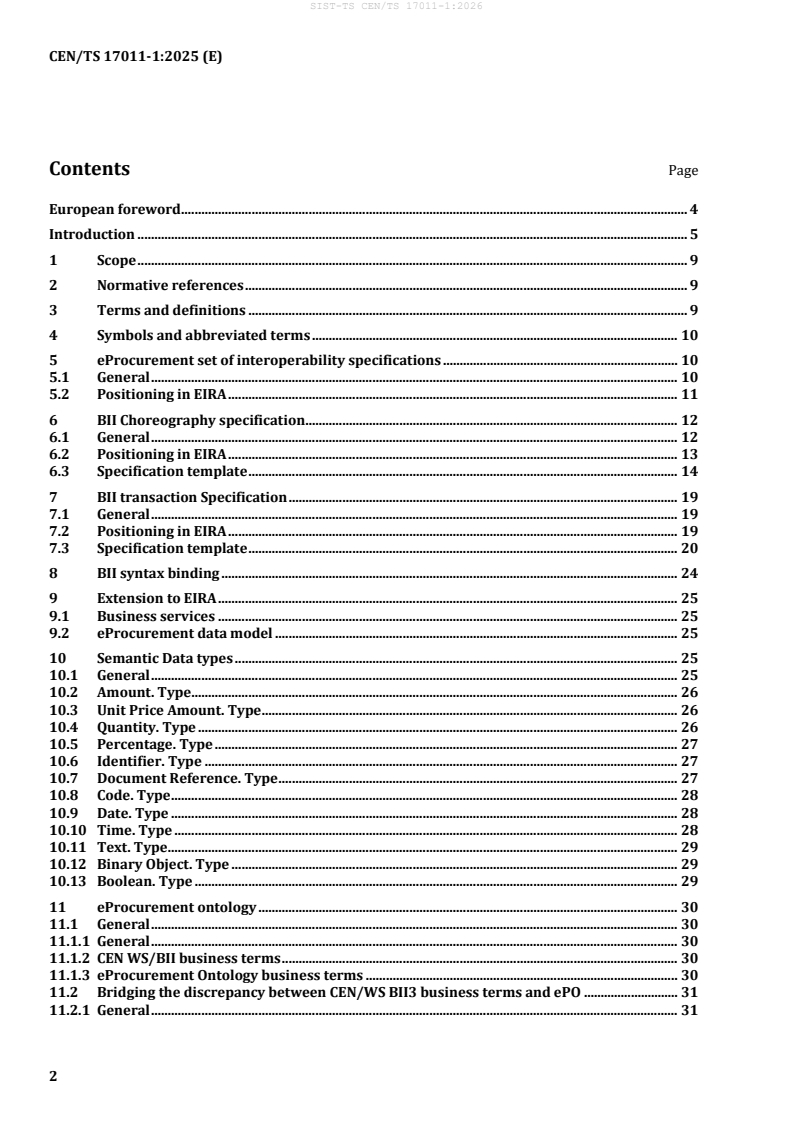
Contents Page
European foreword . 4
Introduction . 5
1 Scope . 9
2 Normative references . 9
3 Terms and definitions . 9
4 Symbols and abbreviated terms . 10
5 eProcurement set of interoperability specifications . 10
5.1 General . 10
5.2 Positioning in EIRA . 11
6 BII Choreography specification . 12
6.1 General . 12
6.2 Positioning in EIRA . 13
6.3 Specification template . 14
7 BII transaction Specification . 19
7.1 General . 19
7.2 Positioning in EIRA . 19
7.3 Specification template . 20
8 BII syntax binding . 24
9 Extension to EIRA . 25
9.1 Business services . 25
9.2 eProcurement data model . 25
10 Semantic Data types . 25
10.1 General . 25
10.2 Amount. Type . 26
10.3 Unit Price Amount. Type . 26
10.4 Quantity. Type . 26
10.5 Percentage. Type . 27
10.6 Identifier. Type . 27
10.7 Document Reference. Type . 27
10.8 Code. Type . 28
10.9 Date. Type . 28
10.10 Time. Type . 28
10.11 Text. Type . 29
10.12 Binary Object. Type . 29
10.13 Boolean. Type . 29
11 eProcurement ontology . 30
11.1 General . 30
11.1.1 General . 30
11.1.2 CEN WS/BII business terms . 30
11.1.3 eProcurement Ontology business terms . 30
11.2 Bridging the discrepancy between CEN/WS BII3 business terms and ePO . 31
11.2.1 General . 31
11.2.2 Approach . 31
11.2.3 Step A: List business terms . 31
11.2.4 Step B: Map to eProcurement Ontology concepts. . 32
11.2.5 Step C: Resolve gaps . 32
11.2.6 Defining the transactions . 33
11.2.7 Documenting the transaction definition . 33
11.2.8 Example . 34
12 How to claim conformance . 41
13 Derivative use . 41
Annex A (informative) Guideline on the use of BPMN for Business reference Model . 42
A.1 General. 42
A.2 BPMN objects used and their explanation . 44
A.3 Events . 45
A.4 Flow/Connecting objects . 46
A.5 Rules for Sending and Receiving Messages . 46
A.6 Artefacts . 47
A.7 Examples . 48
Annex B (informative) Shift from CEN BII architecture to EIRA v2.0 aligned deliverables . 50
Bibliography . 52
European foreword
This document (CEN/TS 17011-1:2025) has been prepared by Technical Committee CEN/TC 440 “Electronic
Public Procurement”, the secretariat of which is held by DIN.
Attention is drawn to the possibility that some of the elements of this document may be the subject of patent
rights. CEN shall not be held responsible for identifying any or all such patent rights.
This document is part of a series of multi-part documents prepared, or under preparation, by CEN/TC 440:
— 17011-series: eProcurement Architecture, providing a set of specifications outlining different aspects of
the eProcurement architecture for Business Interoperability Specifications.
— 17014-series: eTendering Business Interoperability Specifications, providing a set of specifications
outlining business choreography, transaction, syntax binding specifications and guidelines required to
support the eTendering processes.
— 17015-series: eCatalogue Business Interoperability Specifications, providing a set of specifications
outlining business choreography, transaction, syntax binding specifications and guidelines required to
support the eCatalogue processes.
— 17016-series: eOrdering Business Interoperability Specifications, providing a set of specifications
outlining business choreography, transaction, syntax binding specifications and guidelines required to
support the eOrdering processes.
— 17017-series: eFulfilment Business Interoperability Specifications, providing a set of specifications
outlining business choreography, transaction, syntax binding specifications and guidelines required to
support the eDelivery processes.
The terms “shall”, “shall not”, “should”, “should not”, “may”, “need not” “can” and “cannot” are interpreted
according to Annex H of the CEN-CENELEC Internal Regulations, Part 3 .
Any feedback and questions on this document should be directed to the users’ national standards body. A
complete listing of these bodies can be found on the CEN website.
According to the CEN-CENELEC Internal Regulations, the national standards organizations of the following
countries are bound to announce this Technical Specification: Austria, Belgium, Bulgaria, Croatia, Cyprus, Czech
Republic, Denmark, Estonia, Finland, France, Germany, Greece, Hungary, Iceland, Ireland, Italy, Latvia,
Lithuania, Luxembourg, Malta, Netherlands, Norway, Poland, Portugal, Republic of North Macedonia, Romania,
Serbia, Slovakia, Slovenia, Spain, Sweden, Switzerland, Türkiye and the United Kingdom.
https://boss.cen.eu/reference-material/refdocs/pages/
Introduction
The objective of the work in CEN/TC 440, Electronic public procurement, is to provide standards, in the form
of Business Interoperability Interface specifications, as a tool to ensure interoperability and thus facilitate
efficient and effective electronic information exchange in the (public) eProcurement processes between the
buyer and the seller.
This is to facilitate end-to-end eProcurement including both pre-award and post-award processes (see
Figure 1).
Figure 1 — The pre-and post-award processes of public eProcurement
eProcurement refers to the use of electronic communications and transaction processing by public sector
organizations and economic operators when buying/providing supplies and services or tendering works, see
Tables 1 and 2.
Table 1 — Business areas in the pre-award phase of public eProcurement
Example information
Business Areas
a
exchange
Planning Planning of milestones and electronic tracking of
the achievements.
Planning is an internal business process and is
not covered by BII specifications.
Pre-award eNotifying Nofication includes information exchange, — Prior Information
publication and dissemination of notices related
(eTendering) Notice
to procurement opportunities such as Prior
— Contract Notice
Information Notices, Contract Notices and
— Contract Award
Contract Award Notices.
Notice
eNotifying is specified by the Publication Office of
the European Commission and therefore out of
scope for TC 440.
eDiscovery Search for interesting business opportunities on a — Search notice query
publication portal. transaction
eDiscovery is a service of the Publication Office of — Notice metadata
the European Commission and therefore out of transaction
scope for TC 440.
The concept of end-to-end procurement is further elaborated in COM(2013) 453 final on end-to-end eProcurement to
modernize public administration [6].
Example information
Business Areas
a
exchange
eAccess Procurement procedure subscription and access — Express Interest in
includes electronic access to tender documents Call for Tenders
and specifications, including electronic access to
— Call for tender
supporting documents for sellers in the
— European Single
preparation of a Tender response, e.g.
Procurement
clarifications, questions and answers. This
Document (ESPD)
includes expressing interest in a business
(Out of scope for
opportunity to be listed in the procurement
TC 440)
procedure.
— Invitation to Tender
— Pre-award Catalogue
Request
— Call for Tender
Question and
answers
eQualification identification and verification of the capabilities — Qualification
of any economic operator that wants to present
an offer in a particular tendering procedure.
eSubmission Secure submission of tenders and/or catalogues — Tender
in electronic format to the contracting body
— Tender Withdrawal
(contracting authority/ contracting entity), which
— Virtual Company
can receive and process it in compliance with
Dossier
applicable legal requirements.
— European Single
Procurement
Document (ESPD)
— Pre-award Catalogue
eEvaluation Evaluation of the electronic tenders and/or — Clarification
catalogues received by the contracting body questions and
following the closing deadline of a tender answers
competition, including electronic exchange to
enable the clarification of tender content by
evaluations.
eEvaluation is an internal business process and
therefore out of scope for TC 440.
eAwarding Information exchange regarding award of the — Awarding notification
contract, including electronic exchange to support
— Additional
tenderers requesting additional information
information
about the result of the procedure.
eSourcing Information exchange regarding the catalogue to — Pre-award catalogue
be used for ordering. request
— Pre-award catalogue
eContract Signing, enactment of a contract / agreement and — Draft Contract
possibly its related catalogue through electronic
— Signed Contract
means between the contracting bodies and the
— Catalogue Request
winning tenderer(s), as well as the signing of
— Catalogue
contract amendments and possibly their related
catalogue.
It should be noted that the business transactions listed are examples only and do not constitute the full list of
relevant business transactions.
Table 2 — Business areas in the post-award phase of public eProcurement
Example information
Business Areas
exchange
Post- eSourcing Activities preparatory to issuing an order. — Request for Quotation
including the exchange of electronic messages
award
— Quotation
with winning tenderers who have signed a
— Catalogue request
framework agreement with the contracting body,
— Catalogue
a request for quotation and the response to the
quotation (e.g. framework agreements with
— Catalogue response
reopening competition), etc.
— Punch-out
Exchange of catalogue information and punch-out
— Shopping cart
ordering from a catalogue
eOrdering Issuing of an electronic order by the contracting — Order
body and its acceptance by the seller or
— Order Response
conversely issuing of an electronic order
— Order cancellation
agreement by the seller.
— Order agreement
eFulfilment Electronic exchange of information that enable — Despatch Advice
monitoring the execution of the order or the
— Receiving Advice
contract.
eInvoicing Issuing, sending, receiving and processing — Invoice
invoices and billing data.
— Credit Note
eInvoicing is covered by TC434 and therefore out
of scope for TC 440.
ePayment Financial payment involving currency transfer
between a contracting body and a seller.
ePayment is covered by ISO/TC68 and therefore
out of scope for TC 440.
Contract Management of relationships with sellers and
management contracts, including archiving.
Contract management is an internal business
process and therefore out of scope for TC 440.
The aim of CEN/TC 440 is to provide a focused and coordinated approach to development of appropriate
European Standards that:
— build upon and complement existing initiatives, such as CEN WS/BII3 (see Annex B) and CEN/TC 434, and
be part of a wider eBusiness standardization portfolio;
— facilitate end-to-end eProcurement and thus support European policy objectives expressed in e.g. “Digital
Agenda for Europe” [3] and “A strategy for eProcurement (COM(2012) 179 final” [4], “End-to-end
eProcurement to modernise public administration (COM(2013) 453 final)” [5], the “public procurement
directive” [6];
— recognize the rather ambitious timeline envisaged for implementation of the new procurement directives,
stressing the importance of available standards as a basis for compliant software solutions to be available
in the market;
— allow for user engagement and participation as well as effective production of the standards required by
being focused on public procurement needs (but take generic applicability for ‘Business-to-Business’ into
account as and when relevant);
— facilitate improved efficiency and cost reduction in both public and private sector entities;
— focus on cross-border and cross–platform interoperability to allow economic operators to select the
platform of their choice and still can participate in procurement opportunities across the full European
market.
The deliverables from CEN/TC 440 collectively provide a framework for interoperability in pan-European
electronic transactions for eProcurement expressed as a set of technical specifications that is expected to:
— allow for efficient and effective implementation of electronic exchange of documents in public
eProcurement as well as in transactions between enterprises;
— support implementation of end-to-end eProcurement including both pre-award and post-award processes
for public procurement;
— facilitate interoperability between independent solutions;
— provide an added value to stakeholders, such as solution and service providers, as well as contracting
bodies and economic operators involved in the eProcurement process.
The work in CEN/TC 440 focuses on interoperability aspects of the exchange of information between business
partners. Back-office information processing, e.g. the internal processing and business evaluation of the actual
information content, is out of scope. To ensure interoperability, the information exchange will be described in
the form of:
— choreography specifications, describing the flow of the business process and the sequence of information
exchange;
— business transaction information models, describing the information content of each information exchange;
— syntax binding specifications, describing how the information content of a business transaction information
model is represented in a specific syntax;
— guidelines, providing additional guidance on specific topics.
For a full description of different document types, see Clause 6 of this document.
It should be noted that CEN/TC 440 deliverables do not provide the full legal framework enabling business
partners to fulfil their legal obligations. It is the responsibility of the business partners themselves to ensure
that the business documents exchanged respect any rules specified by relevant legislation, including
requirements related to personal data protection, as well as rules stated as part of a trading relationship
between them.
Use of ePO ontology
This document uses the ePO ontology, owned by the European Union, available here (https://github.com/OP-
TED/ePO) and licensed under a CC BY 4.0 licence.
1 Scope
The purpose of this deliverable is to specify and describe the reference architecture applied as the basis for the
development of Business Interoperability Interface specifications in the eProcurement domain by the
CEN/TC 440 Technical Committee.
2 Normative references
The following documents are referred to in the text in such a way that some or all of their content constitutes
requirements of this document. For dated references, only the edition cited applies. For undated references, the
latest edition of the referenced document (including any amendments) applies.
ISO 8601-1:2019, Date and time — Representations for information interchange — Part 1: Basic rules
3 Terms and definitions
For the purposes of this document, the following terms and definitions apply.
ISO and IEC maintain terminology databases for use in standardization at the following addresses:
— IEC Electropedia: available at https://www.electropedia.org/
— ISO Online browsing platform: available at https://www.iso.org/obp/
3.1
agent
person, organization, or system that act in procurement or have the power to act in procurement
[SOURCE: eProcurement Ontology]
3.2
business process
sequence or network of activities and collaborations between two or more agents
3.3
business process variant
specification of a business process belonging to a choreography
Note 1 to entry: Different variants may support different electronic information exchange or collaborations. Agents may
publicly advertise their capability to support one or more variants in an automated fashion.
3.4
choreography
set of business processes having the same goals
3.5
collaboration
interaction between two or more agents that result in the exchange of data between the agents involved as part
of a business process
3.6
role
part played by an agent in a particular business process, including its responsibilities (options and obligations)
to perform certain activities and collaborations in that business process
Note 1 to entry: The role is used to show the division of labour and responsibility amongst the agents involved in the
process or within the organization of an agent.
3.7
state
set of options and obligations of the participating agents at a defined step in a business process to perform
specific activities and collaborations
Note 1 to entry: Additional information: an activity of an agent or a collaboration may cause the transition of one state to
another in a predefined set of next steps.
3.8
transaction
content of data exchanged or shared between the agents in a collaboration
Note 1 to entry: A transaction is the atomic unit that leads to a synchronized state in the information systems of
collaborating agents. It is the basic building block to define the choreography between agents. When an agent recognizes
an event that changes the state of a business object within a business process, it uses a transaction to synchronize with the
collaborating agent. A transaction therefore changes the state of a business process. It carries the intention of the initiating
agent and is represented by a data structure that is defined by a data model. The exchange of a transaction may alter legal
obligations between business partners.
4 Symbols and abbreviated terms
ABB Architectural Building Block
IoP Interoperability
EIF European Interoperability Framework
EIRA European Interoperability Reference Architecture
5 eProcurement set of interoperability specifications
5.1 General
Despite its initial focus on the public sector, the vision of CEN/TC 440 is that all organizations – independent of
whether they are public or private and whatever their size and nationality – are enabled to conduct electronic
business in an effective and efficient manner, significantly lowering costs for transaction processing.
The CEN/TC 440 mission is to spread and facilitate the use of eProcurement standards by sellers and buyers,
and especially public administrations, by:
— identifying requirements (including legal) regarding eProcurement standards;
— providing a general framework for the organizational and semantic levels of the electronic procurement
documents;
— supporting the implementation of commonly applied international eProcurement standards;
— providing organizational support to ensure the governance and maintenance for those requirements.
This will be achieved by focusing on business requirements expressed in the European market and provide
guidance to implementation projects on how relevant international standards may be applied in order to meet
those requirements.
A Business Interoperability Interface (BII) is specified in order to fulfil one or more Business Goals. To achieve
the stated Business Goals the BII is based on one or more Business Requirement(s). A BII implements support
for one or more Business Process(es) by defining the exchange of one or more Business Transaction(s).
When implemented a BII commits two or more Business Partners, each acting in one or more Role(s), by
specifying how they implement electronic messaging or information sharing support through the exchange of
one or more Business Transaction(s). The information content of each Business Transaction is specified in one
or more Information Requirement Model(s). The technical messaging choreography for a Business Transaction
is specified in one or more Business Collaboration(s).
5.2 Positioning in EIRA
EIRA provides a reference model that enables architects to position the IOP specifications. This document
provides a domain-specific IOP specification to which any SBB implementing the ABB should be compliant to.
IoP specifications provide a valuable source of information to formulate requirements during architecture
development and solution development. By identifying architectural building blocks through a common
terminology, it
— helps reuse of cross domain building blocks such for instance eSignature Verification and Validation Service,
and eTimestamp Creation Service;
— helps synchronization with European solutions such as CEF eDelivery;
— and will provide guidance in using them to provide the prescribed capability enabling, thus managing and
rationalizing IT portfolios.
The CEN/TC 440 architecture has been specified by means of extensions of EIRA building blocks to ensure
alignment to the EIF as shown in Figure 2.
Figure 2 — EIRA extension
The eProcurement deliverables address mainly the organizational and semantic interoperability levels of the
EIF framework.
The BII Choreography specification is an organizational interoperability specification that describes the
relevant organizational Solution Building Blocks in order to fulfil specific sub-process goals. TC 440 does not
intend to provide normative statements on the processes to be used to fulfil a given procurement procedure
but focuses on the services required to achieve the desired goal, the capabilities supporting the service and the
information exchanged between the main roles of the procurement process: the Buyer or Contracting body and
the Seller or Economic operator.
Guidelines describe how choreographies may be used in order to support a procurement procedure for
instance.
Additionally, in the BII Transaction specification, TC 440 establishes the core information elements that are
required in the information exchange relating to a choreography, the corresponding data entities and the
business rules that are applicable to these information elements. This specification addresses both the
organizational and the semantic layer.
The BII Syntax Binding specification provides a mapping between the data entities specified in the BII
transaction specifications and their corresponding UBL Document Schema or UN/CEFACT schema, for each
information element in scope of TC 440. Note that this is consistent with the COMMISSION IMPLEMENTING
DECISION of 31 October 2014 on the identification of Universal Business Language version 2.1 for referencing
in public procurement.
The eProcurement Business Term Vocabulary represents the set of core Information elements that are
relevant to the scope of TC 440 and compose the eProcurement data model of which each structured
eProcurement document are composed.
The eProcurement Documents can be alternatively structured as a set of eProcurement properties specified
in eProcurement entities composing the eProcurement data model or unstructured documents conveying
eProcurement information.
These specifications are positioned in the EIF at the organizational and semantic level as shown in Figure 3.
Figure 3 — EIF positioning
6 BII Choreography specification
6.1 General
A BII Choreography specification is used to describe the relatively complex Business Process(es) between two
or more Business Partners, based on Business Goals and Business Requirements. See Figure 4.
6.2 Positioning in EIRA
Figure 4 — BII Choreography specification
The [BII Choreography Specification] describes how an [eProcurement Business Process] involving [Business
Partners] is supported by means of [Business Capabilities]. The [BII Choreography Specification] highlights the
related specific [eProcurement Choreography Goals] of the [eProcurement Business (sub) Process].
In a business environment [Exchange of Business Information] is always implemented because the [Business
Partners] have specified a set of [Business Goals] they want to achieve. Identifying and describing these
[Business Goals] is a key prerequisite for any successful implementation.
Recognizing this fact TC 440 has made the expression of the goals and the [Business Requirements] that shall
be fulfilled in order to achieve the stated goal, the main focus of its [BII Choreography Specification].
The goals, or objectives, of the [BII Choreography Specification] focus on describing the business value that may
be achieved by implementing that specific choreography.
The specification additionally describes the [Business Capabilities] implementing the [Business Requirements].
The [Business Capabilities] use [eProcurement Exchange of Information] supporting the (sub)process to
achieve the business goals.
[eProcurement Exchange of Information] refers to the BII Transaction specifications that in their turn describe
the Business information that is exchanged.
Variants in the use of BII Transaction specifications to fulfil the business goals are listed in each choreography.
Transactions cannot be used outside a choreography and a variant of a choreography when variants are
specified.
Variants cater for addressing different levels of maturity of information systems. The use of variants is further
described below.
6.3 Specification template
This template is a guideline for the lay-out of the specification. Sections that are not applicable should be
deleted. Additional sections may be added if useful.
BII Choreography specifications have the following contents:
1 Scope
Scope of the choreography specification.
2 Normative references
References to normative documents on which this specification is based.
3 Terms and definitions
Definitions of terms used in this specification.
4 Business environment and high level business requirements
4.1 Choreographies (business) Goals
Description of the context in which the business takes place (see Table 3 Business goals and Table 4
Business benefits).
Table 3 — Business goals
ID Description
G-17016-1:2024-1 Enable trading partners to communicate without a previous bi-lateral setup
or agreement.
Table 4 — Business benefits
ID Description
G-17016-1:2024-5 Realize significant savings both by buyers and sellers through automating
and streamlining in-house processes of ordering and subsequent activities
as well through increasing quality of data exchanged.
4.2 Business environment
4.2.1 General
4.2.2 Business context
A context diagram of the business (see Figure 5).
Figure 5 — Example of the position of the BII Choreography in the Procurement process
4.2.3 Positioning in EIRA (see Table 5)
Table 5 — Positioning in EIRA
EIRA ID Title Domain Interface Scope Modality
• eProcurement Endorsing
EN 17016-1:2024 Electronic Procurement Machine
extension of ABB176
Public /Buyer
Organizational
Procurement -
Machine
Interoperability
Ordering -
/Seller
Specification
Choreography
• eProcurement
extension of ABB12
Business Capability
• eProcurement
extension of ABB170
Exchange of Business
Information
• eProcurement
extension of ABB16
Business Rule
4.3 Organization and Business Partners involved (see Table 6)
Table 6 — Roles
Key Role Description
Buyer A role of an agent that awards the contract. Additional information: Examples
of The Buyer may be the role of contracting authority, contracting entity, a
defence contractor, an international organization, or an organization
awarding a contract subsidized by a contracting authority.
Use case diagram.
4.4 High Level Business process requirements
4.4.1 High level business requirements (see Table 7)
Table 7 — High level business requirements
Req. ID Requirement statement Ref. to goal
HLR-17016-1:2024-1 A Buyer submits an Order for delivery of G-17016-1:2024-1
goods, services or works to a Seller.
5 Processes
5.1 General
Description.
State machine diagram (informative, if applicable)
5.2 Business process variants
5.2.1 General (see Table 8)
Table 8 — Business process variants overview
Business Process Short name Description
Variant
BPV-17016-1:2024:A Simple Ordering The Buyer sends an Order to the Seller.
The Seller does not respond to the Buyer.
Decision tree for selecting a variant
5.2.2 High level business process variants requirements
5.2.3 Claiming conformance
5.3 Business process variant X – Name of variant
5.3.1 Business process variant X requirements (see Table 9)
Table 9 — Business process variant X requirements
Req. ID Requirement statement
R-17016-1:2024:A-1 After the Order is sent, no answer is expected from the Seller.
5.3.2 Business process variant X state machine diagram [Informative]
State machine diagram
5.3.3 Business process variant X definition (see Table 10)
BPMN diagram (see Annex A).
Table 10 — Business process variant X description
Category Description
Description The Buyer prepares an electronic Order and sends it to the Seller who
receives it.
Pre-conditions The Buyer and the Seller have identified each other.
The Seller has agreed to receive electronic Orders.
Possibly Buyer and Seller have concluded a contract with general
conditions and/or exchanged a Catalogue with product information
and pricing.
Post-conditions An Order has been received by the Seller.
Exceptions Seller’s acceptance or refusal of an Order are handled externally or by
an agreed silent-consent mechanism.
Buyer’s cancellation or change of an Order are handled externally.
Seller’s cancellation or change of an Order are handled externally.
Fulfilment and invoicing processes are handled externally.
Scenarios An Order sent by the Buyer is received by the Seller.
5.3.4 Business Process variant X Scenarios (see Table 11)
Table 11 — Business Process variant scenarios
Role Pre-conditions Collaboration Post- conditions Business rules
Buyer The Seller may Buyer sends Order Order sent Order compliant or
receive Order conformant
Seller Order sent Buyer sends Order Order received Seller’s capability to
receive Orders
5.3.5 Business process variant X business rules (see Table 12)
Table 12 — Business process variant business rules
ID Description
BR-17016-1:2024:A-1 The Order shall be compliant or conformant to EN 17016-2:202x.
Business rules that apply to multiple variants should have the same ID.
5.3.6 Business process variant X key examples [Informative]
5.4 Business process variant Y – Name of variant
Etc.
6 Sub processes
If applicable a specification of the sub processes, the process variants consist of. For each sub process the
requirements, the definition, the business rules and one or more key examples are stated.
7 BII Transactions involved
7.1 Summary (see Table 13)
Table 13 — BII transactions overview
Role Capabili Collaborati Collaborati Transacti Transacti Variant
ty on ID on on ID on
A B C D E F G H
Buye Send BC-17016- Buyer sends T-17016- Order M M M M M M M
r Order 1:2024-1 Order 2:202x-1
M (Mandatory) means that the transaction shall be supported if the variant is supported.
7.2 Collaborations (see Table 14)
Table 14 — Collaborations
Collaboration ID Collaboration name Initiating Role Transaction
BC-17016-1:2024-1 Buyer sends Order Buyer Order
7.3 Collaboration N (see Table 15)
Collaboration diagram
Table 15 — Collaboration description
Category Description
Description The Buyer prepares an electronic Order and sends it to the Seller.
The Seller receives the Order.
Pre-conditions The Buyer has identified the items to be purchased and the Seller.
The Seller has agreed to receive electronic Orders.
Post-conditions An electronic Order has been sent by the Buyer and received by the
Seller.
Exceptions Not compliant nor conformant Order
8 Bibliography
Non-normative references.
7 BII transaction Specification
7.1 General
The Transactions as specified in a BII Choreography specification require one or more Information
Requirement Model(s) in order to specify the allowed information content of each Business Transaction
exchanged as part of the Business Process(es) supported. These Information Requirement models are specified
in a BII Transaction specification. Each Information Requirement Model contains several Information Elements,
possibly constrained by one or more Information Constraint(s). Each Information Element is specified within
the Information Requirement Model in order to meet one or more stated Bus
...