

EN 1717:2025
(Main)Protection against pollution of water intended for human consumption in potable water installations and general requirements for devices to prevent pollution by backflow
- Abstract
This document specifies an analysing methodology for protecting potable water in potable water installations within and outside buildings but within premises from the risk of pollution by backflow of non-potable water and gives recommendations on the design, risk analysis, backflow prevention devices and their installation methods (see Figure 1 and Figure 2).
This methodology is also intended to be used outside premises for all water systems connected to a potable water distribution system up to and including the point of use (see Figure 3).
The product standards for the specific backflow prevention devices or arrangements are intended to be used in conjunction with this document. For the development of new devices or systems, this document is intended to be used as a reference to establish the necessary level of backflow protection.
- Status
- Withdrawn
- Publication Date
- 05-Aug-2025
- Withdrawal Date
- 20-Oct-2026
- Technical Committee
- CEN/TC 164 - Water supply
- Current Stage
- 9960 - Withdrawal effective - Withdrawal
- Start Date
- 01-Jul-2026
- Completion Date
- 21-Oct-2026

Overview
EN 1717:2025 (aligned with EN 1717:2025) defines a systematic methodology to protect potable water from pollution caused by backflow in water supply systems. Applicable inside and outside buildings - up to and including the point of use - the standard sets out risk analysis principles, design recommendations, and installation methods for backflow prevention devices. It supersedes EN 1717:2000 and was approved by CEN in 2025.
Key topics and technical requirements
- Analysis methodology: A step‑by‑step approach for assessing backflow risk and selecting appropriate protection measures (see Clause 5).
- Fluid categories: Classification of fluids into Categories 1–5 according to contamination risk, used to determine required protection levels (Clause 5.2).
- Installation characteristics: Consideration of pressure conditions, connections, and risk attenuation when choosing devices (Clause 5.3).
- Separation techniques: Guidance on single or double wall separations and leakage testing for double‑wall arrangements (Clause 5.4).
- Air break to drain: Requirements and calculation methods for air gaps and overflow openings to prevent cross‑connection (Clause 8).
- Protection units and matrix: Functional and installation requirements for protection units (families/types referenced) and a matrix linking fluid categories to suitable protection units (Clauses 5.7–5.8).
- Point‑of‑use and connection point protection: Special provisions for devices installed at draw‑off points and at the connection to public supply (Clauses 6–7).
- Normative and informative annexes: Annex A (normative) lists protection units; Annex B provides a guide table for determining fluid categories; Annex C gives practical application examples.
Practical applications and users
Who uses EN 1717:2025:
- Water system designers and consulting engineers specifying safe potable water installations
- Manufacturers developing or certifying backflow prevention devices
- Installers and plumbing contractors implementing protection measures on site
- Building owners and facility managers responsible for compliance and risk mitigation
- Water utilities and regulators setting local requirements and approvals
Practical uses include:
- Selecting appropriate backflow preventers for commercial, industrial and domestic systems
- Designing air gaps and wall separations for tanks, filling points and mobile unit transfer points
- Performing risk analysis for new installations or refurbishments connected to potable networks
Related standards
EN 1717:2025 is intended to be used in conjunction with product standards for backflow devices and installation standards such as:
- EN 806 series (installations inside buildings)
- EN 12729, EN 13076–13079, EN 13433, EN 13959, EN 14367, EN 14451–14453, EN 14622–14623 (device families/types)
EN 1717:2025 is essential reading for professionals responsible for safeguarding drinking water quality through robust backflow protection and compliant system design.
Relations
- Effective Date
- 28-Jan-2023
- Effective Date
- 01-Apr-2026
- Effective Date
- 28-Jan-2026
- Effective Date
- 28-Jan-2026
- Effective Date
- 28-Jan-2026
- Refers
EN 13959:2004 - Anti-pollution check valves - DN 6 to DN 250 inclusive family E, type A, B, C and D - Effective Date
- 28-Jan-2026
- Effective Date
- 28-Jan-2026
- Effective Date
- 28-Jan-2026
- Effective Date
- 28-Jan-2026
- Effective Date
- 28-Jan-2026
- Effective Date
- 28-Jan-2026
- Effective Date
- 28-Jan-2026
- Effective Date
- 28-Jan-2026
- Effective Date
- 28-Jan-2026
- Effective Date
- 28-Jan-2026
Get Certified
Connect with accredited certification bodies for this standard

DIBt (Deutsches Institut für Bautechnik)
German Institute for Building Technology.
DIN CERTCO
DIN Group product certification.

Kiwa BDA Testing
Building and construction product certification.
Sponsored listings
Frequently Asked Questions
EN 1717:2025 is a standard published by the European Committee for Standardization (CEN). Its full title is "Protection against pollution of water intended for human consumption in potable water installations and general requirements for devices to prevent pollution by backflow". This standard covers: This document specifies an analysing methodology for protecting potable water in potable water installations within and outside buildings but within premises from the risk of pollution by backflow of non-potable water and gives recommendations on the design, risk analysis, backflow prevention devices and their installation methods (see Figure 1 and Figure 2). This methodology is also intended to be used outside premises for all water systems connected to a potable water distribution system up to and including the point of use (see Figure 3). The product standards for the specific backflow prevention devices or arrangements are intended to be used in conjunction with this document. For the development of new devices or systems, this document is intended to be used as a reference to establish the necessary level of backflow protection.
This document specifies an analysing methodology for protecting potable water in potable water installations within and outside buildings but within premises from the risk of pollution by backflow of non-potable water and gives recommendations on the design, risk analysis, backflow prevention devices and their installation methods (see Figure 1 and Figure 2). This methodology is also intended to be used outside premises for all water systems connected to a potable water distribution system up to and including the point of use (see Figure 3). The product standards for the specific backflow prevention devices or arrangements are intended to be used in conjunction with this document. For the development of new devices or systems, this document is intended to be used as a reference to establish the necessary level of backflow protection.
EN 1717:2025 is classified under the following ICS (International Classification for Standards) categories: 13.060.20 - Drinking water; 23.060.01 - Valves in general; 91.140.60 - Water supply systems. The ICS classification helps identify the subject area and facilitates finding related standards.
EN 1717:2025 has the following relationships with other standards: It is inter standard links to EN 1717:2000, EN 1717:2025+A1:2026, EN 13433:2021, EN 14453:2005, EN 806-5:2012, EN 13959:2004, EN 13078:2003, EN 806-3:2006, EN 14452:2005, EN 13433:2006, EN 14622:2005, EN 13077:2023, EN 806-2:2005, EN 806-1:2000/A1:2001, EN 806-1:2000. Understanding these relationships helps ensure you are using the most current and applicable version of the standard.
EN 1717:2025 is associated with the following European legislation: Standardization Mandates: M/BC/CEN/88/15. When a standard is cited in the Official Journal of the European Union, products manufactured in conformity with it benefit from a presumption of conformity with the essential requirements of the corresponding EU directive or regulation.
EN 1717:2025 is available in PDF format for immediate download after purchase. The document can be added to your cart and obtained through the secure checkout process. Digital delivery ensures instant access to the complete standard document.
Standards Content (Sample)
SLOVENSKI STANDARD
01-oktober-2025
Varovanje pitne vode pred onesnaževanjem v napeljavah za pitno vodo in splošne
zahteve za varovala za preprečitev onesnaževanja pitne vode zaradi povratnega
toka
Protection against pollution of water intended for human consumption in potable water
installations and general requirements for devices to prevent pollution by backflow
Schutz des Trinkwassers vor Verunreinigungen in Trinkwasser-Installationen und
allgemeine Anforderungen an Sicherungseinrichtungen zur Verhütung von
Trinkwasserverunreinigungen durch Rückfließen
Protection contre la pollution de l’eau destinée à la consommation humaine dans les
installations d’eau potable et exigences générales applicables aux dispositifs de
protection contre la pollution par retour
Ta slovenski standard je istoveten z: EN 1717:2025
ICS:
13.060.20 Pitna voda Drinking water
91.140.60 Sistemi za oskrbo z vodo Water supply systems
2003-01.Slovenski inštitut za standardizacijo. Razmnoževanje celote ali delov tega standarda ni dovoljeno.
EN 1717
EUROPEAN STANDARD
NORME EUROPÉENNE
August 2025
EUROPÄISCHE NORM
ICS 13.060.20; 23.060.01; 91.140.60 Supersedes EN 1717:2000
English Version
Protection against pollution of water intended for human
consumption in potable water installations and general
requirements for devices to prevent pollution by backflow
Protection contre la pollution de l'eau destinée à la Schutz des Trinkwassers vor Verunreinigungen in
consommation humaine dans les installations d'eau Trinkwasser-Installationen und allgemeine
potable et exigences générales applicables aux Anforderungen an Sicherungseinrichtungen zur
dispositifs de protection contre la pollution par retour Verhütung von Trinkwasserverunreinigungen durch
Rückfließen
This European Standard was approved by CEN on 5 June 2025.
CEN members are bound to comply with the CEN/CENELEC Internal Regulations which stipulate the conditions for giving this
European Standard the status of a national standard without any alteration. Up-to-date lists and bibliographical references
concerning such national standards may be obtained on application to the CEN-CENELEC Management Centre or to any CEN
member.
This European Standard exists in three official versions (English, French, German). A version in any other language made by
translation under the responsibility of a CEN member into its own language and notified to the CEN-CENELEC Management
Centre has the same status as the official versions.
CEN members are the national standards bodies of Austria, Belgium, Bulgaria, Croatia, Cyprus, Czech Republic, Denmark, Estonia,
Finland, France, Germany, Greece, Hungary, Iceland, Ireland, Italy, Latvia, Lithuania, Luxembourg, Malta, Netherlands, Norway,
Poland, Portugal, Republic of North Macedonia, Romania, Serbia, Slovakia, Slovenia, Spain, Sweden, Switzerland, Türkiye and
United Kingdom.
EUROPEAN COMMITTEE FOR STANDARDIZATION
COMITÉ EUROPÉEN DE NORMALISATION
EUROPÄISCHES KOMITEE FÜR NORMUNG
CEN-CENELEC Management Centre: Rue de la Science 23, B-1040 Brussels
© 2025 CEN All rights of exploitation in any form and by any means reserved Ref. No. EN 1717:2025 E
worldwide for CEN national Members.
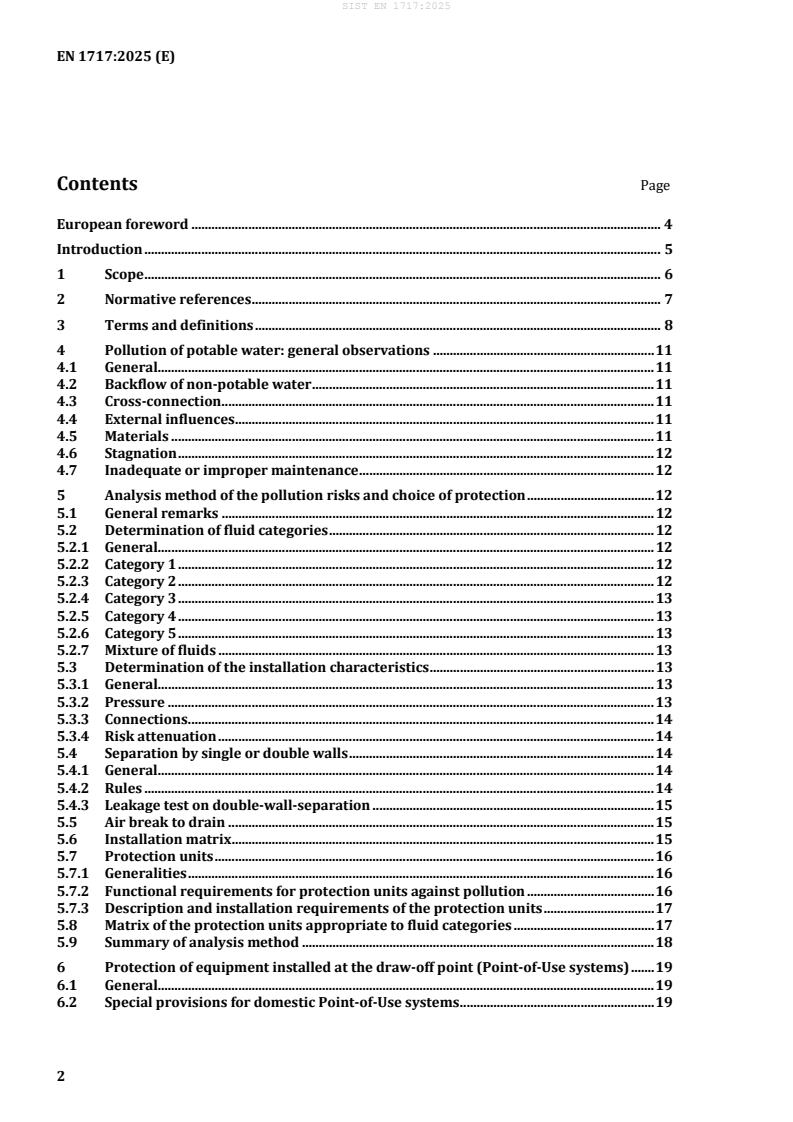
Contents Page
European foreword . 4
Introduction . 5
1 Scope . 6
2 Normative references . 7
3 Terms and definitions . 8
4 Pollution of potable water: general observations . 11
4.1 General. 11
4.2 Backflow of non-potable water . 11
4.3 Cross-connection . 11
4.4 External influences . 11
4.5 Materials . 11
4.6 Stagnation . 12
4.7 Inadequate or improper maintenance . 12
5 Analysis method of the pollution risks and choice of protection . 12
5.1 General remarks . 12
5.2 Determination of fluid categories . 12
5.2.1 General. 12
5.2.2 Category 1 . 12
5.2.3 Category 2 . 12
5.2.4 Category 3 . 13
5.2.5 Category 4 . 13
5.2.6 Category 5 . 13
5.2.7 Mixture of fluids . 13
5.3 Determination of the installation characteristics . 13
5.3.1 General. 13
5.3.2 Pressure . 13
5.3.3 Connections . 14
5.3.4 Risk attenuation . 14
5.4 Separation by single or double walls . 14
5.4.1 General. 14
5.4.2 Rules . 14
5.4.3 Leakage test on double-wall-separation . 15
5.5 Air break to drain . 15
5.6 Installation matrix . 15
5.7 Protection units . 16
5.7.1 Generalities . 16
5.7.2 Functional requirements for protection units against pollution . 16
5.7.3 Description and installation requirements of the protection units . 17
5.8 Matrix of the protection units appropriate to fluid categories . 17
5.9 Summary of analysis method . 18
6 Protection of equipment installed at the draw-off point (Point-of-Use systems) . 19
6.1 General. 19
6.2 Special provisions for domestic Point-of-Use systems . 19
7 Protection at the connection point to the public potable water system . 20
8 Air break to drain . 20
8.1 General . 20
8.2 Minimum requirements . 21
8.3 Calculation of air inlets or overflow openings . 22
Annex A (normative) Reference list of the protection units . 23
Annex B (informative) Guide table for determining the fluid category from which protection
is required . 55
Annex C (informative) Example for the selection of protection devices for the domestic and
non-domestic use . 57
C.1 Example — Care lift bath. 57
C.2 Example — Utilization of rain water . 58
C.3 Example — Detergent dosing system . 59
C.4 Example — Filling station for heating systems . 61
C.5 Example — Animal drinking trough . 62
C.6 Example — Flushing compressor for sewages systems . 63
C.7 Example — Tank filling for vehicles with water tanks . 64
Bibliography . 66
European foreword
This document (EN 1717:2025) has been prepared by Technical Committee CEN/TC 164 “Water supply”,
the secretariat of which is held by AFNOR.
This European Standard shall be given the status of a national standard, either by publication of an
identical text or by endorsement, at the latest by February 2026, and conflicting national standards shall
be withdrawn at the latest by February 2026.
Attention is drawn to the possibility that some of the elements of this document may be the subject of
patent rights. CEN shall not be held responsible for identifying any or all such patent rights.
This document supersedes EN 1717:2000.
This document includes the following significant technical changes with respect to EN 1717:2000:
— the Scope has been made more precise, extended and revised;
— terms and definitions have been amended;
— all Figures have been updated and re-drawn;
— Table 2 has been updated;
— Clause “Air break to drain” has been revised;
— Annex A and Annex B have been completely revised;
— Annex C has been revised and provides application examples.
Any feedback and questions on this document should be directed to the users’ national standards body.
A complete listing of these bodies can be found on the CEN website.
According to the CEN-CENELEC Internal Regulations, the national standards organisations of the
following countries are bound to implement this European Standard: Austria, Belgium, Bulgaria, Croatia,
Cyprus, Czech Republic, Denmark, Estonia, Finland, France, Germany, Greece, Hungary, Iceland, Ireland,
Italy, Latvia, Lithuania, Luxembourg, Malta, Netherlands, Norway, Poland, Portugal, Republic of North
Macedonia, Romania, Serbia, Slovakia, Slovenia, Spain, Sweden, Switzerland, Türkiye and the United
Kingdom.
Introduction
In respect of potential adverse effects on the quality of water intended for human consumption, caused
by the products covered by this document, it provides no information as to whether the products may be
used without restriction in any of the Member state of the EU or EFTA;
NOTE While awaiting the adoption of verifiable European criteria, attention is also drawn to national
regulations that can apply.
The UK Matrix of the protection units appropriate to fluid categories (Table 2) and the determination of
fluid categories (5.2) differs to that detailed within the body of this document. The British Standard
version of EN 1717 therefore contains an A deviation to cover the limited technical deviations to ensure
compliance with the Water Supply (fittings) Regulations 1999.
Annex A of this document is normative.
Annex B and Annex C of this document are informative.
1 Scope
This document specifies an analysing methodology for protecting potable water in potable water
installations within and outside buildings but within premises from the risk of pollution by backflow of
non-potable water and gives recommendations on the design, risk analysis, backflow prevention devices
and their installation methods (see Figure 1 and Figure 2).
This methodology is also intended to be used outside premises for all water systems connected to a
potable water distribution system up to and including the point of use (see Figure 3).
The product standards for the specific backflow prevention devices or arrangements are intended to be
used in conjunction with this document. For the development of new devices or systems, this document
is intended to be used as a reference to establish the necessary level of backflow protection.
Figure 1 — Operator of a building on own property (land), delivery point (DP) in the building,
EN 1717 Scope of application inside and outside buildings
Figure 2 — Operator of a building with its own property (land), delivery point (DP) at the
property boundary, EN 1717 Scope of application inside and outside buildings.
Figure 3 — Withdrawal of drinking water from a public drinking water service pipeline at the
delivery point (DP) for the operation and/or filling of mobile units with containers (vehicles on
road, water, air, rail), EN 1717 with scope at the transfer point in the outdoor area, supply
network
2 Normative references
The following documents are referred to in the text in such a way that some or all of their content
constitutes requirements of this document. For dated references, only the edition cited applies. For
undated references, the latest edition of the referenced document (including any amendments) applies.
EN 806 (all parts), Specifications for installations inside buildings conveying water for human consumption
EN 12729, Devices to prevent pollution by backflow of potable water - Controllable backflow preventer with
reduced pressure zone - Family B - Type A
EN 13076, Devices to prevent pollution by backflow of potable water - Unrestricted air gap-Family A - Type
A
EN 13077, Devices to prevent pollution by backflow of potable water - Air gap with non-circular overflow
(unrestricted) - Family A - Type B
EN 13078, Devices to prevent pollution by backflow of potable water - Air gap with submerged feed
incorporating air inlet plus overflow - Family A, type C
EN 13079, Devices to prevent pollution by backflow of potable water - Air gap with injector - Family A - Type
D
EN 13433, Devices to prevent pollution by backflow of potable water - Mechanical disconnector, direct
actuated - Family G, type A
EN 13959, Anti-pollution check valves - DN 6 to DN 250 inclusive family E, type A, B, C and D
EN 14367, Non controllable backflow preventer with different pressure zones - Family C, type A
EN 14451, Devices to prevent pollution by backflow of potable water - In-line anti-vacuum valves DN 10 to
DN 50 inclusive - Family D, type A
EN 14452, Devices to prevent pollution by backflow of potable water - Pipe interrupter with atmospheric
vent and moving element DN 10 to DN 20 - Family D, type B
EN 14453, Devices to prevent pollution by backflow of potable water - Pipe interrupter with permanent
atmospheric vent DN 10 to DN 20 - Family D, type C
EN 14622, Devices to prevent pollution by backflow of potable water - Air gap with circular overflow
(restricted) - Family A, type F
EN 14623, Devices to prevent pollution by backflow of potable water - Air gaps with minimum circular
overflow (verified by test or measurement) - Family A, type G
3 Terms and definitions
For the purposes of this document, the terms and definitions given in the EN 806 series and the following
apply.
ISO and IEC maintain terminology databases for use in standardization at the following addresses:
— ISO Online browsing platform: available at https://www.iso.org/obp/
— IEC Electropedia: available at https://www.electropedia.org/
3.1
air break to drain
vertical distance realised by air inlets or full disconnection between the lowest point of the outlet and the
spillover level of the atmospheric drain overflow
3.2
air gap
permanent atmospheric separation between the upstream fluid supply and the downstream fluid
3.3
air inlet
orifice designed to admit air from the atmosphere into a hydraulic system
3.4
appliance
equipment
device in which the potable water is used and/or is modified
Note 1 to entry: e.g. water heater, coffee-machine, WC-pan, etc.
3.5
backflow
movement of the fluid from downstream to upstream within an installation
3.6
backflow protection device
device which is intended to prevent pollution of potable water by backflow
3.7
different liquid levels
3.7.1
critical level
physical or piezometric level of the fluid reached in any part of the appliance after closing the water inlet,
starting from maximum level
3.7.2
maximum level
highest fluid level reached above the spillover level under positive pressure fault conditions with all
outlets closed but with the overflow open
3.7.3
spillover level
level at which water will start to overflow the receiving vessel with all outlets closed
3.8
disconnection
break in a hydraulic system creating an atmospheric separation between two elements, one carrying or
containing potable water (upstream) and another carrying or containing another fluid (downstream)
3.8.1
controllable disconnection
device having the ability through the provision of test ports to verify the performance parameters of a
pressure controlled zone – such as the differential pressure
3.8.2
non-controllable disconnection
device which has no provision of test ports or other means to verify performance parameters of pressure
controlled zones
3.9
domestic use
intended use of applications and appliances that are common for a potable water installation in a
household environment
Note 1 to entry: The same use of these appliances and applications in e.g. flats, hotels, schools, offices and collective
residences (student and nurse accommodations or similar) is considered to be domestic use (see also 6.2)
3.10
downstream
side to which fluid flows under normal conditions
3.11
family of protection
general identification of a backflow protection device principle
3.12
fluid
liquid that can assume the shape of any container or vessel, and they are relatively incompressible
Note 1 to entry: Fluids are divided into liquids and gases.
3.13
LD
calculated value, based on OECD 423 test method, of the quantities of substances or mixture which, given
on one intake through oral and parental path, bring about within 15 days (the required time to consider
potential delayed effects) the death of 50 out of 100 treated animals
Note 1 to entry: It should be realized that the results of the LD50-test methods are used only as a tool to differentiate
between category 3 and category 4 for selecting appropriate family and types of protection units. The LD50-method
is not sufficient for conducting a full toxicological evaluation.
3.14
non-domestic use
application different from the domestic use (3.9)
3.15
overflow
means for discharging naturally excess fluid from an appliance when it has reached a specified level
3.16
point of use
point where water is drawn by the user either directly or by connecting an apparatus
3.17
pollution of potable water
reduction in organoleptic (turbidity, odour), taste, chemical or biological quality of potable water
Note 1 to entry: Attention is drawn to DIRECTIVE (EU) 2020/2184 OF THE EUROPEAN PARLIAMENT AND OF THE
COUNCIL of 16 December 2020 on the quality of water intended for human consumption
3.18
potable water
water intended for human consumption
Note 1 to entry: Attention is drawn to DIRECTIVE (EU) 2020/2184 OF THE EUROPEAN PARLIAMENT AND OF THE
COUNCIL of 16 December 2020 on the quality of water intended for human consumption
3.19
potable water installation
water installation located downstream of the delivery point specified by the water supply authorities or
regulations
Note 1 to entry: In DIRECTIVE (EU) 2020/2184 OF THE EUROPEAN PARLIAMENT AND OF THE COUNCIL of
16 December 2020 on the quality of water intended for human consumption the potable water system is
denominated as “domestic distribution system”.
3.20
protection point
location in a hydraulic system where a protection unit is installed
3.21
protection unit
device in combination with other hydraulic components which constitutes the protection against
backflow
3.22
risk of flooding
foreseeable situation where contact between non-potable water and potable water by penetration into
the atmospheric openings of the anti-pollution devices is possible due to flooding of a room or area in a
building in which anti-pollution device is installed
3.23
type of protection
identified operating principle applied to a protection device belonging to a given family
3.24
upstream
side from which fluid flows under normal conditions
4 Pollution of potable water: general observations
4.1 General
The criteria in this clause shall be considered in any risk-based determination of the necessary protection
device to prevent the pollution of potable water installations. The following conditions can give raise to
risk of pollution of the potable water.
4.2 Backflow of non-potable water
The quality of the potable water distributed can be impaired when non-potable water flows back into the
potable water installation.
4.3 Cross-connection
The quality of the potable water distributed can be impaired by a cross-connection with non-potable
water, this can be an actual or potential physical connection between a potable water supply and any
other non-potable water system.
4.4 External influences
Potable water cisterns, pipes and protection units shall be protected from external pollution (see
the EN 806 series).
No other fluid shall be conveyed in a potable water installation (gas, compressed air, ventilation conduct,
vapour, chemicals, water used in heating equipment, recycled water, drainage or run-off water, waste
water, etc.) other than potable water. If it is considered possible that under the prescribed operation any
contaminant could enter through the protection device (e.g. air gap, air inlet) into the potable water
installation, additional corresponding protection measures are to be provided.
4.5 Materials
The quality of the potable water distributed can be impaired by the use of inappropriate materials.
All materials coming into contact with water intended for human consumption shall present no health
risk nor cause any change to the water in terms of quality, appearances, smell or taste.
They shall be compatible with each other, with the water supplied, and with the fluids or substances that
can come into contact with them.
4.6 Stagnation
Stagnation (e.g. as a result of interruptions to operation and disconnection, see the EN 806 series) of
potable water in the systems can result in impairment of the water quality due to a significant
concentration substances released from materials or due to microbial proliferation.
The level of impairment depends on the materials used, the water quality, the ambient temperature (e.g.
pipes for potable water in boiler rooms) and the duration of stagnation.
4.7 Inadequate or improper maintenance
Any insufficient or improper maintenance of the potable water installation including backflow protection
devices can result in an impaired water quality. For proper maintenance see EN 806-5.
5 Analysis method of the pollution risks and choice of protection
5.1 General remarks
Pollution in a potable water supply system can occur by:
a) backsiphonage: by partial vacuum (drop in pressure) in the potable water supply system (due e.g. to
the operation of a valve, the bursting of a pipe, the operation of a booster pump, excessive water
demands in a part of the system, water taken for emergency use from a fire hydrant);
b) back pressure: originated in a non-potable water system in which the pressure exceeds the pressure
in the potable water system;
c) back growth: back contamination pollution in the potable water installation as a result of
proliferation of microorganisms, from the downstream system;
d) stagnation, see 4.6.
5.2 Determination of fluid categories
5.2.1 General
Fluids which could be in contact with potable water are classified in five categories as defined below.
5.2.2 Category 1
Water intended for human consumption coming directly from a potable water distribution system.
5.2.3 Category 2
Fluid recognized as being fit for human consumption, including water taken from a potable water
distribution system, which has undergone a change in taste, odour, colour or an active change in
temperature (heating or cooling).
5.2.4 Category 3
Fluid representing a slight human health hazard due to the presence of one or more harmful substances
of low acute toxicity to be determined by the LD -method > 200 mg/kg, see 3.14 .
5.2.5 Category 4
Fluid presenting a significant human health hazard due to the presence of one or more toxic or very toxic
substances of high acute toxicity to be determined by the LD -method ≤ 200 mg/kg, see 3.14. or one or
more carcinogenic mutagenic and reprotoxic (CMR) substances.
5.2.6 Category 5
Fluid presenting a human health hazard due to the presence of microbiological or viral elements.
5.2.7 Mixture of fluids
If fluids are mixed than the mixture will be classified according to the highest fluid category in the mixture
(independent of the ratio).
5.3 Determination of the installation characteristics
5.3.1 General
The analysis of an existing or projected installation provides information about its characteristics and the
fluid categories.
That information shall then be used to determine an appropriate protection unit to prevent pollution of
the potable water supply or installation.
The analysis is done as described in the following clauses.
The result of this analysis is fixed by a cross in the appropriate field of the installation matrix
(see Table 1).
5.3.2 Pressure
Locate the point(s) within the potable water installation that need to be protected against pollution.
Determine whether downstream of the protection point is subjected to atmospheric pressure (P = atm)
or to a pressure exceeding atmospheric pressure (P > atm):
— the situation will be P = atm if the protection point is subject to backsiphonage only (see Figure 4);
— the situation will be P > atm if the protection point is subject to backsiphonage or back pressure (see
Figure 5).
The border between fluid category 3 and 4 is in principle LD = 200 mg/kg body weight, in accordance with
OECD 423, December 17, 2001.
When the outcome of the calculation method indicates that a dose equal or less than 200 mg/kg body weight of a
fluid is deadly for at least 50 % of the animals, then the fluid is classified into category 4. When the calculation
indicates that a dose of more than 200 mg/kg is required the fluid is regarded as less harmful and the fluid is
classified into category 3.
Remark: In 2002 the original LD50-test, OECD 401 (8), has been deleted from the OECD guidelines.
The LD50-test method in this document is just used as a means for selecting appropriate protection unit. It is not
intended as a replacement for undertaking a full toxicological evaluation of the health risk.
Figure 4 — Pressure equal atmosphere
Figure 5 — Pressure bigger atmosphere
5.3.3 Connections
All connections are considered permanent.
5.3.4 Risk attenuation
The principle of risk attenuation is accepted only for certain facilities for domestic use listed in Clause 6.2
and in conformity with Table 3.
5.4 Separation by single or double walls
5.4.1 General
A single wall separator consists of a single fixed and sealed partition or casing that can be in contact with
the potable water on one side, and with another fluid on the other.
A double wall separator consists of at least two fixed and sealed partitions or casings creating a neutral
intermediate zone between the potable water on one side and another fluid on the other.
The intermediate zone may be designed in two ways:
— containing a pressurized gaseous fluid or an inert porous material (open cells);
— containing a fluid of category 2 or 3.
5.4.2 Rules
5.4.2.1 With respect to pollution prevention
Category 2 or 3 fluids shall be separated from the potable water by a single wall including permanently
fixed joints.
When the fluid from which potable water shall be protected against pollution is of category 4 or 5, a single
wall is not sufficient. A double wall with a safety medium in between (see 5.4.1) is appropriate to separate
the potable water from the second fluid.
5.4.2.2 With respect to direct consumer protection
When the fluid from which potable water shall be protected against is of category 4 or 5 and downstream
of the appliance the water is intended for sanitary or food related use, a double wall shall be required.
5.4.3 Leakage test on double-wall-separation
Separation by a double-wall with a safety medium in between shall be constructed such that any leakage
from one of the walls shall be routed to the outside of the appliance to give a visual leakage detection or
that the leakage initiates a visible and/or acoustic signal.
The leakage test, conducted on a test sample is as follows:
a) drill a (2 ± 0,1) mm hole through the partition wall in contact with the fluid the potable water needs
to be protected against. For the position the most critical location in the double-wall is selected.
(normally the furthest point from the connections);
b) subject the hole in this side of the separation wall with a pressure of (50 ± 5) kPa and maintain that
pressure;
c) verify if a leakage detection is established within (300 ± 5) s after applying the pressure, e.g. by:
1) observing that fluid emerges to the outside of the double wall construction in the atmosphere;
2) a visual alarm is initiated;
3) an acoustic alarm signal is initiated.
5.5 Air break to drain
If apparatus is connected to a drainage system, which does not have an air break to drain that satisfies
the requirements given in Clause 8, the fluid in the apparatus shall be considered as fluid category 5.
5.6 Installation matrix
Table 1 — Example of installation matrix
Category of fluid
Downstream pressure of protection unit
2 3 4 5
P = atm
— — — —
(backsiphonage)
P > atm
— — — —
(Backpressure)
By making an analysis of an installation, assessment of the fluid category from which it shall be protected,
as well as its technical characteristics (see 5.3 to 5.5), the pollution risk of the potable water can be
determined.
Any backflow prevention arrangement already incorporated into the apparatus or the installation shall
be disregarded during the analysis, if the integrated backflow prevention arrangement satisfies the risk
determined during the analysis, then no further backflow prevention arrangement is necessary for the
apparatus.
The matrix above (Table 1) can be completed by inserting a cross for an existing parameter resulting in
the installation matrix (examples given in Annex C).
5.7 Protection units
5.7.1 Generalities
When the protection unit is represented by a symbol it shall be a hexagon shape containing the letter of
the protection family and the letter of the type of protection in this family (see Figure 6).
EXAMPLE
Figure 6 — Example protection unit symbol
Regular inspection and maintenance of the protection units shall be carried out in accordance with the
EN 806 series and the applicable product standards.
The hydraulic system of an installation or of an appliance connected to an installation may have several
protection units; each unit comprises a protection device and the accessories needed for protection of
the water and for its proper functioning, and for inspection, maintenance; (e.g. valve, strainer, etc.).
The protection device itself is an assembled finished product ready to be installed in a hydraulic system.
The characteristic of families and types of protection, and the principle diagrams shall be according to
Annex A.
To ensure that the risk coverage is fully satisfied it is necessary to correctly install the backflow protection
unit.
The components constituting a protection unit combined with a protection device can be:
— a stop valve (servicing valve)
— a test port
— a strainer
— a strainer with drain valve
— an airbreak to drain
5.7.2 Functional requirements for protection units against pollution
Protection units shall be constructed that they will safely prevent pollution of the potable water
installation.
The level of protection and the method of operation of the device, i.e. either an air gap arrangement, air
inlet port, or a mechanical arrangement, will depend upon the category of the contaminated fluid from
which the potable water installation needs to be protected.
Except for particular fields of application, backflow protection devices shall be able to operate without
modification or adjustment:
— at any pressure, up to and including 1 000 kPa (10 bar); and
— for any pressure variation, up to 1 000 kPa (10 bar); and
— in permanent operation at a limited temperature of 65 °C and 90 °C for 1 h maximum.
Internal and external parts of backflow protection devices shall be accessible for:
— inspection and test;
— replacement or repair.
On devices of DN > 50 mm it shall be possible to carry out these operations in situ. Replaceable
components shall be designed that they can only be reassembled without error in their original positions
(with no risk of inversion, reversal, etc.).
Elements contributing to the setting shall be fixed and not adjustable. Details are provided in the
appropriate product standard.
Additional actuating devices (electric, pneumatic, etc.) shall not have a negative influence on the
operation of the backflow protection function.
5.7.3 Description and installation requirements of the protection units
Annex A in this document covers the general applications of the protection units but the specific detail of
the installation and positioning will need to be determined by the manufacturer’s instructions and details
of the applicable product standard for the backflow protection device.
Anti pollution devices with atmospheric openings shall not be installed in areas having the risk of
flooding.
The risk of flooding (see 3.22) is not including the following situations:
— unforeseeable disasters and natural catastrophes;
— the height of the lower edge of the atmospheric openings of the anti pollution devices in the room
represents the maximum level height of non potable water in a flooded room.
5.8 Matrix of the protection units appropriate to fluid categories
The suitability of each protection unit is indicated in Table 2.
NOTE See also Clause 6.
Table 2 — Matrix of the protection units appropriate to fluid categories
Category of fluids
Protection unit
2 3 4 5
AA Unrestricted air gap • • • •
AB Air gap with overflow non-circular (unrestricted) • • • •
AC Air gap with submerged feed incorporating air inlet plus overflow • • – –
AD Air gap with injector • • • •
AF Air gap with overflow circular (restricted) • • • –
AG Air gap with minimum circular overflow • • – –
BA Backflow preventer with controllable reduced pressure zone • • • –
CA Backflow preventer with different non-controllable pressure zones • • – –
DA In line anti-vacuum valve o o – –
DB Pipe interrupter with atmospheric vent and moving element o o o –
DC Pipe interrupter with permanent atmospheric vent o o o o
EA Controllable antipollution check-valve • – – –
EB Non-controllable antipollution check-valve • – – –
EC Controllable antipollution double check-valve • – – –
ED Non-controllable antipollution double check-valve • – – –
GA Mechanical disconnector direct actuated • • – –
GB Mechanical disconnector hydraulic actuated • • • –
HA Hose union backflow preventer • o – –
HB Hose union anti-vacuum valve o – – –
HC Automatic diverter o – – –
HD Hose union anti-vacuum valve combined with a check-valve • o – –
LA Pressurized air inlet valve o – – –
LB Pressurized air inlet valve combined with a check valve located
• o – –
downstream
Units with an atmospheric vent shall not be installed where it is risk of flooding (e.g. AA, BA, CA).
• covers the risk for backpressure and backsiphonage (P ≥ atm, see also 5.3.2).
o covers the risk for backsiphonage only (P = atm, see also 5.3.2).
– does not cover the risk.
5.9 Summary of analysis method
The analysis method consists of the following steps:
— list the fittings and appliances which could cause pollution by backflow. Determine the fluid category;
— ascertain the installation characteristics:
— identify the location where the protection unit should be placed and note any existing protection
units;
— determine the maximum fluid levels;
— determine the downstream pressure at the point of protection (see 5.3.2);
— draw up the installation matrix in accordance with 5.6;
— consider which are the protection units to be used by referring to the protection matrix according
to 5.8 and Clause 6 and Clause 7;
— determine whether single or double separation walls shall be in accordance with 5.4;
— Verify whether the connection to the drainage system is fitted with an air break to drain in accordance
with 5.5.
If the appropriate protection unit(s) are already installed, the equipment may be connected, otherwise,
make provision for the installation of the appropriate protection unit(s) either in the equipment or
upstream of it (see also 5.6).
6 Protection of equipment installed at the draw-off point (Point-of-Use systems)
6.1 General
The protection units of equipment installed for each point of use are analysed according to the method
described in Clause 5.
The protection units shall be incorporated into the equipment. If for specific technical reasons they are
not, then they shall be installed at the connection of the supply of those installations to ensure the
protection of the potable water.
A suitable backflow prevention device is required for each point of use.
A single protection unit may be used to provide backflow protection for several non-potable circuits
provided, that the capability of the protection unit is equal to or greater than the highest risk fluid
category risk of all downstream circuits being protected (see Table 2).If an analysis is not possible, an air
gap of family A, type A, B or D is the only protection unit to be used.
6.2 Special provisions for domestic Point-of-Use systems
For domestic uses the protection units given in Table 3, notwithstanding a risk analysis according to
Clause 5, are also allowed.
For the equipment listed in Table 3, the risk attenuation principle is strictly limited to domestic use.
Table 3 — Risk attenuation for domestic use
Equipment Category Authorized level units
Tap with extractable or flexible outlet with spray at:
— wash basin;
Protection units appropriate to
— sink;
category 2
— shower;
— bath.
Protection units appropriate to
a
Bath with inlet below the rim of the tub 5
category 3
Protection units appropriate to
b
Draw-off tap for hose connection 5
category 3
a
The installation of the protection unit shall be above the rim.
b
Used for washing, cleaning or above ground garden watering (perforated irrigation lines and submerged
nozzles are not allowed).
7 Protection at the connection point to the public potable water system
Risk analysis is based upon an inspection of the water use in the water system located downstream of the
delivery point specified by the water supply authorities or regulations.
A backflow protection unit shall be installed at the origin of the
...