EN 529:2005
(Main)Respiratory protective devices - Recommendations for selection, use, care and maintenance - Guidance document
Respiratory protective devices - Recommendations for selection, use, care and maintenance - Guidance document
This European Standard provides guidance on the best practice for establishing and implementing a suitable respiratory protective device programme. It is published to provide a Europe-wide baseline for the selection, use, care and maintenance of respiratory protective devices. It provides guidelines for preparing national guidance in this area. The guidance contained in this European Standard is not intended to be exhaustive, but highlights important aspects to which attention should be given. The recommendations in this European Standard will help to comply with national legislation on this subject where it exists, or with European legislation.
Respiratory protective devices used exclusively in diving and at increased or reduced atmospheric pressures are not covered by this guidance.
Atemschutzgeräte - Empfehlungen für Auswahl, Einsatz, Pflege und Instandhaltung - Leitfaden
Diese Europäische Norm ist ein Leitfaden zur optimalen Erstellung und Einführung eines geeigneten Atemschutzgeräteprogrammes. Sie wird veröffentlicht, um eine europaweite Grundlage für Auswahl, Einsatz, Pflege und Instandhaltung von Atemschutzgeräten zu geben. Sie gibt Anleitungen zum Erstellen nationaler Leitfäden auf diesem Gebiet. Es ist nicht beabsichtigt, dass der in dieser Europäischen Norm enthaltene Leitfaden erschöpfend ist, aber er betont wichtige Aspekte, die beachtet werden sollten. Die Empfehlungen in dieser Europäischen Norm können helfen, nationaler Gesetzgebung auf diesem Gebiet zu entsprechen, sofern vorhanden, oder europäischer Gesetzgebung zu entsprechen.
Atemschutzgeräte, die ausschließlich zum Tauchen oder bei erhöhten oder erniedrigten atmosphärischen Drücken benutzt werden, werden von diesem Leitfaden nicht abgedeckt.
Appareils de protection respiratoire - Recommandations pour le choix, l'utilisation, l'entretien et la maintenance - Guide
La présente Norme européenne fournit des recommandations concernant la meilleure pratique de
l'établissement et de la mise en oeuvre d'un programme approprié de protection respiratoire. La présente
Norme européenne est publiée pour fournir une base de référence au niveau européen en matière de
sélection, d'utilisation, d'entretien et de maintenance des appareils de protection respiratoire. Elle fournit des
directives visant à l'élaboration de recommandations nationales dans ce domaine. Les recommandations
contenues dans la présente Norme européenne ne sont pas destinées à être exhaustives, mais insistent sur
les aspects importants auxquels il convient d'accorder une attention toute particulière. Les recommandations
contenues dans la présente Norme européenne faciliteront le respect de la législation nationale sur ce sujet,
quand elle existe, ou de la législation européenne.
Les appareils de protection respiratoire utilisés exclusivement en plongée et à des pressions atmosphériques
élevées ou réduites ne sont pas couverts par le présent guide.
Oprema za varovanje dihal – Priporočila za izbiro, uporabo, nego in vzdrževanje – Navodilo
General Information
- Status
- Published
- Publication Date
- 11-Oct-2005
- Technical Committee
- CEN/TC 79 - Respiratory protective devices
- Current Stage
- 9092 - Decision on results of review/2YR ENQ - revise - Review Enquiry
- Start Date
- 01-Jul-2025
- Completion Date
- 23-Sep-2025
Relations
- Effective Date
- 22-Dec-2008
Overview
EN 529:2005 - "Respiratory protective devices - Recommendations for selection, use, care and maintenance - Guidance document" (CEN) provides Europe‑wide guidance for establishing and running a robust respiratory protection programme. It sets a baseline for selection, use, care and maintenance of respiratory protective devices (RPDs) and supports compliance with applicable national and European legislation. Devices used exclusively for diving or at altered atmospheric pressures are excluded.
Key topics and technical requirements
EN 529 is a guidance standard (not a performance test standard) and covers practical elements of a respiratory protection programme:
- Classification and components - overview of facepieces, filters, filtering devices and breathing apparatus (see Annex A).
- Programme process - employer, employee and manufacturer responsibilities, organisation, resources, training and supervision.
- Risk assessment process - stages for identifying hazards and determining when RPDs are required.
- Criteria for use - when respiratory protection is needed and limits of use (including atmospheres immediately dangerous to life or health - IDLH).
- Adequacy and suitability - assessing protection factors, workplace/task/wearer suitability and CE marking considerations.
- Operational use - donning/doffing, workplace procedures and supervision.
- Maintenance, storage and record keeping - care schedules, storage requirements and documentation.
- Annex guidance - informative material on protection factors (Annex C), suitability factors (Annex D), IDLH (Annex B) and types/components (Annex A).
Practical applications and who uses EN 529
EN 529 is aimed at professionals responsible for respiratory protection in industrial, health and emergency response settings:
- Employers and safety managers developing RPD programmes and policies.
- Occupational hygienists and risk assessors performing exposure assessments and selecting appropriate devices.
- PPE procurement teams specifying filters, facepieces and breathing apparatus.
- Training providers designing user instruction and competence programs.
- Manufacturers and distributors seeking to align product information with European guidance.
- Competent persons and supervisors overseeing day‑to‑day RPD use and maintenance.
Practical uses include establishing workplace RPD policy, selecting appropriate filters and respirators, setting training and maintenance routines, and documenting compliance measures.
Related standards
EN 529 references and complements product and performance standards such as EN 136, EN 140, EN 143, EN 14387, EN 12941, EN 12942, EN 14593, EN 14594, EN 1835, EN 12419, EN 12021, EN 943-1 and others that specify facepiece, filter and breathing apparatus requirements.
Keywords: EN 529, respiratory protective devices, respiratory protection programme, selection use care maintenance, RPD risk assessment, protection factors.
Frequently Asked Questions
EN 529:2005 is a standard published by the European Committee for Standardization (CEN). Its full title is "Respiratory protective devices - Recommendations for selection, use, care and maintenance - Guidance document". This standard covers: This European Standard provides guidance on the best practice for establishing and implementing a suitable respiratory protective device programme. It is published to provide a Europe-wide baseline for the selection, use, care and maintenance of respiratory protective devices. It provides guidelines for preparing national guidance in this area. The guidance contained in this European Standard is not intended to be exhaustive, but highlights important aspects to which attention should be given. The recommendations in this European Standard will help to comply with national legislation on this subject where it exists, or with European legislation. Respiratory protective devices used exclusively in diving and at increased or reduced atmospheric pressures are not covered by this guidance.
This European Standard provides guidance on the best practice for establishing and implementing a suitable respiratory protective device programme. It is published to provide a Europe-wide baseline for the selection, use, care and maintenance of respiratory protective devices. It provides guidelines for preparing national guidance in this area. The guidance contained in this European Standard is not intended to be exhaustive, but highlights important aspects to which attention should be given. The recommendations in this European Standard will help to comply with national legislation on this subject where it exists, or with European legislation. Respiratory protective devices used exclusively in diving and at increased or reduced atmospheric pressures are not covered by this guidance.
EN 529:2005 is classified under the following ICS (International Classification for Standards) categories: 13.340.30 - Respiratory protective devices. The ICS classification helps identify the subject area and facilitates finding related standards.
EN 529:2005 has the following relationships with other standards: It is inter standard links to CR 529:1993. Understanding these relationships helps ensure you are using the most current and applicable version of the standard.
EN 529:2005 is associated with the following European legislation: EU Directives/Regulations: 2016/425, 89/686/EEC, 93/68/EEC, 93/95/EEC, 96/58/EC; Standardization Mandates: M/031. When a standard is cited in the Official Journal of the European Union, products manufactured in conformity with it benefit from a presumption of conformity with the essential requirements of the corresponding EU directive or regulation.
You can purchase EN 529:2005 directly from iTeh Standards. The document is available in PDF format and is delivered instantly after payment. Add the standard to your cart and complete the secure checkout process. iTeh Standards is an authorized distributor of CEN standards.
Standards Content (Sample)
SLOVENSKI STANDARD
01-januar-2006
2SUHPD]DYDURYDQMHGLKDO±3ULSRURþLOD]DL]ELURXSRUDERQHJRLQY]GUåHYDQMH±
1DYRGLOR
Respiratory protective devices - Recommendations for selection, use, care and
maintenance - Guidance document
Atemschutzgeräte - Empfehlungen für Auswahl, Einsatz, Pflege und Instandhaltung -
Leitfaden
Appareils de protection respiratoire - Recommandations pour le choix, l'utilisation,
l'entretien et la maintenance - Guide
Ta slovenski standard je istoveten z: EN 529:2005
ICS:
13.340.30 Varovalne dihalne naprave Respiratory protective
devices
2003-01.Slovenski inštitut za standardizacijo. Razmnoževanje celote ali delov tega standarda ni dovoljeno.
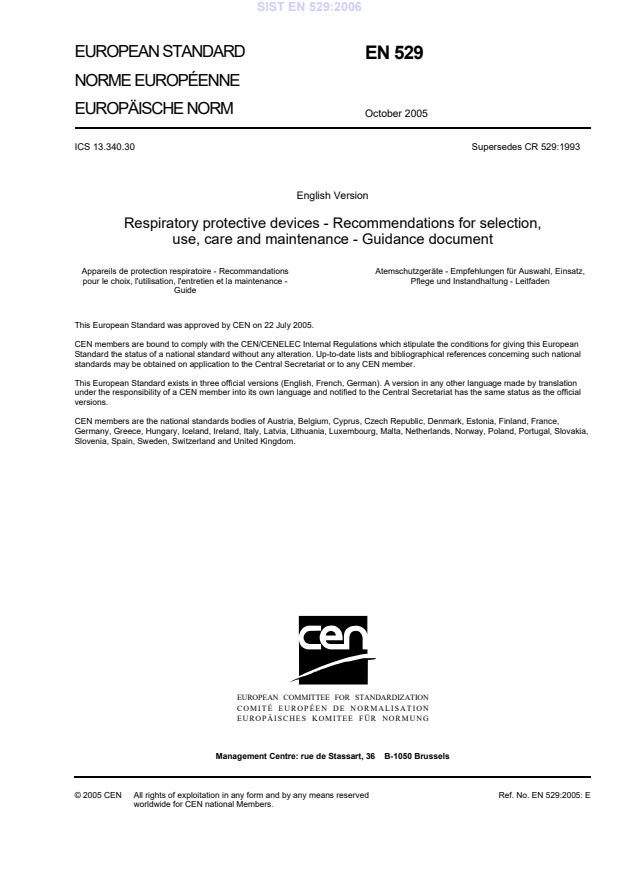
EUROPEAN STANDARD
EN 529
NORME EUROPÉENNE
EUROPÄISCHE NORM
October 2005
ICS 13.340.30 Supersedes CR 529:1993
English Version
Respiratory protective devices - Recommendations for selection,
use, care and maintenance - Guidance document
Appareils de protection respiratoire - Recommandations Atemschutzgeräte - Empfehlungen für Auswahl, Einsatz,
pour le choix, l'utilisation, l'entretien et la maintenance - Pflege und Instandhaltung - Leitfaden
Guide
This European Standard was approved by CEN on 22 July 2005.
CEN members are bound to comply with the CEN/CENELEC Internal Regulations which stipulate the conditions for giving this European
Standard the status of a national standard without any alteration. Up-to-date lists and bibliographical references concerning such national
standards may be obtained on application to the Central Secretariat or to any CEN member.
This European Standard exists in three official versions (English, French, German). A version in any other language made by translation
under the responsibility of a CEN member into its own language and notified to the Central Secretariat has the same status as the official
versions.
CEN members are the national standards bodies of Austria, Belgium, Cyprus, Czech Republic, Denmark, Estonia, Finland, France,
Germany, Greece, Hungary, Iceland, Ireland, Italy, Latvia, Lithuania, Luxembourg, Malta, Netherlands, Norway, Poland, Portugal, Slovakia,
Slovenia, Spain, Sweden, Switzerland and United Kingdom.
EUROPEAN COMMITTEE FOR STANDARDIZATION
COMITÉ EUROPÉEN DE NORMALISATION
EUROPÄISCHES KOMITEE FÜR NORMUNG
Management Centre: rue de Stassart, 36 B-1050 Brussels
© 2005 CEN All rights of exploitation in any form and by any means reserved Ref. No. EN 529:2005: E
worldwide for CEN national Members.
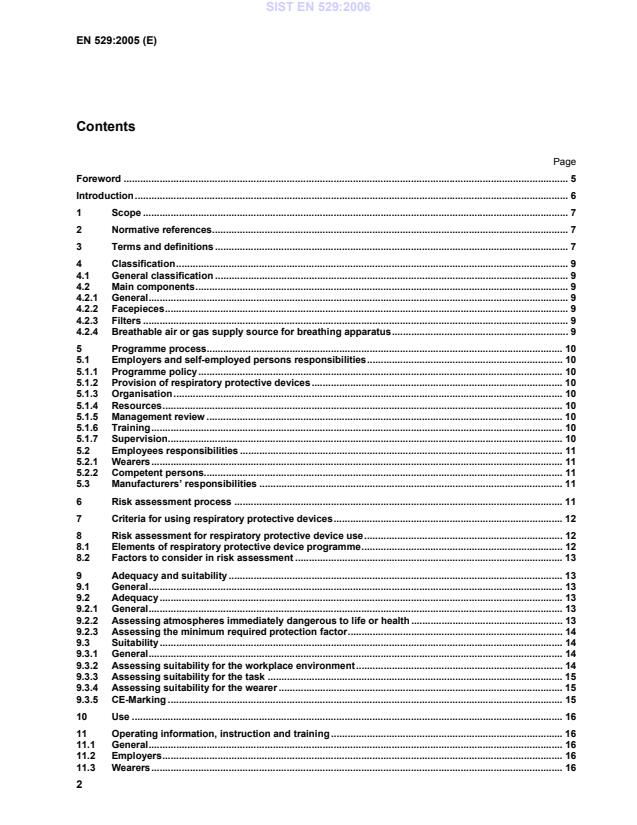
Contents
Page
Foreword . 5
Introduction. 6
1 Scope . 7
2 Normative references. 7
3 Terms and definitions. 7
4 Classification. 9
4.1 General classification . 9
4.2 Main components. 9
4.2.1 General. 9
4.2.2 Facepieces. 9
4.2.3 Filters . 9
4.2.4 Breathable air or gas supply source for breathing apparatus. 9
5 Programme process. 10
5.1 Employers and self-employed persons responsibilities. 10
5.1.1 Programme policy. 10
5.1.2 Provision of respiratory protective devices. 10
5.1.3 Organisation. 10
5.1.4 Resources. 10
5.1.5 Management review . 10
5.1.6 Training. 10
5.1.7 Supervision. 10
5.2 Employees responsibilities . 11
5.2.1 Wearers. 11
5.2.2 Competent persons. 11
5.3 Manufacturers’ responsibilities . 11
6 Risk assessment process . 11
7 Criteria for using respiratory protective devices. 12
8 Risk assessment for respiratory protective device use. 12
8.1 Elements of respiratory protective device programme. 12
8.2 Factors to consider in risk assessment . 13
9 Adequacy and suitability . 13
9.1 General. 13
9.2 Adequacy. 13
9.2.1 General. 13
9.2.2 Assessing atmospheres immediately dangerous to life or health . 13
9.2.3 Assessing the minimum required protection factor. 14
9.3 Suitability. 14
9.3.1 General. 14
9.3.2 Assessing suitability for the workplace environment. 14
9.3.3 Assessing suitability for the task . 15
9.3.4 Assessing suitability for the wearer . 15
9.3.5 CE-Marking . 15
10 Use . 16
11 Operating information, instruction and training . 16
11.1 General. 16
11.2 Employers. 16
11.3 Wearers. 16
11.4 Supervisors . 17
12 Maintenance . 17
13 Storage. 17
13.1 Employers duties . 17
13.2 Employees’ duties. 17
14 Record keeping . 17
Annex A (informative) Types and components of respiratory protective devices . 19
A.1 Facepieces. 19
A.1.1 Half mask without inhalation valves and with separable filters to protect against gases or
gases and particles and particles only (EN 1827). 19
A.1.2 Half masks and quarter masks (EN 140) . 19
A.1.3 Full face Masks (EN 136) . 19
A.2 Filters . 20
A.2.1 General. 20
A.2.2 Particle filters (EN 143, EN 12941 and EN 12942) . 20
A.2.3 Gas filters and combined filters (EN 14387, EN 12941 and EN 12942). 20
A.2.4 Service life of filters . 21
A.3 Filtering devices. 22
A.3.1 General. 22
A.3.2 Negative pressure devices . 22
A.3.3 Assisted filtering devices . 23
A.4 Breathing apparatus . 24
A.4.1 Fresh air hose breathing apparatus. 24
A.4.2 Compressed air line breathing apparatus (EN 14593-1, EN 14593-2, EN 14594, EN 1835 and
EN 12419). 25
A.4.3 Self-contained breathing apparatus . 26
A.4.4 Ventilated protective suits (EN 943-1 and EN 1073-1) . 27
A.4.5 Compressed air for breathing apparatus (EN 12021) . 27
Escape devices . 30
Annex B (informative) Atmospheres immediately dangerous to life or health . 32
B.1 General. 32
B.2 Conditions . 32
B.3 Situations likely to present atmospheres immediately dangerous to life or health. 32
B.3.1 Confined spaces . 32
B.3.2 Oxygen deficiency. 32
B.3.3 Emergency situations created by hazardous substances . 33
Annex C (informative) Protection factors . 34
C.1 General. 34
C.2 Using protection factors. 34
Annex D (informative) Suitability factors . 37
D.1 General. 37
D.2 Environmental factors . 37
D.2.1 Oxygen deficiency. 37
D.2.2 Oxygen enrichment. 37
D.2.3 Asphyxiants. 37
D.2.4 Contaminant levels immediately dangerous to life or health . 38
D.2.5 Potentially corrosive atmospheres. 38
D.2.6 Potentially explosive atmospheres. 38
D.2.7 Potentially permeating contaminants. 39
D.2.8 Particulate contaminants (aerosols). 39
D.2.9 Gas and vapour contaminants . 39
D.2.10 Climatic extremes. 40
D.3 Task/job factors impacting on the wearer. 40
D.3.1 Work rate . 40
D.3.2 Visibility . 41
D.3.3 Mobility . 41
D.3.4 Communication . 41
D.3.5 Thermal stress. 42
D.3.6 Duration of wear. 42
D.3.7 Tools used . 42
D.4 Wearer factors. 43
D.4.1 Medical fitness . 43
D.4.2 Facial characteristics. 43
D.4.3 Spectacles . 44
D.4.4 Contact lenses. 44
D.4.5 Non PPE accessories. 44
D.4.6 Interaction with other PPE. 44
D.5 Legal factors. 45
D.5.1 European Product Directives . 45
D.5.2 European Standards . 45
Annex E (informative) Assessing the fit of tight fitting facepiece. 46
E.1 General. 46
E.2 Fit checking . 46
E.2.1 General. 46
E.2.2 Negative pressure fit check. 46
E.2.3 Positive pressure fit check. 46
E.3 Fit test methods . 46
E.3.1 Qualitative fit testing. 46
E.3.2 Quantitative fit testing . 47
Annex F (informative) Respiratory protection passport . 48
Bibliography. 49
Foreword
This European Standard (EN 529:2005) has been prepared by Technical Committee CEN/TC 79 "Respiratory
protective devices", the secretariat of which is held by DIN.
This European Standard shall be given the status of a national standard, either by publication of an identical
text or by endorsement, at the latest by March 2006, and conflicting national standards shall be withdrawn at
the latest by March 2006.
This European Standard supersedes CR 529:1993.
Users of this European Standard, prepared in the field of application of Article 118A of the EC Treaty, should be
aware that European Standards have no formal legal relationship with Directives which may have been made
under Article 118A of the Treaty. In addition, national legislation in the Member States may contain more
stringent requirements than the minimum requirements of a Directive based on Article 118A. Information on the
relationship between the national legislation implementing Directives based on Article 118A and this European
Standard may be given in a national foreword of the national standard implementing this European Standard.
According to the CEN/CENELEC Internal Regulations, the national standards organizations of the following
countries are bound to implement this European Standard: Austria, Belgium, Cyprus, Czech Republic,
Denmark, Estonia, Finland, France, Germany, Greece, Hungary, Iceland, Ireland, Italy, Latvia, Lithuania,
Luxembourg, Malta, Netherlands, Norway, Poland, Portugal, Slovakia, Slovenia, Spain, Sweden, Switzerland
and United Kingdom.
Introduction
Hazardous substances such as dusts, fibres, fumes, vapours, gases, micro-organisms and radioactive
particulates and gases encountered at work can cause significant damage to health or, in extreme cases, can
lead to death. This frequently occurs by the inhalation of harmful levels of hazardous substances that are
present in the workplace air. Besides the inhalation exposure dermal exposure to hazardous substances can
also lead to local skin damage, and sensitisation, as well as systemic effects.
Similarly exposure to an oxygen deficient atmosphere can lead to death.
Exposure (via all routes - inhalation, dermal and ingestion) to hazardous substances at work should be
eliminated or alternative substances which are less hazardous used. Where elimination is not practicable
adequate protective measures should be put in place so that exposures are reduced to a minimum.
The use of suitable protective measures at source should be the first choice for minimising the exposure. Such
measures protect everyone in the workplace, whereas a respiratory protective device only protects the person
who wears it. If adequate protective measures at source or any other administrative measures are not
reasonably practicable or found to be inadequate for controlling inhalation exposure then an adequate and
suitable respiratory protective device should be used.
Respiratory protective devices are designed to be worn in hazardous environments and should provide wearers
with an adequate supply of breathable air or gas. Respiratory protective devices are considered to be at the
bottom of the hierarchy of protective measures and should only be used after an acceptable case for their use
has been established by way of an appropriate risk assessment.
Fatalities and serious accidents can occur if there is a failure to select and use a respiratory protective device
suited to the substances, the wearer, the task and the environment in which the device is used. The failure to
maintain the device in good working condition can also lead to similar consequences. These problems should
be avoided by implementing a suitably designed respiratory protective device programme.
1 Scope
This European Standard provides guidance on the best practice for establishing and implementing a suitable
respiratory protective device programme. It is published to provide a Europe-wide baseline for the selection,
use, care and maintenance of respiratory protective devices. It provides guidelines for preparing national
guidance in this area. The guidance contained in this European Standard is not intended to be exhaustive, but
highlights important aspects to which attention should be given. The recommendations in this European
Standard will help to comply with national legislation on this subject where it exists, or with European legislation.
Respiratory protective devices used exclusively in diving and at increased or reduced atmospheric pressures
are not covered by this guidance.
2 Normative references
The following referenced documents are indispensable for the application of this European Standard. For dated
references, only the edition cited applies. For undated references, the latest edition of the referenced document
(including any amendments) applies.
EN 132:1998, Respiratory protective devices – Definitions of terms and pictograms
EN 134:1998, Respiratory protective devices – Nomenclature of components
3 Terms and definitions
For the purposes of this European Standard, the terms and definitions given in EN 132:1998 and EN 134:1998
and the following apply.
3.1
atmosphere immediately dangerous to life or health
atmosphere in which the concentrations of hazardous substances, including asphyxiants, or the oxygen levels
present create one or more of the following conditions:
immediate threat to life;
could cause delayed threat to life;
would cause immediate acute health effects;
would prevent the respiratory protective device wearer from an unaided escape to safety in case of the
device malfunctioning or failing to operate correctly
3.2
assigned protection factor (APF)
level of respiratory protection that can realistically be expected to be achieved in the workplace by 95 % of
adequately trained and supervised wearers using a properly functioning and correctly fitted respiratory
th
protective device and is based on the 5 percentile of the Workplace Protection Factor (WPF) data
3.3
breathing zone
space outside the facepiece extending 0,3 m in radius in front of the respiratory protective device wearer’s face
and centred on the mid-point of a line joining the ears
3.4
competent person
person with suitable and sufficient experience and with practical and theoretical knowledge of the elements of
respiratory protective device programme for which that person is responsible
3.5
emergency breathing facility
facility, as specified by the respiratory protective device manufacturer, coming into operation when the normally
operating respiratory protective device is not functioning. The facility provides an adequate level of protection
for a period to enable the device wearer to exit the work area, unassisted, to a place of safety
3.6
nominal protection factor
number derived from the maximum percentage of total inward leakage permitted in relevant European
Standards for a given class of respiratory protective device. The relationship between nominal protection factor
and total inward leakage can be expressed as follows:
nominal protection factor =
permitted maximum percentage total inward leakage
3.7
maximum allowed occupational exposure limit
limit of the time weighted average concentration of hazardous substances in the air within the breathing zone of
a worker in relationship to a specified reference period
3.8
specified reference period
specified time for the purposes of time-weighting the exposure concentration as stated for the occupational
exposure limit value of hazardous substances. The specified reference period for the long-term limit value is
normally 8 h and for the short-term limit value is normally 15 min
3.9
peak inhalation rate
maximum instantaneous volume flow rate which occurs during an inhalation cycle of a respiratory protective
device wearer
3.10
respiratory protective device passport
document for recording the details of initial and refresher training provided to a respiratory protective device
wearer
3.11
workplace protection factor
ratio between the breathing zone (see 3.3) concentration (outside the facepiece) of a chosen hazardous
substance and its concentration inside the facepiece (suitable sampler being placed as near as possible to the
mouth of respiratory protective device wearer) of a correctly functioning respiratory protective device when
correctly worn and used in the work place. The workplace protection factor may be expressed as:
concentration within the breathing zone (outside the facepiece)
workplace protection factor =
concentration inside the facepiece
3.12
work rate
physiological load (strain) imposed on an individual respiratory protective device wearer due to his work rate
can be defined in terms of the maximal oxygen uptake rate in l/min. The rate of oxygen uptake due to work rate
can be categorised into light, moderate, heavy and very heavy metabolic rates (watts)
NOTE Metabolic rate may be calculated using the international standard method (see EN ISO 8996).
4 Classification
4.1 General classification
There are two distinct types of respiratory protective devices:
a) Filtering devices: These purify the ambient air to be breathed using filters able to remove contaminants in
the air.
b) Breathing apparatus: These supply the wearer with breathable air (e.g. compressed air), or breathable gas,
(e.g. compressed oxygen) from an uncontaminated source.
Details of different types of devices are given in Annex A.
4.2 Main components
4.2.1 General
A respiratory protective device consists of two main components, a facepiece and filter(s) or a facepiece and a
means of supplying uncontaminated breathable air or gas.
4.2.2 Facepieces
The facepiece directs the uncontaminated breathable air or gas to the wearer’s nose and mouth area. Filtering
devices and breathing apparatus are available with a range of different facepieces but there are some important
limitations.
Tight-fitting facepieces (filtering facepieces, quarter masks, half masks and full face masks) rely heavily on
a good seal between the mask and the wearer’s face. Full face masks, half masks and quarter masks may
be used for both types of devices as described in 4.1.
Loose-fitting facepieces (e.g. hoods, helmets, visors, blouses, suits) rely on enough air being provided to
prevent contaminants leaking into the facepiece as the wearer breathes and moves about. They are only
used on powered filtering devices or with suitable breathing apparatus. In other words, loose-fitting
facepieces are not suitable for devices which rely on the breathing action of the wearer to draw air. These
include unpowered filtering devices and some breathing apparatus.
Mouthpieces are used with certain devices. They make any form of verbal communication impossible. They
are used in conjunction with a nose clip.
4.2.3 Filters
Filtering devices should have the correct type of filter(s) matched to the substance(s) from which the wearer
needs protection. The filters can only protect against limited concentration ranges of contaminants as specified
by the manufacturers. The filter can be for protection against particles (particle filters), gases/vapours (gas
filters) and for protection against particles and gases/vapours (combined filters). Further details are given in A.2.
4.2.4 Breathable air or gas supply source for breathing apparatus
A source (e.g. chemical oxygen generator or compressed air line) or a vessel (e.g. a gas cylinder) which is
capable of supplying uncontaminated breathable air or gas to a breathing apparatus. The quality of the
compressed air for breathing apparatus should be in accordance with EN 12021. Further details are given in
A.4.5.
5 Programme process
5.1 Employers and self-employed persons responsibilities
5.1.1 Programme policy
The employer and self-employed persons have legal responsibilities for the correct selection, maintenance and
issue of respiratory protective devices and the management of their correct use in the workplace. Therefore,
they should define and document a suitable policy for a respiratory protective device programme including the
objectives for the programme.
The policy should be relevant to the needs of the organisation and adequate for the health and safety risks
involved. The policy should be understood at all levels in the organisation.
When developing the policy the employer should involve the device wearers and their representatives.
NOTE The responsibilities of the employer are detailed in the Directive 89/656/EEC.
5.1.2 Provision of respiratory protective devices
There is no charge to the employee when a respiratory protective device is provided.
5.1.3 Organisation
The people tasked with the responsibility, authority, implementation and running of an effective respiratory
protective device programme should be able to demonstrate the relevant competency.
5.1.4 Resources
The employer should identify and make available the necessary resources for the implementation and running
of an effective programme including the need for supervision, training and developing the relevant competency.
5.1.5 Management review
The employer should review the programme at defined intervals or when necessary to ensure the continued
effectiveness of the programme and to monitor the progress of improvement objectives.
In any event a review should take place annually. An audit schedule relevant to the programme should also be
put in place to review the effectiveness of implementation at all levels within the employer’s responsibilities.
5.1.6 Training
The employer should ensure that the programme supervisors, the wearers and others involved in the
maintenance of the devices receive suitable training. Refresher training should be provided as necessary. In
any event this should take place at least annually unless otherwise decided by individual risk assessments.
5.1.7 Supervision
The employer should ensure that the devices are used in accordance with the manufacturers instructions and
that no respiratory protective device is modified.
5.2 Employees responsibilities
5.2.1 Wearers
Individuals involved in a respiratory protective device programme should always follow procedures and systems
laid down by the programme and be responsible for the delegated responsibilities.
Individuals who are provided with and required to wear respiratory protective devices or any other personal
protective equipment which includes respiratory devices should use the devices in accordance with the
manufacturer’s instructions including the pre-use checks and the training provided by the employer. They
should make known to their supervisor any problems encountered during wear or use.
5.2.2 Competent persons
Individuals nominated as competent persons should co-operate with their employer to ensure that they have the
relevant knowledge, experience and training to undertake respiratory protective device related tasks.
5.3 Manufacturers’ responsibilities
Manufacturers or their appointed representatives are responsible for CE-marking (see 9.3.5) the respiratory
protective devices before the devices are supplied to users.
Respiratory protective device manufacturers and suppliers should ensure that the information they provide with
their devices is accurate, reflects the current knowledge and assists the employers/users in making the correct
choice. The duty to select and use adequate and suitable respiratory protective devices remains with the
employer.
6 Risk assessment process
The exposure to hazardous substances at work should be eliminated. If this is not reasonably practicable then
the exposure should be minimised by other means at source before using respiratory protective devices.
The employer should carry out an adequate and suitable risk assessment wherever hazardous substances are
in use or there are foreseeable risks to health and safety.
The risk assessment should take into account at least the hazard, its nature, the sources contributing to the
exposure, the degree of exposure, the working environment, the tasks and the people carrying out the tasks,
the effectiveness of preventive measures taken or to be taken as well as other foreseeable consequences of
failure of protective measures.
When deciding the protective measures, the steps given in Table 1 should be evaluated in the order given and
put in place as appropriate. It should be noted that in many workplace situations a combination of the steps
described in Table 1 will be needed to minimise exposure. In addition, administrative, including supervisory,
systems should be in place to ensure that the protective measures remain adequate at all times.
The risk assessment should be recorded and be kept up to date through a process of regular review or
whenever the assessment is found to be no longer valid. A review should take place at least annually.
Table 1 — Protective measures
1 The use of alternative substances which are less hazardous.
2 The substitution of a given substance in a form that is less hazardous.
3 The substitution of a process by an alternative process likely to generate lower airborne
concentrations of substances.
4 Total or partially enclosed process and handling systems.
5 Partial enclosure with local exhaust ventilation.
6 Local exhaust ventilation.
7 General ventilation.
8 Reducing period of exposure.
9 The introduction of appropriate working practices and systems of work (e.g. to close and store
containers securely when not in use).
10 Use of monitoring and warning devices to give a clear indication when unsafe airborne
concentrations are present.
11 Good housekeeping.
12 The use of adequate and suitable personal protective equipment including respiratory protective
device.
7 Criteria for using respiratory protective devices
Respiratory protective devices should only be used when one or more of the following conditions are met:
a) other protective measures are in place, yet an unacceptable inhalation exposure risk still exists;
b) exposures exceed the relevant occupational exposure limit value and protective measures are in the
process of being installed;
c) emergency work which cannot wait until other protective measures at source are put in place;
d) exposures are infrequent and of short duration and permanent installation of other protective measures are
not practicable;
e) respiratory protective device is needed for escape in the event of an emergency;
f) emergency rescue work by trained personnel.
However, there are situations where adequate control measures may be in place and the employer may decide
to provide suitable respiratory protective devices as an extra precaution.
8 Risk assessment for respiratory protective device use
8.1 Elements of respiratory protective device programme
Where a respiratory protective device is needed for minimising the exposure it should only be used when a
suitable respiratory protective device programme is in place. The elements of a respiratory protective device
programme will include the following:
a) hazard appreciation and identification;
b) risk assessment to comply with legal requirements;
c) selection of adequate and suitable devices;
d) training for users and others involved in the programme;
e) maintenance of the devices in accordance with manufacturer’s instructions;
f) record keeping which will include programme policy, management systems implementing the programme,
risk assessments, adequacy and suitability assessment, training details and maintenance records;
g) auditing of the programme;
h) management systems for implementing the programme.
8.2 Factors to consider in risk assessment
The risk assessment for minimising the inhalation exposure by using respiratory protective device should
consider at least the following:
a) Will the atmosphere contain sufficient oxygen during the whole period of work/exposure?
b) Which hazardous substances including asphyxiants are likely to be present? What are their physical and
chemical properties?
c) Which forms do the air contaminants take – dust, fibre, mist, fume, micro-organism, gas, vapour or
radioactive particulates or gases?
d) What health effects can these substances have on the body?
e) What are the foreseeable worst-case concentrations in the atmosphere?
f) What are the relevant occupational exposure limit values or the safe exposure levels?
g) What other hazards (e.g. potential for splashing, sparks, fire, flammability) are associated with the
job/process, which will influence the selection and use of a respiratory protective device?
9 Adequacy and suitability
9.1 General
The process of selecting a correct device should only be undertaken after an appropriate risk assessment has
been carried out. The next step in a selection process should be the determination of adequacy. Once the
adequacy has been established suitability should be determined for the correct selection of the device.
9.2 Adequacy
9.2.1 General
A respiratory protective device is considered adequate if it has the capacity to reduce the wearer’s exposure to
a hazard to acceptable levels (e.g. to comply with occupational exposure l
...
SLOVENSKI STANDARD
01-januar-2006
Nadomešča:
SIST CR 529:1998
Oprema za varovanje dihal – Priporočila za izbiro, uporabo, nego in vzdrževanje –
Navodilo
Respiratory protective devices - Recommendations for selection, use, care and
maintenance - Guidance document
Atemschutzgeräte - Empfehlungen für Auswahl, Einsatz, Pflege und Instandhaltung -
Leitfaden
Appareils de protection respiratoire - Recommandations pour le choix, l'utilisation,
l'entretien et la maintenance - Guide
Ta slovenski standard je istoveten z: EN 529:2005
ICS:
13.340.30 Varovalne dihalne naprave Respiratory protective
devices
2003-01.Slovenski inštitut za standardizacijo. Razmnoževanje celote ali delov tega standarda ni dovoljeno.
EUROPEAN STANDARD
EN 529
NORME EUROPÉENNE
EUROPÄISCHE NORM
October 2005
ICS 13.340.30 Supersedes CR 529:1993
English Version
Respiratory protective devices - Recommendations for selection,
use, care and maintenance - Guidance document
Appareils de protection respiratoire - Recommandations Atemschutzgeräte - Empfehlungen für Auswahl, Einsatz,
pour le choix, l'utilisation, l'entretien et la maintenance - Pflege und Instandhaltung - Leitfaden
Guide
This European Standard was approved by CEN on 22 July 2005.
CEN members are bound to comply with the CEN/CENELEC Internal Regulations which stipulate the conditions for giving this European
Standard the status of a national standard without any alteration. Up-to-date lists and bibliographical references concerning such national
standards may be obtained on application to the Central Secretariat or to any CEN member.
This European Standard exists in three official versions (English, French, German). A version in any other language made by translation
under the responsibility of a CEN member into its own language and notified to the Central Secretariat has the same status as the official
versions.
CEN members are the national standards bodies of Austria, Belgium, Cyprus, Czech Republic, Denmark, Estonia, Finland, France,
Germany, Greece, Hungary, Iceland, Ireland, Italy, Latvia, Lithuania, Luxembourg, Malta, Netherlands, Norway, Poland, Portugal, Slovakia,
Slovenia, Spain, Sweden, Switzerland and United Kingdom.
EUROPEAN COMMITTEE FOR STANDARDIZATION
COMITÉ EUROPÉEN DE NORMALISATION
EUROPÄISCHES KOMITEE FÜR NORMUNG
Management Centre: rue de Stassart, 36 B-1050 Brussels
© 2005 CEN All rights of exploitation in any form and by any means reserved Ref. No. EN 529:2005: E
worldwide for CEN national Members.
Contents
Page
Foreword . 5
Introduction. 6
1 Scope . 7
2 Normative references. 7
3 Terms and definitions. 7
4 Classification. 9
4.1 General classification . 9
4.2 Main components. 9
4.2.1 General. 9
4.2.2 Facepieces. 9
4.2.3 Filters . 9
4.2.4 Breathable air or gas supply source for breathing apparatus. 9
5 Programme process. 10
5.1 Employers and self-employed persons responsibilities. 10
5.1.1 Programme policy. 10
5.1.2 Provision of respiratory protective devices. 10
5.1.3 Organisation. 10
5.1.4 Resources. 10
5.1.5 Management review . 10
5.1.6 Training. 10
5.1.7 Supervision. 10
5.2 Employees responsibilities . 11
5.2.1 Wearers. 11
5.2.2 Competent persons. 11
5.3 Manufacturers’ responsibilities . 11
6 Risk assessment process . 11
7 Criteria for using respiratory protective devices. 12
8 Risk assessment for respiratory protective device use. 12
8.1 Elements of respiratory protective device programme. 12
8.2 Factors to consider in risk assessment . 13
9 Adequacy and suitability . 13
9.1 General. 13
9.2 Adequacy. 13
9.2.1 General. 13
9.2.2 Assessing atmospheres immediately dangerous to life or health . 13
9.2.3 Assessing the minimum required protection factor. 14
9.3 Suitability. 14
9.3.1 General. 14
9.3.2 Assessing suitability for the workplace environment. 14
9.3.3 Assessing suitability for the task . 15
9.3.4 Assessing suitability for the wearer . 15
9.3.5 CE-Marking . 15
10 Use . 16
11 Operating information, instruction and training . 16
11.1 General. 16
11.2 Employers. 16
11.3 Wearers. 16
11.4 Supervisors . 17
12 Maintenance . 17
13 Storage. 17
13.1 Employers duties . 17
13.2 Employees’ duties. 17
14 Record keeping . 17
Annex A (informative) Types and components of respiratory protective devices . 19
A.1 Facepieces. 19
A.1.1 Half mask without inhalation valves and with separable filters to protect against gases or
gases and particles and particles only (EN 1827). 19
A.1.2 Half masks and quarter masks (EN 140) . 19
A.1.3 Full face Masks (EN 136) . 19
A.2 Filters . 20
A.2.1 General. 20
A.2.2 Particle filters (EN 143, EN 12941 and EN 12942) . 20
A.2.3 Gas filters and combined filters (EN 14387, EN 12941 and EN 12942). 20
A.2.4 Service life of filters . 21
A.3 Filtering devices. 22
A.3.1 General. 22
A.3.2 Negative pressure devices . 22
A.3.3 Assisted filtering devices . 23
A.4 Breathing apparatus . 24
A.4.1 Fresh air hose breathing apparatus. 24
A.4.2 Compressed air line breathing apparatus (EN 14593-1, EN 14593-2, EN 14594, EN 1835 and
EN 12419). 25
A.4.3 Self-contained breathing apparatus . 26
A.4.4 Ventilated protective suits (EN 943-1 and EN 1073-1) . 27
A.4.5 Compressed air for breathing apparatus (EN 12021) . 27
Escape devices . 30
Annex B (informative) Atmospheres immediately dangerous to life or health . 32
B.1 General. 32
B.2 Conditions . 32
B.3 Situations likely to present atmospheres immediately dangerous to life or health. 32
B.3.1 Confined spaces . 32
B.3.2 Oxygen deficiency. 32
B.3.3 Emergency situations created by hazardous substances . 33
Annex C (informative) Protection factors . 34
C.1 General. 34
C.2 Using protection factors. 34
Annex D (informative) Suitability factors . 37
D.1 General. 37
D.2 Environmental factors . 37
D.2.1 Oxygen deficiency. 37
D.2.2 Oxygen enrichment. 37
D.2.3 Asphyxiants. 37
D.2.4 Contaminant levels immediately dangerous to life or health . 38
D.2.5 Potentially corrosive atmospheres. 38
D.2.6 Potentially explosive atmospheres. 38
D.2.7 Potentially permeating contaminants. 39
D.2.8 Particulate contaminants (aerosols). 39
D.2.9 Gas and vapour contaminants . 39
D.2.10 Climatic extremes. 40
D.3 Task/job factors impacting on the wearer. 40
D.3.1 Work rate . 40
D.3.2 Visibility . 41
D.3.3 Mobility . 41
D.3.4 Communication . 41
D.3.5 Thermal stress. 42
D.3.6 Duration of wear. 42
D.3.7 Tools used . 42
D.4 Wearer factors. 43
D.4.1 Medical fitness . 43
D.4.2 Facial characteristics. 43
D.4.3 Spectacles . 44
D.4.4 Contact lenses. 44
D.4.5 Non PPE accessories. 44
D.4.6 Interaction with other PPE. 44
D.5 Legal factors. 45
D.5.1 European Product Directives . 45
D.5.2 European Standards . 45
Annex E (informative) Assessing the fit of tight fitting facepiece. 46
E.1 General. 46
E.2 Fit checking . 46
E.2.1 General. 46
E.2.2 Negative pressure fit check. 46
E.2.3 Positive pressure fit check. 46
E.3 Fit test methods . 46
E.3.1 Qualitative fit testing. 46
E.3.2 Quantitative fit testing . 47
Annex F (informative) Respiratory protection passport . 48
Bibliography. 49
Foreword
This European Standard (EN 529:2005) has been prepared by Technical Committee CEN/TC 79 "Respiratory
protective devices", the secretariat of which is held by DIN.
This European Standard shall be given the status of a national standard, either by publication of an identical
text or by endorsement, at the latest by March 2006, and conflicting national standards shall be withdrawn at
the latest by March 2006.
This European Standard supersedes CR 529:1993.
Users of this European Standard, prepared in the field of application of Article 118A of the EC Treaty, should be
aware that European Standards have no formal legal relationship with Directives which may have been made
under Article 118A of the Treaty. In addition, national legislation in the Member States may contain more
stringent requirements than the minimum requirements of a Directive based on Article 118A. Information on the
relationship between the national legislation implementing Directives based on Article 118A and this European
Standard may be given in a national foreword of the national standard implementing this European Standard.
According to the CEN/CENELEC Internal Regulations, the national standards organizations of the following
countries are bound to implement this European Standard: Austria, Belgium, Cyprus, Czech Republic,
Denmark, Estonia, Finland, France, Germany, Greece, Hungary, Iceland, Ireland, Italy, Latvia, Lithuania,
Luxembourg, Malta, Netherlands, Norway, Poland, Portugal, Slovakia, Slovenia, Spain, Sweden, Switzerland
and United Kingdom.
Introduction
Hazardous substances such as dusts, fibres, fumes, vapours, gases, micro-organisms and radioactive
particulates and gases encountered at work can cause significant damage to health or, in extreme cases, can
lead to death. This frequently occurs by the inhalation of harmful levels of hazardous substances that are
present in the workplace air. Besides the inhalation exposure dermal exposure to hazardous substances can
also lead to local skin damage, and sensitisation, as well as systemic effects.
Similarly exposure to an oxygen deficient atmosphere can lead to death.
Exposure (via all routes - inhalation, dermal and ingestion) to hazardous substances at work should be
eliminated or alternative substances which are less hazardous used. Where elimination is not practicable
adequate protective measures should be put in place so that exposures are reduced to a minimum.
The use of suitable protective measures at source should be the first choice for minimising the exposure. Such
measures protect everyone in the workplace, whereas a respiratory protective device only protects the person
who wears it. If adequate protective measures at source or any other administrative measures are not
reasonably practicable or found to be inadequate for controlling inhalation exposure then an adequate and
suitable respiratory protective device should be used.
Respiratory protective devices are designed to be worn in hazardous environments and should provide wearers
with an adequate supply of breathable air or gas. Respiratory protective devices are considered to be at the
bottom of the hierarchy of protective measures and should only be used after an acceptable case for their use
has been established by way of an appropriate risk assessment.
Fatalities and serious accidents can occur if there is a failure to select and use a respiratory protective device
suited to the substances, the wearer, the task and the environment in which the device is used. The failure to
maintain the device in good working condition can also lead to similar consequences. These problems should
be avoided by implementing a suitably designed respiratory protective device programme.
1 Scope
This European Standard provides guidance on the best practice for establishing and implementing a suitable
respiratory protective device programme. It is published to provide a Europe-wide baseline for the selection,
use, care and maintenance of respiratory protective devices. It provides guidelines for preparing national
guidance in this area. The guidance contained in this European Standard is not intended to be exhaustive, but
highlights important aspects to which attention should be given. The recommendations in this European
Standard will help to comply with national legislation on this subject where it exists, or with European legislation.
Respiratory protective devices used exclusively in diving and at increased or reduced atmospheric pressures
are not covered by this guidance.
2 Normative references
The following referenced documents are indispensable for the application of this European Standard. For dated
references, only the edition cited applies. For undated references, the latest edition of the referenced document
(including any amendments) applies.
EN 132:1998, Respiratory protective devices – Definitions of terms and pictograms
EN 134:1998, Respiratory protective devices – Nomenclature of components
3 Terms and definitions
For the purposes of this European Standard, the terms and definitions given in EN 132:1998 and EN 134:1998
and the following apply.
3.1
atmosphere immediately dangerous to life or health
atmosphere in which the concentrations of hazardous substances, including asphyxiants, or the oxygen levels
present create one or more of the following conditions:
immediate threat to life;
could cause delayed threat to life;
would cause immediate acute health effects;
would prevent the respiratory protective device wearer from an unaided escape to safety in case of the
device malfunctioning or failing to operate correctly
3.2
assigned protection factor (APF)
level of respiratory protection that can realistically be expected to be achieved in the workplace by 95 % of
adequately trained and supervised wearers using a properly functioning and correctly fitted respiratory
th
protective device and is based on the 5 percentile of the Workplace Protection Factor (WPF) data
3.3
breathing zone
space outside the facepiece extending 0,3 m in radius in front of the respiratory protective device wearer’s face
and centred on the mid-point of a line joining the ears
3.4
competent person
person with suitable and sufficient experience and with practical and theoretical knowledge of the elements of
respiratory protective device programme for which that person is responsible
3.5
emergency breathing facility
facility, as specified by the respiratory protective device manufacturer, coming into operation when the normally
operating respiratory protective device is not functioning. The facility provides an adequate level of protection
for a period to enable the device wearer to exit the work area, unassisted, to a place of safety
3.6
nominal protection factor
number derived from the maximum percentage of total inward leakage permitted in relevant European
Standards for a given class of respiratory protective device. The relationship between nominal protection factor
and total inward leakage can be expressed as follows:
nominal protection factor =
permitted maximum percentage total inward leakage
3.7
maximum allowed occupational exposure limit
limit of the time weighted average concentration of hazardous substances in the air within the breathing zone of
a worker in relationship to a specified reference period
3.8
specified reference period
specified time for the purposes of time-weighting the exposure concentration as stated for the occupational
exposure limit value of hazardous substances. The specified reference period for the long-term limit value is
normally 8 h and for the short-term limit value is normally 15 min
3.9
peak inhalation rate
maximum instantaneous volume flow rate which occurs during an inhalation cycle of a respiratory protective
device wearer
3.10
respiratory protective device passport
document for recording the details of initial and refresher training provided to a respiratory protective device
wearer
3.11
workplace protection factor
ratio between the breathing zone (see 3.3) concentration (outside the facepiece) of a chosen hazardous
substance and its concentration inside the facepiece (suitable sampler being placed as near as possible to the
mouth of respiratory protective device wearer) of a correctly functioning respiratory protective device when
correctly worn and used in the work place. The workplace protection factor may be expressed as:
concentration within the breathing zone (outside the facepiece)
workplace protection factor =
concentration inside the facepiece
3.12
work rate
physiological load (strain) imposed on an individual respiratory protective device wearer due to his work rate
can be defined in terms of the maximal oxygen uptake rate in l/min. The rate of oxygen uptake due to work rate
can be categorised into light, moderate, heavy and very heavy metabolic rates (watts)
NOTE Metabolic rate may be calculated using the international standard method (see EN ISO 8996).
4 Classification
4.1 General classification
There are two distinct types of respiratory protective devices:
a) Filtering devices: These purify the ambient air to be breathed using filters able to remove contaminants in
the air.
b) Breathing apparatus: These supply the wearer with breathable air (e.g. compressed air), or breathable gas,
(e.g. compressed oxygen) from an uncontaminated source.
Details of different types of devices are given in Annex A.
4.2 Main components
4.2.1 General
A respiratory protective device consists of two main components, a facepiece and filter(s) or a facepiece and a
means of supplying uncontaminated breathable air or gas.
4.2.2 Facepieces
The facepiece directs the uncontaminated breathable air or gas to the wearer’s nose and mouth area. Filtering
devices and breathing apparatus are available with a range of different facepieces but there are some important
limitations.
Tight-fitting facepieces (filtering facepieces, quarter masks, half masks and full face masks) rely heavily on
a good seal between the mask and the wearer’s face. Full face masks, half masks and quarter masks may
be used for both types of devices as described in 4.1.
Loose-fitting facepieces (e.g. hoods, helmets, visors, blouses, suits) rely on enough air being provided to
prevent contaminants leaking into the facepiece as the wearer breathes and moves about. They are only
used on powered filtering devices or with suitable breathing apparatus. In other words, loose-fitting
facepieces are not suitable for devices which rely on the breathing action of the wearer to draw air. These
include unpowered filtering devices and some breathing apparatus.
Mouthpieces are used with certain devices. They make any form of verbal communication impossible. They
are used in conjunction with a nose clip.
4.2.3 Filters
Filtering devices should have the correct type of filter(s) matched to the substance(s) from which the wearer
needs protection. The filters can only protect against limited concentration ranges of contaminants as specified
by the manufacturers. The filter can be for protection against particles (particle filters), gases/vapours (gas
filters) and for protection against particles and gases/vapours (combined filters). Further details are given in A.2.
4.2.4 Breathable air or gas supply source for breathing apparatus
A source (e.g. chemical oxygen generator or compressed air line) or a vessel (e.g. a gas cylinder) which is
capable of supplying uncontaminated breathable air or gas to a breathing apparatus. The quality of the
compressed air for breathing apparatus should be in accordance with EN 12021. Further details are given in
A.4.5.
5 Programme process
5.1 Employers and self-employed persons responsibilities
5.1.1 Programme policy
The employer and self-employed persons have legal responsibilities for the correct selection, maintenance and
issue of respiratory protective devices and the management of their correct use in the workplace. Therefore,
they should define and document a suitable policy for a respiratory protective device programme including the
objectives for the programme.
The policy should be relevant to the needs of the organisation and adequate for the health and safety risks
involved. The policy should be understood at all levels in the organisation.
When developing the policy the employer should involve the device wearers and their representatives.
NOTE The responsibilities of the employer are detailed in the Directive 89/656/EEC.
5.1.2 Provision of respiratory protective devices
There is no charge to the employee when a respiratory protective device is provided.
5.1.3 Organisation
The people tasked with the responsibility, authority, implementation and running of an effective respiratory
protective device programme should be able to demonstrate the relevant competency.
5.1.4 Resources
The employer should identify and make available the necessary resources for the implementation and running
of an effective programme including the need for supervision, training and developing the relevant competency.
5.1.5 Management review
The employer should review the programme at defined intervals or when necessary to ensure the continued
effectiveness of the programme and to monitor the progress of improvement objectives.
In any event a review should take place annually. An audit schedule relevant to the programme should also be
put in place to review the effectiveness of implementation at all levels within the employer’s responsibilities.
5.1.6 Training
The employer should ensure that the programme supervisors, the wearers and others involved in the
maintenance of the devices receive suitable training. Refresher training should be provided as necessary. In
any event this should take place at least annually unless otherwise decided by individual risk assessments.
5.1.7 Supervision
The employer should ensure that the devices are used in accordance with the manufacturers instructions and
that no respiratory protective device is modified.
5.2 Employees responsibilities
5.2.1 Wearers
Individuals involved in a respiratory protective device programme should always follow procedures and systems
laid down by the programme and be responsible for the delegated responsibilities.
Individuals who are provided with and required to wear respiratory protective devices or any other personal
protective equipment which includes respiratory devices should use the devices in accordance with the
manufacturer’s instructions including the pre-use checks and the training provided by the employer. They
should make known to their supervisor any problems encountered during wear or use.
5.2.2 Competent persons
Individuals nominated as competent persons should co-operate with their employer to ensure that they have the
relevant knowledge, experience and training to undertake respiratory protective device related tasks.
5.3 Manufacturers’ responsibilities
Manufacturers or their appointed representatives are responsible for CE-marking (see 9.3.5) the respiratory
protective devices before the devices are supplied to users.
Respiratory protective device manufacturers and suppliers should ensure that the information they provide with
their devices is accurate, reflects the current knowledge and assists the employers/users in making the correct
choice. The duty to select and use adequate and suitable respiratory protective devices remains with the
employer.
6 Risk assessment process
The exposure to hazardous substances at work should be eliminated. If this is not reasonably practicable then
the exposure should be minimised by other means at source before using respiratory protective devices.
The employer should carry out an adequate and suitable risk assessment wherever hazardous substances are
in use or there are foreseeable risks to health and safety.
The risk assessment should take into account at least the hazard, its nature, the sources contributing to the
exposure, the degree of exposure, the working environment, the tasks and the people carrying out the tasks,
the effectiveness of preventive measures taken or to be taken as well as other foreseeable consequences of
failure of protective measures.
When deciding the protective measures, the steps given in Table 1 should be evaluated in the order given and
put in place as appropriate. It should be noted that in many workplace situations a combination of the steps
described in Table 1 will be needed to minimise exposure. In addition, administrative, including supervisory,
systems should be in place to ensure that the protective measures remain adequate at all times.
The risk assessment should be recorded and be kept up to date through a process of regular review or
whenever the assessment is found to be no longer valid. A review should take place at least annually.
Table 1 — Protective measures
1 The use of alternative substances which are less hazardous.
2 The substitution of a given substance in a form that is less hazardous.
3 The substitution of a process by an alternative process likely to generate lower airborne
concentrations of substances.
4 Total or partially enclosed process and handling systems.
5 Partial enclosure with local exhaust ventilation.
6 Local exhaust ventilation.
7 General ventilation.
8 Reducing period of exposure.
9 The introduction of appropriate working practices and systems of work (e.g. to close and store
containers securely when not in use).
10 Use of monitoring and warning devices to give a clear indication when unsafe airborne
concentrations are present.
11 Good housekeeping.
12 The use of adequate and suitable personal protective equipment including respiratory protective
device.
7 Criteria for using respiratory protective devices
Respiratory protective devices should only be used when one or more of the following conditions are met:
a) other protective measures are in place, yet an unacceptable inhalation exposure risk still exists;
b) exposures exceed the relevant occupational exposure limit value and protective measures are in the
process of being installed;
c) emergency work which cannot wait until other protective measures at source are put in place;
d) exposures are infrequent and of short duration and permanent installation of other protective measures are
not practicable;
e) respiratory protective device is needed for escape in the event of an emergency;
f) emergency rescue work by trained personnel.
However, there are situations where adequate control measures may be in place and the employer may decide
to provide suitable respiratory protective devices as an extra precaution.
8 Risk assessment for respiratory protective device use
8.1 Elements of respiratory protective device programme
Where a respiratory protective device is needed for minimising the exposure it should only be used when a
suitable respiratory protective device programme is in place. The elements of a respiratory protective device
programme will include the following:
a) hazard appreciation and identification;
b) risk assessment to comply with legal requirements;
c) selection of adequate and suitable devices;
d) training for users and others involved in the programme;
e) maintenance of the devices in accordance with manufacturer’s instructions;
f) record keeping which will include programme policy, management systems implementing the programme,
risk assessments, adequacy and suitability assessment, training details and maintenance records;
g) auditing of the programme;
h) management systems for implementing the programme.
8.2 Factors to consider in risk assessment
The risk assessment for minimising the inhalation exposure by using respiratory protective device should
consider at least the following:
a) Will the atmosphere contain sufficient oxygen during the whole period of work/exposure?
b) Which hazardous substances including asphyxiants are likely to be present? What are their physical and
chemical properties?
c) Which forms do the air contaminants take – dust, fibre, mist, fume, micro-organism, gas, vapour or
radioactive particulates or gases?
d) What health effects can these substances have on the body?
e) What are the foreseeable worst-case concentrations in the atmosphere?
f) What are the relevant occupational exposure limit values or the safe exposure levels?
g) What other hazards (e.g. potential for splashing, sparks, fire, flammability) are associated with the
job/process, which will influence the selection and use of a respiratory protective device?
9 Adequacy and suitability
9.1 General
The process of selecting a correct device should only be undertaken after an appropriate risk assessment has
been carried out. The next step in a selection process should be the determination of adequacy. Once the
adequacy has been established suitability should be determined for the correct selection of the device.
9.2 Adequacy
9.2.1 General
A respiratory protective device is considered adequate if it has the capacity to reduce the wearer’s exposure to
a hazard to acceptable levels (e.g. to comply with occupational exposure
...
標準EN 529:2005は、呼吸用保護具に関する推奨事項を提供する重要な文書であり、その範囲は極めて広範です。この欧州標準は、呼吸用保護具プログラムの確立と実施に関する最良の実践を示すために策定されており、選択、使用、ケア、メンテナンスに関する基本的なガイドラインを提供しています。 この標準の強みの一つは、欧州全体の基準を設定することで、各国がその推奨事項に基づいて国家的なガイダンスを整備できる点です。特に、呼吸用保護具の選択と使用において遵守すべき重要な要素に焦点を当てているため、各国の法令や欧州の法令との適合を助ける内容となっています。 また、EN 529:2005は、呼吸用保護具のケアやメンテナンスに関する具体的な推奨を含んでおり、これにより業界のベストプラクティスに沿った運用が促進されます。ただし、注意すべき点として、ダイビング専用や特定の気圧条件下で使用される呼吸用保護具に関しては、このガイダンスの適用外であることが明記されています。この点は、特定のニーズに応じた適切な基準を確立するために重要です。 全体として、EN 529:2005は、呼吸用保護具に関連する国際基準を考慮した実践的な指針を提供し、各国の法令との整合性を図るための重要なリソースであるといえます。この標準に基づく実施により、関連する業界の安全基準を向上させることが期待されます。
Die EN 529:2005 stellt eine umfassende Richtlinie für Atemschutzgeräte dar und konzentriert sich auf die Empfehlungen zur Auswahl, Anwendung, Pflege und Wartung dieser wichtigen Sicherheitsausrüstungen. Der Umfang dieser europäischen Norm ist bemerkenswert, da sie nicht nur als Grundlage für die Einführung von Programmen zur Nutzung von Atemschutzgeräten in Europa dient, sondern auch nationale Leitlinien in diesem Bereich unterstützt. Besonders hervorzuheben ist der Fokus auf Best Practices, der es Organisationen ermöglicht, die richtigen Atemschutzgeräte gemäß den spezifischen Anforderungen ihrer Arbeitsumgebung auszuwählen. Eine der Stärken der EN 529:2005 ist ihre Relevanz für die Einhaltung nationaler und europäischer Gesetzgebungen. Diese Norm bietet eine strukturierte Herangehensweise, um sicherzustellen, dass die Anwendungen von Atemschutzgeräten den gesetzlichen Anforderungen entsprechen. Durch die Bereitstellung von Richtlinien zur sorgfältigen Auswahl und zur verantwortungsvollen Nutzung werden nicht nur die Sicherheit der Benutzer gewährleistet, sondern auch potenzielle Risiken minimiert. Die Norm hebt zentrale Aspekte hervor, die bei der Auswahl und dem Einsatz von Atemschutzgeräten beachtet werden sollten. Dazu gehören die Berücksichtigung der spezifischen Gefahren am Arbeitsplatz, die individuellen Bedürfnisse der Nutzer sowie die Regelmäßigkeit und Qualität der Wartung und Pflege der Geräte. Dieser Ansatz stellt sicher, dass Unternehmen und Organisationen ihre Atemschutzgeräte sinnvoll und effektiv in Übereinstimmung mit besten Praktiken implementieren können. Es ist erwähnenswert, dass die EN 529:2005 nicht den Einsatz von Atemschutzgeräten im Tauchen oder unter abweichenden atmosphärischen Druckbedingungen behandelt, was den spezifischen Fokus der Norm unterstreicht. Insgesamt ist die EN 529:2005 ein unverzichtbares Dokument für Unternehmen, die sich ernsthaft mit der Sicherheit ihrer Mitarbeiter beschäftigen und sicherstellen möchten, dass die Auswahl und Nutzung von Atemschutzgeräten in den Rahmen der besten Praktiken fällt.
EN 529:2005に関するレビューは、その内容と目的において非常に重要です。この標準は、呼吸用保護具の選定、使用、ケア、メンテナンスに関する推奨事項を提供することを目的としています。標準のスコープは、適切な呼吸保護具プログラムを確立及び実施するための最良の実践に関するガイダンスを提供することであり、欧州全体での呼吸用保護具の選定や使用、保守に関する基準を設けています。 この標準の強みは、その包括的でありながら柔軟な性質にあります。指定されたガイドラインは国の指導策を準備する際の手助けとなり、重要な側面に対する注意を促します。例えば、労働安全衛生に関する国の法律や欧州の法令に準拠するための推奨が含まれています。このように、EN 529:2005は呼吸用保護具を扱うすべての関係者にとって、実用的で有用なリソースとなります。 さらに、この標準はダイビングや大気圧の変化に伴う呼吸用保護具については適用されないことを明示しています。この特定の除外が、ユーザーにとって混乱を避け、必要な情報を明確にする効果があります。 EN 529:2005の relevance(関連性)は、国際的な安全基準が求められる現代社会においてますます重要性を増しています。この標準を参照することで、企業や組織は呼吸用保護具に関する効果的なプログラムを実施でき、労働者の健康と安全を確保する手助けとなるでしょう。したがって、呼吸用保護具に関するガイダンスを探すすべての関係者にとって、当標準は価値ある参考となるといえます。
Die EN 529:2005 ist eine wichtige europäische Norm, die sich mit Atemschutzgeräten befasst. Der Standard bietet umfassende Richtlinien zur Auswahl, Verwendung, Pflege und Wartung von Atemschutzgeräten und ist darauf ausgelegt, einen europaweiten Mindeststandard zu etablieren. Der Schwerpunkt dieser Norm liegt auf der Unterstützung der Entwicklung und Implementierung effektiver Programme zum Einsatz von Atemschutzgeräten in verschiedenen Arbeitsumgebungen. Ein wesentliches Merkmal der EN 529:2005 ist die klare und strukturierte Herangehensweise an die verschiedenen Aspekte der Atemschutzgerätetechnologie. Die Empfehlungen helfen nicht nur dabei, eine sichere Nutzung zu gewährleisten, sondern tragen auch dazu bei, die gesetzlichen Vorgaben auf nationaler sowie europäischer Ebene zu erfüllen. Diese Relevanz in Bezug auf die Einhaltung gesetzlicher Vorschriften macht den Standard besonders wertvoll für Unternehmen und Organisationen, die in risikobehafteten Bereichen operieren. Die Standardisierung durch EN 529:2005 ist auch von großer Bedeutung für die Vorbereitung nationaler Richtlinien. Sie bietet eine Grundlage, auf der nationale Behörden spezifische Empfehlungen ausarbeiten können, die auf regionale Gegebenheiten und gesetzliche Rahmenbedingungen abgestimmt sind. Dies fördert eine homogene Anwendung von Sicherheitsstandards in verschiedenen Ländern und Branchen. Ein weiterer Stärke der EN 529:2005 ist, dass sie ausdrücklich auf die Wichtigkeit der Pflege und Wartung von Atemschutzgeräten hinweist. Durch die Betonung dieser Aspekte trägt die Norm zur Verlängerung der Lebensdauer von Geräten und zur Gewährleistung ihrer Funktionsfähigkeit bei, was letztlich die Sicherheit der Anwender erhöht. Es ist wichtig zu beachten, dass diese Norm nicht für Atemschutzgeräte gilt, die ausschließlich beim Tauchen oder bei erhöhtem oder reduziertem atmosphärischem Druck verwendet werden. Diese Einschränkung stellt sicher, dass der Standard fokussiert bleibt und sich auf die allgemeinen Anwendungen von Atemschutzgeräten konzentriert. Zusammenfassend lässt sich sagen, dass die EN 529:2005 eine unverzichtbare Leitlinie für die Auswahl, Nutzung, Pflege und Wartung von Atemschutzgeräten darstellt. Ihre umfassenden Empfehlungen, der Fokus auf gesetzliche Konformität und die Möglichkeit zur Anwendung auf nationale Richtlinien unterstreichen die Relevanz des Standards im Bereich des Gesundheitsschutzes am Arbeitsplatz.
La norme EN 529:2005, intitulée "Dispositifs de protection respiratoire - Recommandations pour la sélection, l'utilisation, l'entretien et la maintenance - Document de guidance", constitue un cadre essentiel pour l'établissement de programmes efficaces relatifs aux dispositifs de protection respiratoire. Cette norme européenne propose des recommandations précises qui s'appliquent à l'ensemble du continent, garantissant ainsi une approche uniforme pour la sélection, l'utilisation, l'entretien et la maintenance de ces dispositifs cruciaux. Le champ d'application de la norme EN 529 est pertinent car il offre des directives fondamentales pour les pays européens, tout en permettant d'adapter les recommandations aux contextes nationaux. Bien qu'elle ne soit pas exhaustive, elle met en lumière des aspects clés qui méritent une attention particulière lorsqu'il s'agit de protéger les travailleurs exposés à des environnements à risque. La norme souligne également l'importance de la conformité avec la législation nationale et européenne existante, renforçant ainsi la sécurité et la santé des utilisateurs de dispositifs de protection respiratoire. Parmi ses forces, cette norme encourage une approche systématique en matière de sélection et d'utilisation appropriée des dispositifs de protection respiratoire. Elle propose des lignes directrices claires qui facilitent la mise en œuvre des meilleures pratiques, ce qui est fondamental pour minimiser les risques associés à l'inhalation de contaminants. En plus de cela, la norme soutient l'idée d'une maintenance rigoureuse, ce qui est crucial pour garantir l'efficacité continue des dispositifs sur le terrain. En somme, la norme EN 529:2005 représente une ressource incontournable pour les entreprises et les organisations cherchant à établir un programme robuste de protection respiratoire. Sa pertinence réside non seulement dans sa capacité à fournir un cadre de référence fiable, mais aussi dans son rôle de catalyseur pour la promotion de la sécurité au travail à l'échelle européenne.
EN 529:2005 표준은 호흡 보호 장치의 선택, 사용, 관리 및 유지보수에 대한 권장 사항을 제공하는 유럽 표준으로, 적절한 호흡 보호 장치 프로그램을 구축하고 실행하기 위한 최선의 관행을 제시합니다. 이 표준은 유럽 전역에서 호흡 보호 장치의 선택, 사용, 관리 및 유지보수에 대한 기준선을 제공하기 위해 발행되었습니다. 또한 이 문서는 이 분야의 국가 지침을 준비하는 데 도움이 되는 지침을 제공합니다. EN 529:2005 표준의 강점은 각각의 중요 요소에 주목하며, 이를 통해 적절한 호흡 보호 장치를 선택하고 효과적으로 관리할 수 있도록 돕는 명확하고 실용적인 지침을 제공합니다. 이 표준은 완전하지 않지만, 호흡 보호 장치와 관련한 국가법 또는 유럽 법규를 준수하는 데 필요한 핵심 사항을 강조하고 있습니다. 이는 각국의 법률에 맞추어진 호흡 보호 장치 프로그램을 지원하며, 실질적으로 산업 현장에서의 안전성을 높이는 데 기여합니다. 하지만 이 표준은 다이빙 또는 변동하는 대기압에서만 사용하는 호흡 보호 장치는 포괄하지 않으므로 이와 같은 상황에서 필요할 수 있는 추가적인 가이드라인은 별도로 참고해야 합니다. EN 529:2005는 유럽 내에서 호흡 보호 장치의 효과적인 관리를 위한 기본적인 틀을 제시하고 있으며, 따라서 현장에서의 안전성을 보장하기 위해 반드시 따라야 할 중요한 문서입니다.
La norme EN 529:2005, intitulée "Dispositifs de protection respiratoire - Recommandations pour la sélection, l'utilisation, l'entretien et la maintenance - Document d'orientation", fournit un cadre essentiel pour l'établissement d'un programme efficace de dispositifs de protection respiratoire. Cette norme européenne expose les meilleures pratiques à adopter pour la sélection, l'utilisation, le soin et la maintenance de ces dispositifs, garantissant ainsi un niveau de protection cohérent et efficace à l'échelle européenne. L’un des principaux atouts de cette norme est sa capacité à établir une référence commune au sein de l’Europe, permettant aux entreprises et organisations de se conformer aux exigences de la législation nationale et européenne en matière de sécurité respiratoire. Les lignes directrices fournies par la norme EN 529:2005 ne sont pas exhaustives, mais elles mettent en lumière des aspects cruciaux nécessitant une attention particulière dans la gestion des dispositifs de protection respiratoire. De plus, elle facilite la préparation de directives nationales adaptées, en s’assurant que les pratiques recommandées sont pertinentes pour les différents contextes d’application. En outre, il est important de noter que cette norme exclut spécifiquement les dispositifs utilisés uniquement dans le cadre de la plongée et sous des pressions atmosphériques modifiées, ce qui précise son domaine d'application et empêche toute confusion concernant son utilisation. La pertinence de la norme EN 529:2005 dans le paysage européen de la sécurité au travail est indéniable. Elle constitue un guide précieux pour la mise en œuvre de pratiques efficaces d'hygiène et de sécurité, démontrant ainsi son rôle central dans la protection des travailleurs exposés à des risques respiratoires. Les recommandations énoncées favorisent non seulement la sécurité, mais également la santé au travail, en proposant des stratégies claires pour l'utilisation, l'entretien et la maintenance des dispositifs de protection respiratoire.
The EN 529:2005 standard offers a significant contribution to the field of respiratory protective devices by setting forth comprehensive recommendations for their selection, use, care, and maintenance. Its scope is clearly defined, providing a much-needed framework for organizations to establish effective respiratory protective device programs across Europe. This European Standard is particularly valuable as it serves as a baseline for best practices, ensuring consistent implementation across various regions and industries. One of the strengths of this guidance document lies in its approach to align with existing national legislation on respiratory protective devices. By doing so, it not only assists organizations in meeting legal requirements but also enhances overall worker safety. Furthermore, the document emphasizes the importance of attentiveness to crucial aspects of respiratory protection, ensuring that users are informed of significant considerations without overwhelming them with exhaustive details. The relevance of EN 529:2005 is underscored by its role in promoting safety and compliance in environments where respiratory risks are present. Although it specifically excludes respiratory protective devices used in diving or under varying atmospheric pressures, it effectively addresses the needs of the majority of workplace scenarios where respiratory protection is required. The clarity and focus of the standard facilitate its adoption by organizations seeking to improve their health and safety protocols regarding respiratory protective devices. Overall, EN 529:2005 stands out as an essential guideline for anyone involved in the selection, implementation, and maintenance of respiratory protective devices, ensuring they are equipped with the necessary knowledge to operate safely and effectively.
The EN 529:2005 standard titled "Respiratory protective devices - Recommendations for selection, use, care and maintenance - Guidance document" establishes a comprehensive framework for managing respiratory protective devices across diverse applications. This European Standard is instrumental in outlining best practices for selecting, utilizing, caring for, and maintaining respiratory protective devices, thereby ensuring optimal safety for users. The scope of EN 529:2005 encompasses the creation and implementation of effective respiratory protective device programmes within organizations. It serves as a crucial baseline for Europe by providing a cohesive set of recommendations that can be adapted to fit national guidelines. This is particularly relevant in fostering compliance with existing national and European legislation concerning respiratory protection. One of the significant strengths of this standard is its emphasis on highlighting critical aspects that organizations should consider when implementing such programs. This strategic approach not only aids in the effective selection and use of respiratory protective devices but also underlines the importance of regular care and maintenance procedures. Although the guidance is not exhaustive, it provides essential directives that can enhance an organization's ability to protect its workforce from respiratory hazards. Furthermore, the inclusion of recommendations for developing national guidance based on this standard demonstrates its flexibility and adaptability, allowing for regional variations while maintaining a unified standard. It ensures that users of respiratory protective devices are not only equipped with the necessary tools for effective protection but also educated in the care and maintenance essential for the longevity and efficacy of the devices. While the standard clearly defines the scope, it is essential to note that it does not apply to respiratory protective devices used exclusively in diving or in environments with altered atmospheric pressures. This delineation is crucial as it directs users towards more appropriate standards in those specific scenarios. In summary, EN 529:2005 provides a solid foundation for the implementation of respiratory protective device programmes within the European context. Its clear guidelines, focus on best practices, and adaptability to national legislation underscore its relevance in promoting safety and compliance in occupational health.
표준 EN 529:2005는 호흡 보호 장치의 선택, 사용, 관리 및 유지에 대한 권장 사항을 제시하여, 적절한 호흡 보호 장치 프로그램을 수립하고 실행하기 위한 최선의 관행을 안내합니다. 이 유럽 표준은 호흡 보호 장치의 선택, 사용, 관리 및 유지에 대한 유럽 전역의 기준을 제공하기 위해 발행되었습니다. 이 표준의 강점 중 하나는 국별 가이드라인을 준비하는 데 필요한 지침을 제공한다는 점입니다. EN 529:2005는 국가 법규나 유럽 법령을 준수하는 데 도움이 되는 권장 사항을 포함하고 있으며, 이는 법적 요구 사항을 충족하는 데 중요합니다. 또한, 이 표준은 호흡 보호 장치 사용 시 유의해야 할 중요한 측면을 강조하고 있습니다. 표준의 적용 범위는 광범위하지만, 다이빙이나 증가 또는 감소된 대기압에서만 사용되는 호흡 보호 장치는 다루지 않고 있다는 점도 주목할 필요가 있습니다. 이는 특정 상황에서의 호흡 보호 장치에 대한 보다 전문적인 접근이 필요함을 시사합니다. 결론적으로, EN 529:2005는 호흡 보호 장치 프로그램을 수립하고 관리하기 위한 유효하고 실용적인 지침을 제공하여, 모든 사용자가 안전하게 호흡 보호 장치를 선택하고 사용할 수 있도록 도와주는 중요한 문서입니다. 이 표준의 지침은 유럽 전역에서 일관된 기준을 유지하는 데 기여하며, 호흡 보호 장치의 효과적인 관리와 사용을 보장하는 데 필수적입니다.


Questions, Comments and Discussion
Ask us and Technical Secretary will try to provide an answer. You can facilitate discussion about the standard in here.
Loading comments...