

EN 12274-4:2018
(Main)Slurry surfacing - Test methods - Part 4: Determination of cohesion of the mix
- Abstract
This European Standard specifies a test method for determining the minimum cohesion of a slurry surfacing mixture, which enables the set time and trafficability time to be determined.
This European Standard applies to slurry surfacing to be used in surface layers for roads, airfields and other trafficked areas.
- Status
- Published
- Publication Date
- 27-Mar-2018
- Withdrawal Date
- 29-Sep-2018
- Technical Committee
- CEN/TC 227 - Road materials
- Drafting Committee
- CEN/TC 227/WG 2 - Surface dressing and slurry surfacing
- Current Stage
- 9093 - Decision to confirm - Review Enquiry
- Start Date
- 29-Jul-2024
- Completion Date
- 21-Oct-2026

Overview
EN 12274-4:2018 (CEN) specifies a laboratory test method to determine the minimum cohesion of a slurry surfacing mixture. The measured cohesion is used to establish the slurry’s set time and trafficability time, key performance indicators for slurry surfacing applied to roads, airfields and other trafficked areas. This standard is part of the EN 12274 series for slurry surfacing test methods.
Key topics and technical requirements
- Scope and purpose: Defines a repeatable procedure to assess when a slurry surfacing mix has irreversibly set (coalesced) and when it can accept traffic.
- Materials covered: Coarse and fine aggregates, reactive fillers (e.g., cement/lime), and bitumen emulsion. Aggregates/filler are dried to constant mass at (110 ± 5) °C when required.
- Sample preparation:
- Work under normal laboratory conditions (ambient 18–28 °C).
- Mix aggregates, filler, water/additives and emulsion to a homogeneous batch.
- Cast samples into square metal moulds (Types A–D sized to maximum aggregate) mounted on roofing felt and allow to set.
- Apparatus:
- Cohesion tester with a rubber foot (hardness (55 ± 5) IRHD per ISO 48), pneumatic cylinder and torque meter (capable of ≥ 3.5 Nm, ±0.1 Nm).
- Air supply (for pneumatic devices) minimum 700 kPa.
- Oven, balances, timing devices and calibrated moulds.
- Calibration: Annual (or as required) calibration using graded fine aggregate and P220/P100 silicon carbide sandpapers (ISO 6344-2); polish rubber foot then confirm constant readings.
- Test procedure: Torque measurements are taken on identical samples at set intervals (typically between 5 and 120 minutes after casting). Results record torque vs. time and visual condition of samples; note that for some mixes precision may be affected by aggregate loss or uneven surface.
- Changes from previous edition: Removed mandatory five-sample requirement (producer can specify number), increased drying temperature to 110 °C, added automatic device option, clarified precision/reporting.
Applications and users
- Practical use: Determine set time and trafficability time for slurry surfacing mixes used in maintenance overlays, wearing courses and rapid-repair applications.
- Typical users:
- Road materials laboratories and quality control teams
- Pavement engineers and contractors specifying slurry surfacing mixes
- Airport maintenance units and municipal pavement authorities
- Material producers creating method statements for slurry products
Related standards
EN 12274 series (slurry surfacing test methods), notably:
- EN 12274-1 Sampling
- EN 12274-2 Residual binder content
- EN 12274-3 Consistency
- EN 12274-5 Minimum binder content and wearing resistance
- EN 12274-6 Rate of application
- EN 12274-7 Shaking abrasion test
- EN 12274-8 Visual assessment
Keywords: EN 12274-4:2018, slurry surfacing, cohesion test, set time, trafficability time, cohesion tester, slurry surfacing mix, road construction materials, CEN.
Relations
- Replaces
EN 12274-4:2003 - Slurry surfacing - Test methods - Part 4: Determination of cohesion of the mix - Effective Date
- 04-Apr-2018
- Effective Date
- 25-Aug-2026
- Effective Date
- 09-Feb-2026
- Effective Date
- 28-Jan-2026
Get Certified
Connect with accredited certification bodies for this standard

Zavod za gradbeništvo Slovenije (ZAG) - Inšpekcija
ZAG inspection body for construction products, structures, and materials.
Sponsored listings
Frequently Asked Questions
EN 12274-4:2018 is a standard published by the European Committee for Standardization (CEN). Its full title is "Slurry surfacing - Test methods - Part 4: Determination of cohesion of the mix". This standard covers: This European Standard specifies a test method for determining the minimum cohesion of a slurry surfacing mixture, which enables the set time and trafficability time to be determined. This European Standard applies to slurry surfacing to be used in surface layers for roads, airfields and other trafficked areas.
This European Standard specifies a test method for determining the minimum cohesion of a slurry surfacing mixture, which enables the set time and trafficability time to be determined. This European Standard applies to slurry surfacing to be used in surface layers for roads, airfields and other trafficked areas.
EN 12274-4:2018 is classified under the following ICS (International Classification for Standards) categories: 93.080.20 - Road construction materials. The ICS classification helps identify the subject area and facilitates finding related standards.
EN 12274-4:2018 has the following relationships with other standards: It is inter standard links to EN 12274-4:2003, ISO 6344-2:1998, ISO 48:2010, EN 12274-3:2018. Understanding these relationships helps ensure you are using the most current and applicable version of the standard.
EN 12274-4:2018 is available in PDF format for immediate download after purchase. The document can be added to your cart and obtained through the secure checkout process. Digital delivery ensures instant access to the complete standard document.
Standards Content (Sample)
2003-01.Slovenski inštitut za standardizacijo. Razmnoževanje celote ali delov tega standarda ni dovoljeno.Tankoplastne prevleke po hladnem postopku - Preskusne metode - 4. del: Ugotavljanje kohezije zmesiDünne Asphaltschichten in Kaltbauweise - Prüfverfahren - Teil 4: Bestimmung der Kohäsion von SchlämmenMatériaux bitumineux coulés à froid - Méthode d'essai - Partie 4 : Détermination de la cohésion du mélangeSlurry surfacing - Test methods - Part 4: Determination of cohesion of the mix93.080.20Materiali za gradnjo cestRoad construction materialsICS:Ta slovenski standard je istoveten z:EN 12274-4:2018SIST EN 12274-4:2018en,fr,de01-maj-2018SIST EN 12274-4:2018SLOVENSKI
STANDARDSIST EN 12274-4:20041DGRPHãþD
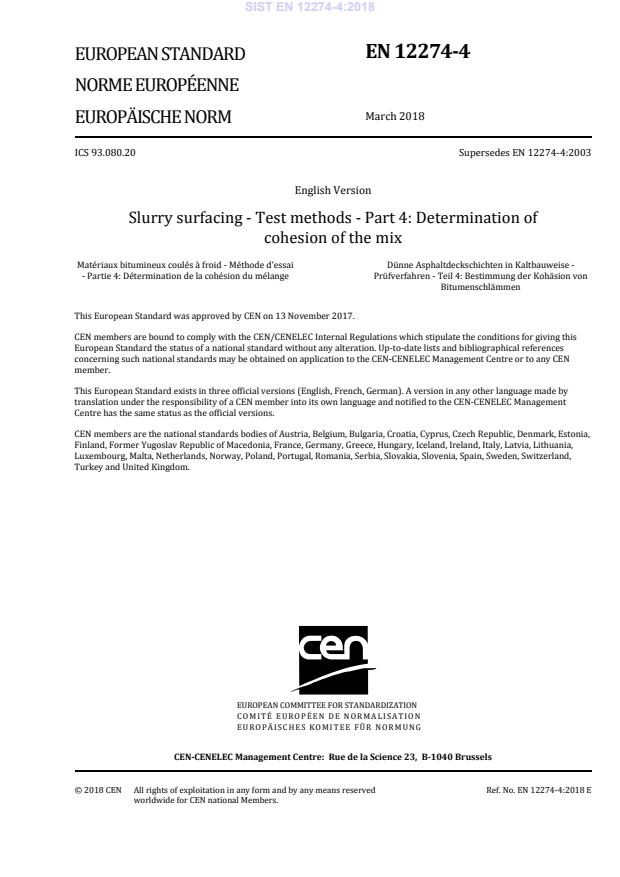
EUROPEAN STANDARD NORME EUROPÉENNE EUROPÄISCHE NORM
EN 12274-4
March
t r s z ICS
{ uä r z rä t r Supersedes EN
s t t y væ vã t r r uEnglish Version
Slurry surfacing æ Test methods æ Part
vã Determination of cohesion of the mix Matériaux bitumineux coulés à froid æ Méthode d 5essai æ Partie
vã Détermination de la cohésion du mélange
Dünne Asphaltdeckschichten in Kaltbauweise æ Prüfverfahren æ Teil
vã Bestimmung der Kohäsion von Bitumenschlämmen This European Standard was approved by CEN on
s u November
t r s yä
egulations which stipulate the conditions for giving this European Standard the status of a national standard without any alterationä Upætoædate lists and bibliographical references concerning such national standards may be obtained on application to the CENæCENELEC Management Centre or to any CEN memberä
translation under the responsibility of a CEN member into its own language and notified to the CENæCENELEC Management Centre has the same status as the official versionsä
CEN members are the national standards bodies of Austriaá Belgiumá Bulgariaá Croatiaá Cyprusá Czech Republicá Denmarká Estoniaá Finlandá Former Yugoslav Republic of Macedoniaá Franceá Germanyá Greeceá Hungaryá Icelandá Irelandá Italyá Latviaá Lithuaniaá Luxembourgá Maltaá Netherlandsá Norwayá Polandá Portugalá Romaniaá Serbiaá Slovakiaá Sloveniaá Spainá Swedená Switzerlandá Turkey and United Kingdomä
EUROPEAN COMMITTEE FOR STANDARDIZATION COMITÉ EUROPÉEN DE NORMALISATION EUROPÄISCHES KOMITEE FÜR NORMUNG
CEN-CENELEC Management Centre:
Rue de la Science 23,
B-1040 Brussels
t r s z CEN All rights of exploitation in any form and by any means reserved worldwide for CEN national Membersä Refä Noä EN
s t t y væ vã t r s z ESIST EN 12274-4:2018
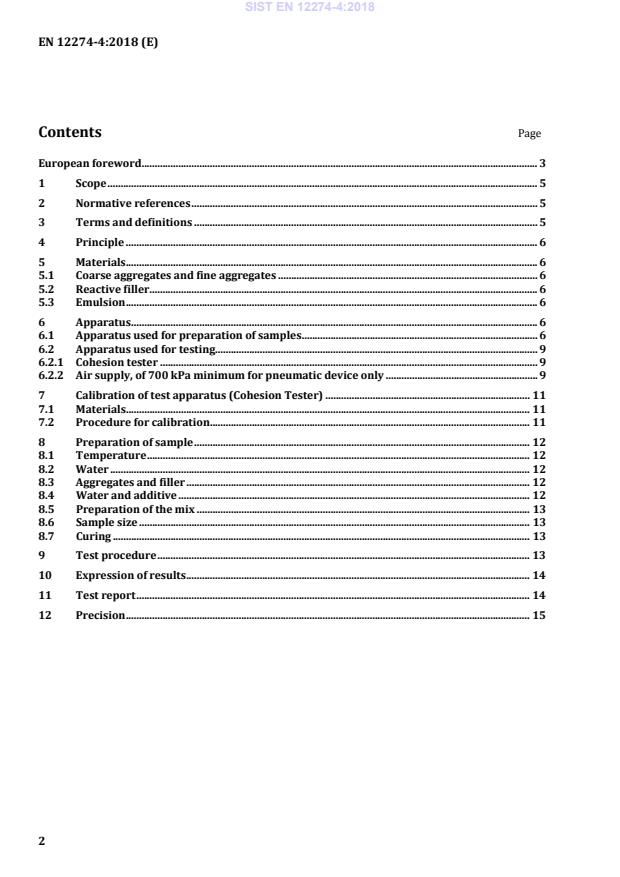
Page European foreword . 3 1 Scope . 5 2 Normative references . 5 3 Terms and definitions . 5 4 Principle . 6 5 Materials . 6 5.1 Coarse aggregates and fine aggregates . 6 5.2 Reactive filler . 6 5.3 Emulsion . 6 6 Apparatus . 6 6.1 Apparatus used for preparation of samples . 6 6.2 Apparatus used for testing. 9 6.2.1 Cohesion tester . 9 6.2.2 Air supply, of 700 kPa minimum for pneumatic device only . 9 7 Calibration of test apparatus (Cohesion Tester) . 11 7.1 Materials . 11 7.2 Procedure for calibration . 11 8 Preparation of sample . 12 8.1 Temperature . 12 8.2 Water . 12 8.3 Aggregates and filler . 12 8.4 Water and additive . 12 8.5 Preparation of the mix . 13 8.6 Sample size . 13 8.7 Curing . 13 9 Test procedure . 13 10 Expression of results . 14 11 Test report . 14 12 Precision . 15
...