

EN ISO 10555-1:2023
(Main)Intravascular catheters - Sterile and single-use catheters - Part 1: General requirements (ISO 10555-1:2023)
- Abstract
This document specifies general requirements for intravascular catheters, supplied sterile and intended for single use, for any application.
This document does not apply to intravascular catheter accessories, e.g. those covered by ISO 11070.
- Status
- Published
- Publication Date
- 28-Nov-2023
- Technical Committee
- CEN/TC 205 - Non-active medical devices
- Drafting Committee
- CEN/TC 205 - Non-active medical devices
- Current Stage
- 6060 - Definitive text made available (DAV) - Publishing
- Start Date
- 29-Nov-2023
- Completion Date
- 29-Nov-2023


Overview
EN ISO 10555-1:2023 - published by CEN and identical to ISO 10555-1:2023 - defines the general requirements for sterile, single‑use intravascular catheters. This third edition supersedes the 2013 version and applies to intravascular catheters supplied sterile and intended for single use for any application. It does not cover catheter accessories (for example, those under ISO 11070).
Key topics and technical requirements
The standard sets out high‑level design, safety and testing expectations for intravascular catheters, including:
- Risk approach and usability engineering - requirements to identify hazards and address user‑interface risks during design.
- Sterilization and shelf life - requirements for devices supplied sterile and information on stability over time.
- Biocompatibility and surface integrity - expectations for materials in contact with blood/tissue and coatings.
- Mechanical performance - tests and requirements for peak tensile force, kink/torque resistance, hubs, and distal tip stiffness (notably for neurovascular applications).
- Leakage and pressure performance - procedures for leakage during pressurization and aspiration, burst pressure, and power injection burst pressure where applicable.
- Fluid performance - determination of catheter flowrate and power injection flow/pressure testing.
- Corrosion resistance and particulate/coating integrity - test methods and considerations for device longevity and safety.
- Packaging and labelling - requirements for sterile packaging systems, device marking, instructions for use, and information to be supplied with the catheter.
- Test methods - several normative annexes provide test procedures (e.g., tensile, leakage, burst pressure, flowrate, power injection and corrosion tests) and informative annexes supply rationale and guidance.
Applications and who uses this standard
EN ISO 10555-1:2023 is intended for professionals involved in the lifecycle of intravascular catheters:
- Medical device manufacturers - to design, test and document compliance for sterile single‑use catheters.
- Quality and regulatory teams - for conformity assessment, technical files and CE/national approvals.
- Testing laboratories and notified bodies - to perform standardized mechanical, leakage and biocompatibility tests.
- Procurement and clinical engineering - to specify performance, packaging and labelling requirements.
- Clinicians and hospital safety officers - to understand device labelling, intended use and compatibility with clinical procedures (e.g., power injection cases).
Related standards
- ISO 10555 series (other parts covering specific catheter types and requirements)
- ISO 11070 (covers some catheter accessories)
- Relevant sterilization, biocompatibility and risk management standards referenced within the document
EN ISO 10555-1:2023 is a foundational standard for ensuring safety, performance and regulatory readiness of sterile single‑use intravascular catheters.
Relations
- Effective Date
- 18-Jan-2023
- Effective Date
- 18-Jan-2023
- Effective Date
- 08-Jul-2026
- Refers
ISO 7886-1:2017 - Sterile hypodermic syringes for single use — Part 1: Syringes for manual use - Effective Date
- 08-Jul-2026
- Effective Date
- 08-Jul-2026
- Effective Date
- 08-Jul-2026
- Refers
IEC 62366-1:2015 - Medical devices - Part 1: Application of usability engineering to medical devices - Effective Date
- 08-Jul-2026
- Effective Date
- 09-Feb-2026
- Effective Date
- 09-Feb-2026
- Refers
CEN/CLC Guide 10:2024 - Policy on the distribution, sale and copyright of CEN and CENELEC Content - Effective Date
- 28-Jan-2026
- Effective Date
- 28-Jan-2026
- Effective Date
- 28-Jan-2026
- Effective Date
- 28-Jan-2026
- Consolidated By
ISO 10555-1:2023 - Intravascular catheters — Sterile and single-use catheters — Part 1: General requirements - Effective Date
- 12-Feb-2026
Get Certified
Connect with accredited certification bodies for this standard

BSI Group
BSI (British Standards Institution) is the business standards company that helps organizations make excellence a habit.

TÜV Rheinland
TÜV Rheinland is a leading international provider of technical services.

TÜV SÜD
TÜV SÜD is a trusted partner of choice for safety, security and sustainability solutions.
Sponsored listings
Frequently Asked Questions
EN ISO 10555-1:2023 is a standard published by the European Committee for Standardization (CEN). Its full title is "Intravascular catheters - Sterile and single-use catheters - Part 1: General requirements (ISO 10555-1:2023)". This standard covers: This document specifies general requirements for intravascular catheters, supplied sterile and intended for single use, for any application. This document does not apply to intravascular catheter accessories, e.g. those covered by ISO 11070.
This document specifies general requirements for intravascular catheters, supplied sterile and intended for single use, for any application. This document does not apply to intravascular catheter accessories, e.g. those covered by ISO 11070.
EN ISO 10555-1:2023 is classified under the following ICS (International Classification for Standards) categories: 11.040.25 - Syringes, needles an catheters. The ICS classification helps identify the subject area and facilitates finding related standards.
EN ISO 10555-1:2023 has the following relationships with other standards: It is inter standard links to EN ISO 10555-1:2013, EN ISO 10555-1:2013/A1:2017, ISO 10993-1:2018, ISO 7886-1:2017, ISO 80369-7:2021, ISO 14971:2019, IEC 62366-1:2015, ISO 11607-1:2019, ISO 15223-1:2021, CEN/CLC Guide 10:2024, EN 13121-3:2026, EN ISO 23411:2021, EN ISP 10613-5:1996, ISO 10555-1:2023. Understanding these relationships helps ensure you are using the most current and applicable version of the standard.
EN ISO 10555-1:2023 is available in PDF format for immediate download after purchase. The document can be added to your cart and obtained through the secure checkout process. Digital delivery ensures instant access to the complete standard document.
Standards Content (Sample)
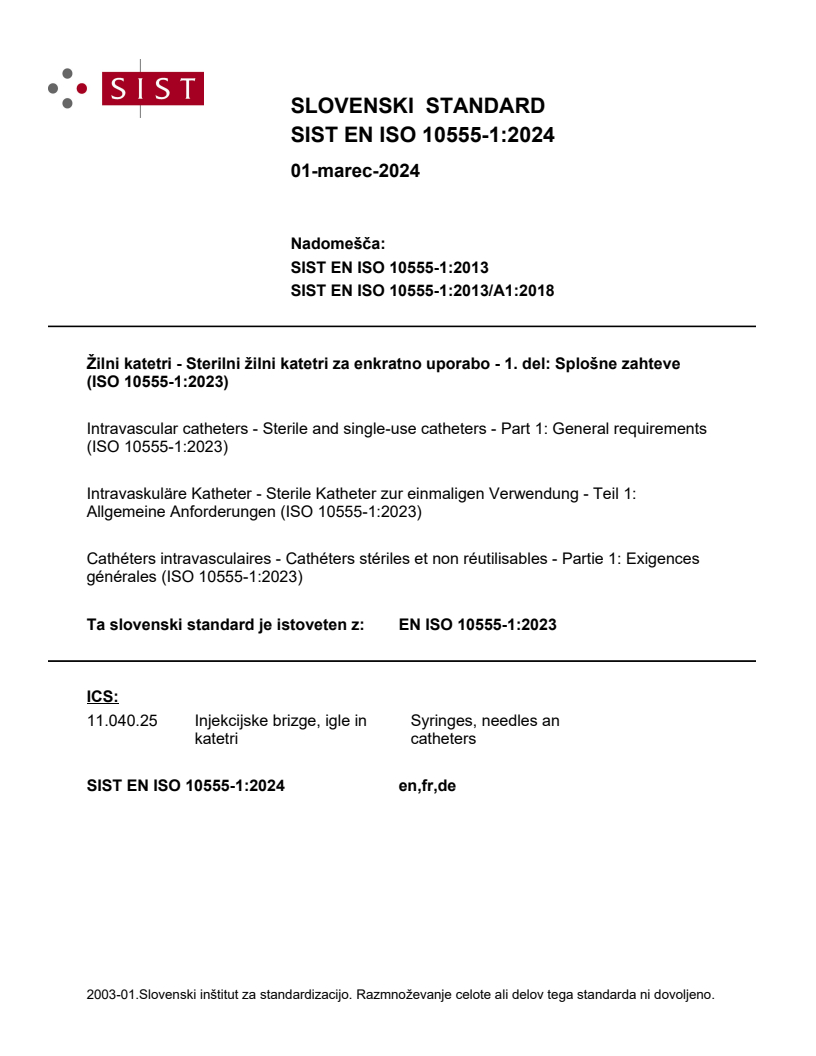
SLOVENSKI STANDARD
01-marec-2024
Nadomešča:
SIST EN ISO 10555-1:2013
SIST EN ISO 10555-1:2013/A1:2018
Žilni katetri - Sterilni žilni katetri za enkratno uporabo - 1. del: Splošne zahteve
(ISO 10555-1:2023)
Intravascular catheters - Sterile and single-use catheters - Part 1: General requirements
(ISO 10555-1:2023)
Intravaskuläre Katheter - Sterile Katheter zur einmaligen Verwendung - Teil 1:
Allgemeine Anforderungen (ISO 10555-1:2023)
Cathéters intravasculaires - Cathéters stériles et non réutilisables - Partie 1: Exigences
générales (ISO 10555-1:2023)
Ta slovenski standard je istoveten z: EN ISO 10555-1:2023
ICS:
11.040.25 Injekcijske brizge, igle in Syringes, needles an
katetri catheters
2003-01.Slovenski inštitut za standardizacijo. Razmnoževanje celote ali delov tega standarda ni dovoljeno.
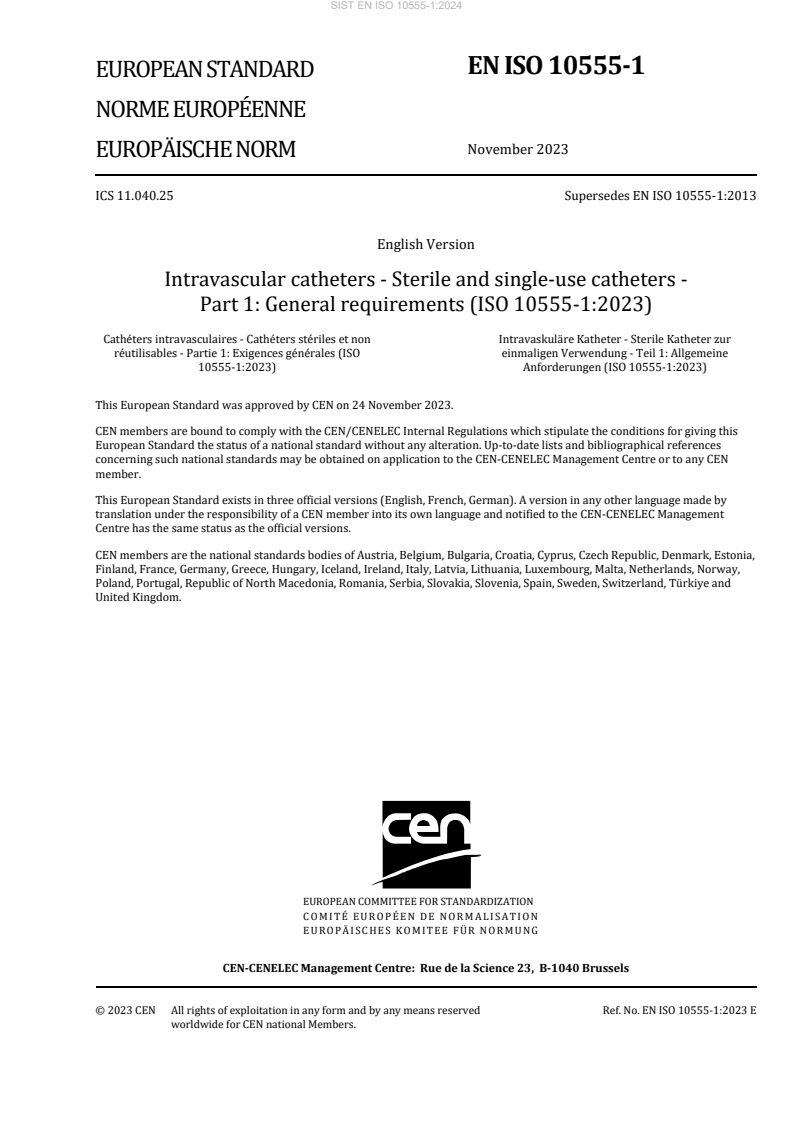
EN ISO 10555-1
EUROPEAN STANDARD
NORME EUROPÉENNE
November 2023
EUROPÄISCHE NORM
ICS 11.040.25 Supersedes EN ISO 10555-1:2013
English Version
Intravascular catheters - Sterile and single-use catheters -
Part 1: General requirements (ISO 10555-1:2023)
Cathéters intravasculaires - Cathéters stériles et non Intravaskuläre Katheter - Sterile Katheter zur
réutilisables - Partie 1: Exigences générales (ISO einmaligen Verwendung - Teil 1: Allgemeine
10555-1:2023) Anforderungen (ISO 10555-1:2023)
This European Standard was approved by CEN on 24 November 2023.
CEN members are bound to comply with the CEN/CENELEC Internal Regulations which stipulate the conditions for giving this
European Standard the status of a national standard without any alteration. Up-to-date lists and bibliographical references
concerning such national standards may be obtained on application to the CEN-CENELEC Management Centre or to any CEN
member.
This European Standard exists in three official versions (English, French, German). A version in any other language made by
translation under the responsibility of a CEN member into its own language and notified to the CEN-CENELEC Management
Centre has the same status as the official versions.
CEN members are the national standards bodies of Austria, Belgium, Bulgaria, Croatia, Cyprus, Czech Republic, Denmark, Estonia,
Finland, France, Germany, Greece, Hungary, Iceland, Ireland, Italy, Latvia, Lithuania, Luxembourg, Malta, Netherlands, Norway,
Poland, Portugal, Republic of North Macedonia, Romania, Serbia, Slovakia, Slovenia, Spain, Sweden, Switzerland, Türkiye and
United Kingdom.
EUROPEAN COMMITTEE FOR STANDARDIZATION
COMITÉ EUROPÉEN DE NORMALISATION
EUROPÄISCHES KOMITEE FÜR NORMUNG
CEN-CENELEC Management Centre: Rue de la Science 23, B-1040 Brussels
© 2023 CEN All rights of exploitation in any form and by any means reserved Ref. No. EN ISO 10555-1:2023 E
worldwide for CEN national Members.
Contents Page
European foreword . 3
European foreword
This document (EN ISO 10555-1:2023) has been prepared by Technical Committee ISO/TC 84 "Devices
for administration of medicinal products and catheters" in collaboration with Technical Committee
CEN/TC 205 “Non-active medical devices” the secretariat of which is held by DIN.
This European Standard shall be given the status of a national standard, either by publication of an
identical text or by endorsement, at the latest by May 2024, and conflicting national standards shall be
withdrawn at the latest by May 2024.
Attention is drawn to the possibility that some of the elements of this document may be the subject of
patent rights. CEN shall not be held responsible for identifying any or all such patent rights.
This document supersedes EN ISO 10555-1:2013.
Any feedback and questions on this document should be directed to the users’ national standards
body/national committee. A complete listing of these bodies can be found on the CEN website.
According to the CEN-CENELEC Internal Regulations, the national standards organizations of the
following countries are bound to implement this European Standard: Austria, Belgium, Bulgaria,
Croatia, Cyprus, Czech Republic, Denmark, Estonia, Finland, France, Germany, Greece, Hungary, Iceland,
Ireland, Italy, Latvia, Lithuania, Luxembourg, Malta, Netherlands, Norway, Poland, Portugal, Republic of
North Macedonia, Romania, Serbia, Slovakia, Slovenia, Spain, Sweden, Switzerland, Türkiye and the
United Kingdom.
Endorsement notice
The text of ISO 10555-1:2023 has been approved by CEN as EN ISO 10555-1:2023 without any
modification.
INTERNATIONAL ISO
STANDARD 10555-1
Third edition
2023-11
Intravascular catheters — Sterile and
single-use catheters —
Part 1:
General requirements
Cathéters intravasculaires — Cathéters stériles et non réutilisables —
Partie 1: Exigences générales
Reference number
ISO 10555-1:2023(E)
ISO 10555-1:2023(E)
© ISO 2023
All rights reserved. Unless otherwise specified, or required in the context of its implementation, no part of this publication may
be reproduced or utilized otherwise in any form or by any means, electronic or mechanical, including photocopying, or posting on
the internet or an intranet, without prior written permission. Permission can be requested from either ISO at the address below
or ISO’s member body in the country of the requester.
ISO copyright office
CP 401 • Ch. de Blandonnet 8
CH-1214 Vernier, Geneva
Phone: +41 22 749 01 11
Email: copyright@iso.org
Website: www.iso.org
Published in Switzerland
ii
ISO 10555-1:2023(E)
Contents Page
Foreword .v
1 Scope . 1
2 Normative references . 1
3 Terms and definitions . 1
4 Requirements . 5
4.1 Risk approach . 5
4.2 Usability engineering . . 5
4.3 Sterilization . 5
4.4 Shelf life. 5
4.5 Detectability . 5
4.6 Biocompatibility . 5
4.7 Surface . 5
4.8 Corrosion resistance . 6
4.9 Peak tensile force . 6
4.10 Freedom from leakage during pressurization . 7
4.11 Freedom from leakage during aspiration . 7
4.12 Hubs . . 7
4.13 Flowrate . 8
4.14 Power injection burst pressure . 8
4.15 Packaging system . . 8
4.16 Simulated use, kink and/or torque testing to consider depending on device design,
intended use, and risk analysis . 8
4.17 Coating integrity and/or particulate testing to consider depending on device
design, intended use, and risk analysis . 9
4.18 Distal tip stiffness testing to consider for neurovascular applications . 9
5 Designation of nominal size . 9
5.1 Nominal outside diameter . 9
5.2 Nominal inside diameter . 9
5.3 Nominal effective length . 9
6 Information to be supplied with the catheter .10
6.1 General . 10
6.2 Marking on the device and/or primary packaging . 10
6.3 Instructions for use . 11
6.4 Marking on the secondary packaging . 11
Annex A (normative) Test method for corrosion resistance .12
Annex B (normative) Method for determining peak tensile force .13
Annex C (normative) Test method for liquid leakage under pressure.16
Annex D (normative) Test method for air leakage into hub assembly during aspiration .18
Annex E (normative) Determination of flowrate through catheter .20
Annex F (normative) Test for burst pressure under static conditions .22
Annex G (normative) Power injection tests for flowrate and device pressure (only for
products indicated for power injection) .25
Annex H (informative) Units of measurement systems other than those specified in
this document .30
Annex I (normative) Test method for air leakage under water .32
Annex J (informative) Rationale and guidance .34
Annex K (informative) Test methods for distal tip stiffness for neurovascular applications .41
iii
ISO 10555-1:2023(E)
Bibliography .43
iv
ISO 10555-1:2023(E)
Foreword
ISO (the International Organization for Standardization) is a worldwide federation of national standards
bodies (ISO member bodies). The work of preparing International Standards is normally carried out
through ISO technical committees. Each member body interested in a subject for which a technical
committee has been established has the right to be represented on that committee. International
organizations, governmental and non-governmental, in liaison with ISO, also take part in the work.
ISO collaborates closely with the International Electrotechnical Commission (IEC) on all matters of
electrotechnical standardization.
The procedures used to develop this document and those intended for its further maintenance are
described in the ISO/IEC Directives, Part 1. In particular, the different approval criteria needed for the
different types of ISO document should be noted. This document was drafted in accordance with the
editorial rules of the ISO/IEC Directives, Part 2 (see www.iso.org/directives).
ISO draws attention to the possibility that the implementation of this document may involve the use
of (a) patent(s). ISO takes no position concerning the evidence, validity or applicability of any claimed
patent rights in respect thereof. As of the date of publication of this document, ISO had not received
notice of (a) patent(s) which may be required to implement this document. However, implementers are
cautioned that this may not represent the latest information, which may be obtained from the patent
database available at www.iso.org/patents. ISO shall not be held responsible for identifying any or all
such patent rights.
Any trade name used in this document is information given for the convenience of users and does not
constitute an endorsement.
For an explanation of the voluntary nature of standards, the meaning of ISO specific terms and
expressions related to conformity assessment, as well as information about ISO's adherence to
the World Trade Organization (WTO) principles in the Technical Barriers to Trade (TBT), see
www.iso.org/iso/foreword.html.
This document was prepared by Technical Committee ISO/TC 84, Devices for administration of medicinal
products and catheters, in collaboration with the European Committee for Standardization (CEN)
Technical Committee CEN/TC 205, Non-active medical devices, in accordance with the Agreement on
technical cooperation between ISO and CEN (Vienna Agreement).
This third edition cancels and replaces the second edition (ISO 10555-1:2013), which has been
technically revised. It also incorporates the amendment ISO 10555-1:2013/Amd 1:2017.
The main changes are as follows:
— added definitions for “inside diameter”, “gauge length”, and “coating” in Clause 3;
— added clarification on requirements (Clause 4) related to:
— peak tensile force (revised the NOTE in Table 1);
— leakage during pressurization: option for air pressure test (Annex I);
— power injection burst pressure.
— added new requirements (Clause 4) related to:
— risk approach;
— usability engineering;
— shelf life;
— packaging system;
— simulated use, kink and torque;
v
ISO 10555-1:2023(E)
— coating integrity, particulate;
— distal tip stiffness.
— removed the requirements on side holes and distal tip;
— added text on “Nominal inside diameter for some applications” (Clause 5);
— added test details in the instructions for use for power injection (Clause 6);
— added reporting of maximum, minimum, standard deviation for variable data analysis in test
reports;
— clarified “conditioning time” and “gauge length” (Annex B);
— clarified “minimum outside pressure requirement” (Annex D);
— introduced alternative test method using constant flowrate source (Annex G);
— replaced Figure H.1 in previous version with the new Table H.1;
— added new Annex I for alternative leakage under pressurization using air pressure;
— added new Annex J for rationale.
A list of all parts in the ISO 10555 series can be found on the ISO website.
Any feedback or questions on this document should be directed to the user’s national standards body. A
complete listing of these bodies can be found at www.iso.org/members.html.
vi
INTERNATIONAL STANDARD ISO 10555-1:2023(E)
Intravascular catheters — Sterile and single-use
catheters —
Part 1:
General requirements
1 Scope
This document specifies general requirements for intravascular catheters, supplied sterile and intended
for single use, for any application.
This document does not apply to intravascular catheter accessories, e.g. those covered by ISO 11070.
2 Normative references
The following documents are referred to in the text in such a way that some or all of their content
constitutes requirements of this document. For dated references, only the edition cited applies. For
undated references, the latest edition of the referenced document (including any amendments) applies.
ISO 7886-1, Sterile hypodermic syringes for single use — Part 1: Syringes for manual use
ISO 10993-1, Biological evaluation of medical devices — Part 1: Evaluation and testing within a risk
management process
ISO 11607-1, Packaging for terminally sterilized medical devices — Part 1: Requirements for materials,
sterile barrier systems and packaging systems
ISO 14971, Medical devices — Application of risk management to medical devices
ISO 15223-1, Medical devices — Symbols to be used with information to be supplied by the manufacturer
— Part 1: General requirements
ISO 80369-7, Small-bore connectors for liquids and gases in healthcare applications — Part 7: Connectors
for intravascular or hypodermic applications
IEC 62366-1, Medical devices — Part 1: Application of usability engineering to medical devices
3 Terms and definitions
For the purposes of this document, the following terms and definitions apply.
ISO and IEC maintain terminology databases for use in standardization at the following addresses:
— ISO Online browsing platform: available at https:// www .iso .org/ obp
— IEC Electropedia: available at https:// www .electropedia .org/
3.1
intravascular catheter
tubular device, single or multilumen, designed to be partially or totally inserted or implanted into the
vascular system for diagnostic and/or therapeutic purposes
ISO 10555-1:2023(E)
3.2
distal end
end of the catheter inserted furthest into the patient
3.3
distal end configuration
shape of the catheter which is designed to facilitate its manual manipulation through the vascular
system and the placement and anchoring of the distal tip in the chosen location
3.4
proximal end
access end
end of the catheter to which connection to another device can be made
3.5
hub
connector(s) at the proximal end (3.4) of the catheter which can either be integral with the catheter or
be capable of being securely fitted to the proximal end (3.4) of the catheter
3.6
effective length
working length
usable length
length of the catheter, or pre- and post-hydration (3.11) lengths of hydratable catheters, that can be
inserted into the body
Note 1 to entry: See Figure 1 where "l" is denoted as effective length.
ISO 10555-1:2023(E)
Key
l effective length
1 catheter hub
2 catheter strain reinforcement
3 length mark
4 junction
5 pre-connected port
6 sidearm
Figure 1 — Examples of effective length of catheters
3.7
outside diameter
largest diameter of the catheter or pre- and post-hydration (3.11) largest diameters of hydratable
catheters over the effective length (3.6)
ISO 10555-1:2023(E)
3.8
inside diameter
largest diameter that can pass through a catheter lumen intended to deliver other devices
Note 1 to entry: See Annex J for additional information.
3.9
junction
joint
fixed connection
joining of one tube or more tubes with another tube or component where the assembly provides
mechanical support in tension/compression during clinical use
3.10
hydratable intravascular catheter
intravascular catheter consisting of a material which, when subjected to an aqueous medium, results in
an increase of more than 1 % of the effective length or 10 % or more of the outside diameter (3.7) of the
effective length in post-hydration (3.11) state compared to pre-hydration
3.11
post-hydration
state of a hydratable intravascular catheter (3.10) after immersion in aqueous medium at (37 ± 2) °C for
a minimum of 2 h or a shorter time upon appropriate clinical justification
3.12
power injection
injection of an imaging contrast agent with a constant-pressure source or constant-flowrate source
capable of generating pressures greater than or equal to 689 kPa
3.13
primary packaging
packaging, which has direct contact with the device and/or maintains sterility
3.14
secondary packaging
packaging designed to contain one or more primary packages (3.13) and/or accessories
3.15
gauge length
length of the test piece between the grips of the tensile testing apparatus that elongates significantly
during testing
Note 1 to entry: See Figure B.1.
Note 2 to entry: See Annex J for additional information.
3.16
coating
substance or material with any different property (e.g. antimicrobial, lubricity, antithrombogenicity)
than the natural surface of the substrate that is intentionally added to cover the substrate
Note 1 to entry: The coating can partially or fully cover the substrate surface. Liquid lubricant is not considered
as coating.
ISO 10555-1:2023(E)
4 Requirements
4.1 Risk approach
Risk analysis, risk evaluation, risk control, evaluation of residual risk acceptability shall be performed
in accordance with ISO 14971.
NOTE See Annex J for additional information.
4.2 Usability engineering
A usability engineering program shall be developed and implemented in accordance with IEC 62366-1,
which shall include addressing use risks and tests and/or assessments as part of the design verification
and validation.
NOTE See Annex J for additional information.
4.3 Sterilization
The devices shall be sterilized by a validated method.
The devices shall fulfil the requirements specified in 4.4 to 4.18 after being sterilized by a sterilization
cycle representative of the final manufacturing process.
NOTE See applicable clause(s) of the ISO 17665 series, ISO 11135 and the ISO 11137 series for appropriate
methods of sterilization.
4.4 Shelf life
The impact of aging on product performance shall be considered based on risk assessment in order to
support the shelf life.
4.5 Detectability
Parts of the catheter shall be detectable by X-ray or by other means (e.g. ultra-sound, MRI, etc.) if
required as determined by the risk assessment.
Detectability shall be demonstrated by an appropriate test method (see, e.g. ASTM F640-20 or
DIN 13273-7).
4.6 Biocompatibility
The catheter shall be free from biological hazard in accordance with the appropriate testing in
ISO 10993-1.
4.7 Surface
When examined by normal or corrected to normal vision and with a minimum x2,5 magnification the
external surface of the catheter shall appear free from foreign matter.
The external surface of the effective length of the catheter, including the distal end, shall be free from
surface defects which could cause embolic risks or trauma to vessels.
If the catheter is lubricated, the lubricant shall not be visible as drops of fluid on the external surface
when the catheter is examined under normal or corrected to normal vision.
ISO 10555-1:2023(E)
4.8 Corrosion resistance
Metallic components of the catheter intended for fluid path contact shall show no signs of corrosion
when tested in accordance with the method given in Annex A.
4.9 Peak tensile force
Every section of the catheter shall be tested for peak tensile force in accordance with Annex B.
Table 1 specifies the minimum peak tensile force for different sized tubular test pieces. Testing can
be done on the complete device or different sections; however, minimum peak tensile force shall
meet the requirements as specified in Table 1. See Figure 2 for examples of catheter sections and
determination of effective outside diameter.
This document does not specify requirements for peak tensile force for tubing of less than 0,55 mm
outside diameter (prehydration outside diameter for hydratable intravascular catheters). For those
cases, the tensile test should be performed in accordance with Annex B and the peak tensile force shall
be determined by the manufacturer based on risk assessment.
For a distal tip with a junction to the shaft tube, the peak tensile force shall be determined by the
manufacturer based on risk assessment. For a distal tip of less than 3 mm with a junction for which a
tensile test is not practical, the test method and requirements shall be determined by the manufacturer
based on risk assessment.
For a distal tip of length less than 3 mm without a junction to the shaft tube, the tensile test is not
required.
For a distal tip of length equal to or more than 3 mm without a junction to the shaft tube, the peak
tensile force shall be determined by the manufacturer based on risk assessment.
The forces experienced during clinical use may be greater than the values listed in Table 1, e.g. the
expected forces applied to a delivery system during clinical use to access the intended location, to deploy
the device, or to withdraw the system. If the forces experienced during clinical use are determined by
the manufacturer to be greater than the values listed in Table 1, the acceptance criteria for the peak
tensile force of each test piece shall be as determined by the manufacturer based on risk assessment.
NOTE See Annex J for additional information.
Table 1 — Peak tensile force of catheter test pieces
Effective outside diameter range Minimum peak tensile force
of tubular portion of test piece
mm N
≥ 0,55 < 0,75 3
≥ 0,75 < 1,15 5
≥ 1,15 < 1,85 10
≥ 1,85 15
NOTE 1 Values listed in Table 1 are not based on clinical data or forces that have been determined to be clinically-
relevant. However, these values have been historically used to support functional performance and can be acceptable with
appropriate rationale.
NOTE 2 See Annex J for additional information.
ISO 10555-1:2023(E)
a) Straight tubing sec- b) Junction between c) Tapered tubing sec- d) Multiple junctions
tion two sections of tubing tion tested simultaneously
Key
d effective outside diameter
e
1 tubing
2 grip
3 hub
Figure 2 — Illustration of effective outside diameter
NOTE See Annex J for additional information.
4.10 Freedom from leakage during pressurization
If subjected to liquid pressure during intended use, the hub or connection fitting assembly or any other
part of the catheter shall not leak when tested using either liquid pressure as set out in Annex C or air
pressure in accordance with Annex I. If a sample fails the air leakage under water test (see Annex I), it is
acceptable to retest the sample using the method in Annex C.
For hydratable intravascular catheters, this requirement shall be met in both the pre- and post-
hydration states.
NOTE See Annex J for additional information.
4.11 Freedom from leakage during aspiration
If subjected to aspiration during intended use, air shall not leak into the hub assembly during aspiration
when tested in accordance with the method given in Annex D.
For hydratable intravascular catheters, this requirement shall be met in both the pre- and post-
hydration states.
4.12 Hubs
If the catheter is supplied with either an integral or a separate hub, it shall be a female hub in accordance
with ISO 80369-7.
ISO 10555-1:2023(E)
4.13 Flowrate
For devices for which flow rate is specified, when tested in accordance with Annex E for all catheter
lumen indicated for gravity delivery of fluid, the flow rate for each lumen shall be a minimum of 80 % of
that stated in the information supplied by the manufacturer for catheters of nominal outside diameter
less than 1,0 mm or a minimum of 90 % of that stated in the information supplied by the manufacturer
for catheters of nominal outside diameter equal to or greater than 1,0 mm.
If the flowrate through hydratable catheters is determined, it shall be determined in post-hydration
states.
4.14 Power injection burst pressure
If a catheter lumen is indicated for power injection, it shall be tested in accordance with Annexes F and
G. In Annex G, either test A or B may be used. The lumen burst pressure (in accordance with Annex F)
shall exceed the peak pressure present in that lumen (in accordance with Annex G) when flowing at the
maximum flowrate stated in the information supplied by the manufacturer.
If desired, each fluid path may be divided into zones along its length and different pressure specifications
can be assigned for each zone. A rationale shall be provided supporting why the pressure specification
for each zone is sufficient. For example, analysis and/or empirical testing can be an appropriate
justification for lower pressures (than that used in accordance with Annex G) in distal zones.
NOTE See Annex J for additional information.
4.15 Packaging system
Design of sterile barrier systems and packaging systems for the catheter shall be in accordance with
the requirements of ISO 11607-1.
NOTE ISO 11607-2 describes the process development and validation requirements for forming, sealing and
assembly processes and addresses controls during normal operations.
4.16 Simulated use, kink and/or torque testing to consider depending on device design,
intended use, and risk analysis
Simulated use testing, kink testing, and torque strength testing shall be considered (if applicable)
for devices that are intended to traverse anatomy that might expose it to multiple modes of
mechanical loading in sufficiently challenging clinical setting (e.g. guide catheters intended to reach
neurovasculature, PTA balloons intended to be used in a contralateral antegrade approach) based on
risk assessment.
— For simulated use testing, the device shall perform as intended in a sufficiently challenging simulated
clinical setting without damage that could affect functionality or safety of the device.
— For kink testing, the device shall resist kinking when used in a sufficiently challenging radius of
curvature.
— For torque testing, the device shall resist damage that can affect functionality or safety of the device
when subjected to sufficiently challenging torque.
Clinical use conditions or scientific justification shall be used to establish methods and criteria
depending on device design, intended use, and risk analysis.
ISO 10555-1:2023(E)
4.17 Coating integrity and/or particulate testing to consider depending on device
design, intended use, and risk analysis
Coating integrity and/or particulate testing shall be considered, if applicable, for devices that include a
coating which might pose a safety risk if inadvertently removed from the device.
— For coating integrity testing, representative sections of the coated device surface shall be
examined under magnification (e.g. light microscopy, scanning electron microscopy) before and
after simulated use to evaluate the amount of material that is removed during simulated use. Non-
disruptive visualization enhancements (e.g. liquid dyes) may be used where appropriate.
— For particulate testing, particulate generated after simulated use shall be quantitatively characterized
using appropriate means (e.g. light obscuration counting, scanning electron microscopy), across a
range of equivalent spherical diameters determined by the manufacturer based on intended use
and risk assessment.
Clinical use conditions or scientific justification shall be used to establish methods and criteria
depending on device design, intended use, and risk analysis. Either test may be sufficient for lower risk
application, while both tests may be applicable for high-risk applications.
NOTE AAMI TIR42 lists several examples of acceptable particulate generation measurement methods.
4.18 Distal tip stiffness testing to consider for neurovascular applications
Distal tip stiffness testing shall be considered for devices that are intended to be used in the
neurovasculature, based on risk assessment.
Clinical use conditions or scientific justification shall be used to establish methods and criteria
depending on device design, intended use, and risk analysis.
NOTE See Annex K for additional information.
5 Designation of nominal size
5.1 Nominal outside diameter
Unless otherwise specified in this document for a particular type of catheter, the outside diameter of
the effective length shall be expressed as the nominal dimension in millimetres, rounded upwards to
the nearest 0,01 mm or 0,1 mm.
For devices which are not round by design, the size shall be designated by the dimension of the largest
axis. Where relevant, manufacturers may choose to report additional information regarding the device
profile, such as the dimension of the second axis for an oval shape.
5.2 Nominal inside diameter
For a neurovascular or coronary device intended to deliver other devices (not included with it), the
inside diameter shall be expressed as the nominal dimension in mm, rounded downwards to the nearest
0,01 mm or 0,1 mm.
NOTE See Annex J for additional information.
5.3 Nominal effective length
The nominal effective length shall be expressed in millimetres for effective lengths of less than 100 mm.
The nominal effective length shall be expressed in millimetres or centimetres for effective lengths of
100 mm or more.
ISO 10555-1:2023(E)
The tolerances to the effective length shall be determined by the manufacturer based on the intended
use and risk assessment.
6 Information to be supplied with the catheter
6.1 General
The catheter shall be accompanied by information, including instruction for use, that is sufficient for its
safe use, considering the training and knowledge of intended users and the intended use environment.
All dimensions given shall be expressed in SI units of measurement. Units of measurement systems
other than those specified should additionally be given if clinically relevant. See Annex H.
For neurovascular devices, additional units of measurement should be given as specified:
— For outside diameter: inches, and French;
— For inside diameter: inches;
— For sheath inside diameter: inches, and French.
Any markings needed for the safe use of the catheter shall be visible and legible. If required, this shall
be assessed by the manufacturer based on the risk assessment.
Where appropriate, specific information to be supplied by the manufacturer should be selected from
ISO 20417, and symbols should be selected from ISO 15223-1.
NOTE Labelling requirements specific to any country or region in which the device is intended to be sold can
apply.
6.2 Marking on the device and/or primary packaging
The primary packaging is often transparent. Therefore, for the purposes of this subclause, the
combination of marking of the device which is visible through the package and the primary packaging
itself shall be considered.
The following information shall be specified on the first practical level in the following order: device,
primary packaging, instructions for use:
a) name or trade name and address of the manufacturer and/or his authorized representative;
b) details strictly necessary to identify the device, including the nominal size as designated in
Clause 5, and the contents of the packaging and, if applicable, the guidewire that is intended by the
manufacturer for use with the catheter;
c) the word “STERILE” or the appropriate symbol in ISO 15223-1;
d) method of sterilization;
e) batch code, preceded by the word 'LOT', or the serial number or the appropriate symbol in
ISO 15223-1;
f) an indication of the date by which the device should be used, in safety, expressed as, at a minimum,
the year and month (e.g. as YYYY-MM);
g) an indication that the device is for single use;
h) any specific storage and/or handling requirements;
i) if the intended purpose of the device is not obvious to the user, the manufacturer shall clearly state
it. Where a device is provided with separate instructions for use, this requirement may be omitted
from the primary packaging;
ISO 10555-1:2023(E)
j) where appropriate, an indication to consult the instructions for use;
k) for catheters without axial symmetry in their distal tips, or for catheters with atypical distal tip
shapes, a depiction or description of the distal end configuration, if not identifiable through the
package.
6.3 Instructions for use
When a separate instruction for use is provided, it shall at least contain information on the following:
a) the requirements in 6.2 with the exception of d), e), f), j) and k);
b) precautions to be taken and any warnings, e.g. to cleaning agents, if relevant;
c) if the device is intended to be connected to other devices or accessories in order to operate as
required for its intended purpose, sufficient details of its characteristics to identify the correct
devices in order to obtain a safe combination;
d) description of additives or coatings, as well as any specific preparation, handling and/or disposal
requirements due to the additives or coatings;
e) any unique requirements for disposal of device, taking into account item d) above;
f) if applicable, specific claims made because of the presence of an additive or coating, and as
applicable:
1) description of the additive or coating material,
2) duration of effectiveness in use,
3) any contra-indications, warnings and precautions based on the additive or coating material(s);
g) if applicable, known reactions between the catheter and magnetic resonance imaging (MRI);
h) date of issue or the latest revision of the instructions for use;
i) for devices indicated for power injection, the following information shall be included:
1) recommended power injector pressure limit setting(s) based upon risk assessment;
2) maximum recommended flow rates for clinically applicable viscosities and/or specific
injectates;
3) power injection flowrate test details including, at a minimum;
i) extension tube length and internal diameter, if used;
ii) any accessories that may limit flowrate;
iii) injectate dynamic viscosity (mPa s);
iv) injectate temperature expressed in °C.
6.4 Marking on the secondary packaging
Where devices are provided in secondary packaging, the marking on the secondary packaging shall be
in accordance with 6.2, if appropriate.
ISO 10555-1:2023(E)
Annex A
(normative)
Test method for corrosion resistance
A.1 Principles
The catheter is immersed in sodium chloride solution, then in boiling distilled water, and afterwards
examined visually for evidence of corrosion.
A.2 Reagents
A.2.1 Saline solution, comprising a solution of analytical reagent grade sodium chloride in freshly
prepared distilled water [c(NaCl) = 0,15 mol/l].
A.2.2 Distilled or deionized water.
A.3 Apparatus
Corrosion resistant and temperature insensitive containers, e.g. borosilicate glass beakers.
A.4 Procedure
Immerse the catheter in the saline solution (A.2.1) in a container (A.3) at room temperature for 5 h.
Remove the catheter and immerse it in boiling distilled water (A.2.2) for 30 min. Allow the water and
the catheter to cool to 37 °C and maintain them at this temperature for 48 h. Remove the catheter and
allow it to dry at room temperature. Disassemble catheters that have two or more components that are
intended to be separable in use. Do not strip away or cut open any coatings on metallic components.
Inspect the catheter visually for signs of corrosion.
A.5 Test report
The test report shall include at least the following information:
a) identity of the catheters;
b) a reference to this document (including its year of publication) and annex;
c) statement as to whether corrosion occurred during the test;
d) any deviations from the procedure;
e) the date of the test.
ISO 10555-1:2023(E)
Annex B
(normative)
Method for determining peak tensile force
B.1 Principle
Test pieces or the entire length of a catheter are chosen so that each tubular portion, each junction
between hub or co
...