

EN 15947-4:2022
(Main)Pyrotechnic articles - Fireworks, Categories F1, F2 and F3 - Part 4: Test methods
- Abstract
This document specifies test methods. It is applicable to fireworks of the categories F1, F2 and F3 as defined by Article 6 Paragraph (1) clause (a) subclause (i) to (iii) of Directive 2013/29/EU.
- Status
- Published
- Publication Date
- 04-Oct-2022
- Technical Committee
- CEN/TC 212 - Fireworks
- Drafting Committee
- CEN/TC 212/WG 1 - Classification and terminology
- Current Stage
- 6060 - Definitive text made available (DAV) - Publishing
- Start Date
- 05-Oct-2022
- Due Date
- 01-May-2020
- Completion Date
- 05-Oct-2022



Overview
EN 15947-4:2022 - published by CEN - is the European test-method standard for pyrotechnic articles (fireworks) in categories F1, F2 and F3 (as defined in Directive 2013/29/EU). It specifies laboratory and field test procedures used to verify construction, performance and safety characteristics of fireworks. This edition (approved August 2022) supersedes EN 15947-4:2015 and forms part of the EN 15947 series that supports EU essential safety requirements.
Key topics and technical requirements
The standard defines detailed, repeatable test methods and related apparatus for assessing fireworks, including (but not limited to):
- Test environment - indoor and outdoor conditions, monitoring height and setup considerations.
- Apparatus - standardized equipment required for many tests (e.g., dropping tube, mass cylinders, sound meters).
- Construction and stability tests - handle length, attachment of handles/bases, tube dimensions, fuse attachment and resistance to abrasive ignition.
- Design verification - conformity to drawings, part lists and determination of net explosive content.
- Combustion and debris tests - paper tests for burning/incandescent matter and horizontally/vertically projected debris.
- Performance tests - angle of ascent, height of explosion, time measurement and burning rate of composition.
- Acoustic measurement - measurement of sound pressure levels for outdoor items and specific indoor articles (party poppers, crackers).
- Durability and conditioning - mechanical and thermal conditioning, droop test, projected debris (outdoor) and function tests.
- Safety-specific tests - striking surface tests, breakability of end closures and extinguishing of flames.
- Chemical test annexes - e.g., normative method for determination of silver fulminate (see Annex B).
The standard also includes informative and normative annexes (mechanical conditioning apparatus, chemical determination methods) and an Annex ZA relating the test methods to Directive 2013/29/EU.
Applications and users
EN 15947-4:2022 is intended for organizations involved in the lifecycle of fireworks, including:
- Manufacturers and product designers - to validate construction and performance during design and production.
- Test laboratories and conformity assessment bodies - for type-testing, certification and repeatable test protocols.
- Regulators and market surveillance authorities - to assess compliance with EU safety rules.
- Importers, distributors and safety officers - to verify supplier conformity and support product safety dossiers.
- R&D teams - to benchmark compositions and mechanical designs against accepted test methods.
Using EN 15947-4 helps ensure reliable, repeatable test outcomes, reducing safety risks and supporting regulatory compliance across the EU market.
Related standards
Part of the EN 15947 series:
- EN 15947-1 (Terminology)
- EN 15947-2 (Categories and types)
- EN 15947-3 (Minimum labelling)
- EN 15947-5 (Requirements for construction and performance)
Keywords: EN 15947-4:2022, fireworks test methods, pyrotechnic articles, CEN, F1 F2 F3, Directive 2013/29/EU, fireworks safety.
Relations
- Replaces
EN 15947-4:2015 - Pyrotechnic articles - Fireworks, Categories F1, F2 and F3 - Part 4: Test methods - Effective Date
- 06-Dec-2017
- Effective Date
- 29-Apr-2026
- Effective Date
- 29-Apr-2026
- Effective Date
- 09-Feb-2026
- Effective Date
- 09-Feb-2026
- Refers
EN 15947-1:2022 - Pyrotechnic articles - Fireworks, Categories F1, F2 and F3 - Part 1: Terminology - Effective Date
- 28-Jan-2026
- Effective Date
- 28-Jan-2026
- Effective Date
- 28-Jan-2026
- Effective Date
- 28-Jan-2026
- Effective Date
- 28-Jan-2026
- Effective Date
- 28-Jan-2026
- Effective Date
- 28-Jan-2026
- Effective Date
- 29-Apr-2026
- Effective Date
- 21-Nov-2017
Get Certified
Connect with accredited certification bodies for this standard

ECOCERT
Organic and sustainability certification.

Eurofins Food Testing Global
Global leader in food, environment, and pharmaceutical product testing.

Intertek Bangladesh
Intertek certification and testing services in Bangladesh.
Sponsored listings
Frequently Asked Questions
EN 15947-4:2022 is a standard published by the European Committee for Standardization (CEN). Its full title is "Pyrotechnic articles - Fireworks, Categories F1, F2 and F3 - Part 4: Test methods". This standard covers: This document specifies test methods. It is applicable to fireworks of the categories F1, F2 and F3 as defined by Article 6 Paragraph (1) clause (a) subclause (i) to (iii) of Directive 2013/29/EU.
This document specifies test methods. It is applicable to fireworks of the categories F1, F2 and F3 as defined by Article 6 Paragraph (1) clause (a) subclause (i) to (iii) of Directive 2013/29/EU.
EN 15947-4:2022 is classified under the following ICS (International Classification for Standards) categories: 71.100.30 - Explosives. Pyrotechnics and fireworks. The ICS classification helps identify the subject area and facilitates finding related standards.
EN 15947-4:2022 has the following relationships with other standards: It is inter standard links to EN 15947-4:2015, ISO 4793:1980, ISO 21948:2001, ISO 6344-3:2013, EN 61672-1:2013, EN 15947-1:2022, EN 13165:2008, EN ISO 3696:1995, EN 15947-5:2022, EN 15947-2:2022, EN 15947-3:2022, EN ISO 80601-2-84:2023, prEN 15947, EN 15947-3:2015. Understanding these relationships helps ensure you are using the most current and applicable version of the standard.
EN 15947-4:2022 is associated with the following European legislation: EU Directives/Regulations: 2013/29/EU; Standardization Mandates: M/416, M/504, M/583. When a standard is cited in the Official Journal of the European Union, products manufactured in conformity with it benefit from a presumption of conformity with the essential requirements of the corresponding EU directive or regulation.
EN 15947-4:2022 is available in PDF format for immediate download after purchase. The document can be added to your cart and obtained through the secure checkout process. Digital delivery ensures instant access to the complete standard document.
Standards Content (Sample)
SLOVENSKI STANDARD
01-december-2022
Nadomešča:
SIST EN 15947-4:2016
Pirotehnični izdelki - Ognjemetni izdelki, kategorije F1, F2 in F3 - 4. del: Preskusne
metode
Pyrotechnic articles - Fireworks, Categories F1, F2 and F3 - Part 4: Test methods
Pyrotechnische Gegenstände - Feuerwerkskörper, Kategorien F1, F2 und F3 - Teil 4:
Prüfverfahren
Articles pyrotechniques - Artifices de divertissement, Catégories F1, F2 et F3 - Partie 4:
Méthodes d'essai
Ta slovenski standard je istoveten z: EN 15947-4:2022
ICS:
71.100.30 Eksplozivi. Pirotehnika in Explosives. Pyrotechnics and
ognjemeti fireworks
2003-01.Slovenski inštitut za standardizacijo. Razmnoževanje celote ali delov tega standarda ni dovoljeno.
EN 15947-4
EUROPEAN STANDARD
NORME EUROPÉENNE
October 2022
EUROPÄISCHE NORM
ICS 71.100.30 Supersedes EN 15947-4:2015
English Version
Pyrotechnic articles - Fireworks, Categories F1, F2 and F3 -
Part 4: Test methods
Articles pyrotechniques - Artifices de divertissement, Pyrotechnische Gegenstände - Feuerwerkskörper,
Catégories F1, F2 et F3 - Partie 4 : Méthodes d'essai Kategorien F1, F2 und F3 - Teil 4: Prüfverfahren
This European Standard was approved by CEN on 8 August 2022.
CEN members are bound to comply with the CEN/CENELEC Internal Regulations which stipulate the conditions for giving this
European Standard the status of a national standard without any alteration. Up-to-date lists and bibliographical references
concerning such national standards may be obtained on application to the CEN-CENELEC Management Centre or to any CEN
member.
This European Standard exists in three official versions (English, French, German). A version in any other language made by
translation under the responsibility of a CEN member into its own language and notified to the CEN-CENELEC Management
Centre has the same status as the official versions.
CEN members are the national standards bodies of Austria, Belgium, Bulgaria, Croatia, Cyprus, Czech Republic, Denmark, Estonia,
Finland, France, Germany, Greece, Hungary, Iceland, Ireland, Italy, Latvia, Lithuania, Luxembourg, Malta, Netherlands, Norway,
Poland, Portugal, Republic of North Macedonia, Romania, Serbia, Slovakia, Slovenia, Spain, Sweden, Switzerland, Türkiye and
United Kingdom.
EUROPEAN COMMITTEE FOR STANDARDIZATION
COMITÉ EUROPÉEN DE NORMALISATION
EUROPÄISCHES KOMITEE FÜR NORMUNG
CEN-CENELEC Management Centre: Rue de la Science 23, B-1040 Brussels
© 2022 CEN All rights of exploitation in any form and by any means reserved Ref. No. EN 15947-4:2022 E
worldwide for CEN national Members.
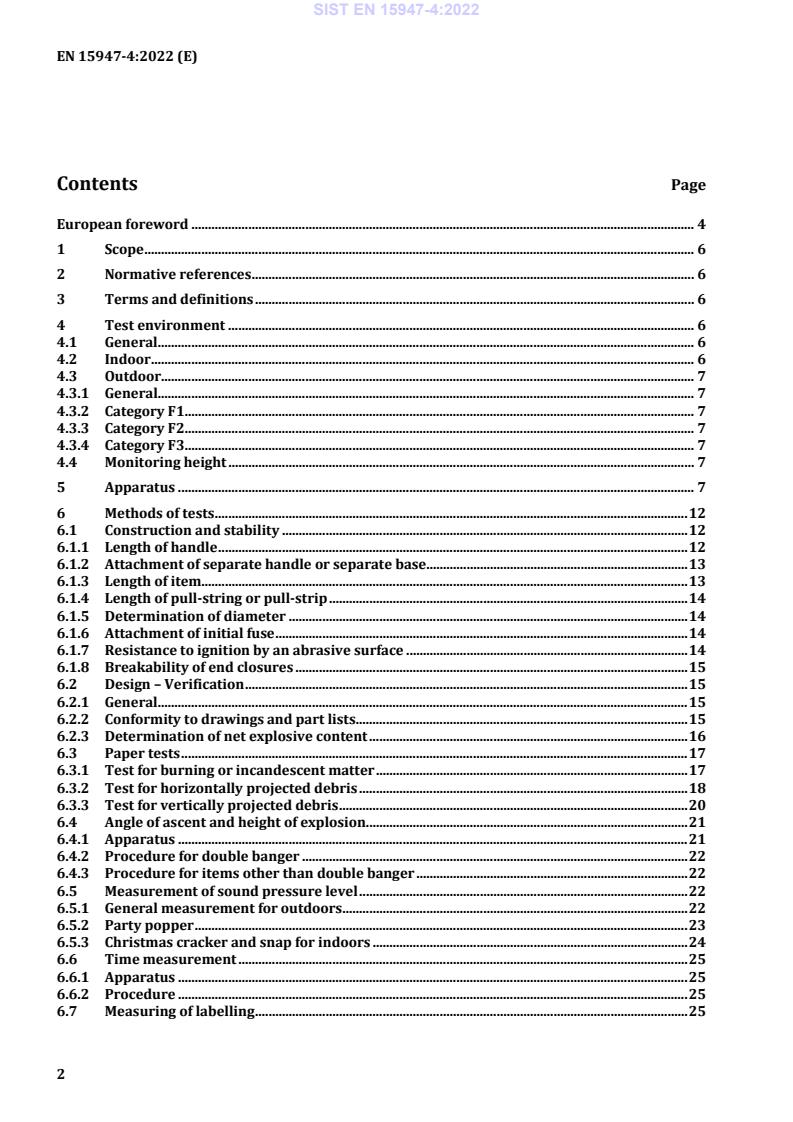
Contents Page
European foreword . 4
1 Scope . 6
2 Normative references . 6
3 Terms and definitions . 6
4 Test environment . 6
4.1 General. 6
4.2 Indoor . 6
4.3 Outdoor. 7
4.3.1 General. 7
4.3.2 Category F1. 7
4.3.3 Category F2. 7
4.3.4 Category F3. 7
4.4 Monitoring height . 7
5 Apparatus . 7
6 Methods of tests . 12
6.1 Construction and stability . 12
6.1.1 Length of handle . 12
6.1.2 Attachment of separate handle or separate base . 13
6.1.3 Length of item. 13
6.1.4 Length of pull-string or pull-strip . 14
6.1.5 Determination of diameter . 14
6.1.6 Attachment of initial fuse . 14
6.1.7 Resistance to ignition by an abrasive surface . 14
6.1.8 Breakability of end closures . 15
6.2 Design – Verification . 15
6.2.1 General. 15
6.2.2 Conformity to drawings and part lists . 15
6.2.3 Determination of net explosive content . 16
6.3 Paper tests . 17
6.3.1 Test for burning or incandescent matter . 17
6.3.2 Test for horizontally projected debris . 18
6.3.3 Test for vertically projected debris . 20
6.4 Angle of ascent and height of explosion. 21
6.4.1 Apparatus . 21
6.4.2 Procedure for double banger . 22
6.4.3 Procedure for items other than double banger . 22
6.5 Measurement of sound pressure level . 22
6.5.1 General measurement for outdoors. 22
6.5.2 Party popper . 23
6.5.3 Christmas cracker and snap for indoors . 24
6.6 Time measurement . 25
6.6.1 Apparatus . 25
6.6.2 Procedure . 25
6.7 Measuring of labelling . 25
6.7.1 Apparatus . 25
6.7.2 Procedure . 25
6.8 Extinguishing of flames . 26
6.8.1 Apparatus . 26
6.8.2 Procedure . 26
6.9 Burning rate of composition . 26
6.9.1 Apparatus . 26
6.9.2 Procedure . 26
6.10 Droop test . 26
6.10.1 Apparatus . 26
6.10.2 Procedure . 26
6.11 Projected debris (outdoor) . 26
6.11.1 Apparatus . 26
6.11.2 Procedure . 26
6.12 Incandescent matter . 27
6.13 Visual and audible examinations . 27
6.14 Mechanical conditioning . 27
6.14.1 Apparatus . 27
6.14.2 Procedure . 27
6.15 Thermal conditioning . 28
6.15.1 Apparatus . 28
6.15.2 Procedure . 28
6.16 Striking surface test . 28
6.16.1 Apparatus . 28
6.16.2 Procedure . 28
6.17 Function test . 28
6.17.1 Apparatus . 28
6.17.2 Procedure . 28
6.18 Determination of tube angle . 29
6.18.1 Apparatus . 29
6.18.2 Procedure . 29
Annex A (informative) Mechanical conditioning (shock apparatus) . 30
Annex B (normative) Determination of silver fulminate . 33
B.1 Reagents . 33
B.2 Apparatus . 33
B.3 Procedure . 33
Annex ZA (informative) Relationship between this European Standard and the essential
safety requirements of Directive 2013/29/EU aimed to be covered . 35
Bibliography . 36
European foreword
This document (EN 15947-4:2022) has been prepared by Technical Committee CEN/TC 212
“Pyrotechnic articles”, the secretariat of which is held by NEN.
This European Standard shall be given the status of a national standard, either by publication of an
identical text or by endorsement, at the latest by April 2023, and conflicting national standards shall be
withdrawn at the latest by December 2023.
Attention is drawn to the possibility that some of the elements of this document may be the subject of
patent rights. CEN shall not be held responsible for identifying any or all such patent rights.
This document supersedes EN 15947-4:2015.
In comparison with the previous edition EN 15947-4:2015, the following technical modifications have
been made:
— as a result of the inclusion of a new test method (6.1.8) two new apparatuses 5.28 “Dropping Tube”
and 5.29 “Mass cylindrical in shape” were added;
— as a consequence of the inclusion of hand-held bengal flame (category F1) into the standard the
titles for subclauses 6.1.1.2.1, 6.1.1.2.2 and 6.1.1.2.3 are changed into “6.1.1.2.1 Hand-held
fireworks with uncoated ends as handles”, “6.1.1.2.2 Hand-held fireworks where the handle is an
integral part of the body and not filled with pyrotechnic composition” and “6.1.1.2.3 Hand-held
fireworks where the handle is a separate component and not filled with pyrotechnic composition”;
— a sentence to cover the testing of fuses fixed with adhesive tape for certain articles is added into
subclause 6.1.6.2;
— a new test method under subclause 6.1.8 “Breakability of end closures” was added;
— Table 2 and Table 3 into subclause 6.3.1.2.2 are updated including all possible types;
— Figure 9 into subclause 6.5.2 has been revised, considering a new positioning of the sound meter
with regards to the party popper;
— bullet point in subclause 6.14.1 has been removed and changes have been done into the whole
subclause proposing an appropriate balance (5.7.3) fitting with the accuracy needed;
— “height of initial fuse for mounted wheels in category F3” has been removed.
This document has been prepared under a Standardization Request (M/583) concerning pyrotechnic
articles given to CEN by the European Commission and the European Free Trade Association, and
supports Essential Safety requirements of Directive 2013/29/EU.
For relationship with Directive 2013/29/EU, see informative Annex ZA, which is an integral part of this
document.
This document is one of the series of standards as listed below:
— EN 15947-1, Pyrotechnic articles — Fireworks, Categories F1, F2 and F3 — Part 1: Terminology
— EN 15947-2, Pyrotechnic articles — Fireworks, Categories F1, F2 and F3 — Part 2: Categories and
types of firework
— EN 15947-3, Pyrotechnic articles — Fireworks, Categories F1, F2 and F3 — Part 3: Minimum labelling
requirements
— EN 15947-4, Pyrotechnic articles — Fireworks, Categories F1, F2 and F3 — Part 4: Test methods
— EN 15947-5, Pyrotechnic articles — Fireworks, Categories F1, F2 and F3 — Part 5: Requirements for
construction and performance
Any feedback and questions on this document should be directed to the users’ national standards body.
A complete listing of these bodies can be found on the CEN website.
According to the CEN-CENELEC Internal Regulations, the national standards organisations of the
following countries are bound to implement this European Standard: Austria, Belgium, Bulgaria,
Croatia, Cyprus, Czech Republic, Denmark, Estonia, Finland, France, Germany, Greece, Hungary, Iceland,
Ireland, Italy, Latvia, Lithuania, Luxembourg, Malta, Netherlands, Norway, Poland, Portugal, Republic of
North Macedonia, Romania, Serbia, Slovakia, Slovenia, Spain, Sweden, Switzerland, Türkiye and the
United Kingdom.
1 Scope
This document specifies test methods. It is applicable to fireworks of the categories F1, F2 and F3 as
defined by Article 6 Paragraph (1) clause (a) subclause (i) to (iii) of Directive 2013/29/EU.
2 Normative references
The following documents are referred to in the text in such a way that some or all of their content
constitutes requirements of this document. For dated references, only the edition cited applies. For
undated references, the latest edition of the referenced document (including any amendments) applies.
EN 15947-1:2022, Pyrotechnic articles — Fireworks, Categories F1, F2 and F3 — Part 1: Terminology
EN 15947-3:2022, Pyrotechnic articles — Fireworks, Categories F1, F2 and F3 — Part 3: Minimum
labelling requirements
EN 15947-5:2022, Pyrotechnic articles — Fireworks, Categories F1, F2 and F3 — Part 5: Requirements for
construction and performance
EN 61672-1:2013, Electroacoustics — Sound level meters — Part 1: Specifications
EN ISO 3696:1995, Water for analytical laboratory use — Specification and test methods (ISO 3696:1987)
ISO 4793:1980, Laboratory sintered (fritted) filters — Porosity grading, classification and designation
ISO 6344-3:2013, Coated abrasives — Grain size analysis — Part 3: Determination of grain size
distribution of microgrits P240 to P2500
ISO 21948:2001, Coated abrasives — Plain sheets
3 Terms and definitions
For the purposes of this document, the terms and definitions given in EN 15947-1:2022 apply.
ISO and IEC maintain terminological databases for use in standardization at the following addresses:
— IEC Electropedia: available at https://www.electropedia.org/
— ISO Online browsing platform: available at https://www.iso.org/obp/ui
4 Test environment
4.1 General
The test area shall be a clean, flat, horizontal, non-flammable and sound reflecting surface (for example
concrete). The test sample shall be placed in accordance with the instructions on the label in the centre
of the test area.
4.2 Indoor
The test area shall be indoors.
The test area shall be inside a fume cupboard, or similar enclosed space, which is capable of preventing
movement of air.
4.3 Outdoor
4.3.1 General
The test area shall be an outdoor site. If applicable, provisions shall be made at the centre of the test
area for partially burying into the ground.
If applicable, insert support pole in the centre of the test area.
4.3.2 Category F1
A test area meeting the requirements given in 4.1, with a radius of at least 2,0 m and a circle, radius
1,0 m, shall be marked around the centre of the test area.
4.3.3 Category F2
A test area meeting the requirements given in 4.1, with a radius of at least 9,0 m and a circle, radius
8,0 m, shall be marked around the centre of the test area.
4.3.4 Category F3
A test area meeting the requirements given in 4.1, with a radius of at least 16,0 m and a circle, radius
15,0 m, shall be marked around the centre of the test area.
4.4 Monitoring height
Two positions in the same horizontal plane for monitoring the height of ascent and angle of flight shall
be provided, at a measured distance of at least 50 m from and at an angle of 90° to each other in relation
to the testing point.
5 Apparatus
The described apparatuses are only examples, any equivalent apparatus with the same accuracy or
better can be used.
5.1 Timing device
5.1.1 Timing device, capable of being read to the nearest 0,1 s.
5.1.2 Timing device, capable of being read to the nearest 1 min.
5.2 Calliper, flat faced vernier calliper reading to 0,1 mm.
5.3 Ruler, reading to 1 mm.
5.4 Measuring tape, reading to 10 mm.
5.5 Wind speed meter, capable to measure with accuracy of at least 0,5 m/s.
5.6 Masses with clamping device
5.6.1 Masses with clamping device, (50 ± 1,0) g mass total.
5.6.2 Masses with clamping device, (100 ± 1,0) g mass total.
5.6.3 Masses with clamping device, (500 ± 1,0) g mass total.
5.7 Balance
5.7.1 Balance, reading to 100 mg.
5.7.2 Balance, reading to 10 mg.
5.7.3 Balance, reading to 0,1 mg.
5.8 Abrasive sheet, large enough to permit striking of the ignition head, conforming to
ISO 21948:2001, grit P240 measured in accordance with ISO 6344-3:2013.
5.9 Temperature chamber
5.9.1 Temperature chamber, up to (+130 ± 2,5) °C.
5.9.2 Temperature chamber, up to (+75 ± 2,5) °C.
5.9.3 Temperature chamber, up to (+50 ± 2,5) °C.
5.10 Test paper, 700 mm × 750 mm, (80 ± 3,0) g/m .
5.11 Clamping device
Means of clamping to hold different test sample at different heights and/or angles.
5.12 Plate, non-flammable, with a diameter of (200 ± 5) mm.
5.13 Paper holder
Means of clamping to fix the test paper in a horizontal or vertical plane in different heights.
5.14 Viewing screen
Viewing screens, as shown in Figure 1, shall be provided for monitoring height and angle of flight
criteria. A configuration for height monitoring is given in Figure 2.
Dimensions in millimetres
Key
1 acryl glass
2 black tape, 10 mm to 20 mm wide
3 solid base
4 stand
5 position of observer
Figure 1 — Viewing screen - general view, observer view and side view
The distance X in Figure 1 is given in metres by the Formula (1):
20 m Y
(1)
=
X 0,6 m
where
Y is the distance in metres from the viewing point to the testing point.
EXAMPLE Y = 50 m
0,6 m⋅⋅20 m 0,6 m 20 m
X 0,24 m
Y 50 m
===
Dimensions in meters
Key
1 base of firework before firing
2 sighting device
3 position of observer
Figure 2 — Use of a viewing screen to monitor a height of 20 m - side view and sighting device
detail
5.15 Poles, with 3 m height.
5.16 Rack
Horizontal plate with a central hole of 800 mm diameter, mounted in a height of 3,0 m above the ground
in a rack.
5.17 Sound level meter, class 1 of EN 61672-1:2013 with free-field microphone.
+100
5.18 Shock apparatus, shall provide a deceleration of 490 m/s (when measured at the centre of an
−50
unloaded platform) and the mechanical conditioning impulse duration (time elapsed from the starting
of the machine's deceleration to the time in which the deceleration reaches its maximum value during
each first shock pulse) shall be 2 ms ± 1 ms working at a frequency of 1 Hz ± 0,1 Hz.
NOTE An example of an apparatus is shown in Annex A.
5.19 Goniometer, read to 1°.
5.20 Frame
The frame shall retain the test sample consistently.
To gauge the length of the handles, clearly marked lines shall be marked at distances of 20 mm, 40 mm
and 75 mm from the handle end of the frame.
Dimensions in millimetres
Key
1 frame
2 fireworks, e.g. sparkler
Figure 3 — Example for determining length of handles (batch test) - top view
5.21 Ignition source, capable of producing a small flame or of smouldering.
5.22 Transparent type size sheet
The printing, as required in EN 15947-3:2022, 4.6 shall comply with the size shown in Figure 4 as
shown below.
Figure 4 — Type size of print
The size of the printing of the transparent type size sheet shall be verified by the use of a calliper (5.2).
5.23 Protractor
Key
1 junction of handle/pyrotechnic composition
2 tip of hand-held sparkler
Figure 5 — Measurement of droop
5.24 Striking surface provided with or as part of the primary pack.
5.25 Post, with a height of (0,50 ± 0,01) m.
5.26 Cage, thin-wire cage with a mesh size of 10 mm to 15 mm.
The wire shall have a diameter of approximately 1,0 mm.
The inner length and width shall be (200 ± 10) mm. The inner height of the cage shall be
(100 ± 10) mm.
5.27 Support pole, with a height of (1,75 ± 0,25) m.
5.28 Dropping tube, with a smooth inside wall (e. g. made of plastics or aluminium) with a height of
(725 ± 25) mm, outer diameter of at least 27,0 mm and inner diameter of (25,0 ± 1,0) mm. One of the
ends of the tube shall be shaped or cut at an angle of (45 ± 5) °.
5.29 Mass cylindrical in shape, (100 ± 1,0) g mass, with a diameter of (20,0 ± 2,0) mm, made of metal.
6 Methods of tests
6.1 Construction and stability
6.1.1 Length of handle
6.1.1.1 Apparatus
— Calliper (5.2);
— ruler (5.3);
— frame (5.20).
6.1.1.2 Procedure
6.1.1.2.1 Hand-held fireworks with uncoated ends as handles
For type test measure and record the length of the uncoated end using the calliper (5.2) if the length of
the handle is smaller than or equal to 100 mm or using the ruler (5.3) if the length exceeds 100 mm.
For batch test measure the length of the uncoated end by using the calliper (5.2), the ruler (5.3) or the
frame (5.20) to determine the length of the uncoated end and record if the length of uncoated end is
within the requirements.
If using the frame (5.20), place the fireworks with the handles in accordance with Figure 3 and record
whether and if so, for how many items, the uncoated end is less than the required length.
6.1.1.2.2 Hand-held fireworks where the handle is an integral part of the body and not filled with
pyrotechnic composition
Carry out the type test using the fireworks that are used for determination of the net explosive content.
Cut open the marked end of the firework case. Using calliper (5.2), measure and record the length of the
firework case which is not filled with pyrotechnic composition to the nearest 1,0 mm.
6.1.1.2.3 Hand-held fireworks where the handle is a separate component and not filled with
pyrotechnic composition
Carry out the type test using the fireworks that are used for determination of the net explosive content.
Cut open the marked end of the firework case. Using calliper (5.2), measure and record the length of the
separate handle to the nearest 1,0 mm.
6.1.2 Attachment of separate handle or separate base
6.1.2.1 Apparatus
— Timing device (5.1.1);
— weight (5.6.3).
6.1.2.2 Procedure
Clamp the sample by means of a clamping device in a position such that the handle respectively base of
the sample is pointing vertically downwards. Securely attach the 500 g weight (5.6.3) to the handle
respectively base.
Using the timing device (5.1.1) determine and record the time until the handle respectively base of the
sample becomes detached. If this time is longer than 10 s, stop the test and record as “longer than 10 s”.
6.1.3 Length of item
6.1.3.1 Apparatus
— Ruler (5.3).
6.1.3.2 Procedure
Use the ruler (5.3) to measure and record the total length of the test item to the nearest 1 mm.
6.1.4 Length of pull-string or pull-strip
6.1.4.1 Apparatus
— Ruler (5.3).
6.1.4.2 Procedure
Carefully extend the pull-string or pull-strip to its full length without firing the test item. Using the ruler
(5.3), measure the total exposed length of the pull-string or pull-strip. Record the length.
6.1.5 Determination of diameter
6.1.5.1 Apparatus
— Calliper (5.2).
6.1.5.2 Procedure
Using the calliper (5.2), measure the inside diameter of the tube at least three times at different
positions to the nearest 1,0 mm.
Using the calliper (5.2), measure the outer diameter of the tube of the mini rocket at least three times at
different positions to the nearest 0,5 mm.
Record the individual diameters and calculate the mean diameter.
6.1.6 Attachment of initial fuse
6.1.6.1 Apparatus
— 50 g mass with clamping device (5.6.1);
— 100 g mass with clamping device (5.6.2);
— timing device (5.1.1).
6.1.6.2 Procedure
Fix the firework in such a position that the initial fuse is pointing vertically downwards. The mass with
clamping device (5.6.1 or 5.6.2) shall be attached to the end of the fuse. Any fixation elements like
adhesive tape or similar shall not be removed. If testing a category F1 firework or a category F2 mini
rocket, securely attach the 50 g mass with clamping device (5.6.1) to the initial fuse. If testing a
category F2 firework other than a mini rocket or a category F3 firework, securely attach the 100 g mass
with clamping device (5.6.2) to the initial fuse.
Using the timing device (5.1.1), determine and record the time until the initial fuse becomes detached. If
this time is longer than 10 s stop the test and record as “longer than
...