

EN ISO 15189:2022
(Main)Medical laboratories - Requirements for quality and competence (ISO 15189:2022)
- Abstract
This document specifies requirements for quality and competence in medical laboratories.
This document is applicable to medical laboratories in developing their management systems and assessing their competence. It is also applicable for confirming or recognizing the competence of medical laboratories by laboratory users, regulatory authorities and accreditation bodies.
This document is also applicable to point-of-care testing (POCT).
NOTE International, national, or regional regulations or requirements can also apply to specific topics covered in this document.
- Status
- Published
- Publication Date
- 13-Dec-2022
- Technical Committee
- CEN/TC 140 - In vitro diagnostic systems
- Drafting Committee
- CEN/TC 140 - In vitro diagnostic systems
- Current Stage
- 6060 - Definitive text made available (DAV) - Publishing
- Start Date
- 14-Dec-2022
- Completion Date
- 14-Dec-2022
- Directive
- 765/2008 - REGULATION (EC) No 765/2008 OF THE EUROPEAN PARLIAMENT AND OF THE COUNCIL of 9 July 2008 setting out the requirements for accreditation and market surveillance relating to the marketing of products and repealing Regulation (EEC) No 339/93OJ Ref: 2024/581, OJ, OJ L, OJ L, 2024/581 OJ Date: 20-Feb-2024
Buy Documents




Overview
EN ISO 15189:2022 (identical to EN ISO 15189:2022 / ISO 15189:2022) specifies requirements for quality and competence in medical laboratories. It is intended for laboratories developing management systems and for assessing or recognising laboratory competence by laboratory users, regulatory authorities and accreditation bodies. The standard also explicitly covers point-of-care testing (POCT) and notes that international, national or regional regulations may additionally apply.
Key topics and technical requirements
The standard addresses both management and technical elements required to achieve reliable laboratory results and patient safety. Major topics include:
General requirements
- Impartiality and confidentiality
- Management of information and release of results
- Requirements regarding patient care and privacy
Structural and governance requirements
- Legal entity and responsibilities of the laboratory director
- Governance, authority, delegation and advisory activities
- Quality management, objectives, policies and risk management
Resource requirements
- Personnel: competence, authorization, continuing education and records
- Facilities and environment, including sample collection areas
- Equipment: selection, maintenance, acceptance, adverse incident reporting
- Calibration and metrological traceability of measurement results
- Reagents and consumables: receipt, storage, acceptance testing and inventory
- Service agreements, relationships with referral laboratories and external providers
Process requirements
- Pre‑examination: patient/lab user information, requests, primary sample collection and transport
- Examination and post‑examination activities (documentation, reporting, result interpretation)
- POCT-specific arrangements and operator agreements
Practical applications - who uses ISO 15189
ISO 15189 is used by:
- Medical laboratory directors and quality managers to design and maintain a laboratory management system
- Laboratory staff for role-based competence and procedural controls
- Accreditation bodies and regulators for assessing and recognising laboratory competence
- Healthcare organisations and clinicians to select competent diagnostic service providers
- POCT programme managers to integrate point‑of‑care devices and operators into the lab quality system
Typical applications include preparing for accreditation, improving test reliability, implementing traceable calibration practices, tightening reagent and equipment controls, and ensuring consistent pre- and post-analytical processes.
Related standards and notes
- Supersedes EN ISO 15189:2012 and EN ISO 22870:2016 (POCT-related content consolidated)
- Developed by ISO/TC 212 (Clinical laboratory testing and in vitro diagnostic test systems) in collaboration with CEN/TC 140
Keywords: ISO 15189, medical laboratories, quality and competence, laboratory accreditation, point-of-care testing, laboratory management system, metrological traceability, equipment calibration, sample handling.
Relations
- Effective Date
- 14-Dec-2022
- Effective Date
- 26-Sep-2018
- Refers
ISO/IEC 17025:2017 - General requirements for the competence of testing and calibration laboratories - Effective Date
- 25-Aug-2026
- Effective Date
- 25-Aug-2026
- Effective Date
- 09-Feb-2026
- Effective Date
- 28-Jan-2026
- Effective Date
- 28-Jan-2026
- Effective Date
- 28-Jan-2026
- Effective Date
- 28-Jan-2026
- Effective Date
- 28-Jan-2026
- Effective Date
- 28-Jan-2026
- Effective Date
- 28-Jan-2026
- Effective Date
- 28-Jan-2026
- Effective Date
- 28-Jan-2026
- Effective Date
- 28-Jan-2026
Buy Documents
Get Certified
Connect with accredited certification bodies for this standard

BSI Group
BSI (British Standards Institution) is the business standards company that helps organizations make excellence a habit.

TÜV Rheinland
TÜV Rheinland is a leading international provider of technical services.

TÜV SÜD
TÜV SÜD is a trusted partner of choice for safety, security and sustainability solutions.
Sponsored listings
Frequently Asked Questions
EN ISO 15189:2022 is a standard published by the European Committee for Standardization (CEN). Its full title is "Medical laboratories - Requirements for quality and competence (ISO 15189:2022)". This standard covers: This document specifies requirements for quality and competence in medical laboratories. This document is applicable to medical laboratories in developing their management systems and assessing their competence. It is also applicable for confirming or recognizing the competence of medical laboratories by laboratory users, regulatory authorities and accreditation bodies. This document is also applicable to point-of-care testing (POCT). NOTE International, national, or regional regulations or requirements can also apply to specific topics covered in this document.
This document specifies requirements for quality and competence in medical laboratories. This document is applicable to medical laboratories in developing their management systems and assessing their competence. It is also applicable for confirming or recognizing the competence of medical laboratories by laboratory users, regulatory authorities and accreditation bodies. This document is also applicable to point-of-care testing (POCT). NOTE International, national, or regional regulations or requirements can also apply to specific topics covered in this document.
EN ISO 15189:2022 is classified under the following ICS (International Classification for Standards) categories: 03.120.10 - Quality management and quality assurance; 11.100.01 - Laboratory medicine in general. The ICS classification helps identify the subject area and facilitates finding related standards.
EN ISO 15189:2022 has the following relationships with other standards: It is inter standard links to EN ISO 22870:2016, EN ISO 15189:2012, ISO/IEC 17025:2017, ISO/IEC 17000:2020, ISO/IEC Guide 99:2007, EN ISO 17468:2023, EN 12255-4:2023, CEN/TS 17811:2022, CEN/TS 17688-2:2021, CEN/TS 17626:2021, CEN/TS 17742:2022, CEN/TS 17688-1:2021, CEN/TS 17747:2022, CEN/TS 17981-1:2023, CEN/TS 17981-2:2023. Understanding these relationships helps ensure you are using the most current and applicable version of the standard.
EN ISO 15189:2022 is associated with the following European legislation: EU Directives/Regulations: 765/2008; Standardization Mandates: M/580. When a standard is cited in the Official Journal of the European Union, products manufactured in conformity with it benefit from a presumption of conformity with the essential requirements of the corresponding EU directive or regulation.
EN ISO 15189:2022 is available in PDF format for immediate download after purchase. The document can be added to your cart and obtained through the secure checkout process. Digital delivery ensures instant access to the complete standard document.
Standards Content (Sample)
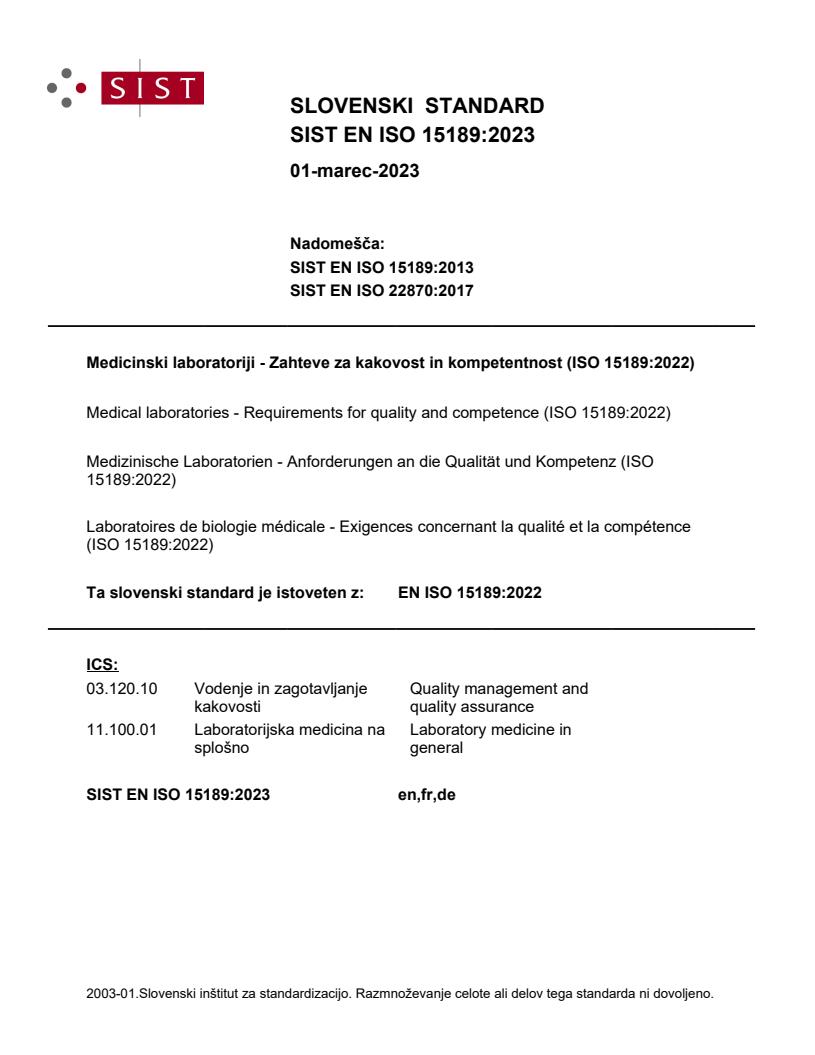
SLOVENSKI STANDARD
01-marec-2023
Nadomešča:
SIST EN ISO 15189:2013
SIST EN ISO 22870:2017
Medicinski laboratoriji - Zahteve za kakovost in kompetentnost (ISO 15189:2022)
Medical laboratories - Requirements for quality and competence (ISO 15189:2022)
Medizinische Laboratorien - Anforderungen an die Qualität und Kompetenz (ISO
15189:2022)
Laboratoires de biologie médicale - Exigences concernant la qualité et la compétence
(ISO 15189:2022)
Ta slovenski standard je istoveten z: EN ISO 15189:2022
ICS:
03.120.10 Vodenje in zagotavljanje Quality management and
kakovosti quality assurance
11.100.01 Laboratorijska medicina na Laboratory medicine in
splošno general
2003-01.Slovenski inštitut za standardizacijo. Razmnoževanje celote ali delov tega standarda ni dovoljeno.
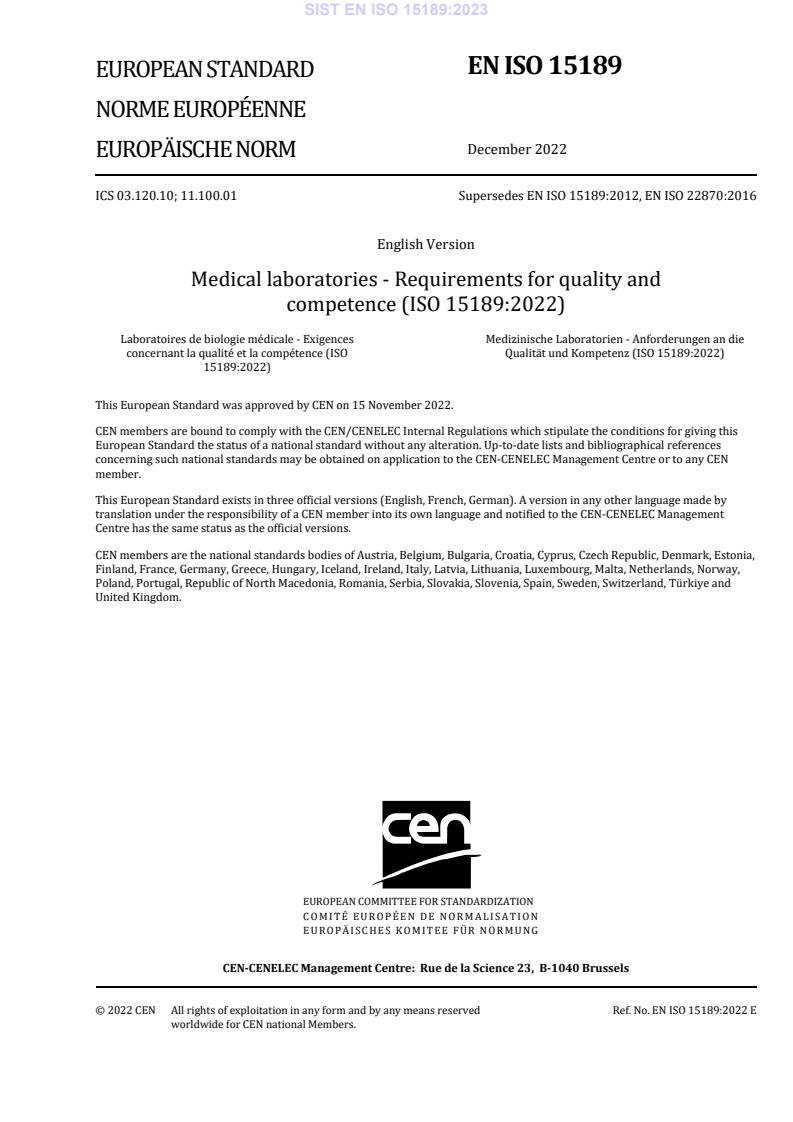
EN ISO 15189
EUROPEAN STANDARD
NORME EUROPÉENNE
December 2022
EUROPÄISCHE NORM
ICS 03.120.10; 11.100.01 Supersedes EN ISO 15189:2012, EN ISO 22870:2016
English Version
Medical laboratories - Requirements for quality and
competence (ISO 15189:2022)
Laboratoires de biologie médicale - Exigences Medizinische Laboratorien - Anforderungen an die
concernant la qualité et la compétence (ISO Qualität und Kompetenz (ISO 15189:2022)
15189:2022)
This European Standard was approved by CEN on 15 November 2022.
CEN members are bound to comply with the CEN/CENELEC Internal Regulations which stipulate the conditions for giving this
European Standard the status of a national standard without any alteration. Up-to-date lists and bibliographical references
concerning such national standards may be obtained on application to the CEN-CENELEC Management Centre or to any CEN
member.
This European Standard exists in three official versions (English, French, German). A version in any other language made by
translation under the responsibility of a CEN member into its own language and notified to the CEN-CENELEC Management
Centre has the same status as the official versions.
CEN members are the national standards bodies of Austria, Belgium, Bulgaria, Croatia, Cyprus, Czech Republic, Denmark, Estonia,
Finland, France, Germany, Greece, Hungary, Iceland, Ireland, Italy, Latvia, Lithuania, Luxembourg, Malta, Netherlands, Norway,
Poland, Portugal, Republic of North Macedonia, Romania, Serbia, Slovakia, Slovenia, Spain, Sweden, Switzerland, Türkiye and
United Kingdom.
EUROPEAN COMMITTEE FOR STANDARDIZATION
COMITÉ EUROPÉEN DE NORMALISATION
EUROPÄISCHES KOMITEE FÜR NORMUNG
CEN-CENELEC Management Centre: Rue de la Science 23, B-1040 Brussels
© 2022 CEN All rights of exploitation in any form and by any means reserved Ref. No. EN ISO 15189:2022 E
worldwide for CEN national Members.
Contents Page
European foreword . 3
European foreword
This document (EN ISO 15189:2022) has been prepared by Technical Committee ISO/TC 212 "Clinical
laboratory testing and in vitro diagnostic test systems" in collaboration with Technical Committee
CEN/TC 140 “In vitro diagnostic medical devices” the secretariat of which is held by DIN.
This European Standard shall be given the status of a national standard, either by publication of an
identical text or by endorsement, at the latest by June 2023, and conflicting national standards shall be
withdrawn at the latest by December 2025.
Attention is drawn to the possibility that some of the elements of this document may be the subject of
patent rights. CEN shall not be held responsible for identifying any or all such patent rights.
This document supersedes EN ISO 15189:2012 and EN ISO 22870:2016.
This document has been prepared under a Standardization Request given to CEN by the European
Commission and the European Free Trade Association.
Any feedback and questions on this document should be directed to the users’ national standards
body/national committee. A complete listing of these bodies can be found on the CEN website.
According to the CEN-CENELEC Internal Regulations, the national standards organizations of the
following countries are bound to implement this European Standard: Austria, Belgium, Bulgaria,
Croatia, Cyprus, Czech Republic, Denmark, Estonia, Finland, France, Germany, Greece, Hungary, Iceland,
Ireland, Italy, Latvia, Lithuania, Luxembourg, Malta, Netherlands, Norway, Poland, Portugal, Republic of
North Macedonia, Romania, Serbia, Slovakia, Slovenia, Spain, Sweden, Switzerland, Türkiye and the
United Kingdom.
Endorsement notice
The text of ISO 15189:2022 has been approved by CEN as EN ISO 15189:2022 without any modification.
INTERNATIONAL ISO
STANDARD 15189
Fourth edition
2022-12
Medical laboratories — Requirements
for quality and competence
Laboratoires de biologie médicale — Exigences concernant la qualité
et la compétence
Reference number
ISO 15189:2022(E)
ISO 15189:2022(E)
© ISO 2022
All rights reserved. Unless otherwise specified, or required in the context of its implementation, no part of this publication may
be reproduced or utilized otherwise in any form or by any means, electronic or mechanical, including photocopying, or posting on
the internet or an intranet, without prior written permission. Permission can be requested from either ISO at the address below
or ISO’s member body in the country of the requester.
ISO copyright office
CP 401 • Ch. de Blandonnet 8
CH-1214 Vernier, Geneva
Phone: +41 22 749 01 11
Email: copyright@iso.org
Website: www.iso.org
Published in Switzerland
ii
ISO 15189:2022(E)
Contents Page
Foreword . vi
Introduction .vii
1 Scope . 1
2 Normative references . 1
3 Terms and definitions . 1
4 General requirements . 8
4.1 Impartiality . 8
4.2 Confidentiality . 8
4.2.1 Management of information . 8
4.2.2 Release of information . 9
4.2.3 Personnel responsibility . 9
4.3 Requirements regarding patients . 9
5 Structural and governance requirements . 9
5.1 Legal entity . 9
5.2 Laboratory director . 10
5.2.1 Laboratory director competence . 10
5.2.2 Laboratory director responsibilities . 10
5.2.3 Delegation of duties . 10
5.3 Laboratory activities . 10
5.3.1 General . 10
5.3.2 Conformance with requirements . 10
5.3.3 Advisory activities . 10
5.4 Structure and authority . 11
5.4.1 General . 11
5.4.2 Quality management . 11
5.5 Objectives and policies . 11
5.6 Risk management .12
6 Resource requirements .12
6.1 General .12
6.2 Personnel .12
6.2.1 General .12
6.2.2 Competence requirements .12
6.2.3 Authorization .13
6.2.4 Continuing education and professional development .13
6.2.5 Personnel records. 13
6.3 Facilities and environmental conditions . 13
6.3.1 General .13
6.3.2 Facility controls . 14
6.3.3 Storage facilities . 14
6.3.4 Personnel facilities . 14
6.3.5 Sample collection facilities . 14
6.4 Equipment . 15
6.4.1 General .15
6.4.2 Equipment requirements . 15
6.4.3 Equipment acceptance procedure . 15
6.4.4 Equipment instructions for use . 15
6.4.5 Equipment maintenance and repair . 15
6.4.6 Equipment adverse incident reporting . 16
6.4.7 Equipment records . 16
6.5 Equipment calibration and metrological traceability . 17
6.5.1 General . 17
6.5.2 Equipment calibration . 17
iii
ISO 15189:2022(E)
6.5.3 Metrological traceability of measurement results . 17
6.6 Reagents and consumables . 18
6.6.1 General . 18
6.6.2 Reagents and consumables — Receipt and storage . 18
6.6.3 Reagents and consumables — Acceptance testing . 18
6.6.4 Reagents and consumables — Inventory management . . 18
6.6.5 Reagents and consumables — Instructions for use . 19
6.6.6 Reagents and consumables — Adverse incident reporting . 19
6.6.7 Reagents and consumables — Records . 19
6.7 Service agreements . 19
6.7.1 Agreements with laboratory users . 19
6.7.2 Agreements with POCT operators . 19
6.8 Externally provided products and services . 20
6.8.1 General .20
6.8.2 Referral laboratories and consultants . 20
6.8.3 Review and approval of externally provided products and services .20
7 Process requirements .21
7.1 General . 21
7.2 Pre-examination processes . 21
7.2.1 General . 21
7.2.2 Laboratory information for patients and users . 21
7.2.3 Requests for providing laboratory examinations . 21
7.2.4 Primary sample collection and handling .22
7.2.5 Sample transportation .23
7.2.6 Sample receipt . 24
7.2.7 Pre-examination handling, preparation, and storage. 24
7.3 Examination processes .25
7.3.1 General . 25
7.3.2 Verification of examination methods . . 25
7.3.3 Validation of examination methods . 25
7.3.4 Evaluation of measurement uncertainty (MU) . 26
7.3.5 Biological reference intervals and clinical decision limits .26
7.3.6 Documentation of examination procedures . 27
7.3.7 Ensuring the validity of examination results . 27
7.4 Post-examination processes . 30
7.4.1 Reporting of results .30
7.4.2 Post-examination handling of samples . 32
7.5 Nonconforming work . 33
7.6 Control of data and information management . 33
7.6.1 General . 33
7.6.2 Authorities and responsibilities for information management.33
7.6.3 Information systems management .34
7.6.4 Downtime plans .34
7.6.5 Off site management .34
7.7 Complaints.34
7.7.1 Process .34
7.7.2 Receipt of complaint . 35
7.7.3 Resolution of complaint . . 35
7.8 Continuity and emergency preparedness planning . 35
8 Management system requirements .35
8.1 General requirements . 35
8.1.1 General . 35
8.1.2 Fulfilment of management system requirements .36
8.1.3 Management system awareness .36
8.2 Management system documentation . 36
8.2.1 General .36
8.2.2 Competence and quality . 36
iv
ISO 15189:2022(E)
8.2.3 Evidence of commitment . 36
8.2.4 Documentation.36
8.2.5 Personnel access .36
8.3 Control of management system documents . 37
8.3.1 General . 37
8.3.2 Control of documents . 37
8.4 Control of records . 37
8.4.1 Creation of records . 37
8.4.2 Amendment of records . 37
8.4.3 Retention of records .38
8.5 Actions to address risks and opportunities for improvement .38
8.5.1 Identification of risks and opportunities for improvement .38
8.5.2 Acting on risks and opportunities for improvement .38
8.6 Improvement . 39
8.6.1 Continual improvement. 39
8.6.2 Laboratory patients, user, and personnel feedback .39
8.7 Nonconformities and corrective actions . 39
8.7.1 Actions when nonconformity occurs .39
8.7.2 Corrective action effectiveness .40
8.7.3 Records of nonconformities and corrective actions .40
8.8 Evaluations .40
8.8.1 General .40
8.8.2 Quality indicators .40
8.8.3 Internal audits .40
8.9 Management reviews . 41
8.9.1 General . 41
8.9.2 Review input . 41
8.9.3 Review output . 41
Annex A (normative) Additional requirements for Point-of-Care Testing (POCT) .43
Annex B (informative) Comparison between ISO 9001:2015 and ISO 15189:2022 (this
document) . 44
Annex C (informative) Comparison between ISO 15189:2012 and ISO 15189:2022 (this
document) .54
Bibliography .61
v
ISO 15189:2022(E)
Foreword
ISO (the International Organization for Standardization) is a worldwide federation of national standards
bodies (ISO member bodies). The work of preparing International Standards is normally carried out
through ISO technical committees. Each member body interested in a subject for which a technical
committee has been established has the right to be represented on that committee. International
organizations, governmental and non-governmental, in liaison with ISO, also take part in the work.
ISO collaborates closely with the International Electrotechnical Commission (IEC) on all matters of
electrotechnical standardization.
The procedures used to develop this document and those intended for its further maintenance are
described in the ISO/IEC Directives, Part 1. In particular, the different approval criteria needed for the
different types of ISO documents should be noted. This document was drafted in accordance with the
editorial rules of the ISO/IEC Directives, Part 2 (see www.iso.org/directives).
Attention is drawn to the possibility that some of the elements of this document may be the subject of
patent rights. ISO shall not be held responsible for identifying any or all such patent rights. Details of
any patent rights identified during the development of the document will be in the Introduction and/or
on the ISO list of patent declarations received (see www.iso.org/patents).
Any trade name used in this document is information given for the convenience of users and does not
constitute an endorsement.
For an explanation of the voluntary nature of standards, the meaning of ISO specific terms and
expressions related to conformity assessment, as well as information about ISO's adherence to
the World Trade Organization (WTO) principles in the Technical Barriers to Trade (TBT), see
www.iso.org/iso/foreword.html.
This document was prepared by Technical Committee ISO/TC 212, Clinical laboratory testing and in
vitro diagnostic test systems, in collaboration with the European Committee for Standardization (CEN)
Technical Committee CEN/TC 140, In vitro diagnostic medical devices, in accordance with the Agreement
on technical cooperation between ISO and CEN (Vienna Agreement).
This fourth edition cancels and replaces the third edition (ISO 15189:2012), which has been technically
revised. It also replaces ISO 22870:2016.
The main changes are as follows:
— Alignment with ISO/IEC 17025:2017 resulted in the management requirements now appearing at
the end of the document;
— Requirements for point-of-care testing (POCT), previously in ISO 22870, have been incorporated;
— Increased emphasis on risk management.
Any feedback or questions on this document should be directed to the user’s national standards body. A
complete listing of these bodies can be found at www.iso.org/members.html.
vi
ISO 15189:2022(E)
Introduction
The objective of this document is to promote the welfare of patients and satisfaction of laboratory users
through confidence in the quality and competence of medical laboratories.
This document contains requirements for the medical laboratory to plan and implement actions
to address risks and opportunities for improvement. Benefits of this approach include: increasing
the effectiveness of the management system, decreasing probability of invalid results, and reducing
potential harm to patients, laboratory personnel, the public and the environment.
The requirements for risk management are aligned with the principles of ISO 22367.
The requirements for laboratory safety are aligned with the principles of ISO 15190.
1)
The requirements for sample collection and transport are aligned with ISO 20658.
This document contains the requirements for point-of-care testing (POCT) and supersedes ISO 22870,
which will be withdrawn upon publication of this document.
The format of this document is based on ISO/IEC 17025:2017.
The medical laboratory is essential to patient care; activities are provided within an ethical and
governance framework, that recognizes the obligations of healthcare providers to the patient. These
activities are undertaken in a timely manner to meet the needs of all patients and the personnel
responsible for the care of those patients. Activities include arrangements for examination requests,
patient preparation, patient identification, collection of samples, transportation, processing of patient
samples, selection of examinations that are fit for intended use, examination of samples, sample storage,
as well as subsequent interpretation, result reporting and advice to laboratory users. This may also
include the provision of results to the patient, arrangements for urgent testing and the notification of
critical results.
While this document is intended for use throughout the currently recognized medical laboratory
disciplines, it can effectively be applied to other healthcare services, such as diagnostic imaging,
respiratory therapy, physiological sciences, blood banks and transfusion services.
The use of this document facilitates cooperation between medical laboratories and other healthcare
services, assists in the exchange of information, and in the harmonization of methods and procedures.
The comparability of patient examination results between medical laboratories, regardless of city or
country, is facilitated when medical laboratories conform to this document.
When a laboratory seeks accreditation, it should select an accreditation body which operates in
accordance with ISO/IEC 17011, and which takes into account the particular requirements of medical
laboratories.
Comparisons between this document, ISO 9001:2015 and ISO/IEC 17025:2017 are in Annex B. The
comparison of ISO 15189:2012 to ISO 15189:2022 (this document) is in Annex C.
1) First edition under preparation (previous edition was a Technical Specification). Stage at the time of publication:
ISO/DIS 20658:2022.
vii
INTERNATIONAL STANDARD ISO 15189:2022(E)
Medical laboratories — Requirements for quality and
competence
1 Scope
This document specifies requirements for quality and competence in medical laboratories.
This document is applicable to medical laboratories in developing their management systems and
assessing their competence. It is also applicable for confirming or recognizing the competence of
medical laboratories by laboratory users, regulatory authorities and accreditation bodies.
This document is also applicable to point-of-care testing (POCT).
NOTE International, national, or regional regulations or requirements can also apply to specific topics
covered in this document.
2 Normative references
The following documents are referred to in the text in such a way that some or all of their content
constitutes requirements of this document. For dated references, only the edition cited applies. For
undated references, the latest edition of the referenced document (including any amendments) applies.
ISO/IEC Guide 99:2007, International vocabulary of metrology — Basic and general concepts and
associated terms (VIM)
NOTE ISO/IEC Guide 99 is also known as the Joint Committee for Guides in Metrology (JCGM) 200.
ISO/IEC 17000:2020, Conformity assessment — Vocabulary and general principles
ISO/IEC 17025:2017, General requirements for the competence of testing and calibration laboratories
3 Terms and definitions
For the purposes of this document, the terms and definitions given in ISO/IEC Guide 99 and
ISO/IEC 17000 and the following apply.
ISO and IEC maintain terminology databases for use in standardization at the following addresses:
— ISO Online browsing platform: available at https:// www .iso .org/ obp
— IEC Electropedia: available at https:// www .electropedia .org/
3.1
bias
measurement bias
estimate of a systematic measurement error
Note 1 to entry: This definition only applies to quantitative measurements
[SOURCE: ISO/IEC Guide 99:2007, 2.18, modified — Note 1 to entry has been added.]
ISO 15189:2022(E)
3.2
biological reference interval
reference interval
specified interval of the distribution of values taken from a biological reference population
Note 1 to entry: A reference interval is commonly defined as the central 95% interval. Another size or an
asymmetrical location of the reference interval could be more appropriate in particular cases.
Note 2 to entry: A reference interval can depend upon the type of primary sample (3.25) and the examination
procedure (3.9) used.
Note 3 to entry: In some cases, only one biological reference limit is important, usually an upper limit, “x”, so that
the corresponding biological reference interval would be less than or equal to “x”.
Note 4 to entry: Terms such as ‘normal range’, ‘normal values’, and ‘clinical range’ are ambiguous and therefore
discouraged.
[SOURCE: ISO 18113-1:2022, 3.1.9, modified — The EXAMPLE has been removed.]
3.3
clinical decision limit
examination (3.8) result that indicates a higher risk of adverse clinical outcomes, or is diagnostic for the
presence of a specifc disease
Note 1 to entry: Clinical decision limits for therapeutic drugs are called "therapeutic range".
Note 2 to entry: It is used to determine risk of disease, to diagnose or to treat.
3.4
commutability of a reference material
commutability
property of a reference material, demonstrated by the closeness of agreement between the relation
among the measurement results for a stated quantity in this material, obtained according to two given
measurement procedures and the relation obtained among the measurement results for other specified
materials
Note 1 to entry: The reference material in question is usually a calibrator and the other specified materials are
usually routine samples.
Note 2 to entry: It is typical that there are more than two measurement procedures available and comparison
among all applicable measurement procedures is desirable.
Note 3 to entry: Closeness of agreement of measurement results is defined in terms of fitness for purpose as
appropriate for the intended use of the reference material.
Note 4 to entry: A commutability statement is restricted to the measurement procedures as specified in a
particular comparison.
[SOURCE: ISO 17511:2020 3.10, modified — Note 2 to entry has been replaced by a new Note 2 to entry.]
3.5
competence
demonstrated ability to apply knowledge and skills to achieve intended results
[SOURCE: ISO/IEC 17021-1:2015, 3.7, modified — "demonstrated" added to the beginning of the
definition.]
ISO 15189:2022(E)
3.6
complaint
expression of dissatisfaction by any person or organization to a laboratory (3.20), relating to the
activities or results of that laboratory, where a response is expected
[SOURCE: ISO/IEC 17000:2020, 8.7, modified — The words “other than appeal” have been deleted, and
the words “a conformity assessment body or accreditation body, relating to the activities of that body”
have been replaced by “a laboratory, relating to the activities or results of that laboratory”.]
3.7
consultant
person who provides expert advice professionally
3.8
examination
set of operations having the objective of determining the numerical value, text value or characteristics
of a property
Note 1 to entry: An examination may be the total of a number of activities, observations or measurements
required to determine a value or characteristic.
Note 2 to entry: Laboratory examinations that determine a numerical value of a property are called "quantitative
examinations"; those that determine the characteristics of a property are called "qualitative examinations".
Note 3 to entry: Laboratory examinations are also called "assays" or "tests".
3.9
examination procedure
specifically described set of operations used in the performance of an examination (3.8) according to a
given method
Note 1 to entry: In the IVD medical device industry and in many laboratories that use IVD medical devices, an
examination procedure for an analyte in a biological sample is commonly referred to as an analytical method,
analytical procedure or test procedure.
[SOURCE: ISO 15198:2004, 3.7, modified — “set of operations described specifically” changed to
“specifically described set of operations”.]
3.10
external quality assessment
EQA
evaluation of participant performance against pre-established criteria by means of interlaboratory
comparisons
Note 1 to entry: Also known as proficiency testing (PT)
[SOURCE: ISO/IEC 17043:2010, 3.7 modified — The term “external quality assessment”, which was
given in Note 2 to entry, is used as the main term. Notes to entry 1 and 2 have been omitted and a new
Note 1 to entry added.]
3.11
impartiality
objectivity with regard to the outc
...
SL O V EN S K I
S T ANDAR D
marec 2023
Medicinski laboratoriji – Zahteve za kakovost in kompetentnost (ISO
15189:2022)
Medical laboratories – Requirements for quality and competence (ISO
15189:2022)
Medizinische Laboratorien – Anforderungen an die Qualität und Kompetenz (ISO
15189:2022)
Laboratoires de biologie médicale – Exigences concernant la qualité et la
compétence (ISO 15189:2022)
Referenčna oznaka
ICS 03.120.10; 11.100.01 SIST EN ISO 15189:2023 (sl)
Nadaljevanje na straneh II in III ter od 1 do 100
© 2025-09. Slovenski inštitut za standardizacijo. Razmnoževanje celote ali delov tega standarda ni dovoljeno.
SIST EN ISO 15189 : 2023
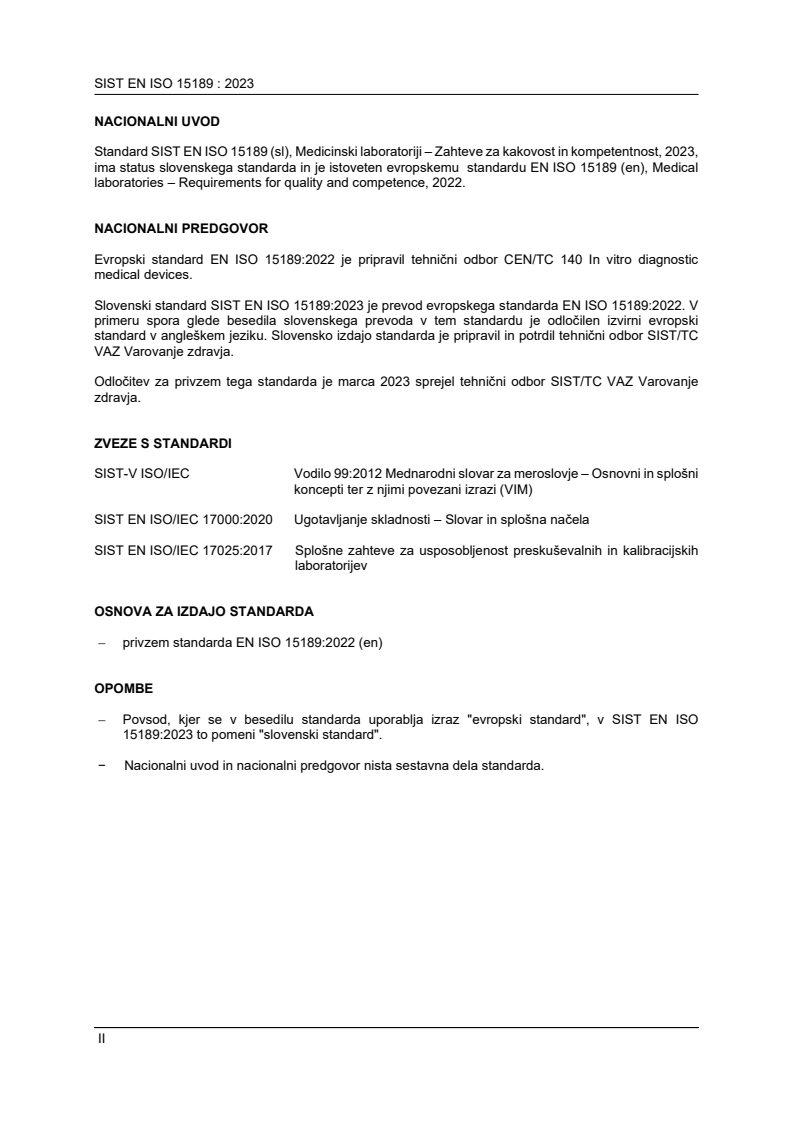
NACIONALNI UVOD
Standard SIST EN ISO 15189 (sl), Medicinski laboratoriji – Zahteve za kakovost in kompetentnost, 2023,
ima status slovenskega standarda in je istoveten evropskemu standardu EN ISO 15189 (en), Medical
laboratories – Requirements for quality and competence, 2022.
NACIONALNI PREDGOVOR
Evropski standard EN ISO 15189:2022 je pripravil tehnični odbor CEN/TC 140 In vitro diagnostic
medical devices.
Slovenski standard SIST EN ISO 15189:2023 je prevod evropskega standarda EN ISO 15189:2022. V
primeru spora glede besedila slovenskega prevoda v tem standardu je odločilen izvirni evropski
standard v angleškem jeziku. Slovensko izdajo standarda je pripravil in potrdil tehnični odbor SIST/TC
VAZ Varovanje zdravja.
Odločitev za privzem tega standarda je marca 2023 sprejel tehnični odbor SIST/TC VAZ Varovanje
zdravja.
ZVEZE S STANDARDI
SIST-V ISO/IEC Vodilo 99:2012 Mednarodni slovar za meroslovje – Osnovni in splošni
koncepti ter z njimi povezani izrazi (VIM)
SIST EN ISO/IEC 17000:2020 Ugotavljanje skladnosti – Slovar in splošna načela
SIST EN ISO/IEC 17025:2017 Splošne zahteve za usposobljenost preskuševalnih in kalibracijskih
laboratorijev
OSNOVA ZA IZDAJO STANDARDA
̶ privzem standarda EN ISO 15189:2022 (en)
OPOMBE
̶ Povsod, kjer se v besedilu standarda uporablja izraz "evropski standard", v SIST EN ISO
15189:2023 to pomeni "slovenski standard".
− Nacionalni uvod in nacionalni predgovor nista sestavna dela standarda.
II
SIST EN ISO 15189 : 2023
– Ta nacionalni dokument je istoveten EN ISO 15189:2012 in je objavljen z dovoljenjem
CENManagement CentreAvenue Marnix 17
B-1000 Bruxelles
Belgija
This national document is identical with EN ISO 15189:2012 and is published with the permission of
CEN Management Centre
Avenue Marnix 17
B-1000 Bruxelles
Belgium
III
SIST EN ISO 15189 : 2023
(Prazna stran)
IV
EVROPSKI STANDARD EN ISO 15189
EUROPEAN STANDARD
NORME EUROPÉENNE
december 2022
EUROPÄISCHE NORM
ICS 03.120.01; 01.100.01
Slovenska izdaja
Medicinski laboratoriji – Zahteve za kakovost in kompetentnost
(ISO 15189:2022)
Medical laboratories - Laboratoires de biologie médicale - Medizinische Laboratorien -
Requirements for quality and Exigences concernant la qualité et Anforderungen an die Qualität und
competence (ISO 15189:2022) la compétence (ISO 15189:2022) Kompetenz (ISO 15189:2022)
Ta evropski standard je CEN sprejel 15. novembra 2022.
Člani CEN morajo izpolnjevati določila notranjih predpisov CEN/CENELEC, s katerimi je predpisano,
da mora biti ta evropski standard brez kakršnihkoli sprememb sprejet kot nacionalni standard.
Seznami najnovejših izdaj teh nacionalnih standardov in njihovi bibliografski podatki so na voljo pri
Upravnem centru CEN-CENELEC ali članih CEN.
Ta evropski standard obstaja v treh uradnih izdajah (angleški, francoski in nemški). Izdaje v drugih
jezikih, ki jih člani CEN na lastno odgovornost prevedejo in izdajo ter prijavijo pri Upravnem centru
CEN-CENELEC, veljajo kot uradne izdaje.
Člani CEN so nacionalni organi za standarde Avstrije, Belgije, Bolgarije, Cipra, Češke republike,
Danske, Estonije, Finske, Francije, Grčije, Hrvaške, Irske, Islandije, Italije, Latvije, Litve,
Luksemburga, Madžarske, Malte, Nemčije, Nizozemske, Norveške, Poljske, Portugalske, Republike
Severna Makedonija, Romunije, Slovaške, Slovenije, Srbije, Španije, Švedske, Švice, Turčije in
Združenega kraljestva.
CEN
Evropski komite za standardizacijo
European Committee for Standardization
Comité Européen de Normalisation
Europäisches Komitee für Normung
Upravni center CEN-CENELEC: Rue de la Science 23, B-1040 Bruselj
© 2022 CEN/CENELEC Lastnice avtorskih pravic so vse države članice CEN in člani Ref. št. EN ISO 15189:2022 E
CENELEC.
SIST EN ISO 15189 : 2023
VSEBINA CONTENTS
Evropski predgovor . 3 European foreword . 3
SIST EN ISO 15189 : 2023
Evropski predgovor European foreword
Ta dokument (EN ISO 15189:2022) je pripravil This document (EN ISO 15189:2022) has been
tehnični odbor ISO/TC 212 "Preskušanje prepared by Technical Committee ISO/TC 212
kliničnih laboratorijev ter diagnostični sistemi in "Clinical laboratory testing and in vitro diagnostic
vitro" v sodelovanju s tehničnim odborom test systems" in collaboration with Technical
CEN/TC 140 "Diagnostični medicinski Committee CEN/TC 140 "In vitro diagnostic
pripomočki in vitro", katerega sekretariat vodi medical devices" the secretariat of which is held
DIN. by DIN.
Ta evropski standard mora dobiti status This European Standard shall be given the
nacionalnega standarda bodisi z objavo status of a national standard, either by
istovetnega besedila bodisi z razglasitvijo publication of an identical text or by
najpozneje do junija 2023; nacionalne endorsement, at the latest by June 2023, and
standarde, ki so v nasprotju s tem standardom, conflicting national standards shall be withdrawn
pa je treba razveljaviti najpozneje do decembra at the latest by December 2025.
2025.
Opozoriti je treba na možnost, da so lahko Attention is drawn to the possibility that some of
nekateri elementi tega dokumenta predmet the elements of this document may be the
patentnih pravic. CEN ne prevzema subject of patent rights. CEN shall not be held
odgovornosti za identifikacijo nekaterih ali vseh responsible for identifying any or all such patent
takih patentnih pravic. rights.
Ta dokument nadomešča standarda EN ISO This document supersedes EN ISO 15189:2012
15189:2012 in EN ISO 22870:2016. and EN ISO 22870:2016
Ta dokument je bil pripravljen v okviru mandata, This document has been prepared under a
ki sta ga CEN podelila Evropska komisija in Standardization Request given to CEN by the
Evropsko združenje za prosto trgovino (EFTA). European Commission and the European Free
Trade Association.
Uporabnik naj vse povratne informacije ali Any feedback and questions on this document
vprašanja o tem dokumentu posreduje should be directed to the users’ national
nacionalnemu organu/komiteju za standarde v standards body/national committee. A complete
svoji državi. Celoten seznam teh organov je na listing of these bodies can be found on the CEN
voljo na spletnem mestu CEN. website.
V skladu z notranjimi predpisi CEN/CENELEC According to the CEN-CENELEC Internal
morajo ta evropski standard obvezno uvesti Regulations, the national standards
nacionalne organizacije za standardizacijo organizations of the following countries are
naslednjih držav: Avstrije, Belgije, Bolgarije, bound to implement this European Standard:
Cipra, Češke republike, Danske, Estonije, Austria, Belgium, Bulgaria, Croatia, Cyprus,
Finske, Francije, Grčije, Hrvaške, Irske, Czech Republic, Denmark, Estonia, Finland,
Islandije, Italije, Latvije, Litve, Luksemburga, France, Germany, Greece, Hungary, Iceland,
Madžarske, Malte, Nemčije, Nizozemske, Ireland, Italy, Latvia, Lithuania, Luxembourg,
Norveške, Poljske, Portugalske, Republike Malta, Netherlands, Norway, Poland, Portugal,
Severna Makedonija, Romunije, Slovaške, Republic of North Macedonia, Romania, Serbia,
Slovenije, Srbije, Španije, Švedske, Švice, Slovakia, Slovenia, Spain, Sweden, Switzerland,
Turčije in Združenega kraljestva. Türkiye and the United Kingdom.
Razglasitvena objava Endorsement notice
Besedilo standarda ISO 15189:2022 je CEN The text of ISO 15189:2022 has been approved
brez sprememb odobril kot standard EN ISO by CEN as EN ISO 15189:2022 without any
15189:2022. modification.
SIST EN ISO 15189 : 2023
VSEBINA CONTENTS
Predgovor . 8 Foreword. . 8
Uvod . 10 Introduction .10
1 Področje uporabe . 12 1 Scope .12
2 Zveze s standardi . 12 2 Normative references .12
3 Izrazi in definicije . 12 3 Terms and definitions .12
4 Splošne zahteve . 23 4 General requirements .23
4.1 Nepristranskost . 23 4.1 Impartiality .23
4.2 Zaupnost . 23 4.2 Confidentiality .23
4.2.1 Upravljanje informacij . 23 4.2.1 Management of information. .23
4.2.2 Objava informacij . 24 4.2.2 Release of information. .24
4.2.3 Odgovornost osebja . 24 4.2.3 Personnel responsibility .24
4.3 Zahteve glede pacientov . 24 4.3 Requirements regarding patients. . 24
5 Zahteve za strukturo in upravljanje . 25 5 Structural and governance requirements .25
5.1 Pravna oseba . 25 5.1 Legal entity .25
5.2 Vodja laboratorija . 25 5.2 Laboratory director. .25
5.2.1 Kompetentnost vodje laboratorija . 25 5.2.1 Laboratory director competence. .25
5.2.2 Odgovornosti vodje laboratorija . 25 5.2.2 Laboratory director responsibilities .25
5.2.3 Dodelitev dolžnosti . 25 5.2.3 Delegation of duties .25
5.3 Aktivnosti laboratorija . 25 5.3 Laboratory activities .25
5.3.1 Splošno . 25 5.3.1 General .25
5.3.2 Skladnost z zahtevami . 26 5.3.2 Conformance with requirements .28
5.3.3 Aktivnosti svetovanja . 26 5.3.3 Advisory activities .28
5.4 Struktura in pooblastila . 26 5.4 Structure and authority .29
5.4.1 Splošno . 26 5.4.1 General .26
5.4.2 Vodenje kakovosti . 27 5.4.2 Quality management .27
5.5 Cilji in politika . 27 5.5 Objectives and policies .27
5.6 Obvladovanje tveganja . 27 5.6 Risk management .28
6 Zahteve za vire . 28 6 Resource requirements .28
6.1 Splošno . 28 6.1 General .28
6.2 Osebje . 28 6.2 Personnel .28
6.2.1 Splošno . 28 6.2.1 General .28
6.2.2 Zahteve za kompetentnost . 28 6.2.2 Competence requirements .28
6.2.3 Pooblastitev . 29 6.2.3 Authorization .29
6.2.4 Stalno izobraževanje in strokovno 6.2.4 Continuing education and professional
izpopolnjevanje . 29 development .29
6.2.5 Zapisi o osebju . 29 6.2.5 Personnel records .29
6.3 Prostori in oprema ter okoljske razmere 30 6.3 Facilities and environmental conditions .30
6.3.1 Splošno . 30 6.3.1 General .30
6.3.2 Kontrole prostorov in opreme . 30 6.3.2 Facility controls .30
6.3.3 Prostori in oprema za shranjevanje . 31 6.3.3 Storage facilities .31
6.3.4 Prostori in oprema za osebje . 31 6.3.4 Personnel facilities .31
6.3.5 Prostori in oprema za odvzem vzorcev 31 6.3.5 Sample collection facilities .31
6.4 Oprema . 31 6.4 Equipment .32
6.4.1 Splošno . 32 6.4.1 General .32
6.4.2 Zahteve za opremo . 32 6.4.2 Equipment requirements .32
SIST EN ISO 15189 : 2023
6.4.3 Postopek za določitev sprejemljivosti 6.4.3 Equipment acceptance procedure .32
opreme . 32
6.4.4 Navodila za uporabo opreme . 32 6.4.4 Equipment instructions for use .33
6.4.5 Vzdrževanje in popravilo opreme . 33 6.4.5 Equipment maintenance and repair .33
6.4.6 Poročanje o neželenih dogodkih v zvezi 6.4.6 Equipment adverse incident reporting .33
z opremo . 33
6.4.7 Zapisi o opremi . 33 6.4.7 Equipment records .33
6.5 Kalibracija in meroslovna sledljivost 6.5 Equipment calibration and metrological
opreme . 34 traceability .34
6.5.1 Splošno . 34 6.5.1 General .34
6.5.2 Kalibracija opreme . 35 6.5.2 Equipment calibration .35
6.5.3 Meroslovna sledljivost merilnih 6.5.3 Metrological traceability of measurement
rezultatov . 35 results .35
6.6 Reagenti in potrošni material . 36 6.6 Reagents and consumables .36
6.6.1 Splošno . 36 6.6.1 General .36
6.6.2 Reagenti in potrošni material – sprejem 6.6.2 Reagents and consumables — Receipt
in shranjevanje . 36 and storage .40
6.6.3 Reagenti in potrošni material – 6.6.3 Reagents and consumables —
preskušanje sprejemljivosti . 37 Acceptance testing .40
6.6.4 Reagenti in potrošni material – vodenje 6.6.4 Reagents and consumables —
zalog . 37 Inventory management .40
6.6.5 Reagenti in potrošni material – navodila 6.6.5 Reagents and consumables —
za uporabo . 37 Instructions for use .40
6.6.6 Reagenti in potrošni material – 6.6.6 Reagents and consumables — Adverse
poročanje o neželenih dogodkih . 37 incident reporting .41
6.6.7 Reagenti in potrošni material – 6.6.7 Reagents and consumables — Records
zapisi . 38 .41
6.7 Storitvene pogodbe (dogovori) . 38 6.7 Service agreements .41
6.7.1 Pogodbe (dogovori) z uporabniki 6.7.1 Agreements with laboratory users .41
laboratorija . 38
6.7.2 Pogodbe (dogovori) z izvajalci POCT . 39 6.7.2 Agreements with POCT operators .39
6.8 Izdelki in storitve, ki jih priskrbijo zunanji 6.8 Externally provided products and services
ponudniki . 39 .39
6.8.1 Splošno . 39 6.8.1 General .39
6.8.2 Prejemni laboratoriji in konzultanti . 39 6.8.2 Referral laboratories and consultants .39
6.8.3 Pregled in odobritev izdelkov in storitev, 6.8.3 Review and approval of externally
ki jih priskrbijo zunanji ponudniki . 40 provided products and services .40
7 Zahteve za procese . 40 7 Process requirements .40
7.1 Splošno . 40 7.1 General .40
7.2 Predpreiskovalni procesi . 40 7.2 Pre-examination processes .40
7.2.1 Splošno . 40 7.2.1 General .40
7.2.2 Informacije laboratorija za paciente in 7.2.2 Laboratory information for patients and
uporabnike . 41 users .41
7.2.3 Naročila laboratorijskih preiskovanj . 41 7.2.3 Requests for providing laboratory
examinations .41
7.2.4 Odvzem primarnih vzorcev in ravnanje 7.2.4 Primary sample collection and handling
z njimi . 42 . 42
7.2.5 Transport vzorcev . 44 7.2.5 Sample transportation .44
7.2.6 Prejem vzorcev . 44 7.2.6 Sample receipt .44
SIST EN ISO 15189 : 2023
7.2.7 Ravnanje z vzorci, njihova priprava in 7.2.7 Pre-examination handling, preparation,
shranjevanje pred preiskavo . 45 and storage .45
7.3 Preiskovalni procesi . 46 7.3 Examination processes .46
7.3.1 Splošno . 46 7.3.1 General .46
7.3.2 Verifikacija preiskovalnih metod . 46 7.3.2 Verification of examination methods .46
7.3.3 Validacija preiskovalnih metod . 47 7.3.3 Validation of examination methods .47
7.3.4 Vrednotenje merilne negotovosti (MU) 48 7.3.4 Evaluation of measurement uncertainty
(MU) .48
7.3.5 Biološki referenčni intervali in mejne 7.3.5 Biological reference intervals and clinical
vrednosti za klinično odločanje . 48 decision limits .48
7.3.6 Dokumentacija preiskovalnih postopkov 7.3.6 Documentation of examination
..................................................................... 49 procedures ..................................................49
7.3.7 Zagotavljanje veljavnosti rezultatov 7.3.7 Ensuring the validity of examination
preiskovanj . 50 results .50
7.4 Popreiskovalni procesi . 54 7.4 Post-examination processes .54
7.4.1 Poročanje o rezultatih . 54 7.4.1 Reporting of results .54
7.4.2 Ravnanje z vzorci po preiskovanjih . 58 7.4.2 Post-examination handling of samples 58
7.5 Neskladno delo . 58 7.5 Nonconforming work .58
7.6 Obvladovanje podatkov in upravljanje 7.6 Control of data and information
informacij . 59 management .59
7.6.1 Splošno . 59 7.6.1 General .59
7.6.2 Pooblastila in odgovornosti za 7.6.2 Authorities and responsibilities for
upravljanje informacij . 59 information management .59
7.6.3 Upravljanje informacijskih sistemov . 59 7.6.3 Information systems management .59
7.6.4 Načrti delovanja v primeru izpada . 60 7.6.4 Downtime plans .60
7.6.5 Upravljanje zunaj lokacije . 60 7.6.5 Off site management .60
7.7 Pritožbe . 61 7.7 Complaints .60
7.7.1 Postopek . 61 7.7.1 Process .61
7.7.2 Prejem pritožbe . 61 7.7.2 Receipt of complaint .61
7.7.3 Reševanje pritožbe . 61 7.7.3 Resolution of complaint .61
7.8 Načrtovanje neprekinjenega delovanja in 7.8 Continuity and emergency preparedness
pripravljenosti v izrednih razmerah . 61 planning .61
8 Zahteve za sistem vodenja . 62 8 Management system requirements .62
8.1 Splošne zahteve . 62 8.1 General requirements .62
8.1.1 Splošno . 62 8.1.1 General .62
8.1.2 Izpolnjevanje zahtev za sistem vodenja 8.1.2 Fulfilment of management system
..................................................................... 62 requirements ...............................................62
8.1.3 Zavedanje sistema vodenja . 62 8.1.3 Management system awareness .62
8.2 Dokumentacija sistema vodenja . 63 8.2 Management system documentation .67
8.2.1 Splošno . 63 8.2.1 General .67
8.2.2 Kompetentnost in kakovost . 63 8.2.2 Competence and quality .67
8.2.3 Dokaz o zavezanosti . 63 8.2.3 Evidence of commitment .68
8.2.4 Dokumentacija . 63 8.2.4 Documentation .68
8.2.5 Dostop osebja . 63 8.2.5 Personnel access .68
8.3 Obvladovanje dokumentov sistema 8.3 Control of management system
vodenja . 63 documents .68
8.3.1 Splošno . 63 8.3.1 General .68
8.3.2 Obvladovanje dokumentov . 64 8.3.2 Control of documents .68
SIST EN ISO 15189 : 2023
8.4 Obvladovanje zapisov . 64 8.4 Control of records .64
8.4.1 Izdelava zapisov . 64 8.4.1 Creation of records .64
8.4.2 Spreminjanje zapisov . 65 8.4.2 Amendment of records .65
8.4.3 Hranjenje zapisov . 65 8.4.3 Retention of records .69
8.5 Ukrepi za obravnavanje tveganj in 8.5 Actions to address risks and opportunities
priložnosti za izboljšanje . 65 for improvement .65
8.5.1 Opredelitev tveganj in priložnosti za 8.5.1 Identification of risks and opportunities
izboljšanje . 65 for improvement .65
8.5.2 Ukrepanje v zvezi s tveganji in 8.5.2 Acting on risks and opportunities for
priložnostmi za izboljšanje . 66 improvement .66
8.6 Izboljševanje . 66 8.6 Improvement .66
8.6.1 Nenehno izboljševanje . 66 8.6.1 Continual improvement .66
8.6.2 Povratne informacije pacientov, 8.6.2 Laboratory patients, user, and personnel
uporabnikov in osebja laboratorija . 67 feedback .67
8.7 Neskladnosti in korektivni ukrepi . 67 8.7 Nonconformities and corrective actions .67
8.7.1 Ukrepanje v primeru neskladnosti . 67 8.7.1 Actions when nonconformity occurs .67
8.7.2 Učinkovitost korektivnih ukrepov . 68 8.7.2 Corrective action effectiveness .68
8.7.3 Zapisi neskladnosti in korektivnih 8.7.3 Records of nonconformities and
ukrepov . 68 corrective actions .68
8.8 Vrednotenje . 68 8.8 Evaluations .68
8.8.1 Splošno . 68 8.8.1 General .68
8.8.2 Kazalniki kakovosti . 68 8.8.2 Quality indicators .68
8.8.3 Notranje presoje . 68 8.8.3 Internal audits .68
8.9 Vodstveni pregledi . 69 8.9 Management reviews .69
8.9.1 Splošno . 69 8.9.1 General .69
8.9.2 Vhodni podatki za pregled . 69 8.9.2 Review input .69
8.9.3 Rezultat pregleda . 70 8.9.3 Review output .70
Dodatek A (normativni) Dodatne zahteve za Annex A (normative) Additional requirements
testiranje ob pacientu (POCT) . 71 for Point-of-Care Testing (POCT) .71
Dodatek B (informativni) Primerjava Annex B (informative) Comparison between
standardov ISO 9001:2015 in ISO 9001:2015 and ISO 15189:2022 (this
ISO 15189:2022 (ta dokument) . 73 document) .73
Dodatek C (informativni) Primerjava Annex C (informative) Comparison between
standardov ISO 15189:2012 in ISO 15189:2012 and ISO 15189:2022 (this
ISO 15189:2022 (ta dokument) . 88 document) .88
Viri in literatura . 97 Bibliography .97
SIST EN ISO 15189 : 2023
Predgovor Foreword
ISO (Mednarodna organizacija za ISO (the International Organization for
standardizacijo) je svetovna zveza nacionalnih Standardization) is a worldwide federation of
organov za standarde (članov ISO). national standards bodies (ISO member bodies).
Mednarodne standarde običajno pripravljajo The work of preparing International Standards is
tehnični odbori ISO. Vsak član, ki želi delovati na normally carried out through ISO technical
določenem področju, za katero je bil ustanovljen committees. Each member body interested in a
tehnični odbor, ima pravico biti zastopan v tem subject for which a technical committee has
odboru. Pri delu sodelujejo tudi mednarodne been established has the right to be represented
vladne in nevladne organizacije, povezane z on that committee. International organizations,
ISO. V vseh zadevah, ki so povezane s governmental and non-governmental, in liaison
standardizacijo na področju elektrotehnike, ISO with ISO, also take part in the work. ISO
tesno sodeluje z Mednarodno elektrotehniško collaborates closely with the International
komisijo (IEC). Electrotechnical Commission (IEC) on all
matters of electrotechnical standardization.
Postopki, uporabljeni pri pripravi tega The procedures used to develop this document
dokumenta, in predvideni postopki za njegovo and those intended for its further maintenance
vzdrževanje so opisani v Direktivah ISO/IEC, 1. are described in the ISO/IEC Directives, Part 1.
del. Posebna pozornost naj se nameni različnim In particular, the different approval criteria
kriterijem odobritve, potrebnim za različne vrste needed for the different types of ISO documents
dokumentov ISO. Ta dokument je bil zasnovan v should be noted. This document was drafted in
skladu z uredniškimi pravili Direktiv ISO/IEC, accordance with the editorial rules of the
2. del (glej www.iso.org/directives). ISO/IEC Directives, Part 2 (see
www.iso.org/directives).
Opozoriti je treba na možnost, da so lahko Attention is drawn to the possibility that some of
nekateri elementi tega dokumenta predmet the elements of this document may be the
patentnih pravic. ISO ne prevzema odgovornosti subject of patent rights. ISO shall not be held
za identifikacijo nekaterih ali vseh takih patentnih responsible for identifying any or all such patent
pravic. Podrobnosti o morebitnih patentnih rights. Details of any patent rights identified
pravicah, opredeljenih med pripravo tega during the development of the document will be
dokumenta, bodo navedene v uvodu in/ali na in the Introduction and/or on the ISO list of patent
seznamu ISO s prejetimi patentnimi izjavami declarations received (see
(glej www.iso.org/patents). www.iso.org/patents).
Trgovska imena, uporabljena v tem dokumentu, Any trade name used in this document is
so informacije za uporabnike in ne pomenijo information given for the convenience of users
podpore blagovni znamki. and does not constitute an endorsement.
Za razlago prostovoljne narave standardov, For an explanation of the voluntary nature of
pomena specifičnih pojmov in izrazov ISO, standards, the meaning of ISO specific terms
povezanih z ugotavljanjem skladnosti ter and expressions related to conformity
informacij o tem, kako ISO spoštuje načela assessment, as well as information about ISO's
Svetovne trgovinske organizacije (WTO) v adherence to the World Trade Organization
tehničnih ovirah pri trgovanju (TBT), glej spletno (WTO) principles in the Technical Barriers to
mesto www.iso.org/iso/foreword.html. Trade (TBT), see
www.iso.org/iso/foreword.html.
Ta dokument je pripravil tehnični odbor This document was prepared by Technical
Mednarodne organizacije za standardizacijo Committee ISO/TC 212, Clinical laboratory
ISO/TC 212 Preskušanje kliničnih laboratorijev testing and in vitro diagnostic test systems, in
ter diagnostični sistemi in vitro v sodelovanju s collaboration with the European Committee for
tehničnim odborom Evropskega odbora za Standardization (CEN) Technical Committee
standardizacijo CEN/TC 140 Diagnostični CEN/TC 140, In vitro diagnostic medical devices,
medicinski pripomočki in vitro v skladu s in accordance with the Agreement on technical
Sporazumom o tehničnem sodelovanju med ISO
SIST EN ISO 15189 : 2023
in CEN (Dunajski sporazum). cooperation between ISO and CEN (Vienna
Agreement).
Ta četrta izdaja razveljavlja in nadomešča tretjo This fourth edition cancels and replaces the third
izdajo (ISO 15189:2012), ki je bila strokovno edition (ISO 15189:2012), which has been
revidirana. Nadomešča tudi standard technically revised. It also replaces ISO
ISO 22870:2016. 22870:2016.
Glavne spremembe so naslednje: The main changes are as follows:
– uskladitev s standardom – Alignment with ISO/IEC 17025:2017
ISO/IEC 17025:2017 – zahteve za vodenje resulted in the management requirements
so zdaj navedene na koncu dokumenta; now appearing at the end of the document;
– vključene so bile zahteve za testiranje ob – Requirements for point-of-care testing
pacientu (POCT), predhodno navedene v (POCT), previously in ISO 22870, have
standardu ISO 22870; been incorporated;
– večji poudarek na obvladovanju tveganja. – increased emphasis on risk management
Uporabnik naj vse povratne informacije ali Any feedback or questions on this document
vprašanja o tem dokumentu posreduje should be directed to the user’s national
nacionalnemu organu za standarde v svoji standards body. A complete listing of these
državi. Celoten seznam teh organov je na voljo bodies can be found at
na spletnem mestu www.iso.org/members.html. www.iso.org/members.html.
SIST EN ISO 15189 : 2023
Uvod Introduction
Namen tega dokumenta je spodbujanje dobrobiti The objective of this document is to promote the
pacientov in zadovoljstva uporabnikov welfare of patients and satisfaction of laboratory
laboratorija z zaupanjem v kakovost in users through confidence in the quality and
kompetentnost medicinskih laboratorijev. competence of medical laboratories.
Dokument vsebuje zahteve za načrtovanje in This document contains requirements for the
izvajanje ukrepov za obravnavanje tveganj in medical laboratory to plan and implement
priložnosti za njihovo izboljšanje v medicinskem actions to address risks and opportunities for
laboratoriju. Prednosti tega pristopa vključujejo improvement. Benefits of this approach include:
večjo uspešnost sistema upravljanja, increasing the effectiveness of the management
zmanjšanje verjetnosti neveljavnih rezultatov ter system, decreasing probability of invalid results,
zmanjšanje morebitnega tveganja za škodo and reducing potential harm to patients,
pacientov, osebja laboratorija, javnosti in okolja. laboratory personnel, the public and the
environment.
Zahteve za obvladovanje tveganja so usklajene The requirements for risk management are
z načeli standarda ISO 22367. aligned with the principles of ISO 22367.
Zahteve za varnost laboratorija so usklajene z The requirements for laboratory safety are
načeli standarda ISO 15190. aligned with the principles of ISO 15190.
Zahteve za odvzem in transport vzorcev so The requirements for sample collection and
1)
usklajene s standardom ISO 20658. transport are aligned with ISO 20658.
Ta dokument vsebuje zahteve za testiranje ob This document contains the requirements for
pacientu (POCT) in nadomešča standard ISO point-of-care testing (POCT) and supersedes
22870, ki bo razveljavljen po objavi tega ISO 22870, which will be withdrawn upon
dokumenta. publication of this document.
Oblika tega dokumenta temelji na standardu The format of this document is based on ISO/IEC
ISO/IEC 17025:2017. 17025:2017.
Medicinski laboratorij je bistvenega pomena za The medical laboratory is essential to patient
oskrbo pacientov; aktivnosti se izvajajo v care; activities are provided within an ethical and
etičnem in upravljalskem okviru, v katerem se governance framework, that recognizes the
priznavajo obveznosti izvajalcev zdravstvenih obligations of healthcare providers to the patient.
storitev do pacienta. Te aktivnosti se morajo These activities are undertaken in a timely
izvajati pravočasno, da so izpolnjene potrebe manner to meet the needs of all patients and the
vseh pacientov in osebja, ki je odgovorno za personnel responsible for the care of those
njihovo oskrbo. Aktivnosti zajemajo ureditve patients. Activities include arrangements for
zahtevkov za preiskovanja, pripravo pacienta, examination requests, patient preparation,
identifikacijo pacienta, odvzem vzorcev, patient identification, collection of samples,
transport, obdelavo vzorcev pacientov, izbiro transportation, processing of patient samples,
preiskovanj, ki so primerna za predvideno selection of examinations that are fit for intended
uporabo, preiskovanje in shranjevanje vzorcev use, examination of samples, sample storage, as
ter nadaljnjo interpretacijo, poročanje o rezultatih well as subsequent interpretation, result
in svetovanje uporabnikom laboratorija. K temu reporting and advice to laboratory users. This
lahko sodi tudi zagotavljanje rezultatov pacientu, may also include the provision of results to the
ureditve nujnega testiranja in obveščanje o patient, arrangements for urgent testing and the
kritičnih rezultatih. notification of critical results.
1) 1)
Prva izdaja je v pripravi (prejšnja izdaja je bila First edition under preparation (previous edition
tehnična specifikacija). Stopnja v času objave: was a Technical Specification). Stage at the time
ISO/DIS 20658:2022. of publication: ISO/DIS 20658:2022
SIST EN ISO 15189 : 2023
Ta dokument je sicer namenjen vsem trenutno While this document is intended for use
priznanim panogam medicinskih laboratorijskih throughout the currently recognized medical
storitev, vendar ga je mogoče uspešno laboratory disciplines, it can effectively be
uporabljati tudi za druge zdravstvene storitve, applied to other healthcare services, such as
kot so diagnostično slikanje, respiratorna diagnostic imaging, respiratory therapy,
terapija, fiziologija, krvne banke in transfuzijske physiological sciences, blood banks and
storitve. transfusion services.
Uporaba tega dokumenta olajšuje sodelovanje The use of this document facilitates cooperation
med medicinskimi laboratoriji in drugimi between medical laboratories and other
zdravstvenimi storitvami ter pomaga pri healthcare services, assists in the exchange of
izmenjavi informacij in usklajevanju metod in information, and in the harmonization of methods
postopkov. and procedures.
Primerljivost rezultatov preiskovanj bolnikov The comparability of patient examination results
med medicinskimi laboratoriji, ne glede na mesto between medical laboratories, regardless of city
ali državo, je lažja, če je delovanje medicinskih or country, is facilitated when medical
laboratorijev skladno s tem dokumentom. laboratories conform to this document.
Če želi laboratorij pridobiti akreditacijo, naj When a laboratory seeks accreditation, it should
izbere akreditacijski organ, ki deluje v skladu s select an accreditation body which operates in
standardom ISO/IEC 17011 in upošteva accordance with ISO/IEC 17011, and which
posebne zahteve medicinskih laboratorijev. takes into account the particular requirements of
medical laboratories.
Primerjave tega dokumenta ter standardov ISO Comparisons between this document, ISO
9001:2015 in ISO/IEC 17025:2017 so v 9001:2015 and ISO/IEC 17025:2017 are in
dodatku B. Primerjava standardov ISO Annex B. The comparison of ISO 15189:2012 to
15189:2012 in ISO 15189:2022 (ta dokument) je ISO 15189:2022 (this document) is in Annex C.
v dodatku C.
SIST EN ISO 15189 : 2023
Medicinski laboratoriji – Zahteve za Medical laboratories — Requirements for
kakovost in kompetentnost quality and competence
1 Področje uporabe 1 Scope
Ta dokument določa zahteve za kakovost in This document specifies requirements for quality
kompetentnost medicinskih laboratorijev. and competence in medical laboratories.
Dokument uporabljajo laboratoriji pri oblikovanju This document is applicable to medical laboratories
sistemov vodenja in vrednotenju lastne in developing their management systems and
kompetentnosti. Uporablja se tudi za potrjevanje assessing their competence. It is also applicable for
ali prepoznavanje kompetentnosti medicinskih confirming or recognizing the competence of
laboratorijev s strani uporabnikov laboratorijev ter medical laboratories by laboratory users, regulatory
upravnih in akreditacijskih organov. authorities and accreditation bodies.
Dokument se uporablja tudi za testiranje ob This document is also applicable to point-of-care
pacientu (POCT). testing (POCT).
OPOMBA: Za določene teme, ki so zajete v tem NOTE International, national, or regional regulations or
dokumentu, lahko veljajo tudi mednarodni, requirements can also apply to specific topics
nacionalni ali regionalni predpisi oziroma covered in this document
zahteve.
2 Zveze s standardi 2 Normative references
Naslednji dokumenti so navedeni v besedilu na The following documents are referred to in the text
način, da njihov del ali celotna vsebina predstavlja in such a way that some or all of their content
zahteve tega dokumenta. Pri datiranih sklicevanjih constitutes requirements of this document. For
se uporablja le navedena izdaja. Pri nedatiranih dated references, only the edition cited applies. For
sklicevanjih se uporablja zadnja izdaja undated references, the latest edition of the
referenčnega dokumenta (vključno z morebitnimi referenced document (including any amendments)
dopolnili). applies
Vodilo ISO/IEC 99:2007, Mednarodni slovar za ISO/IEC Guide 99:2007, International vocabulary of
meroslovje – Osnovni in splošni koncepti ter z metrology — Basic and general concepts and
njimi povezani izrazi (VIM) associated terms (VIM)
OPOMBA: Vodilo ISO/IEC 99 je znano tudi kot Skupni NOTE ISO/IEC Guide 99 is also known as the Joint
odbor za vodila na področju meroslovja Committee for Guides in Metrology (JCGM) 200.
(JCGM) 200.
ISO/IEC 17000:2020, Ugotavljanje skladnosti ISO/IEC 17000:2020, Conformity assessment
– Slovar in splošna načela — Vocabulary and general principles
ISO/IEC 17025:2017, Splošne zahteve za ISO/IEC 17025:2017, General requirements for
usposobljenost preskuševalnih in kalibracijskih the competence of testing and calibration
laboratorijev laboratories
3 Izrazi in definicije 3 Terms and definitions
V tem dokumentu se uporabljajo izrazi in definicije For the purposes of this document, the terms and
iz Vodila ISO/IEC 99 in standarda ISO/IEC 17000 definitions given in
...