

EN 12617-4:2002
(Main)Products and systems for the protection and repair of concrete structures - Test methods - Part 4: Determination of shrinkage and expansion
- Abstract
This European Standard specifies a method for measuring the dimensional stability (i.e. the shrinkage and expansion movement) due to changes in the moisture content of hydraulic mortars or concretes (CC) or polymer hydraulic cement mortars or concretes (PCC) as defined in EN 1504-1. Two methods are proposed, namely a procedure for unrestrained movement and a procedure for restrained movement.
The provisions of the standard are applicable to grout, mortar or concrete products or systems with a maximum aggregate size of 10 mm.
- Status
- Published
- Publication Date
- 21-May-2002
- Withdrawal Date
- 30-Dec-2002
- Technical Committee
- CEN/TC 104 - Concrete ( performance, production, placing and compliance criteria )
- Drafting Committee
- CEN/TC 104/SC 8/WG 2 - Repair
- Current Stage
- 9093 - Decision to confirm - Review Enquiry
- Start Date
- 30-Jun-2023
- Completion Date
- 14-Oct-2026

Overview
EN 12617-4:2002 is a CEN European Standard specifying test methods to determine the dimensional stability - i.e. shrinkage and expansion - of repair products and systems for concrete structures. It applies to hydraulic mortars/concretes (CC) and polymer‑hydraulic cement mortars/concretes (PCC) as defined in EN 1504‑1, including grout, mortar or concrete products with a maximum aggregate size of 10 mm. The standard defines two complementary procedures: an unrestrained movement method (prismatic specimens) and a restrained movement method (repair applied to concrete slab panels).
Key topics and technical requirements
- Scope: Measures dimensional change due to moisture content (drying or immersion) for CC and PCC repair materials.
- Two test procedures:
- Unrestrained movement - prismatic specimens 40 × 40 × 160 mm measured from 24 h up to 56 days after casting.
- Restrained movement - repair applied to reference concrete panels 300 × 300 × 100 mm to assess cracking and loss of adhesion under restraint.
- Specimen preparation and curing: Materials conditioned in a standard laboratory climate (Annex A); curing and conditioning regimes are specified for immersion and drying cycles.
- Measurement apparatus and accuracy:
- Measurement studs (Type 1 recessed, Type 2 projecting) embedded in specimens.
- Measuring apparatus with accuracy of ±0.001 mm and calibration rod (160 ± 1 mm, invar or similar).
- Water baths for immersion at (21 ± 2) °C and triangular support grids to ensure clearance.
- Accessories and tooling: Tampers, mixing equipment (mortar mixer or forced‑action pan mixer), compaction tools per referenced EN methods.
- Data and calculations: Initial mass/length readings after release from mould, subsequent readings, and calculation of specific length variation (%).
Applications and practical value
- Provides reproducible methods for assessing shrinkage, expansion and dimensional stability of repair mortars, grouts and concretes - essential for:
- Predicting cracking risk, bond performance and long‑term durability of repair layers.
- Specifying materials for structural and non‑structural repairs where moisture cycling occurs.
- Quality control during product development and factory or independent laboratory testing.
- Useful for manufacturers validating formulations, test laboratories performing conformity testing, consulting engineers specifying repair systems, and contractors selecting compatible materials for in‑situ repairs.
Who should use this standard
- Product manufacturers (R&D and QA)
- Independent testing laboratories
- Specification writers and material consultants
- Structural and repair engineers
- Construction contractors focused on concrete repair
Related standards
- EN 1504‑1 (definitions for CC/PCC)
- EN 12617‑1, ‑2, ‑3 (related dimensional stability test parts)
- EN 196‑1, EN 1542, EN 1766, EN 1015‑2, ISO 554 (referenced test and conditioning methods)
Keywords: EN 12617‑4:2002, shrinkage and expansion, test methods, dimensional stability, concrete repair, hydraulic mortars, polymer‑cement (PCC), unrestrained movement, restrained movement.
Relations
- Effective Date
- 25-Aug-2026
- Effective Date
- 28-Jan-2026
- Effective Date
- 28-Jan-2026
- Effective Date
- 28-Jan-2026
- Effective Date
- 28-Jan-2026
- Effective Date
- 28-Jan-2026
- Effective Date
- 28-Jan-2026
- Effective Date
- 28-Jan-2026
- Effective Date
- 28-Jan-2026
- Effective Date
- 28-Jan-2026
- Effective Date
- 22-Dec-2008
Get Certified
Connect with accredited certification bodies for this standard

DIBt (Deutsches Institut für Bautechnik)
German Institute for Building Technology.
DIN CERTCO
DIN Group product certification.

Aboma Certification B.V.
Specialized in construction, metal, and transport sectors.
Sponsored listings
Frequently Asked Questions
EN 12617-4:2002 is a standard published by the European Committee for Standardization (CEN). Its full title is "Products and systems for the protection and repair of concrete structures - Test methods - Part 4: Determination of shrinkage and expansion". This standard covers: This European Standard specifies a method for measuring the dimensional stability (i.e. the shrinkage and expansion movement) due to changes in the moisture content of hydraulic mortars or concretes (CC) or polymer hydraulic cement mortars or concretes (PCC) as defined in EN 1504-1. Two methods are proposed, namely a procedure for unrestrained movement and a procedure for restrained movement. The provisions of the standard are applicable to grout, mortar or concrete products or systems with a maximum aggregate size of 10 mm.
This European Standard specifies a method for measuring the dimensional stability (i.e. the shrinkage and expansion movement) due to changes in the moisture content of hydraulic mortars or concretes (CC) or polymer hydraulic cement mortars or concretes (PCC) as defined in EN 1504-1. Two methods are proposed, namely a procedure for unrestrained movement and a procedure for restrained movement. The provisions of the standard are applicable to grout, mortar or concrete products or systems with a maximum aggregate size of 10 mm.
EN 12617-4:2002 is classified under the following ICS (International Classification for Standards) categories: 91.080.40 - Concrete structures; 91.100.10 - Cement. Gypsum. Lime. Mortar. The ICS classification helps identify the subject area and facilitates finding related standards.
EN 12617-4:2002 has the following relationships with other standards: It is inter standard links to ISO 554:1976, EN 915:1996, EN 1015-2:1998, EN 1504-1:2005, EN 1766:2017, EN 1542:1999, prEN 1504-3, EN 196-1:2016, EN 1504-3:2005, EN 421:2010; is excused to EN 12617-1:2003. Understanding these relationships helps ensure you are using the most current and applicable version of the standard.
EN 12617-4:2002 is associated with the following European legislation: EU Directives/Regulations: 305/2011, 89/106/EEC; Standardization Mandates: M/128. When a standard is cited in the Official Journal of the European Union, products manufactured in conformity with it benefit from a presumption of conformity with the essential requirements of the corresponding EU directive or regulation.
EN 12617-4:2002 is available in PDF format for immediate download after purchase. The document can be added to your cart and obtained through the secure checkout process. Digital delivery ensures instant access to the complete standard document.
Standards Content (Sample)
2003-01.Slovenski inštitut za standardizacijo. Razmnoževanje celote ali delov tega standarda ni dovoljeno.Produkte und Systeme für den Schutz und die Instandsetzung von Betontragwerken - Prüfverfahren - Teil 4: Bestimmung des Schwindens und QuellensProduits et systemes de protection et de réparation des structures en béton - Méthodes d'essai - Partie 4: Détermination du retrait et de l'expansionProducts and systems for the protection and repair of concrete structures - Test methods - Part 4: Determination of shrinkage and expansion91.100.10Cement. Mavec. Apno. MaltaCement. Gypsum. Lime. Mortar91.080.40Betonske konstrukcijeConcrete structuresICS:Ta slovenski standard je istoveten z:EN 12617-4:2002SIST EN 12617-4:2002en01-november-2002SIST EN 12617-4:2002SLOVENSKI
STANDARD
EUROPEAN STANDARDNORME EUROPÉENNEEUROPÄISCHE NORMEN 12617-4May 2002ICS 91.080.40English versionProducts and systems for the protection and repair of concretestructures - Test methods - Part 4: Determination of shrinkageand expansionProduits et systèmes de protection et de réparation desstructures en béton - Méthodes d'essai - Partie 4:Détermination du retrait et du gonflementProdukte und Systeme für den Schutz und dieInstandsetzung von Betontragwerken - Prüfverfahren - Teil4: Bestimmung des Schwindens und QuellensThis European Standard was approved by CEN on 4 January 2002.CEN members are bound to comply with the CEN/CENELEC Internal Regulations which stipulate the conditions for giving this EuropeanStandard the status of a national standard without any alteration. Up-to-date lists and bibliographical references concerning such nationalstandards may be obtained on application to the Management Centre or to any CEN member.This European Standard exists in three official versions (English, French, German). A version in any other language made by translationunder the responsibility of a CEN member into its own language and notified to the Management Centre has the same status as the officialversions.CEN members are the national standards bodies of Austria, Belgium, Czech Republic, Denmark, Finland, France, Germany, Greece,Iceland, Ireland, Italy, Luxembourg, Malta, Netherlands, Norway, Portugal, Spain, Sweden, Switzerland and United Kingdom.EUROPEAN COMMITTEE FOR STANDARDIZATIONCOMITÉ EUROPÉEN DE NORMALISATIONEUROPÄISCHES KOMITEE FÜR NORMUNGManagement Centre: rue de Stassart, 36
B-1050 Brussels© 2002 CENAll rights of exploitation in any form and by any means reservedworldwide for CEN national Members.Ref. No. EN 12617-4:2002 ESIST EN 12617-4:2002
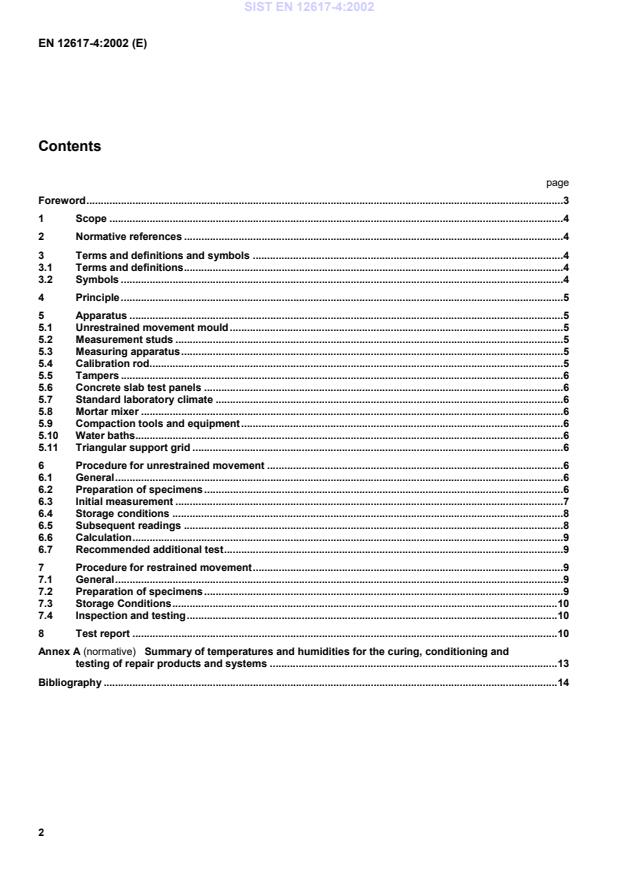
Summary of temperatures and humidities for the curing, conditioning andtesting of repair products and systems.13Bibliography.14SIST EN 12617-4:2002
1 Under preparation.SIST EN 12617-4:2002
...