

prEN 17555-1
(Main)Aggregates for construction works - Part 1: Characteristics
General Information
- Abstract
The Part 1 (harmonised) European Standard will specify the characteristics of aggregates for use in
• concrete for buildings, roads and other civil engineering works,
• mortar
• bituminous mixtures and surface treatments for roads, airfields and other trafficked areas,
• unbound and hydraulically bound materials for use in civil engineering work and road construction
Aggregates to be covered in this European Standard, are obtained by processing natural, manufactured or recycled materials and mixtures of these materials. Families of aggregates covered will include coarse aggregates, grit, fine aggregates, natural graded aggregates, all-in aggregates and added fillers.
The standard will cover natural and manufactured aggregates having an oven dried particle density greater than 2,00 Mg/m3 and recycled aggregates with particle densities greater than 1,50 Mg/m3. Natural and manufactured aggregates of density less than or equal to 2,00 Mg/m3 are already covered by our existing standard EN 13055.
The standard will not cover
• the use of reclaimed bituminous mixtures. Reclaimed asphalt for use as a constituent of bituminous mixtures is specified in EN 13108 8.
• use of aggregates as soil
• the creation of unbound mixtures for road construction from aggregates as this aspect is specified in EN13285
The non-harmonised Part 2 standard will provide non-contradictory complementary information to assist in the practical application of the Part 1 standard, including advice on the reasons for testing and declaring various characteristics and recommendations for the practical implementation of factory production control measures.
- Status
- Not Published
- Publication Date
- 25-Oct-2023
- Technical Committee
- CEN/TC 154 - Aggregates
- Drafting Committee
- CEN/TC 154 - Aggregates
- Current Stage
- 4060 - Closure of enquiry - Enquiry
- Start Date
- 26-Aug-2021
- Due Date
- 02-Aug-2021
- Completion Date
- 26-Aug-2021



Overview
The European Standard prEN 17555-1, titled Aggregates for Construction Works - Part 1: Characteristics, is developed by CEN to specify the key characteristics of aggregates used in various construction applications. This harmonised standard covers natural, manufactured, and recycled aggregates, including various aggregate families such as coarse aggregates, grit, fine aggregates, natural graded aggregates, all-in aggregates, and added fillers. It applies to aggregates with oven-dried particle densities above 2.00 Mg/m³ for natural and manufactured types, and above 1.50 Mg/m³ for recycled materials.
This standard is essential for ensuring consistent quality and performance in aggregates intended for:
- Concrete in buildings, roads, and civil engineering
- Mortar applications
- Bituminous mixtures and surface treatments for traffic areas including roads and airfields
- Unbound and hydraulically bound materials in road and civil engineering construction
prEN 17555-1 replaces several earlier standards, streamlining terminology, testing, and classification to support better harmonisation across Europe.
Key Topics
- Aggregate Types and Definitions: Includes coarse and fine aggregates, grit, natural graded, all-in aggregates, and various types of added fillers (natural, manufactured, mixed, composite, and recycled).
- Particle Properties: Focus on particle size, shape, density, percentage of crushed particles, and cleanliness to ensure optimal performance.
- Mechanical and Durability Characteristics:
- Resistance to fragmentation, wear, polishing, abrasion, attrition, and thermal shock.
- Volume stability and resistance to weathering, including freeze-thaw resistance.
- Water absorption, durability, and chemical characteristics such as sulfate and sulfur content.
- Testing Protocols: Specifies standardized sampling methods and test methods for assessing aggregate properties like methylene blue value, carbonate content, and resistance tests.
- Factory Production Control (FPC): Guidelines for ongoing quality control, initial inspections, and continuous monitoring to ensure the reliability of aggregate production.
- Marking, Labelling, and Packaging: Ensures traceability and information transparency throughout the supply chain.
Notably, the standard excludes the use of reclaimed bituminous mixtures, soil aggregates, armourstone, railway ballast, and aggregates for earthworks, which are covered under other European standards.
Applications
prEN 17555-1 aggregates are fundamental materials in multiple construction sectors:
- Concrete Production: Ensures the performance of structural and non-structural concrete for buildings, bridges, highways, and civil infrastructure.
- Mortar and Plasters: Used in masonry mortar, floor screeds, wall renders, repair mortars, and grouts, requiring precise aggregate characteristics for workability and strength.
- Road Construction: Critical for bituminous mixtures, surface treatments, base and sub-base layers, and sprayed asphalt surfaces on roads and airfields.
- Civil Engineering Works: Suitable for hydraulically bound mixtures and unbound road construction materials, ensuring stability and longevity.
Aggregates that comply with this standard contribute to improved construction quality, durability, safety, and environmental sustainability by integrating both natural and recycled materials within a regulated framework.
Related Standards
- prEN 13055-1:2021: Lightweight aggregates with lower density than those covered in prEN 17555-1.
- prEN 13383-1:2021: Armourstone characteristics for use in hydraulic engineering.
- prEN 13450-1:2021: Aggregates for railway ballast.
- EN 13108-8:2016: Reclaimed asphalt aggregates used in bituminous mixtures.
- EN 16907-2:2018: Aggregates used in earthworks.
- Test Method Standards: Including EN 933 series (geometrical properties), EN 1097 series (mechanical and physical properties), and others for specific chemical and mechanical tests.
This suite of standards collectively ensures the comprehensive assessment and specification of construction aggregates, supporting regulatory compliance, quality assurance, and enhanced construction performance.
Keywords: prEN 17555-1, European Standard aggregates, construction aggregates, coarse aggregates, fine aggregates, added fillers, aggregate characteristics, concrete aggregates, road construction materials, aggregate testing, factory production control, recycled aggregates, civil engineering materials, harmonised aggregate standards, CEN technical committee.
Relations
- Effective Date
- 19-Jan-2023
- Effective Date
- 19-Jan-2023
- Effective Date
- 19-Jan-2023
- Effective Date
- 18-Jan-2023
- Effective Date
- 18-Jan-2023
- Effective Date
- 08-Jun-2022
Get Certified
Connect with accredited certification bodies for this standard

DIBt (Deutsches Institut für Bautechnik)
German Institute for Building Technology.
DIN CERTCO
DIN Group product certification.

Aboma Certification B.V.
Specialized in construction, metal, and transport sectors.
Sponsored listings
Frequently Asked Questions
prEN 17555-1 is a draft published by the European Committee for Standardization (CEN). Its full title is "Aggregates for construction works - Part 1: Characteristics". This standard covers: The Part 1 (harmonised) European Standard will specify the characteristics of aggregates for use in • concrete for buildings, roads and other civil engineering works, • mortar • bituminous mixtures and surface treatments for roads, airfields and other trafficked areas, • unbound and hydraulically bound materials for use in civil engineering work and road construction Aggregates to be covered in this European Standard, are obtained by processing natural, manufactured or recycled materials and mixtures of these materials. Families of aggregates covered will include coarse aggregates, grit, fine aggregates, natural graded aggregates, all-in aggregates and added fillers. The standard will cover natural and manufactured aggregates having an oven dried particle density greater than 2,00 Mg/m3 and recycled aggregates with particle densities greater than 1,50 Mg/m3. Natural and manufactured aggregates of density less than or equal to 2,00 Mg/m3 are already covered by our existing standard EN 13055. The standard will not cover • the use of reclaimed bituminous mixtures. Reclaimed asphalt for use as a constituent of bituminous mixtures is specified in EN 13108 8. • use of aggregates as soil • the creation of unbound mixtures for road construction from aggregates as this aspect is specified in EN13285 The non-harmonised Part 2 standard will provide non-contradictory complementary information to assist in the practical application of the Part 1 standard, including advice on the reasons for testing and declaring various characteristics and recommendations for the practical implementation of factory production control measures.
The Part 1 (harmonised) European Standard will specify the characteristics of aggregates for use in • concrete for buildings, roads and other civil engineering works, • mortar • bituminous mixtures and surface treatments for roads, airfields and other trafficked areas, • unbound and hydraulically bound materials for use in civil engineering work and road construction Aggregates to be covered in this European Standard, are obtained by processing natural, manufactured or recycled materials and mixtures of these materials. Families of aggregates covered will include coarse aggregates, grit, fine aggregates, natural graded aggregates, all-in aggregates and added fillers. The standard will cover natural and manufactured aggregates having an oven dried particle density greater than 2,00 Mg/m3 and recycled aggregates with particle densities greater than 1,50 Mg/m3. Natural and manufactured aggregates of density less than or equal to 2,00 Mg/m3 are already covered by our existing standard EN 13055. The standard will not cover • the use of reclaimed bituminous mixtures. Reclaimed asphalt for use as a constituent of bituminous mixtures is specified in EN 13108 8. • use of aggregates as soil • the creation of unbound mixtures for road construction from aggregates as this aspect is specified in EN13285 The non-harmonised Part 2 standard will provide non-contradictory complementary information to assist in the practical application of the Part 1 standard, including advice on the reasons for testing and declaring various characteristics and recommendations for the practical implementation of factory production control measures.
prEN 17555-1 is classified under the following ICS (International Classification for Standards) categories: 91.100.15 - Mineral materials and products. The ICS classification helps identify the subject area and facilitates finding related standards.
prEN 17555-1 has the following relationships with other standards: It is inter standard links to EN 13139:2002/AC:2004, EN 13043:2002, EN 13139:2002, EN 12620:2002+A1:2008, EN 13043:2002/AC:2004, EN 13242:2002+A1:2007. Understanding these relationships helps ensure you are using the most current and applicable version of the standard.
prEN 17555-1 is associated with the following European legislation: EU Directives/Regulations: 305/2011; Standardization Mandates: M/125. When a standard is cited in the Official Journal of the European Union, products manufactured in conformity with it benefit from a presumption of conformity with the essential requirements of the corresponding EU directive or regulation.
prEN 17555-1 is available in PDF format for immediate download after purchase. The document can be added to your cart and obtained through the secure checkout process. Digital delivery ensures instant access to the complete standard document.
Standards Content (Sample)
SLOVENSKI STANDARD
01-september-2021
Agregati za gradbena dela - 1. del: Značilnosti
Aggregates for construction works - Part 1: Characteristics
Gesteinskörnungen für Bauwerke - Teil 1: Produktnorm
Granulats pour travaux de construction - Partie 1 : caractéristiques
Ta slovenski standard je istoveten z: prEN 17555-1
ICS:
91.100.15 Mineralni materiali in izdelki Mineral materials and
products
2003-01.Slovenski inštitut za standardizacijo. Razmnoževanje celote ali delov tega standarda ni dovoljeno.
DRAFT
EUROPEAN STANDARD
NORME EUROPÉENNE
EUROPÄISCHE NORM
June 2021
ICS 91.100.15 Will supersede EN 12620:2002+A1:2008, EN
13043:2002, EN 13139:2002, EN
13242:2002+A1:2007
English Version
Aggregates for construction works - Part 1: Characteristics
Granulats pour travaux de construction - Partie 1 : Gesteinskörnungen für Bauwerke - Teil 1:
caractéristiques Produktnorm
This draft European Standard is submitted to CEN members for enquiry. It has been drawn up by the Technical Committee
CEN/TC 154.
If this draft becomes a European Standard, CEN members are bound to comply with the CEN/CENELEC Internal Regulations
which stipulate the conditions for giving this European Standard the status of a national standard without any alteration.
This draft European Standard was established by CEN in three official versions (English, French, German). A version in any other
language made by translation under the responsibility of a CEN member into its own language and notified to the CEN-CENELEC
Management Centre has the same status as the official versions.
CEN members are the national standards bodies of Austria, Belgium, Bulgaria, Croatia, Cyprus, Czech Republic, Denmark, Estonia,
Finland, France, Germany, Greece, Hungary, Iceland, Ireland, Italy, Latvia, Lithuania, Luxembourg, Malta, Netherlands, Norway,
Poland, Portugal, Republic of North Macedonia, Romania, Serbia, Slovakia, Slovenia, Spain, Sweden, Switzerland, Turkey and
United Kingdom.
Recipients of this draft are invited to submit, with their comments, notification of any relevant patent rights of which they are
aware and to provide supporting documentation.
Warning : This document is not a European Standard. It is distributed for review and comments. It is subject to change without
notice and shall not be referred to as a European Standard.
EUROPEAN COMMITTEE FOR STANDARDIZATION
COMITÉ EUROPÉEN DE NORMALISATION
EUROPÄISCHES KOMITEE FÜR NORMUNG
CEN-CENELEC Management Centre: Rue de la Science 23, B-1040 Brussels
© 2021 CEN All rights of exploitation in any form and by any means reserved Ref. No. prEN 17555-1:2021 E
worldwide for CEN national Members.
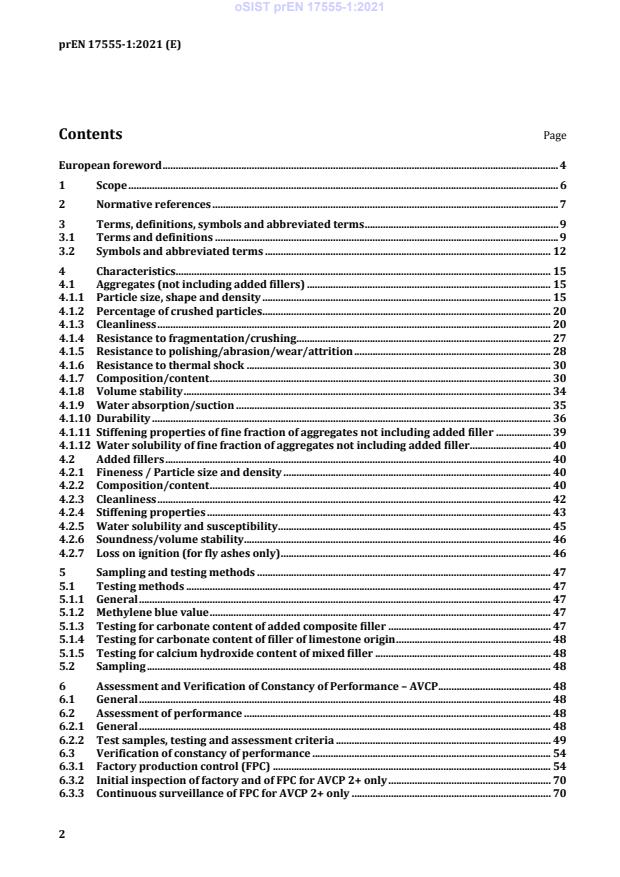
Contents Page
European foreword . 4
1 Scope . 6
2 Normative references . 7
3 Terms, definitions, symbols and abbreviated terms . 9
3.1 Terms and definitions . 9
3.2 Symbols and abbreviated terms . 12
4 Characteristics . 15
4.1 Aggregates (not including added fillers) . 15
4.1.1 Particle size, shape and density . 15
4.1.2 Percentage of crushed particles . 20
4.1.3 Cleanliness . 20
4.1.4 Resistance to fragmentation/crushing . 27
4.1.5 Resistance to polishing/abrasion/wear/attrition . 28
4.1.6 Resistance to thermal shock . 30
4.1.7 Composition/content . 30
4.1.8 Volume stability . 34
4.1.9 Water absorption/suction . 35
4.1.10 Durability . 36
4.1.11 Stiffening properties of fine fraction of aggregates not including added filler . 39
4.1.12 Water solubility of fine fraction of aggregates not including added filler. 40
4.2 Added fillers . 40
4.2.1 Fineness / Particle size and density . 40
4.2.2 Composition/content . 40
4.2.3 Cleanliness . 42
4.2.4 Stiffening properties . 43
4.2.5 Water solubility and susceptibility . 45
4.2.6 Soundness/volume stability . 46
4.2.7 Loss on ignition (for fly ashes only) . 46
5 Sampling and testing methods . 47
5.1 Testing methods . 47
5.1.1 General . 47
5.1.2 Methylene blue value . 47
5.1.3 Testing for carbonate content of added composite filler . 47
5.1.4 Testing for carbonate content of filler of limestone origin . 48
5.1.5 Testing for calcium hydroxide content of mixed filler . 48
5.2 Sampling . 48
6 Assessment and Verification of Constancy of Performance – AVCP . 48
6.1 General . 48
6.2 Assessment of performance . 48
6.2.1 General . 48
6.2.2 Test samples, testing and assessment criteria . 49
6.3 Verification of constancy of performance . 54
6.3.1 Factory production control (FPC) . 54
6.3.2 Initial inspection of factory and of FPC for AVCP 2+ only . 70
6.3.3 Continuous surveillance of FPC for AVCP 2+ only . 70
7 Marking, labelling and packaging . 70
Annex ZA (informative) Relationship of this European Standard with Regulation (EU)
No.305/2011 . 72
Bibliography . 88
European foreword
This document (prEN 17555-1:2021) has been prepared by Technical Committee CEN/TC 154
“Aggregates”, the secretariat of which is held by BSI.
This document is currently submitted to the CEN Enquiry.
This document will supersede the following set of standards:
— EN 12620:2002+A1:2008,
— EN 13043:2002, together with EN 13043:2002/AC:2004,
— EN 13139:2002, together with EN 13139:2002/AC:2004, and
— EN 13242:2002+A1:2007.
The most significant technical changes compared to EN 12620:2002+A1:2008, EN 13043:2002,
together with EN 13043:2002/AC:2004, EN 13139:2002, together with EN 13139:2002/AC:2004, and
EN 13242:2002+A1:2007 include:
a) unification and clarifications of the scope statement;
b) unification and improvement of definitions for aggregate families and other matters which were
common across the four main aggregate standards EN 12620, EN 13043, EN 13139 and EN 13242,
i.e. for coarse, fine, all-in aggregates, natural graded aggregates, grit and added fillers;
c) updating and improving references to supporting test methods;
d) consolidation of classes for characteristics, including:
a. merging of classes which were common across the four main aggregate standards: EN 12620,
EN 13043, EN 13139 and EN 13242;
b. addition of classes to respond to requests from Member States;
c. addition of intermediate classes to provide a more uniform sequence;
e) with regard to aggregates (not including added filler):
a. unification of overall limits for graded coarse aggregates at mid-size sieves;
b. removal of clauses referring to tolerances on grading;
c. deletion of classes (and replacement with a simple level declaration) for proportions of
constituents of recycled aggregates and for water absorption linked to freeze thaw resistance;
d. addition of new classes for the following: grading, particle shape, crushed particles, fines
content, sand equivalent value; methylene blue value; shell content, lightweight
contaminators, resistance to fragmentation, resistance to wear, resistance to abrasion from
studded tyres, total sulfur content, water soluble sulfate content of recycled aggregates, effect
of organic contaminators on the rate of setting and hardening of concrete mortar and
hydraulically bound mixtures – recycled aggregates, resistance to weathering – magnesium
sulfate soundness;
e. introduction of aggregate proxy characteristics and classes for the following:, susceptibility to
attrition; resistance to weathering – water absorption; water soluble sulfate content of coarse
natural aggregates; resistance to freezing and thawing in the presence of salt;
f. formal addition of characteristics and some classes for the fine fraction of aggregates not
including added filler. These are identical to the equivalent tests for added fillers and
previously were just cross referenced to filler tests;
g. removal of simple petrographic description from the characteristics and inclusion instead
under the marking labelling and packaging clause;
f) with regard to added fillers:
a. addition of new classes for total sulfur content, harmful fines, water content, volume of voids
and change of the softening point, carbonate content of filler of limestone origin, loss on
ignition;
b. removal of the clause relating to specific surface area of added filler;
c. introduction of a new characteristic and classes for carbonate content of composite filler;
g) restructuring of all clauses to be in line with the requirements of the Construction Product
Regulations;
h) introduction of revised AVCP clauses and tables, although minimum test frequencies are almost
unchanged.
Provisions for other types of aggregates and their intended uses are specified in the following
European Standards:
— prEN 13055:2021, Lightweight aggregates
— prEN 13383-1:2021, Armourstone — Part 1: Characteristics
— prEN 13450-1:2021, Aggregates for railway ballast — Part 1: Characteristics
This document has been prepared under a mandate given to CEN by the European Commission and
the European Free Trade Association.
For relationship with Regulation (EU) No. 305/2011 on construction products (CPR), see informative
Annex ZA, which is an integral part of this document.
1 Scope
This document specifies the characteristics of aggregates, i.e. aggregates without added fillers (see
3.1.1 a) and added fillers (see 3.1.1 b), for uses, either with or without high safety requirements, for:
a) concrete for buildings, roads and other civil engineering works,
b) bituminous mixtures and surface treatments for roads, airfields and other trafficked areas,
c) mortars, renders and screeds, e.g. masonry mortar, floor/screed mortar, surfacing of internal
walls (plastering mortar), rendering of external walls, special bedding materials, repair mortar
and grouts for buildings, roads and civil engineering works;
d) unbound and hydraulically bound materials for civil engineering works and road constructions.
With regard to the material source and production process, this document covers natural aggregate
(see 3.1.2), manufactured aggregate (see 3.1.3), recycled aggregates (see 3.1.4), and mixtures of these
materials.
Aggregates covered in this document are:
a) aggregates without added fillers, including coarse aggregates (see 3.1.8), grit (see 3.1.11), fine
aggregates (see 3.1.12), all-in aggregates (see 3.1.13), natural graded aggregates (see 3.1.14); and
b) added fillers (see 3.1.15).
Coarse aggregates covered in this document are single sized coarse aggregates (see 3.1.9) and graded
coarse aggregates (see 3.1.10).
Added fillers covered in this document are natural fillers (see 3.1.16), manufactured fillers (see
3.1.18), mixed fillers (see 3.1.19), composite fillers (see 3.1.20) and recycled fillers (see 3.1.21).
Natural fillers include fillers of limestone origin (see 3.1.17).
This document does not cover:
— natural and manufactured aggregates, having oven-dried particle density less than or equal to
2,00 Mg/m , as they are already specified in prEN 13055:2021,
— recycled aggregates, with particle densities less than 1,50 Mg/m ,
— aggregates with a nominal upper size greater than 90 mm,
— armourstone, as this is specified in prEN13383-1:2021,
— aggregates for railway ballast, as these are specified in prEN 13450-1:2021,
— use of aggregates contained within reclaimed bituminous mixtures, as the reclaimed asphalt for
use as a constituent of bituminous mixtures is already specified in EN 13108-8:2016,
— use of aggregates as soil,
— use of aggregates in earthworks, as these are specified in EN 16907-2:2018.
2 Normative references
The following documents are referred to in the text in such a way that some or all of their content
constitutes requirements of this document. For dated references, only the edition cited applies. For
undated references, the latest edition of the referenced document (including any amendments)
applies.
EN 196-2:2013, Method of testing cement - Part 2: Chemical analysis of cement
EN 459-2:—, Building lime — Part 2: Test methods
prEN 932-3:2021, Tests for general properties of aggregates — Part 3: Procedure and terminology for
simplified petrographic description
prEN 933-1:2021, Tests for geometrical properties of aggregates — Part 1: Determination of particle
size distribution — Sieving method
EN 933-3:2012, Tests for geometrical properties of aggregates - Part 3: Determination of particle shape -
Flakiness index
EN 933-4:2008, Tests for geometrical properties of aggregates - Part 4: Determination of particle shape -
Shape index
prEN 933-5:2021, Tests for geometrical properties of aggregates — Part 5: Determination of percentage
of crushed and broken surfaces in coarse aggregate particles
prEN 933-6:2021, Tests for geometrical properties of aggregates — Part 6: Assessment of surface
characteristics — Flow coefficient of aggregates
EN 933-7:1998, Tests for geometrical properties of aggregates - Part 7: Determination of shell content -
Percentage of shells in coarse aggregates
EN 933-8:2012+A1:2015, Tests for geometrical properties of aggregates - Part 8: Assessment of fines -
Sand equivalent test
prEN 933-9:2021, Tests for geometrical properties of aggregates — Part 9: Assessment of fines —
Methylene blue test
EN 933-10:2009, Tests for geometrical properties of aggregates - Part 10: Assessment of fines - Grading
of filler aggregates (air jet sieving)
prEN 933-11:2021, Tests for geometrical properties of aggregates — Part 11: Classification test for the
constituents of coarse recycled aggregate
prEN 1097-1:2021, Tests for mechanical and physical properties of aggregates — Part 1: Determination
of the resistance to wear (micro-Deval)
EN 1097-2:2020, Tests for mechanical and physical properties of aggregates - Part 2: Methods for the
determination of resistance to fragmentation
EN 1097-4:2008, Tests for mechanical and physical properties of aggregates - Part 4: Determination of
the voids of dry compacted filler
To be published. Stage at the time of publication: EN 459-2:2021.
EN 1097-5:2008, Tests for mechanical and physical properties of aggregates - Part 5: Determination of
the water content by drying in a ventilated oven
prEN 1097-6:2021, Tests for mechanical and physical properties of aggregates — Part 6: Determination
of particle density and water absorption
prEN 1097-7:2021, Tests for mechanical and physical properties of aggregates - Part 7: Determination of
the particle density of filler — Pyknometer method
EN 1097-8:2020, Tests for mechanical and physical properties of aggregates - Part 8: Determination of
the polished stone value
EN 1097-9:2014, Tests for mechanical and physical properties of aggregates - Part 9: Determination of
the resistance to wear by abrasion from studded tyres - Nordic test
EN 1097-10:2014, Tests for mechanical and physical properties of aggregates - Part 10: Determination
of water suction height
EN 1367-1:2007, Tests for thermal and weathering properties of aggregates - Part 1: Determination of
resistance to freezing and thawing
EN 1367-2:2009, Tests for thermal and weathering properties of aggregates — Part 2: Magnesium
sulfate test
EN 1367-3:2001, Tests for thermal and weathering properties of aggregates - Part 3 : Boiling test for
"Sonnenbrand basalt"
EN 1367-4:2008, Tests for thermal and weathering properties of aggregates - Part 4: Determination of
drying shrinkage
EN 1367-5:2011, Tests for thermal and weathering properties of aggregates - Part 5: Determination of
resistance to thermal shock
EN 1367-6:2008, Tests for thermal and weathering properties of aggregates - Part 6: Determination of
resistance to freezing and thawing in the presence of salt (NaCl)
EN 1744-1:2009+A1:2012, Tests for chemical properties of aggregates - Part 1: Chemical analysis
EN 1744-4:2005, Tests for chemical properties of aggregates - Part 4: Determination of water
susceptibility of fillers for bituminous mixtures
EN 1744-5:2006, Tests for chemical properties of aggregates - Part 5: Determination of acid soluble
chloride salts
EN 1744-6:2006, Tests for chemical properties of aggregates - Part 6: Determination of the influence of
recycled aggregate extract on the initial setting time of cement
EN 13179-1:2013, Tests for filler aggregate used in bituminous mixtures - Part 1: Delta ring and ball test
EN 13179-2:2000, Tests for filler aggregate used in bituminous mixtures — Part 2: Bitumen number
As impacted by EN 1367-3:2001/AC:2004.
3 Terms, definitions, symbols and abbreviated terms
For the purposes of this document, the following terms and definitions apply.
ISO and IEC maintain terminological databases for use in standardization at the following addresses:
— ISO Online browsing platform: available at https://www.iso.org/obp
— IEC Electropedia: available at https://www.electropedia.org/
3.1 Terms and definitions
3.1.1
aggregate
granular material of natural, manufactured or recycled origin used in construction, and including:
a) aggregates without added fillers, and
b) added fillers
3.1.2
natural aggregate
aggregate from mineral sources that has been subjected to nothing more than mechanical processing
and sometimes washing
3.1.3
manufactured aggregate
aggregate of mineral origin resulting from an industrial process involving thermal or other
modification
Note 1 to entry: Manufactured aggregates (not including added filler) are of different types, including those,
namely air-cooled blast furnace slags, steel slags and foundry cupola furnace slags, for which this standard
defines application of specific test methods to cover some essential characteristics.
3.1.4
recycled aggregate
aggregate resulting from the processing of mineral material either previously used in construction or
from the processing of the residues of material production
Note 1 to entry: Recycled aggregates can also be obtained from production residues e.g. crushed unused
concrete.
3.1.5
aggregate size
designation of aggregate in terms of lower (d) and upper (D) sieve sizes expressed as d/D, where d/D <
0,72
Note 1 to entry: Sieve sizes are selected from those in EN 933-2:2020.
Note 2 to entry: This designation accepts the presence of some particles which are retained on the upper
sieve (oversize) and some which pass the lower sieve (undersize).
3.1.6
grading
particle size distribution expressed as the percentages by mass passing a specified set of sieves
Note 1 to entry: The grading classes are designated as G X/Y (n = C, CA, G or GA) or as G X (n = F, NG or A) in
n n
which:
n: type of grading defined below:
C = coarse;
CA = coarse aggregates for bituminous mixtures only;
G = grit;
GA = grit for bituminous mixtures only;
F = fine;
NG = natural graded;
A = all-in;
X :minimum percentage by mass passing the upper (D) sieve size;
Y :maximum percentage by mass passing the lower (d) sieve size.
3.1.7
fines
particle size fraction of an aggregate that passes the 0,063 mm sieve
3.1.8
coarse aggregate
designation given to the larger aggregate sizes with D greater than 4 mm and less than 90mm and d
greater than or equal to 1 mm
3.1.9
single sized coarse aggregate
designation given to coarse aggregate where either
D > 11,2 mm and D/d ≤ 2 or
D ≤ 11,2 mm and D/d ≤ 4
3.1.10
graded coarse aggregate
designation given to coarse aggregate where either
D > 11,2 mm and D/d > 2 or
D ≤ 11,2mm and D/d > 4
3.1.11
grit
designation given to the aggregate sizes with D less than or equal to 4 mm and d greater than or equal
to 1 mm
3.1.12
fine aggregate
designation given to the smaller aggregate sizes with D less than or equal to 4 mm and d equal to 0
3.1.13
all-in aggregate
processed aggregate consisting of a mixture of coarse and fine aggregates with D greater than 4 mm
and d equal to 0
Note 1 to entry: It can be produced without separating into coarse and fine fractions or it can be produced by
combining coarse and fine aggregates.
3.1.14
natural graded aggregate
designation given to natural aggregate sizes of glacial and/or fluvial origin with D less than or equal to
8 mm and d equal to 0
3.1.15
added filler
aggregate, at least 70% of which passes the 0,063 mm sieve, that has been produced separately, which
can be added to construction materials to provide their performances required for certain end uses
Note 1 to entry: Added filler is sometimes described as ‘filler aggregate’.
3.1.16
natural filler
added filler from mineral sources that has been subjected to nothing more than mechanical processing
3.1.17
filler of limestone origin
added filler produced from limestone, dolomitised limestone or dolomite
3.1.18
manufactured filler
added filler of mineral origin resulting from an industrial process involving thermal or other
modification
Note 1 to entry: Manufactured added fillers are of different types, including those, namely fly ashes, for which
this standard defines application of specific test methods to cover some essential characteristics. .
3.1.19
mixed filler
added filler comprising natural or manufactured filler mixed with calcium hydroxide
3.1.20
composite filler
added filler comprising filler of limestone origin mixed with fly ash
3.1.21
recycled filler
added filler resulting from the processing of mineral material either previously used in construction or
obtained from the residues of material production
3.1.22
particle size fraction
fraction of an aggregate passing the larger of two sieves and retained on the smaller
Note 1 to entry: The lower limit can be zero.
3.1.23
oversize
part of the aggregate retained on the upper of the limiting sieves used in aggregate size description
3.1.24
undersize
part of the aggregate passing the lower of the limiting sieves used in aggregate size description
3.1.25
product family
group of products produced by one manufacturer for which the assessment results for one or more
characteristics from any one product within the range are valid for all other products within this range
3.2 Symbols and abbreviated terms
For the purposes of this document, the following symbols and abbreviations apply:
Symbol/Acronym Meaning:
A Change in the initial setting time
AAV Aggregate Abrasion Value
A Resistance against abrasion from studded tires (Nordic Abrasion value)
N
AS Acid-soluble sulfate content
AVCP Assessment for Verification of Constancy of Performance
BN Bitumen Number (of added filler)
C (Percentage of) Crushed particles
CC Carbonate Content of composite filler
f
CC Carbonate Content of filler of limestone origin
l
d lower sieve size designation in mm
D upper sieve size designation in mm
d/D Aggregate size designation
E Flow coefficient of fine aggregates
CS
f Fines content
F Freeze thaw resistance
F Freeze thaw resistance in the presence of salt (extreme conditions)
EC
FI Flakiness Index
G X/Y Grading (for “n”, “X” and “Y” see 3.1.6)
n
I Percentage passing the 5 mm sieve after thermal shock
Ka Calcium hydroxide content (of mixed filler)
LA Los Angeles coefficient
L Loss on ignition
i
MB, MB Methylene Blue value
A
Symbol/Acronym Meaning:
MBF Methylene Blue value of filler
M Micro-Deval coefficient
DE
m Lightweight contaminators
LPC
MS Magnesium Sulfate soundness
PSV Polished stone value
Q Swelling of a Marshall specimen
S Total sulfur content
SC Shell content
SE , SE Sand equivalent value
10 4
SI Shape Index
SS Water-soluble sulfate content
SZ Impact value
v voids content of dry compacted filler (Rigden)
V Volume Stability
V Absolute loss of Los Angeles coefficient after thermal shock
LA
VSZ Absolute loss of impact value after thermal shock
WC Water Content (of added filler)
WS Water Solubility (of filler)
Δ Delta Ring and Ball (softening point)
R&B
Symbol Constituent of recycled aggregate Additional description
concrete dense and cured (hardened) mix of fine and coarse
aggregates with attached mortar of concrete
concrete products, concrete blocks concrete slabs, concrete pavers, roller compacted
Rc
concrete, concrete bricks, core floor slabs, concrete
roofing tiles, etc.
concrete mortar cured concrete mortar
natural stone stone from mineral sources that has been subjected
Rn to nothing more than mechanical processing and
sometimes washing
Ru
hydraulically bound mixtures - not lean concrete, sand cement, stabilized coarse
concrete aggregates, ternary mixture
Rh
comparable materials screed floor of cement mortar
Rs materials from metallurgical industry ferrous- and non-ferrous slags
Consisting of …
1. elements of baked clay bricks, pottery, roof tiles, vitrified clay pipe,
expanded clay, pavers
2. ceramic products ceramic products (tiles, sanitary elements, plinths)
Rb
3. lightweight concrete concrete with lightweight grains (expanded clay),
aerated concrete, cellcrete
4. masonry mortar mortar from joints in masonry, surface render
5. elements of calcium silicate sand-limestone
6. other comparable materials oven stone, shells and other
hydrocarbon mixtures asphalt, mastic asphalt, lean asphalt, cement asphalt
Ra
aggregate
Rg Glass glass, regardless of origin
Consisting of …
1. cohesive materials clay and soil
2. roofing bitumen and bitumen sheets bitumen roofing and bitumen- and bituminous
materials sheets
3. plastic, rubber PVC, HDPE, LDPE, rubber, polystyrene,
polycarbonate, formica, and other plastics
X
4. wood, organic materials all organic materials
5. metals all metals
6. gypsum gypsum blocks and –plaster
7. materials from thermal processes coal, black carboniferous slate, lignite, coal residues
8. other contaminants (not limited) insulation, fiberboard and other materials
particles with density ≤ 1 000 kg/m all floating materials on water
FL
4 Characteristics
4.1 Aggregates (not including added fillers)
4.1.1 Particle size, shape and density
4.1.1.1 Grading
4.1.1.1.1 Coarse aggregates
The grading of coarse aggregates shall be determined in accordance with prEN 933-1:2021.
The results obtained shall be evaluated against the classification criteria for the relevant grading, for:
a) single sized coarse aggregates, as given in Table 1, and
b) graded coarse aggregates, as given in Tables 1 and 2.
The performance shall be expressed as a grading class in accordance with the provisions of Table 1 or
Tables 1 and 2.
Table 1 — Grading classes for coarse aggregates
Size Percentage passing by mass Class
G X/Y
mm 2D 1,4D D d d/2
n
G 90/15
100 98 to 100 90 to 99 0 to 15 0 to 5
C
G 90/20
100 98 to 100 90 to 99 0 to 20 0 to 5
C
G 85/15
100 98 to 100 85 to 99 0 to 15 0 to 5
C
G 85/20
100 98 to 100 85 to 99 0 to 20 0 to 5
C
G 80/15
100 98 to 100 80 to 99 0 to 15 0 to 5
C
G 80/20
100 98 to 100 80 to 99 0 to 20 0 to 5
C
G 80/35
100 98 to 100 80 to 99 0 to 35 0 to 5
C
D > 4
d ≥ 1
G 85/35
100 98 to 100 85 to 99 0 to 35 0 to 5
C
GC
100 98 to 100 X to 99 0 to Y 0 to 5
StatedX/Y
G 90/10
100 100 90 to 99 0 to 10 0 to 2
CA
G 85/15
100 98 to 100 85 to 99 0 to 15 0 to 2
CA
G 80/15
100 98 to 100 80 to 99 0 to 15 0 to 2
CA
GCA
100 98 to 100 X to 99 0 to Y 0 to 2
StatedX/Y
Table 2 — Overall levels for graded coarse aggregates at mid-size sieves
Overall threshold levels for
Mid-size sieve
percentage passing mid-size sieve
D/d
mm
Percentage passing by mass
< 4 D/1,4 20 to 80
≥ 4 D/2 20 to 70
4.1.1.1.2 Grit
The grading of grits shall be determined in accordance with prEN 933-1:2021.
The results obtained shall be evaluated against the classification criteria for the relevant grading in
Table 3.
The performance shall be expressed as a class in accordance with the provisions of Table 3.
Table 3 — Grading classes for grits
Size Percentage passing by mass Class
G X/Y
mm 2D 1,4D D d d/2
n
G 90/10
100 98 to100 90 to 99 0 to 10 0 to 2
GA
100 98 to 100 X to 99 0 to Y 0 to 2 GGAStated X/Y
G 90/10
100 98 to100 90 to 99 0 to 10 0 to 5
G
G 85/15
100 95 to 100 85 to 99 0 to 15 0 to 5
G
G 85/20
100 98 to 100 85 to 99 0 to 20 0 to 5
G
D ≤ 4
d ≥ 1
G 85/35
100 98 to 100 85 to 99 0 to 35 0 to 5
G
G 80/20
100 98 to 100 80 to 99 0 to 20 0 to 5
G
GGStated (95)
100 95 to 100 X to 99 0 to Y 0 to 5
X/Y
GGStated (98)
100 98 to 100 X to 99 0 to Y 0 to 5
X/Y
4.1.1.1.3 Fine aggregates
The grading of fine aggregates shall be determined in accordance with prEN 933-1:2021.
The results obtained shall be evaluated against the classification criteria for the relevant grading in
Table 4.
The performance shall be expressed as a class in accordance with the provisions of Table 4.
Table 4 — Grading classes for fine aggregates
Size Percentage passing by mass Class
G X
mm 2D 1,4D D
F
G 85
100 98 to 100 85 to 99
F
D ≤ 4
G 80
100 98 to 100 80 to 99
F
d = 0
100 98 to 100 X to 99 G X
F Stated
4.1.1.1.4 All-in aggregates
The grading of all-in aggregates shall be determined in accordance with prEN 933-1:2021.
The results obtained shall be evaluated against the classification criteria for the relevant grading, as
given in Tables 5 and 6.
The performance shall be expressed as a class in accordance with the provisions of Table 5.
Table 5 — Grading classes for all-in aggregates
Size Percentage passing by mass Class
a
G X
mm 2D 1,4D D
A
G 90
100 98 to 100 90 to 99
A
G 85
100 98 to 100 85 to 99
A
G 80
100 98 to 100 80 to 99
A
D > 4
d = 0
G 75
100 - 75 to 99
A
G 70
100 - 70 to 99
A
100 - X to 99 GA Stated X
a
For aggregate sizes where D is greater than 63 mm (e.g. 80 mm and 90 mm), only the oversize limit related to
the 1,4 D sieve applies.
Table 6 — Overall limits for all-in aggregate at intermediate sieves
Overall threshold limits at intermediate sieves
Sieve size
Percentage passing by mass
mm
D/2 4 mm 2 mm 1 mm
D ≤ 10 50 to 90 — — 20 to 60
10 < D < 32 50 to 90 — 20 to 60 —
D ≥ 32 50 to 90 20 to 60 — —
4.1.1.1.5 Natural graded aggregates
The grading of natural graded aggregates shall be determined in accordance with prEN 933-1:2021.
The results obtained shall be evaluated against the classification criteria for the relevant grading in
Table 7.
The performance shall be expressed as a class in accordance with the provisions of Table 7.
Table 7 — Grading classes for natural graded aggregates
Size Percentage passing by mass Class
G X
mm 2D 1,4D D
n
G 90
100 98 to 100 90 to 99
NG
D ≤ 8
d = 0
100 98 to 100 X to 99 GNG Stated X
4.1.1.2 Particle shape
4.1.1.2.1 Flakiness index
The flakiness index of coarse aggregates and the coarse fraction of all-in and natural graded aggregates
shall be determined in accordance with EN 933-3:2012.
The results obtained shall be evaluated against the criterion for the respective class in Table 8.
The performance shall be expressed as a class in accordance with Table 8.
Table 8 — Classes for flakiness index
Class
Values of Flakiness Index
FI
0 to 10 FI 10
0 to 15 FI 15
0 to 20 FI 20
0 to 25 FI 25
0 to 30 FI 30
0 to 35 FI 35
0 to 40 FI 40
0 to 45 FI 45
0 to 50 FI 50
0 to X, where X > 50 FI X
Stated
4.1.1.2.2 Shape index
The shape index of coarse aggregates and the coarse fraction of all-in and natural graded aggregates
shall be determined in accordance with EN 933-4:2008.
The results obtained shall be evaluated against the criterion for the respective class in Table 9.
The performance shall be expressed as a class in accordance with Table 9.
Table 9 — Classes for shape index
Class
Values of Shape Index
SI
0 to 15 SI 15
0 to 20 SI 20
0 to 25 SI 25
0 to 30 SI 30
0 to 35 SI 35
0 to 40 SI 40
0 to 45 SI 45
0 to 50 SI 50
0 to 55 SI 55
0 to X, where X > 55 SI X
Stated
4.1.1.2.3 Angularity
The angularity of fine aggregates, and of the fine fraction of all-in and natural graded aggregates shall
be determined as the flow coefficient in accordance with prEN 933-6:2021, Clause 8.
The results obtained shall be evaluated against the criterion for the respective class in Table 10.
The performance shall be expressed as a class in accordance with Table 10.
Table 10 — Classes for angularity
Class
Values of Flow coefficient
E
CS
38 to 60 E 38
CS
35 to 60 E 35
CS
30 to 60 E 30
CS
X to 60, where X < 30 E X
CS Stated
4.1.1.3 Particle density
4.1.1.3.1 Particle density of aggregates not including added filler
The particle density of aggregates shall be determined in accordance with prEN 1097-6:2021
The performance shall be expressed as a level in Mg/m , stating the means of determination.
4.1.1.3.2 Particle density of fine fraction of aggregates not including added filler
If the fines content of fine aggregates, all-in aggregates and natural graded aggregates is greater than
10 % by mass, the fraction 0 mm to 0,125 mm shall be separated and the particle density determined
for this size fraction in accordance with prEN 1097-7:2021.
The performance shall be expressed as a level in Mg/m .
4.1.2 Percentage of crushed particles
The percentages of crushed particles, totally crushed particles and totally rounded particles of coarse
aggregates, all-in aggregates and natural graded aggregates and grit shall be assessed, either:
a) without testing (WT), where the aggregates are obtained from crushing of massive rock or slag; or
b) based on determination of the percentages of crushed particles, totally crushed particles and
totally rounded particles in accordance with prEN 933-5:2021.
In case b), the results obtained shall be evaluated against the criterion for the respective class in
Table 11.
The performance shall be expressed as a class
(i) in case a) as class C 90/100/0/ (WT)
(ii) in case b) as a class in accordance with Table 11.
Table 11 — Classes for the percentage of crushed particles
Percentage of totally Percentage of totally
Percentage of crushed Class
crushed particles by rounded particles by
particles by mass C
mass mass
90 to 100 100 0 C 90/100/0
30 to 100 95 to 100 0 to 1 C 30/95/1
30 to 100 90 to 100 0 to 1 C 30/90/1
45 to 100 90 to 100 0 to 1 C 45/90/1
a
- 90 to 100 0 to 3 C N/90/3
a
- 70 to 100 0 to 10 C N/70/10
a
- 50 to 100 0 to 10 C N/50/10
a
- 50 to 100 0 to 30 C N/50/30
a
- C N/N/50
- 0 to 50
a
C N/N/70
- - 0 to 70
a
X to 100 Y to 100 0 to Z C X/Y/Z
Stated
a
N = No minimum value for totally crushed or crushed particles
4.1.3 Cleanliness
4.1.3.1 Fines content
The fines content of aggregates shall be determined in accordance with prEN 933-1:2021.
The results obtained shall be evaluated against the criterion for the respective class in Table 12.
The performance shall be expressed as a class in accordance with Table 12.
Table 12 — Classes for fines content
Value of fines content
Class
Aggregate
Percentage passing
f
0,063 mm sieve by mass
f 0,5
0 to 0,5
0 to 1 f 1
f 1,5
0 to 1,5
Coarse and grit
0 to 2 f 2
0 to 3 f 3
0 to 4 f 4
0 to X, where X > 4 f X
Stated
0 to 3 f 3
0 to 5 f 5
0 to 7 f 7
Natural graded 0/8 mm
0 to 10 f 10
0 to 16 f 16
0 to X, where X > 16 f X
Stated
0 to 3 f 3
0 to 5 f 5
0 to 7 f 7
0 to 9 f 9
All-in 0 to 10 f 10
0 to 11 f 11
0 to 12 f 12
0 to 15 f 15
0 to X, where X > 15 f X
Stated
0 to 3 f 3
0 to 4 f 4
0 to 5 f 5
0 to 6 f 6
Fine
0 to 7 f 7
0 to 10 f 10
0 to 16 f 16
0 to 22 f 22
0 to X, where X > 22 f X
Stated
4.1.3.2 Harmful fines
4.1.3.2.1 General
The harmfulness of fines of fine aggregates, all-in aggregates and natural-graded aggregates may be
determined using two different proxy characteristics: the sand-equivalent value and the methylene
blue value. The “sand equivalent” test quantifies the relative proportions of fine dust or clay-like
materials in fine aggregate by forcing the fine particles into suspension using a flocculating agent.
However, the sand equivalent test does not quantify the deleterious adsorbing effect of the fine dust or
clay-like minerals, which varies from one mineral to another. This is achieved instead by the
methylene blue test which is based on the degree of adsorption of a dye solution of methylene blue by
the particles of clay contained in a 0/2 mm fine aggregate.
4.1.3.2.2 Sand equivalent test
4.1.3.2.2.1 General
There are two methods in EN 933-8:2012+A1:2015 for determining sand equivalent value for fine
aggregates, all-in aggregates and natural graded aggregates: SE and SE . The SE method is carried
10 4 10
out on the 0/2 mm size fraction and the SE method is carried out on the 0/4 mm size fraction. The
SE method shall be the reference method.
4.1.3.2.2.2 Sand equivalent SE method
The sand equivalent SE of fine aggregate, all-in aggregate and natural graded aggregate shall be
assessed, either:
a) without testing (WT), if the performance of fines content of these aggregates is declared, based on
the assessment according to 4.1.3.1, and the value determined therein is < 3 % (by mass); or
b) based on determination of the sand equivalent SE10 in accordance with EN 933-8:2012+A1:2015,
Clause 8.
In case b) the results obtained shall be evaluated against the criterion for the respective class in
Table 11.
The performance shall be expressed as a
...