

EN 13557:2024
(Main)Cranes - Control devices and control stations
- Abstract
This document specifies health and safety design requirements for control devices and control stations and their operating positions for all types of cranes.
Specific requirements for particular types of cranes are given in the appropriate European Standard for the particular crane type (see Annex B).
This document does not deal with noise hazards because these are dealt with in safety standards for specific types of cranes. It also does not address the design of the cabin with regard to its sound insulation properties.
This document covers specific hazards which could occur during the use of control devices and control stations. It does not cover hazards which could occur during transport, construction, modification, de-commissioning, or disposal. The hazards covered by this document are identified in Annex A.
This document is not applicable to cranes manufactured before the date of its publication.
- Status
- Published
- Publication Date
- 19-Mar-2024
- Withdrawal Date
- 15-Dec-2022
- Technical Committee
- CEN/TC 147 - Cranes - Safety
- Drafting Committee
- CEN/TC 147/WG 3 - Design - Requirements for equipment
- Current Stage
- 6060 - Definitive text made available (DAV) - Publishing
- Start Date
- 20-Mar-2024
- Due Date
- 23-Dec-2022
- Completion Date
- 20-Mar-2024
- Directive
- 2006/42/EC - Directive 2006/42/EC of the European Parliament and of the Council of 17 May 2006 on machinery, and amending Directive 95/16/EC (recast)OJ Ref: 2024/2408, OJ L, OJ L, 2024/2408 OJ Date: 16-Sep-2024

Overview
EN 13557:2024 - "Cranes - Control devices and control stations" (CEN) specifies health and safety design requirements for control devices, control stations and operating positions for all types of cranes. It is a harmonized European Standard intended to support compliance with the Machinery Directive (see Annex ZA). The standard updates and replaces EN 13557:2003+A2:2008 and applies to cranes manufactured on or after its publication date. It covers operational hazards related to control interfaces but excludes noise hazards and cabin sound insulation, and it does not deal with transport, assembly, modification or disposal phases.
Key topics and technical requirements
- Control devices
- Controls must prevent unintended motion; motions shall only start from a neutral position.
- Levers/joysticks: return to neutral when released; direction of movement should match crane motion; actuation force typically ≤ 20 N (forward/backward/sideways).
- Push buttons: finger/thumb actuation ≤ 10 N; foot-actuated ≤ 100 N; push buttons must return to off when released. Emergency stop actuators per EN ISO 13850:2015.
- Pedals: for seated operation only; ankle actuation ≤ 50 N; leg actuation ≤ 100 N.
- Touch screens: must be protected from environmental influences; shall not be used to directly control crane movements.
- Control device maximum operating temperature: ≤ 43 °C.
- Control stations and cabins
- Requirements for cable-connected and cableless control stations (see EN 62745 for cableless systems).
- Cabin aspects covered include windows, access, emergency exits, roof, seating, climate and fire protection (fire extinguisher requirements referenced).
- Verification & information
- Procedures for verifying safety requirements and providing user information are included.
- Annexes
- Annex A: list of significant hazards.
- Annex B: guidance on selecting appropriate crane-specific standards.
- Annex ZA: relationship with Directive 2006/42/EC.
Applications and who uses it
- Crane manufacturers - design and validate operator controls, cabins and remote control systems to meet EU safety expectations.
- System integrators and designers - ensure control ergonomics, safety interlocks and human-machine interfaces comply with force, return-to-neutral and temperature limits.
- Health & safety bodies and inspectors - assess conformity with harmonized requirements and the Machinery Directive.
- Operators, employers and service providers - understand safe control station layout, emergency stop design and documentation requirements for operation and maintenance.
Related standards
Relevant referenced standards include:
- EN ISO 12100:2010 (machine safety / risk assessment)
- EN 13586:2020 (Cranes - Access)
- EN ISO 13850:2015 (Emergency stop)
- EN 62745 (Cableless control systems)
- EN 60204-32 (Electrical requirements for hoisting machines)
Keywords: EN 13557:2024, cranes, control devices, control stations, crane safety standard, joystick force limits, push button actuation, cableless control, Machinery Directive.
Relations
- Effective Date
- 18-Jan-2023
- Effective Date
- 25-Aug-2026
- Effective Date
- 25-Aug-2026
- Effective Date
- 25-Aug-2026
- Effective Date
- 25-Aug-2026
- Effective Date
- 11-Feb-2026
- Effective Date
- 10-Feb-2026
- Effective Date
- 10-Feb-2026
- Effective Date
- 10-Feb-2026
- Effective Date
- 10-Feb-2026
- Effective Date
- 28-Jan-2026
- Effective Date
- 28-Jan-2026
- Effective Date
- 28-Jan-2026
- Effective Date
- 28-Jan-2026
- Effective Date
- 28-Jan-2026
Frequently Asked Questions
EN 13557:2024 is a standard published by the European Committee for Standardization (CEN). Its full title is "Cranes - Control devices and control stations". This standard covers: This document specifies health and safety design requirements for control devices and control stations and their operating positions for all types of cranes. Specific requirements for particular types of cranes are given in the appropriate European Standard for the particular crane type (see Annex B). This document does not deal with noise hazards because these are dealt with in safety standards for specific types of cranes. It also does not address the design of the cabin with regard to its sound insulation properties. This document covers specific hazards which could occur during the use of control devices and control stations. It does not cover hazards which could occur during transport, construction, modification, de-commissioning, or disposal. The hazards covered by this document are identified in Annex A. This document is not applicable to cranes manufactured before the date of its publication.
This document specifies health and safety design requirements for control devices and control stations and their operating positions for all types of cranes. Specific requirements for particular types of cranes are given in the appropriate European Standard for the particular crane type (see Annex B). This document does not deal with noise hazards because these are dealt with in safety standards for specific types of cranes. It also does not address the design of the cabin with regard to its sound insulation properties. This document covers specific hazards which could occur during the use of control devices and control stations. It does not cover hazards which could occur during transport, construction, modification, de-commissioning, or disposal. The hazards covered by this document are identified in Annex A. This document is not applicable to cranes manufactured before the date of its publication.
EN 13557:2024 is classified under the following ICS (International Classification for Standards) categories: 53.020.20 - Cranes. The ICS classification helps identify the subject area and facilitates finding related standards.
EN 13557:2024 has the following relationships with other standards: It is inter standard links to EN 13557:2003+A2:2008, ISO 3795:1989, ISO 11112:1995/Amd 1:2001, ISO 7296-1:1991, ISO 7296-1:1991/Amd 1:1996, ISO 11112:1995, EN 62745:2017, EN 60068-2-31:2008, EN 60204-32:2008, EN 60068-2-27:2009, EN 13586:2020, EN 13835:2002/A1:2006, EN 4531-001:2007, EN ISO 13850:2015, EN 14502-2:2005+A1:2008. Understanding these relationships helps ensure you are using the most current and applicable version of the standard.
EN 13557:2024 is associated with the following European legislation: EU Directives/Regulations: 2006/42/EC; Standardization Mandates: M/396. When a standard is cited in the Official Journal of the European Union, products manufactured in conformity with it benefit from a presumption of conformity with the essential requirements of the corresponding EU directive or regulation.
EN 13557:2024 is available in PDF format for immediate download after purchase. The document can be added to your cart and obtained through the secure checkout process. Digital delivery ensures instant access to the complete standard document.
Standards Content (Sample)
SLOVENSKI STANDARD
01-julij-2024
Žerjavi - Krmilja in krmilna mesta
Cranes - Controls and control stations
Krane - Stellteile und Steuerstände
Appareils de levage à charge suspendue - Commandes et postes de commande
Ta slovenski standard je istoveten z: EN 13557:2024
ICS:
53.020.20 Dvigala Cranes
2003-01.Slovenski inštitut za standardizacijo. Razmnoževanje celote ali delov tega standarda ni dovoljeno.
EN 13557
EUROPEAN STANDARD
NORME EUROPÉENNE
March 2024
EUROPÄISCHE NORM
ICS 53.020.20 Supersedes EN 13557:2003+A2:2008
English Version
Cranes - Control devices and control stations
Appareils de levage à charge suspendue - Commandes Krane - Stellteile und Steuerstände
et postes de commande
This European Standard was approved by CEN on 12 February 2024.
CEN members are bound to comply with the CEN/CENELEC Internal Regulations which stipulate the conditions for giving this
European Standard the status of a national standard without any alteration. Up-to-date lists and bibliographical references
concerning such national standards may be obtained on application to the CEN-CENELEC Management Centre or to any CEN
member.
This European Standard exists in three official versions (English, French, German). A version in any other language made by
translation under the responsibility of a CEN member into its own language and notified to the CEN-CENELEC Management
Centre has the same status as the official versions.
CEN members are the national standards bodies of Austria, Belgium, Bulgaria, Croatia, Cyprus, Czech Republic, Denmark, Estonia,
Finland, France, Germany, Greece, Hungary, Iceland, Ireland, Italy, Latvia, Lithuania, Luxembourg, Malta, Netherlands, Norway,
Poland, Portugal, Republic of North Macedonia, Romania, Serbia, Slovakia, Slovenia, Spain, Sweden, Switzerland, Türkiye and
United Kingdom.
EUROPEAN COMMITTEE FOR STANDARDIZATION
COMITÉ EUROPÉEN DE NORMALISATION
EUROPÄISCHES KOMITEE FÜR NORMUNG
CEN-CENELEC Management Centre: Rue de la Science 23, B-1040 Brussels
© 2024 CEN All rights of exploitation in any form and by any means reserved Ref. No. EN 13557:2024 E
worldwide for CEN national Members.
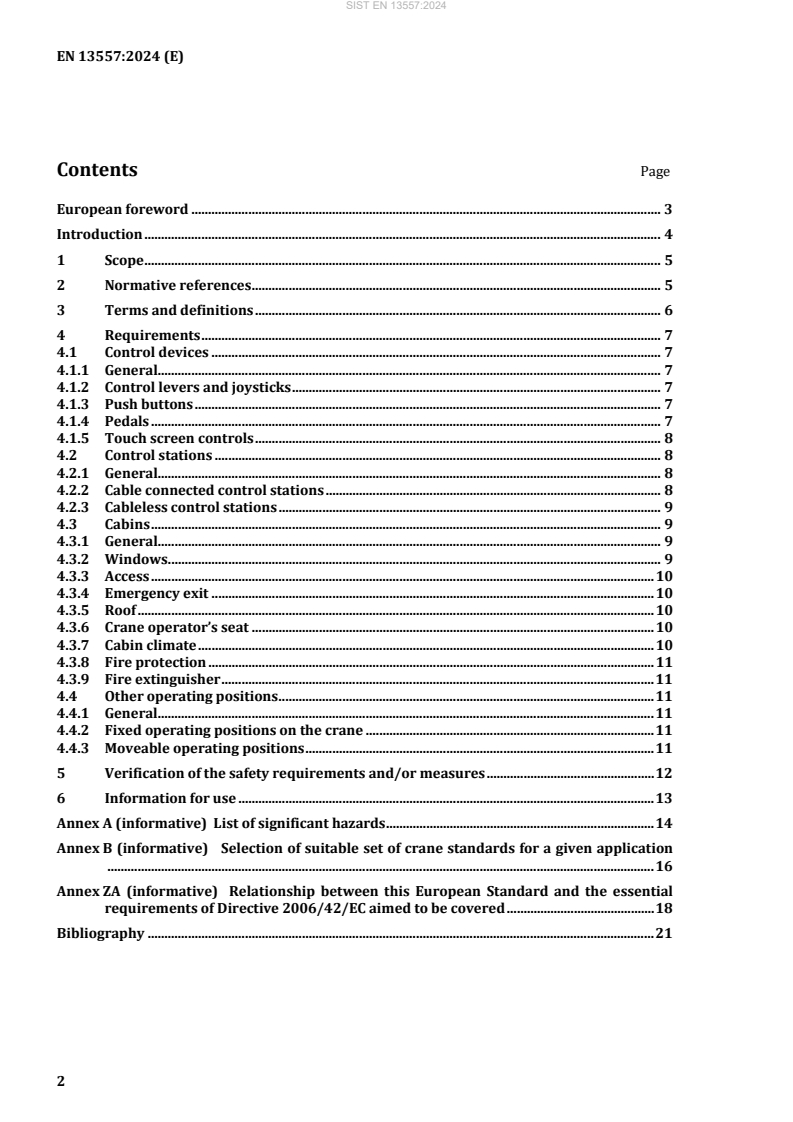
Contents Page
European foreword . 3
Introduction . 4
1 Scope . 5
2 Normative references . 5
3 Terms and definitions . 6
4 Requirements . 7
4.1 Control devices . 7
4.1.1 General. 7
4.1.2 Control levers and joysticks . 7
4.1.3 Push buttons . 7
4.1.4 Pedals . 7
4.1.5 Touch screen controls . 8
4.2 Control stations . 8
4.2.1 General. 8
4.2.2 Cable connected control stations . 8
4.2.3 Cableless control stations . 9
4.3 Cabins . 9
4.3.1 General. 9
4.3.2 Windows . 9
4.3.3 Access . 10
4.3.4 Emergency exit . 10
4.3.5 Roof . 10
4.3.6 Crane operator’s seat . 10
4.3.7 Cabin climate . 10
4.3.8 Fire protection . 11
4.3.9 Fire extinguisher . 11
4.4 Other operating positions . 11
4.4.1 General. 11
4.4.2 Fixed operating positions on the crane . 11
4.4.3 Moveable operating positions . 11
5 Verification of the safety requirements and/or measures . 12
6 Information for use . 13
Annex A (informative) List of significant hazards . 14
Annex B (informative) Selection of suitable set of crane standards for a given application
................................................................................................................................................................... 16
Annex ZA (informative) Relationship between this European Standard and the essential
requirements of Directive 2006/42/EC aimed to be covered . 18
Bibliography . 21
European foreword
This document (EN 13557:2024) has been prepared by Technical Committee CEN/TC 147 “Cranes -
Safety”, the secretariat of which is held by DIN.
This European Standard shall be given the status of a national standard, either by publication of an
identical text or by endorsement, at the latest by September 2024, and conflicting national standards shall
be withdrawn at the latest by September 2024.
Attention is drawn to the possibility that some of the elements of this document may be the subject of
patent rights. CEN shall not be held responsible for identifying any or all such patent rights.
This document supersedes EN 13557:2003+A2:2008.
This document has the following significant technical changes with respect to EN 13557:2003+A2:2008:
— updating of normative references;
— revision of List of significant hazards and move to Annex A;
— revision and update of Table 2 (now Table 1) and Table A.1;
— revision of Annex ZA;
— reorganization of the clauses.
This document has been prepared under a standardization request addressed to CEN by the European
Commission. The Standing Committee of the EFTA States subsequently approves these requests for its
Member States.
For the relationship with EU Legislation, see informative Annex ZA, which is an integral part of this
document.
For the relationship with other European Standards for cranes, see Annex B.
Any feedback and questions on this document should be directed to the users’ national standards body.
A complete listing of these bodies can be found on the CEN website.
According to the CEN-CENELEC Internal Regulations, the national standards organisations of the
following countries are bound to implement this European Standard: Austria, Belgium, Bulgaria, Croatia,
Cyprus, Czech Republic, Denmark, Estonia, Finland, France, Germany, Greece, Hungary, Iceland, Ireland,
Italy, Latvia, Lithuania, Luxembourg, Malta, Netherlands, Norway, Poland, Portugal, Republic of North
Macedonia, Romania, Serbia, Slovakia, Slovenia, Spain, Sweden, Switzerland, Türkiye and the United
Kingdom.
Introduction
This document has been prepared to be a harmonized standard to provide one means for crane access to
conform with the essential health and safety requirements of the Machinery Directive, as mentioned in
Annex ZA.
This document is a type-C standard as stated in EN ISO 12100:2010.
This document is of relevance, in particular, for the following stakeholder groups representing the market
players with regard to machinery safety:
— machine manufacturers (small, medium and large enterprises);
— health and safety bodies (regulators, accident prevention organizations, market surveillance etc.).
Others can be affected by the level of machinery safety achieved with the means of the document by the
above-mentioned stakeholder groups:
— machine users/employers (small, medium and large enterprises);
— machine users/employees (e.g. trade unions, organizations for people with special needs);
— service providers, e.g. for maintenance (small, medium and large enterprises);
— consumers (in case of machinery intended for use by consumers).
The above-mentioned stakeholder groups have been given the possibility to participate in the drafting
process of this document.
The machinery concerned and the extent to which hazards, hazardous situations or hazardous events are
covered are indicated in the Scope of this document.
When requirements of this type-C standard are different from those which are stated in type-A or type-B
standards, the requirements of this type-C standard take precedence over the requirements of the other
standards for machines that have been designed and built according to the requirements of this type-C
standard.
1 Scope
This document specifies health and safety design requirements for control devices and control stations
and their operating positions for all types of cranes.
Specific requirements for particular types of cranes are given in the appropriate European Standard for
the particular crane type (see Annex B).
This document does not deal with noise hazards because these are dealt with in safety standards for
specific types of cranes. It also does not address the design of the cabin with regard to its sound insulation
properties.
This document covers specific hazards which could occur during the use of control devices and control
stations. It does not cover hazards which could occur during transport, construction, modification, de-
commissioning, or disposal. The hazards covered by this document are identified in Annex A.
This document is not applicable to cranes manufactured before the date of its publication.
2 Normative references
The following documents are referred to in the text in such a way that some or all of their content
constitutes requirements of this document. For dated references, only the edition cited applies. For
undated references, the latest edition of the referenced document (including any amendments) applies.
EN ISO 12100:2010, Safety of machinery - General principles for design - Risk assessment and risk reduction
(ISO 12100:2010)
EN 13586:2020, Cranes - Access
EN ISO 13850:2015, Safety of machinery - Emergency stop function - Principles for design (ISO 13850:2015)
EN 14502-2:2005+A1:2008, Cranes - Equipment for the lifting of persons - Part 2: Elevating control stations
EN 62745:2017, Safety of machinery - Requirements for cableless control systems of machinery
EN 60068-2-27:2009, Environmental testing - Part 2-27: Tests - Test Ea and guidance: Shock
EN 60068-2-31:2008, Environmental testing - Part 2-31: Tests - Test Ec: Rough handling shocks, primarily
for equipment-type specimens
EN 60204-32:2008, Safety of machinery - Electrical equipment of machines - Part 32: Requirements for
hoisting machines
ISO 3795:1989, Road vehicles, and tractors and machinery for agriculture and forestry — Determination of
burning behaviour of interior materials
ISO 11112:1995, Earth-moving machinery - Operator's seat - Dimensions and requirements
ISO 7296-1:1991 , Cranes — Graphic symbols — Part 1: General
As impacted by ISO 11112:1995/AMD1:2001.
As impacted by ISO 7296-1:1991/AMD1:1996.
3 Terms and definitions
For the purposes of this document, the terms and definitions given in EN ISO 12100:2010 and the
following apply.
ISO and IEC maintain terminology databases for use in standardization at the following addresses:
— ISO Online browsing platform: available at https://www.iso.org/obp
— IEC Electropedia: available at https://www.electropedia.org/
3.1
cabin
enclosed operating position
3.2
cableless control
means by which the crane operator's commands are transmitted without any physical connection for at
least a part of the distance between the control station and the crane
3.3
control station
assembly of one or more control devices fixed on the same panel or located in the same enclosure
[SOURCE: IEV 441-12-08, modified]
3.4
control device
physical unit that can combine – in a module/subassembly or device – a mode selector, an adjuster for
manual control of the actuating drive and, if necessary, a reference-variable adjuster for the controller
[SOURCE: IEV 351-56-07]
3.5
hatch
access opening to allow the passage of persons, provided with a cover openable without use of tool
[SOURCE: EN 13586:2020]
3.7
operating position
place where the operators carry out their tasks
Note 1 to entry: Cabin (3.1) is also one type of an operating position.
3.8
console
fixed or moveable arrangement of control devices
[SOURCE: ISO 7752-1:2010, modified]
4 Requirements
4.1 Control devices
4.1.1 General
Control devices shall conform to the safety requirements and/or protective measures of this clause. In
addition, control devices shall be designed in accordance with the principles of EN ISO 12100:2010, for
hazards relevant but not significant which are not dealt with by this document.
In order to prevent unintended movement of a crane motion, the motion shall only be able to be initiated
from the neutral position of the control device.
NOTE The typical arrangement of the control devices for a particular crane type is as specified in the
appropriate European Standards for particular crane types.
Protection against electric shock for direct or indirect contact shall be as specified in Clause 5 of
EN 60204-32:2008.
The temperature of control devices, as generated by the crane's operation, shall not exceed 43 °C.
4.1.2 Control levers and joysticks
The direction of movement of control levers and joysticks shall where possible be consistent with crane
motion. Symbols in accordance with ISO 7296-1:1991 shall be fixed in such positions that there is a clear
and unambiguous relationship between the movement of the control lever or joystick in the control
station and the corresponding direction of motion. Control levers and joysticks for crane movements,
when released, shall automatically return to the neutral position.
The force required to actuate the control levers and joysticks shall not exceed the following values:
— forwards or backwards: 20 N;
— sideways, to the left or to the right: 20 N.
A higher actuating force may be accepted for levers and joysticks where specified in a particular crane
type standard.
Control levers or joysticks shall have an actuating force that prevents unintended movement of the
machinery caused by friction, acceleration and/or vibration.
4.1.3 Push buttons
For push buttons actuated by finger or thumb, the force shall not exceed a value of 10 N.
For push buttons actuated by the foot the force shall not exceed a value of 100 N.
Push buttons for crane movements, when released, shall automatically return to the off position.
The emergency stop actuator installed on the control station shall be in accordance with the specification
for emergency stop actuators given in EN ISO 13850:2015.
4.1.4 Pedals
The use of pedals shall only be used when operating the crane in a seated position.
For the pedals, the actuating force shall not exceed the following values:
— pedals actuated by a movement of the ankle: 50 N;
— pedals actuated by a movement of the leg: 100 N.
4.1.5 Touch screen controls
Where touch screens are used, protection against environmental influence e.g. rain, snow, waist, dust
shall be provided. Touch screens shall not be used to control crane movements.
Starting of sequential functions by touch screens shall be differentiated from alarms or other display
signals.
Visibility of the display and the touch points shall be provided to ensure correct control commands.
4.2 Control stations
4.2.1 General
Control stations shall conform to the safety requirements and/or protective measures of this clause. In
addition, control devices shall be designed in accordance with the principles of EN ISO 12100:2010, for
hazards relevant but not significant which are not dealt with by this document.
The logic of the control device arrangement shall be the same at each control station associated with
operating the crane.
Where a crane has more than one control station, measures shall be taken to ensure that only one control
station is operational at a given time. However, an emergency stop command from any control station
shall be effective at all times for safety reasons.
Where vibration damping elements are also used as mountings for a control station, additional fixing(s)
shall be provided to prevent detachment of the control station in the event o
...