


FprEN 14363-4
(Main)Railway applications - Testing and simulation for the assessment of running characteristics of rail vehicles operated on the heavy rail network - Part 4: On-track testing
General Information
- Abstract
This document is applicable to all rail vehicles including OTMs and Road-rail machines, which are operated on the heavy rail network with nominal track gauge 1 435 mm and nominal static vertical wheelset forces up to 350 kN.
This document may also be applicable (partly or in full) to:
— rail systems with different track layout, e.g. urban rail systems and/or;
— rail systems with other than 1 435 mm nominal track gauge and/or;
— non-public rail networks and vehicles, e.g. mine rail systems.
NOTE For rail systems other than 1 435 mm track gauge or urban rail systems, the related post processing, limit values and test conditions could be different. They are specified nationally or individually taking into account track design and operating conditions.
This document contains methods to assess the dynamic behaviour of rail vehicles by on-track testing, including simplifications for special vehicles and for extension of the field of application based on similarities, applicable to vehicles which:
— are newly designed;
— have had relevant design modifications; or
— have relevant changes in their operating conditions.
The following items, as far as handled by on-track testing, are not in the scope of this document
— the strength of the vehicle and the strength of mounted parts,
— passengers and train crew vibration exposure,
— ride comfort,
— quantification of track deterioration or track fatigue,
— load security and,
— effects of cross wind.
- Status
- Not Published
- Publication Date
- 17-Feb-2027
- Technical Committee
- CEN/TC 256 - Railway applications
- Drafting Committee
- CEN/TC 256/WG 10 - Vehicle/Track Interaction
- Current Stage
- 4599 - Dispatch of FV draft to CMC - Finalization for Vote
- Start Date
- 28-May-2026
- Due Date
- 13-Jun-2025
- Completion Date
- 28-May-2026

Overview
FprEN 14363-4 is a draft European Standard developed by CEN’s Technical Committee TC 256 that lays out requirements for on-track testing of rail vehicles on the heavy rail network. This document forms part of the broader EN 14363 series, focusing specifically on methodologies for assessing the running characteristics and dynamic behavior of railway rolling stock through practical, on-track test procedures.
The standard is intended for application to all rail vehicles, including On-Track Machines (OTMs) and road-rail vehicles, operating on networks with a standard nominal track gauge of 1 435 mm and static vertical wheelset forces up to 350 kN. Partial or full application may also extend to rail systems with other track gauges, urban railways, non-public mining networks, and unique track layouts, subject to national requirements.
Key Topics
- On-Track Testing Methods: Outlines procedures for dynamic performance assessment of newly designed or modified railway vehicles. It specifies both normal and simplified measuring methods for assessing running safety, track loading, and vehicle ride characteristics.
- Assessment Scope: Focused on dynamic behavior. Does not cover the mechanical strength of vehicle components, comfort for crew or passengers, track fatigue, load security, or cross-wind effects.
- Test Application: Applied to vehicles that are new designs, have undergone design revisions, or have a change in operating conditions. Also provides for simplified approaches and potential dispensations for certain classes of vehicles, such as those using standardized running gear.
- Test Zones and Parameters: Defines the required test conditions, such as speed, cant deficiency, curve radii, and track geometry, and organizes them into test zones for comprehensive statistical evaluation.
- Statistical Evaluation: Supplies methodologies for analyzing measured data-including single and multi-dimensional regression-in order to verify compliance with safety, performance, and approval requirements.
- Documentation: Requires thorough documentation of vehicle status, test routes, data capture setup, evaluation methods, and results, supporting transparency and future reference.
Applications
FprEN 14363-4 is a valuable reference for organizations involved in the testing, commissioning, and certification of railway vehicles in Europe and beyond. Key practical applications include:
- Rollout of New Vehicles: All newly developed railway vehicles-such as locomotives, multiple units, passenger coaches, and freight wagons-must undergo on-track dynamic assessments before entering service.
- Vehicle Modification Approval: When existing vehicles are modified, or enter new operational contexts, this standard guides the necessary on-track evaluations and extensions to approval.
- Innovative & Special Vehicles: Provides a framework for assessing unconventional vehicles, including OTMs, road-rail, and mine vehicles, ensuring safety and performance even for atypical rolling stock.
- Dispensation Mechanisms: Facilitates process efficiencies where appropriate, such as for freight wagons with proven standard running gear, by enabling dispensation from full on-track dynamic testing under certain conditions.
- International Interoperability: Supports compliance with European interoperability requirements, especially in relation to Directive (EU) 2016/797, by harmonizing test methods across multiple national networks and track gauges.
Related Standards
FprEN 14363-4 is an integral part of the EN 14363 series. Users of this standard will also often reference:
- prEN 14363-1: General Principles – Overarching framework for running dynamics assessment
- prEN 14363-2: Safety against Derailment on Twisted Track
- prEN 14363-3: Stationary Test Methods
- prEN 14363-5: Simulation and Calculation Methods – Used alongside or as an alternative to on-track tests where necessary
- EN 13848-1/2: Track geometry measurement standards
- EN 15302: Definitions and evaluation methods for wheel-rail contact geometry
- EN 16235: Specifics on dispensation criteria for freight wagons
- EN 15663: Reference masses for railway vehicles
- EN 17343: General railway terms and definitions
FprEN 14363-4 promotes safety, reliability, and interoperability across European rail networks by providing a standardized, technically robust approach to the on-track dynamic testing of railway vehicles. This ensures a uniform assessment method, improved market access for vehicle manufacturers, and continued assurance of rail system safety and performance.
Relations
- Effective Date
- 19-Jan-2023
- Effective Date
- 20-Oct-2021
Get Certified
Connect with accredited certification bodies for this standard

IRIS Certification (UNIFE)
International Railway Industry Standard certification.

TÜV SÜD Rail GmbH
TÜV SÜD railway certification services.

Bureau Veritas Railway Certification
Railway and transportation certification.
Sponsored listings
Frequently Asked Questions
FprEN 14363-4 is a draft published by the European Committee for Standardization (CEN). Its full title is "Railway applications - Testing and simulation for the assessment of running characteristics of rail vehicles operated on the heavy rail network - Part 4: On-track testing". This standard covers: This document is applicable to all rail vehicles including OTMs and Road-rail machines, which are operated on the heavy rail network with nominal track gauge 1 435 mm and nominal static vertical wheelset forces up to 350 kN. This document may also be applicable (partly or in full) to: — rail systems with different track layout, e.g. urban rail systems and/or; — rail systems with other than 1 435 mm nominal track gauge and/or; — non-public rail networks and vehicles, e.g. mine rail systems. NOTE For rail systems other than 1 435 mm track gauge or urban rail systems, the related post processing, limit values and test conditions could be different. They are specified nationally or individually taking into account track design and operating conditions. This document contains methods to assess the dynamic behaviour of rail vehicles by on-track testing, including simplifications for special vehicles and for extension of the field of application based on similarities, applicable to vehicles which: — are newly designed; — have had relevant design modifications; or — have relevant changes in their operating conditions. The following items, as far as handled by on-track testing, are not in the scope of this document — the strength of the vehicle and the strength of mounted parts, — passengers and train crew vibration exposure, — ride comfort, — quantification of track deterioration or track fatigue, — load security and, — effects of cross wind.
This document is applicable to all rail vehicles including OTMs and Road-rail machines, which are operated on the heavy rail network with nominal track gauge 1 435 mm and nominal static vertical wheelset forces up to 350 kN. This document may also be applicable (partly or in full) to: — rail systems with different track layout, e.g. urban rail systems and/or; — rail systems with other than 1 435 mm nominal track gauge and/or; — non-public rail networks and vehicles, e.g. mine rail systems. NOTE For rail systems other than 1 435 mm track gauge or urban rail systems, the related post processing, limit values and test conditions could be different. They are specified nationally or individually taking into account track design and operating conditions. This document contains methods to assess the dynamic behaviour of rail vehicles by on-track testing, including simplifications for special vehicles and for extension of the field of application based on similarities, applicable to vehicles which: — are newly designed; — have had relevant design modifications; or — have relevant changes in their operating conditions. The following items, as far as handled by on-track testing, are not in the scope of this document — the strength of the vehicle and the strength of mounted parts, — passengers and train crew vibration exposure, — ride comfort, — quantification of track deterioration or track fatigue, — load security and, — effects of cross wind.
FprEN 14363-4 is classified under the following ICS (International Classification for Standards) categories: 45.060.01 - Railway rolling stock in general. The ICS classification helps identify the subject area and facilitates finding related standards.
FprEN 14363-4 has the following relationships with other standards: It is inter standard links to EN 14363:2016+A2:2022, EN 14363:2016+A1:2018. Understanding these relationships helps ensure you are using the most current and applicable version of the standard.
FprEN 14363-4 is associated with the following European legislation: EU Directives/Regulations: 2016/797/EU, 2016/797/EU, 2016/797/EU, 2016/797/EU, 2016/797/EU, 2016/797/EU, 2016/797/EU, 2016/797/EU, 2016/797/EU, 2016/797/EU, 2016/797/EU, 2016/797/EU, 2016/797/EU; Standardization Mandates: M/483, M/591. When a standard is cited in the Official Journal of the European Union, products manufactured in conformity with it benefit from a presumption of conformity with the essential requirements of the corresponding EU directive or regulation.
FprEN 14363-4 is available in PDF format for immediate download after purchase. The document can be added to your cart and obtained through the secure checkout process. Digital delivery ensures instant access to the complete standard document.
Standards Content (Sample)
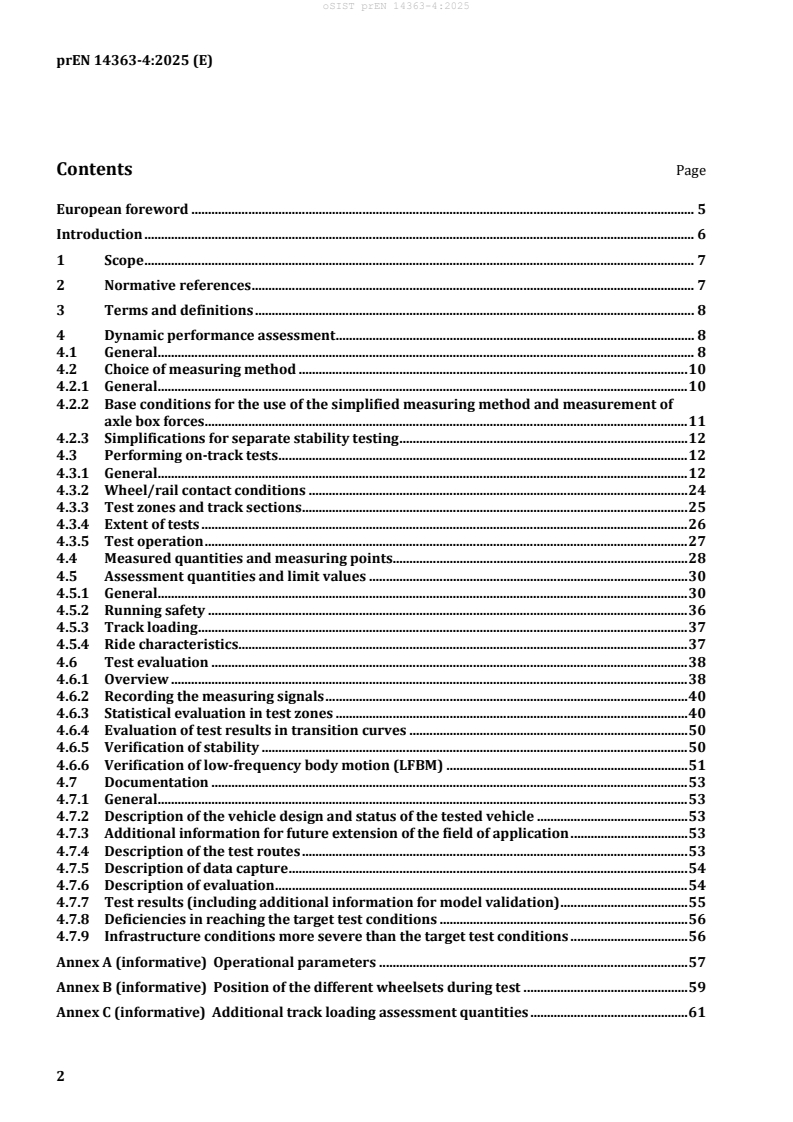
SLOVENSKI STANDARD
01-september-2025
Železniške naprave - Preskušanje in simulacija za oceno voznih lastnosti
železniških vozil, ki obratujejo na omrežju težkih železniških prog - 4. del:
Preskušanje na progi
Railway applications - Testing and simulation for the acceptance of running
characteristics of railway vehicles operated on the heavy rail network - Part 4: On-track
testing
Bahnanwendungen - Prüfungen und Simulationen für die Bewertung der fahrtechnischen
Eigenschaften von Schienenfahrzeugen, die auf dem Vollbahnnetz betrieben werden -
Teil 4: Streckenfahrversuche
Applications ferroviaires - Essais en vue de l'évaluation du comportement dynamique
des véhicules ferroviaires circulant sur un réseau du système ferroviaire lourd - Partie 4 :
Essais en ligne
Ta slovenski standard je istoveten z: prEN 14363-4
ICS:
45.060.01 Železniška vozila na splošno Railway rolling stock in
general
2003-01.Slovenski inštitut za standardizacijo. Razmnoževanje celote ali delov tega standarda ni dovoljeno.
DRAFT
EUROPEAN STANDARD
prEN 14363-4
NORME EUROPÉENNE
EUROPÄISCHE NORM
June 2025
ICS Will supersede EN 14363:2016+A2:2022
English Version
Railway applications - Testing and simulation for the
acceptance of running characteristics of railway vehicles -
Part 4: On-track testing
Applications ferroviaires ¿ Essais en vue de l'évaluation Bahnanwendungen - Versuche und Simulationen für
du comportement dynamique des véhicules die Bewertung der fahrtechnischen Eigenschaften von
ferroviaires circulant sur un réseau du système Schienenfahrzeugen, die auf dem Vollbahnnetz
ferroviaire lourd ¿ Partie 4 : Essais en ligne betrieben werden - Teil 4: Streckenversuche
This draft European Standard is submitted to CEN members for enquiry. It has been drawn up by the Technical Committee
CEN/TC 256.
If this draft becomes a European Standard, CEN members are bound to comply with the CEN/CENELEC Internal Regulations
which stipulate the conditions for giving this European Standard the status of a national standard without any alteration.
This draft European Standard was established by CEN in three official versions (English, French, German). A version in any other
language made by translation under the responsibility of a CEN member into its own language and notified to the CEN-CENELEC
Management Centre has the same status as the official versions.
CEN members are the national standards bodies of Austria, Belgium, Bulgaria, Croatia, Cyprus, Czech Republic, Denmark, Estonia,
Finland, France, Germany, Greece, Hungary, Iceland, Ireland, Italy, Latvia, Lithuania, Luxembourg, Malta, Netherlands, Norway,
Poland, Portugal, Republic of North Macedonia, Romania, Serbia, Slovakia, Slovenia, Spain, Sweden, Switzerland, Türkiye and
United Kingdom.
Recipients of this draft are invited to submit, with their comments, notification of any relevant patent rights of which they are
aware and to provide supporting documentation.
Warning : This document is not a European Standard. It is distributed for review and comments. It is subject to change without
notice and shall not be referred to as a European Standard.
EUROPEAN COMMITTEE FOR STANDARDIZATION
COMITÉ EUROPÉEN DE NORMALISATION
EUROPÄISCHES KOMITEE FÜR NORMUNG
CEN-CENELEC Management Centre: Rue de la Science 23, B-1040 Brussels
© 2025 CEN All rights of exploitation in any form and by any means reserved Ref. No. prEN 14363-4:2025 E
worldwide for CEN national Members.
prEN 14363-4:2025 (E)
Contents Page
European foreword . 5
Introduction . 6
1 Scope . 7
2 Normative references . 7
3 Terms and definitions . 8
4 Dynamic performance assessment . 8
4.1 General . 8
4.2 Choice of measuring method . 10
4.2.1 General . 10
4.2.2 Base conditions for the use of the simplified measuring method and measurement of
axle box forces. 11
4.2.3 Simplifications for separate stability testing . 12
4.3 Performing on-track tests . 12
4.3.1 General . 12
4.3.2 Wheel/rail contact conditions . 24
4.3.3 Test zones and track sections . 25
4.3.4 Extent of tests . 26
4.3.5 Test operation . 27
4.4 Measured quantities and measuring points. 28
4.5 Assessment quantities and limit values . 30
4.5.1 General . 30
4.5.2 Running safety . 36
4.5.3 Track loading . 37
4.5.4 Ride characteristics. 37
4.6 Test evaluation . 38
4.6.1 Overview . 38
4.6.2 Recording the measuring signals . 40
4.6.3 Statistical evaluation in test zones . 40
4.6.4 Evaluation of test results in transition curves . 50
4.6.5 Verification of stability . 50
4.6.6 Verification of low-frequency body motion (LFBM) . 51
4.7 Documentation . 53
4.7.1 General . 53
4.7.2 Description of the vehicle design and status of the tested vehicle . 53
4.7.3 Additional information for future extension of the field of application . 53
4.7.4 Description of the test routes . 53
4.7.5 Description of data capture . 54
4.7.6 Description of evaluation . 54
4.7.7 Test results (including additional information for model validation) . 55
4.7.8 Deficiencies in reaching the target test conditions . 56
4.7.9 Infrastructure conditions more severe than the target test conditions . 56
Annex A (informative) Operational parameters . 57
Annex B (informative) Position of the different wheelsets during test . 59
Annex C (informative) Additional track loading assessment quantities . 61
prEN 14363-4:2025 (E)
C.1 General . 61
C.2 Maximum lateral force . 61
C.3 Combination of lateral and vertical forces . 61
Annex D (informative) Evaluation and background of the rail surface damage quantity . 63
Annex E (informative) Typical maximum estimated values of ride characteristics . 65
Annex F (normative) Track geometric quality – Selection of test tracks . 66
F.1 Basis of evaluation . 66
F.2 Assessment quantities for track geometric quality . 66
F.3 Different measuring systems . 67
F.4 Target test conditions . 68
F.5 Reporting . 70
Annex G (informative) Background of track quality description . 71
Annex H (normative) Statistical evaluation . 72
H.1 Objectives and principles of statistical analysis . 72
H.1.1 General . 72
H.1.2 One-dimensional method . 72
H.1.3 Two-dimensional method or simple regression . 72
H.1.4 Multiple regression . 72
H.2 Determination of the percentiles for each track section. 73
H.3 Preparation of the random samples . 74
H.4 One-dimensional analysis for estimated maximum values . 74
H.5 Two-dimensional analysis for estimated values . 74
H.6 Multiple regression analysis for estimated values . 75
H.7 Statistical evaluation for the overturning criterion . 77
H.8 Regression assumptions . 78
H.8.1 Regression assumptions and associated problems. 78
H.8.2 Identification and correction techniques . 79
Annex I (informative) Running behaviour of special vehicles . 81
I.1 General . 81
I.2 Vehicle design and classification . 81
I.3 Use of the simplified measuring method . 82
I.4 Test conditions . 82
I.5 Specific limit value . 82
Annex J (normative) Extension of the field of application . 83
J.1 General . 83
J.2 Determination of the safety factor . 95
prEN 14363-4:2025 (E)
J.3 Dispensation . 95
J.3.1 General . 95
J.3.2 Special cases . 96
J.3.2.1 More than one reference vehicle available . 96
J.3.2.2 Similar vehicles in the same test train . 96
J.3.2.3 Intermediate loading states of vehicles . 97
J.4 Use of the simplified measuring method in combination with partial on-track test . 97
J.5 Requirements depending on the initial approval . 97
Annex K (normative) Rail profile measurement . 99
K.1 General . 99
K.2 Manual measurements . 99
K.2.1 Measurements for equivalent conicity . 99
K.2.2 Measurements for radial steering index and/or rolling radii coefficient . 99
K.3 Automatic measurements . 99
Annex L (normative) Requirements for evaluation of equivalent conicity . 100
Annex ZA (informative) Relationship between this European Standard and the Essential
Requirements of EU Directive (EU) 2016/797 aimed to be covered . 101
Bibliography. 103
prEN 14363-4:2025 (E)
European foreword
This document (prEN 14363-4:2025) has been prepared by Technical Committee CEN/TC 256 “Railway
applications”, the secretariat of which is held by DIN.
This document is currently submitted to the CEN Enquiry.
This document together with prEN 14363-2:2025, prEN 14363-3:2025, prEN 14363-4:2025 and
prEN 14363 5:2025, will supersede EN 14363:2016+A2:2022.
The EN 14363 Series “Railway applications — Testing and Simulation for the assessment of running
characteristics of rail vehicles operated on the heavy rail network” consists of the following parts: The
EN 14363 Series “Railway applications — Testing and Simulation for the assessment of running
characteristics of rail vehicles operated on the heavy rail network” consists of the following parts:
— prEN 14363-1:2025, General;
— prEN 14363-2:2025, Safety against derailment on twisted track;
— prEN 14363-3:2025, Stationary tests that are not obligatory on European level;
— prEN 14363-4:2025, On-track testing;
— prEN 14363-5:2025, Simulations/calculations;
— prCEN/TR 14363-6:2025, Technical Report providing background information to the EN 14363 series
of standards (under development).
This document has been prepared under a standardization request addressed to CEN by the European
Commission. The Standing Committee of the EFTA States subsequently approves these requests for its
Member States.
For the relationship with EU Legislation, see informative Annex ZA, which is an integral part of this
document.
prEN 14363-4:2025 (E)
Introduction
General information for the application of this document is given in prEN 14363-1:2025.
prEN 14363-4:2025 (E)
1 Scope
This document applies to all railway vehicles including OTM’s and Road-rail machines, which are
operated on the heavy rail network with standard track gauge 1 435°mm and nominal static vertical
wheelset forces up to 350 kN.
This document may also be applicable (partly or in full) to:
— rail systems with different track layout, e.g. urban rail systems and/or;
— rail systems with other than 1 435 mm nominal track gauge and/or;
— non-public rail networks and vehicles, e.g. mine rail systems.
NOTE For rail systems other than 1 435 mm track gauge or urban rail systems, the related post analysis, limit
values and test conditions could be different. They are specified nationally taking into account track design and
operating conditions.
This document contains methods to assess the dynamic behaviour of railway vehicles by on-track
testing, including simplifications for special vehicles and for extension of the field of application based
on similarities, applicable to vehicles which:
— are newly developed;
— have had relevant design modifications; or
— have changes in their operating conditions.
The following items are not, in this document, handled by on-track testing:
— the strength of the vehicle and the strength of mounted parts,
— passengers and train crew vibration exposure,
— ride comfort,
— load security and,
— effects of cross wind.
2 Normative references
The following documents are referred to in the text in such a way that some or all of their content
constitutes requirements of this document. For dated references, only the edition cited applies. For
undated references, the latest edition of the referenced document (including any amendments) applies.
prEN 14363-1:2025, Railway applications — Testing and Simulation for the assessment of running
characteristics of rail vehicles operated on the heavy rail network — Part 1: General
EN 13848-1:2019, Railway applications — Track — Track geometry quality: Characterization of track
geometry
EN 13848-2:2020, Railway applications — Track — Track geometry quality: Measuring systems — Track
recording vehicles
prEN 14363-4:2025 (E)
EN 14033-2:2017, Railway applications — Track — Railbound construction and maintenance
machines — Technical requirements for travelling and working
EN 15302:2021, Railway applications — Wheel-rail contact geometry parameters — Definitions and
methods for evaluation
EN 15663:2017+A1:2019, Railway applications — Vehicle reference masses
EN 16235:2023, Railway applications — Testing for the acceptance of running characteristics of railway
vehicles — Freight wagons — Conditions for dispensation of freight wagons with defined characteristics
from on-track tests according to EN 14363
EN 17343:2023, Railway applications — General terms and definitions
3 Terms and definitions
For the purposes of this document, the terms and definitions given in prEN 14363-1:2025 and
EN 17343:2023 apply.
ISO and IEC maintain terminology databases for use in standardization at the following addresses:
— ISO Online browsing platform: available at https://www.iso.org/obp/
— IEC Electropedia: available at https://www.electropedia.org/
4 Dynamic performance assessment
4.1 General
All new or modified vehicles shall be checked with regard to their dynamic characteristics to evaluate
the running safety, the track loading and the ride characteristics of the vehicle. An initial assessment
may be carried out of the vehicle type or it may be for an extension of the field of application. The
assessment is based on the evaluation of the performance of the vehicle while running on a sample of
track sections (including curves with different radii and straight tracks) with defined assessment
conditions. Then a statistical analysis of the assessed parameters is performed and the results are
compared with limit values. If the conditions described in this sub clause are fulfilled, this gives the
foundation for the vehicle’s type approval.
The initial assessment of the dynamic performance of a vehicle type shall generally be performed based
on on-track tests. The conditions for carrying out this process are given in this sub clause. In certain
circumstances the tests may be supplemented by simulation (see prEN 14363-5:2025) or other means,
e.g. when the combination of the target test conditions cannot be achieved during the test.
An extension of the field of application for vehicles that are of the same basic design, or that have gained
acceptance and subsequently undergone engineering change, is possible. This assessment shall be
carried out either by means of a partial on-track test or by simulation of an on-track test or a
combination of both. The procedure (test extent and measuring method) to be applied for the partial
on-track test (including dispensation from test) is defined in normative Annex J. The possible
application of simulation is described in prEN 14363-5:2025.
For multiple units, the individual vehicles may have different parameters (e.g. forces, stiffness). In this
case, selected vehicles may be used as reference vehicles. All other vehicles are regarded as vehicles
with extension of the field of application due to changes of vehicle parameters. Therefore, the allowable
differences in vehicle parameters, as given in J.3.2, determine the extent of measurements and tests.
prEN 14363-4:2025 (E)
For freight wagons equipped with established or standardized running gear as described in
EN 16235:2023, a dispensation from Clause 4 requirements (on-track testing) is granted if the
requirements described in EN 16235:2023 are fulfilled.
It may be necessary to test a vehicle for more than one combination of V and I as shown in
adm adm
informative Annex A.
For convenience standardized values for I should be used for the assessment as given in informative
adm
Annex A.
NOTE 1 Using values equal to or higher than the maximum limiting values stated in EN 13803:2017 will give
the least restrictions for future operation. For national operation, other values of operational parameters may be a
better choice. In many European countries operation within the standard timetables requires a minimum
performance of the vehicles (see informative Annex A).
It is not necessary for demonstration of compliance to distinguish between admissible cant deficiencies
which differ by no more than 2 %. This is the difference e.g. resulting from inaccuracy converting cant
2 2
deficiency to uncompensated lateral acceleration using g = 10 m/s instead of g = 9,806 m/s .
In case of a deactivation of a tilting system, the cant deficiency is to be reduced, e.g. to the maximum
allowed values for conventional vehicles. In consequence the vehicle shall also be tested under these
operational conditions.
NOTE 2 It is recognized that locomotives or power heads, which are operated with cant deficiencies higher
than used for conventional trains without a tilting system (e.g. SJ-X2000) exist.
NOTE 3 Reasons for limiting operating conditions could be restricted capabilities of vehicle design or restricted
availability of suitable test tracks.
As the target test conditions of equivalent conicities for stability testing are depending on the speed, it
may also be necessary to test vehicles with high admissible speeds for more than one combination of
speed and equivalent conicity.
Test procedures are based on the classification of the test vehicle into:
— locomotives, multiple units (EMU, DMU) and passenger coaches;
— freight wagons;
— special vehicles.
In prEN 14363-2:2025, 3.16, special vehicles are defined as such according to their use. However, their
testing requirements are based on their design characteristics. Informative Annex I describes basic
principles to be applied to special vehicles, before considering general test requirements of the present
Clause 4.
Vehicles with maximum admissible speed V ≤ 60 km/h and a P <= 250 kN are granted dispensation
adm F0
from dynamic performance assessment according to this document. Instead, functional dynamic
running type tests taking into account the intended operating conditions (speed, cant deficiency, load
conditions, working modes, push/pull operation in S-shaped curves etc., whatever relevant) on tangent
track and curved track shall be performed to demonstrate safe behaviour of the vehicle. The test
conditions and the observations shall be documented. It is not required to measure any assessment
quantities specified in this document.
prEN 14363-4:2025 (E)
4.2 Choice of measuring method
4.2.1 General
On-track tests can use the two different measuring methods:
— normal measuring method;
— simplified measuring method.
Figure 1 gives an overview of the assessment quantities used in both measuring methods.
Figure 1 — Measuring methods and assessment quantities
On-track test with normal measuring method includes the assessment of:
— running safety;
— track loading;
— ride characteristics of the vehicle;
with direct measured forces between wheel and rail and accelerations in the running gear and in the
vehicle body.
On-track test with simplified measuring method includes the assessment of:
— running safety;
— ride characteristics of the vehicle;
with measured accelerations at the running gear and accelerations in the vehicle body. In some cases
lateral forces between wheelset and axle box are also measured. If the simplified measuring method is
prEN 14363-4:2025 (E)
applicable, it is assumed that the vehicle will comply with track loading limit values, without needing a
direct assessment of the associated quantities.
For the initial assessment of a vehicle the simplified measuring method is only applicable if the base
conditions in 4.2.2 are fulfilled.
For an extension of the field of application, additional conditions for the use of the simplified measuring
method are given in normative Annex J including the indication of required axle box force
measurement. They are dependent upon the measuring methods used for the reference vehicle and the
new assessment as well as on the results achieved during the assessment of the reference vehicle and
the modifications of relevant parameters.
4.2.2 Base conditions for the use of the simplified measuring method and measurement of axle
box forces
In general the simplified measuring method may be applied to conventional technology vehicles, if all of
the conditions in Table 1 are fulfilled:
Table 1 — Base conditions for the use of a simplified measuring method
Running gear type one of the following:
— single wheelsets;
+
— bogie with two wheelsets 2a ≤ 3,3 m;
— bogie with three or more wheelsets with spacing between outer wheelsets ≤ 4,5 m with
additional measurement of lateral axle box forces H.
Vehicle configuration one of the following:
Single vehicles
— with two single wheelsets;
— with two bogies.
Articulated vehicles consisting of two or more vehicle bodies, with the following possible
arrangements of running gears per vehicle body
— up to two single wheelsets;
— up to two bogies.
a
Nominal static vertical wheelset force P (for all vehicles) ≤ 200 kN
F0
b
Maximum admissible speed of the vehicle V
adm
vehicles with single wheelsets ≤ 100 km/h
freight wagons with bogies ≤ 120 km/h
b
other vehicles with bogie mass m > 10 t ≤ 120 km/h
b
other vehicles with bogie mass m > 10 t ≤ 160 km/h
and additional measurement of lateral axle box forces H
b
other vehicles with Bogie Mass m ≤ 10 t ≤ 200 km/h
a
and (P · V ) ≤ 34 000 [kN km/h]
F0 adm
Admissible cant deficiency I
adm
freight wagons ≤ 130 mm
a
multiple units with nominal static vertical wheelset forces P ≤ 170 kN ≤ 165 mm
F0
prEN 14363-4:2025 (E)
and V ≤ 160 km/h
adm
other vehicles ≤ 150 mm
a
P is the nominal static vertical wheelset force of the highest loaded wheelset of the vehicle in the assessed
F0
load configuration (see 5.3.2).
b
It is allowed to use a simplified measuring method, independently from the operational speed, providing
that the assessment of the vehicle under the dedicated investigation is limited to straight track and curves
with curve radii >600 m and all other base conditions are complied with.
4.2.3 Simplifications for separate stability testing
If stability testing is performed separately, the application of the simplified measuring method is
sufficient as this method is consistent with the normal measuring method.
NOTE This permits the required high conicity condition to be achieved also by modification of the wheel
profile on a running gear without instrumented wheelsets and to keep normal profiles on the instrumented
wheelsets. For testing stability, the instrumentation of running gear (or in the case of a vehicle without a running
gear frame, with instrumentation on the vehicle body) is sufficient.
If a vehicle is equipped with an instability monitoring system based on established standards, results
collected by this system may be used to demonstrate running stability.
4.3 Performing on-track tests
4.3.1 General
The running conditions during tests (and also for numerical simulations) shall include defined
combinations of:
— speed;
— cant deficiency;
— curve radius.
Therefore, the assessment is carried out on different test zones. In each test zone, the test conditions for
track and operation differ with regard to the ranges of test parameters to be examined. To allow a
statistical evaluation of test results, the test lines are divided into track sections. The measured results
from the track sections in which the required test parameters were fulfilled are allocated to the
corresponding test zone. If multiple regression is used (see normative Annex H) all track sections in
curves form together the basis for the statistical evaluation calculated at different target values
specified for the different test zones.
Table 2 defines the test zones and the associated ranges of values for track layout (also in Table 3 and
Table 4). In the first part it also gives the objective of the testing and anticipated vehicle dynamic
behaviour. In a second section the target test conditions for track layout, track quality, wheel/rail
contact and operation (speed and cant deficiency) are defined. These target test conditions shall be
complied with as far as possible in on-track testing of running characteristics. A third section specifies
the requirements for the track sections.
NOTE As it was found in the DYNOTRAIN project, that the nominal rail inclination has no influence on test
results, testing on two networks is no longer necessary, if profiles representative for the service of the vehicle are
used during testing. In that case the range of contact conditions varies sufficiently for the statistical evaluation due
to variations of gauge and rail shape on test lines.
Vehicles with P > 250 kN shall be tested in test zone 3 or test zone 4 also with cant excess, see Table 2
F0
and Table 3.
prEN 14363-4:2025 (E)
As the effects of aerodynamic forces are outside the scope of this document, they shall not have a
significant influence on the tests. This should be assumed unless there are reasonable grounds to
believe otherwise.
prEN 14363-4:2025 (E)
Table 2 — Target conditions for on-track testing – one- and two-dimensional statistical method
Test zone
1 2 3 4
Description
Tangent track and
Small radius
very large radius Large radius curves Very small radius curves
curves
a
curves
Testing the combinations of
Testing in the area of the vehicles admissible cant deficiency.
Testing in the area of
the vehicle’s admissible
Objective the vehicle’s
Including track sections with contact geometry that creates
speeds and cant
admissible speeds
adverse steering conditions for a wheelset in test zone 4
deficiencies
There are no or only
low quasi-static
guiding forces or Superposition of quasi-
Anticipated vehicle Larger quasi-static guiding forces, vertical wheel forces and
accelerations, but static and dynamic contents
dynamic behaviour accelerations, dynamic content generally decreases
larger dynamic content of all assessment quantities
in all assessment
quantities
Curve radius — 400 m ≤ R ≤ 600 m 250 m ≤ R < 400 m
Mean value of curve
500 m 300 m
radius of all track —
c b, c,
(±50 m) , (+50 m, −20 m)
sections Rm
d
Test speed V Vadm ≤ V ≤ 1,1 · Vadm V ≤ 1,1 · Vadm
Tolerance of
±5 km/h
d, e
evaluation range
Test cant deficiency I
m
I ≤ 40 mm 0,70 · I ≤ I ≤ 1,15 · I
adm adm
d
(evaluation range)
Target Test Conditions Test Objectives
prEN 14363-4:2025 (E)
Test zone
1 2 3 4
Description
Tangent track and
Small radius
very large radius Large radius curves Very small radius curves
curves
a
curves
Additional test cant
deficiency, vehicles — -90 mm ≤ I ≤ 0 mm
with PF0 > 250 kN
— one dimensional evaluation: at least 20 % of track sections
Distribution of test 1,05 · I ≤ I ≤ 1,15 · I
adm adm
—
d
cant deficiency — two dimensional evaluation: at least 3 track sections
l
1,05 · Iadm ≤ I ≤ 1,15 · Iadm
90 % value of
distribution for
longitudinal level and
alignment above lower
90 % value of distribution
limit of target test
for longitudinal level and
range TL90 in speed
alignment above lower limit
range of V , see 90 % value of distribution for longitudinal level and alignment
adm
track geometry of target test range TL90 in
Clause F.4 with above lower limit of target test range TL90 in speed range
quality target level speed range of Vadm, see
Table F.3. Compliance 80 km/h < V ≤ 120 km/h, see Clause F.4 with Table F.3.
according to Clause F.4 with Table F.3.
with TL90 is not Possibly exclude exceptional track sections with single
normative Annex F Possibly exclude
mandatory (see defects > QN3, see Table F.4.
exceptional track sections
Clause F.4).
with single defects > QN3,
Possibly exclude
see Table F.4.
exceptional track
sections with single
defects > QN3, see
Table F.4.
Target Test Conditions
prEN 14363-4:2025 (E)
Test zone
1 2 3 4
Description
Tangent track and
Small radius
very large radius Large radius curves Very small radius curves
curves
a
curves
— the majority of
conditions shall be
representative of
k
normal service
— avoid a narrow
Requirements for
range of contact
wheel rail contact
geometry conditions
f, g
geometry avoid a narrow range of contact geometry conditions (radial
(equivalent conicities) —
k
steering index and/or the rolling radii coefficient)
see also normative
k
Annex K, and
— possibly exclude
EN 15302:2021
track sections with
exceptional values of
conicity outside the
expected range of
operation
Wheel rail friction
Dry rails in at least 80 % of the track sections
h
conditions
Vadm ≤ 160 km/h: 100 m
Length of track
160 km/h < Vadm ≤ 220 km/h: 250 m 100 m 70 m
i
section Lts
V > 220 km/h: 500 m
adm
Minimal number of
25 for each test zone.
j
track sections nts,min
Minimal total length
of track sections 10 km 5 km —
ΣL
ts,min
Maximum speed
variation within each 10 km/h 5 km/h
track section
Track Sections Target Test Conditions
prEN 14363-4:2025 (E)
Test zone
1 2 3 4
Description
Tangent track and
Small radius
very large radius Large radius curves Very small radius curves
curves
a
curves
a
It is recommended to include some track sections with curves of very large radius in test zone 1.
b
Test zone 4 shall include track sections with a curve radius below 300 m and track sections with a curve radius above 350 m.
c
For national and multinational restricted operation the range of conditions for the test zones may be varied. In this case associated quantities (e.g. R )
m
shall be adapted.
d
In fault mode (see prEN 14363-1:2025, 5.2.2) it is sufficient to investigate the vehicle only up to the admissible values of speed and cant deficiency. The
ranges for evaluation shall be adapted accordingly.
e
The intention of the tolerance is not to change the target test speed but to allow for a natural variation around the target test speed.
f
For independently rotating wheels there are no requirements for wheel rail contact geometry.
g
If the vehicle allows testing with the simplified measuring method with accelerations only, no requirements for contact geometry apply.
h
Flange lubrication equipment may spread lubrication substance to the running surface, if not adjusted correctly, and that may reduce the lateral wheel
rail forces. Therefore, tests shall be conducted with deactivated on-board lubrication systems on all vehicles in the test train.
i
Tolerance for the length of the individual track section: ± 20 %. The minus tolerance shall only be used if it permits additional track length to be
included in the analysis.
j
n is the minimum required number of unique sections in the evaluation range of speed and cant deficiency.
ts,min
k
For more information, see 4.3.2.
l
It should be noted that a low number of sections close to the target value of 1,1 · Iadm may lead to an unnecessary high confidence interval leading to
high estimated values.
m
For two-dimensional evaluation including lower cant deficiencies can improve the reliability of the analysis.
prEN 14363-4:2025 (E)
Table 3 — Target conditions for on-track testing – multiple regression statistical method
Test zone
m m
1 2 3 4
Description Tangent track and Large radius Small radius curves Very small radius
very large radius curves curves
a
curves
Objective Testing in the area of Testing the Testing in the area of the vehicles admissible cant deficiency
the vehicle’s combinations of the Including track sections with contact geometry that creates adverse
admissible speeds vehicle’s admissible steering conditions for a wheelset in test zone 4
speeds and cant
deficiencies
Anticipated There are no or only Superposition of Larger quasi-static guiding forces, vertical wheel forces and
vehicle dynamic low quasi-static quasi-static and accelerations, dynamic content generally decreases
behaviour guiding forces or dynamic contents
accelerations, but of all assessment
larger dynamic quantities
content in all
assessment
quantities
n
Curve radius — Usually, all results of curved track (R > 250 m) form the basis for the evaluation of the
estimated values. If there is clear evidence of a bi-linear behaviour related to curvature, the
b
regression analysis can be carried out using two different sub-ranges of curve radii.
c, n d d
Test speed V V = V V ≤ V ≤ 1,1 · V V ≤ 1,1 · V
adm adm adm adm
Test cant I ≤ 40 mm 40 mm ≤ I ≤ 1,15 · I
adm
deficiency I
(evaluation
c, n
range)
Target test conditions Test objectives
prEN 14363-4:2025 (E)
Additional test — -90 ≤ I ≤ 0
cant deficiency,
vehicles with P
F0
> 250 kN
k, l ,
Distribution of The distribution of At least 3 track sections with each of the following conditions :
test speed and speed shall be as — I ≥ I and R ≤ 350 m
adm
test cant even as possible and — I ≥ I and R ≥ 500 m
adm
k
deficiency cover V . — I ≥ I and V ≥ V
adm adm adm
Geometric track For longitudinal level and alignment TL50 For longitudinal level and alignment TL50 as specified for the speed
quality target as specified for the speed V = V , see V ≤ 120 km/h, see Clause F.4 with
...