

EN 1069-2:2026
(Main)Water slides - Part 2: Instructions
- Abstract
This document is applicable to all water slides installed at open water areas for public use or in swimming pools for public use.
This document establishes the instructions for use, operation, and maintenance as well as the documentation of water slides.
- Status
- Published
- Publication Date
- 28-Jul-2026
- Technical Committee
- CEN/TC 136 - Sports, playground and other recreational equipment
- Drafting Committee
- CEN/TC 136/WG 3 - Water slides
- Current Stage
- 6060 - Definitive text made available (DAV) - Publishing
- Start Date
- 29-Jul-2026
- Due Date
- 28-Sep-2026
- Completion Date
- 29-Jul-2026

EN 1069-2:2026 is a CEN standard for water slides. It specifies the instructions for use, operation, maintenance, and documentation of water slides installed at open water areas or in swimming pools for public use. It is aimed at the people who operate, maintain, inspect, supply, or install these facilities and need a clear operating framework.
What does EN 1069-2:2026 specify?
EN 1069-2:2026 covers the instruction side of water slide safety and operation. It tells the operator what information, procedures, signage, records, inspections, and maintenance arrangements are needed for public-use water slides in swimming pools and open water areas.
The document is structured as follows:
- Clause 1 - Scope
- Clause 2 - Normative references
- Clause 3 - Terms and definitions
- Clause 4 - Operation
- Clause 5 - Instructions for users
- Clause 6 - Documentation
- Clause 7 - Maintenance instructions
- Clause 8 - Inspections
- Clause 9 - Commissioning
- Clause 10 - Quality of water
- Annex A - normative safety and information signs for water slides
| Annex | What it covers |
|---|---|
| Annex A (normative) | Safety and information signs, general sign formats, and example graphical symbol image content for water slides |
What are the key requirements of EN 1069-2:2026?
Operational risk assessment - Clause 4.2 requires the operator to carry out an operational risk assessment based on the design risk assessment. It specifically calls for attention to spacing between users, collision risks, user position, different user characteristics, ride enhancement devices, children, chain sliding, and unauthorized access. In practice, this assessment drives the operating rules and the supervision level.
Risk reduction and supervision - Clause 4.3 requires the operator to reduce risk to a minimum by choosing an appropriate mix of supervision and technical distance control. The document points to options such as full staff supervision, turnstiles or traffic lights, or a combination chosen from the risk assessment. That matters because the control method has to fit the slide layout and the expected user behaviour.
Operational and emergency instructions - Clause 4.5 requires written operating instructions covering controls, access and egress, allowed sliding positions, limits on speed, sliding time, maximum users, emergency evacuation, environmental limits, and maintenance-related staffing and spare parts. Clause 4.6 requires separate written emergency instructions for competent staff, prepared with the statutory authorities. Clause 4.7 requires an incident logbook so incidents and accidents can be recorded and analysed.
Instructions for users and signage - Clause 5 requires signage for water slide Types 1.2 and higher, installed at commissioning and kept in service during operation. The content has to reflect the preliminary risk analysis and use the sign formats in Annex A. In practice, the operator has to make the user-facing rules visible at the entrance and on the platform, not only in internal procedures.
Sign content and location - Clause 5 requires the signage to show the severity of the ride, user restrictions, fall height where relevant, water depth in the splashdown area, the need to clear the catch unit quickly, the allowed or mandatory sliding position, and any required ride enhancement device. The signs have to be placed at the means of access and on the platform, and separate slide information is needed if several slides start from the same platform.
Documentation at commissioning - Clause 6 requires the manufacturer, supplier, importer, or installer to provide a package at commissioning. This includes contact details, as-built safety-relevant design documents, technical characteristics, a maintenance and operational program, the language version required by contract, and the results of the design risk assessment. For the operator, this is the core handover file used for day-to-day operation and later inspections.
Maintenance, repair, and modification control - Clause 7 requires maintenance to follow the manufacturer’s instructions, with at least yearly maintenance if no other interval is set. It also requires a maintenance logbook, trained or experienced staff, controlled servicing intervals, careful repair practice, and consultation with the manufacturer or inspection body before modifications to structure, flow rate, safety-related components, emergency equipment, or performance. Repairs and modifications have to be documented, because even small changes can affect safety.
Inspections, commissioning, and water quality - Clause 8 requires daily visual checks, periodic operational inspections every one to three months, and for Types 3 and higher an annual thorough inspection by an inspection body. A practical sliding test is required at intervals of not more than three years. Clause 9 requires commissioning according to Part 1, and Clause 10 requires water used in pools to meet the specific requirements for swimming pool water, with statutory bathing-water rules considered for lakes or sea-shore sites.
What terms does EN 1069-2:2026 define?
- Operator - The company, organization, authority, or person with overall control and responsibility for the water slide facility.
- Platform - The area that provides access to the start section of the slide.
- Public use - Use of an installation open to everyone or to a defined group of users, and not limited to the owner’s or operator’s family and guests.
- Raft - A ride enhancement device used by one or more users.
- Safety sign - A sign that gives a general safety message through a colour, shape, and graphical symbol.
- Water slide - An installation with a sliding surface on which the user slides with water as a friction- and/or speed-reducing medium, freely or with a ride enhancement device.
Who uses EN 1069-2:2026?
EN 1069-2:2026 is used by water park operators, public swimming pool operators, and managers of open water leisure facilities. It is also used by manufacturers, suppliers, importers, installers, maintenance contractors, and inspection bodies.
In practice, these users apply it when writing operating procedures, preparing signage, setting inspection schedules, keeping logbooks, planning maintenance, and handing over the technical documentation needed for safe operation.
What changed in EN 1069-2:2026 from the previous edition?
EN 1069-2:2026 supersedes EN 1069-2:2017. The changes stated for this edition are:
- the scope was expanded to include water slides installed at open water areas
- Clause 2 on normative references was revised
- Clause 3 on definitions was revised
- Clause 5 on instructions for users was restructured and revised
- Annex A on safety and information signs was revised, including the examples for graphical symbol image content
- Annex B, the informative example of the risk assessment, was deleted
- the document was editorially revised
Which standards are used with EN 1069-2:2026?
- prEN 1069-1:2025 - the companion part for safety requirements and test methods; Part 2 relies on it for design risk assessment, commissioning, and practical sliding test references.
- EN 15288-1 - gives safety requirements for the design of swimming pools for public use.
- EN 15288-2 - gives safety requirements for the operation of swimming pools for public use and is the main reference for operational control.
- EN ISO 3834 (all parts) - provides quality requirements for fusion welding of metallic materials.
- EN ISO 15607 - covers specification and qualification of welding procedures for metallic materials.
- EN ISO 9606-1 - covers qualification testing of welders for fusion welding of steels.
- EN ISO 7010 - provides registered safety signs used for mandatory, prohibition, warning, and information messages.
- ISO 3864-3 - gives the design principles for graphical symbols used in safety signs.
- ISO 7001 - provides registered public information symbols used for user guidance.
- EN ISO 13849-2 - is cited for validation of technical distance-control equipment.
What does the EN 1069-2:2026 document contain?
EN 1069-2:2026 contains operational guidance, user-signage rules, documentation requirements, maintenance and repair instructions, inspection procedures, commissioning requirements, and water-quality provisions. It also contains Annex A with the sign formats and the graphical symbol examples used on water slides.
Annex A includes the general sign forms and example symbols for ride severity, falling height, water depth, user groups, sliding positions, rafts, clearing the catch unit or splashdown area, keeping distance, getting airborne features, and the prohibition on grasping top returns. These figures are the practical basis for designing the notices that users actually see at the slide entrance and on the platform.
Relations
- Effective Date
- 09-Jul-2024
- Effective Date
- 05-Aug-2026
Frequently Asked Questions
EN 1069-2:2026 is a draft published by the European Committee for Standardization (CEN). Its full title is "Water slides - Part 2: Instructions". This standard covers: This document is applicable to all water slides installed at open water areas for public use or in swimming pools for public use. This document establishes the instructions for use, operation, and maintenance as well as the documentation of water slides.
This document is applicable to all water slides installed at open water areas for public use or in swimming pools for public use. This document establishes the instructions for use, operation, and maintenance as well as the documentation of water slides.
EN 1069-2:2026 is classified under the following ICS (International Classification for Standards) categories: 97.220.40 - Outdoor and water sports equipment. The ICS classification helps identify the subject area and facilitates finding related standards.
EN 1069-2:2026 has the following relationships with other standards: It is inter standard links to EN 1069-2:2017, EN 17232:2020. Understanding these relationships helps ensure you are using the most current and applicable version of the standard.
EN 1069-2:2026 is available in PDF format for immediate download after purchase. The document can be added to your cart and obtained through the secure checkout process. Digital delivery ensures instant access to the complete standard document.
Standards Content (Sample)
SLOVENSKI STANDARD
oSIST prEN 1069-2:2025
01-julij-2025
Vodni tobogani - 2. del: Navodila
Water slides - Part 2: Instructions
Wasserrutschen - Teil 2: Hinweise
Toboggans aquatiques - Partie 2 : Instructions
Ta slovenski standard je istoveten z: prEN 1069-2
ICS:
97.220.40 Oprema za športe na Outdoor and water sports
prostem in vodne športe equipment
oSIST prEN 1069-2:2025 en,fr,de
2003-01.Slovenski inštitut za standardizacijo. Razmnoževanje celote ali delov tega standarda ni dovoljeno.
oSIST prEN 1069-2:2025
oSIST prEN 1069-2:2025
DRAFT
EUROPEAN STANDARD
prEN 1069-2
NORME EUROPÉENNE
EUROPÄISCHE NORM
June 2025
ICS 97.220.40 Will supersede EN 1069-2:2017
English Version
Water slides - Part 2: Instructions
Toboggans aquatiques - Partie 2 : Instructions Wasserrutschen - Teil 2: Hinweise
This draft European Standard is submitted to CEN members for enquiry. It has been drawn up by the Technical Committee
CEN/TC 136.
If this draft becomes a European Standard, CEN members are bound to comply with the CEN/CENELEC Internal Regulations
which stipulate the conditions for giving this European Standard the status of a national standard without any alteration.
This draft European Standard was established by CEN in three official versions (English, French, German). A version in any other
language made by translation under the responsibility of a CEN member into its own language and notified to the CEN-CENELEC
Management Centre has the same status as the official versions.
CEN members are the national standards bodies of Austria, Belgium, Bulgaria, Croatia, Cyprus, Czech Republic, Denmark, Estonia,
Finland, France, Germany, Greece, Hungary, Iceland, Ireland, Italy, Latvia, Lithuania, Luxembourg, Malta, Netherlands, Norway,
Poland, Portugal, Republic of North Macedonia, Romania, Serbia, Slovakia, Slovenia, Spain, Sweden, Switzerland, Türkiye and
United Kingdom.
Recipients of this draft are invited to submit, with their comments, notification of any relevant patent rights of which they are
aware and to provide supporting documentation.
Warning : This document is not a European Standard. It is distributed for review and comments. It is subject to change without
notice and shall not be referred to as a European Standard.
EUROPEAN COMMITTEE FOR STANDARDIZATION
COMITÉ EUROPÉEN DE NORMALISATION
EUROPÄISCHES KOMITEE FÜR NORMUNG
CEN-CENELEC Management Centre: Rue de la Science 23, B-1040 Brussels
© 2025 CEN All rights of exploitation in any form and by any means reserved Ref. No. prEN 1069-2:2025 E
worldwide for CEN national Members.
oSIST prEN 1069-2:2025
prEN 1069-2:2025 (E)
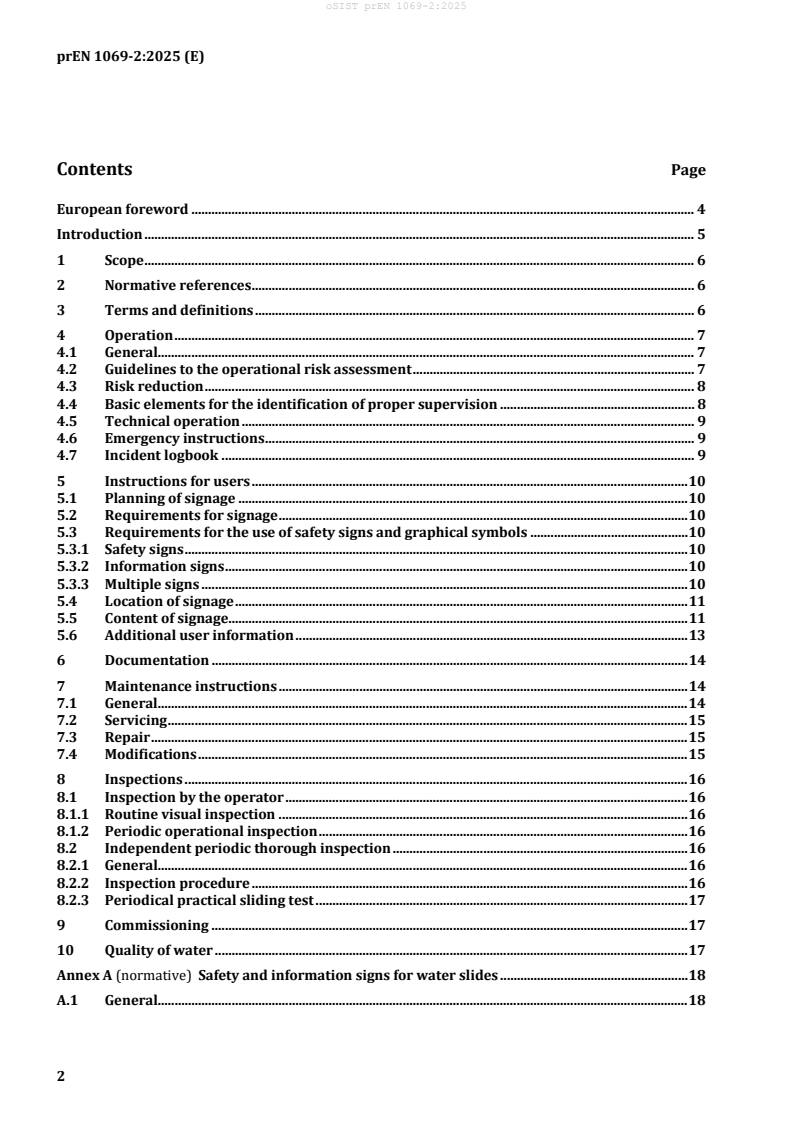
Contents Page
European foreword . 4
Introduction . 5
1 Scope . 6
2 Normative references . 6
3 Terms and definitions . 6
4 Operation . 7
4.1 General. 7
4.2 Guidelines to the operational risk assessment . 7
4.3 Risk reduction . 8
4.4 Basic elements for the identification of proper supervision . 8
4.5 Technical operation . 9
4.6 Emergency instructions . 9
4.7 Incident logbook . 9
5 Instructions for users . 10
5.1 Planning of signage . 10
5.2 Requirements for signage . 10
5.3 Requirements for the use of safety signs and graphical symbols . 10
5.3.1 Safety signs . 10
5.3.2 Information signs . 10
5.3.3 Multiple signs . 10
5.4 Location of signage . 11
5.5 Content of signage. 11
5.6 Additional user information . 13
6 Documentation . 14
7 Maintenance instructions . 14
7.1 General. 14
7.2 Servicing . 15
7.3 Repair . 15
7.4 Modifications . 15
8 Inspections . 16
8.1 Inspection by the operator . 16
8.1.1 Routine visual inspection . 16
8.1.2 Periodic operational inspection . 16
8.2 Independent periodic thorough inspection . 16
8.2.1 General. 16
8.2.2 Inspection procedure . 16
8.2.3 Periodical practical sliding test . 17
9 Commissioning . 17
10 Quality of water . 17
Annex A (normative) Safety and information signs for water slides . 18
A.1 General. 18
oSIST prEN 1069-2:2025
prEN 1069-2:2025 (E)
A.2 Examples for graphical symbol image content . 18
Bibliography . 24
oSIST prEN 1069-2:2025
prEN 1069-2:2025 (E)
European foreword
This document (prEN 1069-2:2025) has been prepared by Technical Committee CEN/TC 136 “Sports,
playground and other recreational facilities and equipment”, the secretariat of which is held by DIN.
This document is currently submitted to the CEN Enquiry.
This document will supersede EN 1069-2:2017.
prEN 1069-2:2025 includes the following significant technical changes with respect to EN 1069-2:2017:
a) change of scope: “to all water slides for public use installed at open water areas or in swimming
pools” →”open water areas” has been added to open the scope to other water facilities;
b) Clause 2 “Normative references” has been revised;
c) Clause 3 “Definitions”, has been revised;
d) Clause 5 “Instructions for users” has been restructured and revised;
e) Annex A “(normative) Safety and information signs for water slides” examples for image content
have been revised;
f) Annex B “(informative) Example of the risk assessment” has been deleted;
g) the document has been editorially revised.
EN 1069, Water slides, consists of:
— Part 1: Safety requirements and test methods
— Part 2: Instructions
oSIST prEN 1069-2:2025
prEN 1069-2:2025 (E)
Introduction
The provision of water slide installations is increasing, also are the concerns over the number of injuries
resulting from the use of water slides, many of which are of a serious nature.
Many of the injuries have resulted from foreseeable circumstances and, given proper knowledge and
control, could have been prevented.
A standard or a code of practice for instructions and the operation of water slides is seen as the most
appropriate way to achieve an improvement in safety.
oSIST prEN 1069-2:2025
prEN 1069-2:2025 (E)
1 Scope
This document is applicable to all water slides for public use, installed at open water areas or in
swimming pools.
This document establishes the instructions for use, operation, and maintenance as well as the
documentation of water slides.
2 Normative references
The following documents are referred to in the text in such a way that some or all of their content
constitutes requirements of this document. For dated references, only the edition cited applies. For
undated references, the latest edition of the referenced document (including any amendments) applies.
prEN 1069-1:2025, Water slides — Part 1: Safety requirements and test methods
EN 15288-1, Swimming pools for public use — Part 1: Safety requirements for design
EN 15288-2, Swimming pools for public use — Part 2: Safety requirements for operation
EN ISO 3834 (all parts), Quality requirements for fusion welding of metallic materials (ISO 3834)
EN ISO 7010, Graphical symbols — Safety colours and safety signs — Registered safety signs
EN ISO 9606-1, Qualification testing of welders — Fusion welding — Part 1: Steels (ISO 9606-1)
EN ISO 15607, Specification and qualification of welding procedures for metallic materials — General rules
(ISO 15607)
ISO 3864-3, Graphical symbols — Safety colours and safety signs — Part 3: Design principles for graphical
symbols for use in safety signs
ISO 7001, Graphical symbols — Registered public information symbols
3 Terms and definitions
For the purposes of this document, the terms and definitions given in prEN 1069-1:2025 and the
following apply.
ISO and IEC maintain terminology databases for use in standardization at the following addresses:
— ISO Online browsing platform: available at https://www.iso.org/obp/
— IEC Electropedia: available at https://www.electropedia.org/
3.1
operator
company, organization, authority or person with overall control and responsibility for the water slide
facility
3.2
platform
area providing access to the start section
oSIST prEN 1069-2:2025
prEN 1069-2:2025 (E)
3.3
public use
use of an installation open to everyone or to a defined group of users, not designated solely for the
owner’s/proprietor’s/operator’s family and guests independently from paying an entrance fee
[SOURCE: EN 15288-1:2018+A1:2024, 3.5]
Note 1 to entry: Pools serving houses rented for private use are not of public use.
3.4
raft
type of ride enhancement device for one or more users
3.5
safety sign
sign giving a general safety message, obtained by a combination of a colour and geometric shape and
which, by the addition of a graphical symbol, gives a particular safety message
[SOURCE: EN ISO 7010:2020, 3.3]
3.6
water slide
piece of equipment or installation with a sliding surface on which the user slides with water as a friction-
and/or speed-reducing medium; the user slides freely or with the use of a ride enhancement device
[SOURCE: prEN 1069-1:2025, 3.3]
Note 1 to entry: On some water slides the user can also be pushed e.g. by a water stream.
4 Operation
4.1 General
EN 15288-2 applies and EN 15288-1 shall be considered if appropriate. The following subclauses give
specific advice related to water slides.
4.2 Guidelines to the operational risk assessment
An operational risk assessment shall be performed by the slide operator, based on the results of the
design risk assessment, as a basis for the identification of the proper supervision, following the
requirements of EN 15288-2. In addition, and referring to the fact that impact between the users proved
to be a critical issue, also the following risks shall be taken into consideration:
h) inappropriate spacing at the start between users;
i) sliding position (e.g. sitting) can bring the user to an involuntary stop;
j) significant differences in speed can cause collisions of users;
k) significant differences in speed caused by:
1) different sliding positions;
2) different bathing costume respectively wearing hardly any bathing costume (e.g. G-string type);
oSIST prEN 1069-2:2025
prEN 1069-2:2025 (E)
3) different fitness, size, weight and age of user;
4) stopping or changing water flow rate (malfunction of water supply);
l) reasonably foreseeable risky behaviours by the users:
1) higher risk of collision between users at a splashdown area in contrast to a catch unit;
m) suitability for children;
n) foreseeable users categories (e.g. adults, children, both) and number of users (e.g. chain sliding
allowed);
o) allowed use of ride enhancement devices (e.g. mattresses, rafts);
p) unauthorised access.
4.3 Risk reduction
The operator shall take measures to reduce possible risks to a minimum bearing in mind the risky
behaviours of users by choosing an appropriate level of distance control and supervision and shall
identify a risk reduction strategy from the following options:
a) permanent full supervision by the staff at the start section and at the splashdown area/catch unit,
staff is in communication with each other;
b) adequate technical distance control, e.g. turnstiles at the entrance and/or exit area and/or a traffic
light control at the entrance;
c) a proper level of supervision/technical measures as a result of the risk assessment.
Additional safety equipment which may be used:
d) for the user: The installation of a monitor at the start section that transmits the situation at the end
of the slide and at the catch unit/splashdown area for the person who is starting to see whether the
catch unit or the splashdown area of the pool is free;
e) for the supervisory staff: The installation of a monitor at the staff terminal that transmits the situation
at the start and the end of the slide and at the catch unit/splashdown area. The quality of technical
distance control equipment depends on the risk assessment and should be carried out in accordance
with EN ISO 13849-2.
4.4 Basic elements for the identification of proper supervision
The operator, by performing the part of the risk assessment concerning proper supervision, shall take
into account at least the following:
a) kind of landing:
1) catch unit;
2) sofa unit;
3) special pool and its water depth at landing;
4) general purpose pool and its water depth at landing;
oSIST prEN 1069-2:2025
prEN 1069-2:2025 (E)
b) speed at the final part;
c) presence and kind of distance control:
1) full technical distance control;
2) traffic lights;
3) other types;
d) visibility for the user:
1) slide fully visible from the start;
2) catch unit visible from the start;
3) pool visible from the start.
The use of mandatory and prohibition signs and public information symbols should also be considered
when determining the proper supervision to enforce them.
4.5 Technical operation
Written guidelines shall be produced concerning operational instructions by the operator paying
particular attention to operational safety aspects (e.g. starting procedure, sliding speed of the users – see
prEN 1069-1:2025, 7.13).
These instructions shall comprise:
— detailed explanation of the controls and their function;
— recommended user access and egress procedures, exclusively allowed sliding positions and any
limitations necessary to prevent static overload of the water slide;
— the prescribed limiting conditions stating any limitations for user, the limits of speed of operation,
the sliding time and the maximum numbers of user to be carried;
— emergency evacuation procedures;
— any environmental limitations, e.g. conditions of wind, rain, snow during which the water slide shall
not be operated;
— details of the maintenance, service or repairs, qualification of the maintenance staff and specification
about selection of proper spare parts.
4.6 Emergency instructions
Written guidelines for emergency situations shall be produced for competent staff by the operator in
association with the statutory authorities.
4.7 Incident logbook
All incidents, including accidents, occurring with the use of a slide shall be recorded, monitored and
analysed regularly to ensure that the necessary improvement of the design, operation or maintenance of
the slide are made in order to prevent accidents as far as possible in future.
oSIST prEN 1069-2:2025
prEN 1069-2:2025 (E)
5 Instructions for users
5.1 Planning of signage
Water slides of types 1.2 and higher shall be equipped with a signage providing information for the safe
use of the water slides. The signage shall be installed at the time of commissioning and the operator shall
ensure that the signage is in function for the duration of the operation.
Extent and content of the signage shall be determined by the producer considering the
— installation and operation of the slide;
— the requirements of the operator;
— the experience of the producer;
— the requirements of this standard;
— the result of the preliminary risk analysis according to EN 1069-1.
If for extent and content of the signage additional requirements exist, a risk assessment according to 4.2
can be carried out.
5.2 Requirements for signage
Safety signs shall refer to EN ISO 7010. The safety signs shown in Annex A are designed according to
ISO 3864 series.
Requirements and examples for safety signs are given in Annex A.
5.3 Requirements for the use of safety signs and graphical symbols
5.3.1 Safety signs
In this standard safety signs are used as mandato
...