

EN 12856:1999
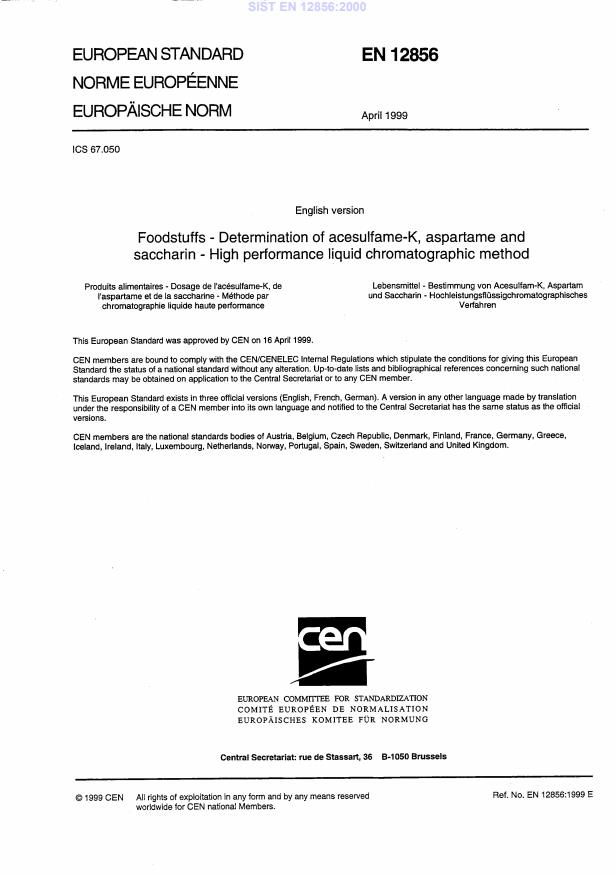
(Main)Foodstuffs - Determination of acesulfame-K, aspartame and saccharin - High performance liquid chromatographic method
- Abstract
This European Standard specifies a high performance liquid chromatographic (HPLC) method for the determination of acesulfame-K, aspartame, and saccharin, see (1), (2) and (3). It also allows the determination of caffeine, sorbic acid and benzoic acid in foodstuffs. Interlaboratory tests have been carried out with acesulfame-K in marzipan, yogurt, fruit yogurt, orange juice beverage, cola, cream and jam, with aspartame in marzipan, fruit yogurt, orange juice beverage, orange flavoured beverage, cola, jam, and preparation for flan, and with sodium saccharin in marzipan, yogurt, fruit yogurt, orange juice, ...
- Status
- Published
- Publication Date
- 20-Apr-1999
- Withdrawal Date
- 30-Oct-1999
- Technical Committee
- CEN/TC 275 - Food analysis - Horizontal methods
- Drafting Committee
- CEN/TC 275/WG 2 - Sweeteners
- Current Stage
- 9093 - Decision to confirm - Review Enquiry
- Start Date
- 12-Mar-2024
- Completion Date
- 30-Sep-2026

Overview
EN 12856:1999 (CEN) defines a high performance liquid chromatographic (HPLC) method for the determination of the artificial sweeteners acesulfame‑K, aspartame and saccharin in foodstuffs. The standard also permits simultaneous determination of caffeine, sorbic acid and benzoic acid, making it a versatile procedure for routine food analysis. Interlaboratory validation was performed across a range of food matrices (e.g., marzipan, yogurt, fruit yogurt, orange juice beverage, cola, cream, jam, and flan preparation), demonstrating the method’s applicability to complex food products.
Key topics and technical requirements
- Scope and applicability: Specifies which sweeteners and auxiliaries the HPLC method covers and the food matrices evaluated during validation.
- Analytical approach: Defines the use of HPLC for separation and quantification of target analytes (acesulfame‑K, aspartame, saccharin) and optional analytes (caffeine, sorbic acid, benzoic acid).
- Validation and interlaboratory testing: Includes information on method performance and repeatability as demonstrated by multi‑laboratory trials across diverse food types.
- Quality and reporting: Requires documented procedures for sample handling, analysis, and result reporting consistent with general methods for food product testing.
- Classification: Published under ICS 67.050 (general methods of tests and analysis for food products).
Practical applications
- Routine food quality control to verify compliance with labeling and regulatory limits for artificial sweeteners and preservatives.
- Regulatory laboratories performing official control and surveillance of sugar‑reduced and diet products (soft drinks, dairy, confectionery, baked goods).
- Food manufacturers validating supplier ingredients, batch release testing, and stability studies where sweetener levels and preservative content must be monitored.
- Contract testing and analytical service labs implementing validated HPLC methods for client testing across multiple matrices.
Who should use this standard
- Analytical chemists and lab managers in food testing laboratories
- Quality assurance and regulatory affairs professionals in the food and beverage industry
- Laboratories preparing methods for official controls or accreditation that require standardised HPLC procedures
Related standards
- Other CEN/ISO standards and national methods covering sweeteners, preservatives and HPLC analysis for foodstuffs (consult national standards bodies or CEN catalogues for exact references).
Keywords: EN 12856, HPLC method, acesulfame‑K, aspartame, saccharin, foodstuffs, caffeine, sorbic acid, benzoic acid, food analysis, CEN standard.
Relations
- Effective Date
- 28-Jan-2026
Get Certified
Connect with accredited certification bodies for this standard

BSI Group
BSI (British Standards Institution) is the business standards company that helps organizations make excellence a habit.

Bureau Veritas
Bureau Veritas is a world leader in laboratory testing, inspection and certification services.

DNV
DNV is an independent assurance and risk management provider.
Sponsored listings
Frequently Asked Questions
EN 12856:1999 is a standard published by the European Committee for Standardization (CEN). Its full title is "Foodstuffs - Determination of acesulfame-K, aspartame and saccharin - High performance liquid chromatographic method". This standard covers: This European Standard specifies a high performance liquid chromatographic (HPLC) method for the determination of acesulfame-K, aspartame, and saccharin, see (1), (2) and (3). It also allows the determination of caffeine, sorbic acid and benzoic acid in foodstuffs. Interlaboratory tests have been carried out with acesulfame-K in marzipan, yogurt, fruit yogurt, orange juice beverage, cola, cream and jam, with aspartame in marzipan, fruit yogurt, orange juice beverage, orange flavoured beverage, cola, jam, and preparation for flan, and with sodium saccharin in marzipan, yogurt, fruit yogurt, orange juice, ...
This European Standard specifies a high performance liquid chromatographic (HPLC) method for the determination of acesulfame-K, aspartame, and saccharin, see (1), (2) and (3). It also allows the determination of caffeine, sorbic acid and benzoic acid in foodstuffs. Interlaboratory tests have been carried out with acesulfame-K in marzipan, yogurt, fruit yogurt, orange juice beverage, cola, cream and jam, with aspartame in marzipan, fruit yogurt, orange juice beverage, orange flavoured beverage, cola, jam, and preparation for flan, and with sodium saccharin in marzipan, yogurt, fruit yogurt, orange juice, ...
EN 12856:1999 is classified under the following ICS (International Classification for Standards) categories: 67.050 - General methods of tests and analysis for food products. The ICS classification helps identify the subject area and facilitates finding related standards.
EN 12856:1999 has the following relationships with other standards: It is inter standard links to EN ISO 3696:1995. Understanding these relationships helps ensure you are using the most current and applicable version of the standard.
EN 12856:1999 is available in PDF format for immediate download after purchase. The document can be added to your cart and obtained through the secure checkout process. Digital delivery ensures instant access to the complete standard document.
Standards Content (Sample)
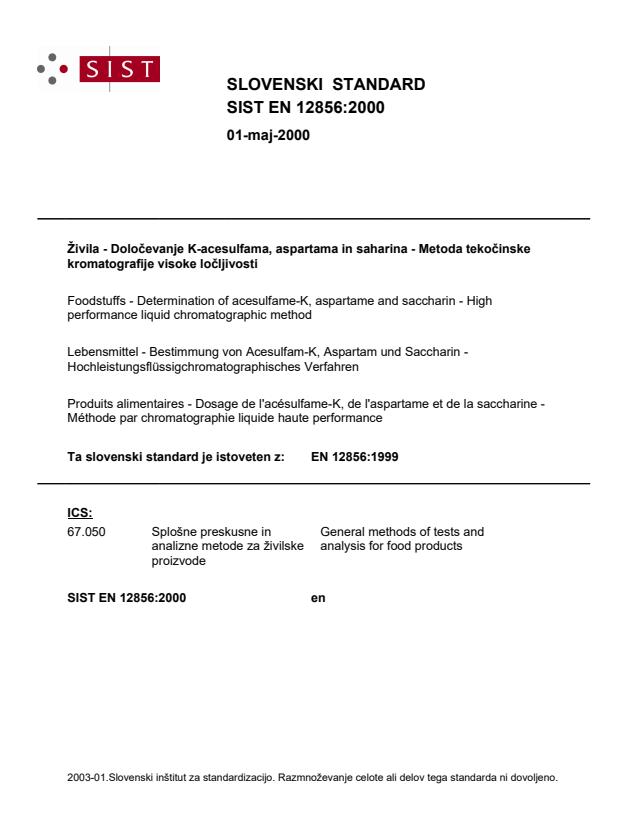
2003-01.Slovenski inštitut za standardizacijo. Razmnoževanje celote ali delov tega standarda ni dovoljeno.Lebensmittel - Bestimmung von Acesulfam-K, Aspartam und Saccharin - Hochleistungsflüssigchromatographisches VerfahrenProduits alimentaires - Dosage de l'acésulfame-K, de l'aspartame et de la saccharine - Méthode par chromatographie liquide haute performanceFoodstuffs - Determination of acesulfame-K, aspartame and saccharin - High performance liquid chromatographic method67.050Splošne preskusne in analizne metode za živilske
...