

EN 15964:2011
(Main)Breath alcohol test devices other than single use devices - Requirements and test methods
- Abstract
This European Standard applies to breath alcohol test devices which measure the concentration of alcohol contained in an exhaled breath sample intended to be used for screening or preliminary testing. This standard specifies requirements for basic safety and performance, test methods and requirements for marking, labelling and operating instructions.
This standard gives guidelines for type approval procedure consisting of a number of technical performance tests, but excluding in vivo tests, that are carried out on devices supplied by the manufacturers.
In vivo tests, which are designed to test the ability of the device to work with real subjects, may be arranged in compliance with national requirements.
This standard is not applicable to devices covered by OIML R 126:1998 (Evidential breath analyzers) or single use testers.
Devices are designed for law enforcement.
- Status
- Published
- Publication Date
- 01-Mar-2011
- Withdrawal Date
- 29-Sep-2011
- Technical Committee
- CEN/TC 367 - Project Committee - Breath-alcohol testers
- Drafting Committee
- CEN/TC 367 - Project Committee - Breath-alcohol testers
- Current Stage
- 9093 - Decision to confirm - Review Enquiry
- Start Date
- 09-Feb-2023
- Completion Date
- 14-Oct-2026

Overview
EN 15964:2011 is the European Standard published by CEN that specifies requirements and test methods for breath alcohol test devices other than single‑use devices (multi‑use breathalysers) intended for screening or preliminary testing. The standard covers basic safety and performance, metrological testing procedures, marking, labelling and operating instructions, and provides guidelines for a type‑approval test programme carried out on devices supplied by manufacturers. It applies to devices designed for law enforcement, traffic‑safety and workplace screening, but excludes evidential analyzers covered by OIML R 126:1998 and single‑use testers.
Key topics and technical requirements
- Scope & exclusions: Applies to multi‑use screening devices; excludes single‑use testers and OIML R 126 evidential instruments.
- Safety requirements: Hygiene (single‑use mouthpieces), general and electrical safety for battery/charger systems.
- Metrological characteristics: Test methods for accuracy, repeatability, drift, and memory (hysteresis) using defined test gases and reference conditions.
- Maximum Permissible Error (MPE): Establishes MPE and procedures for verification and adjustment when devices fall outside limits (standard defines MPE but does not prescribe device‑specific numeric values in this summary).
- Influence factors & robustness: Tests for temperature, humidity, interfering substances, breath sampling parameters, voltage variation, and condensation/water vapour effects.
- Environmental and mechanical testing: Shock, vibration, climatic (cold, heat, damp heat), and electrical disturbances (electrostatic discharge, radiated RF immunity).
- Usability & performance: Requirements for measurement range, units and expression of results, start‑up time, power‑supply duration, data storage, and ease of use.
- Type‑approval guidance: Annexes provide example testing requirements, formulae and guidance on software validation and test procedures.
Practical applications - who uses EN 15964:2011
- Manufacturers of multi‑use breath alcohol testers for design verification and pre‑market testing.
- Accredited test laboratories performing type testing and metrological evaluations.
- Law enforcement and public safety procurement teams specifying device performance for roadside screening.
- Certification and conformity assessment bodies establishing type‑approval programs (excluding in vivo tests which remain subject to national rules).
- Regulators and workplace safety managers referencing minimum performance and labeling requirements for screening devices.
Related standards
- OIML R 126:1998 - Evidential breath analyzers (excluded from EN 15964 scope)
- Selected normative references cited in EN 15964: EN 60068 (environmental tests), EN 61000‑4‑2 / EN 61000‑4‑3 (EMC immunity), EN 60335‑2‑29 (battery charger safety) - used for specific test procedures.
EN 15964:2011 helps ensure that multi‑use screening breathalysers provide reliable, repeatable results suitable for preliminary testing in traffic and workplace safety contexts, and supports manufacturers and authorities in establishing consistent type‑approval and testing practices.
Relations
- Effective Date
- 09-Feb-2026
- Effective Date
- 09-Feb-2026
- Effective Date
- 09-Feb-2026
- Effective Date
- 09-Feb-2026
- Effective Date
- 09-Feb-2026
- Effective Date
- 09-Feb-2026
- Effective Date
- 09-Feb-2026
- Effective Date
- 09-Feb-2026
- Effective Date
- 09-Feb-2026
- Effective Date
- 09-Feb-2026
- Effective Date
- 09-Feb-2026
Get Certified
Connect with accredited certification bodies for this standard

ECOCERT
Organic and sustainability certification.

Eurofins Food Testing Global
Global leader in food, environment, and pharmaceutical product testing.

Great Wall Tianjin Quality Assurance Center
Established 1993, first batch to receive national accreditation with IAF recognition.
Sponsored listings
Frequently Asked Questions
EN 15964:2011 is a standard published by the European Committee for Standardization (CEN). Its full title is "Breath alcohol test devices other than single use devices - Requirements and test methods". This standard covers: This European Standard applies to breath alcohol test devices which measure the concentration of alcohol contained in an exhaled breath sample intended to be used for screening or preliminary testing. This standard specifies requirements for basic safety and performance, test methods and requirements for marking, labelling and operating instructions. This standard gives guidelines for type approval procedure consisting of a number of technical performance tests, but excluding in vivo tests, that are carried out on devices supplied by the manufacturers. In vivo tests, which are designed to test the ability of the device to work with real subjects, may be arranged in compliance with national requirements. This standard is not applicable to devices covered by OIML R 126:1998 (Evidential breath analyzers) or single use testers. Devices are designed for law enforcement.
This European Standard applies to breath alcohol test devices which measure the concentration of alcohol contained in an exhaled breath sample intended to be used for screening or preliminary testing. This standard specifies requirements for basic safety and performance, test methods and requirements for marking, labelling and operating instructions. This standard gives guidelines for type approval procedure consisting of a number of technical performance tests, but excluding in vivo tests, that are carried out on devices supplied by the manufacturers. In vivo tests, which are designed to test the ability of the device to work with real subjects, may be arranged in compliance with national requirements. This standard is not applicable to devices covered by OIML R 126:1998 (Evidential breath analyzers) or single use testers. Devices are designed for law enforcement.
EN 15964:2011 is classified under the following ICS (International Classification for Standards) categories: 03.160 - Law. Administration; 71.040.40 - Chemical analysis. The ICS classification helps identify the subject area and facilitates finding related standards.
EN 15964:2011 has the following relationships with other standards: It is inter standard links to ISO 8986-1:1993, EN 60068-2-27:2009, EN 60068-2-31:2008, EN IEC 61000-4-2:2025, EN IEC 60068-2-2:2025, EN 60068-2-6:2008, EN 60068-2-64:2008, EN IEC 60068-2-30:2025, EN IEC 60068-2-1:2025, EN IEC 60068-2-78:2025, EN 60335-2-29:2021. Understanding these relationships helps ensure you are using the most current and applicable version of the standard.
EN 15964:2011 is available in PDF format for immediate download after purchase. The document can be added to your cart and obtained through the secure checkout process. Digital delivery ensures instant access to the complete standard document.
Standards Content (Sample)
2003-01.Slovenski inštitut za standardizacijo. Razmnoževanje celote ali delov tega standarda ni dovoljeno.Preskusne naprave za merjenje alkohola v sapi (razen naprave za enkratno uporabo) - Zahteve in preskusne metodeAtemalkohol-testgeräte zur Mehrfachverwendung - Anforderungen und PrüfverfahrenEthylotests autres que les dispositifs à usage unique - Exigences et méthodes d'essaisBreath alcohol test devices other than single use devices - Requirements and test methods71.040.10Kemijski laboratoriji. Laboratorijska opremaChemical laboratories. Laboratory equipmentICS:Ta slovenski standard je istoveten z:EN 15964:2011SIST EN 15964:2011en,fr,de01-november-2011SIST EN 15964:2011SLOVENSKI
STANDARD
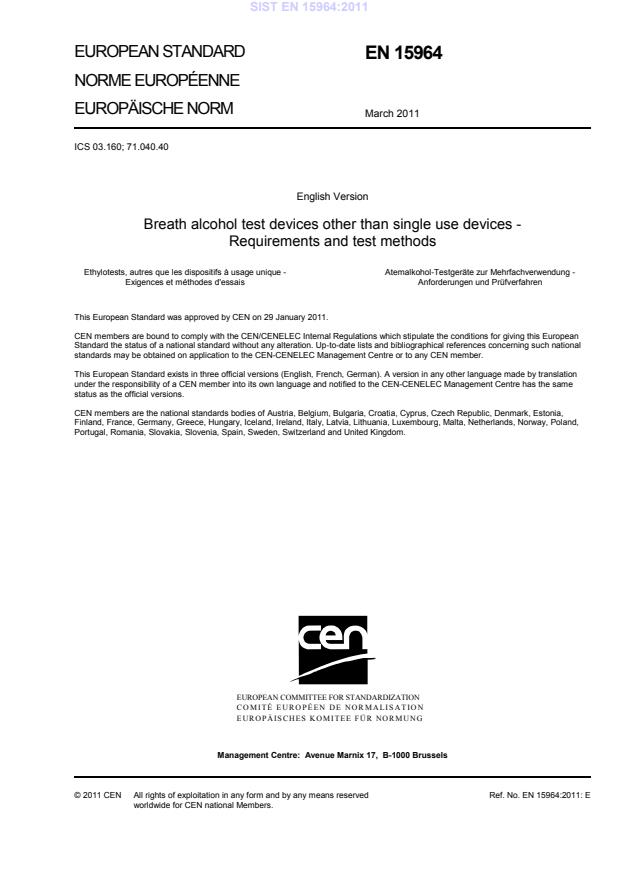
EUROPEAN STANDARD NORME EUROPÉENNE EUROPÄISCHE NORM
EN 15964
March 2011 ICS 03.160; 71.040.40 English Version
Breath alcohol test devices other than single use devices - Requirements and test methods
Ethylotests, autres que les dispositifs à usage unique - Exigences et méthodes d'essais
Atemalkohol-Testgeräte zur Mehrfachverwendung - Anforderungen und Prüfverfahren This European Standard was approved by CEN on 29 January 2011.
CEN members are bound to comply with the CEN/CENELEC Internal Regulations which stipulate the conditions for giving this European Standard the status of a national standard without any alteration. Up-to-date lists and bibliographical references concerning such national standards may be obtained on application to the CEN-CENELEC Management Centre or to any CEN member.
This European Standard exists in three official versions (English, French, German). A version in any other language made by translation under the responsibility of a CEN member into its own language and notified to the CEN-CENELEC Management Centre has the same status as the official versions.
CEN members are the national standards bodies of Austria, Belgium, Bulgaria, Croatia, Cyprus, Czech Republic, Denmark, Estonia, Finland, France, Germany, Greece, Hungary, Iceland, Ireland, Italy, Latvia, Lithuania, Luxembourg, Malta, Netherlands, Norway, Poland, Portugal, Romania, Slovakia, Slovenia, Spain, Sweden, Switzerland and United Kingdom.
EUROPEAN COMMITTEE FOR STANDARDIZATION
COMITÉ EUROPÉEN DE NORMALISATION EUROPÄISCHES KOMITEE FÜR NORMUNG
Management Centre:
Avenue Marnix 17,
B-1000 Brussels © 2011 CEN All rights of exploitation in any form and by any means reserved worldwide for CEN national Members. Ref. No. EN 15964:2011: ESIST EN 15964:2011
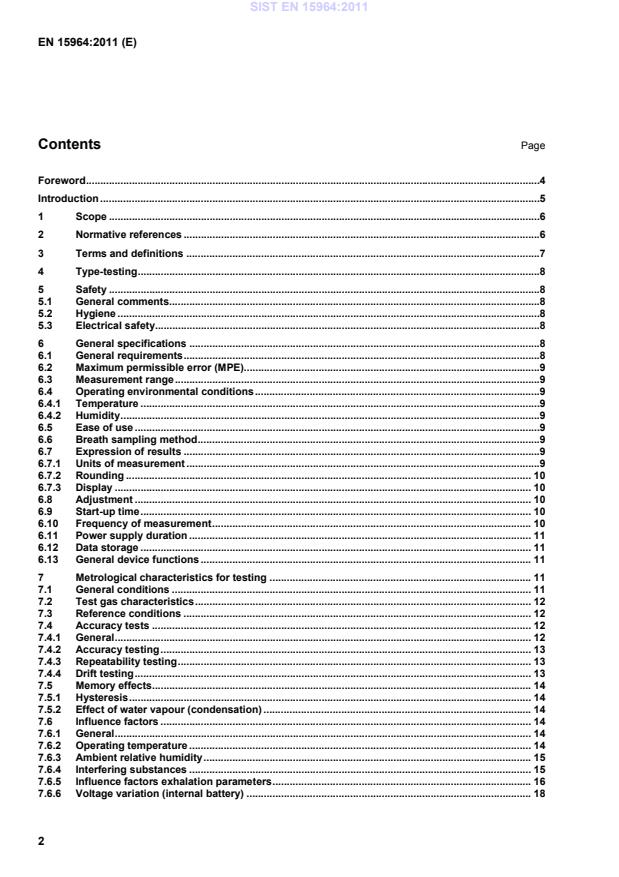
Example of type testing requirements . 25A.1Additional information for compliance testing. 25A.2Certification procedure . 25Annex B (informative)
Formula . 27Annex C (informative)
Simulated tetra immunity test . 28C.1Test procedure – General . 28C.2Test frequencies . 28C.3Test limits . 28C.4Modulation. 28Annex D (informative)
Software validation and verification . 30D.1General . 30D.2Security. 30Bibliography . 33 SIST EN 15964:2011
1) European standardization does not cover those subjects that clearly belong to the domain of regulation of the Member States unless this is explicitly supported by the national authority (i.e. regulatory measures remain the competence of the various Member States). SIST EN 15964:2011
Part 2-6: Tests
Test Fc: Vibration (sinusoidal) EN 60068-2-27, Environmental testing Part 2-27: Tests Test Ea and guidance: Shock EN 60068-2-30, Environmental testing Part 2-30: Tests Test Db: Damp heat, cyclic (12 h + 12 h cycle) EN 60068-2-32, Basic environmental testing procedures Part 2: Tests Test Ed: Free fall EN 60068-2-64, Environmental testing Part 2-64: Tests Test Fh: Vibration, broadband random and guidance EN 60068-2-78, Environmental testing Part 2-78: Tests Test Cab: Damp heat, steady state EN 60335-2-29, Household and similar electrical appliances Safety Part 2-29: Particular requirements for battery chargers EN 61000-4-2, Electromagnetic compatibility (EMC) Part 4-2: Testing and measurement techniques Electrostatic discharge immunity test EN 61000-4-3, Electromagnetic compatibility (EMC) Part 4-3: Testing and measurement techniques Radiated, radio-frequency, electromagnetic field immunity test SIST EN 15964:2011
Concentration in ethanol may be expressed in any other equivalent units, e.g. mg/L, µg/L or µg/100 ml. 3.7 manufacturer natural or legal person with responsibility for the design, manufacture, packaging and labelling of a device before it is placed on the market under his own name, regardless of whether these operations are carried out by that person himself or on his behalf by a third party 3.8 MPE
maximum permissible error extreme allowed value of measurement with respect to a test gas concentration defined in this standard 3.9 verification testing process to establish that the breath alcohol test device is operating within the limits of the defined MPE and repeatability 3.10 adjustment process required to correct the measurement value of the breath alcohol test device when it is found to be outside of the defined MPE 3.11 mouthpiece hygienically wrapped part intended for single use that is fitted to the breath alcohol test device through which the subject under test provides the breath specimen NOTE
A mouthpiece is used to prevent the breath sample being mixed with ambient air and diluting the alcohol concentration. SIST EN 15964:2011
In normal mode the specimen of breath shall be taken automatically after the requirements in 6.6 have been met. The device may have provision for manual acceptance of the vapour presented to it when conducting adjustment or verification operations as well as metrological tests. Devices shall be provided with an indication when the internal power supply is becoming exhausted. If this low power indication is given, the device shall be capable of running at least ten further measurements. The battery warning indicator shall not lead to confusion with any other displayed function. Devices that also use external power supply shall be provided with an indicator that displays that power is on. This indicator shall not lead to confusion with any other displayed function. The means by which the device is calibrated or adjusted shall only be accessible to authorised persons. SIST EN 15964:2011
The required period between two successive adjustments shall be at least three months. During this period the results shall remain stable (see 7.4.4). 6.9 Start-up time Within the specified operating temperature range, the device shall be ready to carry out a measurement in less than 3 minutes after switching on. 6.10 Frequency of measurement The maximum allowed time between two measurements shall be: ≤ 1 min for a concentration ≤ 0,05 mg/L; ≤ 2 min for a
concentration > 0,05 mg/L and ≤ 0,40 mg/L; ≤ 3 min for a concentration > 0,40 mg/L and ≤ 2,0 mg/L. SIST EN 15964:2011
For example, in case of lot by lot testing, the manufacturer shall perform the adjustment.
Perform the tests at the maximum rate authorised by the provided features, taking into account the test equipment possibilities. The tests shall be able to check that the devices comply with the provisions of this document in the different submitted power supply configurations. The effect of each factor shall be determined in turn with all other factors being at their reference level. The effects shall not be combined unless otherwise specified. In performing the tests in this scheme a complete breath test using the standard vapours shall be carried out. Wherever possible, the test shall allow all aspects of the normal operation of the device to be verified. Tests shall be run at the reference point and the extreme points of each condition listed. The power supply used shall be of the type recommended by the manufacturer. The following tests shall be carried out on a device representative of devices intended for use and without any additional protective means. SIST EN 15964:2011
± 0,1) L. If required by the test device, the test gas flow rate shall be reduced to allow the device to take a sample of the test gas for analysis. Regardless of the selected mode (normal or test mode), the device shall be tested the way it is normally used. For a breath alcohol test device that is not capable of displaying the measured concentration, the manufacturer shall provide the necessary methods to be able to obtain quantitative readings for the purpose of testing the compliance of the breath alcohol test device with the requirement of this European Standard. 7.4 Accuracy tests 7.4.1 General The device shall be tested with the number and concentration of test gases listed in Table 1 in 7.4.2. The individual results and the average results shall be within the error limits indicated for each test gas. SIST EN 15964:2011
For accuracy, the following concentrations and number of measurements shall be used for the tests: Table 1 Concentration (mg/L) Number of measurements 0,00 10 0,10 20 0,25 20 0,40 20 0,60 10
If digital values are required above 0,60 mg/L, the accuracy has to be tested ten times at 90 % of the maximum value, e.g. at 1,80 mg/L for the maximum range given in 6.3. If no digital values are required above 0,60 mg/L, the functionality of the device up to the maximum value of the measurement range has to be checked. If a
...