

EN 12966:2014+A1:2018
(Main + Amendment)Road vertical signs - Variable message traffic signs
- Abstract
This European Standard provides specifications for two types of variable message signs (VMS); i.e. continuous (see 3.4) and discontinuous (see 3.7).
This European Standard covers mobile, temporary and permanently installed VMS used in circulation areas, on public and private land, including tunnels for the information, guidance, warning and/or direction of traffic. Test modules are used to demonstrate compliance with the requirements.
This European Standard specifies visual and physical characteristics of VMS as well as their durability aspects. It also provides relevant requirements and corresponding test methods, assessment and verification of constancy of performance (AVCP) and marking.
NOTE Provisions for the evaluation of conformity with regards to type testing are further specified in 6.2; provisions with regards to factory production control (FPC) are further specified in 6.3.
This European Standard does not cover
a) sign gantries, cantilevers, posts (supports) and foundations,
b) signal heads,
c) sizes and shapes of VMS messages,
d) control units and monitoring units unless inside the VMS,
e) control of sign luminance.
- Status
- Published
- Publication Date
- 11-Dec-2018
- Withdrawal Date
- 29-Sep-2020
- Technical Committee
- CEN/TC 226 - Road equipment
- Drafting Committee
- CEN/TC 226/WG 11 - Variable message signs
- Current Stage
- 9092 - Decision on results of review/2YR ENQ - revise - Review Enquiry
- Start Date
- 05-Jun-2023
- Completion Date
- 21-Oct-2026


Overview
EN 12966:2014+A1:2018 (equivalent to EN 12966:2014+A1:2018) is the European standard for road vertical variable message signs (VMS). It specifies requirements for two VMS types - continuous and discontinuous - and applies to mobile, temporary and permanently installed signs used in circulation areas (including tunnels) for information, guidance, warning and direction of traffic. The standard defines visual and physical characteristics, durability, test modules and the procedures for assessment and verification of constancy of performance (AVCP) and marking.
Key topics and technical requirements
The standard organizes technical requirements and test methods across several areas (see clauses and annexes for details):
- Scope and definitions - terminology for continuous vs discontinuous VMS and related parts.
- Product characteristics - dimensions, tolerances and general design requirements.
- Visual performance - requirements for luminance, chromaticity and luminance distribution for both continuous and discontinuous VMS.
- Physical performance - mechanical, environmental and electrical durability aspects and protection against dangerous substances.
- Testing methods and test modules - standardized test modules, test sequences, sampling and measurement set‑ups to demonstrate compliance.
- Durability and performance verification - accelerated ageing tests, environmental tests and service life considerations.
- AVCP (Assessment and Verification of Constancy of Performance) - type testing (clause 6.2) and factory production control (FPC, clause 6.3).
- Classification, marking and product information - performance codes, class combinations and labelling (Annexes B, R).
- Informative guidance - annexes providing calculation methods (equivalent area), guidance on graphics, legibility, beam width, energy efficiency and technical documentation.
Note: the standard explicitly excludes support structures (gantries, posts), signal heads, message sizes/shapes, and external control units unless they are inside the VMS; also it does not cover control of sign luminance.
Practical applications and who uses this standard
SIST EN 12966 is intended for practical use by:
- VMS manufacturers - design, production and internal FPC to meet European performance classes.
- Road authorities and procurement teams - specifying performance, durability and marking requirements in tenders.
- System integrators and installers - ensuring installed VMS comply with visual/physical requirements and interoperability guidance.
- Testing laboratories and certification bodies - conducting type testing and AVCP assessments using the standard test modules and methods.
- Tunnel operators and traffic managers - selecting appropriate VMS classes for visibility, beam width and legibility in specific traffic environments.
Related standards and regulatory links
- The standard is a CEN/EN document implemented nationally (here as SIST EN 12966).
- Annex ZA addresses the relationship with EU Regulation (EU) No. 305/2011 and clarifies which clauses relate to that Regulation.
- For full implementation, users should cross‑reference national transpositions and relevant standards on support structures and traffic control systems.
Keywords: SIST EN 12966, EN 12966, variable message signs, VMS standard, road vertical signs, visual performance, luminance, AVCP, VMS testing, continuous VMS, discontinuous VMS.
Relations
- Effective Date
- 19-Jan-2023
- Effective Date
- 09-Feb-2026
- Effective Date
- 09-Feb-2026
- Effective Date
- 09-Feb-2026
- Effective Date
- 09-Feb-2026
- Effective Date
- 09-Feb-2026
- Effective Date
- 09-Feb-2026
- Effective Date
- 09-Feb-2026
- Effective Date
- 09-Feb-2026
- Effective Date
- 09-Feb-2026
- Effective Date
- 09-Feb-2026
- Effective Date
- 28-Jan-2026
- Effective Date
- 28-Jan-2026
- Effective Date
- 28-Jan-2026
- Effective Date
- 28-Jan-2026
Get Certified
Connect with accredited certification bodies for this standard

Zavod za gradbeništvo Slovenije (ZAG) - Inšpekcija
ZAG inspection body for construction products, structures, and materials.
Sponsored listings
Frequently Asked Questions
EN 12966:2014+A1:2018 is a standard published by the European Committee for Standardization (CEN). Its full title is "Road vertical signs - Variable message traffic signs". This standard covers: This European Standard provides specifications for two types of variable message signs (VMS); i.e. continuous (see 3.4) and discontinuous (see 3.7). This European Standard covers mobile, temporary and permanently installed VMS used in circulation areas, on public and private land, including tunnels for the information, guidance, warning and/or direction of traffic. Test modules are used to demonstrate compliance with the requirements. This European Standard specifies visual and physical characteristics of VMS as well as their durability aspects. It also provides relevant requirements and corresponding test methods, assessment and verification of constancy of performance (AVCP) and marking. NOTE Provisions for the evaluation of conformity with regards to type testing are further specified in 6.2; provisions with regards to factory production control (FPC) are further specified in 6.3. This European Standard does not cover a) sign gantries, cantilevers, posts (supports) and foundations, b) signal heads, c) sizes and shapes of VMS messages, d) control units and monitoring units unless inside the VMS, e) control of sign luminance.
This European Standard provides specifications for two types of variable message signs (VMS); i.e. continuous (see 3.4) and discontinuous (see 3.7). This European Standard covers mobile, temporary and permanently installed VMS used in circulation areas, on public and private land, including tunnels for the information, guidance, warning and/or direction of traffic. Test modules are used to demonstrate compliance with the requirements. This European Standard specifies visual and physical characteristics of VMS as well as their durability aspects. It also provides relevant requirements and corresponding test methods, assessment and verification of constancy of performance (AVCP) and marking. NOTE Provisions for the evaluation of conformity with regards to type testing are further specified in 6.2; provisions with regards to factory production control (FPC) are further specified in 6.3. This European Standard does not cover a) sign gantries, cantilevers, posts (supports) and foundations, b) signal heads, c) sizes and shapes of VMS messages, d) control units and monitoring units unless inside the VMS, e) control of sign luminance.
EN 12966:2014+A1:2018 is classified under the following ICS (International Classification for Standards) categories: 93.080.30 - Road equipment and installations. The ICS classification helps identify the subject area and facilitates finding related standards.
EN 12966:2014+A1:2018 has the following relationships with other standards: It is inter standard links to EN 12966:2014, EN IEC 61158-5-21:2019, EN 62625-1:2013, EN 61375-3-1:2012, EN 61375-2-1:2012, EN 60839-11-31:2017, EN 61375-2-5:2015, EN 62625-2:2016, EN 61158-6-2:2012, EN 62580-1:2016, EN 62591:2016, CEN/TS 17402:2020, EN ISO 24534-3:2016, EN 12966-1:2005+A1:2009, EN ISO 11073-10101:2020. Understanding these relationships helps ensure you are using the most current and applicable version of the standard.
EN 12966:2014+A1:2018 is associated with the following European legislation: EU Directives/Regulations: 305/2011; Standardization Mandates: M/111. When a standard is cited in the Official Journal of the European Union, products manufactured in conformity with it benefit from a presumption of conformity with the essential requirements of the corresponding EU directive or regulation.
EN 12966:2014+A1:2018 is available in PDF format for immediate download after purchase. The document can be added to your cart and obtained through the secure checkout process. Digital delivery ensures instant access to the complete standard document.
Standards Content (Sample)
2003-01.Slovenski inštitut za standardizacijo. Razmnoževanje celote ali delov tega standarda ni dovoljeno.Vertikale Verkehrszeichen - WechselverkehrszeichenSignaux de signalisation routière verticale - Panneaux à messages variableRoad vertical signs - Variable message traffic signs93.080.30Cestna oprema in pomožne napraveRoad equipment and installationsICS:Ta slovenski standard je istoveten z:EN 12966:2014+A1:2018SIST EN 12966:2015+A1:2019en,fr,de01-februar-2019SIST EN 12966:2015+A1:2019SLOVENSKI
STANDARDSIST EN 12966:20151DGRPHãþD
EUROPEAN STANDARD NORME EUROPÉENNE EUROPÄISCHE NORM
EN 12966:2014+A1
December
t r s z ICS
{ uä r z rä u r Supersedes EN
s t { x xã t r s vEnglish Version
Road vertical signs æ Variable message traffic signs Signaux de signalisation routière verticale æ Panneaux à messages variable
Vertikale Verkehrszeichen æ WechselverkehrszeichenThis European Standard was approved by CEN on
s z October
t r s v and includes Amendment
s approved by CEN on
s r October
t r s zä
egulations which stipulate the conditions for giving this European Standard the status of a national standard without any alterationä Upætoædate lists and bibliographical references concerning such national standards may be obtained on application to the CENæCENELEC Management Centre or to any CEN memberä
translation under the responsibility of a CEN member into its own language and notified to the CENæCENELEC Management Centre has the same status as the official versionsä
CEN members are the national standards bodies of Austriaá Belgiumá Bulgariaá Croatiaá Cyprusá Czech Republicá Denmarká Estoniaá Finlandá Former Yugoslav Republic of Macedoniaá Franceá Germanyá Greeceá Hungaryá Icelandá Irelandá Italyá Latviaá Lithuaniaá Luxembourgá Maltaá Netherlandsá Norwayá Polandá Portugalá Romaniaá Serbiaá Slovakiaá Sloveniaá Spainá Swedená Switzerlandá Turkey and United Kingdomä
EUROPEAN COMMITTEE FOR STANDARDIZATION COMITÉ EUROPÉEN DE NORMALISATION EUROPÄISCHES KOMITEE FÜR NORMUNG
CEN-CENELEC Management Centre:
Rue de la Science 23,
B-1040 Brussels
t r s z CEN All rights of exploitation in any form and by any means reserved worldwide for CEN national Membersä Refä Noä EN
s t { x xã t r s v ªA sã t r s z ESIST EN 12966:2015+A1:2019
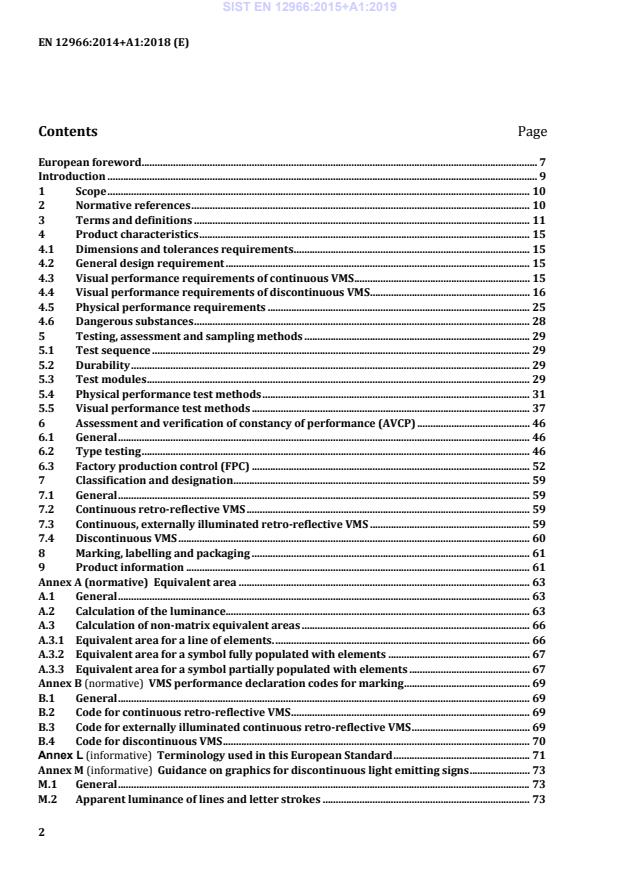
Equivalent area . 63 A.1 General . 63 A.2 Calculation of the luminance. 63 A.3 Calculation of non-matrix equivalent areas . 66 A.3.1 Equivalent area for a line of elements. . 66 A.3.2 Equivalent area for a symbol fully populated with elements . 67 A.3.3 Equivalent area for a symbol partially populated with elements . 67 Annex B (normative)
VMS performance declaration codes for marking . 69 B.1 General . 69 B.2 Code for continuous retro-reflective VMS . 69 B.3 Code for externally illuminated continuous retro-reflective VMS . 69 B.4 Code for discontinuous VMS . 70 Annex L (informative)
Terminology used in this European Standard . 71 Annex M (informative)
Guidance on graphics for discontinuous light emitting signs . 73 M.1 General . 73 M.2 Apparent luminance of lines and letter strokes . 73 SIST EN 12966:2015+A1:2019
Guidance on dimensions , luminance, beam width,
legibility and efficiency for discontinuous VMS . 83 N.1 General . 83 N.2 Dimensions . 83 N.2.1 General . 83 N.2.2 Text . 84 N.2.3 Circles. 84 N.2.4 Triangles . 85 N.3 Luminance and beam width classes . 85 N.4 Beam width and distances of legibility . 90 N.4.1 Group of VMS, centred above the road . 90 N.4.2 Group of VMS, not centred above the road . 91 N.4.3 Curved road sections . 92 N.4.4 Limits of legibility due to vertical beam . 93 N.4.5 Calculation of recognition time . 95 N.4.5.1 General . 95 N.4.5.2 Distances in metres per second at various speeds . 95 N.4.5.3 Example of calculation of the recognition time . 95 N.4.5.3.1 General . 95 N.4.5.3.2 Using beam width class B2 . 96 N.4.5.3.3 Using beam width class B4 . 97 N.4.5.3.4 Using beam width class B6 . 97 N.4.5.4 Conclusions after calculation of recognition time . 98 N.4.6 Luminance and luminance ratio . 98 N.4.7 Beam width . 99 N.5 Energy efficiency . 99 Annex O (informative)
Specific design issues . 100 O.1 Finish . 100 O.2 Front panels . 100 O.3 Front screens . 100 O.4 Appearance . 100 O.5 Electrolytic compatibility . 100 O.6 Protection against thermal overload . 100 O.7 Physical security against unauthorized access . 100 O.8 Interfaces between VMS, control, and higher order equipment. 100 O.9 Diagnostic . 101 Annex P (informative)
Guidance for design of VMS messages. 102 P.1 Design of VMS messages . 102 P.2 Specifying text dimensions . 103 Annex Q (informative)
Technical documentation. 106 Q.1 Sign enclosure . 106 Q.2 Electrical equipment . 106 Q.3 Mounting devices (if applicable) . 106 Q.4 Retro-reflective and non retro-reflective components . 106 Annex R (informative)
Example of recommended summary of class combinations. 108 SIST EN 12966:2015+A1:2019
!Relationship of this European Standard with Regulation (EU) No.305/2011 . 116 ZA.1 Scope and relevant characteristics . 116 ZA.2 System of Assessment and Verification of Constancy of Performance (AVCP) . 119 ZA.3 Assignment of AVCP tasks . 119 ZA.4 The following clauses are not related to Regulation (EU) No 305/2011: . 120 Bibliography . 121 Figures Page Figure 1 — Chromaticity areas for the colour classes C1 and C2 plotted in the CIE 1931 chromaticity diagram . 18 Figure 2 — Examples of passed and failed luminance distributions . 23 Figure 3 — Examples of variable message traffic sign test modules in front view – a) and c) - and side view b) . 31 Figure 4 — Side elevation of the set-up for the measurement of luminance and luminance ratio . 38 Figure 5 — Layout examples for a test module and the positioning of the measuring area (circle) of the luminance meter . 43 Figure A.1 — Merging of elements . 63 Figure A.2 — Character with a regular orthogonal matrix of (5 × 8) elements . 64 Figure A.3 — Open line . 66 Figure A.4 — Closed line . 66 Figure A.5 — Example of symbol with an area fully populated with elements . 67 Figure A.6 — Example of symbol with an area partially populated with elements . 68 Figure B.1 — Code of performance classes of continuous retro-reflective VMS. 69 Figure B.2 — Code of performance classes of externally illuminated continuous retro-reflective VMS . 70 Figure B.3 — Code of performance classes of discontinuous VMS . 70 Figure L.1 — Parts of a VMS . 71 Figure L.2 — Test configuration . 72 Figure M.1 — A legend seen at short (left), longer (centre), and very long distance (right) . 74 Figure M.2 — Example for calculation of dimensions of circular mandatory VMS . 78 Figure M.3 — Example for calculation of dimensions of circular mandatory VMS . 79 Figure M.4 — Example for calculation of dimensions of a triangular warning VMS . 80 Figure M.5 — Example of VMS using (64 × 64) elements with colour inversion . 81 Figure M.6 — Example of VMS using (48 × 48) elements with colour inversion . 81 Figure M.7 — Example of VMS using (32 × 32) elements with colour inversion . 81 Figure M.8 — Example of VMS using (64 × 64) elements, no colour inversion . 82 Figure M.9 — Example of VMS using (48 × 48) elements, no colour inversion . 82 Figure M.10 — Example of VMS using (32 × 32) elements, no colour inversion . 82 Figure N.1 — Relation between classes . 86 Figure N.2 — Example of coverage by beam width class B1 . 87 Figure N.3 — Example of coverage by beam width class B3 . 88 Figure N.4 — Example of coverage by beam width class B6 . 89 Figure N.5 — Legibility of group of VMS, centred on gantry above the road . 90 Figure N.6 — Legibility of group of VMS, mounted on cantilever aside the road . 91 Figure N.7— Legibility of group of VMS, mounted on cantilever aside the road . 93 Figure N.8— Legibility of group of VMS, mounted on cantilever aside the road . 94 Figure P.1 — Example of the design of the letter E in a regular orthogonal matrix . 102 Figure P.2 — Equivalent text dimensions using uppercase characters . 103 SIST EN 12966:2015+A1:2019
...