

EN ISO 14630:2024
(Main)Non-active surgical implants - General requirements (ISO 14630:2024)
- Abstract
This document specifies general requirements for non-active surgical implants, hereafter referred to as implants.
This document is not applicable to dental implants, dental restorative materials, transendodontic and transradicular implants, intra-ocular lenses and implants utilizing viable animal or human tissue.
With regard to safety, this document specifies requirements for intended performance, design attributes, materials, design evaluation, manufacture, sterilization, packaging and information supplied by the manufacturer, and tests to demonstrate compliance with these requirements.
Additional requirements applicable to specific implants or implant families are given or referred to in Level 2 and Level 3 standards.
NOTE 1 This document does not require that the manufacturer have a quality management system in place. However, many regulatory authorities require the application of a quality management system, such as that described in ISO 13485, to ensure that the implant achieves its intended performance and safety.
NOTE 2 In this document, when not otherwise specified, the term "implant" refers to each individual component of a system or a modular implant, provided separately or as a set of components, as well as to all ancillary implants or associated implants designed for improving the intended performance.
- Status
- Published
- Publication Date
- 17-Dec-2024
- Technical Committee
- CEN/TC 285 - Non-active surgical implants
- Drafting Committee
- CEN/TC 285 - Non-active surgical implants
- Current Stage
- 6060 - Definitive text made available (DAV) - Publishing
- Start Date
- 18-Dec-2024
- Completion Date
- 18-Dec-2024
- Directive
- 2017/745 - Regulation (EU) 2017/745 of the European Parliament and of the Council of 5 April 2017 on medical devices, amending Directive 2001/83/EC, Regulation (EC) No 178/2002 and Regulation (EC) No 1223/2009 and repealing Council Directives 90/385/EEC and 93/42/EECOJ Ref: 2026/193, OJ L, OJ L, 2026/193 OJ Date: 30-Jan-2026

Overview
EN ISO 14630:2024 (Non-active surgical implants - General requirements) specifies general safety and performance requirements for non-active surgical implants. It applies to individual implant components, modular implants and ancillary components, and covers design, materials, manufacture, sterilization, packaging and the information that manufacturers must supply. The standard is not applicable to dental implants, dental restorative materials, transendodontic/transradicular implants, intra‑ocular lenses, or implants using viable human or animal tissue. EN ISO 14630:2024 supersedes the 2012 edition and has been adopted by CEN as a harmonized European standard.
Key topics and technical requirements
- Intended performance and design attributes: Requirements to ensure implants meet their intended clinical function and usability.
- Materials and biocompatibility: General expectations for selection and evaluation of materials used in implants (referenced biological evaluation standards apply).
- Design evaluation and testing: Tests and assessments to demonstrate that the implant satisfies safety and performance claims.
- Manufacture and process controls: Requirements addressing production processes and controls necessary to maintain implant integrity.
- Sterilization and sterile barrier systems: Requirements for sterilization method selection, validation and packaging for terminally sterilized devices.
- Packaging: Criteria for materials and packaging systems to preserve sterility and device integrity during distribution and storage.
- Information supplied by the manufacturer: Labeling, instructions for use and processing instructions to ensure safe handling and clinical use.
- Modular systems and components: Application of requirements to individual components and sets provided separately or together.
- Regulatory alignment: Annex ZA links clauses to the EU Medical Device Regulation (EU) 2017/745 and identifies referenced standards that support conformity.
Practical applications and users
Who uses EN ISO 14630:2024:
- Medical device manufacturers - during design, risk assessment and technical documentation for non‑active implants.
- Design and R&D engineers - to define design inputs, materials selection and verification testing.
- Regulatory and quality teams - to support conformity assessment and alignment with EU MDR requirements (when harmonized and cited in the OJ).
- Notified bodies and conformity assessors - as a reference for evaluating general safety and performance.
- Testing laboratories and sterilization service providers - for validation of sterilization processes and packaging performance.
- Procurement and clinical engineering - to specify device requirements and processing instructions.
Related standards (examples)
This general standard is intended to be used with Level 2/3 product‑specific standards and normative references such as ISO 10993‑1 (biological evaluation), ISO 14971 (risk management), ISO 11607 (packaging), and sterilization standards (ISO 11135, ISO 11137, ISO 17664). Manufacturers should apply the edition(s) referenced in Annex ZA when using this standard to support EU MDR conformity.
Keywords: EN ISO 14630:2024, ISO 14630, non-active surgical implants, general requirements, implant sterilization, biocompatibility, packaging standards, EU MDR, ISO 13485.
Relations
- Effective Date
- 10-Oct-2018
- Effective Date
- 25-Aug-2026
- Effective Date
- 25-Aug-2026
- Effective Date
- 25-Aug-2026
- Effective Date
- 25-Aug-2026
- Effective Date
- 25-Aug-2026
- Effective Date
- 25-Aug-2026
- Effective Date
- 25-Aug-2026
- Effective Date
- 25-Aug-2026
- Effective Date
- 25-Aug-2026
- Effective Date
- 25-Aug-2026
- Effective Date
- 25-Aug-2026
- Effective Date
- 25-Aug-2026
- Effective Date
- 25-Aug-2026
- Effective Date
- 25-Aug-2026
Get Certified
Connect with accredited certification bodies for this standard

BSI Group
BSI (British Standards Institution) is the business standards company that helps organizations make excellence a habit.

TÜV Rheinland
TÜV Rheinland is a leading international provider of technical services.

TÜV SÜD
TÜV SÜD is a trusted partner of choice for safety, security and sustainability solutions.
Sponsored listings
Frequently Asked Questions
EN ISO 14630:2024 is a standard published by the European Committee for Standardization (CEN). Its full title is "Non-active surgical implants - General requirements (ISO 14630:2024)". This standard covers: This document specifies general requirements for non-active surgical implants, hereafter referred to as implants. This document is not applicable to dental implants, dental restorative materials, transendodontic and transradicular implants, intra-ocular lenses and implants utilizing viable animal or human tissue. With regard to safety, this document specifies requirements for intended performance, design attributes, materials, design evaluation, manufacture, sterilization, packaging and information supplied by the manufacturer, and tests to demonstrate compliance with these requirements. Additional requirements applicable to specific implants or implant families are given or referred to in Level 2 and Level 3 standards. NOTE 1 This document does not require that the manufacturer have a quality management system in place. However, many regulatory authorities require the application of a quality management system, such as that described in ISO 13485, to ensure that the implant achieves its intended performance and safety. NOTE 2 In this document, when not otherwise specified, the term "implant" refers to each individual component of a system or a modular implant, provided separately or as a set of components, as well as to all ancillary implants or associated implants designed for improving the intended performance.
This document specifies general requirements for non-active surgical implants, hereafter referred to as implants. This document is not applicable to dental implants, dental restorative materials, transendodontic and transradicular implants, intra-ocular lenses and implants utilizing viable animal or human tissue. With regard to safety, this document specifies requirements for intended performance, design attributes, materials, design evaluation, manufacture, sterilization, packaging and information supplied by the manufacturer, and tests to demonstrate compliance with these requirements. Additional requirements applicable to specific implants or implant families are given or referred to in Level 2 and Level 3 standards. NOTE 1 This document does not require that the manufacturer have a quality management system in place. However, many regulatory authorities require the application of a quality management system, such as that described in ISO 13485, to ensure that the implant achieves its intended performance and safety. NOTE 2 In this document, when not otherwise specified, the term "implant" refers to each individual component of a system or a modular implant, provided separately or as a set of components, as well as to all ancillary implants or associated implants designed for improving the intended performance.
EN ISO 14630:2024 is classified under the following ICS (International Classification for Standards) categories: 11.040.40 - Implants for surgery, prosthetics and orthotics. The ICS classification helps identify the subject area and facilitates finding related standards.
EN ISO 14630:2024 has the following relationships with other standards: It is inter standard links to EN ISO 14630:2012, ISO 22442-3:2007, ISO 10993-1:2018, ISO 11607-2:2019, ISO 17664-1:2021, ISO 14971:2019, ISO 22442-2:2020, ISO 80000-1:2022, ISO 10993-17:2023, ISO 20857:2010, ISO 14160:2020, ISO 17665:2024, ISO 11137-1:2006, ISO 14155:2020, ISO 22442-1:2020. Understanding these relationships helps ensure you are using the most current and applicable version of the standard.
EN ISO 14630:2024 is associated with the following European legislation: EU Directives/Regulations: 2017/745, 2017/746; Standardization Mandates: M/575, M/575 AMD 2. When a standard is cited in the Official Journal of the European Union, products manufactured in conformity with it benefit from a presumption of conformity with the essential requirements of the corresponding EU directive or regulation.
EN ISO 14630:2024 is available in PDF format for immediate download after purchase. The document can be added to your cart and obtained through the secure checkout process. Digital delivery ensures instant access to the complete standard document.
Standards Content (Sample)
SLOVENSKI STANDARD
01-februar-2025
Nadomešča:
SIST EN ISO 14630:2013
Neaktivni kirurški vsadki (implantati) - Splošne zahteve (ISO 14630:2024)
Non-active surgical implants - General requirements (ISO 14630:2024)
Nichtaktive chirurgische Implantate - Allgemeine Anforderungen (ISO 14630:2024)
Implants chirurgicaux non actifs - Exigences générales (ISO 14630:2024)
Ta slovenski standard je istoveten z: EN ISO 14630:2024
ICS:
11.040.40 Implantanti za kirurgijo, Implants for surgery,
protetiko in ortetiko prosthetics and orthotics
2003-01.Slovenski inštitut za standardizacijo. Razmnoževanje celote ali delov tega standarda ni dovoljeno.
EN ISO 14630
EUROPEAN STANDARD
NORME EUROPÉENNE
December 2024
EUROPÄISCHE NORM
ICS 11.040.40 Supersedes EN ISO 14630:2012
English Version
Non-active surgical implants - General requirements (ISO
14630:2024)
Implants chirurgicaux non actifs - Exigences générales Nichtaktive chirurgische Implantate - Allgemeine
(ISO 14630:2024) Anforderungen (ISO 14630:2024)
This European Standard was approved by CEN on 17 July 2024.
CEN members are bound to comply with the CEN/CENELEC Internal Regulations which stipulate the conditions for giving this
European Standard the status of a national standard without any alteration. Up-to-date lists and bibliographical references
concerning such national standards may be obtained on application to the CEN-CENELEC Management Centre or to any CEN
member.
This European Standard exists in three official versions (English, French, German). A version in any other language made by
translation under the responsibility of a CEN member into its own language and notified to the CEN-CENELEC Management
Centre has the same status as the official versions.
CEN members are the national standards bodies of Austria, Belgium, Bulgaria, Croatia, Cyprus, Czech Republic, Denmark, Estonia,
Finland, France, Germany, Greece, Hungary, Iceland, Ireland, Italy, Latvia, Lithuania, Luxembourg, Malta, Netherlands, Norway,
Poland, Portugal, Republic of North Macedonia, Romania, Serbia, Slovakia, Slovenia, Spain, Sweden, Switzerland, Türkiye and
United Kingdom.
EUROPEAN COMMITTEE FOR STANDARDIZATION
COMITÉ EUROPÉEN DE NORMALISATION
EUROPÄISCHES KOMITEE FÜR NORMUNG
CEN-CENELEC Management Centre: Rue de la Science 23, B-1040 Brussels
© 2024 CEN All rights of exploitation in any form and by any means reserved Ref. No. EN ISO 14630:2024 E
worldwide for CEN national Members.
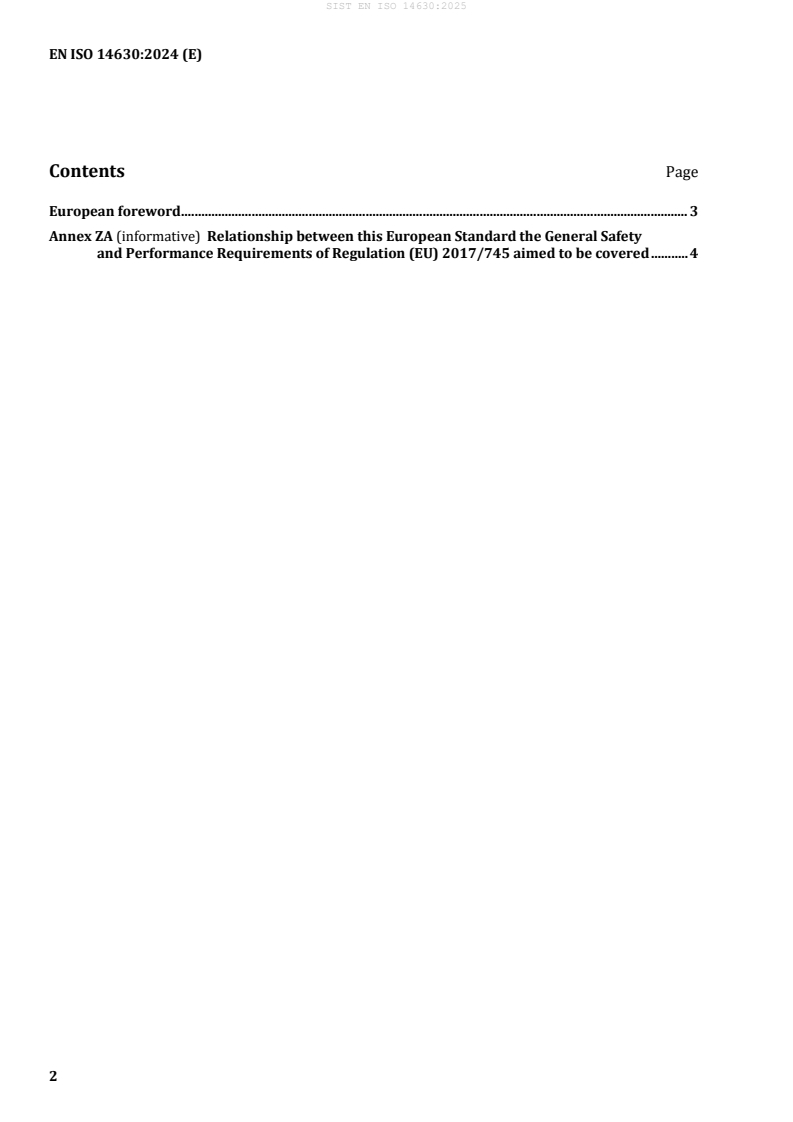
Contents Page
European foreword . 3
Annex ZA (informative) Relationship between this European Standard the General Safety
and Performance Requirements of Regulation (EU) 2017/745 aimed to be covered . 4
European foreword
This document (EN ISO 14630:2024) has been prepared by Technical Committee ISO/TC 150 "Implants
for surgery" in collaboration with Technical Committee CEN/TC 285 “Non-active surgical implants” the
secretariat of which is held by DIN.
This European Standard shall be given the status of a national standard, either by publication of an
identical text or by endorsement, at the latest by June 2025, and conflicting national standards shall be
withdrawn at the latest by June 2025.
Attention is drawn to the possibility that some of the elements of this document may be the subject of
patent rights. CEN shall not be held responsible for identifying any or all such patent rights.
This document supersedes EN ISO 14630:2012.
This document has been prepared under a standardization request addressed to CEN by the European
Commission. The Standing Committee of the EFTA States subsequently approves these requests for its
Member States.
For the relationship with EU Legislation, see informative Annex ZA, which is an integral part of this
document.
Any feedback and questions on this document should be directed to the users’ national standards
body/national committee. A complete listing of these bodies can be found on the CEN website.
According to the CEN-CENELEC Internal Regulations, the national standards organizations of the
following countries are bound to implement this European Standard: Austria, Belgium, Bulgaria,
Croatia, Cyprus, Czech Republic, Denmark, Estonia, Finland, France, Germany, Greece, Hungary, Iceland,
Ireland, Italy, Latvia, Lithuania, Luxembourg, Malta, Netherlands, Norway, Poland, Portugal, Republic of
North Macedonia, Romania, Serbia, Slovakia, Slovenia, Spain, Sweden, Switzerland, Türkiye and the
United Kingdom.
Endorsement notice
The text of ISO 14630:2024 has been approved by CEN as EN ISO 14630:2024 without any modification.
Annex ZA
(informative)
Relationship between this European Standard the General Safety and
Performance Requirements of Regulation (EU) 2017/745 aimed to be
covered
This European standard has been prepared under M/575 to provide one voluntary means of
conforming to the General Safety and Performance Requirements of Regulation (EU) 2017/745 of 5
April 2017 concerning medical devices [OJ L 117] and to system or process requirements including
those relating to quality management systems, risk management, post-market surveillance systems,
clinical investigations, clinical evaluation or post-market clinical follow-up.
Once this standard is cited in the Official Journal of the European Union under that Regulation,
compliance with the normative clauses of this standard given in Table ZA.1 and application of the
edition of the normatively referenced standards as given in Table ZA.2 confers, within the limits of the
scope of this standard, a presumption of conformity with the corresponding General Safety and
Performance Requirements of that Regulation, and associated EFTA Regulations.
Where a definition in this harmonised standard differs from a definition of the same term set out in
Regulation (EU) 2017/745, the differences are indicated in the Annex ZA. For the purpose of using this
standard in support of the requirements set out in Regulation (EU) 2017/745, the definitions set out in
this Regulation prevail.
Where the European standard is an adoption of an International Standard, the scope of this document
can differ from the scope of the European Regulation that it supports. As the scope of the applicable
regulatory requirements differ from nation to nation and region to region the standard can only
support European regulatory requirements to the extent of the scope of the European Regulation for
medical devices ((EU) 2017/745).
For application of this European standard under Regulation (EU) 2017/745,
1. it is recognized that the normatively referenced ISO 10993-1 includes a dated reference to ISO
14971:2007 which is outdated and for application of this European standard under Regulation (EU)
2017/745 the most recent European version EN ISO 14971:2019 + A11:2021 shall be used;
2. it is recognized that the limits for residuals of ethylene oxide referenced in 9.4 and specified in the
normatively referenced EN ISO 10993-7:2008 + AC 2009 + A1 2022 are not designed for patients
with weight lower than 70 kg and are in particular not appropriate for neonates and other patients
with a weight substantially below 70 kg;
3. it is recognized that the normatively referenced ISO 20857 refers to “applicable clauses of ISO
13485” and that for application of this European standard under Regulation (EU) 2017/745 the
most recent European version EN ISO 13485:2016 + AC:2018 + A11:2021 shall be used.
4. it is recognized that the normatively referenced ISO 22442-1 states in its introduction that it can
only be used in combination with ISO 14971 and is not a “stand-alone” standard and it is also
recognized that for application of this European standard under Regulation (EU) 2017/745 the
most recent European version EN ISO 14971:2019 + A11:2021 shall be used;
5. it is recognized that this European standard does not cover any of the legal requirements of
Regulation (EU) 722/2012 which are applicable to devices or system or process requirements
falling under its scope.
NOTE 1 Where a reference from a clause of this standard to the risk management process is made, the risk
management process needs to be in compliance with Regulation (EU) 2017/745. This means that risks have to be
‘reduced as far as possible’, ‘reduced to the lowest possible level’, ‘reduced as far as possible and appropriate’,
‘removed or reduced as far as possible’, ‘eliminated or reduced as far as possible’, ’removed or minimized as far as
possible’ or ‘minimized’, according to the wording of the corresponding General Safety and Performance
Requirement.
NOTE 2 The manufacturer’s policy for determining acceptable risk must be in compliance with General Safety
and Performance Requirements 1, 2, 3, 4, 5, 8, 9, 10, 11, 14, 16, 17, 18, 19, 20, 21 and 22 of the Regulation.
NOTE 3 When a General Safety and Performance Requirement does not appear in Table ZA.1, it means that it is
not addressed by this European Standard.
Differences in definitions of the terms set out in Regulation (EU) 2017/745
Definition in Definition in EN ISO 14630 Explanation
Regulation (EU)
2017/745, Article 2
44 ‘clinical evaluation 3.4 clinical evaluation: Since EN ISO 14630 is based on an
means a systematic international standard, the definition in
set of ongoing activities that
and planned process to the standard is taken from IMDRF MDCE
use scientifically sound
continuously generate, WG/N56FINAL:2019, 4.0.
methods for the assessment
collect, analyse and
and analysis of clinical data to While the exact wording differs, the
assess the clinical data
verify the safety, clinical intent of the definitions seems to be
pertaining to a device
performance and/or mostly identical.
in order to verify the
effectiveness of the device
For the purpose of using this standard in
safety and
when used as intended by the
support of the requirements set out in
performance including
manufacturer
Regulation (EU) 2017/745, the
clinical benefits of the
definitions set out in this Regulation
device when used as
prevail.
intended by the
manufacture’
45 ‘clinical 3.5 clinical investigation Since EN ISO 14630 is based on an
investigation means international standard, the definition in
systematic investigation or
any systematic the standard is taken from IMDRF MDCE
study in or on one or more
investigation involving WG/N56FINAL:2019, 4.0.
human subjects, undertaken to
one or more human
assess the safety, clinical While the exact wording differs, the
subjects undertaken to
performance and/or intent of the definitions seems to be
assess the safety or
effectiveness of a medical mostly identical.
performance of a
device
For the purpose of using this standard in
device’
support of the requirements set out in
Regulation (EU) 2017/745, the
definitions set out in this Regulation
prevail.
30 ‘manufacturer 3.12 manufacturer: Since EN ISO 14630 is based on an
means a natural or international standard, the definition in
natural or legal person with
legal person who the standard is taken from ISO
responsibility for design
manufacturers or fully 14971:2019, 3.9 and was only slightly
and/or manufacture of an
refurbishes a device or modified by replacing "Medical device"
implant (3.14) with the
has a device designed, by "implant".
intention of making the
manufactured or fully
implant available for use, For the purpose of using this standard in
refurbished and
under his name, whether or support of the requirements set out in
markets that device not such an implant is Regulation (EU) 2017/745, the
under its name or designed and/or definitions set out in this Regulation
trademark’ manufactured by that person prevail.
himself or on his behalf by
another person(s)
Table ZA.1 — Correspondence between this European Standard and Annex I of
Regulation (EU) 2017/745 [OJ L 117] and to system or process requirements including those relating
to quality management systems, risk management, post-market surveillance systems, clinical
investigations, clinical evaluation or post-market clinical follow-up
General Safety and
Performance Clause(s) / sub-
Requirements of clause(s) Remarks / Notes
Regulation (EU) of this EN
2017/745
23.1 (a) 11.3 23.1 (a) is covered with respect to legibility of the
label by 11.3 (Label) which requires that the
information on the label shall be legible under
illumination of 215 lux using normal vision at a
distance of 1 m.
Table ZA.2 — Applicable Standards to confer presumption of conformity as described in this
Annex ZA
Reference in International Title Corresponding European
Clause 2 Standard Edition Standard Edition
ISO 10993-1 ISO 10993-1:2018 Biological evaluation of medical EN ISO 10993-1:2020
devices — Part 1: Evaluation and
testing within a risk management
process
ISO 10993-7 ISO 10993-7:2008 Biological evaluation of medical EN ISO 10993-7:2008
+ Cor 1:2009 devices — Part 7: Ethylene oxide
+ AC:2009
sterilization residuals
+ Amd 1: 2019
+ A1:2022
ISO 10993-17 ISO 10993-17:2023 Biological evaluation of medical EN ISO 10993-17:2023
device — Part 17: Toxicological
risk assessment of medical device
constituents
ISO 11135 ISO 11135:2014 Sterilization of health care EN ISO 11135:2014
products — Ethylene oxide —
+ Amd 1:2018 + A1:2019
Requirements for the
development, validation and
routine control of a sterilization
process for medical devices
ISO 11137-1 ISO 11137-1:2006 Sterilization of health care EN ISO 11137-1:2015
+ Amd 1:2013 products — Radiation — Part 1:
+ A2:2019
Requirements for development,
+ Amd 2:2018
validation and routine control of a
sterilization process for medical
devices
ISO 11137-2 ISO 11137-2:2013 Sterilization of health care EN ISO 11137-2:2015
+ Amd 1:2022 products — Radiation — Part 2:
+ A1:2023
Establishing the sterilization dose
ISO 11137-3 ISO 11137-3:2017 Sterilization of health care EN ISO 11137-3:2017
products — Radiation — Part 3:
Guidance on dosimetric aspects of
development, validation and
routine control
ISO 11607-1 ISO 11607-1:2019 Packaging for terminally sterilized EN ISO 11607-1:2020
+ Amd 1:2023 medical devices — Part 1:
+ A1:2023
Requirements for materials, sterile
barrier systems and packaging
systems
ISO 11607-2 ISO 11607-2:2019 Packaging for terminally sterilized EN ISO 11607-2:2020
+ Amd 1:2023 medical devices — Part 2:
+ A1:2023
Validation requirements for
forming, sealing and assembly
processes
ISO 13408-1 ISO 13408-1:2023 Aseptic processing of health care EN ISO 13408-1:2024
products — Part 1: General
requirements
ISO 14155 ISO 14155:2020 Clinical investigation of medical EN ISO 14155:2020
devices for human subjects —
Good clinical practice
ISO 14160 ISO 14160:2020 Sterilization of health care EN ISO 14160:2021
products — Liquid chemical
sterilizing agents for single-use
medical devices utilizing animal
tissues and their derivatives —
Requirements for characterization,
development, validation and
routine control of a sterilization
process for medical devices
ISO 14937 ISO 14937:2009 Sterilization of health care EN ISO 14937:2009
products — General requirements
for characterization of a sterilizing
agent and the development,
validation and routine control of a
sterilization process for medical
devices
ISO 14971 ISO 14971:2019 Medical devices — Application of EN ISO 14971:2019
risk management to medical
+ A11:2021
devices
ISO 17664-1 ISO 17664-1:2021 Processing of health care products EN ISO 17664-1:2021
— Information to be provided by
the medical device manufacturer
for the processing of medical
devices — Part 1: Critical and
semi-critical medical devices
ISO 17665 ISO 17665:2024 Sterilization of health care EN ISO 17665:2024
products — Moist heat —
Requirements for the
development, validation and
routine control of a sterilization
process for medical devices
ISO 20857 ISO 20857:2010 Sterilization of health care EN ISO 20857:2013
products — Dry heat —
Requirements for the
development, validation and
routine control of a sterilization
process for medical devices
ISO 22442-1 ISO 22442-1:2020 Medical devices utilizing animal EN ISO 22442-1:2020
tissues and their derivatives —
Part 1: Application of risk
management
ISO 22442-2 ISO 22442-2:2020 Medical devices utilizing animal EN ISO 22442-2:2020
tissues and their derivatives —
Part 2: Controls on sourcing,
collection and handling
ISO 22442-3 ISO 22442-3:2007 Medical devices utilizing animal EN ISO 22442-3:2007
tissues and their derivatives —
Part 3: Validation of the
elimination and/or inactivation of
viruses and transmissible
spongiform encephalopathy (TSE)
agents
ISO 25424 ISO 25424:2018 Sterilization of health care EN ISO 25424:2019
products — Low temperature
+ Amd 1:2022 + A1:2022
steam and formaldehyde —
Requirements for development,
validation and routine control of a
sterilization process for medical
devices
ISO 80000-1 ISO 80000-1:2022 Quantities and units — Part 1: EN ISO 80000-1:2022
General
The documents listed in the Column 1 of table ZA.2, in whole or in part, are normatively referenced in
this document, i.e. are indispensable for its application. The achievement of the presumption of
conformity is subject to the application of the edition of Standards as listed in Column 4 or, if no
European Standard Edition exists, the International Standard Edition given in Column 2 of table ZA.2.
WARNING 1 — Presumption of conformity stays valid only as long as a reference to this European
standard is maintained in the list published in the Official Journal of the European Union. Users of this
standard should consult frequently the latest list published in the Official Journal of the European
Union.
WARNING 2 — Other Union legislation may be applicable to the product(s) falling within the scope of
this standard.
International
Standard
ISO 14630
Fifth edition
Non-active surgical implants —
2024-09
General requirements
Implants chirurgicaux non actifs — Exigences générales
Reference number
ISO 14630:2024(en) © ISO 2024
ISO 14630:2024(en)
© ISO 2024
All rights reserved. Unless otherwise specified, or required in the context of its implementation, no part of this publication may
be reproduced or utilized otherwise in any form or by any means, electronic or mechanical, including photocopying, or posting on
the internet or an intranet, without prior written permission. Permission can be requested from either ISO at the address below
or ISO’s member body in the country of the requester.
ISO copyright office
CP 401 • Ch. de Blandonnet 8
CH-1214 Vernier, Geneva
Phone: +41 22 749 01 11
Email: copyright@iso.org
Website: www.iso.org
Published in Switzerland
ii
ISO 14630:2024(en)
Contents Page
Foreword .iv
Introduction .vi
1 Scope . 1
2 Normative references . 1
3 Terms and definitions . 2
4 Intended performance . 6
5 Design attributes . 6
6 Selection of materials . 7
7 Design evaluation . 8
7.1 General .8
7.2 Pre-clinical evaluation . .8
7.3 Clinical evaluation and clinical investigation .10
7.4 Post-market surveillance .11
8 Manufacture .11
9 Sterilization .11
9.1 Implants supplied sterile .11
9.2 Implants supplied non-sterile . 12
9.3 Re-sterilizable implants . 12
9.4 Sterilization residuals . 12
10 Packaging.12
10.1 Protection from damage in transport, storage and handling . 12
10.2 Maintenance of sterility in transport, storage and handling . 13
10.3 Use by date . 13
11 Information supplied by the manufacturer .13
11.1 General . 13
11.2 Marking on implants .14
11.3 Label .14
11.4 Instructions for use .16
11.5 Patient record label(s) .17
11.6 Implant card . .18
11.7 Implants for special purposes.18
Bibliography . 19
iii
ISO 14630:2024(en)
Foreword
ISO (the International Organization for Standardization) is a worldwide federation of national standards
bodies (ISO member bodies). The work of preparing International Standards is normally carried out through
ISO technical committees. Each member body interested in a subject for which a technical committee
has been established has the right to be represented on that committee. International organizations,
governmental and non-governmental, in liaison with ISO, also take part in the work. ISO collaborates closely
with the International Electrotechnical Commission (IEC) on all matters of electrotechnical standardization.
The procedures used to develop this document and those intended for its further maintenance are described
in the ISO/IEC Directives, Part 1. In particular, the different approval criteria needed for the different types
of ISO document should be noted. This document was drafted in accordance with the editorial rules of the
ISO/IEC Directives, Part 2 (see www.iso.org/directives).
ISO draws attention to the possibility that the implementation of this document may involve the use of (a)
patent(s). ISO takes no position concerning the evidence, validity or applicability of any claimed patent
rights in respect thereof. As of the date of publication of this document, ISO had not received notice of (a)
patent(s) which may be required to implement this document. However, implementers are cautioned that
this may not represent the latest information, which may be obtained from the patent database available at
www.iso.org/patents. ISO shall not be held responsible for identifying any or all such patent rights.
Any trade name used in this document is information given for the convenience of users and does not
constitute an endorsement.
For an explanation of the voluntary nature of standards, the meaning of ISO specific terms and expressions
related to conformity assessment, as well as information about ISO's adherence to the World Trade
Organization (WTO) principles in the Technical Barriers to Trade (TBT), see www.iso.org/iso/foreword.html.
This document was prepared by Technical Committee ISO/TC 150, Implants for surgery, in collaboration
with the European Committee for Standardization (CEN) Technical Committee CEN/TC 285, Non-active
surgical implants, in accordance with the Agreement on technical cooperation between ISO and CEN (Vienna
Agreement).
This fifth edition cancels and replaces the fourth edition (ISO 14630:2012), which has been technically
revised.
The main changes are as follows:
— the scope has been revised to clarify that this document does not apply to implants utilizing viable animal
or human tissue;
— definitions have been added for clinical evaluation and clinical investigation based on the International
Medical Device Regulators Forum (IMDRF) guidance on clinical evaluation;
— definitions have been added for demonstrably similar implant and reference implant to clarify when
data for other implants can be used during pre-clinical and clinical evaluation of the implant under
investigation;
— indications, contraindications and target patient population have been added in Clause 4 to the list of
factors to consider when establishing the intended performance of an implant;
— reorganized list of design attributes in Clause 5 to put then in a more logical sequence;
— revised Clause 6 on selection of material to use a risk analysis as the basis for selection of implant
materials and to list factors to be taken into account when performing the risk analysis;
— Clause 7 has been significantly expanded on design evaluation to address pre-clinical evaluation, clinical
evaluation and investigation, and post-market surveillance in more detail;
— Clause 8 has been expanded on manufacturing to address cleanliness of the implant;
iv
ISO 14630:2024(en)
— subclause 9.1 has been revised to list the methods of sterilizing the implant in a tabular form rather than
as running text;
— a new subclause 10.3 has been added to address the determination of the use by date;
— Clause 11 has been revised on information supplied by the manufacturer to include new subclauses
addressing patient record labels (11.5) and implant card (11.6);
— the subclause on restrictions on combinations (formerly 11.4) has been deleted because the safety of
combinations is addressed in Clause 5 l).
Any feedback or questions on this document should be directed to the user’s national standards body. A
complete listing of these bodies can be found at www.iso.org/members.html.
v
ISO 14630:2024(en)
Introduction
There are three levels of standards dealing with non-active surgical implants and related instrumentation.
For the implants themselves, they are as follows, with Level 1 being the highest:
— Level 1: general requirements for non-active surgical implants;
— Level 2: particular requirements for families of non-active surgical implants;
— Level 3: specific requirements for types of non-active surgical implants.
Level 1 standards include this document which contains requirements that apply to all non-active surgical
implants, and ISO 16061, which contains requirement for instruments associated with non-active surgical
implants. They also anticipate that there are additional requirements in the Level 2 and Level 3 standards.
Level 2 standards (see References [2], [12], [23], [27] and [42]) apply to a more restricted set or family of
non-active surgical implants, such as those designed for use in neurosurgery, cardiovascular surgery or joint
replacement.
Level 3 standards (see References [3], [13], [24] and [25]) apply to specific types of implants within a family
of non-active surgical implants, such as hip joints or arterial stents.
To address the requirements for a specific implant, all related Level 1, 2 and 3 standards should be applied.
vi
International Standard ISO 14630:2024(en)
Non-active surgical implants — General requirements
1 Scope
This document specifies general requirements for non-active surgical implants, hereafter referred to as
implants.
This document is not applicable to dental implants, dental restorative materials, transendodontic and
transradicular implants, intra-ocular lenses and implants utilizing viable animal or human tissue.
With regard to safety, this document specifies requirements for intended performance, design attributes,
materials, design evaluation, manufacture, sterilization, packaging and information supplied by the
manufacturer, and tests to demonstrate compliance with these requirements.
Additional requirements applicable to specific implants or implant families are given or referred to in
Level 2 and Level 3 standards.
NOTE 1 This document does not require that the manufacturer have a quality management system in place.
However, many regulatory authorities require the application of a quality management system, such as that described
in ISO 13485, to ensure that the implant achieves its intended performance and safety.
NOTE 2 In this document, when not otherwise specified, the term "implant" refers to each individual component
of a system or a modular implant, provided separately or as a set of components, as well as to all ancillary implants or
associated implants designed for improving the intended performance.
2 Normative references
The following documents are referred to in the text in such a way that some or all of their content constitutes
requirements of this document. For dated references, only the edition cited applies. For undated references,
the latest edition of the referenced document (including any amendments) applies.
ISO 10993-1, Biological evaluation of medical devices — Part 1: Evaluation and testing within a risk
management process
ISO 10993-7, Biological evaluation of medical devices — Part 7: Ethylene oxide sterilization residuals
ISO 10993-17, Biological evaluation of medical devices — Part 17: Toxicological risk assessment of medical
device constituents
ISO 11135, Sterilization of health-care products — Ethylene oxide — Requirements for the development,
validation and routine control of a sterilization process for medical devices
ISO 11137-1, Sterilization of health care products — Radiation — Part 1: Requirements for development,
validation and routine control of a sterilization process for medical devices
ISO 11137-2, Sterilization of health care products — Radiation — Part 2: Establishing the sterilization dose
ISO 11137-3, Sterilization of health care products — Radiation — Part 3: Guidance on dosimetric aspects of
development, validation and routine control
ISO 11607-1, Packaging for terminally sterilized medical devices — Part 1: Requirements for materials, sterile
barrier systems and packaging systems
ISO 11607-2, Packaging for terminally sterilized medical devices — Part 2: Validation requirements for forming,
sealing and assembly processes
ISO 14630:2024(en)
ISO 13408-1, Aseptic processing of health care products — Part 1: General requirements
ISO 14155, Clinical investigation of medical devices for human subjects — Good clinical practice
ISO 14160, Sterilization of health care products — Liquid chemical sterilizing agents for single-use medical
devices utilizing animal tissues and their derivatives — Requirements for characterization, development,
validation and routine control of a sterilization process for medical devices
ISO 14937, Sterilization of health care products — General requirements for characterization of a sterilizing
agent and the development, validation and routine control of a sterilization process for medical devices
ISO 14971, Medical devices — Application of risk management to medical devices
ISO 17664-1, Processing of health care products — Information to be provided by the medical device
manufacturer for the processing of medical devices — Part 1: Critical and semi-critical medical devices
ISO 17665, Sterilization of health care products — Moist heat — Requirements for the development, validation
and routine control of a sterilization process for medical devices
ISO 20857, Sterilization of health care products — Dry heat — Requirements for the development, validation
and routine control of a sterilization process for medical devices
ISO 22442-1, Medical devices utilizing animal tissues and their derivatives — Part 1: Application of risk
management
ISO 22442-2, Medical devices utilizing animal tissues and their derivatives — Part 2: Controls on sourcing,
collection and handling
ISO 22442-3, Medical devices utilizing animal tissues and their derivatives — Part 3: Validation of the elimination
and/or inactivation of viruses and transmissible spongiform encephalopathy (TSE) agents
ISO 25424, Sterilization of health care products — Low temperature steam and formaldehyde — Requirements
for development, validation and routine control of a sterilization process for medical devices
ISO 80000-1, Quantities and units — Part 1: General
3 Terms and definitions
For the purposes of this document, the terms and definitions given in ISO 14971 and the following apply.
ISO and IEC maintain terminology databases for use in standardization at the following addresses:
— ISO Online browsing platform: available at https:// www .iso .org/ obp
— IEC Electropedia: available at https:// www .electropedia .org/
3.1
ancillary implant
implant, not included as a component of an implant system, but without which the system cannot be
surgically inserted
EXAMPLE Cement for cemented stem of a hip joint replacement or screws for orthopaedic plates.
[SOURCE: ISO 16054:2019, 3.4, modified — “implantable device” has been replaced by “implant”.]
3.2
associated implant
implant, included as a component of a modular implant (3.13) or supplied separately, that is surgically
inserted for the specific clinical condition to facilitate the use of the primary implant
EXAMPLE An augmentation device used to stabilise the tibial tray of a knee joint replacement or the acetabular
cup of a hip joint replacement; sleeves applied to the stem of a hip or knee joint prosthesis to fill canal defects and
prevent rotation; a cement restrictor used in hip joint replacement to occlude the intramedullary canal.
ISO 14630:2024(en)
[SOURCE: ISO 16054:2019, 3.5, modified — “implantable device” has been replaced by “implant”.]
3.3
B hazard area
space around the magnetic resonance equipment where the static magnetic field can cause harm
Note 1 to entry: The B hazard area is not identical to the special environment as defined in IEC 60601-1-2.
Note 2 to entry: The B hazard area is not identical to the magnetic resonance environment (3.10) as defined in
IEC 62570.
[SOURCE: IEC 60601-2-33:2022, 201.3.202, modified — the abbreviation "MR" in the definition and Note 2
to entry has been replaced by "magnetic resonance".]
3.4
clinical evaluation
set of ongoing activities that use scientifically sound methods for the assessment and analysis of clinical
data to verify the safety, clinical performance and/or effectiveness of the device when used as intended by
the manufacturer
[SOURCE: IMDRF MDCE WG/N56FINAL: 2019, 4.0]
3.5
clinical investigation
systematic investigation or study in or on one or more human subjects, undertaken to assess the safety,
clinical performance and/or effectiveness of a medical device
[SOURCE: IMDRF MDCE WG/N56FINAL: 2019, 4.0]
3.6
coating
layer of material covering or partially covering a surface of an implant
3.7
final implant
implant that has been subjected to all manufacturing processes including packaging, and if applicable,
sterilization, and that is ready to be marketed
Note 1 to entry: The final implant (i.e. implant to be evaluated) is the final product referred to in ISO 10993-1:2018, 3.8.
3.8
demonstrably similar implant
legally-marketed implant with the same intended use to the implant under evaluation for which similarity can
be demonstrated in technical, biological and clinical characteristics based on proper scientific justification
and to the extent that there is no clinically significant difference in the safety and clinical performance of the
implants under evaluation
Note 1 to entry: Manufacturers shall have sufficient levels of access to the data relating to implants with which they
are claiming similarity in order to justify their claims of similarity.
Note 2 to entry: In a demonstrably similar implant, most of the performance parameters (technical, biological and
clinical) under consideration are similar to the implant under evaluation whereas in a reference implant (3.15) as few
as one performance parameter may be considered.
Note 3 to entry: A demonstrably similar implant is one which can be used to avoid some technical or biological tests or
a clinical investigation of the implant under evaluation.
Note 4 to entry: Some regulatory authorities can require that a demonstrably similar implant is one that is legally
marketed in their own country or jurisdiction.
Note 5 to entry: For a demonstrably similar implant, there shall be evidence of successful clinical use in sufficient
numbers, for a sufficient period of time, and, at a minimum, without known or reasonably known evidence of design or
performance-related recalls.
ISO 14630:2024(en)
Note 6 to entry: The manufacturer is responsible for identifying the demonstrably similar implant according to the
regulatory requirements in the jurisdictions where the implant under evaluation will be marketed.
3.9
leakage
unintended movement of fluid, including body fluids, into or out of an implant
Note 1 to entry: An unintended diffusion phenomenon is an example of leakage for the purposes of this document.
3.10
magnetic resonance environment
MR environment
three-dimensional volume surrounding the magnetic resonance magnet that contains both the special
environment (Faraday shielded volume) and the B hazard area (3.3)
Note 1 to entry: This volume is the region in which an item can pose a hazard from exposure to the electromagnetic
fields produced by the magnetic resonance equipment and accessories, and for which access control is part of the risk
mitigation.
Note 2 to entry: The entrance to the magnetic resonance environment is controlled by the responsible organization.
The area to which entry is controlled is sometimes referred to as the magnetic resonance controlled access area.
[SOURCE: IEC 60601-2-33:2022, 201.3.224]
3.11
magnetic resonance imaging
MRI
imaging technique that uses a static magnetic field, time-varying gradient magnetic fields and radio
frequency fields to provide images of tissue by the magnetic resonance of nuclei
[SOURCE: ASTM F2182-19e2, 3.1.6]
3.12
manufacturer
natural or legal person with responsibility for design and/or manufacture of an implant with the intention
of making the implant available for use, under their nam
...