

FprEN 18213-1
(Main)District heating and district cooling pipes - Bonded single and twin pipe systems for directly buried hot and cold water networks - Part 1: Qualification testing of fitter
- Abstract
This document specifies the methods of examining the knowledge and skill set of the fitter required to carry out on-site sealable joint casing connections on thermally insulated rigid single and twin pipe systems for directly buried hot and cold water networks according to EN 13941-1 [7] and EN 13941-2 [8] also as for flexible pipe systems according to EN 15632-1 [10], EN 15632-2 [11], EN 15632-3 [12], EN 15632-4 [13], EN 17414-1 [17], EN 17414-2 [18], EN 17414-3 [19], EN 17878-1 [23], EN 17878-2 [24], EN 17878-3 [25] and CEN/TS 17889 [26].
The application of these specifications ensures that the examination is carried out according to a standardised examining procedure.
This document covers the following processes:
- preparatory works for joint casing assembly;
- assembling and testing the elements for surveillance systems;
- assembling sealable joint casing system;
- verifying joint tightness (leak tightness testing);
- thermally insulating the joint casing (PUR foaming or half-shells);
- sealing fill & vent openings (weldable or sealable plugs);
- assessing overall installation quality of the completed sealed joint casing assembly (non destructive).
Requirements for test institutes and supervisors are also specified.
NOTE Due to differences of the specific application methods and equipment from joint casing system suppliers, it might be advisable for the fitter to be certified for the particular sealable joint casing system.
- Status
- Not Published
- Publication Date
- 02-Dec-2026
- Technical Committee
- CEN/TC 107 - Pre-fabricated district heating pipe systems
- Drafting Committee
- CEN/TC 107/WG 4 - Joints
- Current Stage
- 5020 - Submission to Vote - Formal Approval
- Start Date
- 13-Aug-2026
- Due Date
- 03-Aug-2026
- Completion Date
- 13-Aug-2026


prEN 18213-1 is a draft European Standard from CEN for examining the knowledge and practical skill of fitters who make on-site sealable joint casing connections on directly buried district heating and district cooling pipe systems. It specifies a standardised qualification procedure for fitters, together with the rules for test institutes, supervisors, written and practical testing, and qualification documents.
What does prEN 18213-1 specify?
prEN 18213-1 specifies how to test a fitter’s competence for sealable joint casing work on thermally insulated rigid single and twin pipe systems and on flexible pipe systems used in directly buried hot and cold water networks. In practice, the standard is about qualification testing, not pipe design or general installation rules.
The scope covers these activities:
- preparatory work for joint casing assembly
- assembling and testing surveillance system elements
- assembling the sealable joint casing system
- checking joint tightness by leak tightness testing
- insulating the joint casing by PUR foaming or half-shells
- sealing fill and vent openings with weldable or sealable plugs
- non-destructive assessment of the completed sealed joint casing assembly
A note in the scope advises that fitters may need system-specific certification because joint casing systems from different suppliers can use different application methods and equipment.
The document is organised into clauses 1 to 13 and four annexes. Clauses 4 to 13 cover the testing bodies, candidate admission, theoretical and practical examinations, evaluation, certificates, failure, validity, and renewal.
| Annex | What it covers |
|---|---|
| Annex A | Qualification of fitters: knowledge, skills, background for training, and training subjects |
| Annex B | Checklist of sealed joint casing systems for the practical assessment |
| Annex C | Template fitter’s qualification test certificate |
| Annex D | Template fitter’s qualification tests identity card |
What are the key requirements of prEN 18213-1?
prEN 18213-1 sets out a supervised qualification process with both written and practical elements. The result is a competence record that is tied to specific joint casing system types and is only valid while the fitter remains active and competent.
Qualification bodies: test institute and supervisor
Clause 4 says the examination must be carried out by a recognised Test Institute and a qualified Supervisor. The Test Institute can be a manufacturer, distributor, or installation company with extensive theoretical and practical joint installation experience, or an education/examination body with the additional personnel requirements needed for the role.
This matters because the standard expects the examiner to understand the work in practice, not only in theory. Recognition is handled through the Euroheat & Power association, and the Test Institute recognition is valid for 5 years.
The Supervisor needs relevant technical qualifications, at least 5 years of extensive experience in joint casing installation and assessment, and experience from observations or internships during fitter examinations. The standard also allows an alternative route based on valid test certificates from this document and prEN 18213-2, together with 10 days of observation/internship on construction sites.
Admission to qualification and training
Clause 5 limits admission to candidates whose background suggests they can pass the test. Typical entry routes include a plastics fabricator apprenticeship, at least 1 year of experience as a joint casing installation assistant, or completion of both theoretical and practical preparation training.
The candidate must also be trained in handling isocyanate. Annex A sets out the recommended training content, which matters because the job involves chemicals, insulation work, surveillance systems, and site conditions that can affect quality and safety.
Theoretical test
Clause 6.2 requires a supervised multiple-choice test with 20 questions, completed within 1 hour without teaching aids. The questions cover PPE, trench preparation, chemicals and flammable or corrosive substances, tools, site conditions, installation equipment, joint casing preparation, surveillance systems, surface preparation, tightness testing, PUR foam sample production, insulation, sealing of openings, and safety awareness.
In practice, this checks whether the fitter knows the correct sequence and the quality risks before touching the actual joint.
Practical test
Clause 6.3 requires a practical test under supervision on a sealable joint casing system approved in accordance with EN 489-1. The candidate assembles the test piece according to the installation instructions, and the supervisor gives no advice during the test. The practical test lasts up to 120 minutes.
The candidate must use suitable PPE and approved equipment. If personal tools are used, their condition, function, and calibration must be proven. The test piece is prepared above ground to simulate site conditions, and the set-up follows Figure 1.
Assessment, acceptance, and system scope
Clauses 8 and 9 require the supervisor to check identity, materials, and equipment before assembly, monitor the work, and stop the test if the work is not compliant or the candidate cannot achieve a satisfactory result. The result is recorded as conform or non-conform.
Clause 9 gives the main acceptance checks for the finished work:
- surveillance system installation and electrical checks according to EN 14419
- visual condition of the joint casing and shrink sleeve
- adhesive wetting test for processed shrink sleeves
- visual and mechanical checks for welded PE plugs
- visual and wetting checks for sealed plugs
Table 3 in Clause 10 ties the practical pass result to the joint casing system type. That means the fitter is qualified only for the system families successfully covered in the practical exam, such as PE shrink joint casing, PEX shrink joint casing, and thin metal sheet casing with sleeve coverage.
Certificates, validity, and renewal
Clause 10 says the qualification is passed only when both the theoretical and practical tests are passed. The theoretical test requires at least 80% correct answers. The practical test passes only if every requirement in Clause 9 is met.
Clause 10 also requires a qualification certificate and a qualification identity card. These documents identify the fitter, the Test Institute, the supervisor, the date, the validity end date, and the qualified joint casing systems.
Clause 12 states that the qualification is valid for 3 years, provided the fitter keeps working with reasonable continuity, has no reason for doubt about competence, and is checked annually by the employer. An interruption longer than 6 months is not allowed. Clause 13 allows renewal testing shortly before expiry, with validity starting from the expiry date if the retest is taken in time.
What terms does prEN 18213-1 define?
prEN 18213-1 uses the terms and definitions from EN 17248 and adds practical qualification content for fitter testing.
- Fitter - the person whose knowledge and skills are examined for installing sealable joint casing connections.
- Test Institute - a recognised centre that examines fitters and may also provide training.
- Supervisor - the qualified person who supervises, rates, and validates the examination.
- Surveillance system - the measuring and monitoring system installed in the pipe assembly to check continuity and insulation resistance.
- PUR-foam - polyurethane foam used to thermally insulate the joint cavity.
- PE - polyethylene, the casing material used in several joint casing system types.
- PPE (personal protective equipment) - the protective clothing and equipment the fitter must use during the work.
- Identity card - the on-site proof of qualification carried by the fitter.
Who uses prEN 18213-1?
prEN 18213-1 is used by Test Institutes, Supervisors, training organisations, certification bodies, employers, and fitters working on district heating and district cooling networks. It is also relevant to manufacturers, distributors, and installation companies that need a common qualification procedure for sealable joint casing work.
In practice, these users apply it for candidate admission, training design, examination, assessment of practical competence, issuing qualification documents, and checking whether a fitter is qualified for a specific joint casing system type.
Which standards are used with prEN 18213-1?
| Standard | Role in prEN 18213-1 |
|---|---|
| EN 489-1 | Main joint casing and thermal insulation reference for sealable joint casing systems and practical exam approval |
| EN 14419 | Surveillance systems reference used for installation and electrical checks |
| EN 17248 | Terms and definitions reference |
| EN 13941-1 and EN 13941-2 | Design and installation context for bonded single and twin pipe systems |
| EN 15632-1, EN 15632-2, EN 15632-3, EN 15632-4 | Flexible pipe system families named in the scope |
| EN 17414-1, EN 17414-2, EN 17414-3 | District cooling pipe system families named in the scope |
| EN 17878-1, EN 17878-2, EN 17878-3 | Additional pipe system families named in the scope |
| CEN/TS 17889 | Additional companion specification named in the scope |
| prEN 18213-2 | Companion part for PE-welder qualification, mentioned in the introduction and bibliography |
What does the prEN 18213-1 document contain?
prEN 18213-1 contains the qualification procedure for fitters, the exam structure, and the criteria used to judge the result. It also includes the practical setup for the test piece, the visual and mechanical checks for the finished joint, and the certificate and identity card templates.
Annex A provides the training and subject list, including PE casing, surveillance systems, PUR-foam systems, joint casing systems, and joint installation. Annex B is a detailed checklist for the different sealed joint casing system types and the inspection steps linked to each type. Annex C and Annex D give the document layouts used to issue proof of qualification.
Get Certified
Connect with accredited certification bodies for this standard

Institut za varilstvo d.o.o. (Welding Institute)
Slovenia's leading welding institute since 1952. ISO 3834, EN 1090, pressure equipment certification, NDT personnel, welder qualification. Only IIW Au
Sponsored listings
Frequently Asked Questions
FprEN 18213-1 is a draft published by the European Committee for Standardization (CEN). Its full title is "District heating and district cooling pipes - Bonded single and twin pipe systems for directly buried hot and cold water networks - Part 1: Qualification testing of fitter". This standard covers: This document specifies the methods of examining the knowledge and skill set of the fitter required to carry out on-site sealable joint casing connections on thermally insulated rigid single and twin pipe systems for directly buried hot and cold water networks according to EN 13941-1 [7] and EN 13941-2 [8] also as for flexible pipe systems according to EN 15632-1 [10], EN 15632-2 [11], EN 15632-3 [12], EN 15632-4 [13], EN 17414-1 [17], EN 17414-2 [18], EN 17414-3 [19], EN 17878-1 [23], EN 17878-2 [24], EN 17878-3 [25] and CEN/TS 17889 [26]. The application of these specifications ensures that the examination is carried out according to a standardised examining procedure. This document covers the following processes: - preparatory works for joint casing assembly; - assembling and testing the elements for surveillance systems; - assembling sealable joint casing system; - verifying joint tightness (leak tightness testing); - thermally insulating the joint casing (PUR foaming or half-shells); - sealing fill & vent openings (weldable or sealable plugs); - assessing overall installation quality of the completed sealed joint casing assembly (non destructive). Requirements for test institutes and supervisors are also specified. NOTE Due to differences of the specific application methods and equipment from joint casing system suppliers, it might be advisable for the fitter to be certified for the particular sealable joint casing system.
This document specifies the methods of examining the knowledge and skill set of the fitter required to carry out on-site sealable joint casing connections on thermally insulated rigid single and twin pipe systems for directly buried hot and cold water networks according to EN 13941-1 [7] and EN 13941-2 [8] also as for flexible pipe systems according to EN 15632-1 [10], EN 15632-2 [11], EN 15632-3 [12], EN 15632-4 [13], EN 17414-1 [17], EN 17414-2 [18], EN 17414-3 [19], EN 17878-1 [23], EN 17878-2 [24], EN 17878-3 [25] and CEN/TS 17889 [26]. The application of these specifications ensures that the examination is carried out according to a standardised examining procedure. This document covers the following processes: - preparatory works for joint casing assembly; - assembling and testing the elements for surveillance systems; - assembling sealable joint casing system; - verifying joint tightness (leak tightness testing); - thermally insulating the joint casing (PUR foaming or half-shells); - sealing fill & vent openings (weldable or sealable plugs); - assessing overall installation quality of the completed sealed joint casing assembly (non destructive). Requirements for test institutes and supervisors are also specified. NOTE Due to differences of the specific application methods and equipment from joint casing system suppliers, it might be advisable for the fitter to be certified for the particular sealable joint casing system.
FprEN 18213-1 is classified under the following ICS (International Classification for Standards) categories: 23.040.07 - Pipeline and its parts for district heat; 23.040.99 - Other pipeline components. The ICS classification helps identify the subject area and facilitates finding related standards.
FprEN 18213-1 is available in PDF format for immediate download after purchase. The document can be added to your cart and obtained through the secure checkout process. Digital delivery ensures instant access to the complete standard document.
Standards Content (Sample)
SLOVENSKI STANDARD
oSIST prEN 18213-1:2025
01-december-2025
Cevi za daljinsko ogrevanje in daljinsko hlajenje - Sistemi s spojenimi eno- in
dvocevnimi sistemi za neposredno vkopana omrežja za toplo in hladno vodo - 1.
del: Preskus usposobljenosti monterja
District heating and district cooling pipes - Bonded single and twin pipe systems for
directly buried hot and cold water networks - Part 1: Qualification testing of fitter
Fernwärme- und Fernkälterohre - Ein- und Doppelrohr-Verbundsysteme für direkt
erdverlegte Fernwärme- und Fernkältenetze - Teil 1: Prüfung von Muffenmonteuren
Tuyaux de chauffage et de refroidissement urbains - Systèmes bloqués de monotubes et
bitubes pour les réseaux d'eau chaude et froide enterrés directement - Partie 1 :
Epreuve de qualification d’installateur
Ta slovenski standard je istoveten z: prEN 18213-1
ICS:
23.040.07 Cevovodi za daljinsko Pipeline and its parts for
ogrevanje in njihovi deli district heat
23.040.99 Drugi sestavni deli za Other pipeline components
cevovode
oSIST prEN 18213-1:2025 en,fr,de
2003-01.Slovenski inštitut za standardizacijo. Razmnoževanje celote ali delov tega standarda ni dovoljeno.
oSIST prEN 18213-1:2025
oSIST prEN 18213-1:2025
DRAFT
EUROPEAN STANDARD
prEN 18213-1
NORME EUROPÉENNE
EUROPÄISCHE NORM
October 2025
ICS 23.040.07; 23.040.99
English Version
District heating and district cooling pipes - Bonded single
and twin pipe systems for directly buried hot and cold
water networks - Part 1: Qualification testing of fitter
Tuyaux de chauffage et de refroidissement urbains - Fernwärme- und Fernkälterohre - Ein- und
Systèmes bloqués de monotubes et bitubes pour les Doppelrohr-Verbundsysteme für direkt erdverlegte
réseaux d'eau chaude et froide enterrés directement - Fernwärme- und Fernkältenetze - Teil 1: Prüfung von
Partie 1 : Epreuve de qualification d'installateur Muffenmonteuren
This draft European Standard is submitted to CEN members for enquiry. It has been drawn up by the Technical Committee
CEN/TC 107.
If this draft becomes a European Standard, CEN members are bound to comply with the CEN/CENELEC Internal Regulations
which stipulate the conditions for giving this European Standard the status of a national standard without any alteration.
This draft European Standard was established by CEN in three official versions (English, French, German). A version in any other
language made by translation under the responsibility of a CEN member into its own language and notified to the CEN-CENELEC
Management Centre has the same status as the official versions.
CEN members are the national standards bodies of Austria, Belgium, Bulgaria, Croatia, Cyprus, Czech Republic, Denmark, Estonia,
Finland, France, Germany, Greece, Hungary, Iceland, Ireland, Italy, Latvia, Lithuania, Luxembourg, Malta, Netherlands, Norway,
Poland, Portugal, Republic of North Macedonia, Romania, Serbia, Slovakia, Slovenia, Spain, Sweden, Switzerland, Türkiye and
United Kingdom.
Recipients of this draft are invited to submit, with their comments, notification of any relevant patent rights of which they are
aware and to provide supporting documentation.
Warning : This document is not a European Standard. It is distributed for review and comments. It is subject to change without
notice and shall not be referred to as a European Standard.
EUROPEAN COMMITTEE FOR STANDARDIZATION
COMITÉ EUROPÉEN DE NORMALISATION
EUROPÄISCHES KOMITEE FÜR NORMUNG
CEN-CENELEC Management Centre: Rue de la Science 23, B-1040 Brussels
© 2025 CEN All rights of exploitation in any form and by any means reserved Ref. No. prEN 18213-1:2025 E
worldwide for CEN national Members.
oSIST prEN 18213-1:2025
prEN 18213-1:2025 (E)
Page
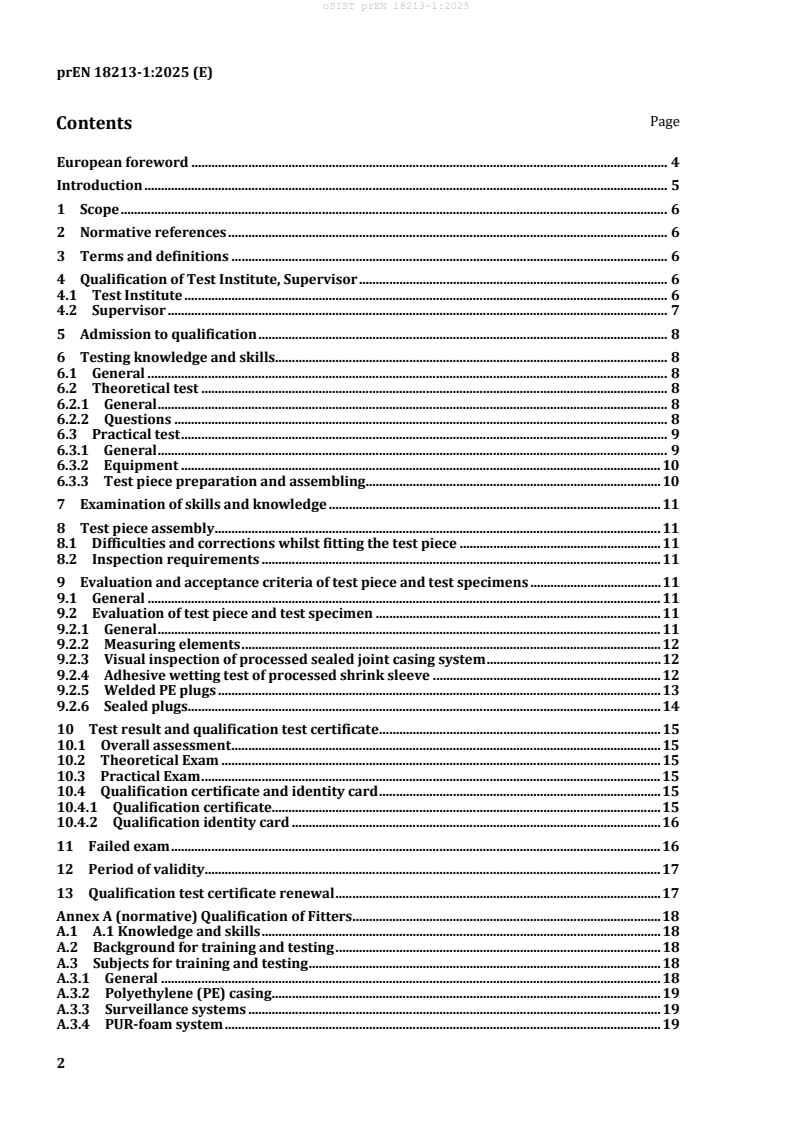
Contents
European foreword . 4
Introduction . 5
1 Scope . 6
2 Normative references . 6
3 Terms and definitions . 6
4 Qualification of Test Institute, Supervisor . 6
4.1 Test Institute . 6
4.2 Supervisor . 7
5 Admission to qualification . 8
6 Testing knowledge and skills. 8
6.1 General . 8
6.2 Theoretical test . 8
6.2.1 General . 8
6.2.2 Questions . 8
6.3 Practical test . 9
6.3.1 General . 9
6.3.2 Equipment . 10
6.3.3 Test piece preparation and assembling . 10
7 Examination of skills and knowledge . 11
8 Test piece assembly . 11
8.1 Difficulties and corrections whilst fitting the test piece . 11
8.2 Inspection requirements . 11
9 Evaluation and acceptance criteria of test piece and test specimens . 11
9.1 General . 11
9.2 Evaluation of test piece and test specimen . 11
9.2.1 General . 11
9.2.2 Measuring elements . 12
9.2.3 Visual inspection of processed sealed joint casing system . 12
9.2.4 Adhesive wetting test of processed shrink sleeve . 12
9.2.5 Welded PE plugs . 13
9.2.6 Sealed plugs. 14
10 Test result and qualification test certificate . 15
10.1 Overall assessment . 15
10.2 Theoretical Exam . 15
10.3 Practical Exam . 15
10.4 Qualification certificate and identity card . 15
10.4.1 Qualification certificate. 15
10.4.2 Qualification identity card . 16
11 Failed exam . 16
12 Period of validity. 17
13 Qualification test certificate renewal . 17
Annex A (normative) Qualification of Fitters. 18
A.1 A.1 Knowledge and skills . 18
A.2 Background for training and testing . 18
A.3 Subjects for training and testing . 18
A.3.1 General . 18
A.3.2 Polyethylene (PE) casing . 19
A.3.3 Surveillance systems . 19
A.3.4 PUR-foam system . 19
oSIST prEN 18213-1:2025
prEN 18213-1:2025 (E)
A.3.5 Joint casing systems . 20
A.3.6 Joint installation . 20
Annex B (normative) Checklist of sealed joint casing systems . 24
Annex C (informative) Template fitter's qualification test certificate . 27
Annex D (informative) Template fitter's qualification tests identity card . 28
D.1 Front of the identity card (example) . 28
D.2 Back of the identity card (example) . 28
Bibliography . 29
oSIST prEN 18213-1:2025
prEN 18213-1:2025 (E)
European foreword
This document (prEN:18213-1:2025) has been prepared by Technical Committee CEN/TC 107 “District
heating and cooling systems”, the secretariat of which is held by DS.
This document is currently submitted to the CEN Enquiry.
oSIST prEN 18213-1:2025
prEN 18213-1:2025 (E)
Introduction
The installation quality of joint casing application and the installation of measuring elements for
surveillance systems is crucial for the service life and efficiency of district heating and cooling networks,
built with factory-made thermally insulated pipe, fitting and valve assemblies. Damage caused by
improper installation leads to moisture ingress into the thermal insulation and to corrosion of the steel
service pipe.
This document deals with the installation of sealable joint casing systems according to EN 489-1[1].
The fitter’s ability to follow verbal or written instructions and to testify his skills are important factors
in ensuring the integrity of the joint casing connection.
This document serves as the basis for general recognition by test and certification bodies of the fitter's
competency and qualification.
Fitters can also take an examination according to prEN 18213-2[2] to demonstrate their ability to install
weldable joint casing systems.
This document is an integral part of the standards for bonded pipe systems for district heating and
cooling.
Other standards from CEN/TC 107 covering this subject:EN 253[3], EN 448[4], EN 489-1[1], EN 13941-
1[5], EN 13941-2[6], EN 14419[7], EN 15698-1[8], EN 15698-2[9], EN 17248[10], EN 17415-1[11], EN
17415-2[12], EN 17415-3[13]and prEN 18213-2[2] are listed in the bibliography.
oSIST prEN 18213-1:2025
prEN 18213-1:2025 (E)
1 Scope
This document specifies the methods of examining the knowledge and skill set of the fitter required to
carry out on-site joint casing connections on thermally insulated single and twin pipe systems for
directly buried hot and cold water networks according to EN 13941-2[14].
The application of these specified methods specifications ensures that the examination is carried out
according to a standardised examining procedure.
This document covers the following processes:
— preparatory works for joint casing assembly;
— assembling and testing the elements for surveillance systems;
NOTE For special surveillance systems it can be important to have additional training.
— preparing work for joint casing system installation;
— assembling sealable joint casing system;
— verifying joint tightness (leakage testing);
— thermally insulating the joint casing (PUR foaming or half-shells);
— sealing fill & vent openings (weldable or sealable plugs);
— assessing overall installation quality of the completed joint connection (non-destructive).
2 Normative references
The following documents are referred to in the text in such a way that some or all of their content
constitutes requirements of this document. For dated references, only the edition cited applies. For
undated references, the latest edition of the referenced document (including any amendments) applies.
EN 489-1, District heating pipes - Bonded single and twin pipe systems for buried hot water networks -
Part 1: Joint casing assemblies and thermal insulation for hot water networks in accordance with EN
13941-1
EN 14419, District heating pipes - Bonded single and twin pipe systems for buried hot water networks -
Surveillance systems
EN 17248, District heating and district cooling pipe systems - Terms and definitions
District heating and district cooling pipes — Bonded single and twin pipe systems for directly buried
hot and cold water networks — Qualification testing of PE-welder
3 Terms and definitions
For the purposes of this document, the terms and definitions given in EN 17248 and the following apply.
— ISO Online browsing platform: available at http://www.iso.org/obp
— IEC Electropedia: available at http://www.electropedia.org/
4 Qualification of Test Institute, Supervisor
4.1 Test Institute
The test institute is a recognized centre for the examination of fitters.
oSIST prEN 18213-1:2025
prEN 18213-1:2025 (E)
NOTE The training of fitters can also take place at the test institute.
Test institutes can be companies that:
— manufacture factory made district heating and district cooling pipe, fitting and valve assemblies,
— distribute factory made district heating and district cooling pipe, fitting and valve assemblies,
— carry out joint installation work on factory made bonded and flexible pipe systems for district
heating and district cooling,
who have demonstrated extensive theoretical and practical experience in joint installation over a
minimum period of 5 years.
or:
— institutions whose business activities include the education and examination of specialist staff,
however with additional personnel requirements, in case extensive theoretical and practical
expertise over a minimum period of 5 years cannot be demonstrated.
Factual requirements for test institutes are suitable equipment engineering, testing technology and
premises for knowledge and practical skills tests.
The application for recognition as testing institute shall be submitted in writing to the Euroheat & Power
association (EHP), followed by an examination of the required specialist knowledge of the supervisors
as well as by an inspection of the required spatial and factual infrastructure. A group of experts decides
on the award or refusal of the certificate of recognition or raises deficiencies for rectification.
The rules of procedure for the entire recognition process should be adhered to
— process of the recognition procedure
— duration of validity
— recognition of additional supervisors
— issuance, expiry or withdrawal of recognition
— monitoring
— review
— extension of the period of validity
— change of recognition
— complaints procedure
The recognition is valid for a period of 5 years. In order to maintain its recognition, the test institute
shall ensure the necessary premises, technical equipment, further training and the availability of a
recognized supervisor.
4.2 Supervisor
The qualification of a supervisor shall be:
— an engineer, bachelor, master, technician or state-recognized master craftsman respectively
master chamber of industry and commerce in a relevant technical profession;
— proving extensive theoretical and practical experience over a minimum period of 5 years in joint
casing installation as well as in the assessment of joint casing quality characteristics, in particular
in the joint casing installation processes to be tested;
oSIST prEN 18213-1:2025
prEN 18213-1:2025 (E)
— having served at least 3 observations/internships during fitter examinations.
Instead of the 5 years of practical experience, the necessary skills can be demonstrated through the
following evidence:
— a valid test certificate according to this document, and
— a valid test certificate according to prEN 18213-2[2], and
— at least 10 days observation/internship on joint casing installation construction sites.
5 Admission to qualification
Only applicants whose training and/or previous activities indicate that they are likely to pass the
planned test may be admitted as candidate.
As a rule, this is the case if one of the following applies:
— completed apprenticeship as plastics fabricator;
— at least one year experience as joint casing installation assistant, confirmed by employer’s
declaration;
— completion of both a theoretical and practical training course in preparation for the fitter’s
qualification test.
The applicant shall be trained in handling of isocyanate.
NOTE Further information can be found in the European REACH regulation.
.
The content of the training course is defined in Annex A
6 Testing knowledge and skills
6.1 General
The candidate shall demonstrate in qualification tests his theoretical knowledge according to 6.2 and
practical skills according to 6.3.
6.2 Theoretical test
6.2.1 General
The candidate’s knowledge of the practical rules for skillful and safe working shall be evaluated in a
theoretical test.
This part of the qualification is carried out under the supervision of the supervisor.
The candidate shall answer 20 multiple-choice questions. Filling in the questionnaire shall not exceed
one hour and be continuous without access to teaching aids.
The questions shall cover the subjects in 6.2.2.
6.2.2 Questions
The questions shall be related to the following subjects, as appropriate:
— personal protective equipment (PPE) (observe the national requirements)
— preparation of pipe trench
oSIST prEN 18213-1:2025
prEN 18213-1:2025 (E)
— storage, transport and handling of chemicals and flammable/corrosive substances
— proper installation equipment and tools
— surrounding conditions for joint installation
— working and ambient conditions
— systems and products to be used
— preparatory works for joint casing installation
— assembly and test of surveillance systems
— preparation of sealing surfaces
— installation of sealable joint casing systems
— tightness testing of joint casing prior to thermal insulation
— production of PUR foam sample
— thermal insulation of joint casing cavity
— sealing foam and vent openings
— self-assessment possibilities of sealed joint casing assembly
— awareness of health and safety requirements.
6.3 Practical test
6.3.1 General
The practical test shall be carried out under the supervision of the supervisor on a sealable joint casing
system approved in accordance with EN 489-1.
Assembling the examination test piece is to be carried out following the installation instructions.
Prior to the practical test, the supervisor shall inform the candidates about the procedures of examining
and rating the individual installation steps. During the practical test, the supervisor shall not provide
any advice.
All materials and documents necessary for the practical test shall be available to the candidate.
The fitter himself is responsible for the personal protective and suitable installation equipment.
The fitter himself can decide whether to use his own tools and equipment (or those of his employer) or
those of the test centre. Unless the fitter uses the tools and equipment of the test centre, separate proof
shall be provided about its flawless condition, functionality and calibration.
The practical test shall be conducted within 120 minutes.
Subject areas of the practical test are:
— preparatory works for sealable joint casing assembly;
— assembly of measuring elements and test of surveillance system;
— preparation of sealing surfaces;
— handling of joint casing system;
oSIST prEN 18213-1:2025
prEN 18213-1:2025 (E)
— tightness test of joint casing, if applicable;
— handling of PUR foam
— closing of foam and vent openings, if applicable;
— visual assessment of assembled joint casing system;
— documentation of joint casing system installation.
6.3.2 Equipment
The equipment to be used in the practical test shall be in flawless condition, functional and calibrated.
Equipment can be the one of the candidate or of the test institute.
6.3.3 Test piece preparation and assembling
The test piece shall be positioned above ground level similarly to the situation on site. The height of the
supports to be attached to the free ends of the steel service pipe shall be between 200 and 400 mm from
the floor to the bottom edge of the steel service pipe, see Figure 1.
The test piece shall be properly prepared for assembling of the joint casing system by the candidate.
Key
A Non-rotating pipe fixings
B Factory made pipe assembly according to EN 253[15]
C Sealable joint casing according to EN 489-1[1]
D Distance between floor and bottom edge of the service pipe (200 mm to 400 mm)
E Floor
Figure 1 — Set-up of the test piece for the preparation and assembly of the joint system
oSIST prEN 18213-1:2025
prEN 18213-1:2025 (E)
7 Examination of skills and knowledge
The exam shall be supervised, rated and validated by the supervisor.
8 Test piece assembly
8.1 Difficulties and corrections whilst fitting the test piece
In the event of difficulties during the practical test for which the candidate is not responsible, the test
piece on which assembling has been started may be replaced provided the supervisor’s prior consent.
Errors made or occurring during the assembling may be repaired only after permission has been given
by the supervisor.
8.2 Inspection requirements
Before assembling, the supervisor shall check the identity of the candidate, as well as the suitability of
the materials and equipment. The test piece shall be identified with the number or mark of the
supervisor and of the candidate.
The supervisor shall
— supervise the preparation and the assembling of the test piece.
— terminate the qualification test if the assembling is not in compliance with the manufacturer’s
instructions or the candidate does not have the skills required to obtain a satisfactory result.
— visually check the test piece after completion by the candidate.
9 Evaluation and acceptance criteria of test piece and test specimens
9.1 General
The supervisor inspects the installation documentation and evaluates the test specimen made by the
candidate.
The test has to be evaluated as follows:
— “c”: conform;
— “nc”: non-conform.
Storage or disposal of the test piece or test specimens shall be as instructed by the supervisor.
9.2 Evaluation of test piece and test specimen
9.2.1 General
Assembly of the test piece shall comply with the installation instructions of the joint casing system used
in the practical test.
The supervisor shall visually evaluate the correct application by accompanying the assembly of the test
piece by the candidate.
After completion of the test piece, visual inspection and destructive tests shall be performed under
supervision.
The evaluation shall be recorded in accordance with Annex B.
Mechanical-technological tests in general shall be carried out after cooling down to 20 +/-10°C.
oSIST prEN 18213-1:2025
prEN 18213-1:2025 (E)
9.2.2 Measuring elements
The following requirements shall be met when installing the surveillance system according to
EN 14419:
— Applying the spacers
— Connecting the measuring elements
— Checking for electrical continuity
— Testing for electrical circuit
— Measuring the electrical insulation resistance
— Evaluating the measured values of electrical circuit and electrical insulation resistance
9.2.3 Visual inspection of processed sealed joint casing system
— Joint casing
— is centred over the joint, evenly installed without overheating and firmly resting against the
casing (no upstanding edges)
— shows uniform appearance around the entire circumference
— Shrink sleeve
— is duly positioned onto,
...