

EN 15900:2010
(Main)Energy efficiency services - Definitions and requirements
- Abstract
This European Standard specifies the definitions and minimum requirements for an energy efficiency service.
- Status
- Published
- Publication Date
- 25-May-2010
- Withdrawal Date
- 29-Nov-2010
- Technical Committee
- CEN/CLC/TC 14 - Energy management, energy audits, energy savings
- Drafting Committee
- CEN/CLC/TC 14 - Energy management, energy audits, energy savings
- Current Stage
- 9093 - Decision to confirm - Review Enquiry
- Start Date
- 04-Apr-2017
- Completion Date
- 21-Oct-2026


Overview
EN 15900:2010 is a key European Standard developed by CEN that establishes clear definitions and minimum requirements for energy efficiency services. It aims to support energy savings and promote more efficient energy use across various sectors by providing a framework for the delivery and verification of these services. EN 15900:2010 plays an essential role in enabling service providers and customers to collaborate on improving energy performance, aligning with EU Directive 2006/32/EC on energy end-use efficiency and energy services.
This standard enhances transparency and trust in energy efficiency services by specifying procedures for service delivery, energy audits, improvement actions, and performance verification. It helps accelerate the market development for energy efficiency by defining terms, responsibilities, and best practices.
Key Topics
Energy Efficiency Service Definition
An energy efficiency service is a set of agreed tasks designed to achieve a quantifiable improvement in energy efficiency, potentially including guarantees on minimum performance improvement.General Requirements
Services must aim at measurable energy efficiency improvements and other performance metrics such as comfort, safety, or productivity. They should be based on collected data and include energy audits, implementation of improvement actions, and monitoring.Energy Efficiency Improvement Actions
These may involve:- Reduction of energy consumption (e.g., insulation, reducing leakage)
- Equipment upgrades (e.g., combined heat and power, efficient lighting)
- Enhanced operations (e.g., automation, process optimization)
- Continuous optimization and maintenance improvements
- Behavioral change programs (training, awareness campaigns)
- Implementation of energy management systems (e.g., compliant with EN 16001)
Verification and Measurement
The standard requires documented baselines and adjustment factors to allow consistent comparisons of energy consumption before and after interventions. Verification includes measurement plans, agreed procedures, and regular reporting.Framework and Follow-Up
A documented framework should define baseline energy use, planned actions, expected improvements, contractual guarantees, responsibilities, verification methods, and timelines.
Applications
EN 15900:2010 is applicable across multiple industries and services where control of energy consumption is critical, including:
Industrial and Manufacturing Sectors
Optimizing processes, integrating high-efficiency equipment, and maintaining systems for better energy performance.Buildings and Facilities Management
Implementing insulation, HVAC optimization, and building automation to reduce energy waste.Energy Service Companies (ESCOs)
Facilitating contractual energy savings projects with guaranteed or measured energy efficiency improvements.Public and Private Sectors
Helping organizations meet regulatory requirements and sustainability goals through standardized energy efficiency services.Consultants and Auditors
Providing clear methodologies for audits, baseline setting, and energy savings verification to support credible energy service offerings.
Related Standards
EN 16001 – Energy management systems - Requirements with guidance for use
Supports implementation of structured energy management to sustain efficiency improvements.CEN/CLC TR 16103 – Energy management and energy efficiency - Glossary of terms
Clarifies terminology used in energy efficiency services and management.International Performance Measurement and Verification Protocol (IPMVP)
Provides additional guidance on quantifying energy and water savings.Relevant EU Directives:
- Directive 2006/32/EC on energy end-use efficiency and energy services
- Directive 2002/91/EC on the energy performance of buildings
- Directive 2004/8/EC promoting cogeneration with useful heat demand
EN 15900:2010 establishes a rigorous foundation to improve the quality, accountability, and market trust of energy efficiency services, thereby supporting Europe’s energy efficiency targets and sustainability commitments. Organizations adopting this standard benefit from clear processes for energy audits, improvement action delivery, and results verification, ensuring continuous energy performance enhancements and cost savings.
Get Certified
Connect with accredited certification bodies for this standard

DIBt (Deutsches Institut für Bautechnik)
German Institute for Building Technology.
DIN CERTCO
DIN Group product certification.

Aboma Certification B.V.
Specialized in construction, metal, and transport sectors.
Sponsored listings
Frequently Asked Questions
EN 15900:2010 is a standard published by the European Committee for Standardization (CEN). Its full title is "Energy efficiency services - Definitions and requirements". This standard covers: This European Standard specifies the definitions and minimum requirements for an energy efficiency service.
This European Standard specifies the definitions and minimum requirements for an energy efficiency service.
EN 15900:2010 is classified under the following ICS (International Classification for Standards) categories: 01.040.03 - Services. Company organization, management and quality. Administration. Transport. Sociology. (Vocabularies); 01.040.91 - Construction materials and building (Vocabularies); 03.080.10 - Maintenance services. Facilities management; 91.120.10 - Thermal insulation of buildings. The ICS classification helps identify the subject area and facilitates finding related standards.
EN 15900:2010 is available in PDF format for immediate download after purchase. The document can be added to your cart and obtained through the secure checkout process. Digital delivery ensures instant access to the complete standard document.
Standards Content (Sample)
2003-01.Slovenski inštitut za standardizacijo. Razmnoževanje celote ali delov tega standarda ni dovoljeno.Energieeffizienz-Dienstleistungen - Definitionen und wesentliche AnforderungenEnergy efficiency services - Definitions and essential requirements27.010Prenos energije in toplote na splošnoEnergy and heat transfer engineering in general03.080.10Industrijske storitveIndustrial services01.040.03Storitve. Organizacija podjetja, vodenje in kakovost. Uprava. Transport. Sociologija. (Slovarji)Services. Company organization, management and quality. Administration. Transport. Sociology. (Vocabularies)ICS:Ta slovenski standard je istoveten z:EN 15900:2010SIST EN 15900:2011en,fr,de01-april-2011SIST EN 15900:2011SLOVENSKI
STANDARD
EUROPEAN STANDARD NORME EUROPÉENNE EUROPÄISCHE NORM
EN 15900
May 2010 ICS 01.040.03; 01.040.91; 03.080.10; 91.120.10
English version
Energy efficiency services - Definitions and requirements
Services d'efficacité énergétique - Définitions et exigences Energieeffizienz-Dienstleistungen - Definitionen und Anforderungen This European Standard was approved by CEN on 29 April 2010.
CEN and CENELEC members are bound to comply with the CEN/CENELEC Internal Regulations which stipulate the conditions for giving this European Standard the status of a national standard without any alteration. Up-to-date lists and bibliographical references concerning such national standards may be obtained on application to the CEN Management Centre or to any CEN and CENELEC member.
This European Standard exists in three official versions (English, French, German). A version in any other language made by translation under the responsibility of a CEN and CENELEC member into its own language and notified to the CEN Management Centre has the same status as the official versions.
CEN and CENELEC members are the national standards bodies and national electrotechnical committees of Austria, Belgium, Bulgaria, Croatia, Cyprus, Czech Republic, Denmark, Estonia, Finland, France, Germany, Greece, Hungary, Iceland, Ireland, Italy, Latvia, Lithuania, Luxembourg, Malta, Netherlands, Norway, Poland, Portugal, Romania, Slovakia, Slovenia, Spain, Sweden, Switzerland and United Kingdom.
CEN Management Centre: CENELEC Central Secretariat:Avenue Marnix 17, B-1000 Brussels Avenue Marnix 17, B-1000 Brussels© 2010 CEN/CENELEC All rights of exploitation in any form and by any means reserved worldwide for CEN national Members and for CENELEC Members. Ref. No. EN 15900:2010 E SIST EN 15900:2011
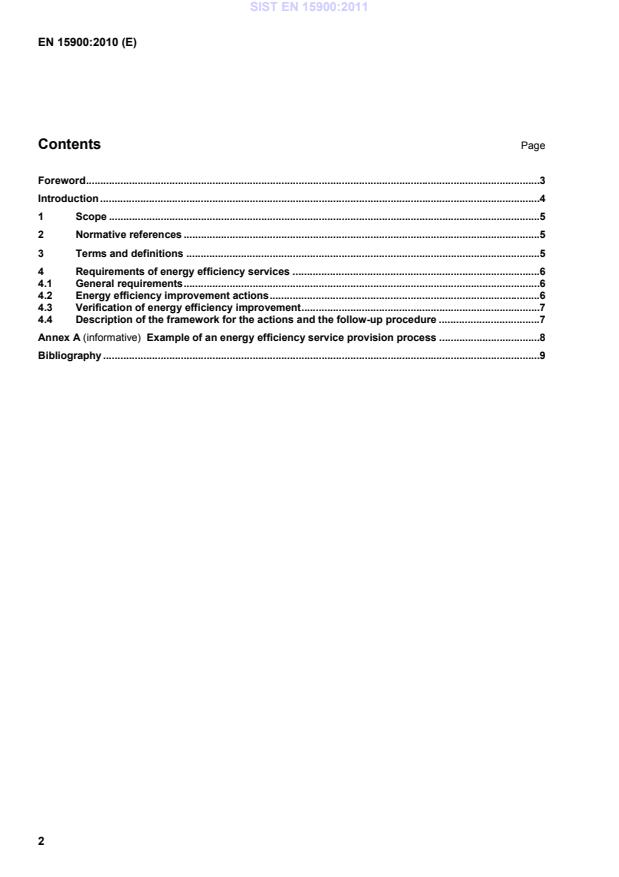
Example of an energy efficiency service provision process .8Bibliography .9 SIST EN 15900:2011
This standard may be used as a reference document for appropriate qualification, accreditation and/or certification schemes for providers of energy efficiency services, as mentioned in Article 8 of Directive 2006/32/EC. This standard is written to provide guidance to both customers and providers of energy efficiency services, as mentioned in Article 1 of Directive 2006/32/EC, and to contribute to the development of a market for energy efficiency services.
Figure 1 — Diagram illustrating a typical energy efficiency service provision process A diagram illustrating a typical energy efficiency service provision process is shown in Figure 1, where upper shapes represent "activities" and lower shapes represent "deliverables", according with Table A.1 in Annex A. The process steps may be performed by different parties although the responsibility for the energy efficiency improvement is generally taken by one single party.
The service provider(s) and the customer should strive to implement a continuous improvement in energy efficiency.
adjustment factor quantifiable parameter affecting energy consumption
EXAMPLES Weather conditions, behaviour related parameters (indoor temperature, light level), working hours, production throughput, etc. 3.2
baseline energy consumption calculated or measured over a period of time normalized by adjustment factors 3.3
energy audit systematic inspection and analysis of energy use and energy consumption of a system or organisation with the object of identifying energy flows and the potential for energy efficiency improvements NOTE "Energy audit" is the normal expression in English but can cause confusion when translated due to the word "audit" having multiple meanings. Suitable expressions can be used when translating into other languages, for example: "diagnosi" in Italian, "diagnostic" in French.
3.4
energy consumption amount of energy used
NOTE Energy consumpt
...