

prEN 12805
(Main)LPG equipment and accessories - Automotive LPG components - Containers
- Abstract
This document defines the requirements for design, manufacturing and testing of welded steel automotive Liquefied Petroleum Gas (LPG) containers, to be permanently attached to a motor vehicle, where the automotive LPG is to be used as a fuel in the vehicle.
- Status
- Not Published
- Publication Date
- 11-Mar-2027
- Technical Committee
- CEN/TC 286 - Liquefied petroleum gas equipment and accessories
- Drafting Committee
- CEN/TC 286/WG 6 - Automative LPG system
- Current Stage
- 4060 - Closure of enquiry - Enquiry
- Start Date
- 12-Mar-2026
- Due Date
- 29-Jan-2025
- Completion Date
- 12-Mar-2026

Overview
The prEN 12805 standard, developed by the European Committee for Standardization (CEN), specifies requirements for the design, manufacturing, and testing of welded steel automotive Liquefied Petroleum Gas (LPG) containers. These containers are intended to be permanently mounted on motor vehicles using LPG as fuel. The current draft edition, projected for release in 2026, updates and supersedes EN 12805:2002, introducing important technical enhancements such as new tank shapes and corrosion testing.
This standard is essential for manufacturers, testers, and certifiers aiming to ensure safety, reliability, and regulatory compliance of automotive LPG containers. It addresses various technical and quality aspects including dimensions, materials, welding, pressure design, heat treatment, and extensive pressure and safety testing.
Key Topics
Scope and Application
Defines technical and safety requirements specifically for welded steel LPG containers permanently attached to vehicles using automotive LPG fuel.Design Requirements
Covers dimensional specifications, steel quality, design temperature and pressure limits to guarantee structural integrity under operational conditions.Manufacturing and Welding Standards
Establishes qualifications for welding personnel, welding methods, inspection processes, and weld repair procedures vital for container durability.Testing Procedures
Specifies mandatory production and prototype tests including tensile, bend, macroscopic, hydraulic pressure, burst, hardness, radiographic, and bonfire tests, ensuring container safety and durability.Corrosion Testing
Introduced in the current draft to assess container resistance to corrosion, vital for long service life and environmental challenges.Marking and Traceability
Specifies requirements for clear marking, identification, and documentation to track container certification and performance compliance.Tank Categories
Incorporates traditional cylindrical tanks along with new categories like toroidal and centre-closed toroidal tanks, expanding applicability to diverse vehicle designs.
Applications
Automotive Industry
prEN 12805 provides a critical framework for manufacturers producing LPG fuel containers for vehicles, ensuring compliance with European safety standards.LPG Conversion and Retrofitting
Companies converting vehicles from petrol/diesel to LPG can rely on this standard to select and test containers that meet stringent quality and safety norms.Quality Control and Certification
Testing laboratories and certification bodies use the standard to assess container safety, welding quality, structural integrity, and overall reliability before market release.Regulatory Compliance
Supports adherence to vehicle safety and environmental regulations such as UN ECE Regulation 67, facilitating type approval and market access across European countries.
Related Standards
- EN 10120 – Steel sheet and strip for welded gas cylinders, ensuring material quality compatibility.
- EN ISO 4136, EN ISO 5173 – Destructive weld testing methods for mechanical property validation.
- EN ISO 9606-1 – Qualification of welders performing fusion welding on steels.
- EN ISO 6507-1 – Hardness testing methods employed during quality control.
- EN ISO 9227 – Corrosion tests in artificial atmospheres, combining with prEN 12805 corrosion testing requirements.
- EN ISO 17636-1 & 17636-2 – Radiographic testing techniques of welds, critical for non-destructive evaluation.
- UN ECE Regulation 67 – International vehicle LPG container approval framework referenced in annexes.
This comprehensive standard ensures that automotive LPG containers conform to the highest levels of safety, durability, and performance. By following prEN 12805 guidelines, manufacturers and stakeholders can deliver LPG fuel systems that foster confidence and sustainability in automotive fuel technology.
Relations
- Effective Date
- 07-Feb-2024
Get Certified
Connect with accredited certification bodies for this standard

TÜV Rheinland
TÜV Rheinland is a leading international provider of technical services.

TÜV SÜD
TÜV SÜD is a trusted partner of choice for safety, security and sustainability solutions.

DEKRA Certification Inc.
DEKRA US certification services.
Sponsored listings
Frequently Asked Questions
prEN 12805 is a draft published by the European Committee for Standardization (CEN). Its full title is "LPG equipment and accessories - Automotive LPG components - Containers". This standard covers: This document defines the requirements for design, manufacturing and testing of welded steel automotive Liquefied Petroleum Gas (LPG) containers, to be permanently attached to a motor vehicle, where the automotive LPG is to be used as a fuel in the vehicle.
This document defines the requirements for design, manufacturing and testing of welded steel automotive Liquefied Petroleum Gas (LPG) containers, to be permanently attached to a motor vehicle, where the automotive LPG is to be used as a fuel in the vehicle.
prEN 12805 is classified under the following ICS (International Classification for Standards) categories: 23.020.20 - Vessels and containers mounted on vehicles; 23.020.35 - Gas cylinders; 43.060.40 - Fuel systems. The ICS classification helps identify the subject area and facilitates finding related standards.
prEN 12805 has the following relationships with other standards: It is inter standard links to EN 12805:2002. Understanding these relationships helps ensure you are using the most current and applicable version of the standard.
prEN 12805 is available in PDF format for immediate download after purchase. The document can be added to your cart and obtained through the secure checkout process. Digital delivery ensures instant access to the complete standard document.
Standards Content (Sample)
SLOVENSKI STANDARD
01-februar-2026
Oprema in pribor za utekočinjeni naftni plin (UNP) - Sestavni deli za pogon
motornih vozil na UNP - Rezervoarji
LPG equipment and accessories - Automotive LPG components - Containers
Flüssiggas-Geräte und Ausrüstungsteile - Bauteile für Autogasanlagen/Treibgasanlagen
- Autogastanks
Équipements pour GPL et leurs accessoires - Composants pour véhicules au GPL -
Réservoirs
Ta slovenski standard je istoveten z: prEN 12805
ICS:
23.020.35 Plinske jeklenke Gas cylinders
43.060.40 Sistemi za gorivo Fuel systems
2003-01.Slovenski inštitut za standardizacijo. Razmnoževanje celote ali delov tega standarda ni dovoljeno.
DRAFT
EUROPEAN STANDARD
NORME EUROPÉENNE
EUROPÄISCHE NORM
December 2025
ICS 23.020.20; 23.020.35; 43.060.40 Will supersede EN 12805:2002
English Version
LPG equipment and accessories - Automotive LPG
components - Containers
Équipements pour GPL et leurs accessoires - Flüssiggas-Geräte und Ausrüstungsteile - Bauteile für
Composants pour véhicules au GPL - Réservoirs Autogasanlagen/Treibgasanlagen - Autogastanks
This draft European Standard is submitted to CEN members for enquiry. It has been drawn up by the Technical Committee
CEN/TC 286.
If this draft becomes a European Standard, CEN members are bound to comply with the CEN/CENELEC Internal Regulations
which stipulate the conditions for giving this European Standard the status of a national standard without any alteration.
This draft European Standard was established by CEN in three official versions (English, French, German). A version in any other
language made by translation under the responsibility of a CEN member into its own language and notified to the CEN-CENELEC
Management Centre has the same status as the official versions.
CEN members are the national standards bodies of Austria, Belgium, Bulgaria, Croatia, Cyprus, Czech Republic, Denmark, Estonia,
Finland, France, Germany, Greece, Hungary, Iceland, Ireland, Italy, Latvia, Lithuania, Luxembourg, Malta, Netherlands, Norway,
Poland, Portugal, Republic of North Macedonia, Romania, Serbia, Slovakia, Slovenia, Spain, Sweden, Switzerland, Türkiye and
United Kingdom.
Recipients of this draft are invited to submit, with their comments, notification of any relevant patent rights of which they are
aware and to provide supporting documentation.
Warning : This document is not a European Standard. It is distributed for review and comments. It is subject to change without
notice and shall not be referred to as a European Standard.
EUROPEAN COMMITTEE FOR STANDARDIZATION
COMITÉ EUROPÉEN DE NORMALISATION
EUROPÄISCHES KOMITEE FÜR NORMUNG
CEN-CENELEC Management Centre: Rue de la Science 23, B-1040 Brussels
© 2025 CEN All rights of exploitation in any form and by any means reserved Ref. No. prEN 12805:2025 E
worldwide for CEN national Members.
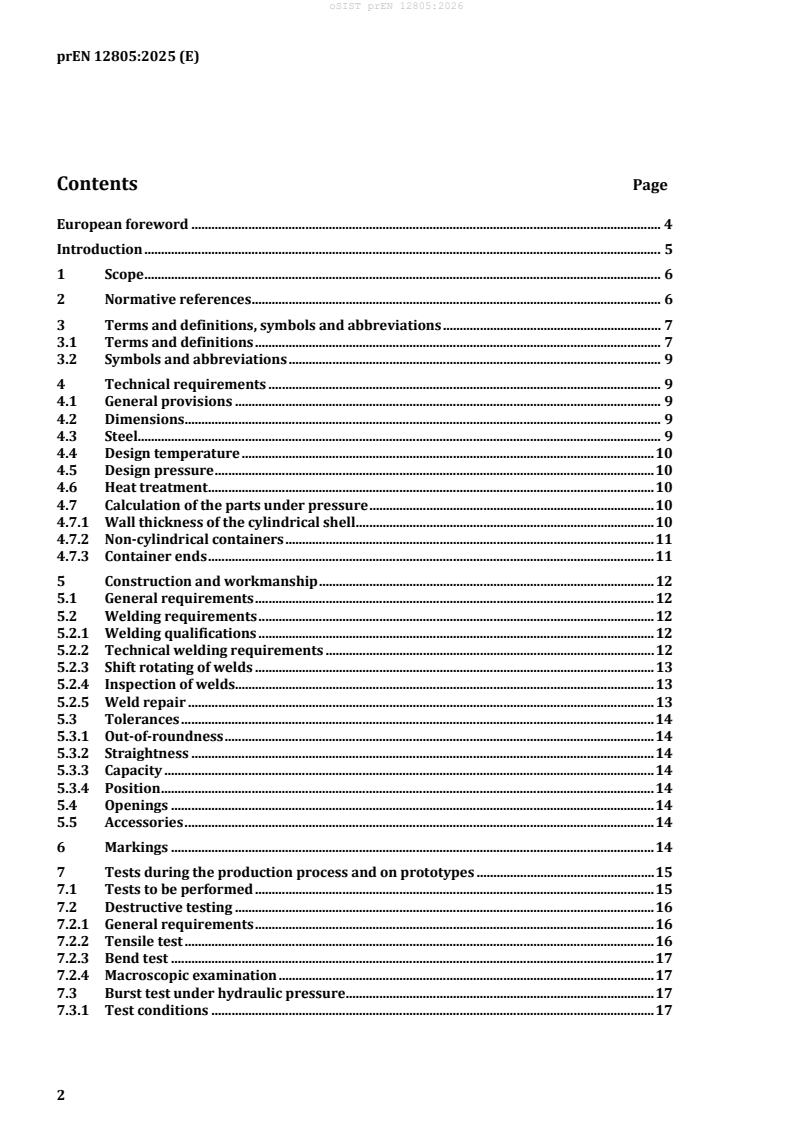
Contents Page
European foreword . 4
Introduction . 5
1 Scope . 6
2 Normative references . 6
3 Terms and definitions, symbols and abbreviations . 7
3.1 Terms and definitions . 7
3.2 Symbols and abbreviations . 9
4 Technical requirements . 9
4.1 General provisions . 9
4.2 Dimensions. 9
4.3 Steel. 9
4.4 Design temperature . 10
4.5 Design pressure . 10
4.6 Heat treatment . 10
4.7 Calculation of the parts under pressure . 10
4.7.1 Wall thickness of the cylindrical shell . 10
4.7.2 Non-cylindrical containers . 11
4.7.3 Container ends . 11
5 Construction and workmanship . 12
5.1 General requirements . 12
5.2 Welding requirements . 12
5.2.1 Welding qualifications . 12
5.2.2 Technical welding requirements . 12
5.2.3 Shift rotating of welds . 13
5.2.4 Inspection of welds. 13
5.2.5 Weld repair . 13
5.3 Tolerances . 14
5.3.1 Out-of-roundness . 14
5.3.2 Straightness . 14
5.3.3 Capacity . 14
5.3.4 Position . 14
5.4 Openings . 14
5.5 Accessories . 14
6 Markings . 14
7 Tests during the production process and on prototypes . 15
7.1 Tests to be performed . 15
7.2 Destructive testing . 16
7.2.1 General requirements . 16
7.2.2 Tensile test . 16
7.2.3 Bend test . 17
7.2.4 Macroscopic examination . 17
7.3 Burst test under hydraulic pressure . 17
7.3.1 Test conditions . 17
7.3.2 Interpretation of test . 18
7.3.3 Test acceptance conditions . 18
7.3.4 Retesting for burst test . 18
7.4 Hydraulic test . 18
7.5 Hardness test . 19
7.6 Bonfire test. 19
7.6.1 General . 19
7.6.2 Container set-up . 20
7.6.3 Fire source . 20
7.6.4 Temperature and pressure measurements . 20
7.6.5 General test requirements . 20
7.6.6 Acceptable results . 20
7.7 Radiographic examination . 21
7.8 Corrosion test . 21
Annex A (informative) Examples of container shapes . 23
Annex B (informative) Examples of container ends . 24
Annex C (normative) Examples of butt welds . 25
Annex D (normative) Examples of welded plates and rings . 26
Annex E (normative) Shifting rotating of welds . 27
Annex F (normative) Tolerance on position of plate or ring for cylindrical and toroidal
containers . 28
Annex G (normative) Location of test specimen . 30
G.1 Location of test specimen from a 2-section cylindrical container . 30
G.2 Location of test specimen from a 3-section cylindrical container . 31
G.3 Location of macrosection for valve boss/plate welds in cylindrical containers . 32
G.4 Location of test specimen from a toroidal container . 32
G.5 Location of test specimen from a centre closed toroidal container . 34
Annex H (normative) Test specimen for mechanical tests . 37
Annex I (normative) Radiography of welds . 38
Annex J (normative) Determination of the shape factor C . 40
Annex K (informative) Type approval recommendations . 43
K.1 Application for type approval . 43
K.2 Approval according to UN ECE Regulation 67 . 43
K.3 Modification of a container type and extension of approval . 44
K.4 Conformity of production . 44
K.5 Production definitely discontinued . 44
Annex L (informative) Approval mark and communication form . 45
L.1 Type approval mark . 45
L.2 Example of a communication form. 45
L.3 International country numbers in accordance with UN-ECE regulation 67 . 49
Bibliography . 51
European foreword
This document (prEN 12805:2025) has been prepared by Technical Committee CEN/TC 286 “Liquefied
petroleum gas equipment and accessories”, the secretariat of which is held by NSAI.
This document is currently submitted to the CEN Enquiry.
This document will supersede EN 12805:2002.
In comparison with the previous edition, the following technical modifications have been made:
— added toroidal tanks and centre closed toroidal tanks in tank categories;
— added corrosion test;
— eliminated fatigue test.
Annexes A, B, K and L are informative, Annexes C to J are normative.
Introduction
This document defines requirements for the design, manufacturing and testing of welded steel
automotive Liquefied Petroleum Gas (LPG) containers.
This document calls for the use of substances and procedures that can be injurious to health if adequate
precautions are not taken. It refers only to technical suitability and does not absolve the user from legal
obligations relating to health and safety at any stage.
It has been assumed in the drafting of this document that execution of its provisions is entrusted to
appropriately qualified and experienced people.
1 Scope
This document defines the requirements for design, manufacturing and testing of welded steel
automotive Liquefied Petroleum Gas (LPG) containers, to be permanently attached to a motor vehicle,
where the automotive LPG is to be used as a fuel in the vehicle.
2 Normative references
The following documents are referred to in the text in such a way that some or all of their content
constitutes requirements of this document. For dated references, only the edition cited applies. For
undated references, the latest edition of the referenced document (including any amendments) applies.
EN 10120, Steel sheet and strip for welded gas cylinders
EN 22768-1, General tolerances - Part 1: Tolerances for linear and angular dimensions without individual
tolerance indications (ISO 2768-1:1989)
EN ISO 4136, Destructive tests on welds in metallic materials - Transverse tensile test (ISO 4136)
EN ISO 5173, Destructive tests on welds in metallic materials - Bend tests (ISO 5173)
EN ISO 5178, Destructive tests on welds in metallic materials - Longitudinal tensile test on weld metal in
fusion welded joints ISO 5178)
EN ISO 6507-1, Metallic materials - Vickers hardness test - Part 1: Test method (ISO 6507-1)
EN ISO 6892-1, Metallic materials - Tensile testing - Part 1: Method of test at room temperature (ISO 6892-
1)
EN ISO 7438, Metallic materials - Bend test (ISO 7438)
EN ISO 7799, Metallic materials - Sheet and strip 3 mm thick or less - Reverse bend test (ISO 7799)
EN ISO 9227, Corrosion tests in artificial atmospheres — Salt spray tests (ISO 9227)
EN ISO 9606-1, Qualification testing of welders - Fusion welding - Part 1: Steels (ISO 9606-1)
EN ISO 15614-1, Specification and qualification of welding procedures for metallic materials - Welding
procedure test - Part 1: Arc and gas welding of steels and arc welding of nickel and nickel alloys (ISO 15614-
1)
EN ISO 17636-1, Non-destructive testing of welds – Radiographic testing - Part 1: X- and gamma-ray
techniques with film (ISO 17636-1)
EN ISO 17636-2, Non-destructive testing of welds - Radiographic testing - Part 2: X- and gamma-ray
techniques with digital detectors (ISO 17636-2)
ISO 2504, Radiography of welds and vewing conditions for films - Utilization of recommended patterns of
image quality indicators (I.Q.I.)
3 Terms and definitions, symbols and abbreviations
3.1 Terms and definitions
For the purposes of this document, the following terms and definitions apply.
ISO and IEC maintain terminological databases for use in standardization at the following addresses:
— IEC Electropedia: available at https://www.electropedia.org/
— ISO Online browsing platform: available at https://www.iso.org/obp
3.1.1
test pressure
pressure to which the container is subjected during the test procedure
3.1.2
design pressure
pressure on which the calculations are based
3.1.3
working pressure
pressure under normal operating conditions
3.1.4
container
vessel used for the storage of automotive LPG
3.1.5
cylindrical container
container with a cylindrical shell and two dished ends, either torispherical or elliptical
3.1.6
toroidal container
container with a toroidal shell and an inner or external multivalve
3.1.7
centre closed toroidal container
toroidal container, whose inner chamber is closed by a cover and an internal steel diaphragm, with an
external multivalve
3.1.8
special container
container other than cylindrical and toroidal container
3.1.9
type of containers
container or a group of containers where the individual container does not differ significantly with
respect to the following conditions:
— the manufacturer (different trade names or marks possible);
— the shape;
— the openings;
— the material;
— the welding process;
— the heat treatment;
— the production line;
— the diameter;
— height (in case of a toroidal, centre closed toroidal and special container);
— the nominal wall thickness
3.1.10
stress relieving
heat treatment given to objects to reduce the residual stresses without altering the metallurgical
structure of steel, by heating to a uniform temperature, Ac , and cooling in a controlled atmosphere
3.1.11
normalising
heating to a uniform temperature, Ac , of the steel and then cooling in a controlled atmosphere
3.1.12
hot-rolled
deformation of the material at the critical temperature Ac3
NOTE Ac and Ac will be obtained from the material data sheet.
1 3
3.1.13
longitudinal weld
weld over the full length of the shell or cylindrical part of the shell, excluding welds for fittings
3.1.14
batch
number of containers made under the same process, that belong to the same type
Note to entry: The maximum number of containers in a batch is 200.
3.1.15
parent material
material in the state before any specific transformation with regards to the container manufacturing
process
3.1.16
Liquefied Petroleum Gas (LPG)
mixture of light hydrocarbons, gaseous under normal atmospheric conditions which can be liquefied by
increased pressure or decreased temperature. The main components are propane, propene, butane and
butene isomers
3.1.17
automotive LPG
motor fuel complying with EN 589
3.2 Symbols and abbreviations
For the purposes of this document, the following symbols and abbreviations apply.
a minimum calculated wall thickness of the cylindrical shell in mm;
b minimum calculated wall thickness of the dished ends in mm;
e actual wall thickness;
C shape factor;
D nominal outside diameter of the container in mm;
F force in N;
g gravity in m/s ;
h height of cylindrical part of dished end in mm;
H outside height of dished part of container end in mm;
P maximum pressure measured in the burst test in kPa;
b
P hydraulic test pressure /design pressure in kPa;
h
r inside knuckle radius of the dished end of the standard cylindrical container in mm;
R inside dish radius of the dished end of a standard cylindrical container in mm;
R minimum yield stress in N/mm guaranteed by the material standard;
e
R minimum tensile strength in N/mm guaranteed by the material standard;
m
z welding factor;
HV Vickers hardness;
PRV pressure relief valve;
PRD pressure relief device or fuse.
4 Technical requirements
4.1 General provisions
The container for vehicles using automotive LPG in their propulsion system shall function in a correct
and safe way.
The materials of the container shall be compatible with LPG.
All necessary corrosion prevention measures shall be taken to protect the finished container including
any permanently fixed parts.
4.2 Dimensions
For all dimensions without indication of tolerances, general tolerances of EN 22768-1 shall apply.
4.3 Steel
Steel for shells, dished ends, welded plates and rings (see Annex D) shall be in accordance with EN 10120.
Steels other than those in EN 10120 may be used, provided that the container complies with the
requirements of this document.
The container manufacturer shall ensure that all parent materials are free from defects.
Container parts shall be made of materials that are compatible when welded.
The filler materials shall be compatible with the material used to form welds with properties equivalent
to those specified for the parent material (see EN ISO 15614-1).
The container manufacturer shall obtain and provide chemical cast analysis certificates and mechanical
properties of the steel used for the construction of the parts subject to pressure.
The container manufacturer shall maintain a system for identification during the fabrication so that all
parent materials for parts subject to pressure can be traced.
The container manufacturer shall maintain records of the results of metallurgical and mechanical tests
and analyses of parent and filler materials.
4.4 Design temperature
The minimum design temperature shall be –20 °C.
The maximum design temperature shall be +65 °C.
For extreme operating temperatures, exceeding the above, a minimum design temperature of –40 °C shall
be applied.
4.5 Design pressure
The design pressure of the container shall be 3 000 kPa.
4.6 Heat treatment
The container manufacturer shall maintain records to demonstrate that the containers have been
adequately heat treated.
Localised heat treatment of a completed container shall not be permitted.
The heat-treatment shall be performed as follow:
a) containers with a wall thickness greater than or equal to 5 mm:
— for hot-rolled and normalized material: stress relieving or normalizing;
— for material of a different kind: normalizing;
b) containers with a wall thickness less than 5 mm:
— normalizing the whole container, or
— normalizing the parts having been deformed by more than 5 %.
Heat treatment shall not be required if the elongation after rupture is 14 % or more in a tensile test
carried out after forming by a standard procedure in accordance with EN ISO 6892-1.
4.7 Calculation of the parts under pressure
4.7.1 Wall thickness of the cylindrical shell
The minimum wall thickness a of the cylindrical shell shall be calculated according to the following
calculation:
— containers without a longitudinal weld:
PD
h
a=
1 500RP+
e h
— containers with a longitudinal weld:
PD
h
a=
1 500Rz+ P
eh
For the value z see 5.2.4.2.
4.7.2 Non-cylindrical containers
For container shapes other than a cylindrical container the adequacy of their design shall be shown by a
calculation or demonstrated by a fatigue test in accordance with 7.6 or by appropriate stress analysis. All
welding requirements for cylindrical containers shall apply.
4.7.3 Container ends
Container ends shall be in one piece, concave to the pressure, and shall be either torispherical or semi-
ellipsoidal.
The minimum wall thickness b of the ends after forming shall be calculated according to the following
formula:
PD
h
bC=
1 500R
e
The shape factor C shall be obtained from Table J.1 or Figure J.1 or Figure J.2.
The difference between the wall thickness of the cylindrical edge of the ends and the shell shall be 15 %
or less of the smallest wall thickness.
The dimensions of the container ends shall fulfil the following conditions:
NOTE For illustration of container ends, see Annex B.
— Torispherical ends:
r ≥ 0,1 D
R ≤ D
r ≥ 2 b
h ≥ 4 b
H ≥ 0,18 D
0,003 D ≤ b ≤ 0,080 D
D D
H= Rb+ − Rb+ − x Rb+ + − 2 r+ b
( ) ( ) ( ) ( )
22
h ≤ 0,15 D
— Semi-ellipsoidal ends:
H ≥ 0,1 D
h ≥ 4 b
0,003 D ≤ b ≤ 0,080 D
h ≤ 0,15 D
5 Construction and workmanship
5.1 General requirements
The manufacturer shall be able to demonstrate that the quality control system used ensures that the
containers produced meet the requirements of this document.
The manufacturer shall maintain records of the welding procedures and inspections that are carried out
during production.
The manufacturer shall visually examine the pressure containing parts of the container before assembly.
5.2 Welding requirements
5.2.1 Welding qualifications
Before proceeding with the production of containers, the manufacturer shall qualify his welding
procedures and welders, ensuring that they meet the requirements of EN ISO 15614-1 and
EN ISO 9606-1 respectively.
The manufacturer shall maintain records of these qualifications.
5.2.2 Technical welding requirements
Butt welds shall be executed by an automatic or semi-automatic welding process.
Butt welds on the pressure containing shell shall not be located in any areas where there are changes of
profile.
Angle (fillet) welds shall be at least 10 mm away from butt welds.
Welded attachment points in the area of the small radius r of ends are permitted if the container fulfils
the requirements of the burst test.
Container welds shall satisfy the following:
— a longitudinal weld shall be in the form of a butt weld on the full section of the wall, see Figure C.1;
— a circumferential weld shall be in the form of a butt weld on the full section of the wall, see Figure C.2;
NOTE 1 A joggle weld is considered to be a special type of butt weld.
— a weld attaching the valve boss/plate or ring to the container shall be in accordance with Annex D;
— a weld attaching a collar or support to the container shall be either a butt or an angle weld;
— misalignment of the joint-faces of a butt weld shall not exceed 20 % of the wall thickness.
Welded mounting supports shall be welded circumferentially. Welds shall be strong enough to withstand
vibrations and forces of at least 30 g in all directions, to be demonstrated by impact test or calculation.
NOTE 2 For details, see EN 12979.
5.2.3 Shift rotating of welds
When the cylindrical part of the container is made of two or more parts, the longitudinal welds shall not
be aligned and the distance between the welds shall be at least 10 times the wall thickness of the
container, see Annex E.
5.2.4 Inspection of welds
5.2.4.1 Visual inspection of welds
The manufacturer shall visually inspect all container welds.
During the inspection, the welded surface shall be well illuminated and shall be free from grease, dust,
scale residue or any kind of coating.
The excess thickness of welds shall not exceed 25 % of the width of the weld, see Figure C.1.
All welds shall have an even finish without concavity and shall merge into the parent metal without
undercutting or abrupt irregularity.
5.2.4.2 Radiographic inspection of welds
The manufacturer shall ensure that all butt welds show full penetration without any deviation of the weld
seam. The fusion of the filler material with the parent steel shall be smooth and free from etching. The
welds shall be free from defects that are likely to jeopardize the safe use of the container. This shall be
demonstrated in the following manner:
— for containers in two pieces, a radiographic inspection shall be performed on 100 mm of the
circumferential butt-weld, or
— for containers with more than two parts a radiographic inspection shall be performed on each weld
intersection and 100 mm of the adjacent longitudinal weld. The adjacent circumferential weld of each
intersection shall also be radiographed over 25 mm on each side of the intersection, in accordance
with Figure I.1.
These inspections shall be performed on the first container from each shift period of a continuous
production and, in the event of production being interrupted for a period of more than 12 h, the first
welded container shall be radiographed. In addition, depending on the welding factor, the following
radiographic inspection shall also be performed:
— when z = 0,85: 1 in every 200 containers for an automatic welding process,
— when z = 0,85: 1 in every 100 containers for a semi-automatic welding process,
— when z = 1: 1 in every 20 containers for an automatic welding process,
— when z = 1: 1 in every 10 containers for a semi-automatic welding process.
The containers that are submitted to the inspections shall be chosen randomly.
If these radiographic inspections reveal unacceptable defects, as defined in 7.8, all the necessary steps
shall be taken to examine the production run in question and eliminate the defects.
5.2.5 Weld repair
Welding imperfections shall be removed and the weld shall be repaired in accordance with an approved
procedure. Any section repaired by welding shall be re-inspected visually and the container shall be
subjected to a hydraulic test. An unacceptable imperfection found by radiography shall be re-
radiographed after repair.
5.3 Tolerances
5.3.1 Out-of-roundness
The out-of-roundness of the cylindrical shell of the container shall be limited so that the difference
between the maximum and minimum outside diameter of the same cross-section is not more than 1 % of
the average of those diameters.
5.3.2 Straightness
Unless otherwise shown on the construction drawing, the maximum deviation of the cylindrical part of
the shell from a straight line shall not exceed 0,3 % of the length of the cylindrical part.
5.3.3 Capacity
The actual water capacity of the container, shall have a tolerance of 0 % to +3 % compared to the figure,
marked on the plate.
5.3.4 Position
The tolerance on the position of the valve boss/plate in the container shall be plus or minus 1 degree in
two directions, transverse and twist, see Annex F.
5.4 Openings
Openings shall be provided for filling, off-take, pressure relief and level indication.
Openings for pressure relief valves shall be connected to the vapour phase.
Openings may also be provided for power supply, pumps etc.
NOTE 1 Openings for valves can be either separate or combined.
Openings shall be taper threaded or flanged.
NOTE 2 An O-ring can be fitted either in the ring or in the flange, see Figure D.2.
Internal vapour off-take pipework shall be adequately supported and shall end in the vapour space of the
container as high as possible above the maximum filling level. Internal liquid off-take pipework shall end
as low as possible in the container.
5.5 Accessories
Where fitted, the identification plate shall be fixed permanently on the container shell or end.
The accessories in and on the container shall be fitted under the responsibility of the holder of the bonfire
test approval certificate, see 7.6.
It shall be possible to securely mount a gas-tight housing or other protective device over the container
accessories.
6 Markings
The following data shall be clearly and permanently marked on the fitting plate or ring, or on a
permanently attached identification plate:
— a serial number;
— the water capacity in litres;
— the marking “LPG”;
— hydraulic test pressure in bar;
— the wording: “maximum degree of filling: 80 %”;
— year and month of hydraulic testing (e.g. 99/01);
— approval mark;
NOTE Examples of approval marks in accordance with those requested in the UN/ECE Regulation 67 are shown
in the Annex L.
— the name or trade mark of the manufacturer (if not permanently marked on the container
elsewhere);
— diameter in mm (in case of a cylindrical container);
— height in mm (in case of special containers);
— the marking “pump inside” and a marking identifying the pump, when a pump is mounted in the
container.
The marking plate shall have enough space to accommodate the re-qualification mark of the container.
A reference mark shall be affixed on the container to ensure its correct orientation when installed.
7 Tests during the production process and on prototypes
7.1 Tests to be performed
Table 1 —Overview of tests
Test during Certification Number of prototypes
production testing to be tested
a
Tensile test 1 per batch X 2
a
Bend test 1 per batch X 2
Burst test X 2
Hydraulic test Each container X 100 %
a
Hardness test X 2
Bonfire test X 1
Radiographic examination 1 per batch X 100 %
a
Macroscopic examination 1 per batch X 2
Inspection of welds 1 per batch X 100 %
Visual inspection of the parts of the 1 per batch X 100 %
container
Corrosion test X 2
a
These test pieces can be taken from one container.
The number of containers that shall be submitted for type testing is 6.
On one of these prototypes the volume of the container and the wall thickness of each part of the
container shall be determined.
7.2 Destructive testing
7.2.1 General requirements
All tests for checking the properties of the parent steel and welds of the container shall be carried out on
test pieces taken from finished containers.
The frequency of the tests is:
a) during production:
— 1 from each 200 containers manufactured by a semi-automatic welding process;
— 1 of each batch when manufactured by an automatic welding process;
b) for type testing, see Table 1.
Test pieces which are not flat shall be flattened by a cold process.
In test pieces containing a weld, the weld shall be machined to trim the surplus.
Containers shall be subjected to the tests as described in Table 1.
Test pieces from cylindrical containers with one circumferential weld only (two sections) shall be taken
from the places shown in Figure G.1.
Test pieces from cylindrical containers with longitudinal and circumferential welds (three or more
sections) shall be taken from the places shown in Figure G.2.
Test pieces from toroidal containers shall be taken from the places shown in Figure G.4.
Test pieces from centre closed toroidal containers shall be taken from the places shown in Figure G.5.
7.2.2 Tensile test
7.2.2.1 Tensile test on parent material
The tensile test shall be carried out in accordance with EN ISO 5178, EN ISO 4136 and EN ISO 6892-1.
The two faces of the test piece, representing the inside and the outside walls of the container respectively,
shall not be machined.
The values determined for yield stress, tensile strength and elongation of the parent steel shall comply
with the characteristics of the steel as required by 4.3.
7.2.2.2 Tensile test on welds
The tensile test perpendicular to the weld shall be carried out on a test piece having the dimensions of
Figure H.1.
The obtained tensile strength value shall be at least equal to the guaranteed value for the parent steel,
irrespective of where the burst occurs in the cross-section of the central part of the test piece.
7.2.2.3 Retesting for a tensile test
If the first test fails, a second test shall be carried out on two test pieces from the same container. If both
pieces pass the retest, the first test shall be ignored. Where one or both of the retests fail, the batch shall
be rejected.
7.2.3 Bend test
7.2.3.1 Bend test on welds
The bend test shall be carried out in accordance with EN ISO 7438 and EN ISO 7799 and EN ISO 5173 for
welded parts.
The bend test shall be carried out transversely to the weld on a test piece, with a width of 25 mm, as
shown in Figure H.2. The mandrel shall be placed in the centre of the weld.
Cracks shall not appear in the test piece when it is bent around a mandrel as long as the inside edges are
separated by a distance not greater than the diameter of the mandrel +3a, as shown in Figure H.3.
The ratio (n) between the diameter of the mandrel and the thickness of the test piece shall not exceed the
values in Table 2.
Table 2 — Maximum value of ratio n
Tensile strength R N/mm value of n
m
≤ 440 2
above 440 to 520 inclusive 3
> 520 b4
Bend tests shall be carried out from the back of the weld and from the front.
7.2.3.2 Retesting for a bend test
If the first test fails, a second test shall be carried out on two test pieces from the same container. If both
test pieces pass the test, the first test shall be ignored. Where one or both of the retests fail, the batch shall
be rejected.
7.2.4 Macroscopic examination
The macroscopic examination to verify the properties of the parent material and welds of the pressure
containing shell of the container shall be carried out on test pieces taken from finished containers. For
location of test pieces, see Annex G.
The macroscopic examination of a full transverse section of the weld shall show a complete fusion on the
surface, and shall not show any welding fault or a significant inclusion or other defects.
In case of doubt a microscopic examination shall be made of the suspect area.
7.3 Burst test under hydraulic pressure
7.3.1 Test conditions
Containers subjected to this test shall be properly marked according to Clause 6 of this document.
The pressure shall be increased at an even rate until the container bursts and the change in pressure over
time shall be recorded. The maximum flow rate during the test shall not exceed 3 % of the capacity of the
container per minute.
7.3.1.1 Centre closed toroidal containers
Test shall be terminated if any sign of bursting during the pressure increase occurs. If the rupture occurs
in the inner chamber, the container is checked by cutting the container to scan the rupture shape.
7.3.2 Interpretation of test
The criteria adopted for the interpretation of the burst test are:
— the burst pressure;
— increase of the volume of the container between the moment that the pressure starts to rise and the
moment of burst;
— examination of the tear and the shape of its edges.
7.3.3 Test acceptance conditions
The measured burst pressure P shall be at least 2,25 × design pressure = 6 750 kPa.
b
The specific change in volume of the container at the moment of burst shall not be less than:
— 20 % if the length of the container is greater than the diameter;
— 17 % if the length of the container is equal to or less than the diameter;
— 8 % in the case of a special container as shown in Annex A.
The burst test shall not cause any fragmentation of the container.
The main fracture shall not be brittle, i.e. the edges of the fracture shall not be radial but shall be at an
angle to a diametrical plane and display a reduction of area throughout their thickness.
The fracture shall not reveal any defects in the steel.
7.3.4 Retesting for burst test
If the first test fails, a second burst test shall be carried out on two containers which have been produced
successively to the first container within the same batch. If both containers pass the retest, the first test
shall be ignored.
If one or both of the retests fail, the batch shall be rejected.
7.4 Hydraulic test
All finished containers, without accessories but with the openings closed, shall withstand an inner
hydraulic pressure of 3 000 kPa without leakage or becoming permanently distorted, according to the
following requirements:
— the hydraulic pressure in the container shall be increased at an even rate until the test pressure of
3 000 kPa is reached;
— the container shall remain long enough under the test pressure to make it possible to verify that the
pressure is not falling off and that the container can is free of leaks.
After the test, the container shall show no signs of permanent deformation.
Any container that does not pass the test shall be rejected.
7.5 Hardness test
The hardness of the weld and the steel around the weld of a finished container shall be determined in
accordance with EN ISO 6507-1.
For the test the test force F shall be between: 50 N and 300 N.
The Vickers hardness shall be determined on:
— the parent steel;
— the weld;
— the heat-effected zone.
The Vickers hardness shall be no more than:
— 100 HV for parent steel with carbon content less than or equal to 0,23 % and Re less than or equal to
320 N/mm ;
— 150 HV for parent steel with carbon content less than or equal to 0,25 % and Re less than or equal to
320 N/mm .
7.6 Bonfire test
7.6.1 Gener
...