

CEN/TS 17340:2020
(Main)Stationary source emissions - Determination of mass concentration of fluorinated compounds expressed as HF - Standard reference method
- Abstract
This European Standard specifies a manual method for the determination of the concentration of fluorinated compounds expressed in HF. Two cases are presented:
- first case: the measurand is the concentration of hydrofluoric acid and gaseous and bound to particulates fluorides,
- second case: the measurand is the concentration of hydrofluoric acid and gaseous fluorides.
Three analytical techniques are proposed: ionometry, spectrophotometry and ion-exchange chromatography.
This European Standard specifies the performance characteristics to be determined and the performance criteria to be fulfilled when it is used as the Standard Reference Method (SRM) for periodic monitoring and for calibration or control of Automated Measuring Systems (AMS) permanently installed on a stack, for regulatory or other purposes.
This document applies to more or less dust-laden flue gases whose HF concentration may vary between 0,1 mg/m3 and 10 mg/m3, at standard conditions of pressure and temperature. The quantification limit of the method is estimated at 0.1 mg/m3 for a sampled volume of 0.1 m3.
- Status
- Published
- Publication Date
- 29-Sep-2020
- Technical Committee
- CEN/TC 264 - Air quality
- Drafting Committee
- CEN/TC 264 - Air quality
- Current Stage
- 9093 - Decision to confirm - Review Enquiry
- Start Date
- 11-Jun-2024
- Completion Date
- 14-Oct-2026



Overview
CEN/TS 17340:2020 - "Stationary source emissions - Determination of mass concentration of fluorinated compounds expressed as HF - Standard reference method" - defines a manual Standard Reference Method (SRM) for measuring fluorinated compounds in stack and flue gases, expressed as hydrofluoric acid (HF). It covers two measurand cases:
- Case 1: HF plus fluorides bound to particulates (gaseous and particle‑bound fluorides).
- Case 2: HF and gaseous fluorides only.
The Technical Specification applies to dust‑laden flue gases with HF concentrations typically between 0.1 mg/m3 and 10 mg/m3 (standard conditions). The method’s quantification limit is 0.1 mg/m3 for a sampled volume of 0.1 m3.
Key topics and requirements
- Sampling strategy and field operation: measurement planning, selection of measurement plane/points, sampling time and volume, sampling ports and platform.
- Sampling equipment: probe, heated sampling line, filter housing and particle filter, absorbers (impingers), pump, gas volume meter and temperature controller.
- Two sampling configurations: main/side stream system for particulate‑bound plus gaseous fluorides (first case) and single‑line for gaseous fluorides (second case).
- Analytical techniques: three validated options - ionometry, spectrophotometry, and ion‑exchange chromatography (detailed sample preparation and interference handling included).
- Sample treatment: procedures for absorber solutions and filter treatment (including alkaline extraction and pyrohydrolysis where relevant).
- Performance characteristics and criteria: requirements to qualify the method as an SRM for periodic monitoring and for calibration or control of Automated Measuring Systems (AMS) permanently installed on stacks.
- Uncertainty and reporting: methods for establishing an uncertainty budget, expression of results on dry/wet gas basis, oxygen reference correction, and required elements of the test report.
Applications and users
- Regulatory monitoring: use as a reference method for compliance testing of stack emissions where fluorinated compounds/HF are regulated.
- AMS calibration and QA/QC: periodic calibration and performance control of continuous emission monitoring systems (CEMS/AMS) for fluoride/HF measurement.
- Industrial emissions testing: applicable to industries with HF or fluoride emissions (e.g., chemical manufacturing, metal processing, glass/ceramics, fluorochemical production).
- Environmental laboratories and field teams: laboratories performing ionometry, spectrophotometry or ion chromatography and field technicians conducting stack sampling.
Keywords: stationary source emissions, HF measurement, fluorinated compounds, standard reference method, ionometry, spectrophotometry, ion‑exchange chromatography, AMS calibration, flue gas sampling, stack emissions.
Related standards
This CEN/TS was prepared by CEN/TC 264 (Stationary source emissions) and is intended to complement other CEN standards and technical specifications for stack gas sampling, emission monitoring and CEMS/AMS calibration used in regulatory monitoring and industry practice.
Relations
- Effective Date
- 09-Feb-2026
- Effective Date
- 28-Jan-2026
- Effective Date
- 28-Jan-2026
- Effective Date
- 28-Jan-2026
Get Certified
Connect with accredited certification bodies for this standard

CIS Institut d.o.o.
Personal Protective Equipment (PPE) certification body. Notified Body NB-2890 for EU Regulation 2016/425 PPE.

Kiwa BDA Testing
Building and construction product certification.
Kmetijski inštitut Slovenije
Agricultural Institute of Slovenia. Soil testing, plant health, agricultural product analysis.
Sponsored listings
Frequently Asked Questions
CEN/TS 17340:2020 is a technical specification published by the European Committee for Standardization (CEN). Its full title is "Stationary source emissions - Determination of mass concentration of fluorinated compounds expressed as HF - Standard reference method". This standard covers: This European Standard specifies a manual method for the determination of the concentration of fluorinated compounds expressed in HF. Two cases are presented: - first case: the measurand is the concentration of hydrofluoric acid and gaseous and bound to particulates fluorides, - second case: the measurand is the concentration of hydrofluoric acid and gaseous fluorides. Three analytical techniques are proposed: ionometry, spectrophotometry and ion-exchange chromatography. This European Standard specifies the performance characteristics to be determined and the performance criteria to be fulfilled when it is used as the Standard Reference Method (SRM) for periodic monitoring and for calibration or control of Automated Measuring Systems (AMS) permanently installed on a stack, for regulatory or other purposes. This document applies to more or less dust-laden flue gases whose HF concentration may vary between 0,1 mg/m3 and 10 mg/m3, at standard conditions of pressure and temperature. The quantification limit of the method is estimated at 0.1 mg/m3 for a sampled volume of 0.1 m3.
This European Standard specifies a manual method for the determination of the concentration of fluorinated compounds expressed in HF. Two cases are presented: - first case: the measurand is the concentration of hydrofluoric acid and gaseous and bound to particulates fluorides, - second case: the measurand is the concentration of hydrofluoric acid and gaseous fluorides. Three analytical techniques are proposed: ionometry, spectrophotometry and ion-exchange chromatography. This European Standard specifies the performance characteristics to be determined and the performance criteria to be fulfilled when it is used as the Standard Reference Method (SRM) for periodic monitoring and for calibration or control of Automated Measuring Systems (AMS) permanently installed on a stack, for regulatory or other purposes. This document applies to more or less dust-laden flue gases whose HF concentration may vary between 0,1 mg/m3 and 10 mg/m3, at standard conditions of pressure and temperature. The quantification limit of the method is estimated at 0.1 mg/m3 for a sampled volume of 0.1 m3.
CEN/TS 17340:2020 is classified under the following ICS (International Classification for Standards) categories: 13.040.40 - Stationary source emissions. The ICS classification helps identify the subject area and facilitates finding related standards.
CEN/TS 17340:2020 has the following relationships with other standards: It is inter standard links to ISO/IEC Guide 98-3:2008, EN 15259:2007, EN 13284-1:2017, EN ISO 10304-1:2009. Understanding these relationships helps ensure you are using the most current and applicable version of the standard.
CEN/TS 17340:2020 is available in PDF format for immediate download after purchase. The document can be added to your cart and obtained through the secure checkout process. Digital delivery ensures instant access to the complete standard document.
Standards Content (Sample)
SLOVENSKI STANDARD
01-december-2020
Emisije nepremičnih virov - Določevanje masne koncentracije fluoriranih spojin,
izraženih kot fluorovodikova kislina (HF) - Standardna referenčna metoda
Stationary source emissions - Determination of mass concentration of fluorinated
compounds expressed as HF - Standard reference method
Emissionen aus stationären Quellen - Bestimmung des Massenkonzentration von
gasförmigen Fluoriden, angegeben als HF - Standardreferenzverfahren
Emissions de sources fixes - Détermination de la concentration massique en composés
fluorés exprimée en HF - Méthode de référence
Ta slovenski standard je istoveten z: CEN/TS 17340:2020
ICS:
13.040.40 Emisije nepremičnih virov Stationary source emissions
2003-01.Slovenski inštitut za standardizacijo. Razmnoževanje celote ali delov tega standarda ni dovoljeno.
CEN/TS 17340
TECHNICAL SPECIFICATION
SPÉCIFICATION TECHNIQUE
September 2020
TECHNISCHE SPEZIFIKATION
ICS 13.040.40
English Version
Stationary source emissions - Determination of mass
concentration of fluorinated compounds expressed as HF -
Standard reference method
Émissions de sources fixes - Détermination de la Emissionen aus stationären Quellen - Bestimmung der
concentration massique en composés fluorés, exprimée Massenkonzentration fluorierter Verbindungen,
en HF - Méthode de référence normalisée angegeben als HF - Standardreferenzverfahren
This Technical Specification (CEN/TS) was approved by CEN on 17 August 2020 for provisional application.
The period of validity of this CEN/TS is limited initially to three years. After two years the members of CEN will be requested to
submit their comments, particularly on the question whether the CEN/TS can be converted into a European Standard.
CEN members are required to announce the existence of this CEN/TS in the same way as for an EN and to make the CEN/TS
available promptly at national level in an appropriate form. It is permissible to keep conflicting national standards in force (in
parallel to the CEN/TS) until the final decision about the possible conversion of the CEN/TS into an EN is reached.
CEN members are the national standards bodies of Austria, Belgium, Bulgaria, Croatia, Cyprus, Czech Republic, Denmark, Estonia,
Finland, France, Germany, Greece, Hungary, Iceland, Ireland, Italy, Latvia, Lithuania, Luxembourg, Malta, Netherlands, Norway,
Poland, Portugal, Republic of North Macedonia, Romania, Serbia, Slovakia, Slovenia, Spain, Sweden, Switzerland, Turkey and
United Kingdom.
EUROPEAN COMMITTEE FOR STANDARDIZATION
COMITÉ EUROPÉEN DE NORMALISATION
EUROPÄISCHES KOMITEE FÜR NORMUNG
CEN-CENELEC Management Centre: Rue de la Science 23, B-1040 Brussels
© 2020 CEN All rights of exploitation in any form and by any means reserved Ref. No. CEN/TS 17340:2020 E
worldwide for CEN national Members.
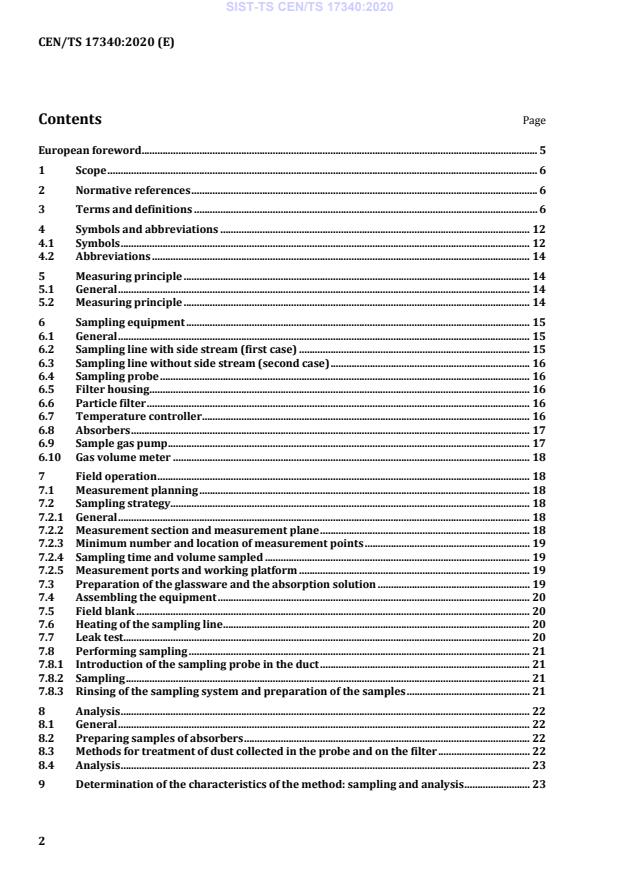
Contents Page
European foreword . 5
1 Scope . 6
2 Normative references . 6
3 Terms and definitions . 6
4 Symbols and abbreviations . 12
4.1 Symbols . 12
4.2 Abbreviations . 14
5 Measuring principle . 14
5.1 General . 14
5.2 Measuring principle . 14
6 Sampling equipment . 15
6.1 General . 15
6.2 Sampling line with side stream (first case) . 15
6.3 Sampling line without side stream (second case) . 16
6.4 Sampling probe . 16
6.5 Filter housing . 16
6.6 Particle filter . 16
6.7 Temperature controller . 16
6.8 Absorbers . 17
6.9 Sample gas pump . 17
6.10 Gas volume meter . 18
7 Field operation . 18
7.1 Measurement planning . 18
7.2 Sampling strategy. 18
7.2.1 General . 18
7.2.2 Measurement section and measurement plane . 18
7.2.3 Minimum number and location of measurement points . 19
7.2.4 Sampling time and volume sampled . 19
7.2.5 Measurement ports and working platform . 19
7.3 Preparation of the glassware and the absorption solution . 19
7.4 Assembling the equipment . 20
7.5 Field blank . 20
7.6 Heating of the sampling line . 20
7.7 Leak test. 20
7.8 Performing sampling . 21
7.8.1 Introduction of the sampling probe in the duct . 21
7.8.2 Sampling . 21
7.8.3 Rinsing of the sampling system and preparation of the samples . 21
8 Analysis . 22
8.1 General . 22
8.2 Preparing samples of absorbers . 22
8.3 Methods for treatment of dust collected in the probe and on the filter . 22
8.4 Analysis . 23
9 Determination of the characteristics of the method: sampling and analysis . 23
9.1 General . 23
9.2 Performance characteristics for the method and applicable performance criteria . 23
9.2.1 General . 23
9.2.2 Sampling procedure . 24
9.2.3 Analysis procedure . 24
9.2.4 Performance criterion of analysis . 25
9.3 Establishment of the uncertainty budget . 26
10 Expression of results . 27
10.1 Volume of dry sampled gas . 27
10.1.1 General . 27
10.1.2 For the main line (bound to particulate fluorides) . 27
10.1.3 For the secondary line (gaseous Fluorides) . 27
10.2 Calculation of HF concentration on dry gas basis . 28
10.3 Expression of results on wet gas basis under standard conditions . 28
10.4 Expression of results with respect to a reference O content . 28
11 Test report . 29
Annex A (informative) Types of sampling devices . 30
Annex B (normative) Treatment of filters method (first case) . 31
B.1 Filter treatment with sodium carbonate . 31
B.2 Modus operandi in case of presence of elements sequestering fluorides . 31
B.3 Alkaline attack . 31
B.4 Pyrohydrolysis . 31
Annex C (normative) Description of the three analytical techniques for the determination
of HF . 34
C.1 Matrix interferences . 34
C.2 Ionometry . 34
C.3 Spectrophotometry . 36
C.4 Ion chromatography . 39
C.5 Equipment . 40
C.6 Operating procedure . 41
C.7 Expression of the results . 42
Annex D (informative) Example of evaluation of compliance of the reference method for HF
with emission measurement requirements – First case: the measurand is the
concentration of hydrofluoric acid and gaseous and bound to particulates fluorides . 43
D.1 Uncertainty estimation process . 43
D.2 Site specific conditions . 44
D.3 Performance characteristics of the method. 45
D.4 Calculation of standard uncertainty of the measured concentration . 47
Annex E (informative) Example of evaluation of compliance of the reference method for HF
with emission measurement requirements - Second case: the measurand is the
concentration of hydrofluoric acid and gaseous fluorides . 55
E.1 Uncertainty estimation process . 55
E.2 Specific conditions in the field. 56
E.3 Performance characteristics of the method . 56
E.4 Calculation of standard uncertainty of concentration measured. 57
E.5 Calculation of the overall (or expanded) uncertainty . 60
E.6 Uncertainty associated to the mass concentration of gaseous fluorides at O
reference concentration . 60
Annex F (normative) Determination of water vapour concentration for water saturated
gas, at p = 101,325 kPa . 62
std
Annex G (informative) Calculation of the uncertainty associated with a concentration
expressed on dry gas and at an oxygen reference concentration . 66
G.1 Uncertainty associated with a concentration expressed on dry gas . 66
G.2 Uncertainty associated with a concentration expressed at an oxygen reference
concentration . 68
Bibliography . 71
European foreword
This document (CEN/TS 17340:2020) has been prepared by Technical Committee CEN/TC 264
“Stationary source emissions”, the secretariat of which is held by DIN.
Attention is drawn to the possibility that some of the elements of this document may be the subject of
patent rights. CEN shall not be held responsible for identifying any or all such patent rights.
According to the CEN/CENELEC Internal Regulations, the national standards organisations of the
following countries are bound to announce this Technical Specification: Austria, Belgium, Bulgaria,
Croatia, Cyprus, Czech Republic, Denmark, Estonia, Finland, France, Germany, Greece, Hungary, Iceland,
Ireland, Italy, Latvia, Lithuania, Luxembourg, Malta, Netherlands, Norway, Poland, Portugal, Republic of
North Macedonia, Romania, Serbia, Slovakia, Slovenia, Spain, Sweden, Switzerland, Turkey and the United
Kingdom.
1 Scope
This document specifies a manual method for the determination of the concentration of fluorinated
compounds expressed in HF. Two cases are presented:
— first case: the measurand is the concentration of gaseous and bound to particulates fluorides;
— second case: the measurand is the concentration of gaseous fluorides.
Three analytical techniques are proposed: ionometry, spectrophotometry and ion-exchange
chromatography.
This document specifies the performance characteristics to be determined and the performance criteria
to be fulfilled when it is used as the Standard Reference Method (SRM) for periodic monitoring and for
calibration or control of Automated Measuring Systems (AMS) permanently installed on a stack, for
regulatory or other purposes.
This document applies to fluoride concentrations which may vary between 0,1 mg HF/m and 10 mg
HF/m , at standard conditions of pressure and temperature (see NOTE). The limit of quantification of the
3 3
method is estimated at 0,1 mg/m for a sampled volume of 0,1 m .
Interference may occur for some matrices. Known elements that may lead to interference are mentioned
in Annex C.
NOTE The Emission Limit Values (ELV) for HF are expressed in mg/m , for dry gases at the standard conditions
(Tstd = 273 K and Pstd = 101,3 kPa).
2 Normative references
The following documents are referred to in the text in such a way that some or all of their content
constitutes requirements of this document. For dated references, only the edition cited applies. For
undated references, the latest edition of the referenced document (including any amendments) applies.
EN 13284-1, Stationary source emissions - Determination of low range mass concentration of dust - Part 1:
Manual gravimetric method
EN 15259, Air quality - Measurement of stationary source emissions - Requirements for measurement
sections and sites and for the measurement objective, plan and report
EN ISO 10304-1, Water quality - Determination of dissolved anions by liquid chromatography of ions - Part
1: Determination of bromide, chloride, fluoride, nitrate, nitrite, phosphate and sulfate (ISO 10304-1)
ISO/IEC Guide 98-3, Uncertainty of measurement — Part 3: Guide to the expression of uncertainty in
measurement (GUM:1995)
3 Terms and definitions
For the purposes of this document, the following terms and definitions apply.
ISO and IEC maintain terminological databases for use in standardization at the following addresses:
— ISO Online browsing platform: available at http://www.iso.org/obp
— IEC Electropedia: available at http://www.electropedia.org/
3.1
absorber
device in which the compound to be trapped is absorbed into the absorption solution
3.2
absorption efficiency
ε
ratio in % of quantity of the collected analyte q (for two absorbers) or q + q (for three absorbers)
1 1 2
divided by the quantity of the analyte collected in the series of absorbers
— ε = (q / (q + q )) × 100 % for 2 absorbers;
1 1 2
— or ε = ((q + q )/ (q + q + q )) × 100 %, in the case of 3 absorbers.
1 2 1 2 3
3.3
alternative method
AM
measurement method which complies with the criteria given by this document with respect to the
reference method
Note 1 to entry: An alternative method can consist of a simplification of the reference method.
[SOURCE: EN 14793:2017]
3.4
analytical repeatability in the laboratory
closeness of the agreement between the results of successive measurements of the same measurand
carried out under the same conditions of measurement
Note 1 to entry: Repeatability conditions include:
— the same measurement procedure;
— the same laboratory;
— the same measuring instrument, used under the same conditions;
— the same location;
— repetition over a short period of time.
Note 2 to entry: Repeatability may be expressed quantitatively in terms of the dispersion characteristics of the
results. In this document, repeatability is expressed as a repeatability standard deviation with a level of confidence
of 95 %.
3.5
automated measuring system
AMS
entirety of all measuring instruments and additional devices for obtaining a result of measurement
Note 1 to entry: Apart from the actual measuring device (the analyser), an AMS includes facilities for taking
samples (e.g. probe, sample gas lines, flow meters and regulator, delivery pump) and for sample conditioning (e.g.
dust filter, pre-separator for interferents, cooler, converter). This definition also includes testing and adjusting
devices that are required for functional checks and, if applicable, for commissioning.
Note 2 to entry: The term “automated measuring system” (AMS) is typically used in Europe. The term
“continuous emission monitoring system” (CEMS) is also typically used in the UK and USA.
[SOURCE: EN 15267-4:2017]
3.6
calibration
set of operations that establish, under specified conditions, the relationship between values of quantities
indicated by a measuring method or measuring system, and the corresponding values given by the
applicable reference
Note 1 to entry: In case of automated measuring systems (AMS) permanently installed on a stack the applicable
reference is the standard reference method (SRM) used to establish the calibration function of the AMS.
Note 2 to entry: In case of manual methods the applicable reference can be reference materials used as calibration
standards to establish the relationship between the output signal of the analytical device and the reference values.
Note 3 to entry: Calibration should not be confused with adjustment of a measuring system.
3.7
emission limit value
ELV
emission limit value according to regulations on the basis of 30 min, 1 hour or 1 day
3.8
field blank procedure
procedure used to ensure that no significant contamination has occurred during all the steps of the
measurement
Note 1 to entry: This includes for instance the equipment preparation in laboratory, its transport and installation
in the field as well as the subsequent analytical work in the laboratory.
[SOURCE: EN 13284-1:2017]
3.9
field blank value
value determined by a specific procedure used to ensure that no significant contamination has occurred
during all the measurement steps and to verify that the operator can reach a level of quantification
suitable for the measurement
3.10
fluorinated compounds
— particulate: particle-bound fluorides present on the filter and analysed according to one of the
methods described in Annex C
— gaseous: fluorinated compounds not retained by the filter and trapped in the absorbers
— Total: sum of gaseous and bound to particulates fluorides
3.11
limit of detection
L
D
concentration value of the measurand below which there is at least 95 % level of confidence that the
measured value corresponds to a sample free of that measurand
3.12
limit of quantification
L
Q
lowest amount of an analyte that is quantifiable with a given confidence level
Note 1 to entry: For a manual method the limit of quantification is usually calculated as ten times the standard
deviation of field blank measurements. If the blank is not negligible then the L is added to ten times the standard
Q
deviation. This corresponds to a confidence level of 95 %.
3.13
measurand
particular quantity subject to measurement
Note 1 to entry: The measurand is a quantifiable property of the stack gas under test, for example mass
concentration of a measured component, temperature, velocity, mass flow, oxygen content and water vapour
content.
[SOURCE: EN 15259:2007]
3.14
measurement line
line in the measurement plane along which the measurement points are located, bounded by the inner
duct wall
[SOURCE: EN 15259:2007]
3.15
measurement plane
plane normal to the centreline of the duct at the sampling position
Note 1 to entry: Measurement plane is also known as sampling plane.
[SOURCE: EN 15259:2007]
3.16
measurement point
specific position on a measurement plane at which a sample is extracted
3.17
measurement port
opening in the waste gas duct along the measurement line, through which access to the waste gas is
gained
Note 1 to entry: Measurement port is also known as sampling port or access port.
[SOURCE: EN 15259:2007]
3.18
measurement series
several successive measurements carried out on the same measurement plane and at the same process
operating conditions
[SOURCE: EN 13284-1]
3.19
measurement site
place on the waste gas duct in the area of the measurement plane(s) consisting of structures and technical
equipment, for example working platforms, measurement ports, energy supply
Note 1 to entry: Measurement site is also known as sampling site.
[SOURCE: EN 15259:2007]
3.20
measuring system
set of one or more measuring instruments and often other devices, including any reagent and supply,
assembled and adapted to give information used to generate measured quantity values within specified
intervals for quantities of specified kinds
[SOURCE: JCGM 200:2012]
3.21
performance characteristic
one of the quantities (described by values, tolerances, range) assigned to equipment in order to define its
performance
3.22
reference method
RM
measurement method taken as a reference by convention, which gives the accepted reference value of
the measurand
Note 1 to entry: A reference method is fully described.
Note 2 to entry: A reference method can be a manual or an automated method.
Note 3 to entry: Alternative methods can be used if equivalence to the reference method has been demonstrated.
[SOURCE: EN 15259:2007]
3.23
repeatability of the measurement method in the field
closeness of the agreement between the results of simultaneous measurements of the same measurand
carried out with two sets of equipment meeting the performance criteria set out in the document under
the same conditions of measurement
Note 1 to entry: These conditions include:
— the same measurement procedure;
— two sets of equipment, the performance of which fulfils the requirements of the reference method,
used under the same conditions
— the same location;
— implemented by the same laboratory;
— typically calculated on short periods of time in order to avoid the effect of changes of influence
parameters (e.g. 30 min).
Note 2 to entry: Repeatability may be expressed quantitatively in terms of the dispersion characteristics of the
results.
3.24
reproducibility of the measurement method in the field
closeness of the agreement between the results of simultaneous measurements of the same measurand,
carried out with several sets of equipment under the same conditions of measurement
Note 1 to entry: These conditions are called “field reproducibility conditions” and include:
— the same measurement procedure;
— several sets of equipment, the performance of which fulfils the requirements of the reference method,
used under the same conditions;
— the same location;
— measurements carried out by several laboratories.
Note 2 to entry: Reproducibility may be expressed quantitatively in terms of the dispersion characteristics of the
results.
3.25
standard reference method
SRM
reference method prescribed by European or national legislation
3.26
uncertainty
parameter associated with the result of a measurement, that characterises the dispersion of the values
that could reasonably be attributed to the measurand
[SOURCE: ISO/IEC Guide 98-3]
3.27
standard uncertainty
u
uncertainty of the result of a measurement expressed as a standard deviation
3.28
combined uncertainty
u
c
standard uncertainty attached to the measurement result calculated by combination of several standard
uncertainties according to the principles laid down in ISO/IEC Guide 98-3 (GUM)
3.29
expanded uncertainty
U
quantity defining a level of confidence about the result of a measurement that may be expected to
encompass a specific fraction of the distribution of values that could reasonably be attributed to a
measurand
U ku×
Note 1 to entry: In this document, the expanded uncertainty is calculated with a coverage factor of k = 2, and with
a level of confidence of 95 %.
Note 2 to entry: The expression overall uncertainty is sometimes used to express the expanded uncertainty.
4 Symbols and abbreviations
4.1 Symbols
C mass concentration of hydrofluoric acid in the gas sample, in milligrams per cubic metre (of
m
gas)
lC repeatability confidence interval, in milligrams per cubic metre
r
lC reproducibility confidence interval, in milligrams per cubic metre
R
L limit of quantification, in milligrams per litre of F
Q
m weight of the sample solution (absorption solution used for sampling + rinsing solution), in
s
grams
=
P pressure at the gas volume meter, in kilopascals
m
P standard pressure (101,3 kPa)
std
P saturation vapour pressure of water at gas volume meter temperature, in kilopascals
sat
(Tm)
q mass concentration of fluoride in sample absorption solution, in milligrams per litre (of
s
solution)
q mass concentration of fluoride in chemical blank solution, in milligrams per litre (of solution)
cb
r repeatability, in milligrams per cubic metre or percentage
R reproducibility, in milligrams per cubic metre or percentage
R volume of titration solution used for titration of sample absorption solution, in millilitres
s
S volume of titration solution used for titration of chemical blank solution, in millilitres
cb
S repeatability standard deviation, in milligrams per cubic metre or percentage
r
S reproducibility standard deviation, in milligrams per cubic metre or percentage
R
S volume of titration solution used for the titration of the aliquot of the pre-treated sample
s
solution, in millilitres
t retention time of the first peak, in seconds
t retention time of the second peak, in seconds
T temperature at the gas meter, in Kelvin
j
T mean temperature at the gas volume meter, in Kelvin
m
T standard temperature (273 K)
std
V reading at the gas volume meter at the beginning of the sampling period, in cubic metres
V reading of gas volume meter, at the end of the sampling period, in cubic metres
V dry gas volume measured, corrected to standard conditions, in cubic metres
m
(std)
V volume of the sample solution (absorption solution used for sampling + rinsing solution), in
s
litres
w peak width on the time axis, of the first peak, in seconds
w peak width on the time axis, of the second peak, in seconds
ε absorption efficiency, in percentage
σ conductivity, in micro-siemens per metre
density of a liquid at 20 °C compared to that of water at 4 °C, in kilograms per litre volume
ρ
content, in percentage
4.2 Abbreviations
PE polyethylene
PTFE polytetrafluoroethylene
PVC polyvinylchloride
5 Measuring principle
5.1 General
The specific components and requirements of the measurement system are described in the remainder
of this document. When this method is used as an SRM, minimum performance characteristics with
associated performance criteria, specified for the measurement system in Table 1 concerning sampling
and in Table 2 concerning analysis (in 8.2.2 and 8.2.4) have to be achieved. The expanded uncertainty of
the method shall meet the specifications given in 8.1.
5.2 Measuring principle
This document describes a method for determining the concentration of fluorides.
Two cases are presented:
— first case: the measurand is the concentration of gaseous and bound to particulates fluorides;
— second case: the measurand is the concentration of gaseous fluorides.
In the first case, the sample is taken in accordance with the EN 15259. The sample is collected
isokinetically, the particulate fraction being collected on a plane filter maintained at least at 20 °C above
the dew point.
The gaseous fraction is trapped by absorption into an absorption solution and the particulate fraction is
collected on a filter. The sampling devices are illustrated in Annex A.
WARNING Due to the high reactivity of HF, with certain materials and particles collected on the filter
(desorption occurs only from 400 °C), the determination of HF and fluorinated gaseous compounds only
may lead to underestimate the concentration present in the stack. Special precautions are therefore taken
during sampling (materials, temperature, line rinsing) which, however, do not completely eliminate the
phenomenon. As a result, the distribution between the gaseous fraction and particulate fraction of
fluorinated compounds as it appears from the results given by the measurement method may not match
what is in the duct; this distribution is conventional in nature when the dust accumulation is significant
and/or with highly reactive dust (aluminium manufacturing industry, for example).
This document proposes the following three analytical techniques:
— ionometry (method recommended for a concentration ≥ 0,4 mg/l);
the fluoride ion concentration of a solution is calculated by applying the law of Nernst, based on
potentials measured by a specific fluoride ion electrode placed successively in the sample solution,
with a first known addition of fluoride in the same solution and then with a second known addition
of fluoride.
— spectrophotometry (method recommended for a concentration ≥ 0,3 mg/l);
in acetone medium, the fluoride ion forms a coloured complex in the presence of the lanthanum-
alizarin complexone reagent. The fluoride ion content is determined by spectrophotometric
measurement at 620 nm by comparison with synthetic fluoride solutions of known content.
— ion chromatography (method recommended for a concentration ≥ 0,1 mg/l).
Ion chromatography: this method is based on the separation of anions by ion exchange and
conductivity detection after post-column reaction (ion exchange) for highly conductive eluents. The
process of separating anions between the eluting mobile phase and the stationary phase comprising
ion exchange groups is based on the difference in affinity of the exchanger for the solute.
The analytical equipment and instruments for each of these methods are described in Annex C.
When the laboratory wishes to determine the contents of gaseous chlorides and gaseous fluorides jointly,
the laboratory can use water as an absorption solution or a series of two or three absorbers must be used:
the first containing demineralized water, the second (and the third, if necessary) containing one of the
absorption solution proposed for HF. Gaseous fluorine is then determined by analysing separately the
fluorine contained in each absorber. The number of absorbers must be selected to fulfil the absorption
efficiency required by this Technical Specification and EN 1911.
6 Sampling equipment
6.1 General
A known volume of flue gas is extracted representatively from a duct or a chimney during a certain period
of time at a controlled flow rate. A filter removes the dust in the sampled volume, thereafter the gas
stream is passed through a series of absorbers containing an absorption solution.
The materials used may be PTFE, borosilicate glass or quartz or any other material for which it has been
proven that it does not absorb or react with the components present in the sample gas at the temperature
in question.
The measurement may be performed according to the following two cases presented in 6.2 and 6.3:
If the amount of fluorides in particles in the sample is considered to be less than 10 % (based on previous
data) of the total fluorides (particles + gas), then the filter may be omitted, provided the uncertainty of
measurement remains below the maximum required level. In this case, choose the procedure described
for the second case
6.2 Sampling line with side stream (first case)
The main sampling line shall comply with that described in EN 13284-1. To this main line is added a
secondary line through which an aliquot of the sample gases circulates. Gaseous fluorides are trapped in
a series of two absorbers containing an absorption solution. The connection between the main line and
the secondary line is maintained at a temperature so as to prevent condensation. The line linking the
connection to the first absorber shall be maintained at above the acid dew point or shall be rinsed
thoroughly using the absorption solution. The rinsing product is added to the sample solution from the
first absorber.
The flow rate in the secondary line, shall be selected so as to maintain the required absorption efficiency.
6.3 Sampling line without side stream (second case)
Sampling without secondary line (sampling without side stream) may be used if the operator has a
sampling system used only for determining gaseous fluorides or the combination of gaseous chlorides
and fluorides.
6.4 Sampling probe
In order to reach the measurement points of the measurement plane, probes of different lengths and
inner diameters may be used. The design and configuration of the probe used shall ensure the residence
time of the sample gas within the probe is minimized in order to reduce the response time of the
measuring system.
When droplets are present in the flue gases, they may contain fluorinated compounds dissolved in it. In
that case, the probe is equipped with a nozzle and an isokinetic sampling shall be performed according
to EN 13284-1.
NOTE The probe can be marked before sampling in order to demonstrate that the measurement points in the
measurement plane have been reached.
6.5 Filter housing
The filter housing may be located either:
— in the duct or chimney, mounted directly behind the entry nozzle (in-stack filtration); or
— outside the duct or chimney, mounted directly behind the suction tube (out-stack filtration).
If condensation is liable to occur in the sampling probe or in the filter housing, then a heated out-stack
filter housing shall be used. For out-stack filtration, the filter housing shall be heated at a controlled
temperature of 20 °C above the acid dew point. It shall be connected to the probe without any cold path
between the two.
Filter housings of different designs may be used, but the residence time of the sample gas shall be
minimized.
The filter housing shall have the possibility to be jointed with the probe thereby avoiding leaks.
NOTE A stop valve after the filter housing can be useful to prevent back flush of absorption solution into the
probe or into the filter when sampling in flue gases under unfavourable conditions (e.g. high depression in the duct).
In special cases where the sample gas temperature is greater than 200 °C, the heating jacket around the
sampling probe, filter housing and connector line may be switched off. However, the temperature in the
sampled gas just after the filter housing should not fall below the required temperature.
6.6 Particle filter
The filter shall have an efficiency of more than 99,5 % on a test aerosol with a mean particle diameter of
0,3 μm, at the maximum flow rate anticipated, (or 99,9 % on a test aerosol of 0,6 μm mean diameter).
With the alkaline extraction method, it appears that the extraction of fluorides is much more efficient in
PTFE filters than in glass fibre filters and to a lesser extent in quartz filters. Glass fibre filters shall be
avoided, because glass fibre filters can react with hydrogen fluorides.
Do not use a filter holder that reacts with fluorides.
6.7 Temperature controller
A temperature controller is required for the filter housing. It shall be capable of controlling temperature
with an uncertainty of 2,5 K or better.
6.8 Absorbers
The line joining the main line connection and the first absorber shall be as short as possible and shall be
made of PTFE, borosilicate glass, quartz, PVC or PE.
The two absorbers shall be arranged in series. They are made of PTFE or polymethylmethacrylate, PE or
any other compatible plastic material. Borosilicate glass may also be used on condition that after the test,
the content of the absorber is transferred to a plastic container.
Downstream of these absorbers, an extra empty absorber may be used as a protection for the
downstream equipment.
The absorption efficiency shall be higher than 95 % or the concentration measured in the last absorber
shall be lower than the limit of quantification. This efficiency shall be checked at least every day of
monitoring. Except when the absorption efficiency shall be checked, the solutions from the absorbers
may be combined and analysed together.
In order to test absorption efficiency:
— Place a suitable volume of absorption solution into each of the absorbers, where the first absorber is
...