

CEN/TS 15447:2006
(Main)Mounting and fixing in reaction to fire tests under the Construction Products Directive
- Abstract
This guidance document is intended to provide basic rules, which are generally valid for the mounting & fixing of construction products in the reaction to fire test standards EN 13823, EN ISO 9239-1 and EN ISO 11925-2 which are referred to in the classification standard EN 13501-1. The mounting & fixing rules are intended to ensure that the reaction to fire test results in these tests are representative of the product behaviour in one or more end-use applications when exposed to a fire in the relevant fire scenario.
This document contains for each of the test methods the compulsory rules (given in EN 13501-1, EN 13238 and the relevant test standard) and recommendations for groups or (sub)families of products.
- Status
- Published
- Publication Date
- 04-Jul-2006
- Technical Committee
- CEN/TC 127 - Fire safety in buildings
- Drafting Committee
- CEN/TC 127/WG 4 - Reaction to fire
- Current Stage
- 9093 - Decision to confirm - Review Enquiry
- Start Date
- 20-Jul-2009
- Completion Date
- 20-Jul-2009

Overview
CEN/TS 15447:2006 - "Mounting and fixing in reaction to fire tests under the Construction Products Directive" - is a CEN Technical Specification that provides guidance on how construction products should be mounted, fixed and configured when tested for reaction to fire. Its purpose is to ensure that laboratory test results (EN 13823, EN ISO 9239-1, EN ISO 11925-2) are representative of product behaviour in real end‑use applications, and to reduce unnecessary repeat testing by defining standardised mounting and fixing rules.
Key topics and technical requirements
This Technical Specification covers the compulsory rules and additional recommendations relevant to reaction-to-fire testing and classification:
- Scope and purpose: guidance for mounting & fixing to support classification under EN 13501-1 and the Construction Products Directive (CPD).
- Normative references: links to EN 13823, EN ISO 9239-1, EN ISO 11925-2, EN 13238, EN 13501-1, and related material standards.
- Terms and definitions: clarifies terms such as end-use application, direct/extended field of application, conditioning, backing board, etc.
- General approach: principles to ensure test configurations represent end-use conditions and to determine when a classification is or isn’t representative.
- Test-specific mounting & fixing rules: detailed guidance for each test method, including:
- specimen preparation and mounting
- fixings, attachments and supports
- substrate selection and conditioning
- air gaps/cavities, edges and joints
- product orientation and exposure to thermal attack
- product-specific recommendations and families of products
- Direct and extended field of application: rules to determine which end‑use applications a given test result may cover.
Practical applications and users
CEN/TS 15447 is intended for stakeholders involved in reaction-to-fire assessment, including:
- Standards developers and product technical committees - to incorporate standardised mounting/fixing arrangements into product standards.
- Test laboratories and certification bodies - to configure specimens consistently and justify the field of application of test results.
- Manufacturers and product designers - to plan representative testing strategies and reduce the number of required tests for CE marking.
- Fire safety engineers and specifiers - to interpret test reports relative to end‑use installation conditions.
Practical benefits include more consistent test outcomes, clearer linkage between laboratory tests and real installations, and potential reduction in testing scope through standardised mounting arrangements.
Related standards (key references)
- EN 13501-1 (classification using reaction-to-fire data)
- EN 13823 (SBI test)
- EN ISO 9239-1 (flooring radiant heat test)
- EN ISO 11925-2 (single-flame ignitability)
- EN 13238 (substrate selection and conditioning)
- EN ISO 1182, EN ISO 1716 (material characteristics)
Relations
- Effective Date
- 28-Jan-2026
- Effective Date
- 28-Jan-2026
- Effective Date
- 28-Jan-2026
- Effective Date
- 28-Jan-2026
- Effective Date
- 28-Jan-2026
- Effective Date
- 28-Jan-2026
- Effective Date
- 28-Jan-2026
Get Certified
Connect with accredited certification bodies for this standard

CIS Institut d.o.o.
Personal Protective Equipment (PPE) certification body. Notified Body NB-2890 for EU Regulation 2016/425 PPE.

Kiwa BDA Testing
Building and construction product certification.
Kmetijski inštitut Slovenije
Agricultural Institute of Slovenia. Soil testing, plant health, agricultural product analysis.
Sponsored listings
Frequently Asked Questions
CEN/TS 15447:2006 is a technical specification published by the European Committee for Standardization (CEN). Its full title is "Mounting and fixing in reaction to fire tests under the Construction Products Directive". This standard covers: This guidance document is intended to provide basic rules, which are generally valid for the mounting & fixing of construction products in the reaction to fire test standards EN 13823, EN ISO 9239-1 and EN ISO 11925-2 which are referred to in the classification standard EN 13501-1. The mounting & fixing rules are intended to ensure that the reaction to fire test results in these tests are representative of the product behaviour in one or more end-use applications when exposed to a fire in the relevant fire scenario. This document contains for each of the test methods the compulsory rules (given in EN 13501-1, EN 13238 and the relevant test standard) and recommendations for groups or (sub)families of products.
This guidance document is intended to provide basic rules, which are generally valid for the mounting & fixing of construction products in the reaction to fire test standards EN 13823, EN ISO 9239-1 and EN ISO 11925-2 which are referred to in the classification standard EN 13501-1. The mounting & fixing rules are intended to ensure that the reaction to fire test results in these tests are representative of the product behaviour in one or more end-use applications when exposed to a fire in the relevant fire scenario. This document contains for each of the test methods the compulsory rules (given in EN 13501-1, EN 13238 and the relevant test standard) and recommendations for groups or (sub)families of products.
CEN/TS 15447:2006 is classified under the following ICS (International Classification for Standards) categories: 13.220.50 - Fire-resistance of building materials and elements. The ICS classification helps identify the subject area and facilitates finding related standards.
CEN/TS 15447:2006 has the following relationships with other standards: It is inter standard links to EN 13238:2001, EN 13501-1:2018, EN 13823:2020+A1:2022, EN ISO 11925-2:2002, EN ISO 9239-1:2002, EN 14041:2018, EN 15725:2010. Understanding these relationships helps ensure you are using the most current and applicable version of the standard.
CEN/TS 15447:2006 is associated with the following European legislation: EU Directives/Regulations: 305/2011, 89/106/EEC. When a standard is cited in the Official Journal of the European Union, products manufactured in conformity with it benefit from a presumption of conformity with the essential requirements of the corresponding EU directive or regulation.
CEN/TS 15447:2006 is available in PDF format for immediate download after purchase. The document can be added to your cart and obtained through the secure checkout process. Digital delivery ensures instant access to the complete standard document.
Standards Content (Sample)
SLOVENSKI STANDARD
01-oktober-2006
Vgradnja in pritrjevanje pri preskusih odziva proizvodov na ogenj v okviru
Direktive o gradbenih proizvodih
Mounting and fixing in reaction to fire tests under the Construction Products Directive
Einbau und Besfestigung bei Prüfungen zum Brandverhalten von Bauprodukten, die
unter die Bauproduktenrichtlinie fallen
Montage et fixation en réaction a des essais au feu dans le cadre de la DPC
Ta slovenski standard je istoveten z: CEN/TS 15447:2006
ICS:
13.220.50 Požarna odpornost Fire-resistance of building
gradbenih materialov in materials and elements
elementov
2003-01.Slovenski inštitut za standardizacijo. Razmnoževanje celote ali delov tega standarda ni dovoljeno.
TECHNICAL SPECIFICATION
CEN/TS 15447
SPÉCIFICATION TECHNIQUE
TECHNISCHE SPEZIFIKATION
July 2006
ICS 13.220.50
English Version
Mounting and fixing in reaction to fire tests under the
Construction Products Directive
Montage et fixation en réaction à des essais au feu dans le Einbau und Besfestigung bei Prüfungen zum
cadre de la DPC Brandverhalten von Bauprodukten, die unter die
Bauproduktenrichtlinie fallen
This Technical Specification (CEN/TS) was approved by CEN on 20 May 2006 for provisional application.
The period of validity of this CEN/TS is limited initially to three years. After two years the members of CEN will be requested to submit their
comments, particularly on the question whether the CEN/TS can be converted into a European Standard.
CEN members are required to announce the existence of this CEN/TS in the same way as for an EN and to make the CEN/TS available
promptly at national level in an appropriate form. It is permissible to keep conflicting national standards in force (in parallel to the CEN/TS)
until the final decision about the possible conversion of the CEN/TS into an EN is reached.
CEN members are the national standards bodies of Austria, Belgium, Cyprus, Czech Republic, Denmark, Estonia, Finland, France,
Germany, Greece, Hungary, Iceland, Ireland, Italy, Latvia, Lithuania, Luxembourg, Malta, Netherlands, Norway, Poland, Portugal, Romania,
Slovakia, Slovenia, Spain, Sweden, Switzerland and United Kingdom.
EUROPEAN COMMITTEE FOR STANDARDIZATION
COMITÉ EUROPÉEN DE NORMALISATION
EUROPÄISCHES KOMITEE FÜR NORMUNG
Management Centre: rue de Stassart, 36 B-1050 Brussels
© 2006 CEN All rights of exploitation in any form and by any means reserved Ref. No. CEN/TS 15447:2006: E
worldwide for CEN national Members.
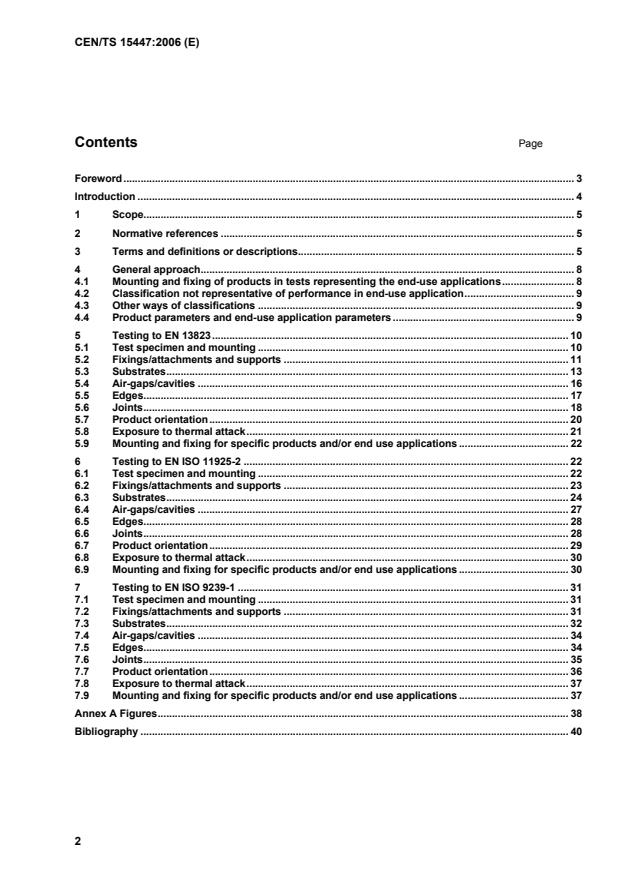
Contents Page
Foreword. 3
Introduction . 4
1 Scope. 5
2 Normative references . 5
3 Terms and definitions or descriptions. 5
4 General approach. 8
4.1 Mounting and fixing of products in tests representing the end-use applications. 8
4.2 Classification not representative of performance in end-use application. 9
4.3 Other ways of classifications . 9
4.4 Product parameters and end-use application parameters . 9
5 Testing to EN 13823. 10
5.1 Test specimen and mounting . 10
5.2 Fixings/attachments and supports . 11
5.3 Substrates. 13
5.4 Air-gaps/cavities . 16
5.5 Edges. 17
5.6 Joints. 18
5.7 Product orientation. 20
5.8 Exposure to thermal attack. 21
5.9 Mounting and fixing for specific products and/or end use applications . 22
6 Testing to EN ISO 11925-2 . 22
6.1 Test specimen and mounting . 22
6.2 Fixings/attachments and supports . 23
6.3 Substrates. 24
6.4 Air-gaps/cavities . 27
6.5 Edges. 28
6.6 Joints. 28
6.7 Product orientation. 29
6.8 Exposure to thermal attack. 30
6.9 Mounting and fixing for specific products and/or end use applications . 30
7 Testing to EN ISO 9239-1 . 31
7.1 Test specimen and mounting . 31
7.2 Fixings/attachments and supports . 31
7.3 Substrates. 32
7.4 Air-gaps/cavities . 34
7.5 Edges. 34
7.6 Joints. 35
7.7 Product orientation. 36
7.8 Exposure to thermal attack. 37
7.9 Mounting and fixing for specific products and/or end use applications . 37
Annex A Figures. 38
Bibliography . 40
Foreword
This Technical Specification (CEN/TS 15447:2006) has been prepared by Technical Committee
CEN/TC 127 “Fire safety in buildings”, the secretariat of which is held by BSI.
This Technical Specification has been prepared by ad hoc working group 40 (“Mounting and fixing in
reaction to fire tests”) of Technical Committee CEN/TC 127 (“Fire safety in buildings”).
This document has been prepared on request of the CEC as support for CEN Technical Committees
involved in the production of technical specifications under the Construction Products Directive (CPD).
According to the CEN/CENELEC Internal Regulations, the national standards organizations of the
following countries are bound to announce this CEN Technical Specification: Austria, Belgium, Cyprus,
Czech Republic, Denmark, Estonia, Finland, France, Germany, Greece, Hungary, Iceland, Ireland,
Italy, Latvia, Lithuania, Luxembourg, Malta, Netherlands, Norway, Poland, Portugal, Romania,
Slovakia, Slovenia, Spain, Sweden, Switzerland and United Kingdom.
Introduction
The Essential Requirements of the CPD apply to the construction works. Interpretative documents
have been produced to form a link between the Essential Requirements and the performance
characteristics of construction products incorporated in a permanent manner in construction works, i.e.
in end-use application . The Essential Requirement concerned in this document is “Safety in case of
fire”, and from that requirement the reaction to fire performance of construction products only is
considered.
Technical specifications under the CPD, such as product standards, deal with construction products
and their reaction to fire performance. For the assessment of reaction to fire performance the
technical specifications use a set of supporting fire standards through reference to the classification
standard EN 13501-1.
Five reaction to fire test methods have been developed for the purpose of testing construction
products, including products incorporated within building elements. The procedure for classification is
outlined in EN 13501-1 providing a choice of Euroclasses. Since EN ISO 1182 (“non-combustibility”)
and EN ISO 1716 (“gross calorific potential”) deal with material characteristics and are thus
independent of the end-use application of the product, the mounting and fixing instructions presented
apply to EN 13823, EN ISO 9239-1 and EN ISO 11925-2.
Technical specifications refer to EN 13501-1 for the assessment of reaction to fire performance. The
EN 13501-1 refers to the five supporting test standards for determination of the relevant parameters.
In principle a product standard should not refer directly to the test standards. However, where
EN 13501-1 and the test standards do not fully define the mounting and fixing of a product in a test,
the relevant product standard may add instructions to ensure that the test result is representative of
the product behaviour in one or more end-use applications when exposed to a fire in the relevant fire
scenario.
In the absence of standard mounting and fixing rules, a test result is only valid for the end-use
application that is represented by the mounting and fixing (and other test configuration aspects) used
in the test . As a consequence all other end-use applications have to be tested. EN 13501-1, test
standards and substrate standard EN 13238 contain some aspects of standardised mounting and
fixing, to some degree limiting the number of tests to be performed to classify a product, which can
lead to CE-marking. To limit the number of tests further, standardised mounting and fixing test
arrangements may be introduced in the technical specifications. This may reduce the number of m&f
test arrangements needed to cover all possible end-use applications to a few or even one.
A reaction to fire test method may in principle be used to assess the performance of (a) a material; (b)
a product (a combination of one or more materials) without taking into account the incorporation of the
product in the building; or (c) a product in its end-use application (i.e. taking into account the
incorporation of the product in the building).
This frame work should be used by technical specification writers to develop further specific rules for
product groups.
In some documents “end-use application” is used as a global indication of the use of the product (e.g. use as
wall lining or ceiling lining). The more detailed description of the way the product is incorporated in the building in
the (global) “end-use application” is then referred to as “end-use condition” (including e.g. jointing, fixing and
position in relation to adjacent products).
In this document the two terms are both covered by “end-use application”, in line with the definition given in EN
13501-1.
In this document “mounting and fixing” is often abbreviated as “m&f”.
When direct field of application rules are defined it should read “only valid for the direct field of application of
the test results”.
1 Scope
This guidance document is intended to provide basic rules, which are generally valid for the mounting
& fixing of construction products in the reaction to fire test standards EN 13823, EN ISO 9239-1 and
EN ISO 11925-2 which are referred to in the classification standard EN 13501-1. The mounting &
fixing rules are intended to ensure that the reaction to fire test results in these tests are representative
of the product behaviour in one or more end-use applications when exposed to a fire in the relevant
fire scenario.
This document contains for each of the test methods the compulsory rules (given in EN 13501-1,
EN 13238 and the relevant test standard) and recommendations for groups or (sub)families of
products.
2 Normative references
The following referenced documents are indispensable for the application of this document. For dated
references, only the edition cited applies. For undated references, the latest edition of the referenced
document (including any amendments) applies.
EN 13238:2001, Reaction to fire tests for building products — Conditioning procedures and general
rules for selection of substrates
EN 13501-1, Fire classification of construction products and building elements — Part 1: Classification
using test data from reaction to fire tests
EN 13823, Reaction to fire tests for building products — Building products excluding floorings
exposed to the thermal attack by a single burning item
EN ISO 9239-1:2002, Reaction to fire tests for floorings — Part 1: Determination of the burning
behaviour using a radiant heat source (ISO 9239-1:2002)
EN ISO 11925-2:2002, Reaction to fire tests — Ignitability of building products subjected to direct
impingement of flame — Part 2: Single-flame source test (ISO 11925-2:2002)
3 Terms and definitions or descriptions
For the purposes of this Technical Specification, the following terms and definitions apply.
NOTE Definitions and descriptions copied from other documents are marked as such with the reference
between brackets.
In this document, terms may not always be used consistent with all quoted documents since the quoted
documents are not always consistent between themselves. Where different wordings are used it is tried to follow
the document(s) highest in hierarchy.
3.1
backing board
calcium silicate panel used to back the specimen that can be placed directly against a free-standing
test specimen or at a distance from it. [EN 13823]
3.2
classification
the process defined in EN 13501, whereby the fire performance parameters obtained from the results
of one test, or a set of tests, or from a process of extended application, are compared with limiting
values for those parameters that are set as criteria for achieving a certain classification. The relevant
classes and related criteria for fire resistance, for reaction to fire and for external fire exposure to roofs,
are specified in Commission Decisions (2000/367/EC, 2000/147/EC and 2001/671/EC respectively).
[TC127 Resolution 331]
3.3
conditioning
exposure to a controlled atmosphere. [EN 13238]
3.4
direct field of application of test results
outcome of a process (involving the application of defined rules) whereby a test result is deemed to
be equally valid for variations in one or more of the product properties and/or intended end use
applications. [TC127 Resolution 331]
3.5
end-use application
real application of a product, in relation to all aspects that influence the behaviour of that product
under different fire situations. It covers aspects such as its quantity, its orientation, its position in
relation to other adjacent products, and its method of fixing. [EN 13501-1]
3.6
end-use application parameter
aspect of the mounting and fixing arrangement of a product in its end-use application (for example
type of substrate, fixing method, position and type of joints) which may or may not affect the fire
performance
3.7
extended field of application of test results
outcome of a process (involving the application of defined rules that may incorporate calculation
procedures) that predicts, for a variation of a product property and/or its intended end use
application(s), a test result on the basis of one or more test results to the same test standard. [TC127
Resolution 331]
3.8
homogeneous product
product consisting of a single material, having uniform density and composition throughout the
product [EN 13501-1]
3.9
intended use
refers to the role(s) that a product is intended to play in the fulfilment of the essential requirements of
the CPD (definition in the IDs). The intended use is thus related to the function of a product in a
construction works. [GP G]
3.10
field of application of a classification
refers to the range of end-use applications for which a given classification is considered to be valid.
[GP G]
3.11
fire scenario
detailed description of conditions, including environmental, of one or more stages from before ignition
to after completion of combustion at a specific location or in a real scale simulation [EN ISO 13943]
3.12
flooring
upper layer(s) of a floor, comprising any surface finish with or without an attached backing and with
any accompanying underlay, interlayer and adhesives. [EN 13501-1]
3.13
material
single basic substance or uniformly dispersed mixture of substances, e.g. metal, stone, timber,
concrete, mineral wool with uniformly dispersed binder or polymers [EN 13501-1]
3.14
product
material, element or component about which information is required. [EN 13501-1] Refers to a
construction product, as defined by the CPD, from an individual producer (i.e. the item to which the
CE marking applies). [GP G]
3.15
product family
refers to a set of generic products having a similar intended use (e.g. internal wall finishes, roof
coverings). [GP G]
3.16
product sub-family
refers to a subset of a product family, grouping together products having a similar nature (e.g. wall
panels, flat and profiled roof sheets) or behaviour (e.g. products that melt or shrink under flame
attack). [GP G]
3.17
product parameter
aspect of a product (for example thickness, composition, density) which may vary and which may or
may not affect the fire performance
3.18
product type
a “type” may cover several versions of a product provided that the differences between the versions
do not affect the level of safety and the other requirements concerning the performance of the product
(c.f. initial type test and EC type examination). The direct field of application of a fire test will
effectively define the type for fire safety purposes (e.g. products of a different colour will normally be
of the same type). [GP G]
3.19
standard substrate
product which is representative of the substrate used in end-use applications [EN 13501-1]
3.20
substrate
product which is used immediately beneath the product about which information is required. For
flooring, it is the floor on which it is mounted or the material which represents this floor. [EN 13501-1]
3.21
reaction to fire
response of a product in contributing by its own decomposition to a fire to which it is exposed, under
specified conditions [EN 13501-1]
3.22
reference scenario
hazard situation used as a reference for a given test method or classification system. [EN 13501-1]
3.23
specimen
piece of a product which is to be tested
NOTE 1 This can include the mounting technique used in its end-use application. This also can include an air
gap and/or a substrate where appropriate. [EN 13823].
NOTE 2 The term “specimen” in EN 13823 is identical to the term “test specimen” used in this document.
3.24
test result
outcome of a testing process and its associated procedures detailed within a specific test standard
(which may include some processing of the results from the testing of a number of specimens). A test
result is expressed in terms of one or more fire performance parameter(s). [TC127 Resolution 331]
3.25
test specimen
piece of the product which is to be tested together with or without any substrate or treatment. [EN
13238]
4 General approach
4.1 Mounting and fixing of products in tests representing the end-use applications
The basic concept of the Construction Products Directive (CPD) is that construction products are
tested in relation to their end-use application. The mounting and fixing (m&f) instructions are devoted
to that.
The product, as put on the market, shall be submitted to the tests for the purpose of CE marking and
hence classification. The mounting and fixing options apply and define the field of application of the
classification. Generic products shall be tested and classified in a consistent manner throughout
Europe.
Two options for mounting and fixing are available:
standardised mounting & fixing to cover a group or possibly all end-use applications;
mounting & fixing representative of a specific end-use application.
Standardized m&f arrangement should be defined in a technical specification, respecting the general
rules laid down in the supporting fire standards, to enlarge the field of application of a test result. For
all standardized m&f arrangement specifications its field of application shall be defined, using the
principle that the performance in the standardized m&f is equal to or lower than the performance in
the end-use applications covered.
Without standardised mounting and fixing test arrangements all end-use applications should be tested.
Using standardized m&f test arrangements this can be limited to a few or even one end-use
application .
In the tests, the product shall be tested so that, as far as possible, the classification relates to its
performance in end-use application. Composite products are tested as such. However, if underlying
layers can be exposed in the end-use application, the ignitability test shall be applied on the edge of
the specimens so as to assess the ignitability of the underlying layers.
For products that are covered by another surface product in the end-use application, the thermal
attack in the testing should be on the surface product of the assembly of products which is tested.
Where the end-use application is known the product may be tested accordingly or using standardised
m&f arrangement. Products may be tested using a specific m&f test arrangement advised by the
In the case that a direct field of application of the test result is defined the number may already be limited.
producer; the applicability of the resulting classification is likely to be limited (to the end-use
application(s) represented by the chosen m&f test arrangement).
Tests performed on “sliced” products (products with top layers removed) for reaction to fire
information about the different layers, are not to be used for CE marking purposes.
4.2 Classification not representative of performance in end-use application
Some Member States require, for regulatory purposes, the classification for the product in isolation
(not taking into account the incorporation of the product in the building, i.e. the end-use application).
Accordingly Technical Committees may, if appropriate, devise simple standardised mounting and
fixing arrangements for these tests.
4.3 Other ways of classifications
Where proof is provided that test results are not representative of the fire behaviour in one or more
end-use applications, alternative m&f instructions for the currently used supporting fire tests,
alternative fire tests, or even alternative reference scenario(s) and related test(s) (whether small,
intermediate or large scale) may be used to assess the performance of the building products under
consideration. The only procedure to call upon this alternative route for classification is outlined in
Guidance document “G”, Clause 4. This procedure is open to “Member States (e.g. fire regulators),
CEN/ CENELEC/ EOTA, European Industry Federations or the Fire Sector Group of Notified Bodies”
[GP G], not for individual manufacturers.
NOTE None of the reaction to fire tests for classification are suitable for assessing directly full scale
assemblies. For that purpose large-scale tests should be used. These large-scale tests are primarily meant for
risk-oriented assessment. This procedure is not to be used for CE-marking purposes unless it is the result of the
procedure outlined in Guidance document “G”.
4.4 Product parameters and end-use application parameters
Standardized mounting and fixing instructions are based on the principle that the performance in such
a m&f arrangement is equal or lower compared to that in the end-use applications covered.
To be able to make this comparison, the following product and end-use application parameters, and
their variability, should be taken into account:
thickness;
density;
colour;
surface coating;
composition of product;
geometry and structure, e.g. shape, number and composition of layers;
substrate;
method of fixing;
joints, type and position;
air gaps;
edges;
product orientation;
exposure to thermal attack.
The parameters of this list that may be part of the m&f instructions are discussed in this document.
Parameters may be neglected if it is demonstrated that they have no effect on the reaction to fire
performance or if they are not relevant for the product(s) under consideration.
5 Testing to EN 13823
5.1 Test specimen and mounting
5.1.1 General comments
The different aspects of mounting and fixing are dealt with separately below. EN 13823 is a medium
scale test and, because of the effects of scaling on reaction to fire performance, it may not always be
appropriate (or even possible) to introduce all features of real-scale mounting and fixing in order to
achieve a test arrangement that adequately represents the product behaviour in one or more end-use
applications when exposed to a fire in the relevant fire scenario.
5.1.2 Rules in the reaction to fire standards
EN 13501-1:2002, 6.3:
“The potential contribution of a product to a fire does not only depend on its intrinsic properties and
the thermal attack, but also to a large extent on its end use application in the construction. Therefore,
it shall be tested so as to simulate its end use application.
NOTE It should be noted that as a consequence of a product being used in different end use applications,
the product may have different classifications relating to each application.”
“All construction products, except floorings, shall be tested in the vertical position for the purpose of
classification.”
EN 13823:2002, 5.1, concerning dimensions:
“The corner specimen consists of two wings, designated the short and long wings.”
The maximum thickness of a specimen is 200 mm.
Sheet products shall have the following dimensions:
a) short wing: (495 ± 5) mm x (1 500 ± 5) mm,
b) long wing: (1 000 ± 5) mm x (1 500 ± 5) mm.
NOTE If additional products are used to construct the specimen (in accordance with EN 13823:2002, 5.3.2),
the given dimensions refer to the total specimen dimensions.
“Specimens with a thickness of more than 200 mm shall be reduced to a thickness of 200 (+0/-10)
mm by cutting away the unexposed surface.”
EN 13823:2002, 5.2.2, concerning non-flat products:
“Non-flat products shall be tested in such a way that not more than 30 % of a representative area of
250 mm” square “of the exposed surface area is more than 10 mm behind the vertical plane through
the rear side of the U-profile. Non-flat products may be reshaped and/or may partly extend over the U-
profile to the side of the burner to fulfil this requirement. A product shall not extend over the burner (i.e.
maximum extension over the U-profile is 40 mm).
NOTE Products are mounted for testing against the rear side of the U-profile (see 5.3.1). A mounted, totally
flat product is therefore positioned in the vertical plane against the rear of the U-profile. Since the position of the
surface influences the heat received from the burner flames, the major parts of a non-flat product should not be
far behind the vertical plane through the rear side of the U-profile.”
5.1.3 Recommendations
Products smaller than the test specimens:
If a product is not normally produced in a size large enough to accommodate the size of the test
specimen it is necessary to prepare a special test specimen. Examples are ceiling tiles.
Horizontal or vertical joints should be positioned in accordance with clause 5.2.2 e) of EN 13823:2002,
where such joints are required. Both wings should be built up using full-sized products starting at the
lower corner that is intended to be nearest to the burner in testing. Where cutting of the product is
necessary to engineer a horizontal or vertical joint in the specified position, installation of the product
on an adjacent segment should then continue using full sized products after the joint.
This is illustrated in Figure 1 (Annex A), in which the dotted lines show the position of possibly cut
product edges.
5.2 Fixings/attachments and supports
5.2.1 Influence of fixings/attachments and supports
Fixings/attachments and supports may influence the test result. Important parameters for these are
composition, type, size, position and number.
If mechanical fixings are used, the distance chosen between fixings may influence the test result.
Examples:
If a product separates from a support the product may start burning on both sides. A large
number of fixings in this case may lead to a better test result.
If the product separates from a support and falls apart, a large part of the product may fall away
from the burner flame. A large number of fixings in this case may lead to a worse test result.
If an adhesive is used, the type and amount of adhesive, the way of application (full area, dots or
waves) and curing are important. An adhesive may fail (and the product may become partly or fully
detached from its support) or contribute to the fire.
Important parameters for a support are the mechanical deformation and the “heat sink” effect. If the
support represents a rigid construction (e.g. concrete wall) mechanical deformation should be
prevented.
Examples:
Mechanical deformation of a support will probably lead to deformation of the product tested; this may
damage fixings and may open joints. Thin products in contact with a support may lose a significant
amount of heat to the support limiting the progress of the flame front.
5.2.2 Rules in the reaction to fire standards
EN 13501-1:2002, 6.3 and 13:
“Typical positions in relation to other products” (than floorings) “are for example:
Free standing: without any product immediately behind or in front of it. In this case the product
shall be tested free standing with an appropriate support.
On a substrate: glued, mechanically fastened or simply in contact. In this case the product shall
be tested with a substrate and fastening representing the end use application.”
“Taking into account the role of the substrates and the fixings on the potential contribution of a
product to a fire, a single product may be classified in different classes as a function of its end use
application. If only one end use is envisaged, only that end use shall be tested.”
“The applicability of test results obtained for products attached to a substrate is limited to the method
of attachment used in the test. If generic adhesives are used, the results apply for all adhesives of the
same type, applied in similar quantities. ‘Generic’ refers to adhesives giving the same or higher
reaction to fire classification to the product in question, as that tested. Subject to the above, ‘generic’
may also apply to adhesives of a defined type (e.g. polyvinylpyrolidone, polyvinylacetate). If specific
adhesives are used. the results apply only for the specific adhesives.”
EN 13238:2001, 5.2:
“The method of attachment, e.g, adhesive, shall be representative of end-use application.
The method of attachment in end-use practice shall be reproduced in the preparation of the specimen
for test i.e. end-use adhesive and end-use quantities etc. If the order in which the attachments are
conducted is known, this shall also be reproduced in the test specimen e.g. if the adhesive is applied
to the substrate and not to the surface product in practice, then it shall be applied to the substrate
during test specimen preparation. The same or greater time for curing and drying as used in end-use
practice shall also be allowed.”
EN 13823:2002, 5.2.2:
“Boards that are fixed mechanically to a substrate in the end use application shall be tested fixed to a
substrate using appropriate fixings. Fixings that stick out of the specimen surface shall be placed in
such a way that the specimen wing can be placed against the U-profile at the bottom and against the
other specimen wing at its side, over its full length.”
“Products that in their end use application are glued to a substrate shall be tested glued to a
substrate.”
5.2.3 Recommendations
All products
The method of fixing should be specified in any m&f test arrangement used. It should consist of at
least the composition, type, size, position and number of fixings and including the position of
supporting elements like battens.
If no influence of the fixing to the reaction to fire performance is expected and a product does not
collapse or distort during testing, the test specimen should just be mechanically pressed by the
backing board against the U-profiles of the SBI-apparatus.
Free standing products
For rigid free standing products which can stand without support and which are expected not to
collapse during test, distance holders should be used between the product and the backing board and
the product should be held only at the periphery of the product.
For the following free standing products a supporting frame and spacers should be used (the
supporting frame should be representative of the end-use application):
those supported in end-use,
those expected to collapse, fall apart or melt,
those for which the test specimen has to be assembled from a number of smaller pieces to get
the necessary test specimen size.
It is recommended to use screwing to fix products to a frame. If washers are used, they should not
exceed a diameter of 30 mm. The number of fixings and their spacings should be representative of
the end-use application.
Distance holders can be any profile of Euroclass A1 or A2, which is mounted on the backside of the
frame, at the upper and lower edge of the test specimen. For samples which can stand without
support, distance holders can be mounted on the front side of the backing board. Distance holders
should not substantially influence the air ventilation.
Products mechanically fixed to a substrate
In practical applications, screws, nails and staples are used for mechanical fixing. If washers are used,
they should not exceed a diameter of 30 mm. Clamping of test specimens should preferably be done
on a frame like the ones shown in Figure A.2. The second version of the long wing frame should be
used for specimens with both horizontal and vertical joints. For screwed products or products held on
pins, the preferred position of the screws/pins are presented too. The same positions can be used in
case of a planar substrate.
NOTE It is sometimes practical to place the fixings from the backside of a substrate into the product.
When a product is smaller than the standard SBI test specimen, a number of products should be
combined (see 5.1.2). Each product should be fixed as much as possible as in end-use application.
The supporting construction should be adapted to the required fixing position.
5.3 Substrates
5.3.1 Influence of substrates
Substrates may influence the test result. Important parameters are thickness, density, heat capacity,
heat conductivity, deformation and the contribution of the substrate to the fire development.
5.3.2 Rules in the reaction to fire standards
EN 13501-1:2002, 6.3:
“In order to reduce the amount of testing, a series of standard substrates is given in EN 13238 and a
set of representative mounting conditions is given in the relevant test method or product specification.
A sponsor, however, may choose none of the standard substrates or the representative mounting
conditions, although this will limit the field of application of the test results and classifications
obtained.”
EN 13501-1:2002, 13:
“In considering substrates and backings which can be applied in practice, EN 13238 specifies
standard substrates for use in tests and also gives rules for the field of application of test results
obtained using these standard substrates. Use of these substrates is not mandatory. The product may
also be applied in end use condition or with a non-standard substrate representative of end use.
The applicability of test results using standard substrates given in EN 13238 is included in that
standard.
Where non-standard substrates are used, the test result is limited to that same substrate in its end
use application.”
EN 13238:2001, 5.2:
“A list of standard substrates is given in Table 1.
The choice of a substrate for the test shall be made in view of the field of application of test results,
taking into account the end-use substrate and the following rules which apply as a whole:
a) Standard substrates represent end-use substrates which have a density equal to or greater than
the nominal value of the density of the standard substrate. This rule applies to all substrates of
Euroclasses A1 and A2 at least 6 mm thick and it also applies to substrates of Euroclasses B, C,
D and E at least 12 mm thick.
b) Standard substrates of Euroclasses A1 and A2 represent end-use substrates of Euroclasses A1
and A2 only.
c) The standard particleboard substrate represents end-use wood based substrates and also any
end-use substrates of Euroclasses A1 and A2.
d) The standard gypsum plasterboard substrate is representative of end-use gypsum plasterboard
substrates and also any end-use substrates of Euroclasses A1 and A2. Standard calcium silicate
substrate is not representative of a gypsum plasterboard end-use substrate.
e) The standard steel substrate is only representative of metal substrates in end-use with a melting
point equal to or greater than 1 000 ºC, independent of thickness and density.
f) The standard aluminium substrate is only representative of metal substrates in end-use of a
greater thickness and density
g) For a surface product, where there are layers behind the immediate substrate which can
influence the performance of the product, e.g. an insulating material behind a painted steel sheet,
the surface product together with its substrates shall be representative of the end-use application.
h) Surface products with end-use substrates not represented by a standard substrate shall be
evaluated in end-use application.”
[EN ISO 13238], part of Table 1:
List of standard substrates for wall and ceiling surface products
Nature Nominal Thickness Euroclass
density mm
kg/m
Fibre cement board (see ISO 390) 1 800 ± 200 6 ± 1 A2
Calcium silicate board 870± 50 11 ± 2 A2
Rock fibre mineral wool slab, mass loss 50 ± 20 20 ± 1 A2
less than 3 % at 550 °C (ISO 1887)
Steel sheet 7 850 ± 50 0,8 ± 0,1 A1
Aluminium sheet 2 700 ± 50 1,0 ± 0,2 A1
Gypsum plasterboard (paper faced) (see 800 ± 100 12 ± 1 A2
EN 520:1991)
Particle board non-FR treated, for internal 680 ± 50 12 ± 2 D
use (see EN 312-2)
EN 13823:2002, 5.2:
“Standard substrates shall meet the requirements of EN 13238. The dimensions of the substrates
shall be in accordance with the dimensions of the specimens (see “EN 13823:2002 ” 5.1.1).”
5.3.3 Recommendations
5.3.3.1 All products
Re-use of substrates
A substrate may be re-used after cleaning and reconditioning if it is fully intact and undeformed after
the test. A substrate is deemed to remain intact if its integrity and density is completely maintained.
This is to verify that its chemical and physical state is unchanged. Minor damage, e.g. small pinholes
from nailing or screwing, can be tolerated.
Joints in substrates
If the substrate with the product to be tested includes vertical and/or horizontal joints in end-use
application, the arrangement of the joints in the SBI test should be done as described in EN
13823:2002, 5.2.2 e).
The joints of the product and those of the substrate are normally arranged in a staggered
configuration to each other in the SBI test. The distances given in 5.2.2 e) for the horizontal joint and
for the vertical joint should apply for the product and not for the substrate.
NOTE If the product is fixed to the substrate in such a way that it forms a composite product (for example a
laminate glued to a substrate), then this composite product should be positioned as described in 5.2.2 e) of EN
13823:2002.
A special treatment of the joint may be disregarded in case of the standard substrates given in
EN 13238. The joints between these substrates should be made tightly without gaps except in those
cases when the product to be tested is particularly used for jointing application. In the latter case open
joints should be made and the product should be applied according to the instructions in the relevant
technical standards or guidelines.
5.4 Air-gaps/cavities
5.4.1 Description of air-gaps/cavities
Air gaps are spaces between a building product and the neighbouring elements of a building. Air gaps
should be part of t
...