

CEN/TR 16670:2014
(Main)Information technology - RFID threat and vulnerability analysis
General Information
- Abstract
The scope of the Technical Report is to consider the threats and vulnerabilities associated with specific characteristics of RFID technology in a system comprising:
— the air interface protocol covering all the common frequencies;
— the tag including model variants within a technology;
— the interrogator features for processing the air interface;
— the interrogator interface to the application.
The Technical Report addresses specific RFID technologies as defined by their air interface specifications. The threats, vulnerabilities, and mitigating methods are presented as a toolkit, enabling the specific characteristics of the RFID technology being used in an application to be taken into consideration. While the focus is on specifications that are standardized, the feature analysis can also be applied to proprietary RFID technologies. This should be possible because some features are common to more than one standardized technology, and it should be possible to map these to proprietary technologies.
Although this Technical Report may be used by any operator, even for a small system, the technical details are better considered by others. In particular the document should be a tool used by RFID system integrators, to improve security aspects using a privacy by design approach. As such it is also highly relevant to operators that are not SME’s, and to industry bodies representing SME members.
Although this Technical Report may be used by any operator, even for a small system, the technical details are better considered by others. In particular the document should be a tool used by RFID system integrators, to improve security aspects using a privacy by design approach. As such it is also highly relevant to operators that are not SME’s, and to industry bodies representing SME members.
- Status
- Published
- Publication Date
- 03-Jun-2014
- Technical Committee
- CEN/TC 225 - AIDC technologies
- Drafting Committee
- CEN/TC 225 - AIDC technologies
- Current Stage
- 6060 - Definitive text made available (DAV) - Publishing
- Start Date
- 04-Jun-2014
- Due Date
- 25-Feb-2014
- Completion Date
- 04-Jun-2014



Overview
CEN/TR 16670:2014 - "Information technology - RFID threat and vulnerability analysis" is a Technical Report that evaluates security and privacy risks specific to Radio Frequency Identification (RFID) systems. It examines threats and vulnerabilities across the full RFID system stack: the air interface protocol, tags (including model variants), interrogators/readers, and the reader-to-application interface. The report presents a toolkit of threats, vulnerabilities and mitigation options that can be applied to both standardized and proprietary RFID technologies.
Key topics and technical requirements
- Threat and attack taxonomy: detailed scenarios such as fake readers, fake tags, combined attacks, and real-tag/reader compromises.
- Vulnerabilities: common classes covered include denial of service (DoS), eavesdropping, man-in-the-middle (relay attacks) and skimming.
- Mitigation measures: guidance is structured by device type - tags, readers and air interface protocols - and by attack type (e.g., measures against eavesdropping, skimming, relays, DoS).
- Privacy-by-design emphasis: the report is intended as a practical tool for integrating security and privacy features early in RFID system design.
- Empirical testing: annexes document test set-ups and results (range, write capability, illicit reading, eavesdropping, indoor detection), supporting risk assessments with measured data.
- Use-case scenarios: illustrative examples include entertainment (amusement parks) and healthcare (multi-tag hospital environments), useful for threat modelling.
Practical applications and intended users
Who benefits:
- RFID system integrators - apply the toolkit during design and deployment to harden systems and implement privacy-by-design.
- Operators and asset managers (retail, logistics, healthcare, access control, manufacturing) - identify real-world operational risks such as illicit reading and relay attacks.
- Privacy and security assessors - perform RFID threat and vulnerability analyses and inform mitigation planning.
- Industry bodies and SMEs - adopt recommended controls appropriate to constrained deployments.
How it’s used:
- Conducting RFID risk assessments and privacy impact analyses.
- Selecting or specifying tag/reader features and air-interface controls.
- Designing operational countermeasures (read zone control, authentication, protocol selection) and testing effectiveness using the annexed test procedures.
Related standards
CEN/TR 16670:2014 is part of the Mandate M/436 deliverables and complements standards and guidance such as:
- EN 16570 (RFID notification & information sign)
- EN 16571 (RFID privacy impact assessment)
- CEN/TR 16672 (RFID privacy capability features)
- Other CEN/CENELEC/ETSI RFID deliverables in the same work programme
Keywords: RFID security, RFID threat analysis, RFID vulnerabilities, privacy by design, air interface, RFID tags, RFID readers, eavesdropping, relay attack, DoS.
Relations
- Effective Date
- 28-Jan-2026
Get Certified
Connect with accredited certification bodies for this standard

BSI Group
BSI (British Standards Institution) is the business standards company that helps organizations make excellence a habit.

NYCE
Mexican standards and certification body.
Sponsored listings
Frequently Asked Questions
CEN/TR 16670:2014 is a technical report published by the European Committee for Standardization (CEN). Its full title is "Information technology - RFID threat and vulnerability analysis". This standard covers: The scope of the Technical Report is to consider the threats and vulnerabilities associated with specific characteristics of RFID technology in a system comprising: — the air interface protocol covering all the common frequencies; — the tag including model variants within a technology; — the interrogator features for processing the air interface; — the interrogator interface to the application. The Technical Report addresses specific RFID technologies as defined by their air interface specifications. The threats, vulnerabilities, and mitigating methods are presented as a toolkit, enabling the specific characteristics of the RFID technology being used in an application to be taken into consideration. While the focus is on specifications that are standardized, the feature analysis can also be applied to proprietary RFID technologies. This should be possible because some features are common to more than one standardized technology, and it should be possible to map these to proprietary technologies. Although this Technical Report may be used by any operator, even for a small system, the technical details are better considered by others. In particular the document should be a tool used by RFID system integrators, to improve security aspects using a privacy by design approach. As such it is also highly relevant to operators that are not SME’s, and to industry bodies representing SME members. Although this Technical Report may be used by any operator, even for a small system, the technical details are better considered by others. In particular the document should be a tool used by RFID system integrators, to improve security aspects using a privacy by design approach. As such it is also highly relevant to operators that are not SME’s, and to industry bodies representing SME members.
The scope of the Technical Report is to consider the threats and vulnerabilities associated with specific characteristics of RFID technology in a system comprising: — the air interface protocol covering all the common frequencies; — the tag including model variants within a technology; — the interrogator features for processing the air interface; — the interrogator interface to the application. The Technical Report addresses specific RFID technologies as defined by their air interface specifications. The threats, vulnerabilities, and mitigating methods are presented as a toolkit, enabling the specific characteristics of the RFID technology being used in an application to be taken into consideration. While the focus is on specifications that are standardized, the feature analysis can also be applied to proprietary RFID technologies. This should be possible because some features are common to more than one standardized technology, and it should be possible to map these to proprietary technologies. Although this Technical Report may be used by any operator, even for a small system, the technical details are better considered by others. In particular the document should be a tool used by RFID system integrators, to improve security aspects using a privacy by design approach. As such it is also highly relevant to operators that are not SME’s, and to industry bodies representing SME members. Although this Technical Report may be used by any operator, even for a small system, the technical details are better considered by others. In particular the document should be a tool used by RFID system integrators, to improve security aspects using a privacy by design approach. As such it is also highly relevant to operators that are not SME’s, and to industry bodies representing SME members.
CEN/TR 16670:2014 is classified under the following ICS (International Classification for Standards) categories: 35.240.60 - IT applications in transport. The ICS classification helps identify the subject area and facilitates finding related standards.
CEN/TR 16670:2014 has the following relationships with other standards: It is inter standard links to EN 16571:2014. Understanding these relationships helps ensure you are using the most current and applicable version of the standard.
CEN/TR 16670:2014 is associated with the following European legislation: Standardization Mandates: M/436. When a standard is cited in the Official Journal of the European Union, products manufactured in conformity with it benefit from a presumption of conformity with the essential requirements of the corresponding EU directive or regulation.
CEN/TR 16670:2014 is available in PDF format for immediate download after purchase. The document can be added to your cart and obtained through the secure checkout process. Digital delivery ensures instant access to the complete standard document.
Standards Content (Sample)
SLOVENSKI STANDARD
01-september-2014
Informacijska tehnologija - RFID, analiza groženj in ranljivosti
Information technology - RFID threat and vulnerability analysis
Informationstechnik - Analyse zur Bedrohung und Verletzlichkeit durch beziehungsweise
von RFID
Technologie de l’information - RFID, Analyse de vulnérabilité et de menace
Ta slovenski standard je istoveten z: CEN/TR 16670:2014
ICS:
35.040.50 Tehnike za samodejno Automatic identification and
razpoznavanje in zajem data capture techniques
podatkov
2003-01.Slovenski inštitut za standardizacijo. Razmnoževanje celote ali delov tega standarda ni dovoljeno.
TECHNICAL REPORT
CEN/TR 16670
RAPPORT TECHNIQUE
TECHNISCHER BERICHT
June 2014
ICS 35.240.60
English Version
Information technology - RFID threat and vulnerability analysis
Technologies de l'information - RFID, analyse vulnérabilité Informationstechnik - Analyse zur Bedrohung und
et de menace Verletzlichkeit durch beziehungsweise von RFID
This Technical Report was approved by CEN on 20 January 2014. It has been drawn up by the Technical Committee CEN/TC 225.
CEN members are the national standards bodies of Austria, Belgium, Bulgaria, Croatia, Cyprus, Czech Republic, Denmark, Estonia,
Finland, Former Yugoslav Republic of Macedonia, France, Germany, Greece, Hungary, Iceland, Ireland, Italy, Latvia, Lithuania,
Luxembourg, Malta, Netherlands, Norway, Poland, Portugal, Romania, Slovakia, Slovenia, Spain, Sweden, Switzerland, Turkey and United
Kingdom.
EUROPEAN COMMITTEE FOR STANDARDIZATION
COMITÉ EUROPÉEN DE NORMALISATION
EUROPÄISCHES KOMITEE FÜR NORMUNG
CEN-CENELEC Management Centre: Avenue Marnix 17, B-1000 Brussels
© 2014 CEN All rights of exploitation in any form and by any means reserved Ref. No. CEN/TR 16670:2014 E
worldwide for CEN national Members.
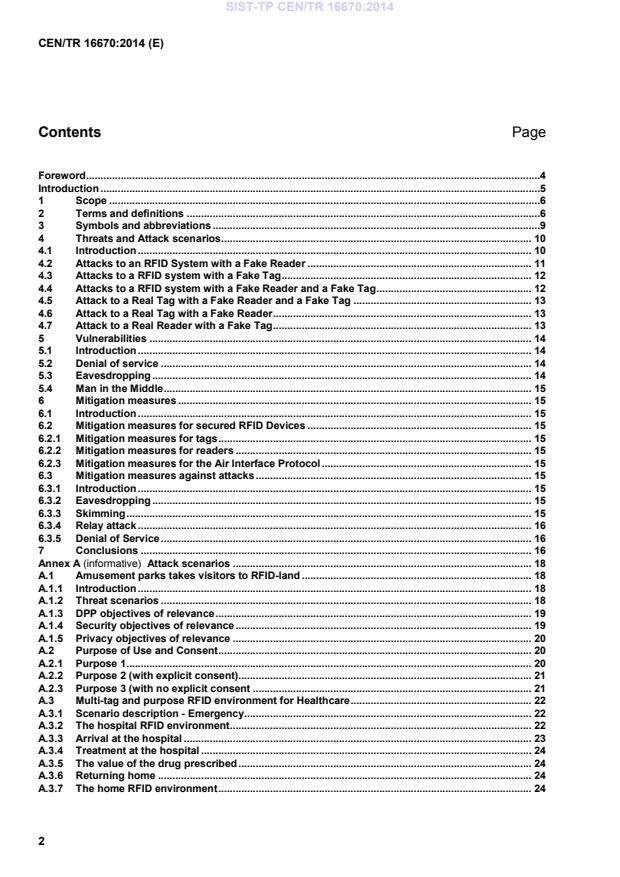
Contents Page
Foreword .4
Introduction .5
1 Scope .6
2 Terms and definitions .6
3 Symbols and abbreviations .9
4 Threats and Attack scenarios . 10
4.1 Introduction . 10
4.2 Attacks to an RFID System with a Fake Reader . 11
4.3 Attacks to a RFID system with a Fake Tag . 12
4.4 Attacks to a RFID system with a Fake Reader and a Fake Tag . 12
4.5 Attack to a Real Tag with a Fake Reader and a Fake Tag . 13
4.6 Attack to a Real Tag with a Fake Reader . 13
4.7 Attack to a Real Reader with a Fake Tag . 13
5 Vulnerabilities . 14
5.1 Introduction . 14
5.2 Denial of service . 14
5.3 Eavesdropping . 14
5.4 Man in the Middle . 15
6 Mitigation measures . 15
6.1 Introduction . 15
6.2 Mitigation measures for secured RFID Devices . 15
6.2.1 Mitigation measures for tags . 15
6.2.2 Mitigation measures for readers . 15
6.2.3 Mitigation measures for the Air Interface Protocol . 15
6.3 Mitigation measures against attacks . 15
6.3.1 Introduction . 15
6.3.2 Eavesdropping . 15
6.3.3 Skimming . 15
6.3.4 Relay attack . 16
6.3.5 Denial of Service . 16
7 Conclusions . 16
Annex A (informative) Attack scenarios . 18
A.1 Amusement parks takes visitors to RFID-land . 18
A.1.1 Introduction . 18
A.1.2 Threat scenarios . 18
A.1.3 DPP objectives of relevance . 19
A.1.4 Security objectives of relevance . 19
A.1.5 Privacy objectives of relevance . 20
A.2 Purpose of Use and Consent . 20
A.2.1 Purpose 1 . 20
A.2.2 Purpose 2 (with explicit consent) . 21
A.2.3 Purpose 3 (with no explicit consent . 21
A.3 Multi-tag and purpose RFID environment for Healthcare . 22
A.3.1 Scenario description - Emergency. 22
A.3.2 The hospital RFID environment . 22
A.3.3 Arrival at the hospital . 23
A.3.4 Treatment at the hospital . 24
A.3.5 The value of the drug prescribed . 24
A.3.6 Returning home . 24
A.3.7 The home RFID environment . 24
A.3.8 Drug repeat prescription and out of date drug recycling . 25
Annex B Original Test Set ups and Results . 26
B.1 Test Area . 26
B.2 Equipment . 26
B.3 Overview of the Tests . 27
B.3.1 Introduction . 27
B.3.2 Range tests . 27
B.3.3 Write Tests . 27
B.3.4 Illicit Reading . 27
B.3.5 Eavesdropping . 28
B.3.6 Detection inside buildings . 28
B.3.7 Combined EAS/RFID systems . 28
B.4 Test procedures and results . 28
B.4.1 General . 28
B.4.2 Reading range . 30
B.4.3 Write range . 37
B.4.4 Illicit reading . 41
B.4.5 Eavesdropping . 46
B.4.6 Detection inside buildings . 47
B.4.7 Combined EAS/RFID system . 48
B.5 Analysis of results . 48
B.6 Conclusions . 49
Annex C Additional Test Set ups and Results . 50
C.1 Introduction . 50
C.2 Scope of tests . 50
C.3 Documenting the results . 50
C.4 Equipment required for additional tests . 50
C.5 Description of tests . 51
C.5.1 Activation distance for HF system . 51
C.5.2 Activation distance for UHF system . 52
C.5.3 Eavesdropping tests for HF system . 53
C.5.4 Eavesdropping tests for UHF system . 55
C.6 Test results . 56
C.6.1 Equipment utilised during the tests . 56
C.6.2 Description of Tests . 56
Bibliography . 70
Foreword
This document (CEN/TR 16670:2014) has been prepared by Technical Committee CEN/TC 225 “AIDC
Technologies”, the secretariat of which is held by NEN.
Attention is drawn to the possibility that some of the elements of this document may be the subject of patent
rights. CEN [and/or CENELEC] shall not be held responsible for identifying any or all such patent rights.
This Technical Report is one of a series of related deliverables, which comprise mandate 436 Phase 2. The
other deliverables are:
— EN 16570, Information technology — Notification of RFID — The information sign and additional
information to be provided by operators of RFID application systems
— EN 16571, Information technology — RFID privacy impact assessment process
— EN 16656, Information technology - Radio frequency identification for item management - RFID Emblem
(ISO/IEC 29160:2012, modified)
— CEN/TR 16684, Information technology — Notification of RFID — Additional information to be provided
by operators
— CEN/TS 16685, Information technology — Notification of RFID — The information sign to be displayed in
areas where RFID interrogators are deployed
— CEN/TR 16669, Information technology — Device interface to support ISO/IEC 18000-3
— CEN/TR 16671, Information technology — Authorisation of mobile phones when used as RFID
interrogators
— CEN/TR 16672, Information technology — Privacy capability features of current RFID technologies
— CEN/TR 16673, Information technology — RFID privacy impact assessment analysis for specific sectors
— CEN/TR 16674, Information technology — Analysis of privacy impact assessment methodologies relevant
to RFID
Introduction
In response to the growing deployment of RFID systems in Europe, the European Commission published in
2007 the Communication COM(2007) 96 ‘RFID in Europesteps towards a policy framework’. This
Communication proposed steps which needed to be taken to reduce barriers to adoption of RFID whilst
respecting the basic legal framework safeguarding fundamental values such as health, environment, data
protection, privacy and security.
In December 2008, the European Commission addressed Mandate M/436 to CEN, CENELEC and ETSI in the
field of ICT as applied to RFID systems. The Mandate M/436 was accepted by the ESOs in the first months of
2009. The Mandate addresses the data protection, privacy and information aspects of RFID, and is being
executed in two phases. Phase 1, completed in May 2011, identified the work needed to produce a complete
framework of future RFID standards. The Phase 1 results are contained in the ETSI Technical Report TR 187
020, which was published in May 2011.
Phase 2 is concerned with the execution of the standardization work programme identified in the first phase.
This document will provide the additional information of the RFID application that will need to be provided to a
citizen by accessing the source identified on the sign where the RFID application is operating. This information
will be aligned with the details set out in the Recommendation, but some of this might not be available at the
outset, a Technical Report is the preferred form of initial delivery to establish basic requirements.
1 Scope
The scope of the Technical Report is to consider the threats and vulnerabilities associated with specific
characteristics of RFID technology in a system comprising:
— the air interface protocol covering all the common frequencies;
— the tag including model variants within a technology;
— the interrogator features for processing the air interface;
— the interrogator interface to the application.
The Technical Report addresses specific RFID technologies as defined by their air interface specifications.
The threats, vulnerabilities, and mitigating methods are presented as a toolkit, enabling the specific
characteristics of the RFID technology being used in an application to be taken into consideration. While the
focus is on specifications that are standardized, the feature analysis can also be applied to proprietary RFID
technologies. This should be possible because some features are common to more than one standardized
technology, and it should be possible to map these to proprietary technologies.
Although this Technical Report may be used by any operator, even for a small system, the technical details
are better considered by others. In particular the document should be a tool used by RFID system integrators,
to improve security aspects using a privacy by design approach. As such it is also highly relevant to operators
that are not SME’s, and to industry bodies representing SME members.
2 Terms and definitions
For the purposes of this document, the following terms and definitions apply.
2.1
blocker tag
tag forcing the reader to enter in its singulation algorithm
Note 1 to entry: The idea of the blocker tag that looks like a tag that we can have in our pocket, is to emit both ‘0’ and
‘1’ creating a collision and forcing the reader to enter in its singulation algorithm. If the blocker tag emits simultaneously ‘0’
and ‘1’ (that requires two antennas), the reader may never complete its algorithm. The blocker tag should be seen as a
hacker device that is able to generate a denial of service in a legitimate system. We can even assess that a blocker tag
has always a malicious behaviour since it cannot be selective and forbids the reading of one tag whereas it authorises the
reading of the others. Moreover, the blocker tag works like a tag in a passive mode. So, it requires being in the reader field
and it will protect only a small volume around itself. So a blocker tag can be considered as a malicious tag, which prevents
a legal system to read legal tags or as a mitigation technique preventing an illegal reader to read a legal tag.
2.2
blocking
another way to produce a denial of service is to interfere during the anti-collision sequence
Note 1 to entry: Different devices have been developed.
2.3
cloning
impersonation technique that is used to duplicate data from one tag to another
Note 1 to entry: Data acquired from the tag by whatever means is written to another tag. Unless the technology and
application require the interrogator to authenticate the RFID tag, cloning is possible. Cloning the unique chip ID presents a
significantly bigger challenge for the attacker, but some researchers claim that this is possible. There is also a special
case of cloning that needs to be considered where the application accepts multiple AIDC technologies. Cloning data from
an RFID-enabled card can be replicated in magnetic stripe. In some payment card systems, information that might be
cloned from an AIDC card could be used in payment situations known as 'cardholder not present' for purchases made on
the Internet or by telephone. In this case, the clone is virtual and requires no encoding on another RFID tag.
2.4
denial of service
preventing communication between the interrogator and the tags
Note 1 to entry: There are two main ways to accomplish a "denial of service". The first one is to create electromagnetic
interferences, the second one is to insert a blocker tag in the communication.
2.5
destruction
making the tag definitively unusable without using a logical kill function whenever such a function exist in the
rfid protocol
Note 1 to entry: Destruction may refer to the reader too. Although this attack threats RFID system availability, it’s
different from deny of service because it can’t reactivate and repair it. Destruction is considered as an attack when it’s
practiced without holder’s knowledge. Two destruction types can be distinguished1) Hardware-and 2) Software
destruction. While this can be seen as a security threat to the RFID operator, there are also situations where it might affect
the individual. For example, if a public transport tag is accidentally damaged, then the individual's rights associated with it
can be lost. In a similar manner as for tag removal, tag destruction can be used as a control to protect the privacy
2.6
eavesdropping
passive attack, which consists in remotely listening to transactions between a Real Reader and a Real Tag
2.7
guardian
special device developed by Melanie Rieback from a Dutch University to help citizens to communicate with
their own contactless smartcards
Note 1 to entry: As an active device it can be turned into a blocking tag preventing an attacker to access such
contactless cards. Thus, it can blur any pervasive reading by actively emitting a jamming signal in the sidebands of a
typical RFID tag. Such a mechanism enables multiple functionalities:
— information can be sent to the reader or to the tag for secret key management, authentication, access control;
— monitoring of the RFID environment to warn of possible unsolicited reading;
— creation of collisions to prevent from the possible inquisitive reading.
As a consequence, the RFID guardian is a useful tool to ensure the privacy but it is also an efficient device to create
denials of service. Whereas the blocker tag is designed to carry out a simple load modulation, the RFID guardian is an
active device that requires batteries and that is able to emit is own signal. As a consequence, the distance of use is much
larger.
2.8
jamming
creating a signal in the same range as used by the reader in order to prevent tags from communicating with
the reader
Note 1 to entry: Because the RFID air interface protocol depends on radio signals, an attacker can exploit any such
signals within the range of the communication between interrogator and tag
2.9
man in the middle
object or person interfering in the communication between a real reader and a real tag
Note 1 to entry: "Man in the middle" attack is often mistaken for relay attack. These are indeed similar but with the
distinctive feature that in this attack the bit stream can be modified in the relay. Since the relay implies the adaptation of
the modulation and of the bit coding by the Fake Reader or the Fake Tag for its use, it is not a problem to change some
bits. This additional feature may take time but it will always be shorter than the timeout of the Real Reader.
2.10
RFlD (1)
radio frequency identification
use of electromagnetic or inductive coupling in the radio frequency portion of the spectrum to communicate to
or from a tag through a variety of modulation and encoding schemes to uniquely read the identity of an RF
Tag
[SOURCE: ISO/IEC 19762-3]
2.11
RFlD (2)
radio frequency identification
use of electromagnetic radiating waves or reactive field coupling in the radio frequency portion of the spectrum
to communicate to or from a tag through a variety of modulation and encoding schemes to uniquely read the
identity of a radio frequency tag or other data stored on it
[SOURCE: RFID Recommendation C(2009) 3200 final]
2.12
relay attack
kind of Man in the Middle attack where fake reader and fake tag are used
Note 1 to entry: The relay attack is based on a specific weakness of the RFID tags that has the possibility to activate
the device without the consent of the user. Indeed, a user is not able to switch off his tag. Thus an attacker can, therefore,
access the tag discreetly, without knowledge of its owner, and relay information through a communication link between the
tag and a remote Fake Reader. The reader will assume that the tag, and by implication the user, is in close vicinity and
provides access to the attacker. Using this attack on cryptographic authentication schemes, the attacker would be able to
convince both Real Reader and Real Tag to share a common secret key. The attacker would not be able to view in
plaintext any subsequent communications. This is not needed as long as it can continue relaying the respective
messages. The attack can be given an active twist by relaying the initial authentication sequence after which subsequent
data is modified and relayed. Relay attacks involve two different devices and as a consequence two attackers that should
coordinate each other except if the relay is really short (an arm’s length for example). The device that will skim the data of
the attacked person is the Fake Reader. The Fake Reader is linked via the relay to the Fake Tag, a Fake Tag that will
reproduce the data of the Real Tag.
2.13
side channel analysis
analysis which allows to find secret information by using the analysis of the RF field during the processes
made by the tag processor
2.14
side channel attack
attack which uses a Side Channel Analysis
Note 1 to entry: In a side channel attack, the information that is usually exploited includes timing information, power
consumption or even electro-magnetic fields. This type of attack requires sufficient time, specialist equipment, and deep
knowledge of the internal systems on which the cryptographic and other algorithms are implemented.
2.15
singulation
identifying an individual tag in a multiple-tag environment
2.16
skimming
active attack which consists in reading a tag
Note 1 to entry: It includes powering and modulation. It implies distance tag activation without consent of the operator
of the application.
2.17
substitution
action of changing a real reader or tag by a fake one
Note 1 to entry: There are two kinds of substitution:
— Reader substitution: Reader substitution is a kind of smart jamming. During such an attack a Fake Reader radiates a
RF magnetic field in order to perturb a communication between a Real Reader and a Real Tag. The goal of this
perturbation is not to entirely block the communication but to transform the initial reader’s message to access
forbidden zones of the tag memory or to induce misusing of the tag. Depending of the goal of the attacker, all Real
Reader’s messages can be transformed or some messages can be kept unchanged (during initialisation protocol or
Real Tag’s authentication for example). A way of setting up such an attack is to make the Fake Reader speak louder
than the Real Reader. This can be easily done if the Real Reader is far from the tag. The Fake Reader attacker has
only to be nearer than the Real Reader. This attack is very complex to set up.
— Tag substitution: Tag substitution cannot be performed in the same way as reader substitution. Indeed, the attacker’s
tag cannot “speak” louder than the official Real Tag. The attacker has to use a powered RF device near the Real
Reader and Real Tag to create a RF signal. This signal can then be superimposed on the official backscattered
signal from the Real Tag leading to the cancellation of this signal from the Real Reader’s point of view.
2.18
tag
RFID device having the ability to produce a radio signal or a RFID device which re-couples, back- scatters or
reflects (depending on the type of device) and modulates a carrier signal received from a reader or writer
[SOURCE: RFID Recommendation C(2009) 3200]
2.19
tag cloning
action of taking information from a real tag to create a fake tag with same functionalities
2.20
truncation
action of shortening (a number or a word) by dropping one or more digits or bits
3 Symbols and abbreviations
ALOHA Probabilistic algorithm used for RFID tag singulation.
CCTV Closed Circuit Television
CSP Communications Service Provider
CEN European Committee for Standardization
CENELEC European Committee for Electrotechnical Standardization
DPP Data Protection and Privacy
EAS Electronic Article Surveillance
EPC Electronic Product Code
ESO European Standard Organisation
ETSI European Telecommunication Standard Institute
FR Fake Reader
NOTE 1 The reader used for the attack and not part of the application.
FT Fake Tag
NOTE 2 The tag used for the attack and not part of the application.
HF High Frequency
ICT Information and Communication Technology
IEC International Electrotechnical Commission
ISO International Standard Organization
LF Low Frequency
OCR-B Optical Character Recognition type B (cf. ISO 1073-2).
PIA Privacy Impact Assessment
RFID Radio Frequency Identification
RR Real Reader
NOTE 3 The reader used in the application.
RT Real Tag
NOTE 4…The tag used in the application.
SIM Subscriber Identification Module
SME Small and Medium Enterprise
STF ETSI Special Task Force
TID Tag IDentifier
UHF Ultra High Frequency
UII Unique Item Identifier
UWB Ultra Wide Band
WLAN Wireless Local Area Network
4 Threats and Attack scenarios
4.1 Introduction
This clause analyses the various combinations of attacks to a RFID system comprising a RR and a RT, with
the help of a FR, or a FT, or both a FR and a FT. Figure 1 summarises the combination of different readers
and tags for a given attack.
Figure 1 — Penetration Testing Framework: a proposed pictorial representation
4.2 Attacks to an RFID System with a Fake Reader
Three RFID devices are operating at the same time: RR + RT + FR.
A Fake Reader operating within the range of a RFID application, can perform two types of attacks:
— By generating radio waves at the same wavelength of the application it can generate interference with the
application communication sequences, if sufficient energy is deployed (field strength in the vicinity of the
RR). This prevents the exchange of data between RR and RT, and creates a denial of service.
Figure 2 — FR used as interferer
— The reader can also listen (record the variation of the amplitude or the frequency during the
communication) to the RF communication of the real RFID application. The FR is eavesdropping on the
RFID application.
Figure 3 — FR used to eavesdrop RT's signal
NOTE An attack performed by a Fake Reader is not possible if there is no Real Tag in the environment, since a Real
Reader will not respond to a Fake Reader.
4.3 Attacks to a RFID system with a Fake Tag
Three RFID devices are operating at the same time: RR + RT + FT.
If the FT talks to the RR at the same time then the RT, the RR will not determine which of the two tags will
send the correct information creating a denial of service.
Figure 4 — Attack performed by a FT
NOTE An attack performed by a Fake Tag alone will be inoperative if there is no Real Reader in the environment,
since no communication can exist between two tags.
4.4 Attacks to a RFID system with a Fake Reader and a Fake Tag
Four RFID devices are operating at the same time: RR + RT + FR + FT.
In this scenario, two attacks can be performed at the same time or independently:
— RT is activated by FR. FR writes the information collected from RT into FT creating a cloned tag;
Figure 5 — Creating a cloned tag
— FT is activated by RR and responds with its own fake data creating a Man in the Middle attack.
Figure 6 — Relay attack
4.5 Attack to a Real Tag with a Fake Reader and a Fake Tag
Since there is no communication possible between two tags, the attack can be performed only by the Fake
Reader. See 4.6.
4.6 Attack to a Real Tag with a Fake Reader
A Fake Reader activates a Real Tag and writes new information in the Real Tag creating an unwanted tag
activation. Real data may be modified without consent.
Figure 7 — Unauthorised tag activation
We can dissociate the activation side of the attack from the listening side. In that case, we need a first fake
reader which only purpose is to activate the tag by sending it a transmitting signal. Another fake reader can be
placed farther away just to eavesdrop the backscattered signal from the real tag. The spatial limitation of such
an attack is given by the activation range. Some commercial systems make use of this approach by using
different activation points to "illuminate" a wide area and place only one receiver to collect all the tags'
responses. Special signal processing is set up to recover the antenna which activates the tag and therefore
performs localisation.
4.7 Attack to a Real Reader with a Fake Tag
The Fake Tag can send false information to the Real Reader. The consequence can be similar to the case of
an unwanted activation.
Figure 8 — Use of unauthorised tag with Real Reader
5 Vulnerabilities
5.1 Introduction
All attacks are made while listening to and/or activating the communication between the Real Reader and/or
the Real Tag. In all cases, the attacking devices must operate at the same frequency as the victim.
The vulnerabilities are to the reader, tag or Air Interface Protocol depending on the type of attack.
At the reader level, the Real Reader cannot differentiate between the Real Tag and the Fake Tag. At the tag
level, the Real Tag cannot differentiate between the Real Reader and the Fake Reader.
At the Air Interface Protocol level, the vulnerability comes from the fact that the communication between the
Real Reader and the Real Tag is normally understandable, deterministic and sequenced. Thus leaving space
and time to intervene in the communication with fake devices.
— Understandable: commands and answers can be identified and copied enabling fabrication of Fake
Readers and Fake Tags capable of communicating with Real Readers and Real Tags. Where this is
applied it enables unwanted data capture or sending wrong information or creating interference and noise
to provoke denial of service;
— Deterministic: commands and answers are always the same in the protocol, thus enabling unwanted
activation and therefore unauthorised identification of personal data and/or data linked with individuals;
— Sequenced: the timing for questions and answers is sequenced. When the sequence is long or if there is
no sequencing, it leaves enough time for an attacking system (Fake Reader and Fake Tag) to attack
through man in the middle.
5.2 Denial of service
This attack can be made either by a Fake Reader or by a Fake Tag. The vulnerability is located in the air
interface protocol and at the reader level.
5.3 Eavesdropping
This attack can be made by a Fake Reader. The vulnerability is at the Real Reader, Real Tag and Air
Interface Protocol level.
NOTE Listening to the communication between a tag and a reader by scrutinising small signal variations on device's
power line supply cannot be associated with eavesdropping. Such an attack can be classified in the side channel attack of
the system and is not specific to RFID.
5.4 Man in the Middle
This attack needs a Fake Reader associated with a Fake Tag. The vulnerability is in the Air Interface Protocol.
6 Mitigation measures
6.1 Introduction
The measures depend on the RFID technology used. There are several standardised Air Interface Protocols
used in each frequency range and many non-standardized protocols being used in existing RFID applications.
6.2 Mitigation measures for secured RFID Devices
6.2.1 Mitigation measures for tags
— authentication of tags;
— special command for the TID enabling comparison to a pre established list;
— encryption of data.
6.2.2 Mitigation measures for readers
— authentication of tags.
6.2.3 Mitigation measures for the Air Interface Protocol
— no personal data;
— encryption of data;
— no TID;
— truncated UII/EPC codes;
— reduced reading range.
6.3 Mitigation measures against attacks
6.3.1 Introduction
This subclause lists solutions against the following types of attacks.
6.3.2 Eavesdropping
The main solution to eavesdropping attacks is the encryption of the data and the use of cryptographic
signatures. Symmetric keys, and asymmetric keys can be used. However, those algorithms require a lot of
computing resources which could be too large for RFID tags in certain applications.
6.3.3 Skimming
There are several measures to avoid skimming of contactless cards:
Optical reading: To avoid skimming of contactless cards, a solution was developed for and applied in the
electronic passport. This is the association of an optical reading with the contactless reading of the device
often linked with symmetric algorithms. Only the optically read data on the two dimensional barcode of the
passport enables the access to the contactless chip. A main weakness of this countermeasure is that a
barcode or OCR-B can be easily counterfeited. As a consequence, a passport should not be opened and
showed to anyone else but the authorities. This condition is difficult to enforce as everybody knows that his
passport could be looked at the desk when checking in a hotel.
The Faraday cage: Another basic solution is to confine the tag or the contactless card in a wallet made of a
metallic sheet or mesh. This wallet is acting as a Faraday cage blocking the HF and UHF radio signals of
readers. The efficiency is certain but the use is restraint.
6.3.4 Relay attack
A mitigation technique to reduce relay attack risk on classic RFID channel (narrow band communication) is to
use another channel to send very short pulses (time domain). For a given distance range, time of flight (time
between reader command and tag response) for such short pulses are well known so that if relay attack
occurs, time of flight will be much greater than that expected resulting in a code violation (error) in the second
encrypted channel. Knowing that real reader and real tag can infer that man in the middle attack occurs and
can decide to stop the data transmission.
The data channel does not change (still classical HF or UHF narrow band signals can be used) but a second
channel (UWB like) is needed to share the value of the time of flight between reader and tag.
6.3.5 Denial of Service
A number of techniques exist to prevent operation of a RFID system.
The active jamming: It is possible to create a device that emits signals at the same frequency as the Real
Reader to jam its communications with the Real Tag. A lot of denial of service attacks could be seen also as a
more or less efficient countermeasure. This device should broadcast signals at higher powers than the
different standards permit and as a consequence it is illegal.
The blocker tag: This device is mentioned in previous subclauses since it can be seen also seen as an attack
tool. The main drawbacks of the blocker tag are that it cannot be selective (it will blur a family of tags) and that
it is a passive device that requires activation by the Fake Reader to work.
The RFID Guardian: This device is also aforementioned in the denial of service attack. It enables a large
panel of services to protect the user: secret key management, authentication, access control, monitoring of
the tag environment, creation of collisions. It does not have the main drawbacks of the blocker tag since it can
be active. Nevertheless, the selectivity can only be reached with an ALOHA type anti collision protocol and
this is not a multi - standards solution.
7 Conclusions
It is worth pointing out the tremendous richness of the hackers’ imagination and the profusion of concepts
designed to jeopardise the contactless link. It is therefore important to stay informed of any new potential
threats. Of course this kind of "sporting" activity is not specific to contactless smartcard technology.
During the risk analysis process required for a PIA, the operator will have to quantify the scale of risk
associated with the various threats. In order to do that the RFID operator can use the results of this Technical
Report and, some complementary experiments may be undertaken to assess the technical possibilities of
each specific attack and to measure the associated risk numerically.
Finally, because hacking is an endless human activity, a continuous survey of new attacks must be performed
through published technical papers, hackers’ websites and unofficial workshops.
In all cases, the threats can be real if carried out within the read and/or write range of each of the RFID
technologies used in a given RFID application.
A lot of articles have been published quoting actual read and/or write ranges at each of the frequencies and
protocols used by RFID. Metrics covering such ranges is part of this Technical Report and are included in
Annexes B and C.
In order to assess the level of risk associated with the differe
...