

EN 2574:1990
(Main)Aerospace series - Welds - Information on drawings
- Abstract
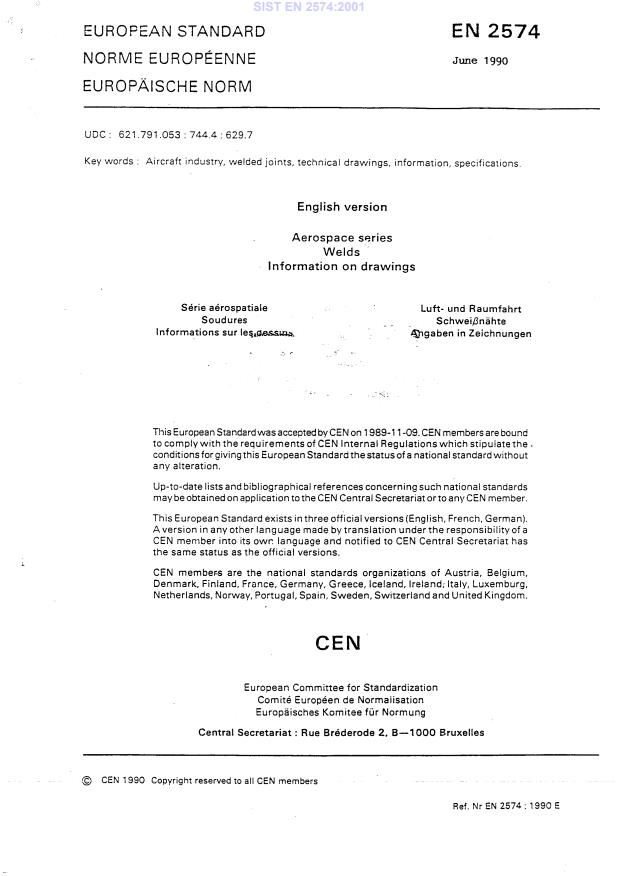
This standard specifies the indications to be shown on drawings or other documents dealing with welding of metallic materials in aerospace industries
- Status
- Published
- Publication Date
- 03-Jul-1990
- Withdrawal Date
- 03-Jan-1991
- Technical Committee
- ASD-STAN - Aerospace
- Drafting Committee
- ASD-STAN/D 1 - General
- Current Stage
- 6060 - Definitive text made available (DAV) - Publishing
- Start Date
- 04-Jul-1990
- Completion Date
- 04-Jul-1990

Overview
EN 2574:1990 - Aerospace series - Welds - Information on drawings sets out the requirements and recommendations for indicating welding information on drawings or related documents in the aerospace industry. Issued by CEN, this European standard is instrumental in ensuring all welding processes involving metallic materials are clearly and consistently documented, facilitating high-quality results in aerospace manufacturing and maintenance.
By defining the information to be presented for welded joints, EN 2574:1990 helps streamline communication, minimize errors, and ensure that complex welding requirements are met to industry specifications.
Key Topics
EN 2574:1990 addresses several critical topics relevant to aerospace welded joints and their documentation, including:
- Standardized Weld Symbols: Clear guidelines for presenting weld symbols and annotations on technical drawings for metallic materials.
- Documentation Requirements: Specifications for indicating welding types, processes, positions, and inspection criteria directly on drawings.
- Clarity and Consistency: Recommendations to promote unambiguous communication between design, engineering, fabrication, and quality assurance teams.
- Material Identification: Methods for referencing metallic materials and weld consumables on official documents.
- Conformance Assurance: Alignment with industry best practices for weld information presentation to meet regulatory and contractual aerospace standards.
Applications
This standard finds widespread application across the aerospace sector, particularly wherever metallic structures and components require welding. Typical use cases include:
- Design and Engineering: Ensuring that all essential welding specifications are easily interpreted on design schematics and engineering drawings.
- Manufacturing and Fabrication: Supporting welding technicians, machine operators, and assemblers with clear, standardized instructions for welding processes.
- Quality Assurance: Facilitating inspection and verification of welds in accordance with the documented requirements to maintain regulatory compliance and aircraft safety.
- Maintenance and Repair: Providing maintenance teams with detailed welding information for repair operations and retrofitting on existing aerospace structures.
By applying EN 2574:1990, aerospace manufacturers and suppliers can mitigate risks associated with miscommunication, rework, and non-compliance, thereby improving overall product quality and reliability.
Related Standards
EN 2574:1990 is part of a broader framework of standards governing welded joints and technical documentation in the aerospace industry. Relevant associated standards include:
- EN 150 160.40: Standards addressing welded joints - symbols, terminology, and requirements.
- EN 29500: Technical documentation standards for aerospace manufacturing.
- EN ISO 2553: Welded, brazed, and soldered joints - Symbolic representation on drawings.
- EN 9100: Quality management systems for aerospace organizations, which reference documentation requirements for special processes such as welding.
Summary
Adopting EN 2574:1990 ensures that information related to aerospace welds is presented accurately and consistently across all relevant drawings and documents. This standard helps organizations maintain high-quality outcomes, improve process reliability, and achieve compliance with industry regulations and customer requirements. Its alignment with other key aerospace standards supports integrated quality assurance throughout the product lifecycle, from design and manufacturing to maintenance and support.
Relations
- Effective Date
- 28-Jan-2026
Get Certified
Connect with accredited certification bodies for this standard

DVS-ZERT GmbH
German welding certification society.
CARES (UK Certification Authority for Reinforcing Steels)
UK certification for reinforcing steels and construction.
EWF/IIW (European/International Welding Federation)
International welding personnel certification.
Sponsored listings
Frequently Asked Questions
EN 2574:1990 is a standard published by the European Committee for Standardization (CEN). Its full title is "Aerospace series - Welds - Information on drawings". This standard covers: This standard specifies the indications to be shown on drawings or other documents dealing with welding of metallic materials in aerospace industries
This standard specifies the indications to be shown on drawings or other documents dealing with welding of metallic materials in aerospace industries
EN 2574:1990 is classified under the following ICS (International Classification for Standards) categories: 25.160.40 - Welded joints and welds. The ICS classification helps identify the subject area and facilitates finding related standards.
EN 2574:1990 has the following relationships with other standards: It is inter standard links to EN 3375-001:2007. Understanding these relationships helps ensure you are using the most current and applicable version of the standard.
EN 2574:1990 is available in PDF format for immediate download after purchase. The document can be added to your cart and obtained through the secure checkout process. Digital delivery ensures instant access to the complete standard document.
Standards Content (Sample)
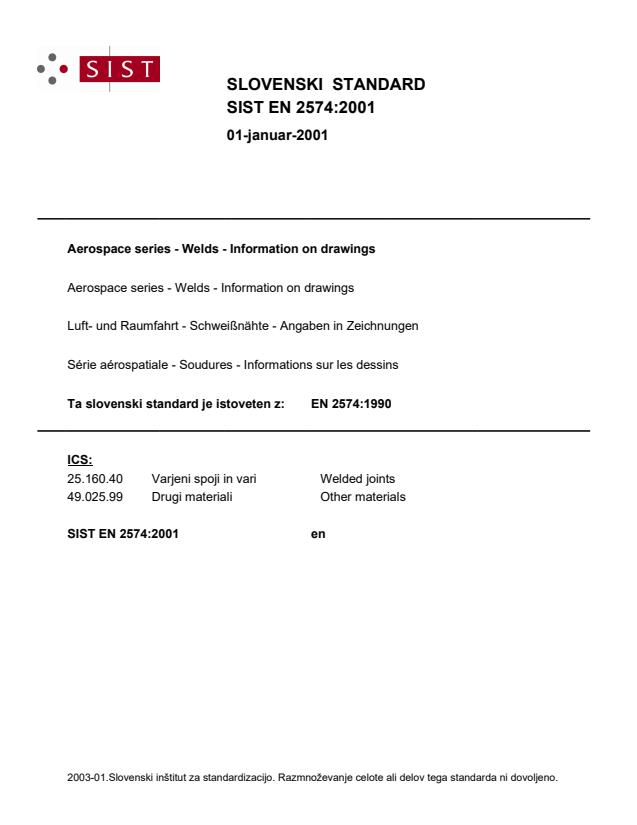
SLOVENSKI STANDARD
01-januar-2001
Aerospace series - Welds - Information on drawings
Aerospace series - Welds - Information on drawings
Luft- und Raumfahrt - Schweißnähte - Angaben in Zeichnungen
Série aérospatiale - Soudures - Informations sur les dessins
Ta slovenski standard je istoveten z: EN 2574:1990
ICS:
25.160.40 Varjeni spoji in vari Welded joints
49.025.99 Drugi materiali Other materials
2003-01.Slovenski
...