

EN 13260:2025
(Main)Railway applications - Wheelsets and bogies - Wheelsets - Product requirements
- Abstract
This document specifies the characteristics of wheelsets for all heavy rail track gauges.
This document is applicable to heavy rail vehicles and is applicable, in principle, to other vehicles such as urban rail vehicles.
This document is applicable to wheelsets made from elements defined by the following standards:
- EN 13262:20251 for wheels;
- EN 13261:2024 for axles.
The requirements defined in this document are applicable to cylindrical wheel seats. Most of the requirements are also applicable to wheelsets with conical wheel seats. If needed, specific requirements for conical wheel seats (e.g. press-fitting curves, geometric dimensions...) are defined in the technical specification. Most of the requirements are also applicable to wheelsets with inboard bearings. If needed, specific requirements for inboard bearings wheelsets are defined in the technical specification.
Some characteristics are given according to category 1 or category 2.
- Status
- Published
- Publication Date
- 02-Dec-2025
- Technical Committee
- CEN/TC 256 - Railway applications
- Drafting Committee
- CEN/TC 256/SC 2/WG 11 - Wheels - Wheelsets
- Current Stage
- 6060 - Definitive text made available (DAV) - Publishing
- Start Date
- 03-Dec-2025
- Due Date
- 08-Nov-2023
- Completion Date
- 03-Dec-2025

Overview
EN 13260:2025 - "Railway applications - Wheelsets and bogies - Wheelsets - Product requirements" (CEN) defines product-level characteristics, tests and delivery conditions for wheelsets used on all heavy-rail gauges. Applicable to heavy-rail vehicles and, in principle, to urban rail vehicles, the standard covers wheelsets assembled from wheels and axles specified in EN 13262 (wheels) and EN 13261:2024 (axles). It applies primarily to cylindrical wheel seats, with many requirements also valid for conical seats and inboard-bearing wheelsets; additional parameters are provided in technical specifications where needed.
Key Topics
- Product definition & assembly: Requirements for shrink-fitting and press-fitting, heating limits (wheel temperature ≤ 250 °C for shrink-fitting), oil-injection removal features, and interference-fit specification tied to wheel seat nominal diameter (dm).
- Interference ranges: shrink-fitting j = 0.0009·dm to 0.0015·dm; press-fitting j = 0.0010·dm to 0.0015·dm + 0.06 (mm).
- Press-fitting diagram & measurement: Press must record force-displacement curves. X-axis (displacement) scale ≥ 0.5× actual displacement; force sensor accuracy 10 kN; curve read accuracy 25 kN; minimum data density = 1 point/mm and per 25 kN force variation.
- Mechanical resistance of assemblies: Assemblies must resist a defined axial force F for 30 s without relative displacement. Default F for wheels (if unspecified): F = 4·dm (kN) when 0.8·dm ≤ L ≤ 1.1·dm (L = fitting length).
- Fatigue characteristics: Rotational bending fatigue limits for axle seat stresses are specified for conventional designs; separate limits for solid vs hollow axles are given and used in EN 13103-1 design calculations. Minimum fatigue limits by steel grade are included.
- Additional requirements: dimensions & tolerances, residual stresses on wheel seats, electrical resistance, dynamic imbalance, corrosion/mechanical protection, marking, product qualification and delivery conditions. Annexes cover press-fitting curves, fatigue test-piece info, component identification, product qualification and supply conditions.
Applications
- Who uses EN 13260:2025:
- Wheelset manufacturers and assembly shops
- Axle and wheel designers and suppliers
- Rail vehicle OEMs and maintenance organizations
- Test laboratories and conformity/approval bodies
- Procurement and technical specification writers for operators and infrastructure managers
- Practical uses:
- Specifying wheelset designs and acceptance criteria
- Defining assembly procedures (press-fit/shrink-fit) and test plans
- Performing mechanical resistance and fatigue verification for product qualification
- Ensuring traceability, marking and delivery compliance
Related standards
- EN 13261:2024 - Axles - Product requirements
- EN 13262 (under preparation) - Wheels - Product requirements
- EN 13103-1:2017+A1:2022 - Axle design method (external journals)
Keywords: EN 13260:2025, wheelsets, railway wheelsets, bogies, press-fitting, shrink-fitting, fatigue testing, wheel seat, axle requirements, product qualification.
Relations
- Replaces
EN 13260:2020 - Railway applications - Wheelsets and bogies - Wheelsets - Product requirements - Effective Date
- 18-Jan-2023
- Effective Date
- 28-Jan-2026
- Effective Date
- 28-Jan-2026
- Effective Date
- 28-Jan-2026
- Effective Date
- 28-Jan-2026
- Effective Date
- 28-Jan-2026
- Effective Date
- 28-Jan-2026
- Effective Date
- 28-Jan-2026
- Effective Date
- 28-Jan-2026
- Referred By
EN 13261:2009+A1:2010 - Railway applications - Wheelsets and bogies - Axles - Product requirements - Effective Date
- 28-Jan-2026
- Effective Date
- 28-Jan-2026
- Effective Date
- 28-Jan-2026
- Effective Date
- 28-Jan-2026
- Effective Date
- 28-Jan-2026
- Effective Date
- 28-Jan-2026
Get Certified
Connect with accredited certification bodies for this standard

IRIS Certification (UNIFE)
International Railway Industry Standard certification.

TÜV SÜD Rail GmbH
TÜV SÜD railway certification services.

Bureau Veritas Railway Certification
Railway and transportation certification.
Sponsored listings
Frequently Asked Questions
EN 13260:2025 is a standard published by the European Committee for Standardization (CEN). Its full title is "Railway applications - Wheelsets and bogies - Wheelsets - Product requirements". This standard covers: This document specifies the characteristics of wheelsets for all heavy rail track gauges. This document is applicable to heavy rail vehicles and is applicable, in principle, to other vehicles such as urban rail vehicles. This document is applicable to wheelsets made from elements defined by the following standards: - EN 13262:20251 for wheels; - EN 13261:2024 for axles. The requirements defined in this document are applicable to cylindrical wheel seats. Most of the requirements are also applicable to wheelsets with conical wheel seats. If needed, specific requirements for conical wheel seats (e.g. press-fitting curves, geometric dimensions...) are defined in the technical specification. Most of the requirements are also applicable to wheelsets with inboard bearings. If needed, specific requirements for inboard bearings wheelsets are defined in the technical specification. Some characteristics are given according to category 1 or category 2.
This document specifies the characteristics of wheelsets for all heavy rail track gauges. This document is applicable to heavy rail vehicles and is applicable, in principle, to other vehicles such as urban rail vehicles. This document is applicable to wheelsets made from elements defined by the following standards: - EN 13262:20251 for wheels; - EN 13261:2024 for axles. The requirements defined in this document are applicable to cylindrical wheel seats. Most of the requirements are also applicable to wheelsets with conical wheel seats. If needed, specific requirements for conical wheel seats (e.g. press-fitting curves, geometric dimensions...) are defined in the technical specification. Most of the requirements are also applicable to wheelsets with inboard bearings. If needed, specific requirements for inboard bearings wheelsets are defined in the technical specification. Some characteristics are given according to category 1 or category 2.
EN 13260:2025 is classified under the following ICS (International Classification for Standards) categories: 45.040 - Materials and components for railway engineering. The ICS classification helps identify the subject area and facilitates finding related standards.
EN 13260:2025 has the following relationships with other standards: It is inter standard links to EN 13260:2020, EN 13261:2024, EN 13262:2004, EN 13262:2020, EN 13979-1:2023, EN 13262:2026, EN 13103-1:2017+A1:2022, EN 15827:2011, EN 14033-1:2017, EN 13261:2009+A1:2010, EN 15313:2016, EN 13103-1:2017, EN 14535-2:2019, EN 17069-1:2019, CEN/TS 13103-2:2020. Understanding these relationships helps ensure you are using the most current and applicable version of the standard.
EN 13260:2025 is associated with the following European legislation: EU Directives/Regulations: 2016/797/EU, 2016/797/EU, 2016/797/EU, 2016/797/EU, 2016/797/EU, 2016/797/EU, 2016/797/EU, 2016/797/EU, 2016/797/EU, 2016/797/EU, 2016/797/EU, 2016/797/EU; Standardization Mandates: M/483, M/591. When a standard is cited in the Official Journal of the European Union, products manufactured in conformity with it benefit from a presumption of conformity with the essential requirements of the corresponding EU directive or regulation.
EN 13260:2025 is available in PDF format for immediate download after purchase. The document can be added to your cart and obtained through the secure checkout process. Digital delivery ensures instant access to the complete standard document.
Standards Content (Sample)
SLOVENSKI STANDARD
01-februar-2026
Nadomešča:
SIST EN 13260:2020
Železniške naprave - Kolesni pari in podstavni vozički - Kolesni pari - Zahtevane
lastnosti proizvoda
Railway applications - Wheelsets and bogies - Wheelsets - Product requirements
Bahnanwendungen - Radsätze und Drehgestelle - Radsätze - Produktanforderungen
Applications ferroviaires - Essieux montés et bogies - Essieux montés - Prescriptions
pour le produit
Ta slovenski standard je istoveten z: EN 13260:2025
ICS:
45.040 Materiali in deli za železniško Materials and components
tehniko for railway engineering
2003-01.Slovenski inštitut za standardizacijo. Razmnoževanje celote ali delov tega standarda ni dovoljeno.
EN 13260
EUROPEAN STANDARD
NORME EUROPÉENNE
December 2025
EUROPÄISCHE NORM
ICS 45.040 Supersedes EN 13260:2020
English Version
Railway applications - Wheelsets and bogies - Wheelsets -
Product requirements
Applications ferroviaires - Essieux montés et bogies - Bahnanwendungen - Radsätze und Drehgestelle -
Essieux montés - Prescriptions pour le produit Radsätze - Produktanforderungen
This European Standard was approved by CEN on 26 October 2025.
CEN members are bound to comply with the CEN/CENELEC Internal Regulations which stipulate the conditions for giving this
European Standard the status of a national standard without any alteration. Up-to-date lists and bibliographical references
concerning such national standards may be obtained on application to the CEN-CENELEC Management Centre or to any CEN
member.
This European Standard exists in three official versions (English, French, German). A version in any other language made by
translation under the responsibility of a CEN member into its own language and notified to the CEN-CENELEC Management
Centre has the same status as the official versions.
CEN members are the national standards bodies of Austria, Belgium, Bulgaria, Croatia, Cyprus, Czech Republic, Denmark, Estonia,
Finland, France, Germany, Greece, Hungary, Iceland, Ireland, Italy, Latvia, Lithuania, Luxembourg, Malta, Netherlands, Norway,
Poland, Portugal, Republic of North Macedonia, Romania, Serbia, Slovakia, Slovenia, Spain, Sweden, Switzerland, Türkiye and
United Kingdom.
EUROPEAN COMMITTEE FOR STANDARDIZATION
COMITÉ EUROPÉEN DE NORMALISATION
EUROPÄISCHES KOMITEE FÜR NORMUNG
CEN-CENELEC Management Centre: Rue de la Science 23, B-1040 Brussels
© 2025 CEN All rights of exploitation in any form and by any means reserved Ref. No. EN 13260:2025 E
worldwide for CEN national Members.
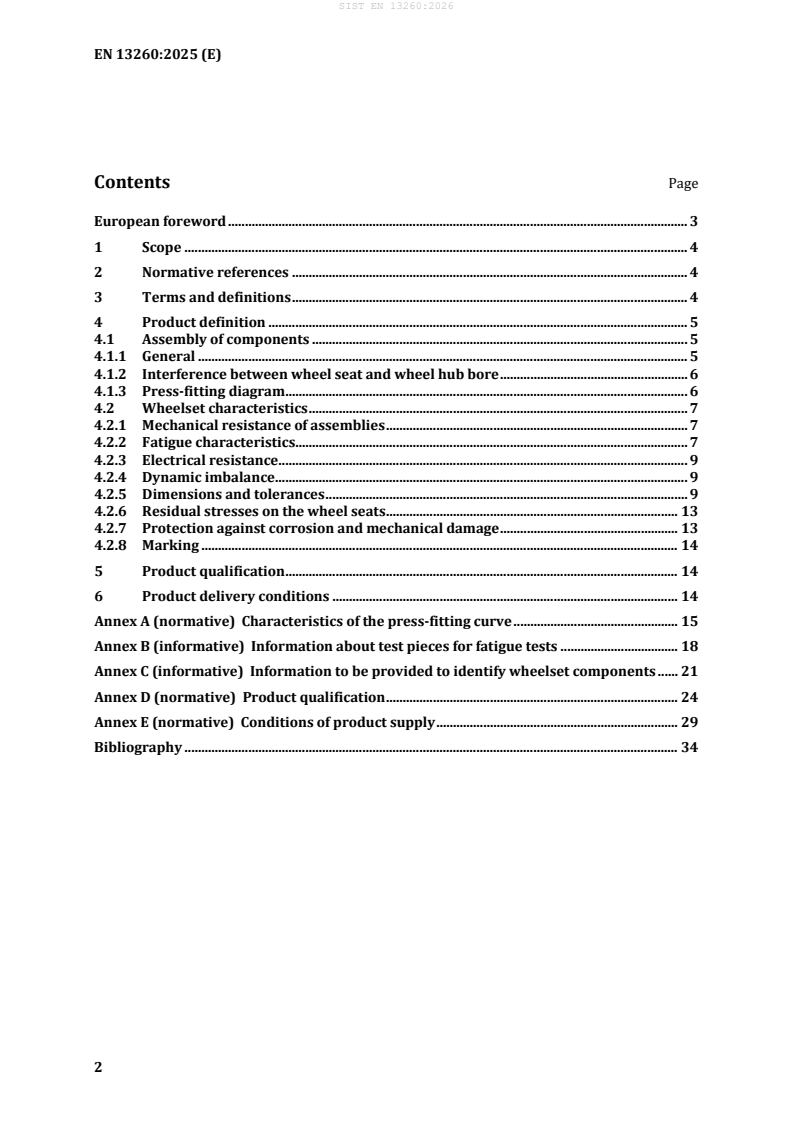
Contents Page
European foreword . 3
1 Scope . 4
2 Normative references . 4
3 Terms and definitions . 4
4 Product definition . 5
4.1 Assembly of components . 5
4.1.1 General . 5
4.1.2 Interference between wheel seat and wheel hub bore . 6
4.1.3 Press-fitting diagram . 6
4.2 Wheelset characteristics . 7
4.2.1 Mechanical resistance of assemblies . 7
4.2.2 Fatigue characteristics . 7
4.2.3 Electrical resistance . 9
4.2.4 Dynamic imbalance . 9
4.2.5 Dimensions and tolerances . 9
4.2.6 Residual stresses on the wheel seats . 13
4.2.7 Protection against corrosion and mechanical damage . 13
4.2.8 Marking . 14
5 Product qualification . 14
6 Product delivery conditions . 14
Annex A (normative) Characteristics of the press-fitting curve . 15
Annex B (informative) Information about test pieces for fatigue tests . 18
Annex C (informative) Information to be provided to identify wheelset components . 21
Annex D (normative) Product qualification . 24
Annex E (normative) Conditions of product supply . 29
Bibliography . 34
European foreword
This document (EN 13260:2025) was prepared by the CEN/TC 256 “Railway Applications”
Technical Committee, the secretariat of which is held by the DIN.
This European Standard shall be given the status of a national standard, either by publication of
an identical text or by endorsement, at the latest by June 2026, and conflicting national standards
shall be withdrawn at the latest by June 2026.
Attention is drawn to the possibility that some of the elements of this document may be the subject
of patent rights. CEN shall not be held responsible for identifying any or all such patent rights.
This document supersedes EN 13260:2020.
In comparison with the previous edition EN 13260:2020, the following technical modifications
have been made:
— correction of several editing mistakes leading to technical misunderstandings;
— a clearer definition of the requirements for dynamic imbalance (4.2.4) and fatigue tests
(4.2.2);
— a clarification of the product qualification conditions (Annex D);
— a clearer definition of the allowable rectifications of the wheelset after assembly (E.5).
This document has been prepared under a standardization request addressed to CEN by the
European Commission. The Standing Committee of the EFTA States subsequently approves these
requests for its Member States.
Any feedback and questions on this document should be directed to the users’ national standards
body. A complete listing of these bodies can be found on the CEN website.
According to the CEN-CENELEC Internal Regulations, the national standards organisations of the
following countries are bound to implement this European Standard: Austria, Belgium, Bulgaria,
Croatia, Cyprus, Czech Republic, Denmark, Estonia, Finland, France, Germany, Greece, Hungary,
Iceland, Ireland, Italy, Latvia, Lithuania, Luxembourg, Malta, Netherlands, Norway, Poland,
Portugal, Republic of North Macedonia, Romania, Serbia, Slovakia, Slovenia, Spain, Sweden,
Switzerland, Türkiye and the United Kingdom.
1 Scope
This document specifies the characteristics of wheelsets for all heavy rail track gauges.
This document is applicable to heavy rail vehicles and is applicable, in principle, to other vehicles
such as urban rail vehicles.
This document is applicable to wheelsets made from elements defined by the following standards:
— EN 13262:— for wheels;
— EN 13261:2024 for axles.
The requirements defined in this document are applicable to cylindrical wheel seats. Most of the
requirements are also applicable to wheelsets with conical wheel seats. If needed, specific
requirements for conical wheel seats (e.g. press-fitting curves, geometric dimensions.) are
defined in the technical specification. Most of the requirements are also applicable to wheelsets
with inboard bearings. If needed, specific requirements for inboard bearings wheelsets are
defined in the technical specification.
Some characteristics are given according to category 1 or category 2.
2 Normative references
The following documents referred to in the text establish, for all or part of their content, the
requirements of this document. For dated references, only the cited edition applies. For undated
references, the last edition of the reference document applies (including any amendments).
EN 13103-1:2017+A1:2022, Railway applications — Wheelsets and bogies — Part 1: Design
method for axles with external journals
EN 13261:2024, Railway applications — Wheelsets and bogies — Axles - Product requirements
EN 13262:—, Railway applications — Wheelsets and bogies — Wheels — Product requirements
EN 13979-1:2023, Railway applications — Wheelsets and bogies — Monobloc Wheels - Technical
approval procedure - Part 1: Forged and rolled wheels
3 Terms and definitions
For the purposes of this document, the following terms and definitions apply.
ISO and IEC maintain terminology databases for standardization, which can be accessed via the
following addresses:
— IEC Electromedia: available at https://www.electropedia.org/
— ISO Online browsing platform: available at https://www.iso.org/obp
3.1
technical specification
document describing specific parameters and/or product requirements in addition to the
requirements of this document
Under preparation. Stage at the time of publication: FprEN 13262:2025.
3.2
wheelset category
classification of the component, based on operational aspects that determine the list of
requirements to be applied
Note 1 to entry: Category 1 is generally selected when the operating speed is greater than 200 km/h. The
wheelset is then composed of category 1 wheels and a category 1 axle, according to EN 13262:— for wheels
and EN 13261:2024 for axles.
Note 2 to entry: Category 2 is divided into sub-categories (2a and 2b) to specify certain characteristics:
— 2a) max. speed ≤ 120 km/h;
— 2b) 120 < max. speed ≤ 200 km/h
Note 3 to entry: These categories can also be defined in accordance with the technical specification.
4 Product definition
4.1 Assembly of components
4.1.1 General
Before assembly, the various components of the wheelset shall fulfil the geometric requirements
of the specific documents that define them. In particular, the axle and wheels shall be in the “ready
for assembly” state defined in EN 13262:— for wheels and EN 13261:2024 for axles.
The components of the wheelset can be shrink-fitted or press-fitted to the axle.
For removal, the press-fitted or shrink fitted components (wheels, brake disc, couplings, gear
wheels) shall use an oil injection feature.
The interference fits to be used shall be defined by the technical specification, depending on the
characteristics of the material used for this element and the forces and torques to be transmitted
through the fit. The wheel/axle interference shall be defined according to the geometric tolerances
of the wheel seats and the interference values are specified in 4.1.2.
In the case of shrink-fitting, the wheel shall be uniformly heated and its temperature shall not
exceed 250 °C. If a local heating method is used (e.g. inductive coil in the hub), proof shall be
provided that it has had no influence on the characteristics of the wheel, as defined in EN 13262:—
.
If another fitting method is used, it shall be defined in the technical specification. It shall at least
demonstrate that the characteristics of the axle and wheel as defined in EN 13261:2024 and
EN 13262:— are not affected by the fitting. Then the mechanical resistance of the assembly (see
4.2.1) shall be demonstrated and the traceability documents for each fitting shall be defined to
give the same type of information as specified in E.6.
The static imbalance of the two wheels on each wheelset shall be within the same diametric plane
and on the same side of the axle. The static imbalance of the brake discs shall be in the same plane
as the wheels but on the opposite side of the axle.
4.1.2 Interference between wheel seat and wheel hub bore
If no other requirement is given in the technical specification, the interference values “j” to fulfil
are, in millimetres:
— for shrink-fitting: 0,000 9 dm ≤ j ≤ 0,001 5 dm;
— for press-fitting: 0,001 0 dm ≤ j ≤ 0,001 5 dm + 0,06;
where dm is the wheel seat nominal diameter in millimetres.
4.1.3 Press-fitting diagram
4.1.3.1 Results to be achieved
For press-fitting, the force-displacement curve ensures that the fitting has not damaged the
contact surfaces and that the specified interference is effective.
The shape of the curve to be achieved is defined in Annex A.
The final fitting force F is a function of the force F defined in 4.2.1 and shall be within the range:
f
0,85 F ≤ F ≤ 1,45 F
f
This range applies to:
— press-fitting of solid wheels;
— with L /dm 0,8 to 1,1, where dm is the nominal diameter of the wheel seat, and L is the fitting
f f
length (in mm);
) and tallow.
— molybdenum-based pastes (MoS2
If other lubricants are used, they shall be defined in the technical specification and verified during
the product qualification in accordance with Annex D, including the counter-press test in
accordance with 4.2.1.
4.1.3.2 Measurement method
The press used for assembling shall have a calibrated system to plot the diagram representing the
force value at each position of the element to be fitted, obtained during the displacement of the
element on the axle. The x-axis scale of the displacement shall be at least 0,5 times the actual
displacement of the element to be fitted. The y-axis scale of force shall allow the force to be read
at each point of the curve at an accuracy of 25 kN. The accuracy of the force sensor shall be 10 kN.
The x-axis and y-axis can be inverted.
In the case of point recording, at least one point shall be plotted per millimetre of relative
displacement of the parts to be fitted and per 25 kN variation in force.
For all equipment used, both for measurements and controls, to ensure compliance with the
requirements of this document, the relevant calibration certificates shall be available.
NOTE EN ISO/IEC 17025 is a means of achieving this requirement.
4.2 Wheelset characteristics
4.2.1 Mechanical resistance of assemblies
4.2.1.1 General requirements
Annexes A and E define the need to perform this test.
4.2.1.2 Results to be achieved
In order to transmit moments and forces between the axle and the wheel, the assembly shall be
able to withstand an axial force F for 30 s, without displacement between one element and
another.
This force F shall be defined in the technical specification.
For wheels, if no specific requirement is given in the technical specification, the value of F is as
follows:
F = 4 dm
when
0,8 dm ≤ L ≤ 1,1 dm
f
where
dm is the nominal diameter of the wheel seat in mm, L is the length of the fitting in
f
millimetres and F is the force in kN.
4.2.1.3 Test method
The test shall be performed on a press equipped with a device to record forces.
The mechanical resistance test should be carried out preferably in the opposite direction to the
fitting direction.
The force is applied gradually up to the value F, between one of the hub faces of the fitted element
and the axle.
For press-fitted wheels, the counter-press test is recommended to be carried out no earlier than
48 h after the fitting.
For shrink-fitted wheels, the test shall be carried out when the wheel and axle have returned to
the same temperature after the fitting.
NOTE In case the counter-press test is performed before 48 h (e.g. 24 h), the results are conservative.
4.2.2 Fatigue characteristics
4.2.2.1 General
This subclause defines the rotational bending fatigue limit values for 10 cycles. These values shall
be used to calculate the maximum permissible axle seat stresses and are required for the
application of EN 13103-1:2017+A1:2022. These values are valid for “conventional” axle designs,
wheels and assembly processes (press-fitting or shrink-fitting) and do not need to be verified for
product qualification.
NOTE A design is considered “conventional” when the parameters defining the assembled parts fulfil
the requirements of European Product and Design Standards for internal and external journals (e.g.
roughness, geometry, interference adjustment, overlap, diameter ratios, steel grades, etc.).
For other types of design or assembly processes (e.g. cooling a wheel seat, specific diameter ratio,
new materials, specific surface coating of the wheel seat, etc.), the following characteristics shall
be verified and tested at least once in the event of a new or modified set of parameters affecting
the assembly.
These fatigue characteristics are not the same for a solid axle and a hollow axle. This is the result
of the axle bore effect on stress distribution.
For a solid axle, only one fatigue limit (F ) shall be determined under the fitting surfaces.
For a hollow axle, given that the fitting effect is greater on journals than on other fitting surfaces
due to the difference in metal thickness, two fatigue limits shall be considered:
— under the wheel seat, excluding journals, limit F ;
— under the fitted parts of the journal, limit F
5.
If necessary, the fatigue limit F or F shall be verified by testing during product qualification (see
3 4
Annex D). The fatigue limit F can be calculated using the ratios F /F = 1,17 and F /F = 1,28.
5 4 5 3 5
NOTE Fatigue characteristics F and F of the axle are defined in EN 13261:2024.
1 2
4.2.2.2 Fatigue limits
The minimum fatigue limits for wheelset axles are given in Table 1.
Table 1 — Minimum fatigue limits for wheelset axle (in MPa)
Steel grade F F F
3 4 5
EA1N/EA1T 120 110 94
EA4T 145 132 113
4.2.2.3 Fatigue test pieces
For fatigue testing of wheelsets, a wheel or dummy test wheel with similar dimensions (especially
the hub) shall be press-fitted or shrink-fitted on the wheel seat. The interference shall fulfil the
requirements of 4.1.2.
The area of the test piece where the crack is expected to initiate shall have geometry, environment
and surface characteristics representative of the axle.
Examples of test pieces are given in Annex B.
4.2.2.4 Test method
Tests shall be carried out on machines that can create rotating bending stresses in the area where
it is required to initiate a crack.
For each limit F and F , it shall be verified on three test pieces that no cracks have propagated
3 4
after 10 cycles of a load creating a surface stress equal to F or F . Indications with a depth of
3 4
less than 0,5 mm shall not be considered as propagating cracks. The verification of the indication
depth can be made by machining off 0,5 mm (in the radius) and performing magnetic particle
inspection.
These stress levels shall be calculated on the wheel seat according to the beam theory, without
taking into account the interference stresses.
4.2.3 Electrical resistance
The electrical resistance of each wheelset, measured between the treads of the two wheels shall
not exceed 0,01 Ω.
The device and method used for this measurement shall be defined in the technical specification.
4.2.4 Dynamic imbalance
4.2.4.1 Maximum permissible values
For a non-powered wheelset of a vehicle capable of running at a speed greater than 120 km/h, the
maximum dynamic imbalance values are given in Table 2. They shall be measured in the wheel
plane.
For category 1 non-powered wheelsets, the dynamic imbalance shall be measured individually.
For category 2 non-powered wheelsets (speed greater than 120 km/h), the dynamic imbalance
shall be measured individually, unless otherwise specified in the technical specification.
Table 2 — Maximum dynamic imbalance values
Speed Imbalance
km/h g⋅m
120 < S ≤ 200 75
S > 200 50
For a powered wheelset, balancing shall be achieved by the fulfilment of each component
imbalance requirement (wheels, brake discs and other components such as couplings and gears)
and placement in the correct orientation in order to ensure minimum imbalance (see 4.1.1 for
wheels and brake discs). In this case, dynamic imbalance measurement is not necessary.
4.2.4.2 Test piece
The imbalance is measured on a fully assembled and machined wheelset.
4.2.4.3 Test method
The device and method used for this measurement shall be defined in the technical specification.
4.2.5 Dimensions and tolerances
4.2.5.1 General
The dimensions of the wheelset shall be in accordance with the design drawings, and the
dimensional and geometrical tolerances to be applied when assembling the different parts of the
wheelset are given in the following subclauses.
Wheelset dimensions and tolerances depend on the category of the wheelset.
The values are given for measurements made without any load on the wheelset.
4.2.5.2 Wheels
Unless otherwise specified in the technical specification, the parameter tolerances defined in
Figure 1 shall be those given in Table 3.
Figure 1 — Wheelset parameters
Table 3 — Tolerances on wheelset parameters
Dimensions in millimetres
Symbol Category 2 Category 1
Description
2a 2b
a b b
a
Back to back dimension + 2 + 2
0 0
Difference in distances between the inner face of each wheel rim c-c ≤ 1 ≤ 1
and the reference planes of the axle
or
c1-c
Difference in tread circle diameter d-d1 ≤ 0,5 ≤ 0,3 ≤ 0,3
or
d1-d
Radial run-out in tread circle h ≤ 0,5 ≤ 0,3 ≤ 0,3
a g ≤ 0,8 ≤ 0,5 ≤ 0,3
Axial run-out of the internal wheel face
a
Measurement at 60 mm beneath the top of the flange.
b
The tolerances may be changed for special designs of wheelsets.
4.2.5.3 Brake discs
4.2.5.3.1 General
The parameter tolerances defined in Figures 2 and 3 shall be those required in Tables 4, 5 and 6.
Table 4 — Axial run-out of the internal face
Dimensions in millimetres
Symbol Category 2a Category 2b Category 1
Description
Axial run-out of the internal 𝑔𝑔1 ≤ 0,75 ≤ 0,5 ≤ 0,5
a
face
a
See Figures 2 and 3. Measurements at 30 mm from the external diameter.
4.2.5.3.2 Single-seat axles for one or two brake discs
Figure 2 — Single-seat axle for one or two brake discs
Table 5 — Tolerances for single-seat axles for one or two brake discs
Dimensions in millimetres
Description Symbol Category 1 and 2
Difference in distances between the inner friction face of the f ±0,5
disc and the reference planes of the axle
4.2.5.3.3 Double-seat axles for two or four brake discs
Figure 3 — Double-seat axles for two or four brake discs
Table 6 — Tolerances for double-seat axles for two or four brake discs
Dimensions in millimetres
Description Symbol Category 1 and 2
Distance between the inner friction faces of the disc a ±0,5
f-f1
Difference in distances between the inner friction face of
≤ 1
or
each disc and the reference planes of the axle
f -f
4.2.5.3.4 More than two seats
If there are more than two seats for brake discs, tolerances for dimensions such as a or f – f (see
3 1
Figure 3) are the same as in 4.2.5.3.3.
4.2.5.4 Cylindrical gear wheels for powered axle, reducing gears, etc
The parameter tolerances defined in Figure 4 shall be those given in Table 7.
Figure 4 — Cylindrical gear wheels for motor axle, reducing gears etc.
Table 7 — Tolerances for cylindrical gear wheels for motor axle, reducing gears etc
Dimensions in millimetres
Description Symbol Category 2 Category 1
a
b b
h1
Radial run-out
a
𝑔𝑔 b b
Axial run-out
Distance between the lateral reference surface of the
c2 ±0,5 ±0,2
a
gear wheel and the reference planes of the axle
a
See Figure 4.
b
In accordance with the technical specification.
4.2.6 Residual stresses on the wheel seats
The different manufacturing processes leading to the “ready for assembly” state of the axle shall
not create residual stresses that may cause fatigue crack initiation.
The requirements are given in EN 13261:2024.
4.2.7 Protection against corrosion and mechanical damage
The components of the wheelset shall be protected in accordance with the requirements of their
respective standards.
Cavities caused by the overhang of the wheel hub on the wheel seats shall be protected by an anti-
corrosion product, which shall be defined in the technical specification.
4.2.8 Marking
The constituent parts of the wheelset shall be marked in accordance with the corresponding
standards.
The wheelset shall at least be identified by the following marks (in accordance with the technical
specification):
1) type of wheelset;
2) serial number;
3) assembler's marks;
4) date of assembly;
5) owner’s marks.
These marks shall be located at the end of the journal that already bears the marks of the axle
defined in EN 13261:2024 and below these latter marks.
At the end of the other journal, half of the surface shall be reserved for maintenance. The other
half of this surface is free.
Marks shall be permanent, for example by stamping, dot peen marking or engraving. Any
protruding burrs resulting from the stamping shall be levelled to allow in-service ultrasonic
examination; furthermore, for solid axles to be inspected by far end scan techniques, in order to
be able to carry out ultrasonic checks from the journal end faces, the same faces should each have
a circular external anulus free of markings.
5 Product qualification
Product qualification shall be carried out in accordance with the requirements set
...