

EN 12385-1:2002+A1:2008
(Main + Amendment)Steel wire ropes - Safety - Part 1: General requirements
- Abstract
This Part specifies the general requirements for the manufacture and testing of steel wire rope, whose particular requirements are specified in the other Parts.
Annex A gives the type testing regimes for rope produced in series.
Annex B gives the testing requirements for wires taken from the rope when specified in other Parts of this standard.
- Status
- Published
- Publication Date
- 14-Oct-2008
- Withdrawal Date
- 27-Dec-2009
- Technical Committee
- CEN/TC 168 - Chains, ropes, webbing, slings and accessories - safaty
- Current Stage
- 9060 - Closure of 2 Year Review Enquiry - Review Enquiry
- Start Date
- 04-Jun-2023
- Completion Date
- 04-Jun-2023
- Directive
- 2006/42/EC - Directive 2006/42/EC of the European Parliament and of the Council of 17 May 2006 on machinery, and amending Directive 95/16/EC (recast)OJ Ref: C, C 214 OJ Date: 08-Sep-2009
98/37/EC - MachineryOJ Ref: C, C 74 OJ Date: 28-Mar-2009

Overview
EN 12385-1:2002+A1:2008 - Steel wire ropes - Safety - Part 1: General requirements (CEN) defines the general manufacturing and testing framework for steel wire ropes. This Part sets baseline safety, material, dimensional, breaking force and verification requirements that support the more application‑specific Parts 2–10 (definitions, lifting ropes, mine shafts, cableways, etc.). Annex A contains type testing regimes for ropes produced in series; Annex B gives testing requirements for wires taken from the rope.
Key topics and technical requirements
- Scope & intent: Establishes general requirements for manufacture and testing; intended to be used together with other EN 12385 parts for specific applications.
- Materials: Requirements and verification for wire grades, core types (fibre cores per ISO 4345), and coatings (zinc coating quality per EN 10244‑2 where applicable).
- Rope manufacture: Rules for wire joints (brazing/welding for >0.4 mm, minimum joint spacing), preformation of strands, wire finish (limits on substituting bright by zinc‑coated wires), and securing rope ends to prevent unlaying.
- Physical dimensions: Nominal diameter (or width/thickness) is the designating dimension; measured values must comply with tolerances specified in the relevant Part.
- Breaking force: Minimum breaking force (Fmin) or minimum aggregate breaking force (Fe.min) requirements; three test methods are referenced (Methods 1, 2, 3). Table 1 prescribes testing regimes depending on rope diameter, production in series and whether the manufacturer operates an EN ISO 9001 quality system.
- Length tolerances: Specified tolerances for supplied rope lengths (different bands for up to 400 m, 400–1000 m, over 1000 m).
- Verification & documentation: Visual verification of inspection documents for wires and cores, sampling/acceptance criteria (Annex A & B), and manufacturer’s certificates/marking requirements to support correct specification selection.
- Safety context: Identifies risk from rope failure (load release) and points to the role of correct specification, manufacture and testing in preventing hazards.
Applications
- Use as the foundational standard for manufacturers, quality managers and testing laboratories producing or certifying steel wire ropes for lifting, hoisting, cableways, mining and structural applications.
- Reference for purchasers, specifiers, and equipment designers to verify rope conformity, test regimes and documentation required for safe selection and installation.
- Basis for routine production control, type testing of series production and acceptance testing of supplied rope lengths.
Who should use this standard
- Rope manufacturers and production engineers
- Quality assurance teams (EN ISO 9001 certified and non‑certified manufacturers)
- Testing laboratories and conformity assessors
- Equipment designers, lifting specialists, procurement and asset managers, and safety assessors
Related standards (normative references)
- EN 12385‑2, prEN 12385‑3, EN 10264‑1/2/3, EN 10244‑2, EN 10204, EN 13411‑4, EN 292‑2, EN 1050, ISO 7500‑1, ISO 4345, plus Annexes ZA/ZB linking to EU Directives (98/37/EC, 2006/42/EC).
Keywords: EN 12385‑1, steel wire ropes, safety standard, breaking force, rope manufacture, type testing, Annex A, Annex B, CEN, rope testing, rope specification.
Relations
- Effective Date
- 19-Jan-2023
- Effective Date
- 25-Aug-2026
- Effective Date
- 25-Aug-2026
- Effective Date
- 28-Jan-2026
- Effective Date
- 28-Jan-2026
- Effective Date
- 28-Jan-2026
- Effective Date
- 28-Jan-2026
- Effective Date
- 28-Jan-2026
- Effective Date
- 28-Jan-2026
- Refers
EN 13411-4:2002 - Terminations for steel wire ropes - Safety - Part 4: Metal and resin socketing - Effective Date
- 28-Jan-2026
- Effective Date
- 28-Jan-2026
- Refers
EN 10264-1:2002 - Steel wire and wire products - Steel wire for ropes - Part 1: General requirements - Effective Date
- 28-Jan-2026
- Effective Date
- 28-Jan-2026
- Effective Date
- 28-Jan-2026
- Effective Date
- 28-Jan-2026
Get Certified
Connect with accredited certification bodies for this standard

Element Materials Technology
Materials testing and product certification.

Inštitut za kovinske materiale in tehnologije
Institute of Metals and Technology. Materials testing, metallurgical analysis, NDT.
Sponsored listings
Frequently Asked Questions
EN 12385-1:2002+A1:2008 is a standard published by the European Committee for Standardization (CEN). Its full title is "Steel wire ropes - Safety - Part 1: General requirements". This standard covers: This Part specifies the general requirements for the manufacture and testing of steel wire rope, whose particular requirements are specified in the other Parts. Annex A gives the type testing regimes for rope produced in series. Annex B gives the testing requirements for wires taken from the rope when specified in other Parts of this standard.
This Part specifies the general requirements for the manufacture and testing of steel wire rope, whose particular requirements are specified in the other Parts. Annex A gives the type testing regimes for rope produced in series. Annex B gives the testing requirements for wires taken from the rope when specified in other Parts of this standard.
EN 12385-1:2002+A1:2008 is classified under the following ICS (International Classification for Standards) categories: 77.140.65 - Steel wire, wire ropes and link chains. The ICS classification helps identify the subject area and facilitates finding related standards.
EN 12385-1:2002+A1:2008 has the following relationships with other standards: It is inter standard links to EN 12385-1:2002, ISO 7500-1:2004, ISO 4345:1988, EN 14505:2005, EN 10264-2:2002, EN 10264-3:2023, EN 1050:1996, EN 15302:2008/FprA1, EN 12385-3:2020, EN 13411-4:2002, EN 12385-2:2002+A1:2008, EN 10264-1:2002, EN 292-2:1991/A1:1995, EN 10204:1991, EN 10244-2:2023. Understanding these relationships helps ensure you are using the most current and applicable version of the standard.
EN 12385-1:2002+A1:2008 is associated with the following European legislation: EU Directives/Regulations: 2006/42/EC, 98/13/EC, 98/37/EC; Standardization Mandates: M/396. When a standard is cited in the Official Journal of the European Union, products manufactured in conformity with it benefit from a presumption of conformity with the essential requirements of the corresponding EU directive or regulation.
EN 12385-1:2002+A1:2008 is available in PDF format for immediate download after purchase. The document can be added to your cart and obtained through the secure checkout process. Digital delivery ensures instant access to the complete standard document.
Standards Content (Sample)
2003-01.Slovenski inštitut za standardizacijo. Razmnoževanje celote ali delov tega standarda ni dovoljeno.Drahtseile aus Stahldraht - Sicherheit - Teil 1: Allgemeine AnforderungenCâbles en acier - Sécurité - Partie 1: Prescriptions généralesSteel wire ropes - Safety - Part 1: General requirements77.140.65Jeklene žice, jeklene vrvi in verigeSteel wire, wire ropes and link chainsICS:Ta slovenski standard je istoveten z:EN 12385-1:2002+A1:2008SIST EN 12385-1:2003+A1:2008en,fr01-december-2008SIST EN 12385-1:2003+A1:2008SLOVENSKI
STANDARD
EUROPEAN STANDARD NORME EUROPÉENNE EUROPÄISCHE NORM
EN 12385-1:2002+A1
October 2008 ICS 77.140.65 Supersedes EN 12385-1:2002 English Version
Steel wire ropes - Safety - Part 1: General requirements
Câbles en acier - Sécurité - Partie 1: Prescriptions générales
Drahtseile aus Stahldraht - Sicherheit - Teil 1: Allgemeine Anforderungen This European Standard was approved by CEN on 12 November 2001 and includes Amendment 1 approved by CEN on 9 September 2008.
CEN members are bound to comply with the CEN/CENELEC Internal Regulations which stipulate the conditions for giving this European Standard the status of a national standard without any alteration. Up-to-date lists and bibliographical references concerning such national standards may be obtained on application to the CEN Management Centre or to any CEN member.
This European Standard exists in three official versions (English, French, German). A version in any other language made by translation under the responsibility of a CEN member into its own language and notified to the CEN Management Centre has the same status as the official versions.
CEN members are the national standards bodies of Austria, Belgium, Bulgaria, Cyprus, Czech Republic, Denmark, Estonia, Finland, France, Germany, Greece, Hungary, Iceland, Ireland, Italy, Latvia, Lithuania, Luxembourg, Malta, Netherlands, Norway, Poland, Portugal, Romania, Slovakia, Slovenia, Spain, Sweden, Switzerland and United Kingdom.
EUROPEAN COMMITTEE FOR STANDARDIZATION
COMITÉ EUROPÉEN DE NORMALISATION EUROPÄISCHES KOMITEE FÜR NORMUNG
Management Centre: rue de Stassart, 36
B-1050 Brussels © 2008 CEN All rights of exploitation in any form and by any means reserved worldwide for CEN national Members. Ref. No. EN 12385-1:2002+A1:2008: ESIST EN 12385-1:2003+A1:2008
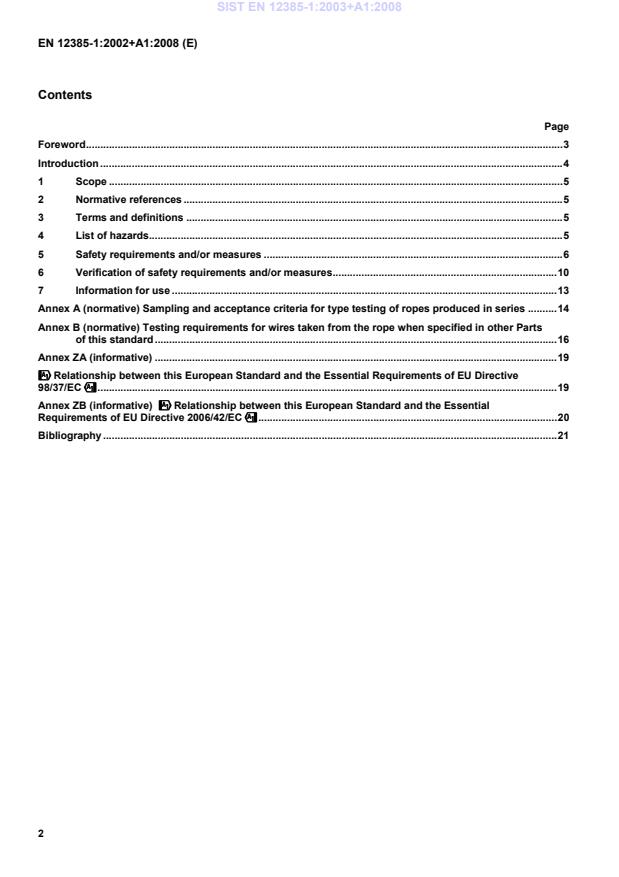
!!!!Relationship between this European Standard and the Essential Requirements of EU Directive 2006/42/EC"""".20 Bibliography.21
Foreword This document (EN 12385-1:2002+A1:2008) has been prepared by Technical Committee CEN/TC 168, “Chains, ropes, webbing, slings and accessories – Safety”, the secretariat of which is held by BSI.
This European Standard shall be given the status of a national standard, either by publication of an identical text or by endorsement, at the latest by April 2009, and conflicting national standards shall be withdrawn at the latest by December 2009.
This document supersedes EN 12385-1:2002. This document includes Amendment 1, approved by CEN on 2008-09-09. The start and finish of text introduced or altered by amendment is indicated in the text by tags !". !This European Standard has been prepared under a mandate given to CEN by the European Commission and the European Free Trade Association, and supports essential requirements of EU Directive(s). For relationship with EU Directive(s), see informative Annexes ZA and ZB, which are integral parts of this document."
The other Parts of EN 12385 are:
Part 2: Definitions, designation and classification Part 3: Information for use and maintenance Part 4: Stranded ropes for general lifting applications Part 5: Stranded ropes for lifts Part 6: Stranded ropes for mine shafts Part 7: Locked coil ropes for mine shafts Part 8: Stranded hauling and carrying-hauling ropes for cableway installations designed to carry persons Part 9: Locked coil carrying ropes for cableway installations designed to carry persons Part 10: Spiral ropes for general structural applications
According to the CEN/CENELEC Internal Regulations, the national standards organizations of the following countries are bound to implement this European Standard: Austria, Belgium, Bulgaria, Cyprus, Czech Republic, Denmark, Estonia, Finland, France, Germany, Greece, Hungary, Iceland, Ireland, Italy, Latvia, Lithuania, Luxembourg, Malta, Netherlands, Norway, Poland, Portugal, Romania, Slovakia, Slovenia, Spain, Sweden, Switzerland and United Kingdom. SIST EN 12385-1:2003+A1:2008
Introduction This Part of this European Standard has been prepared to support Parts 4 to 10 that concern themselves with the particular requirements for steel wire ropes for use in specific applications. It cannot, therefore, exist alone. The ropes concerned and the extent to which hazards are covered for specific applications are indicated in the scopes of Parts 4 to 10.
EN 292-2:1991/A1:1995, Safety of machinery — Basic concepts, general principles of design — Part 2: Technical principles and specifications.
EN 1050:1996, Safety of machinery – Principles for risk assessment.
EN 10204:1991, Metallic products — Types of inspection documents.
EN 10244-2, Steel wire and wire products – Non ferrous metallic coatings on steel wire – Part 2: Zinc or zinc
alloy coatings.
EN 10264-1:2002, Steel wire and wire products — Steel wire for ropes — Part 1: General requirements.
EN 10264-2:2002, Steel wire and wire products – Steel wire for ropes – Part 2: Cold drawn non-alloyed steel wire for ropes for general applications.
EN 10264-3, Steel wire and wire products – Steel wire for ropes – Part 3: Cold drawn and cold shaped non-alloyed steel wire for heavy duty applications.
EN 12385-2, Steel wire ropes — Safety — Part 2: Definitions, designation and classification.
prEN 12385-3, Steel wire ropes — Safety — Part 3:Information of use and maintenance.
EN 13411-4:2002, Terminations for steel wire ropes — Safety — Part 4: Metal and resin socketing.
ISO 7500-1, Metallic materials — Verification of static uniaxial testing machines — Part 1: Tension/compression testing machines – Verification and calibration of the force-measuring system.
ISO 4345:1988, Steel wire ropes – Fibre main cores – Specification.
3 Terms and definitions For the purposes of this part of EN 12385, the terms and definitions in part 2 of EN 12385 shall apply.
4 List of hazards The release of a load due to failure of steel wire ropes puts at risk directly or indirectly the safety or health of those persons within the danger zone. SIST EN 12385-1:2003+A1:2008
For intermediate wire tensile strength grades the reverse bend and torsion properties shall be as for the next higher grade.
5.1.1.2 After ropemaking When other parts of this standard require tests to be carried out on wires taken from the rope, sampling, test methods and acceptance criteria shall be in accordance with annex B. 5.1.2
Core Fibre cores (FC) shall comply with ISO 4345 unless specified otherwise in the appropriate part of this standard.
Fibre cores (FC) for single layer stranded ropes larger than 8 mm diameter shall be doubly closed
Natural fibre cores (NFC) shall be treated with an impregnating compound to inhibit rotting and decay unless stated that the core is dry.
5.2
Rope manufacture 5.2.1
Wire joints When joints are necessary in wires over 0,4 mm they shall have their ends joined by brazing or welding.
For stranded ropes the minimum distance between joints within one strand shall be 18 × rope diameter (d).
For spiral ropes the minimum distance between joints in any wire layer shall be 36 × diameter of the wire layer. If twisting as a joint is performed on wires up to and including 0,4 mm during manufacture, the twist shall be removed from the finished rope.
NOTE 1
Wires up and including 0,4 mm can be joined by twisting or by the ends being simply inserted into the strand’s formation. NOTE 2
When joints in wires before closing are not accepted, this should be the subject of agreement (see introduction) between the purchaser and the manufacturer. SIST EN 12385-1:2003+A1:2008
5.2.3
Wire finish For ropes of bright wire finish, substitution of bright wires by zinc coated wires shall be limited to inner wires, centre wires, filler wires and core wires. For stranded ropes of zinc coated wire finish, all of the wires shall be zinc coated, including those of any steel core. Quality B coating as given in EN 10244-2 shall be used for zinc coated wires unless specified otherwise in the appropriate part of this standard.
5.2.4
Rope ends Rope ends that have no end fittings shall be so secured as to maintain the integrity of the rope and prevent its unlaying.
5.3
Physical dimensions 5.3.1
Diameter or width and thickness The nominal diameter for round ropes or the nominal width and thickness for flat ropes shall be the dimension(s) by which the rope is designated. 5.3.2
Tolerances When measured in accordance with 6.3 the measured diameter or the measured width and thickness shall not vary from the nominal by more than the tolerance(s) specified in the appropriate part of this standard. 5.4
Breaking force 5.4.1
General The minimum breaking force Fmin or, where specified in the other parts of this standard, the minimum aggregate breaking force Fe.min for a given size, grade (where applicable) and construction or class of rope shall be either, a) in accordance with the value or calculation given in the appropriate part of this standard; or b) as stated by the manufacturer. When tested in accordance with Method 1 as described in 6.4.1 the measured breaking force Fm shall be equal to or greater than the minimum breaking force Fmin.
When tested in accordance with Method 2 as described in 6.4.2 the measured aggregate breaking force Fe.m shall be equal to or greater than the minimum aggregate breaking force Fe.min.
When tested in accordance with Method 3 as described in 6.4.3 the calculated measured (post-spin) breaking force Fm.c shall be equal to or greater than the minimum breaking force Fmin.
Unless specified otherwise in the appropriate part of this standard, breaking force testing shall be in accordance with Table 1.
NOTE The requirements for breaking force testing take into account (i) the rope size, (ii) whether or not ropes are produced in series i.e. repeatedly produced, (iii) whether or not the minimum breaking force factor is consistent throughout a sub-group of rope diameters and (iv) whether or not the manufacturer is operating a quality system in accordance with
EN ISO 9001 certified by an accredited third party certification body, see 5.4.2. SIST EN 12385-1:2003+A1:2008
Ropes produced in series – manufacturer operating a quality system in accordance with
EN ISO 9001 certified by an accredited third party certification body The manufacturer shall record the results from testing in accordance with the sampling and acceptance criteria as detailed in annex A.
Additional production lengths of rope from any size grouping shall be deemed to comply with the breaking force requirements when the manufacturer has satisfactorily completed a) the appropriate type tests, refer annex A and b) a periodic test (see Table 1) in accordance with Method 1 or alternatively, Method 3, as described in 6.4, on a sample from every twentieth production length or after re-starting of production, whichever is the sooner.
If any rope subject to the periodic test fails to meet or exceed the minimum value, testing of a sample from each production length shall continue until the manufacturer satisfies the type testing requirements.
Any increase in breaking force factor for a particular construction shall also require that the type tests are repeated on the modified ropes for each of the size bands. It shall not be necessary to repeat the tests if the same breaking force factor is used for ropes using wires of a lower grade.
Table 1 — Breaking force testing requirements
Rope diameter Minimum breaking force factor Manufacturer operating a quality system in accordance with EN ISO 9001 certified by an accredited third party certification body Manufacturer NOT operating a quality system in accordance with EN ISO 9001 certified by an accredited third party certification body Up to and including 60 mm Same factor throughout a sub-group of rope diameters Breaking force test in accordance with Method 1 on a sample from each production length; or, if produced in series, Type testing in accordance with A.1.1 plus periodic breaking force test in accordance with Method 1 or Method 3 on a sample from every twentieth production length relating to the sub-group of rope diameters
Different factor throughout a sub-group of rope diameters Breaking force test in accordance with Method 1 on a sample from each production length; or, if produced in series, Type testing in accordance with A.1.2 plus periodic breaking force test in accordance with Method 1 or Method 3 on a sample from every twentieth production length of a given rope diameter and construction Breaking force test in accordance with Method 1 on a sample from each production length Over
60 mm
Breaking force test in accordance with Method 1, Method 2 or Method 3 on a sample from each production length, or, either a) if produced in a series, type testing in accordance with A.2 plus periodic breaking force test in accordance with Method 1, Method 2 or Method 3 on a sample from every twentieth production length; or b) if produced for supply as a set of ropes of the same design for a specific installation the alternative breaking force testing and sampling as also given in A.2. Breaking force test in accordance with Method 1 or Method 2 on a sample from each production length
NOTE Breaking force type testing demonstrates that a steel wire rope produced in series and certified by the manufacturer as conforming
...