


FprEN 14363-3
(Main)Railway applications - Testing and simulation for the assessment of running characteristics of rail vehicles operated on the heavy rail network - Part 3: Stationary tests not obligatory on a European level
General Information
- Abstract
This document is applicable to all rail vehicles including OTMs and Road-rail machines, which are operated on the heavy rail network with standard track gauge 1 435 mm and nominal static vertical wheelset forces up to 350 kN.
This document may also be applicable (partly or in full) to:
— rail systems with different track layout, e.g. urban rail systems and/or;
— rail systems with other than 1 435 mm nominal track gauge and/or;
— non-public rail networks and vehicles, e.g. mine rail systems.
NOTE For rail systems other than 1 435 mm track gauge or urban rail systems, the related post analysis, limit values and test conditions could be different. They are specified nationally or individually taking into account track design and operating conditions.
This document defines the assessment of rail vehicles according to stationary test methods that are not obligatory on European level:
— determination of displacement characteristics;
— loading of the diverging branch of a switch;
— running safety in curved crossings for vehicles with small wheels.
It includes information about the field of possible applications.
- Status
- Not Published
- Publication Date
- 17-Feb-2027
- Technical Committee
- CEN/TC 256 - Railway applications
- Drafting Committee
- CEN/TC 256/WG 10 - Vehicle/Track Interaction
- Current Stage
- 4599 - Dispatch of FV draft to CMC - Finalization for Vote
- Start Date
- 28-May-2026
- Due Date
- 13-Jun-2025
- Completion Date
- 28-May-2026

Overview
FprEN 14363-3 is a draft European Standard developed by CEN/TC 256 for the railway sector, focusing on Railway applications - Testing and simulation for the assessment of running characteristics of rail vehicles operated on the heavy rail network - Part 3: Stationary tests not obligatory on a European level. This standard applies to all rail vehicles, including On-Track Machines (OTMs) and road-rail machines, that operate on the heavy rail network with a standard track gauge of 1,435 mm and static vertical wheelset forces up to 350 kN. The document may also be relevant for urban rail systems, non-standard track gauges, and non-public rail networks such as mining systems, with adaptations as required by national conditions.
This standard describes stationary test methods not mandatory across Europe, providing methodologies for specific assessments where a European obligation does not exist. These methods include determining displacement characteristics, assessing the loading of the diverging branch of a switch, and evaluating running safety for vehicles with small wheels in curved crossings.
Key Topics
The main areas covered by FprEN 14363-3 include:
- Displacement Characteristics: Methods for evaluating how rail vehicle bodies displace due to lateral forces during operation. The standard defines stationary and on-track test methodologies suitable for input into gauging calculations.
- Loading of Diverging Switch Branches: Procedures for assessing vehicle-induced forces on switch blades, especially in tight-radius curves where switch fatigue is a concern.
- Safety in Curved Crossings with Small Wheels: Approaches for risk evaluation when small-wheel vehicles traverse obtuse crossings in curves, by analyzing lateral forces and wheel-rail interaction.
- Applicability Criteria: Guidance on when these stationary test methods are required, with flexibility for adaptation in systems with different track layouts or gauges.
- Documentation & Evaluation: Requirements for data documentation, assessment of results, and consideration of test environments, including track state and loading conditions.
Applications
Practical implementations of FprEN 14363-3 include:
- Rolling Stock Acceptance: Using the defined stationary tests to supplement core safety assessments and document compliance with national or operator-specific requirements.
- Infrastructure Design and Maintenance: Evaluating the interaction of vehicles with special track features, such as switches and crossings, to ensure track durability, reduce fatigue, and optimize maintenance cycles.
- Adaptation for Non-Standard Systems: Applying methodologies-partially or in full-for urban rail, narrow gauge, or private industrial railways where European-wide requirements do not fully apply.
- Model Validation: Providing test data for the validation of computer simulations and dynamic models of vehicle-track interaction.
- Customized Safety Assessment: Enabling national authorities or infrastructure managers to require specialized tests for unique operating environments or vehicle designs.
Related Standards
FprEN 14363-3 is part of the EN 14363 family of standards and works alongside several related documents:
- prEN 14363-1:2025 - General principles for the assessment of running characteristics.
- prEN 14363-2:2025 - Focuses on safety against derailment, especially on twisted track.
- prEN 14363-4:2025 - Details on-track testing procedures.
- prEN 14363-5:2025 - Emphasizes simulation and calculation approaches for performance assessment.
- EN 15273-2:2013+A1:2016 - Specifies rolling stock gauge requirements, essential for gauging analysis.
- EN 17343:2023 - General terms and definitions relevant to railway applications.
- UIC 510-2 and related ERRI/Ore reports - Reference documentation for specific technical methodologies.
Conclusion
FprEN 14363-3 supports national rail authorities, manufacturers, and operators by outlining detailed procedures for performing optional stationary tests that complement mandatory European requirements. By defining a consistent approach for diverse rail systems and infrastructure, this standard enhances safety, facilitates interoperability, and supports the certification and innovation of rail vehicles across the heavy rail network and beyond.
Keywords: railway standards, stationary testing, rail vehicle assessment, heavy rail network, switch loading, displacement characteristics, small wheel safety, EN 14363-3, CEN railway standards, rolling stock testing.
Relations
- Effective Date
- 28-Jan-2026
- Effective Date
- 28-Jan-2026
- Effective Date
- 28-Jan-2026
- Effective Date
- 28-Jan-2026
- Referred By
EN 15566:2022 - Railway applications - Railway Rolling stock - Draw gear and screw coupling - Effective Date
- 28-Jan-2026
- Effective Date
- 18-Jan-2023
- Effective Date
- 20-Oct-2021
Get Certified
Connect with accredited certification bodies for this standard

IRIS Certification (UNIFE)
International Railway Industry Standard certification.

TÜV SÜD Rail GmbH
TÜV SÜD railway certification services.

Bureau Veritas Railway Certification
Railway and transportation certification.
Sponsored listings
Frequently Asked Questions
FprEN 14363-3 is a draft published by the European Committee for Standardization (CEN). Its full title is "Railway applications - Testing and simulation for the assessment of running characteristics of rail vehicles operated on the heavy rail network - Part 3: Stationary tests not obligatory on a European level". This standard covers: This document is applicable to all rail vehicles including OTMs and Road-rail machines, which are operated on the heavy rail network with standard track gauge 1 435 mm and nominal static vertical wheelset forces up to 350 kN. This document may also be applicable (partly or in full) to: — rail systems with different track layout, e.g. urban rail systems and/or; — rail systems with other than 1 435 mm nominal track gauge and/or; — non-public rail networks and vehicles, e.g. mine rail systems. NOTE For rail systems other than 1 435 mm track gauge or urban rail systems, the related post analysis, limit values and test conditions could be different. They are specified nationally or individually taking into account track design and operating conditions. This document defines the assessment of rail vehicles according to stationary test methods that are not obligatory on European level: — determination of displacement characteristics; — loading of the diverging branch of a switch; — running safety in curved crossings for vehicles with small wheels. It includes information about the field of possible applications.
This document is applicable to all rail vehicles including OTMs and Road-rail machines, which are operated on the heavy rail network with standard track gauge 1 435 mm and nominal static vertical wheelset forces up to 350 kN. This document may also be applicable (partly or in full) to: — rail systems with different track layout, e.g. urban rail systems and/or; — rail systems with other than 1 435 mm nominal track gauge and/or; — non-public rail networks and vehicles, e.g. mine rail systems. NOTE For rail systems other than 1 435 mm track gauge or urban rail systems, the related post analysis, limit values and test conditions could be different. They are specified nationally or individually taking into account track design and operating conditions. This document defines the assessment of rail vehicles according to stationary test methods that are not obligatory on European level: — determination of displacement characteristics; — loading of the diverging branch of a switch; — running safety in curved crossings for vehicles with small wheels. It includes information about the field of possible applications.
FprEN 14363-3 is classified under the following ICS (International Classification for Standards) categories: 45.060.01 - Railway rolling stock in general. The ICS classification helps identify the subject area and facilitates finding related standards.
FprEN 14363-3 has the following relationships with other standards: It is inter standard links to EN 15502-2-1:2022, EN 15502-2-1:2022+A1:2023, EN 15551:2022, EN 15807:2021, EN 15566:2022, EN 14363:2016+A2:2022, EN 14363:2016+A1:2018. Understanding these relationships helps ensure you are using the most current and applicable version of the standard.
FprEN 14363-3 is associated with the following European legislation: Standardization Mandates: M/591. When a standard is cited in the Official Journal of the European Union, products manufactured in conformity with it benefit from a presumption of conformity with the essential requirements of the corresponding EU directive or regulation.
FprEN 14363-3 is available in PDF format for immediate download after purchase. The document can be added to your cart and obtained through the secure checkout process. Digital delivery ensures instant access to the complete standard document.
Standards Content (Sample)
SLOVENSKI STANDARD
01-september-2025
Železniške naprave - Preskušanje in simulacija za oceno voznih lastnosti
železniških vozil, ki obratujejo na omrežju težkih železniških prog - 3. del:
Stacionarni preskusi, neobvezni na evropski ravni
Railway applications - Testing and simulation for the acceptance of running
characteristics of railway vehicles operated on the heavy rail network - Part 3: Stationary
tests not obligatory on a European level
Bahnanwendungen - Prüfungen und Simulationen für die Bewertung der fahrtechnischen
Eigenschaften von Schienenfahrzeugen, die auf dem Vollbahnnetz betrieben werden -
Teil 3: Stationäre Prüfungen, die auf Europäischer Ebene nicht obligatorisch sind
Applications ferroviaires - Essais en vue de l'évaluation du comportement dynamique
des véhicules ferroviaires circulant sur un réseau du système ferroviaire lourd - Partie 3 :
Essais stationnaires non obligatoires au niveau européen
Ta slovenski standard je istoveten z: prEN 14363-3
ICS:
45.060.01 Železniška vozila na splošno Railway rolling stock in
general
2003-01.Slovenski inštitut za standardizacijo. Razmnoževanje celote ali delov tega standarda ni dovoljeno.
DRAFT
EUROPEAN STANDARD
prEN 14363-3
NORME EUROPÉENNE
EUROPÄISCHE NORM
June 2025
ICS Will supersede EN 14363:2016+A2:2022
English Version
Railway applications - Testing and simulation for the
acceptance of running characteristics of railway vehicles -
Part 3: Stationary tests not obligatory on a European level
Applications ferroviaires ¿ Essais en vue de l'évaluation Bahnanwendungen - Versuche und Simulationen für
du comportement dynamique des véhicules die Bewertung der fahrtechnischen Eigenschaften von
ferroviaires circulant sur un réseau du système Schienenfahrzeugen, die auf dem Vollbahnnetz
ferroviaire lourd ¿ Partie 3 : Essais stationnaires non betrieben werden - Teil 3: Stationäre Prüfungen, die
obligatoires au niveau Européen auf Europäischer Ebene nicht obligatorisch sind
This draft European Standard is submitted to CEN members for enquiry. It has been drawn up by the Technical Committee
CEN/TC 256.
If this draft becomes a European Standard, CEN members are bound to comply with the CEN/CENELEC Internal Regulations
which stipulate the conditions for giving this European Standard the status of a national standard without any alteration.
This draft European Standard was established by CEN in three official versions (English, French, German). A version in any other
language made by translation under the responsibility of a CEN member into its own language and notified to the CEN-CENELEC
Management Centre has the same status as the official versions.
CEN members are the national standards bodies of Austria, Belgium, Bulgaria, Croatia, Cyprus, Czech Republic, Denmark, Estonia,
Finland, France, Germany, Greece, Hungary, Iceland, Ireland, Italy, Latvia, Lithuania, Luxembourg, Malta, Netherlands, Norway,
Poland, Portugal, Republic of North Macedonia, Romania, Serbia, Slovakia, Slovenia, Spain, Sweden, Switzerland, Türkiye and
United Kingdom.
Recipients of this draft are invited to submit, with their comments, notification of any relevant patent rights of which they are
aware and to provide supporting documentation.
Warning : This document is not a European Standard. It is distributed for review and comments. It is subject to change without
notice and shall not be referred to as a European Standard.
EUROPEAN COMMITTEE FOR STANDARDIZATION
COMITÉ EUROPÉEN DE NORMALISATION
EUROPÄISCHES KOMITEE FÜR NORMUNG
CEN-CENELEC Management Centre: Rue de la Science 23, B-1040 Brussels
© 2025 CEN All rights of exploitation in any form and by any means reserved Ref. No. prEN 14363-3:2025 E
worldwide for CEN national Members.
prEN 14363-3:2025 (E)
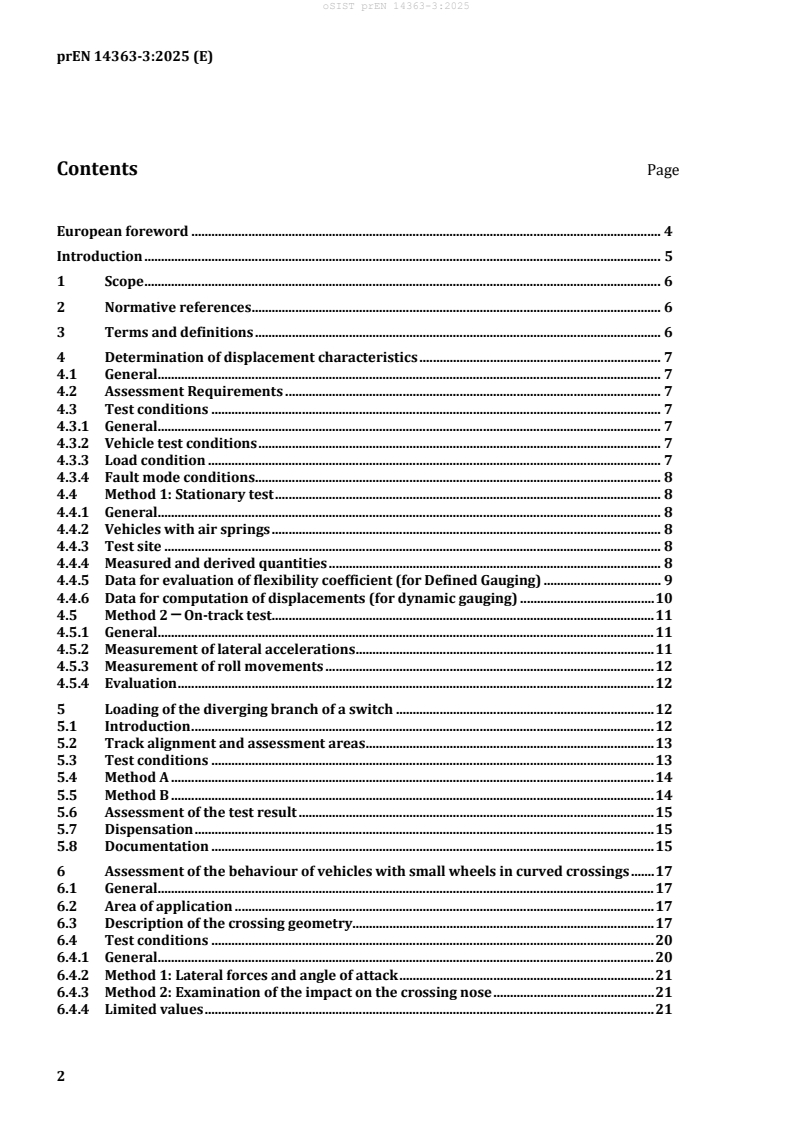
Contents Page
European foreword . 4
Introduction . 5
1 Scope . 6
2 Normative references . 6
3 Terms and definitions . 6
4 Determination of displacement characteristics . 7
4.1 General. 7
4.2 Assessment Requirements . 7
4.3 Test conditions . 7
4.3.1 General. 7
4.3.2 Vehicle test conditions . 7
4.3.3 Load condition . 7
4.3.4 Fault mode conditions . 8
4.4 Method 1: Stationary test . 8
4.4.1 General. 8
4.4.2 Vehicles with air springs . 8
4.4.3 Test site . 8
4.4.4 Measured and derived quantities . 8
4.4.5 Data for evaluation of flexibility coefficient (for Defined Gauging) . 9
4.4.6 Data for computation of displacements (for dynamic gauging) . 10
4.5 Method 2 ─ On-track test . 11
4.5.1 General. 11
4.5.2 Measurement of lateral accelerations . 11
4.5.3 Measurement of roll movements . 12
4.5.4 Evaluation . 12
5 Loading of the diverging branch of a switch . 12
5.1 Introduction . 12
5.2 Track alignment and assessment areas . 13
5.3 Test conditions . 13
5.4 Method A . 14
5.5 Method B . 14
5.6 Assessment of the test result . 15
5.7 Dispensation . 15
5.8 Documentation . 15
6 Assessment of the behaviour of vehicles with small wheels in curved crossings . 17
6.1 General. 17
6.2 Area of application . 17
6.3 Description of the crossing geometry. 17
6.4 Test conditions . 20
6.4.1 General. 20
6.4.2 Method 1: Lateral forces and angle of attack . 21
6.4.3 Method 2: Examination of the impact on the crossing nose . 21
6.4.4 Limited values . 21
prEN 14363-3:2025 (E)
6.4.5 Assessment . 22
6.4.6 Dispensation . 22
6.4.7 Simulation . 22
Bibliography . 23
prEN 14363-3:2025 (E)
European foreword
This document (prEN 14363-3:2025) has been prepared by Technical Committee CEN/TC 256 “Railway
Applications”, the secretariat of which is held by DIN.
This document is currently submitted to the CEN Enquiry.
This document together with prEN 14363-1:2025, prEN 14363-3:2025, prEN 14363-4:2025 and
prEN 14363 5:2025, will supersede EN 14363:2016+A2:2022.
The EN 14363 Series “Railway applications — Testing and Simulation for the assessment of running
characteristics of rail vehicles operated on the heavy rail network” consists of the following parts:
— prEN 14363-1:2025, General;
— prEN 14363-2:2025, Safety against derailment on twisted track;
— prEN 14363-3:2025, Stationary tests that are not obligatory on European level;
— prEN 14363-4:2025, On-track testing;
— prEN 14363-5:2025, Simulations/calculations;
— prCEN/TR 14363-6:2025, Technical Report providing background information to the EN 14363 series
of standards (under development).
prEN 14363-3:2025 (E)
Introduction
General information for the application of this document is given in prEN 14363-1:2025.
prEN 14363-3:2025 (E)
1 Scope
This document applies to all railway vehicles including OTM’s and Road-rail machines, which are
operated on the heavy rail network with standard track gauge 1 435°mm and nominal static vertical
wheelset forces up to 350 kN.
This document may also be applicable (partly or in full) to:
— rail systems with different track layout, e.g. urban rail systems and/or;
— rail systems with other than 1 435 mm nominal track gauge and/or;
— non-public rail networks and vehicles, e.g. mine rail systems.
NOTE For rail systems other than 1 435 mm track gauge or urban rail systems, the related post analysis, limit
values and test conditions could be different. They are specified nationally taking into account track design and
operating conditions.
This document contains the assessment of railway vehicles according to stationary test methods that are
not obligatory on European level:
— determination of displacement characteristics;
— loading of the diverging branch of a switch;
— running safety in curved crossings for vehicles with small wheels;
— safety against derailment under longitudinal compressive forces in S-shaped curves.
It includes information about the field of possible applications.
2 Normative references
The following documents are referred to in the text in such a way that some or all of their content
constitutes requirements of this document. For dated references, only the edition cited applies. For
undated references, the latest edition of the referenced document (including any amendments) applies.
prEN 14363-1:2025, Railway applications — Testing and Simulation for the assessment of running
characteristics of rail vehicles operated on the heavy rail network — Part 1: General
EN 15273-2:2013+A1:2016, Railway applications - Gauges - Part 2: Rolling stock gauge
EN 17343:2023, Railway applications - General terms and definitions
3 Terms and definitions
For the purposes of this document, the terms and definitions given in prEN 14363-1:2025 and
EN 17343:2023 apply.
ISO and IEC maintain terminology databases for use in standardization at the following addresses:
— ISO Online browsing platform: available at https://www.iso.org/obp/
— IEC Electropedia: available at https://www.electropedia.org/
At draft stage.
prEN 14363-3:2025 (E)
4 Determination of displacement characteristics
4.1 General
The determination of displacement characteristics are related to the requirements of
EN 15273-2:2013+A1:2016.
The tests described in this document evaluate the vehicle body's displacement characteristics caused by
lateral forces acting on the vehicle body arising from cant excess and cant deficiency. With the tests
described here it is possible to determine inputs for gauging calculations, as defined in
EN 15273-1:2013+A1:2016 and required in EN 15273-2:2013+A1:2016.
NOTE It could also be useful to apply the test to confirm that the displacements of the vehicle in roll around
the x-axis and the characteristics for the installed suspension components are within the design limits. It is also
possible to use the results for computer model validation.
Two alternative assessment methods are specified that may be used to determine the displacement
characteristics of the vehicle. Only one assessment method is required to be used.
— Assessment method 1: Vehicle while standing. The determination of the displacement
characteristics is carried out by measurements of the vehicle while standing.
— Assessment method 2: On-track testing. Determination of the displacement characteristics during
on-track tests is carried out either by measurement of accelerations in the vehicle body or by
measurement of the relative movement of parts within the vehicle together with the cant deficiency.
Alternatively, simulation as described in prEN 14363-5:2024, Clause 5 can be used.
4.2 Assessment Requirements
No assessment requirements are specified in this sub clause, only the methods of testing are defined. The
appropriate assessment requirement is determined by reference to EN 15273-2:2013+A1:2016.
4.3 Test conditions
4.3.1 General
Unless stated below, all conditions of the test vehicle shall comply with the requirements specified in
prEN 14363-1:2025, 5.3.
4.3.2 Vehicle test conditions
Single vehicles that are not subject to the influence of adjacent vehicles shall be tested separately without
any inter-vehicle constraints. Where a test on a single vehicle is not possible the influence of inter-vehicle
constraints shall be analysed in order to determine their significance.
Other vehicles such as articulated trains shall be tested with the normal configuration of the connections
to adjacent vehicles.
4.3.3 Load condition
The test vehicle shall comply with the requirements in prEN 14363-1:2025, 5.3.2 or with requirements
specified in EN 15273-2:2013+A1:2016 depending on the aim of the test.
Where test conditions do not allow the defined loading to be achieved it is permitted to simulate the
loaded condition. This load simulation should include, as far as possible, a representation of the position
of the centre of gravity of the loaded vehicle body, including height and offset.
The applied load, including offset of the load and height of centre of gravity above top of rail of the load
shall be documented in the test report.
prEN 14363-3:2025 (E)
4.3.4 Fault mode conditions
The requirements in prEN 14363-1:2025, 5.2.2 shall form the basis of determining which tests are to be
carried out.
4.4 Method 1: Stationary test
4.4.1 General
The requirements in prEN 14363-1:2025, 5.2.2 shall form the basis of determining which tests are to be
carried out.
4.4.2 Vehicles with air springs
The effect of the air spring levelling system’s response time shall be investigated. If the response time of
the levelling system affects body roll of the vehicle during the test, then the levelling valves shall be
disconnected such that the air springs act as passive elements.
4.4.3 Test site
The test shall be carried out at a measurement place consisting of track that is level in both the
longitudinal and transverse planes with provision to apply the inclination accurately. It shall be possible
to incline the plane of all wheelsets in both directions to simulate cant excess and cant deficiency at all
positions of the vehicle. The inclination of the wheelsets shall be applied simultaneously in steps to the
maximum value.
The maximum applied test cant shall be sufficient to represent the forces arising from steady-state cant
deficiency or excess.
The load path through the suspension shall be consistent with that experienced by the vehicle in
operation.
4.4.4 Measured and derived quantities
Vertical deflections or angles of the vehicle body and one wheelset shall be measured on marked points
in such a way that it is possible to derive:
— η roll angle of the wheelsets relative to the un-canted track plane (cant angle);
+ 0
— η bogie roll angle relative to η ;
— η* vehicle body roll angle relative to η ;
— s = η*/η flexibility coefficient;
Depending on the gauging method (see EN 15273-2:2013+A1:2016) additional quantities shall be
measured:
+
— Δy lateral movement of the bogie at a defined point relative to the perpendicular axis of the wheelset;
— Δy* lateral movement in the secondary suspension;
— y* lateral movement of the vehicle body at a defined point P relative to the perpendicular axis of the
wheelsets;
— h the height above the running plane of a defined point P in the longitudinal centre plane of the
P
vehicle.
prEN 14363-3:2025 (E)
Figure 1 shows the condition represented by the test. At each value of cant – from maximum negative to
maximum positive value – measured values and derived values shall be measured and evaluated.
Figure 1 — Standing vehicle on canted track (example of vehicle without bogies)
4.4.5 Data for evaluation of flexibility coefficient (for Defined Gauging)
For evaluation of the flexibility coefficient (as defined in EN 15273-1:2013+A1:2016) diagrams shall be
0 0
produced showing η* = f (η ) and y* = f (η ), if measured. To enable unambiguous evaluation of the
flexibility coefficient the tests shall be carried out for positive and negative cant, the maximum (positive
and negative) test cant shall be at least 10 % higher than the specified maximum operating cant deficiency
or cant excess. The results shall be plotted. Generally, this takes the form of a hysteresis loop. A sufficient
set of data shall be recorded to achieve a closed loop.
Figure 2 shows an example of a diagram η* = f (η ).
NOTE The crosses in the diagram indicate the measured values at different cant angles. It shows a hysteresis
of the measured roll angles which is
...