

EN ISO/ASTM 52920:2023
(Main)Additive manufacturing - Qualification principles - Requirements for industrial additive manufacturing processes and production sites (ISO/ASTM 52920:2023)
- Abstract
The requirements in this document are for part manufacturers using additive manufacturing techniques and are independent of the used material and manufacturing method.
This document specifies criteria for AM relevant processes as well as quality-relevant characteristics and factors along the additive system operations and defines activities and sequences within an additive manufacturing production site.
This document is applicable to the additive manufacturing technologies defined in ISO/ASTM 52900 and defines quality assurance measures along the manufacturing process.
Environment, health and safety aspects are not covered comprehensively in this document. The corresponding content is addressed in the equipment manufacturer guidelines and ISO/ASTM 52931, ISO 27548, ISO/ASTM 52933 and ISO/ASTM 52938-1.
This document provides requirements that are additional to those provided by a quality management system (such as ISO 9001, ISO/TS 22163, ISO 19443, EN 9100, ISO 13485, IATF 16949). Additionally, this document can be used to establish quality management system relevant content that is specific to AM-technology.
- Status
- Published
- Publication Date
- 11-Jul-2023
- Technical Committee
- CEN/TC 438 - Additive Manufacturing
- Drafting Committee
- CEN/TC 438 - Additive Manufacturing
- Current Stage
- 6060 - Definitive text made available (DAV) - Publishing
- Start Date
- 12-Jul-2023
- Completion Date
- 12-Jul-2023


Overview
EN ISO/ASTM 52920:2023 (ISO/ASTM 52920:2023) defines qualification principles and requirements for industrial additive manufacturing (AM) processes and production sites. It is aimed at part manufacturers and is independent of material and specific AM technology (applies to technologies defined in ISO/ASTM 52900). The standard specifies criteria for AM-relevant processes, quality‑relevant characteristics across additive system operations, and sequences and activities within an AM production site. It complements, rather than replaces, an organization's quality management system.
Key topics and technical requirements
The standard addresses practical, process-focused topics for AM qualification and quality assurance, including:
- Infrastructure and site requirements
- AM system installation, ancillary equipment, feedstock storage, IT infrastructure, foreign object debris (FOD) controls, and provision of process resources.
- Manufacturability assessment and review
- Design and manufacturing reviews, process finalization and post‑processing considerations.
- Qualification of additive system operations
- Scope of qualification, validation planning, process mapping, risk assessment, and creating a master validation plan.
- IQ/OQ/PQ approach
- Installation Qualification (IQ), Operational Qualification (OQ) and Performance Qualification (PQ) for AM systems and the complete process chain.
- Manufacturing plan and documentation
- Manufacturing plan specification, documentation and traceability of process steps, and required IQ/OQ/PQ documentation.
- Process-specific requirements
- Data preparation, feedstock management, system set‑up, build cycle operations, and process finalization.
- Quality assurance and controls
- Personnel competence, handling non‑conformities, continuous improvement, production run approval and part approval. Annexes cover post‑processing and supplementary guidance.
Note: Environment, health and safety (EHS) is not covered comprehensively and is addressed in equipment manufacturer guidance and other AM standards.
Applications and who should use it
This standard is intended for:
- AM part manufacturers and production site managers establishing or scaling industrial AM operations
- Process engineers and validation engineers implementing IQ/OQ/PQ for AM
- Quality managers integrating AM‑specific requirements into QMS
- Suppliers and OEMs qualifying AM processes for series production
- Auditors and certification bodies assessing AM production readiness
Use cases include qualifying new AM equipment, validating production processes for serial manufacturing, establishing traceability and control of feedstock, and documenting manufacturing plans and approvals.
Related standards
For full implementation and EHS considerations, consult:
- ISO/ASTM 52900 (AM technology taxonomy)
- ISO/ASTM 52931, ISO 27548, ISO/ASTM 52933, ISO/ASTM 52938-1 (AM safety/equipment guidance)
- Quality management standards: ISO 9001, ISO/TS 22163, ISO 19443, EN 9100, ISO 13485, IATF 16949
EN ISO/ASTM 52920:2023 is a practical foundation for robust AM qualification, traceability, and production‑level quality assurance in industrial 3D printing operations.
Relations
- Refers
ISO/ASTM 52950:2021 - Additive manufacturing — General principles — Overview of data processing - Effective Date
- 25-Aug-2026
- Refers
ISO/ASTM 52900:2021 - Additive manufacturing — General principles — Fundamentals and vocabulary - Effective Date
- 25-Aug-2026
- Effective Date
- 28-Jan-2026
- Effective Date
- 12-Feb-2026
Get Certified
Connect with accredited certification bodies for this standard

DVS-ZERT GmbH
German welding certification society.
CARES (UK Certification Authority for Reinforcing Steels)
UK certification for reinforcing steels and construction.
EWF/IIW (European/International Welding Federation)
International welding personnel certification.
Sponsored listings
Frequently Asked Questions
EN ISO/ASTM 52920:2023 is a standard published by the European Committee for Standardization (CEN). Its full title is "Additive manufacturing - Qualification principles - Requirements for industrial additive manufacturing processes and production sites (ISO/ASTM 52920:2023)". This standard covers: The requirements in this document are for part manufacturers using additive manufacturing techniques and are independent of the used material and manufacturing method. This document specifies criteria for AM relevant processes as well as quality-relevant characteristics and factors along the additive system operations and defines activities and sequences within an additive manufacturing production site. This document is applicable to the additive manufacturing technologies defined in ISO/ASTM 52900 and defines quality assurance measures along the manufacturing process. Environment, health and safety aspects are not covered comprehensively in this document. The corresponding content is addressed in the equipment manufacturer guidelines and ISO/ASTM 52931, ISO 27548, ISO/ASTM 52933 and ISO/ASTM 52938-1. This document provides requirements that are additional to those provided by a quality management system (such as ISO 9001, ISO/TS 22163, ISO 19443, EN 9100, ISO 13485, IATF 16949). Additionally, this document can be used to establish quality management system relevant content that is specific to AM-technology.
The requirements in this document are for part manufacturers using additive manufacturing techniques and are independent of the used material and manufacturing method. This document specifies criteria for AM relevant processes as well as quality-relevant characteristics and factors along the additive system operations and defines activities and sequences within an additive manufacturing production site. This document is applicable to the additive manufacturing technologies defined in ISO/ASTM 52900 and defines quality assurance measures along the manufacturing process. Environment, health and safety aspects are not covered comprehensively in this document. The corresponding content is addressed in the equipment manufacturer guidelines and ISO/ASTM 52931, ISO 27548, ISO/ASTM 52933 and ISO/ASTM 52938-1. This document provides requirements that are additional to those provided by a quality management system (such as ISO 9001, ISO/TS 22163, ISO 19443, EN 9100, ISO 13485, IATF 16949). Additionally, this document can be used to establish quality management system relevant content that is specific to AM-technology.
EN ISO/ASTM 52920:2023 is classified under the following ICS (International Classification for Standards) categories: 25.030 - Additive manufacturing. The ICS classification helps identify the subject area and facilitates finding related standards.
EN ISO/ASTM 52920:2023 has the following relationships with other standards: It is inter standard links to ISO/ASTM 52950:2021, ISO/ASTM 52900:2021, EN 16116-2:2024, ISO/ASTM 52920:2023. Understanding these relationships helps ensure you are using the most current and applicable version of the standard.
EN ISO/ASTM 52920:2023 is available in PDF format for immediate download after purchase. The document can be added to your cart and obtained through the secure checkout process. Digital delivery ensures instant access to the complete standard document.
Standards Content (Sample)
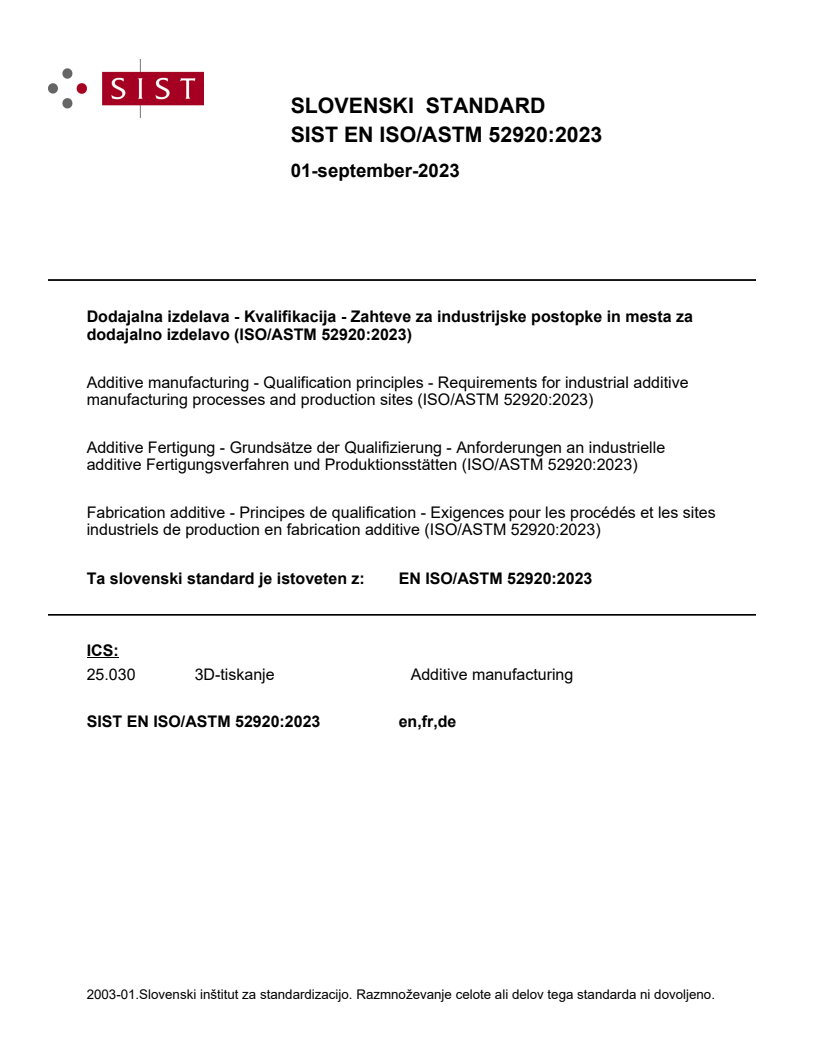
SLOVENSKI STANDARD
01-september-2023
Dodajalna izdelava - Kvalifikacija - Zahteve za industrijske postopke in mesta za
dodajalno izdelavo (ISO/ASTM 52920:2023)
Additive manufacturing - Qualification principles - Requirements for industrial additive
manufacturing processes and production sites (ISO/ASTM 52920:2023)
Additive Fertigung - Grundsätze der Qualifizierung - Anforderungen an industrielle
additive Fertigungsverfahren und Produktionsstätten (ISO/ASTM 52920:2023)
Fabrication additive - Principes de qualification - Exigences pour les procédés et les sites
industriels de production en fabrication additive (ISO/ASTM 52920:2023)
Ta slovenski standard je istoveten z: EN ISO/ASTM 52920:2023
ICS:
25.030 3D-tiskanje Additive manufacturing
2003-01.Slovenski inštitut za standardizacijo. Razmnoževanje celote ali delov tega standarda ni dovoljeno.
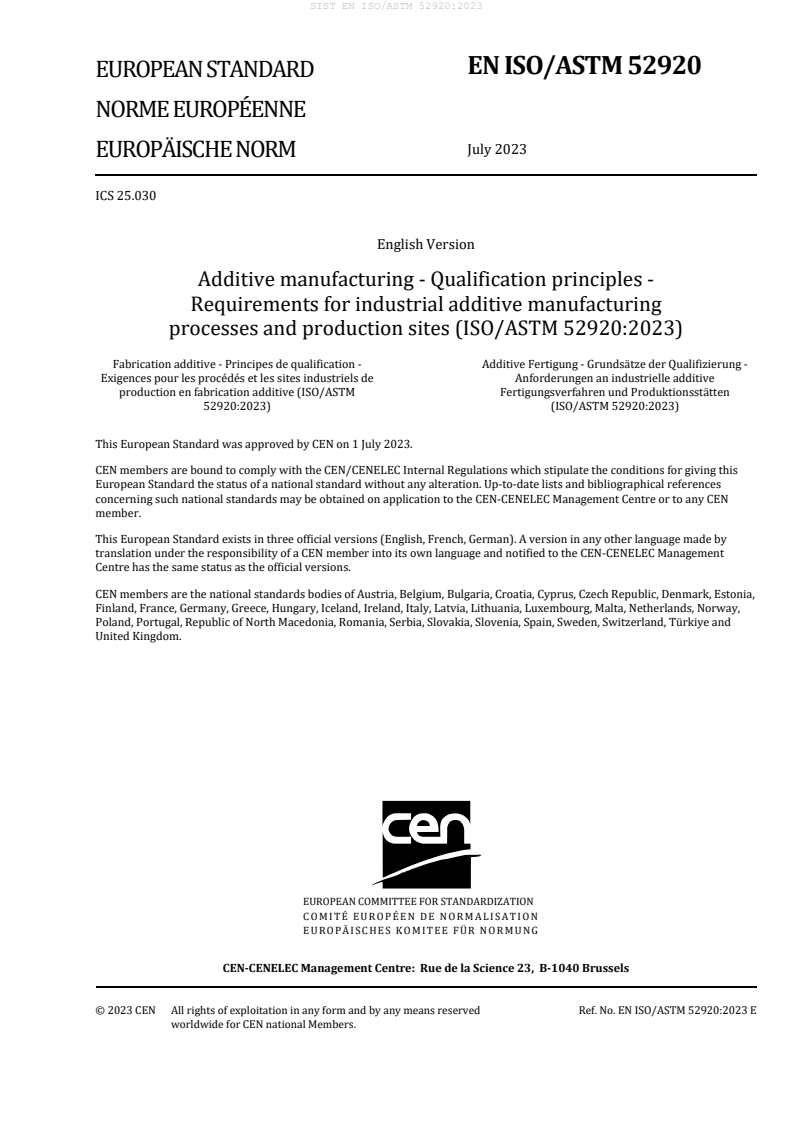
EN ISO/ASTM 52920
EUROPEAN STANDARD
NORME EUROPÉENNE
July 2023
EUROPÄISCHE NORM
ICS 25.030
English Version
Additive manufacturing - Qualification principles -
Requirements for industrial additive manufacturing
processes and production sites (ISO/ASTM 52920:2023)
Fabrication additive - Principes de qualification - Additive Fertigung - Grundsätze der Qualifizierung -
Exigences pour les procédés et les sites industriels de Anforderungen an industrielle additive
production en fabrication additive (ISO/ASTM Fertigungsverfahren und Produktionsstätten
52920:2023) (ISO/ASTM 52920:2023)
This European Standard was approved by CEN on 1 July 2023.
CEN members are bound to comply with the CEN/CENELEC Internal Regulations which stipulate the conditions for giving this
European Standard the status of a national standard without any alteration. Up-to-date lists and bibliographical references
concerning such national standards may be obtained on application to the CEN-CENELEC Management Centre or to any CEN
member.
This European Standard exists in three official versions (English, French, German). A version in any other language made by
translation under the responsibility of a CEN member into its own language and notified to the CEN-CENELEC Management
Centre has the same status as the official versions.
CEN members are the national standards bodies of Austria, Belgium, Bulgaria, Croatia, Cyprus, Czech Republic, Denmark, Estonia,
Finland, France, Germany, Greece, Hungary, Iceland, Ireland, Italy, Latvia, Lithuania, Luxembourg, Malta, Netherlands, Norway,
Poland, Portugal, Republic of North Macedonia, Romania, Serbia, Slovakia, Slovenia, Spain, Sweden, Switzerland, Türkiye and
United Kingdom.
EUROPEAN COMMITTEE FOR STANDARDIZATION
COMITÉ EUROPÉEN DE NORMALISATION
EUROPÄISCHES KOMITEE FÜR NORMUNG
CEN-CENELEC Management Centre: Rue de la Science 23, B-1040 Brussels
© 2023 CEN All rights of exploitation in any form and by any means reserved Ref. No. EN ISO/ASTM 52920:2023 E
worldwide for CEN national Members.
Contents Page
European foreword . 3
European foreword
This document (EN ISO/ASTM 52920:2023) has been prepared by Technical Committee ISO/TC 261
"Additive manufacturing" in collaboration with Technical Committee CEN/TC 438 “Additive
Manufacturing” the secretariat of which is held by AFNOR.
This European Standard shall be given the status of a national standard, either by publication of an
identical text or by endorsement, at the latest by January 2024, and conflicting national standards shall
be withdrawn at the latest by January 2024.
Attention is drawn to the possibility that some of the elements of this document may be the subject of
patent rights. CEN shall not be held responsible for identifying any or all such patent rights.
Any feedback and questions on this document should be directed to the users’ national standards
body/national committee. A complete listing of these bodies can be found on the CEN website.
According to the CEN-CENELEC Internal Regulations, the national standards organizations of the
following countries are bound to implement this European Standard: Austria, Belgium, Bulgaria,
Croatia, Cyprus, Czech Republic, Denmark, Estonia, Finland, France, Germany, Greece, Hungary, Iceland,
Ireland, Italy, Latvia, Lithuania, Luxembourg, Malta, Netherlands, Norway, Poland, Portugal, Republic of
North Macedonia, Romania, Serbia, Slovakia, Slovenia, Spain, Sweden, Switzerland, Türkiye and the
United Kingdom.
Endorsement notice
The text of ISO/ASTM 52920:2023 has been approved by CEN as EN ISO/ASTM 52920:2023 without
any modification.
INTERNATIONAL ISO/ASTM
STANDARD 52920
First edition
2023-06
Additive manufacturing —
Qualification principles —
Requirements for industrial additive
manufacturing processes and
production sites
Fabrication additive — Principes de qualification — Exigences pour
les procédés et les sites industriels de production en fabrication
additive
Reference number
ISO/ASTM 52920:2023(E)
© ISO/ASTM International 2023
ISO/ASTM 52920:2023(E)
© ISO/ASTM International 2023
All rights reserved. Unless otherwise specified, or required in the context of its implementation, no part of this publication may
be reproduced or utilized otherwise in any form or by any means, electronic or mechanical, including photocopying, or posting on
the internet or an intranet, without prior written permission. Permission can be requested from either ISO at the address below
or ISO’s member body in the country of the requester. In the United States, such requests should be sent to ASTM International.
ISO copyright office ASTM International
CP 401 • Ch. de Blandonnet 8 100 Barr Harbor Drive, PO Box C700
CH-1214 Vernier, Geneva West Conshohocken, PA 19428-2959, USA
Phone: +41 22 749 01 11 Phone: +610 832 9634
Fax: +610 832 9635
Email: copyright@iso.org Email: khooper@astm.org
Website: www.iso.org Website: www.astm.org
Published in Switzerland
ii
© ISO/ASTM International 2023 – All rights reserved
ISO/ASTM 52920:2023(E)
Contents Page
Foreword .v
Introduction . vi
1 Scope . 1
2 Normative references . 1
3 Terms and definitions . 1
4 Overview of AM related processes . 2
5 Infrastructure of the part manufacturer . 3
5.1 Environmental, health and safety (EHS) . 3
5.2 Waste disposal . 3
5.3 AM system installation . 3
5.4 Ancillary equipment . 4
5.5 Feedstock storage . 4
5.6 IT infrastructure . 4
5.7 Foreign object debris (FOD) . 4
5.8 Provision of the process resources . 4
5.9 Manufacturing management system . 5
5.10 Maintenance/calibration system . 5
6 Manufacturability assessment and review. 5
6.1 General . 5
6.2 Design assessment and review . 5
6.3 Manufacturing assessment and review . 6
6.3.1 Additive manufacturing process. 6
6.3.2 Process finalization . 6
6.3.3 Post processing . 6
7 Qualification of the additive system operations . 6
7.1 General . 6
7.2 Scope of qualification . 7
7.3 Validation planning . 7
7.3.1 Process mapping . 7
7.3.2 Risk assessment . 7
7.3.3 Master validation plan . 8
7.4 Qualification [installation, operation, and performance (IQ/OQ/PQ)] . 8
7.5 Manufacturing plan specification . 9
7.6 Documentation and tracing of the process steps . 10
7.6.1 General . 10
7.6.2 Manufacturing plan . 10
7.6.3 IQ documents . 10
7.6.4 OQ/PQ documents for the complete process . 11
7.7 Relevant process steps within the additive system operations . 11
7.7.1 Overview of additive system operations . 11
7.7.2 Requirements for pre-process: data preparation . 11
7.7.3 Requirements for feedstock management .13
7.7.4 Requirements for pre-process: system set-up . 15
7.7.5 Requirements for additive manufacturing: build cycle . 16
7.7.6 Requirements for AM-process: process finalization . 17
8 Quality assurance .19
8.1 General . 19
8.2 Personnel requirements . 19
8.3 Non-conformities . 20
8.3.1 General .20
8.3.2 Acceptance criteria .20
iii
© ISO/ASTM International 2023 – All rights reserved
ISO/ASTM 52920:2023(E)
8.3.3 Handling of non-conformities . 20
8.4 Continuous improvement process. 21
8.5 Quality controls . 21
8.5.1 General . 21
8.5.2 Production run approval . 22
8.5.3 Part approval .23
Annex A (informative) Requirements for Post-processing and part approval .24
Annex B (informative) Supplementary information .26
Bibliography .34
iv
© ISO/ASTM International 2023 – All rights reserved
ISO/ASTM 52920:2023(E)
Foreword
ISO (the International Organization for Standardization) is a worldwide federation of national standards
bodies (ISO member bodies). The work of preparing International Standards is normally carried out
through ISO technical committees. Each member body interested in a subject for which a technical
committee has been established has the right to be represented on that committee. International
organizations, governmental and non-governmental, in liaison with ISO, also take part in the work.
ISO collaborates closely with the International Electrotechnical Commission (IEC) on all matters of
electrotechnical standardization.
The procedures used to develop this document and those intended for its further maintenance are
described in the ISO/IEC Directives, Part 1. In particular, the different approval criteria needed for the
different types of ISO documents should be noted. This document was drafted in accordance with the
editorial rules of the ISO/IEC Directives, Part 2 (see www.iso.org/directives).
Attention is drawn to the possibility that some of the elements of this document may be the subject of
patent rights. ISO shall not be held responsible for identifying any or all such patent rights. Details of
any patent rights identified during the development of the document will be in the Introduction and/or
on the ISO list of patent declarations received (see www.iso.org/patents).
For an explanation of the voluntary nature of standards, the meaning of ISO specific terms and
expressions related to conformity assessment, as well as information about ISO's adherence to
the World Trade Organization (WTO) principles in the Technical Barriers to Trade (TBT), see
www.iso.org/iso/foreword.html.
This document was prepared by Technical Committee ISO/TC 261, Additive manufacturing, in
cooperation with ASTM Committee F42, Additive Manufacturing Technologies, on the basis of a
partnership agreement between ISO and ASTM International with the aim to create a common set of
ISO/ASTM standards on Additive Manufacturing, and in collaboration with the European Committee
for Standardization (CEN) Technical Committee CEN/TC 438, Additive manufacturing, in accordance
with the Agreement on technical cooperation between ISO and CEN (Vienna Agreement).
Any feedback or questions on this document should be directed to the user’s national standards body. A
complete listing of these bodies can be found at www.iso.org/members.html.
v
© ISO/ASTM International 2023 – All rights reserved
ISO/ASTM 52920:2023(E)
Introduction
Additive manufacturing increasingly represents an attractive alternative to more conventional
manufacturing method for companies. The trend towards complex parts, decentralised manufacturing
and customised products allows economically viable application for a wider area. This applies to an
increasing number of serial applications, which pose new requirements to the processes’ performance.
In particular, high quality and safety requirements need to be fulfilled for components used for various
applications in several branches of industry, including but not limited to: automotive, mechanical
engineering, railway, aerospace, processing plants and medical. Historically, this need has been
addressed by the definition of the processes for the manufacturing of parts individually for each case,
which entails a high degree of expense, and which permits little transparency and hence little trust
amongst stakeholders in the process.
If industrial parts are produced using additive manufacturing techniques, it should be verified that
these meet the requirements placed on them. To this end, the process sequence and environment should
be designed in a way that the process quality and part quality remain consistent and reproducible at all
times.
The document outlines the relevant requirements to establish quality-assured processes in additive
manufacturing.
This document has the aim of outlining the requirements as an integral whole (not product specifically),
which are necessary as a basis for designing processes for high-quality parts made by additive
manufacturing. In particular, in regulated industries, such as the automotive industry, mechanical
engineering, the rail sector, aerospace, process and industrial systems or medical technology,
consideration of the criteria defined within the framework of this document will establish a basis for
fulfilling the requirements for specific products.
Important measures relating to the additive system operations are defined, which are to be controlled
and monitored in order to ensure a reproducible quality of AM parts. As this document is not intended
to be technology-dependent, the sub-processes are either applicable or can be disregarded, depending
on the technology used.
This document provides a common approach for the proper manufacturing of additively manufactured
series and replacement parts. In this way, the scope of a supplier audit can be minimised if the
requirements of this document are fulfilled.
vi
© ISO/ASTM International 2023 – All rights reserved
INTERNATIONAL STANDARD ISO/ASTM 52920:2023(E)
Additive manufacturing — Qualification principles —
Requirements for industrial additive manufacturing
processes and production sites
1 Scope
The requirements in this document are for part manufacturers using additive manufacturing techniques
and are independent of the used material and manufacturing method.
This document specifies criteria for AM relevant processes as well as quality-relevant characteristics
and factors along the additive system operations and defines activities and sequences within an
additive manufacturing production site.
This document is applicable to the additive manufacturing technologies defined in ISO/ASTM 52900
and defines quality assurance measures along the manufacturing process.
Environment, health and safety aspects are not covered comprehensively in this document. The
corresponding content is addressed in the equipment manufacturer guidelines and ISO/ASTM 52931,
1) 2)
ISO 27548 , ISO/ASTM 52933 and ISO/ASTM 52938-1 .
This document provides requirements that are additional to those provided by a quality management
system (such as ISO 9001, ISO/TS 22163, ISO 19443, EN 9100, ISO 13485, IATF 16949). Additionally, this
document can be used to establish quality management system relevant content that is specific to AM-
technology.
2 Normative references
The following documents are referred to in the text in such a way that some or all of their content
constitutes requirements of this document. For dated references, only the edition cited applies. For
undated references, the latest edition of the referenced document (including any amendments) applies.
ISO/ASTM 52900, Additive manufacturing — General principles — Fundamentals and vocabulary
ISO/ASTM 52950, Additive manufacturing — General principles — Overview of data processing
3 Terms and definitions
For the purposes of this document, the terms and definitions given in ISO/ASTM 52900 and the
following apply.
ISO and IEC maintain terminological databases for use in standardization at the following addresses:
— ISO Online browsing platform: available at https:// www .iso .org/ obp
— IEC Electropedia: available at https:// www .electropedia .org/
1) Under preparation. Stage at the time of publication: ISO/DIS 27548:2023.
2) Under preparation. Stage at the time of publication: ISO/ASTM DIS 52938-1:2023.
© ISO/ASTM International 2023 – All rights reserved
ISO/ASTM 52920:2023(E)
3.1
rework, verb
unplanned operation, or series of operations performed on a nonconforming part to make it conform to
the requirements
Note 1 to entry: Rework of nonconforming parts should be performed by an approved process and does not
require customer approval.
EXAMPLE Required hole in part is drilled too small. Part is reworked by drilling the hole to the specified
width by the approved drill process.
3.2
repair, verb
operation, or series of operations performed to preserve or to restore the function of a defect part or
product
Note 1 to entry: Repair of nonconforming parts require customer approval.
EXAMPLE Part is broken or damaged (e.g. dent in part or something broke off part), but the specified
requirements can still be restored/preserved (e.g. dent is filled or the broken off piece is added/replaced).
3.3
reuse, verb
supply and process used feedstock (3.4) in subsequent build cycles
Note 1 to entry: Reuse of feedstock such as powders or resins normally requires additional processing, such as
sieving, or drying of powders or filtering of photopolymer resins.
Note 2 to entry: Reuse can include blending of different batches of feedstock, such as blending or used and virgin
material, or blending of used material from different batches.
3.4
used feedstock
feedstock that has been supplied to an AM machine that has been subjected to at least one previous
build cycle
3.5
additive system operations
operation of an entire additive system or any component of an additive manufacturing system
Note 1 to entry: Additive systems operations typically include data preparation, system set-up, build-cycle
operation, feedstock management and process finalization.
Note 2 to entry: Additive system operations are illustrated in Figure 4.
3.6
process finalization
process steps which are an intrinsic portion of an AM process category but are not part of the build
cycle
Note 1 to entry: Examples for process finalization, see 7.7.6
4 Overview of AM related processes
In order to ensure high quality within an industrial AM production site, all AM relevant processes
(see Figure 1) shall be considered. In the following document, all processes shown in Figure 1 will be
discussed in detail and corresponding requirements will be given.
A quality management system (e.g. ISO 9001, ISO/TS 22163, ISO 19443, EN 9100, ISO 13485, IATF
16949) should be in place when the AM part manufacturer applies this document.
© ISO/ASTM International 2023 – All rights reserved
ISO/ASTM 52920:2023(E)
Figure 1 — Overview of AM relevant processes in an AM production site
5 Infrastructure of the part manufacturer
5.1 Environmental, health and safety (EHS)
Conformity to local statutory regulations regarding environmental, health and safety requirements
shall be ensured. This includes explosion protection and personnel instruction concerning the
occupational safety measures and equipment.
EXAMPLE Ventilation system appropriate for the processed materials; personal protective equipment.
5.2 Waste disposal
The categorisation into hazard levels of wear parts, waste feedstock and excessive material is
recommended for appropriate disposal.
5.3 AM system installation
Utilities requirements (e.g. electricity, inert gases, ventilation) and operating conditions shall be
collected, planned, and completed.
The specifications of the equipment manufacturer in respect to ambient and installation conditions
shall be met. In case of deviation from the manufacturer’s machine specifications, the reasons shall be
documented.
NOTE When installing new machines, the conditions of already installed ones can be compromised.
Based on the requirements for the additive manufacturing technique, the installation conditions can
comprise the following aspects:
a) logged installation conditions and qualification of the additive system;
b) logs covering all other quality-relevant influencing factors on the function of a system;
c) cleanliness of the production environment;
d) climate controlled rooms with controlled or permissible temperature, humidity, light conditions,
air particle components;
e) extensive availability, minimum distance to neighbouring systems and equipment;
f) floor load capacity and evenness of the ground, absence of vibration;
© ISO/ASTM International 2023 – All rights reserved
ISO/ASTM 52920:2023(E)
g) no undesired sources that generate or extract heat in the vicinity;
h) no one-sided and/or local heating or cooling of the system;
i) absence of interference sources with high-frequency and electromagnetic radiation.
5.4 Ancillary equipment
Utilities requirements (e.g. electricity, inert gases, ventilation) and operating conditions shall be
collected, planned, and completed. This includes all post processing equipment which affects product
quality. This equipment can include, but is not limited to
a) sieving station, powder blender,
b) de-powdering system, blast cabinets, vibratory grinding machine,
c) band saw/wire cutting system,
d) UV oven, impregnation system, heating furnace, HIP furnace, and
e) testing and inspection equipment (e.g. calipers, scales, 3D-scanner).
5.5 Feedstock storage
The organization shall establish, maintain, and document the procedure necessary to ensure the
feedstock quality. Temperature and humidity in a specified range shall be ensured.
5.6 IT infrastructure
The following aspects shall be fulfilled by the manufacturer:
a) security of the server landscape;
b) security of remote production survey systems;
c) maintenance of remote data access systems (e.g. see IEC 62443, ISO 27001);
d) provision of the IT hardware;
e) protection and archiving systems.
5.7 Foreign object debris (FOD)
Cleanliness of the equipment shall be maintained by the manufacturer:
a) All tools and operating media shall be as free from FOD as specified in the manufacturing plan (see
7.6.2).
b) Appropriate measures shall be taken to prevent cross-contamination of feedstock.
EXAMPLE Same machine operator works across several materials and working stations without proper
procedures for changing/cleaning their PPE/clothing.
5.8 Provision of the process resources
The manufacturer shall ensure
a) uniquely marked tools (e.g. pliers, screws), and
b) sufficient operating media (compressed air, filter cascades, inert gas supply: temperature and
purity, coolant, wearing parts, etc.).
© ISO/ASTM International 2023 – All rights reserved
ISO/ASTM 52920:2023(E)
EXAMPLE Allocation of a toolbox per material; inventories of disposable layer deposition systems.
5.9 Manufacturing management system
The manufacturer shall ensure that the correct steps occur in the qualified sequence with the
corresponding parameters. This includes planning the machine capacity utilisation and available
feedstock corresponding to a defined minimum level.
NOTE Efficient resource planning reduces machine downtime resulting in opportunity cost.
5.10 Maintenance/calibration system
The manufacturer shall maintain a system to document equipment preventative/predictive
maintenance and calibration history.
6 Manufacturability assessment and review
6.1 General
The part manufacturer shall perform a manufacturability assessment and review.
Upon receipt of the customer order, the part manufacturer shall review the data from the customer to
ensure all requirements, specifications, drawings and CAD models are clear and complete. Customer
requirements can extend to production requirements such as heat treatment profile, build platform
thickness, feedstock properties, batch purity or alternatively powder tests before build cycle.
This assessment and review include manufacturing feasibility. Any issues shall be reviewed with the
customer/design authority for possible resolutions.
EXAMPLE Reference in the offer to part-unspecific material data sheet and standardised quality control.
Figure 2 shows the two individual steps for manufacturability assessment and review.
Figure 2 — Steps of manufacturability assessment and review
The assessment and review shall be performed by suitable personnel (see 8.2). It is important to include
all part requirements.
6.2 Design assessment and review
The process-relevant design directives should be consulted to evaluate the manufacturing feasibility
of the design. In addition, process-relevant manufacturing restrictions shall also be taken into
consideration, such as minimum wall thicknesses and support accessibility.
EXAMPLE Aspect ratio of struts, holes, slits, gap size for joints or installation suitability of parts belonging
together.
NOTE Further guidance is provided in ISO/ASTM 52910:2018, 6.8.
© ISO/ASTM International 2023 – All rights reserved
ISO/ASTM 52920:2023(E)
6.3 Manufacturing assessment and review
6.3.1 Additive manufacturing process
a) It shall be checked whether the desired part, including the part properties, can be manufactured
with the machine/material combination. The process parameters for the machine / material
combination will be qualified in 7.2.
EXAMPLE Minimum and maximum wall thicknesses within the desired part are compared to the
qualified wall thickness range for the parameter set(s) for the selected material.
b) Check of dimensions/tolerances (see ISO/ASTM 52910:2018, 6.6): the tolerances specified in the
design shall be attainable in the selected manufacturing process.
EXAMPLE Due to the process, fitting holes are not mapped. The required tolerances of holes are only
attainable by further processing (drilling).
Thermal effects, such as cooling of the part or thermal post-treatment, can influence the part
dimensions. This shall be considered before the start of the manufacturing process.
c) Check of material/material properties (see ISO/ASTM 52910:2018, 6.7): the manufacturing
feasibility shall be considered beyond the selected technology, depending on the material over the
entire manufacturing process. The specified material properties shall be incorporated here.
EXAMPLE 1 Ceramic-filled resins exhibit different manufacturing restrictions than pure photopolymers –
even with the same AM machine.
EXAMPLE 2 Brittle materials (e.g. some titanium alloys) cannot sometimes be processed further
mechanically.
Thermal effects, such as cooling of the part or thermal post-treatment, can influence the material
properties. This shall be considered before the start of the manufacturing process.
6.3.2 Process finalization
It shall be checked whether the design is appropriate for process finalization operations required by
the selected AM technology.
EXAMPLE 1 Check in advance concerning whether it is possible to remove raw material remaining after the
process from internal cavities. A part can be suitable for additive manufacturing, but not useful for the intended
application e.g. due to powder caking in cavities after heat treatment.
EXAMPLE 2 Multi-step process such as BJT of metals (described in ISO/ASTM 52900:2021 Annex B).
6.3.3 Post processing
If a further (semi-)automated manufacturing or inspection step occurs, it shall be checked whether the
design is appropriate for this, if auxiliaries cannot be used.
EXAMPLE If machining is carried out to attain the required manufacturing tolerances, corresponding
clamping points are to be provided as early as the data processing, if necessary.
7 Qualification of the additive system operations
7.1 General
The purpose of process qualification is to quantify the process location and dispersion parameters with
regard to a certain property and thus ensure that the additive system operations can produce parts
repeatable that meet specified requirements. Elements of process qualification and validation, as per
ISO/ASTM TS 52930, are shown in Figure 3 and are briefly described.
© ISO/ASTM International 2023 – All rights reserved
ISO/ASTM 52920:2023(E)
Figure 3 — Elements of process qualification and validation
7.2 Scope of qualification
Based on risk assessment, use-case or authority/regulatory requirements, the process qualification
shall either be part-specific (process adjusted to part requirements), e.g. purpose of process clearance
for serial production of a certain part, or process generic (parts adjusted to process performance), e.g.
purpose of process clearance for production of changing parts of the same material.
Changes to the qualified additive system should be evaluated individually for the need of re-qualification
depending on the quality impact to the process or the part (e.g. hardware, firmware, power source,
machine repair, machine relocation, feedstock specifications). Where the evaluation concludes that
the process or part is impacted by the change, a re-qualification shall be performed. Where there is
no impact, re-qualification is not required. A record of the evaluation which includes changes in work
procedures, parameter sets, evaluation method/s and the quality impact shall be retained by the
organization. The master validation plan (see 7.3.3) shall list all cases when re-validation is required or
not required.
NOTE 1 The phased approach of a qualification followed by production mode supports a flexible and cost-
effective AM production for multiple applications. This also allows the concept of a direct inspection on a
production run for yet unqualified values (e.g. one large part with many test artifacts to assess and ensure new
material characteristics).
NOTE 2 Some industries refer to product specific as “build” qualification, which is encompassed in 6.3.
NOTE 3 Effort for (re)qualification can be reduced when changing one variable at a time: e.g. AM machine
(same machine model), process parameter set (modification of a single variable), feedstock (same composition
from a new supplier).
7.3 Validation planning
7.3.1 Process mapping
To ensure that all processes, interactions and influences are understood, a comprehensive process map
should be created (e.g. as process flow chart, typically pictorially) showing the sequence of operations
of the individual process steps and other relevant information.
7.3.2 Risk assessment
The method of risk assessment should be agreed upon between the part manufacturer and design
authority prior to starting (e.g. with PFMEA or PFMECA as described in standards such as IEC 60812
or AS 13004). For general risk assessment, it can be referred to ISO 14971 and ISO 31000. Output of
the risk assessment shall be used to define requirements for inspections according to AM part and AM
process categories.
NOTE 1 There are currently plans to develop an AM process category specific risk evaluation standard.
The current common practice is to use the system manufacturer documentation, industry best-practices and
experiences.
© ISO/ASTM International 2023 – All rights reserved
ISO/ASTM 52920:2023(E)
NOTE 2 It is useful to document all relevant parameters and variables for each single process step. A helpful
tool for this can be the turtle model, which helps to define the most relevant parts of the process [input, output,
material and equipment, competence/skill/training, support processes/procedures and methods and key
performance Indicators (KPI)].
7.3.3 Master validation plan
a) Validation plan: the part manufacturer shall define a validation plan for the series part. The pre-
requisite is qualification of the material for a definite sequence of additive system operations (see
7.7). The plan shall contain the relevant test methods according to work instructions, procedural
steps and/or other quality assurance elements. The part production is validated in a one, two or
three stage process described in B.1 or ISO/ASTM 52901:2017, 4.5.1. Each stage is successfully
completed upon signing by suitable personnel. The customer / design authority could request
approval of the validation plan. The test methods can be applied to the parts themselves, associated
production run values or co-built test artifacts.
The methodical recording of the part requirements can be derived from different sources (e.g.
ISO/ASTM 52901, ISO/ASTM 52904 or ISO/ASTM TS 52930). The inspection and test plan with
defined limits to demonstrate fulfilment of part requirements can include requirements listed in
ISO 17296-3:2014, 4.3. This makes it possible to derive which validations can be necessary beyond
this document. Part marking can alter the validation effort if area, technique (during AM, laser
engraving, labelling), indent or text size is not properly specified.
b) Execution of validation plan/report: the part manufacturer shall monitor and measure the part
characteristics to verify that its requirements have been met. This shall be carried out at applicable
stages of the manufacturing process in accordance with the validation plan that can contain
application-specific instructions. The results of testing shall be documented in report(s). The
customer/design authority could request approval of the validation report:
1) Evidence of conformity to the acceptance criteria at each stage of the process shall be
maintained. The identity of the person performing any inspection or testing and authorising
release of part shall be recorded. As appropriate, records shall identify the test equipment used
to perform measurement activities both during qualification and production.
2) Part release and service delivery shall not proceed until the planned and documented
validation report have been satisfactorily completed.
7.4 Qualification [installation, operation, and performance (IQ/OQ/PQ)]
a) Proof of evidence regarding compliance with the specified installation conditions shall be provided
by corresponding documents (service report, final acceptance report, reports on modifications to
the system, designation of the machine type including version status of the software components
and, if applicable, version status of the hardware components, machine identification number). All
quality-relevant system parameters shall be included in the documentation.
b) The process qualification forms the basis for both the identification of reproducible material
properties as well as evaluation of the current process quality. This requires testing of reference
samples, to a statistically significant extent, that includes all qualified process steps defined by the
manufacturing plan.
c) The scope and frequency for controlling the process quality shall be defined and documented
...