

EN ISO 4892-3:2024
(Main)Plastics - Methods of exposure to laboratory light sources - Part 3: Fluorescent UV lamps (ISO 4892-3:2024)
- Abstract
This document specifies methods for exposing plastic specimens to fluorescent UV lamp radiation, heat and water in apparatus designed to simulate the weathering effects that occur when plastic materials are exposed in actual end-use environments to global solar radiation, or to window-glass filtered solar radiation.
Fluorescent UV lamp exposures for paints, varnishes and other coatings are described in ISO 16474-3.
- Status
- Published
- Publication Date
- 22-Oct-2024
- Technical Committee
- CEN/TC 249 - Plastics
- Drafting Committee
- CEN/TC 249 - Plastics
- Current Stage
- 6060 - Definitive text made available (DAV) - Publishing
- Start Date
- 23-Oct-2024
- Completion Date
- 23-Oct-2024
Overview - EN ISO 4892-3:2024 (ISO 4892-3:2024)
EN ISO 4892-3:2024 specifies laboratory methods for exposing plastic specimens to fluorescent UV lamps, together with controlled heat and water, to simulate the weathering effects of real-world sun or window-glass filtered solar radiation. This fifth-edition standard (adopted by CEN in October 2024) updates the previous 2016 version and provides procedures, apparatus requirements and reporting guidance for accelerated UV-weathering tests on plastics.
Key topics and technical requirements
- Scope & principle: Uses fluorescent UV lamps to reproduce the short-wavelength UV component of solar radiation and combines UV, temperature and wetting cycles to simulate outdoor degradation.
- Apparatus: Requirements for laboratory light sources, test chambers (two fundamental types are clarified), radiometers and specimen holders - including control of temperature, humidity and wetting systems (condensation and spray).
- Test conditions: Guidance on selecting lamp type, irradiance level, exposure temperature, wetting mode and cycle design. Annexes describe condensation-type and climatic chamber devices and provide alternative test cycles.
- Measurement & control: Use of radiometers to measure radiant exposure and procedures for lamp maintenance/rotation and temperature control.
- Procedure & reporting: Mounting, exposure, measurement of radiant exposure, determination of changes in properties and required test report contents.
- ** normative & informative content**: Includes normative references (e.g., ISO 4892-1, ISO 4582), terms and definitions, plus informative annexes and bibliography.
- 2024 revisions: Clarifications on chamber types, new Annexes B–D, update to CIE reference (CIE 241), and removal of certain lamp type designations and combinations.
Practical applications and users
This standard is essential for organizations needing reproducible accelerated weathering data for plastics:
- Plastics manufacturers assessing UV stability, discoloration, embrittlement or loss of mechanical properties.
- Product developers and formulation chemists validating additives (UV stabilizers, antioxidants) and resin choices.
- Testing laboratories and certification bodies conducting standardized accelerated weathering tests for specifications and quality assurance.
- R&D and failure analysis teams investigating outdoor degradation mechanisms and lifetime prediction.
Common applications include testing of housings, outdoor components, building materials, films and other plastic parts exposed to sunlight or window-filtered solar radiation.
Related standards
- ISO 4892-1 - General guidance for laboratory light source exposure methods.
- ISO 4582 - Determination of changes in colour and property variations after exposure.
- ISO 16474-3 - Fluorescent UV lamp exposures for paints, varnishes and other coatings.
Keywords: EN ISO 4892-3:2024, ISO 4892-3, fluorescent UV lamps, plastics weathering, accelerated weathering, laboratory light sources, UV exposure, test chambers, irradiance.
Relations
- Effective Date
- 18-Jan-2023
- Effective Date
- 09-Feb-2026
- Effective Date
- 09-Feb-2026
- Effective Date
- 14-Jul-2026
- Effective Date
- 09-Feb-2026
- Effective Date
- 09-Feb-2026
- Effective Date
- 09-Feb-2026
- Effective Date
- 09-Feb-2026
- Effective Date
- 09-Feb-2026
- Effective Date
- 09-Feb-2026
- Effective Date
- 09-Feb-2026
- Effective Date
- 09-Feb-2026
- Effective Date
- 09-Feb-2026
- Effective Date
- 09-Feb-2026
- Effective Date
- 09-Feb-2026
Get Certified
Connect with accredited certification bodies for this standard

DIN CERTCO
DIN Group product certification.

Smithers Quality Assessments
US management systems and product certification.
Sponsored listings
Frequently Asked Questions
EN ISO 4892-3:2024 is a standard published by the European Committee for Standardization (CEN). Its full title is "Plastics - Methods of exposure to laboratory light sources - Part 3: Fluorescent UV lamps (ISO 4892-3:2024)". This standard covers: This document specifies methods for exposing plastic specimens to fluorescent UV lamp radiation, heat and water in apparatus designed to simulate the weathering effects that occur when plastic materials are exposed in actual end-use environments to global solar radiation, or to window-glass filtered solar radiation. Fluorescent UV lamp exposures for paints, varnishes and other coatings are described in ISO 16474-3.
This document specifies methods for exposing plastic specimens to fluorescent UV lamp radiation, heat and water in apparatus designed to simulate the weathering effects that occur when plastic materials are exposed in actual end-use environments to global solar radiation, or to window-glass filtered solar radiation. Fluorescent UV lamp exposures for paints, varnishes and other coatings are described in ISO 16474-3.
EN ISO 4892-3:2024 is classified under the following ICS (International Classification for Standards) categories: 83.080.01 - Plastics in general. The ICS classification helps identify the subject area and facilitates finding related standards.
EN ISO 4892-3:2024 has the following relationships with other standards: It is inter standard links to EN ISO 4892-3:2016, ISO 4582:2017, ISO 4892-1:2024, EN IEC 62561-8:2026, EN 61753-111-8:2010, EN 61753-111-7:2010, EN IEC 61753-111-08:2021, EN 60794-1-22:2012, EN 61753-111-9:2010, EN IEC 60684-2:2025, EN 60099-4:2014, EN IEC 62561-4:2023, EN 50526-2:2014, EN IEC 60794-1-214:2025, EN 62852:2015. Understanding these relationships helps ensure you are using the most current and applicable version of the standard.
EN ISO 4892-3:2024 is available in PDF format for immediate download after purchase. The document can be added to your cart and obtained through the secure checkout process. Digital delivery ensures instant access to the complete standard document.
Standards Content (Sample)
SLOVENSKI STANDARD
01-december-2024
Polimerni materiali - Metode izpostavljanja laboratorijskim virom svetlobe - 3. del:
Fluorescentne UV-svetilke (ISO 4892-3:2024)
Plastics - Methods of exposure to laboratory light sources - Part 3: Fluorescent UV lamps
(ISO 4892-3:2024)
Kunststoffe - Künstliches Bestrahlen oder Bewittern in Geräten - Teil 3: UV-
Leuchtstofflampen (ISO 4892-3:2024)
Plastiques - Méthodes d'exposition à des sources lumineuses de laboratoire - Partie 3:
Lampes fluorescentes UV (ISO 4892-3:2024)
Ta slovenski standard je istoveten z: EN ISO 4892-3:2024
ICS:
83.080.01 Polimerni materiali na Plastics in general
splošno
2003-01.Slovenski inštitut za standardizacijo. Razmnoževanje celote ali delov tega standarda ni dovoljeno.
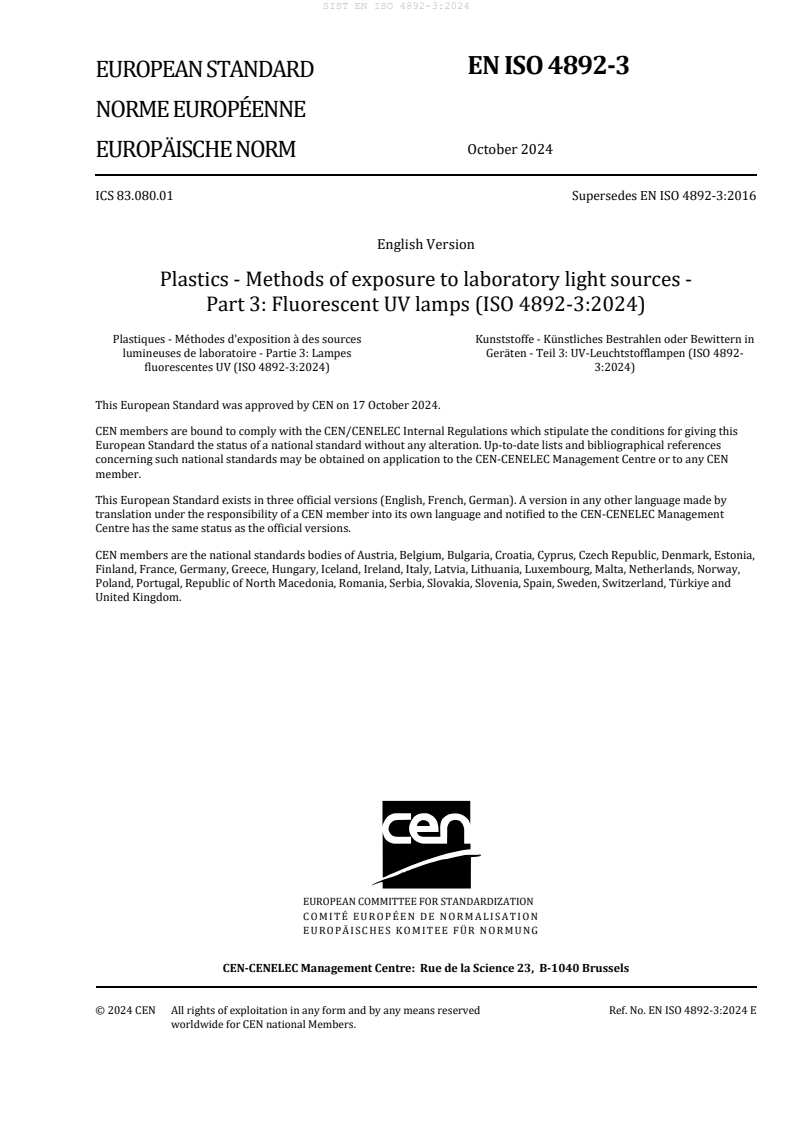
EN ISO 4892-3
EUROPEAN STANDARD
NORME EUROPÉENNE
October 2024
EUROPÄISCHE NORM
ICS 83.080.01 Supersedes EN ISO 4892-3:2016
English Version
Plastics - Methods of exposure to laboratory light sources -
Part 3: Fluorescent UV lamps (ISO 4892-3:2024)
Plastiques - Méthodes d'exposition à des sources Kunststoffe - Künstliches Bestrahlen oder Bewittern in
lumineuses de laboratoire - Partie 3: Lampes Geräten - Teil 3: UV-Leuchtstofflampen (ISO 4892-
fluorescentes UV (ISO 4892-3:2024) 3:2024)
This European Standard was approved by CEN on 17 October 2024.
CEN members are bound to comply with the CEN/CENELEC Internal Regulations which stipulate the conditions for giving this
European Standard the status of a national standard without any alteration. Up-to-date lists and bibliographical references
concerning such national standards may be obtained on application to the CEN-CENELEC Management Centre or to any CEN
member.
This European Standard exists in three official versions (English, French, German). A version in any other language made by
translation under the responsibility of a CEN member into its own language and notified to the CEN-CENELEC Management
Centre has the same status as the official versions.
CEN members are the national standards bodies of Austria, Belgium, Bulgaria, Croatia, Cyprus, Czech Republic, Denmark, Estonia,
Finland, France, Germany, Greece, Hungary, Iceland, Ireland, Italy, Latvia, Lithuania, Luxembourg, Malta, Netherlands, Norway,
Poland, Portugal, Republic of North Macedonia, Romania, Serbia, Slovakia, Slovenia, Spain, Sweden, Switzerland, Türkiye and
United Kingdom.
EUROPEAN COMMITTEE FOR STANDARDIZATION
COMITÉ EUROPÉEN DE NORMALISATION
EUROPÄISCHES KOMITEE FÜR NORMUNG
CEN-CENELEC Management Centre: Rue de la Science 23, B-1040 Brussels
© 2024 CEN All rights of exploitation in any form and by any means reserved Ref. No. EN ISO 4892-3:2024 E
worldwide for CEN national Members.
Contents Page
European foreword . 3
European foreword
This document (EN ISO 4892-3:2024) has been prepared by Technical Committee ISO/TC 61 "Plastics"
in collaboration with Technical Committee CEN/TC 249 “Plastics” the secretariat of which is held by SIS.
This European Standard shall be given the status of a national standard, either by publication of an
identical text or by endorsement, at the latest by April 2025, and conflicting national standards shall be
withdrawn at the latest by April 2025.
Attention is drawn to the possibility that some of the elements of this document may be the subject of
patent rights. CEN shall not be held responsible for identifying any or all such patent rights.
This document supersedes EN ISO 4892-3:2016.
Any feedback and questions on this document should be directed to the users’ national standards
body/national committee. A complete listing of these bodies can be found on the CEN website.
According to the CEN-CENELEC Internal Regulations, the national standards organizations of the
following countries are bound to implement this European Standard: Austria, Belgium, Bulgaria,
Croatia, Cyprus, Czech Republic, Denmark, Estonia, Finland, France, Germany, Greece, Hungary, Iceland,
Ireland, Italy, Latvia, Lithuania, Luxembourg, Malta, Netherlands, Norway, Poland, Portugal, Republic of
North Macedonia, Romania, Serbia, Slovakia, Slovenia, Spain, Sweden, Switzerland, Türkiye and the
United Kingdom.
Endorsement notice
The text of ISO 4892-3:2024 has been approved by CEN as EN ISO 4892-3:2024 without any
modification.
International
Standard
ISO 4892-3
Fifth edition
Plastics — Methods of exposure to
2024-10
laboratory light sources —
Part 3:
Fluorescent UV lamps
Plastiques — Méthodes d'exposition à des sources lumineuses de
laboratoire —
Partie 3: Lampes fluorescentes UV
Reference number
ISO 4892-3:2024(en) © ISO 2024
ISO 4892-3:2024(en)
© ISO 2024
All rights reserved. Unless otherwise specified, or required in the context of its implementation, no part of this publication may
be reproduced or utilized otherwise in any form or by any means, electronic or mechanical, including photocopying, or posting on
the internet or an intranet, without prior written permission. Permission can be requested from either ISO at the address below
or ISO’s member body in the country of the requester.
ISO copyright office
CP 401 • Ch. de Blandonnet 8
CH-1214 Vernier, Geneva
Phone: +41 22 749 01 11
Email: copyright@iso.org
Website: www.iso.org
Published in Switzerland
ii
ISO 4892-3:2024(en)
Contents Page
Foreword .iv
1 Scope . 1
2 Normative references . 1
3 Terms and definitions . 1
4 Principle . 1
5 Apparatus . 2
5.1 Laboratory light source .2
5.2 Test chamber .5
5.3 Radiometer .6
5.4 Control of temperature .6
5.5 Wetting .6
5.5.1 General .6
5.5.2 Condensation and water spray system.7
5.6 Control of humidity .7
5.7 Specimen holders .7
5.8 Apparatus to assess changes in properties .7
6 Test specimens . 8
7 Test conditions . 8
7.1 Radiation .8
7.2 Temperature .8
7.3 Condensation and spray cycles .8
7.4 Cycles with dark periods .8
7.5 Sets of exposure conditions .8
8 Procedure .10
8.1 General .10
8.2 Mounting the test specimens .10
8.3 Exposure .10
8.4 Measurement of radiant exposure .11
8.5 Determination of changes in properties after exposure.11
9 Test report .11
Annex A (normative) Relative irradiance of typical fluorescent UV lamps .12
Annex B (informative) Condensation type device .16
Annex C (informative) Climatic chamber type device . 17
Annex D (informative) Alternative test cycles .18
Bibliography . 19
iii
ISO 4892-3:2024(en)
Foreword
ISO (the International Organization for Standardization) is a worldwide federation of national standards
bodies (ISO member bodies). The work of preparing International Standards is normally carried out through
ISO technical committees. Each member body interested in a subject for which a technical committee
has been established has the right to be represented on that committee. International organizations,
governmental and non-governmental, in liaison with ISO, also take part in the work. ISO collaborates closely
with the International Electrotechnical Commission (IEC) on all matters of electrotechnical standardization.
The procedures used to develop this document and those intended for its further maintenance are described
in the ISO/IEC Directives, Part 1. In particular, the different approval criteria needed for the different types
of ISO documents should be noted. This document was drafted in accordance with the editorial rules of the
ISO/IEC Directives, Part 2 (see www.iso.org/directives).
ISO draws attention to the possibility that the implementation of this document may involve the use of (a)
patent(s). ISO takes no position concerning the evidence, validity or applicability of any claimed patent
rights in respect thereof. As of the date of publication of this document, ISO had not received notice of (a)
patent(s) which may be required to implement this document. However, implementers are cautioned that
this may not represent the latest information, which may be obtained from the patent database available at
www.iso.org/patents). ISO shall not be held responsible for identifying any or all such patent rights.
Any trade name used in this document is information given for the convenience of users and does not
constitute an endorsement.
For an explanation of the voluntary nature of standards, the meaning of ISO specific terms and expressions
related to conformity assessment, as well as information about ISO's adherence to the World Trade
Organization (WTO) principles in the Technical Barriers to Trade (TBT) see www.iso.org/iso/foreword.html.
This document was prepared by Technical Committee ISO/TC 61, Plastics, Subcommittee SC 6, Ageing,
chemical and environmental resistance, in collaboration with the European Committee for Standardization
(CEN) Technical Committee CEN/TC 249, Plastics, in accordance with the Agreement on technical cooperation
between ISO and CEN (Vienna Agreement).
This fifth edition cancels and replaces the fourth edition (ISO 4892-3:2016), which has been technically
revised.
The main changes are as follows:
— clarification that two fundamentally different types of test chambers exist added (e.g. in 5.2, 5.4, new
Annexes);
— Table 4 has been split into two separate tables for the different types of test chambers, Table 4 applies to
condensation type devices and Table 5 to climatic chamber type devices;
— new Annex B “Condensation type device”, Annex C “Climatic chamber type device” and Annex D
“Alternative test cycles” have been added;
— reference to CIE 85 has been updated to CIE 241;
— combination of different UV fluorescent lamps have been deleted;
— mandatory Clause 3 “Terms and definitions” has been added and subsequent clauses have been
renumbered;
— lamp type designations 1A, 1B, 2 have been deleted.
A list of all parts in the ISO 4892 series can be found on the ISO website.
Any feedback or questions on this document should be directed to the user’s national standards body. A
complete listing of these bodies can be found at www.iso.org/members.html.
iv
International Standard ISO 4892-3:2024(en)
Plastics — Methods of exposure to laboratory light sources —
Part 3:
Fluorescent UV lamps
1 Scope
This document specifies methods for exposing plastic specimens to fluorescent UV lamp radiation, heat
and water in apparatus designed to simulate the weathering effects that occur when plastic materials are
exposed in actual end-use environments to global solar radiation, or to window-glass filtered solar radiation.
Fluorescent UV lamp exposures for paints, varnishes and other coatings are described in ISO 16474-3.
2 Normative references
The following documents are referred to in the text in such a way that some or all of their content constitutes
requirements of this document. For dated references, only the edition cited applies. For undated references,
the latest edition of the referenced document (including any amendments) applies.
ISO 4582, Plastics — Determination of changes in colour and variations in properties after exposure to glass-
filtered radiation, natural weathering or laboratory radiation sources
ISO 4892-1, Plastics — Methods of exposure to laboratory light sources — Part 1: General guidance
3 Terms and definitions
For the purposes of this document, the terms and definitions given in ISO 4892-1 apply.
ISO and IEC maintain terminology databases for use in standardization at the following addresses:
— ISO Online browsing platform: available at https:// www .iso .org/ obp
— IEC Electropedia: available at https:// www .electropedia .org/
4 Principle
4.1 General guidance is given in ISO 4892-1. Following the manufacturer’s recommendations for lamp
maintenance and/or rotation, fluorescent UV lamps are used to simulate the spectral irradiance of global
solar radiation in the short wavelength ultraviolet (UV) region of the spectrum.
4.2 Specimens are exposed to various levels of UV radiation, heat and moisture (see 4.4) under controlled
environmental conditions.
NOTE Specimen preparation and evaluation of the results are covered in other International Standards for
specific materials.
4.3 The exposure conditions are varied by selection of the following:
a) type of fluorescent UV lamp;
b) irradiance level;
ISO 4892-3:2024(en)
c) temperature during the UV exposure;
d) type of wetting (see 4.4);
e) wetting temperature and cycle;
f) timing of the UV/dark cycle.
4.4 Wetting is usually produced by condensation of water vapour on to the exposed specimen surface or
by spraying the test specimens with demineralized/deionized water.
4.5 The procedure(s) can include measurement of the irradiance and the radiant exposure in the plane of
the specimen.
4.6 It is recommended that a similar material of known performance (a control) be exposed simultaneously
with the test specimens to provide a standard for comparative purposes.
4.7 Intercomparison of results obtained from specimens exposed in different types of apparatus as per
Annex B and Annex C or to different types of lamps should not be made unless an appropriate statistical
relationship has been established between the different types of equipment for the material to be tested.
5 Apparatus
5.1 Laboratory light source
5.1.1 Fluorescent UV lamps are fluorescent lamps in which radiant emission in the ultraviolet region of
the spectrum, i.e. below 400 nm, makes up at least 80 % of the total light output. The UV fluorescent lamps
used shall conform with the requirements of Annex A. There are three types of fluorescent UV lamp used in
this document.
— UVA-340 fluorescent UV lamp: these lamps have a radiant emission below 300 nm of less than 1 % of
the total radiation output, have an emission peak at 343 nm, and are more commonly identified as UVA-
340 for simulation of global solar radiation from 300 nm to 360 nm (see Table 1). Figure A.1 is a graph
of spectral irradiance from 250 nm to 400 nm of a typical UVA-340 fluorescent lamp compared to global
solar radiation.
— UVA-351 fluorescent UV lamp: these lamps have a radiant emission below 310 nm of less than 1 % of
the total radiation output, have a peak emission at 353 nm, and are more commonly identified as UVA-
351 for simulation of the UV portion of window-glass filtered solar radiation (see Table 2). Figure A.2 is a
graph of spectral irradiance from 250 nm to 400 nm of a typical UVA-351 fluorescent UV lamp compared
to window-glass filtered global solar radiation.
— UVB-313 fluorescent UV lamp: these lamps have a radiant emission below 300 nm that is more than
10 % of the total radiation output, have a peak emission at 313 nm, and are more commonly identified
as UVB-313 (see Table 3). Figure A.3 is a graph of the spectral irradiance from 250 nm to 400 nm of two
typical UVB-313 fluorescent lamps compared to global solar radiation. UVB-313 lamps may be used only
by agreement between the parties concerned. Such agreement shall be stated in the test report.
NOTE 1 UVB-313 lamps have a spectral distribution of radiation that peaks near the 313 nm mercury line and emits
radiation below λ = 295 nm, which can initiate ageing processes that never occur in natural environments.
NOTE 2 The solar spectral irradiance for a number of different atmospheric conditions is described in
CIE Publication No. 241. The benchmark global solar radiation used in this document is from CIE Publication No. 241,
CIE-H1.
Different lamp types shall not be mixed.
ISO 4892-3:2024(en)
5.1.2 Unless otherwise specified, UVA-340 fluorescent UV lamps shall be used to simulate the UV part of
global solar radiation (see Tables 4 and 5, method A). Unless otherwise specified, UVA-351 lamps shall be
used to simulate the UV part of window-glass filtered solar radiation (see Tables 4 and 5, method B). Refer to
Table 4 for condensation type devices and Table 5 for climatic chamber type devices.
5.1.3 Fluorescent lamps age significantly with extended use. If an automatic irradiance control system
is not used, follow the apparatus manufacturer’s instructions on the procedure necessary to maintain the
desired irradiance.
5.1.4 Irradiance uniformity shall be in accordance with the requirements specified in ISO 4892-1.
Requirements for periodic repositioning of specimens when irradiance within the exposure area is less than
90 % of the peak irradiance are described in ISO 4892-1.
Table 1 — Relative ultraviolet spectral irradiance for UVA-340 lamps for global solar UV radiation
a,b
(method A)
Spectral passband
c d,e c
Minimum CIE 241, CIE-H1 Maximum
[λ = wavelength
% % %
in nanometres (nm)]
λ < 290 — 0 0,1
290 ≤ λ ≤ 320 5,9 5,9 9,3
320 < λ ≤ 360 60,9 40,4 65,5
360 < λ ≤ 400 26,5 53,8 32,8
a
This table gives the irradiance in the given passband, expressed as a percentage of the total irradiance between 290 nm and
400 nm. To determine whether or not a specific UVA-340 lamp meets the requirements of this table, the spectral irradiance from
250 nm to 400 nm shall be measured. Typically, this is done in 2 nm increments. The total irradiance in each passband is then
summed and divided by the total irradiance between 290 nm and 400 nm.
b
The minimum and maximum limits for UVA-340 lamps in this table are based on more than 60 spectral irradiance
[1]
measurements with UVA-340 lamps from different production lots and of various ages . The spectral irradiance data are for
lamps within the ageing recommendations of the manufacturer of the apparatus. As more spectral irradiance data become
available, minor changes in the limits are possible. The minimum and maximum limits are at least three sigmas from the mean
for all the measurements.
c
The minimum and maximum columns will not necessarily sum to 100 % because they represent the minima and maxima for
the measurement data used. For any individual spectral irradiance distribution, the percentages calculated for the passbands in
this table will sum to 100 %. For any individual UVA-340 fluorescent lamp, the calculated percentage in each passband shall fall
within the minimum and maximum limits given. Test results can be expected to differ between exposures using UVA-340 lamps
in which the spectral irradiance differs by as much as that allowed by the tolerances. Contact the manufacturer of the fluorescent
UV apparatus for specific spectral irradiance data for the UVA-340 lamp used.
d
The data from CIE 241, CIE-H1 are the global solar irradiance on a horizontal surface for an air mass of 1,0, an ozone column
of 0,34 cm at STP, 1,42 cm of precipitable water vapour, and a spectral optical depth of aerosol extinction of 0,1 at 500 nm. These
data are provided for reference purposes only and are intended to serve as a target.
e
For the solar spectrum represented by CIE 241, CIE-H1, the UV irradiance (290 nm to 400 nm) is 11 % and the visible
irradiance (400 nm to 800 nm) is 89 %, expressed as a percentage of the total irradiance from 290 nm to 800 nm.
ISO 4892-3:2024(en)
Table 2 — Relative ultraviolet spectral irradiance for UVA-351 lamps for window-glass filtered solar
a,b
radiation (method B)
CIE 241, CIE-H1,
Spectral passband
c c
Minimum plus effect of Maximum
[λ = wavelength
d,e
% window glass %
in nanometres (nm)]
%
λ < 300 — 0 0,2
300 ≤ λ ≤ 320 1,1 ≤1 3,3
320 < λ ≤ 360 60,5 33,1 66,8
360 < λ ≤ 400 30,0 66,0 38,0
a
This table gives the irradiance in the given passband, expressed as a percentage of the total irradiance between 290 nm
and 400 nm. To determine whether a specific UVA-351 lamp meets the requirements of this table, the spectral irradiance from
250 nm to 400 nm shall be measured. The total irradiance in each passband is then summed and divided by the total irradiance
between 290 nm and 400 nm.
b
The minimum and maximum limits given in this table are based on 21 spectral irradiance measurements with UVA-
[1]
351 lamps from different production lots and of various ages. The spectral irradiance data are for lamps within the ageing
recommendations of the manufacturer of the apparatus. As more spectral irradiance data become available, minor changes in the
limits are possible. The minimum and maximum limits are at least three sigmas from the mean for all the measurements.
c
The minimum and maximum columns will not necessarily sum to 100 % because they represent the minima and maxima for
the measurement data used. For any individual spectral irradiance distribution, the percentages calculated for the passbands in
this table will sum to 100 %. For any individual UVA-351 fluorescent lamp, the calculated percentage in each passband shall fall
within the minimum and maximum limits given. Test results can be expected to differ between exposures using UVA-351 lamps
in which the spectral irradiance differs by as much as that allowed by the tolerances. Contact the manufacturer of the fluorescent
UV apparatus for specific spectral irradiance data for the UVA-351 lamp used.
d
The data from CIE 241, CIE-H1, plus the effect of window glass were determined by multiplying the data from CIE 241, CIE-H1
by the spectral transmittance of typical 3 mm-thick window glass (see ISO 16474-2). These data are provided for reference
purposes only and are intended to serve as a target.
e
For the CIE 241, CIE-H1, plus window glass data, the UV irradiance from 300 nm to 400 nm is typically about 9 % and the
visible irradiance (400 nm to 800 nm) is typically about 91 %, expressed as a percentage of the total irradiance from 300 nm to
800 nm.
ISO 4892-3:2024(en)
a,b
Table 3 — Relative ultraviolet spectral irradiance for UVB-313 lamps (method C)
Spectral passband
c d,e c
Minimum CIE 241, CIE-H1 Maximum
[λ = wavelength
% % %
in nanometres (nm)]
λ < 270 - 0 0
270 ≤ λ < 290 1,3 0 5,4
290 ≤ λ ≤ 320 47,8 5,9 65,9
320 < λ ≤ 360 26,9 40,4 43,9
360 < λ ≤ 400 1,7 53,8 7,2
a
This table gives the irradiance in the given passband, expressed as a percentage of the total irradiance between 250 nm
and 400 nm. To determine whe
...