

EN 117:2023
(Main)Wood preservatives - Determination of toxic values against Reticulitermes species (European termites) (Laboratory method)
- Abstract
This document specifies a method for the determination of the toxic values of a wood preservative against the Reticulitermes species of European termites.
This method is applicable to:
- water-insoluble chemicals which are being studied as active insecticides;
- organic water-dispersible formulations as supplied or as prepared in the laboratory by dilution of concentrates; and
- water-soluble materials, for example salts.
NOTE This method can be used in conjunction with an ageing procedure, for example EN 73 or EN 84.
- Status
- Published
- Publication Date
- 05-Dec-2023
- Technical Committee
- CEN/TC 38 - Durability of wood and derived materials
- Drafting Committee
- CEN/TC 38/WG 24 - Insect testing - (beetles - termites)
- Current Stage
- 6060 - Definitive text made available (DAV) - Publishing
- Start Date
- 06-Dec-2023
- Due Date
- 15-Feb-2024
- Completion Date
- 06-Dec-2023

Overview
EN 117:2023 - published by CEN - is the European laboratory method for determining the toxic values of wood preservatives against Reticulitermes species (European termites). The standard specifies how to prepare, treat and expose susceptible wood specimens to Reticulitermes colonies in controlled laboratory conditions to establish the preservative concentration that prevents termite attack. EN 117:2023 supersedes EN 117:2012 and was approved in December 2023.
Key Topics and Requirements
- Scope of application: Applies to water‑insoluble active chemicals, organic water‑dispersible formulations (as supplied or diluted), and water‑soluble materials (e.g., salts). Can be combined with ageing procedures (for example EN 73 or EN 84).
- Biological material: Uses workers, soldiers and nymphs of identified Reticulitermes species; test reports must state species and locality of origin.
- Test preparation:
- Impregnation of multiple sets of susceptible wood specimens across a concentration series.
- Conditioning, drying and handling rules for treated specimens.
- Test conditions: Defined environmental controls (examples from the standard include culturing/testing at (26 ± 2) °C and (70 ± 5) % RH, conditioning at (20 ± 2) °C and (65 ± 5) % RH).
- Substrates and reagents: Options include fine white quartz sand (≈90 % silica), horticultural foams or exfoliated silicate particles; use EN ISO 3696 grade water for analytical work.
- Apparatus and safety: Specifies culturing chambers, vacuum impregnation vessels (capable of ~700 Pa), testing containers and handling instruments. Emphasises environmental, health and safety precautions (Annex C).
- Assessment and reporting: Visual examination protocols, validity criteria and derivation of toxic values; example test report and culturing guidance are included.
Applications and Who Uses This Standard
- Wood preservative manufacturers - to quantify efficacy and support product development or registration dossiers.
- Independent testing laboratories - to perform standardized termite resistance testing for certification and quality control.
- Regulatory bodies and certification schemes - to evaluate conformity and label claims on termite protection.
- Research institutions and pest control specialists - for comparative studies of active ingredients and formulation performance.
- Specifiers and architects - to understand laboratory evidence of termite resistance when selecting treated wood products.
Related Standards
- EN 73, EN 84 - ageing procedures that can be used in conjunction with EN 117.
- EN ISO 3696 - water quality for analytical laboratory use (referenced in EN 117).
Using EN 117:2023 helps ensure reproducible, comparable termite testing, clear documentation of toxic values, and harmonized evaluation of wood protection chemicals across Europe.
Relations
- Effective Date
- 28-Nov-2018
- Effective Date
- 28-Jan-2026
- Effective Date
- 28-Jan-2026
- Effective Date
- 28-Jan-2026
- Effective Date
- 28-Jan-2026
- Referred By
CEN/TS 15534-2:2007 - Wood-plastics composites (WPC) - Part 2: Characterisation of WPC materials - Effective Date
- 28-Jan-2026
- Effective Date
- 28-Jan-2026
Get Certified
Connect with accredited certification bodies for this standard

ECOCERT
Organic and sustainability certification.

Eurofins Food Testing Global
Global leader in food, environment, and pharmaceutical product testing.

Intertek Bangladesh
Intertek certification and testing services in Bangladesh.
Sponsored listings
Frequently Asked Questions
EN 117:2023 is a standard published by the European Committee for Standardization (CEN). Its full title is "Wood preservatives - Determination of toxic values against Reticulitermes species (European termites) (Laboratory method)". This standard covers: This document specifies a method for the determination of the toxic values of a wood preservative against the Reticulitermes species of European termites. This method is applicable to: - water-insoluble chemicals which are being studied as active insecticides; - organic water-dispersible formulations as supplied or as prepared in the laboratory by dilution of concentrates; and - water-soluble materials, for example salts. NOTE This method can be used in conjunction with an ageing procedure, for example EN 73 or EN 84.
This document specifies a method for the determination of the toxic values of a wood preservative against the Reticulitermes species of European termites. This method is applicable to: - water-insoluble chemicals which are being studied as active insecticides; - organic water-dispersible formulations as supplied or as prepared in the laboratory by dilution of concentrates; and - water-soluble materials, for example salts. NOTE This method can be used in conjunction with an ageing procedure, for example EN 73 or EN 84.
EN 117:2023 is classified under the following ICS (International Classification for Standards) categories: 71.100.50 - Wood-protecting chemicals. The ICS classification helps identify the subject area and facilitates finding related standards.
EN 117:2023 has the following relationships with other standards: It is inter standard links to EN 117:2012, EN ISO 3696:1995, EN 599-1:2009+A1:2013, EN 599-1:2009, CEN/TS 15679:2007, CEN/TS 15534-2:2007, EN 350:2016. Understanding these relationships helps ensure you are using the most current and applicable version of the standard.
EN 117:2023 is available in PDF format for immediate download after purchase. The document can be added to your cart and obtained through the secure checkout process. Digital delivery ensures instant access to the complete standard document.
Standards Content (Sample)
SLOVENSKI STANDARD
01-marec-2024
Nadomešča:
SIST EN 117:2013
Zaščitna sredstva za les - Ugotavljanje toksičnih vrednosti proti termitom iz rodu
Reticulitermes (evropskim termitom) (laboratorijska metoda)
Wood preservatives - Determination of toxic values against Reticulitermes species
(European termites) (Laboratory method)
Holzschutzmittel - Bestimmung der Grenze der Wirksamkeit gegenüber Reticulitermes-
Arten (Europäische Termiten) (Laboratoriumsverfahren)
Produit de préservation du bois - Détermination du seuil d'efficacité contre les termites
européens du genre Reticulitermes (Méthode de laboratoire)
Ta slovenski standard je istoveten z: EN 117:2023
ICS:
71.100.50 Kemikalije za zaščito lesa Wood-protecting chemicals
2003-01.Slovenski inštitut za standardizacijo. Razmnoževanje celote ali delov tega standarda ni dovoljeno.
EN 117
EUROPEAN STANDARD
NORME EUROPÉENNE
December 2023
EUROPÄISCHE NORM
ICS 71.100.50 Supersedes EN 117:2012
English Version
Wood preservatives - Determination of toxic values
against Reticulitermes species (European termites)
(Laboratory method)
Produit de préservation du bois - Détermination du Holzschutzmittel - Bestimmung der Grenze der
seuil d'efficacité contre les termites européens du Wirksamkeit gegenüber Reticulitermes-Arten
genre Reticulitermes (Méthode de laboratoire) (Europäische Termiten) (Laboratoriumsverfahren)
This European Standard was approved by CEN on 6 November 2023.
CEN members are bound to comply with the CEN/CENELEC Internal Regulations which stipulate the conditions for giving this
European Standard the status of a national standard without any alteration. Up-to-date lists and bibliographical references
concerning such national standards may be obtained on application to the CEN-CENELEC Management Centre or to any CEN
member.
This European Standard exists in three official versions (English, French, German). A version in any other language made by
translation under the responsibility of a CEN member into its own language and notified to the CEN-CENELEC Management
Centre has the same status as the official versions.
CEN members are the national standards bodies of Austria, Belgium, Bulgaria, Croatia, Cyprus, Czech Republic, Denmark, Estonia,
Finland, France, Germany, Greece, Hungary, Iceland, Ireland, Italy, Latvia, Lithuania, Luxembourg, Malta, Netherlands, Norway,
Poland, Portugal, Republic of North Macedonia, Romania, Serbia, Slovakia, Slovenia, Spain, Sweden, Switzerland, Türkiye and
United Kingdom.
EUROPEAN COMMITTEE FOR STANDARDIZATION
COMITÉ EUROPÉEN DE NORMALISATIO N
EUROPÄISCHES KOMITEE FÜR NORM UN G
CEN-CENELEC Management Centre: Rue de la Science 23, B-1040 Brussels
© 2023 CEN All rights of exploitation in any form and by any means reserved Ref. No. EN 117:2023 E
worldwide for CEN national Members.
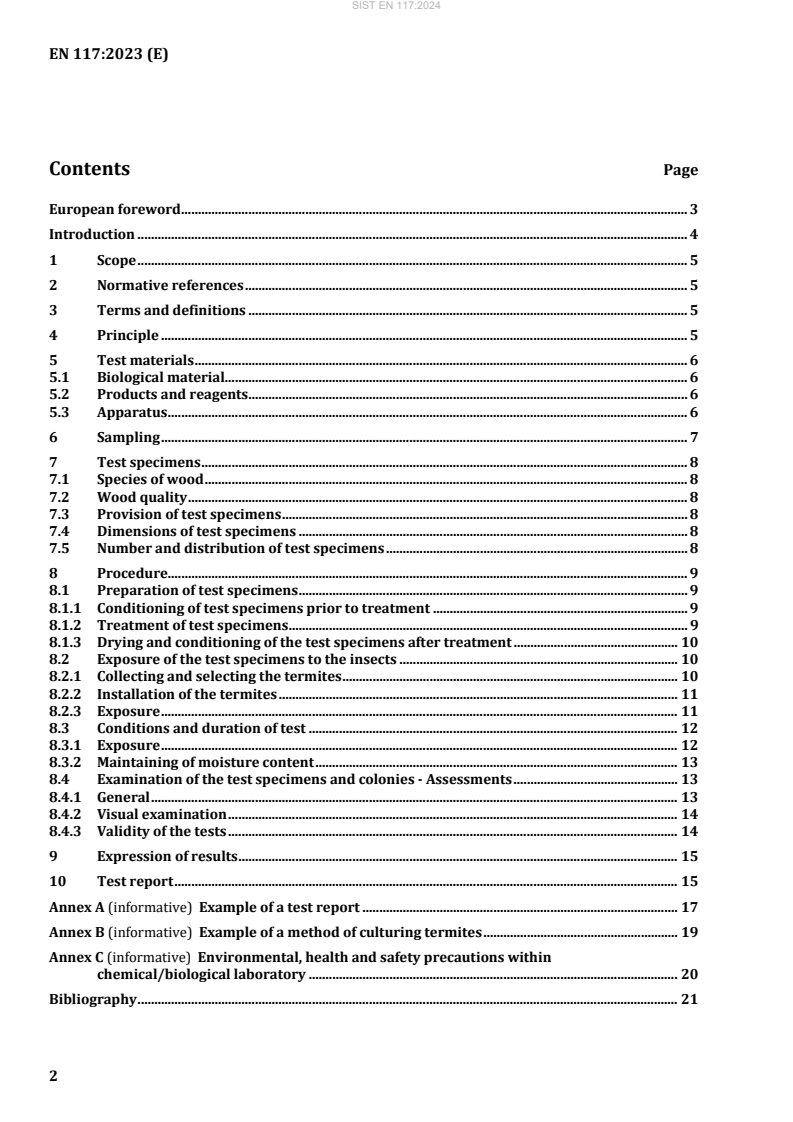
Contents Page
European foreword . 3
Introduction . 4
1 Scope . 5
2 Normative references . 5
3 Terms and definitions . 5
4 Principle . 5
5 Test materials . 6
5.1 Biological material . 6
5.2 Products and reagents . 6
5.3 Apparatus . 6
6 Sampling . 7
7 Test specimens . 8
7.1 Species of wood . 8
7.2 Wood quality . 8
7.3 Provision of test specimens . 8
7.4 Dimensions of test specimens . 8
7.5 Number and distribution of test specimens . 8
8 Procedure. 9
8.1 Preparation of test specimens . 9
8.1.1 Conditioning of test specimens prior to treatment . 9
8.1.2 Treatment of test specimens . 9
8.1.3 Drying and conditioning of the test specimens after treatment . 10
8.2 Exposure of the test specimens to the insects . 10
8.2.1 Collecting and selecting the termites . 10
8.2.2 Installation of the termites . 11
8.2.3 Exposure . 11
8.3 Conditions and duration of test . 12
8.3.1 Exposure . 12
8.3.2 Maintaining of moisture content . 13
8.4 Examination of the test specimens and colonies - Assessments . 13
8.4.1 General . 13
8.4.2 Visual examination . 14
8.4.3 Validity of the tests . 14
9 Expression of results . 15
10 Test report . 15
Annex A (informative) Example of a test report . 17
Annex B (informative) Example of a method of culturing termites . 19
Annex C (informative) Environmental, health and safety precautions within
chemical/biological laboratory . 20
Bibliography . 21
European foreword
This document (EN 117:2023) has been prepared by Technical Committee CEN/TC 38 “Durability of
wood and wood-based products”, the secretariat of which is held by SIS.
This European Standard shall be given the status of a national standard, either by publication of an
identical text or by endorsement, at the latest by June 2024, and conflicting national standards shall be
withdrawn at the latest by June 2024.
Attention is drawn to the possibility that some of the elements of this document may be the subject of
patent rights. CEN shall not be held responsible for identifying any or all such patent rights.
This document supersedes EN 117:2012.
The main changes compared to the previous edition EN 117:2012 are listed below:
a) the required purity of fine white quartz sand was lowered (5.2.1.1);
b) the values for the examination of termite attack in rating 2a) and 3a) were slightly changed to close
rating gaps (8.4.2).
NOTE 1 The species name “Reticulitermes santonensis” is officially withdrawn and replaced by Reticulitermes
flavipes. This document uses the preferred nomenclature.
NOTE 2 Test results obtained according to earlier versions of this document and when the tests had started
before this version of EN 117 was published are considered as valid.
Any feedback and questions on this document should be directed to the users’ national standards body.
A complete listing of these bodies can be found on the CEN website.
According to the CEN-CENELEC Internal Regulations, the national standards organisations of the
following countries are bound to implement this European Standard: Austria, Belgium, Bulgaria, Croatia,
Cyprus, Czech Republic, Denmark, Estonia, Finland, France, Germany, Greece, Hungary, Iceland, Ireland,
Italy, Latvia, Lithuania, Luxembourg, Malta, Netherlands, Norway, Poland, Portugal, Republic of North
Macedonia, Romania, Serbia, Slovakia, Slovenia, Spain, Sweden, Switzerland, Türkiye and the United
Kingdom.
Introduction
This document describes a laboratory method of testing which gives a basis for assessment of the
effectiveness of a wood preservative against the Reticulitermes species of subterranean termites. It allows
the determination of the concentration at which the product completely prevents attack by these insects
of impregnated wood of a susceptible species.
This laboratory method provides one criterion by which the value of a product can be assessed. In making
this assessment the methods by which the preservative can be applied should be taken into account. It is
further recommended that results from this should be supplemented by those from other appropriate
tests, and above all by comparison with practical experience.
When products which are very active at low concentrations are used it is very important to take suitable
precautions to isolate and separate, as far as possible, operations involving chemical products, other
products, treated wood, laboratory apparatus and clothing. Suitable precautions should include the use
of separate rooms, areas within rooms, extraction facilities and conditioning chambers as well as special
training for personnel (see also Annex C for environmental, health and safety precautions).
1 Scope
This document specifies a method for the determination of the toxic values of a wood preservative against
the Reticulitermes species of European termites.
NOTE 1 The method can be applied not only to different species of Reticulitermes, but also to other species of
the family of the Rhinotermitidae, adapting the conditions of temperature and humidity where necessary to the
specific requirements of the species concerned.
This method is applicable to:
— water-insoluble chemicals which are being studied as active insecticides;
— organic water-dispersible formulations as supplied or as prepared in the laboratory by dilution of
concentrates;
— water-soluble materials, for example salts.
NOTE 2 This method can be used in conjunction with an ageing procedure, for example EN 73 or EN 84.
2 Normative references
The following documents are referred to in the text in such a way that some or all of their content
constitutes requirements of this document. For dated references, only the edition cited applies. For
undated references, the latest edition of the referenced document (including any amendments) applies.
EN ISO 3696, Water for analytical laboratory use — Specification and test methods (ISO 3696)
3 Terms and definitions
For the purposes of this document, the following terms and definitions apply.
ISO and IEC maintain terminology databases for use in standardization at the following addresses:
— IEC Electropedia: available at https://www.electropedia.org/
— ISO Online browsing platform: available at https://www.iso.org/obp
3.1
representative sample
sample having its physical or chemical characteristics identical to the volumetric average characteristics
of the total volume being sampled
3.2
supplier
sponsor of the test
4 Principle
Impregnation of several sets of test specimens of susceptible wood with a series of solutions in which the
concentration of preservative is ranged in a given progression.
Exposure of these test specimens to specified colonies of Reticulitermes and assessment of the attack
suffered after exposure under fixed conditions and over a fixed period. In providing biological validation
of individual species, it is essential that the locality of origin of each test termite species is given. The
description of the locality should at least include the district name.
Comparison of these results with those obtained with untreated and solvent or diluent-treated control
test specimens.
Derivation of the toxic values of the product under test.
5 Test materials
5.1 Biological material
Workers, soldiers and nymphs of an identified termite species of Reticulitermes.
The termite species and the locality of origin should be stated in the test report and their identification
should be proved.
The termites should be obtained from colonies reared as described in Annex B.
5.2 Products and reagents
5.2.1 Substrate for establishing the colonies. A choice of:
5.2.1.1 Fine white quartz sand consisting of grains of crystallized silica, very pure (90 % silica), and
free from any organic substances
5.2.1.2 A hydrated, laminar, aluminium-iron-magnesium silicate exfoliated to give particles of
3 3
1 mm to 3 mm with an apparent density of 80 kg/m to 90 kg/m
Particles of less than 1 mm shall be eliminated by sieving prior to use to ensure the absence of free water
and prevent any significant agglomeration of the particles.
5.2.1.3 Rigid polyurethane foam with open pores
3 2 2
Horticulture foam with mass per unit of volume of 14 kg/m and compressive strength of 0,02 N/mm
to 0,03 N/mm is suitable. It is recommended to cut the foam into sheets 15 mm thick.
5.2.2 Fumigant (if necessary) xylene, technical grade, mixed isomers
5.2.3 Water, complying with grade 3 of EN ISO 3696
5.2.4 Solvent or diluent, a suitable volatile liquid that will dissolve or dilute the preservative but does
not leave a residue in the wood which would have a toxic effect on the insect at the end of the conditioning
period
5.2.5 Filter paper, ordinary quality, medium-fast grade
5.3 Apparatus
5.3.1 Culturing chamber, with air circulation, controlled at (26 ± 2) °C and at a relative humidity of
(70 ± 5) %
Fontainebleau sand, of which more than 97 % of the particles are between 75 µm and 300 µm in size, provides
these features.
Determined in accordance with EN IS0 844.
5.3.2 Conditioning chamber, well ventilated, controlled at (20 ± 2) °C and relative humidity
(65 ± 5) %
5.3.3 Laboratory work area, well ventilated, where treatment of the test specimens is carried out. It
is essential to follow safety procedures for handling flammable and toxic materials. Excessive exposure
of operators to solvents or their vapours should be avoided.
5.3.4 Testing chamber, protected from light, ventilated and controlled at (26 ± 2) °C and at a relative
humidity of (70 ± 5) %
5.3.5 Treatment vessels, of a material that does not react with the preservative under test, for example
glass for organic products and polyethylene for salts containing fluorine
5.3.6 Drying vessel(s), capable of holding sets of three test specimens (7.5), provided with a close-
fitting cover and containing supports that will give minimum contact with treated test specimens to be
placed on them
The vessels and supports shall be of a material that does not react with the preservative under test, for
example glass for organic compounds and polyethylene for products containing fluorine.
5.3.7 Weights, to provide ballast for the test specimens
The weights shall not react with any materials with which they come in contact during the test.
5.3.8 Vacuum vessels, fitted with stopcocks, capable of receiving the treatment
5.3.9 Vacuum pump, fitted with a pressure gauge and capable of maintaining a pressure of 700 Pa
5.3.10 Instruments, adapted for termite manipulation (aspirator, forceps)
5.3.11 Test containers, suitable for holding the test specimens and of material resistant to the product
used, and fitted with perforated cover to provide a good exchange of air
Base area 2 2
35 cm to 60 cm
Minimum height 8,5 cm
Volume 3 3
500 cm to 1 000 cm
5.3.12 Glass rings or rings of other inert materials, ca. 20 mm to ca. 25 mm high, ca. 15 mm to ca.
25 mm in diameter and with a wall thickness of ca. 1 mm to ca. 2 mm
5.3.13 Ordinary laboratory equipment, including a balance capable of weighing to an accuracy of
0,01 g
6 Sampling
The sample of preservative shall be representative of the product to be tested. Samples should be stored
and handled in accordance with any written recommendations from the supplier.
NOTE For the sampling of preservatives from bulk supplies, the procedure given in EN 212 will be used.
The conditioning of test specimens after treatment can be carried out in the laboratory work area (5.3.3) provided
that this meets the conditions specified for the conditioning chamber (5.3.2).
7 Test specimens
7.1 Species of wood
The reference species is Scots pine (Pinus sylvestris Linnaeus).
Additional tests can be carried out using other species but, if so, this should be stated in the test report.
7.2 Wood quality
The wood shall be free from visible cracks, stain, decay, insect damage and other defects. The wood shall
not have been water-stored, floated, chemically treated or steamed. The wood shall originate from trees
preferably felled in winter.
NOTE Wood that has been kiln dried at temperatures below 60 °C can be used.
The wood shall be exclusively sapwood containing little resin and having between 2,5 annual rings per
10 mm and eight annual rings per 10 mm. The proportion of latewood in the annual rings shall not exceed
30 % of the whole.
It is recommended to use test specimens of similar growth rate within a single test.
7.3 Provision of test specimens
Prepare planed strips having a cross-section of (25 ± 0,5) mm × (15 ± 0,5) mm removing a minimum of
2 mm from any surfaces exposed during drying. The longitudinal faces shall be parallel to the direction
of the grain. The annual rings shall have a contact angle of greater than 10° to the broad faces of the test
specimens. Make transverse cuts, neatly to give sharp edges and a fine-sawn finish to the end grain
surfaces, to give test specimens (50 ± 0,5) mm long.
The test specimens shall originate from a minimum of three trees or shall be taken at random from a
stock originally of more than 500 test specimens.
7.4 Dimensions of test specimens
The dimensions of each test specimen after reaching equilibrium in the conditioning chamber (5.3.2)
shall be (50 ± 0,5) mm × (25 ± 0,5) mm × (15 ± 0,5) mm.
For the purposes of calculating the mass of preservative retained per unit volume of wood (8.1.2.2) the
nominal volume of each test specimen shall be taken as 18,75 cm .
Mark each test specimen so that it can be identified throughout the test.
7.5 Number and distribution of test specimens
The test specimens shall be divided as follows:
a) treated test specimens: these are the test specimens which are impregnated and subject to attack by
Reticulitermes, use at least five test specimens for each concentration of the product;
b) untreated control test specimens for checking the virulence of the termite taken for the test: these
non-impregnated test specimens are subjected to attack by Reticulitermes; they are three in number;
c) solvent or diluent treated control test specimens subjected to attack by Reticulitermes; they are three
in number.
8 Procedure
8.1 Preparation of test specimens
8.1.1 Conditioning of test specimens prior to treatment
Allow the test specimens to condition in the conditioning chamber (5.3.2) for a minimum of two weeks.
8.1.2 Treatment of test specimens
8.1.2.1 Preparation of treatment solutions
8.1.2.1.1 Solid preservatives
Water-soluble preservatives: dissolve the preservative in water (5.2.3) to the required concentration.
Non-water-soluble preservatives: dissolve the preservative in an appropriate solvent (5.2.4) to the
required concentration.
8.1.2.1.2 Liquid preservatives
If appropriate, use the preservative without further preparation other than any necessary stirring. If it is
a concentrate, dilute the preservative with the diluent to the required working concentration, using the
procedure specified by the supplier.
Prepare a series of at least five concentrations by mass, distributed evenly about the expected toxic
values. A solvent or diluent control, i.e. treatment at concentration = 0, shall also be used (7.5 c)). If the
approximate toxic values are unknown, the concentrations shall form a widely spaced geometric
progression for a first test and a more closely spaced geometric or arithmetic progression for subsequent
tests.
All treatment solutions shall be freshly prepared.
8.1.2.2 Impregnation
Carry out impregnation in ascending order of concentration, starting with the solvent control
(concentration = 0). The following procedure ensures the required complete
...