

EN ISO 10993-15:2023
(Main)Biological evaluation of medical devices - Part 15: Identification and quantification of degradation products from metals and alloys (ISO 10993-15:2019)
General Information
- Abstract
NEXT ACTION: TC ACTION BY 2022-10-26 : TC to send a revised annex ZA for assessment at PUB
2020-02-19- JO-CEN/TC 206 to take decision either to remove the link or send a revised annex ZA for assessment at PUB
- Status
- Published
- Publication Date
- 23-May-2023
- Withdrawal Date
- 15-Mar-2020
- Technical Committee
- CEN/TC 206 - Biocompatibility of medical and dental materials and devices
- Current Stage
- 6060 - Definitive text made available (DAV) - Publishing
- Start Date
- 24-May-2023
- Completion Date
- 24-May-2023
2017/745 - Regulation (EU) 2017/745 of the European Parliament and of the Council of 5 April 2017 on medical devices, amending Directive 2001/83/EC, Regulation (EC) No 178/2002 and Regulation (EC) No 1223/2009 and repealing Council Directives 90/385/EEC and 93/42/EECOJ Ref: 2024/815, OJ, OJ L, OJ L, 2024/815 OJ Date: 08-Mar-2024

Overview
EN ISO 10993-15:2023 (adoption of ISO 10993-15:2019) is part of the ISO 10993 series on the biological evaluation of medical devices. It provides guidance for the identification and quantification of degradation products from metals and alloys used in medical devices. The standard describes how to plan and perform degradation studies, prepare samples and reagents, run electrochemical and immersion tests, and analyze degradation products to support biological risk assessment and regulatory submissions.
Key Topics
- Scope and harmonisation: Adopted by CEN as EN ISO 10993-15:2023 and mapped to Regulation (EU) 2017/745 via Annex ZA to support presumption of conformity when cited in the Official Journal.
- Degradation test methods: Framework for designing degradation studies (electrochemical tests, potentiostatic/potentiodynamic measurements and immersion tests).
- Sample and reagent preparation: Documentation, sample shape, surface condition, sampling and electrolyte/test solution considerations.
- Analytical requirements: Identification and quantitative analysis of released metal ions and other degradation products; sample handling and analysis strategy to generate data for biological evaluation.
- Integration with risk management: Links to ISO 10993-1 and other ISO 10993 parts for overall biological evaluation and with ISO 10993-16 for toxicokinetic study design where needed.
- Documentation & reporting: Emphasis on traceable sample documentation and test record keeping to support safety assessments and regulatory audits.
Applications
EN ISO 10993-15 is intended for:
- Medical device manufacturers assessing biocompatibility and corrosion-related risks of metallic implants, instruments and components.
- Testing laboratories that perform electrochemical, immersion and chemical analyses to quantify metal release.
- Regulatory and quality teams preparing clinical evaluation reports, CE marking dossiers and demonstrating conformity with MDR (EU) 2017/745.
- Materials scientists and design engineers selecting alloys, surface treatments and coatings to minimise harmful degradation products.
Practical uses include planning degradation studies, generating quantitative release data for biological risk assessments, comparing material options, and supporting post-market surveillance and clinical evaluation.
Related standards
Key referenced standards within the ISO 10993 series and related documents:
- ISO 10993-1 - Biological evaluation framework
- ISO 10993-9 - Framework for identification/quantification of potential degradation products
- ISO 10993-12 - Sample preparation and reference materials
- ISO 10993-13 / -14 - Identification and quantification for polymers and ceramics
- ISO 10993-16 - Toxicokinetic study design for degradation products
Keywords: EN ISO 10993-15:2023, ISO 10993-15, biological evaluation of medical devices, degradation products, metals and alloys, electrochemical tests, immersion tests, biocompatibility, EU MDR.
Relations
- Effective Date
- 08-Jun-2015
- Effective Date
- 25-Aug-2026
- Effective Date
- 25-Aug-2026
- Effective Date
- 25-Aug-2026
- Effective Date
- 25-Aug-2026
- Effective Date
- 25-Aug-2026
- Effective Date
- 25-Aug-2026
- Effective Date
- 25-Aug-2026
- Effective Date
- 09-Feb-2026
- Effective Date
- 09-Feb-2026
- Effective Date
- 28-Jan-2026
- Refers
EN ISO 19353:2019 - Safety of machinery - Fire prevention and fire protection (ISO 19353:2019) - Effective Date
- 28-Jan-2026
- Effective Date
- 28-Jan-2026
- Effective Date
- 28-Jan-2026
- Effective Date
- 28-Jan-2026
Get Certified
Connect with accredited certification bodies for this standard

BSI Group
BSI (British Standards Institution) is the business standards company that helps organizations make excellence a habit.

TÜV Rheinland
TÜV Rheinland is a leading international provider of technical services.

TÜV SÜD
TÜV SÜD is a trusted partner of choice for safety, security and sustainability solutions.
Sponsored listings
Frequently Asked Questions
EN ISO 10993-15:2023 is a standard published by the European Committee for Standardization (CEN). Its full title is "Biological evaluation of medical devices - Part 15: Identification and quantification of degradation products from metals and alloys (ISO 10993-15:2019)". This standard covers: NEXT ACTION: TC ACTION BY 2022-10-26 : TC to send a revised annex ZA for assessment at PUB 2020-02-19- JO-CEN/TC 206 to take decision either to remove the link or send a revised annex ZA for assessment at PUB
NEXT ACTION: TC ACTION BY 2022-10-26 : TC to send a revised annex ZA for assessment at PUB 2020-02-19- JO-CEN/TC 206 to take decision either to remove the link or send a revised annex ZA for assessment at PUB
EN ISO 10993-15:2023 is classified under the following ICS (International Classification for Standards) categories: 11.100.20 - Biological evaluation of medical devices. The ICS classification helps identify the subject area and facilitates finding related standards.
EN ISO 10993-15:2023 has the following relationships with other standards: It is inter standard links to EN ISO 10993-15:2009, ISO 10993-14:2001, ISO 10993-1:2018, ISO 3585:1998, ISO 10993-9:2019, ISO 10993-12:2021, ISO 8044:2020, ISO 10993-16:2017, ISO 10993-13:2010, ISO 3696:1987, EN 4652-220:2017, EN ISO 19353:2019, EN 17703:2024, CEN ISO/TS 15877-7:2009, EN ISO 23411:2021. Understanding these relationships helps ensure you are using the most current and applicable version of the standard.
EN ISO 10993-15:2023 is associated with the following European legislation: EU Directives/Regulations: 2007/47/EC, 2017/745, 93/42/EEC, 98/79/EC; Standardization Mandates: M/575, M/575 Amd 2, M/BC/CEN/89/9. When a standard is cited in the Official Journal of the European Union, products manufactured in conformity with it benefit from a presumption of conformity with the essential requirements of the corresponding EU directive or regulation.
EN ISO 10993-15:2023 is available in PDF format for immediate download after purchase. The document can be added to your cart and obtained through the secure checkout process. Digital delivery ensures instant access to the complete standard document.
Standards Content (Sample)
SLOVENSKI STANDARD
01-september-2023
Nadomešča:
SIST EN ISO 10993-15:2009
Biološko ovrednotenje medicinskih pripomočkov - 15. del: Identifikacija in
ugotavljanje količine razgradnih produktov iz kovin in zlitin (ISO 10993-15:2019)
Biological evaluation of medical devices - Part 15: Identification and quantification of
degradation products from metals and alloys (ISO 10993-15:2019)
Biologische Beurteilung von Medizinprodukten - Teil 15: Qualitativer und quantitativer
Nachweis von Abbauprodukten aus Metallen und Legierungen (ISO 10993-15:2019)
Évaluation biologique des dispositifs médicaux - Partie 15: Identification et quantification
des produits de dégradation issus des métaux et alliages (ISO 10993-15:2019)
Ta slovenski standard je istoveten z: EN ISO 10993-15:2023
ICS:
11.100.20 Biološko ovrednotenje Biological evaluation of
medicinskih pripomočkov medical devices
2003-01.Slovenski inštitut za standardizacijo. Razmnoževanje celote ali delov tega standarda ni dovoljeno.
EN ISO 10993-15
EUROPEAN STANDARD
NORME EUROPÉENNE
May 2023
EUROPÄISCHE NORM
ICS 11.100.20 Supersedes EN ISO 10993-15:2009
English Version
Biological evaluation of medical devices - Part 15:
Identification and quantification of degradation products
from metals and alloys (ISO 10993-15:2019)
Évaluation biologique des dispositifs médicaux - Partie Biologische Beurteilung von Medizinprodukten - Teil
15: Identification et quantification des produits de 15: Qualitativer und quantitativer Nachweis von
dégradation issus des métaux et alliages (ISO 10993- Abbauprodukten aus Metallen und Legierungen (ISO
15:2019) 10993-15:2019)
This European Standard was approved by CEN on 19 April 2023.
CEN members are bound to comply with the CEN/CENELEC Internal Regulations which stipulate the conditions for giving this
European Standard the status of a national standard without any alteration. Up-to-date lists and bibliographical references
concerning such national standards may be obtained on application to the CEN-CENELEC Management Centre or to any CEN
member.
This European Standard exists in three official versions (English, French, German). A version in any other language made by
translation under the responsibility of a CEN member into its own language and notified to the CEN-CENELEC Management
Centre has the same status as the official versions.
CEN members are the national standards bodies of Austria, Belgium, Bulgaria, Croatia, Cyprus, Czech Republic, Denmark, Estonia,
Finland, France, Germany, Greece, Hungary, Iceland, Ireland, Italy, Latvia, Lithuania, Luxembourg, Malta, Netherlands, Norway,
Poland, Portugal, Republic of North Macedonia, Romania, Serbia, Slovakia, Slovenia, Spain, Sweden, Switzerland, Türkiye and
United Kingdom.
EUROPEAN COMMITTEE FOR STANDARDIZATION
COMITÉ EUROPÉEN DE NORMALISATION
EUROPÄISCHES KOMITEE FÜR NORMUNG
CEN-CENELEC Management Centre: Rue de la Science 23, B-1040 Brussels
© 2023 CEN All rights of exploitation in any form and by any means reserved Ref. No. EN ISO 10993-15:2023 E
worldwide for CEN national Members.
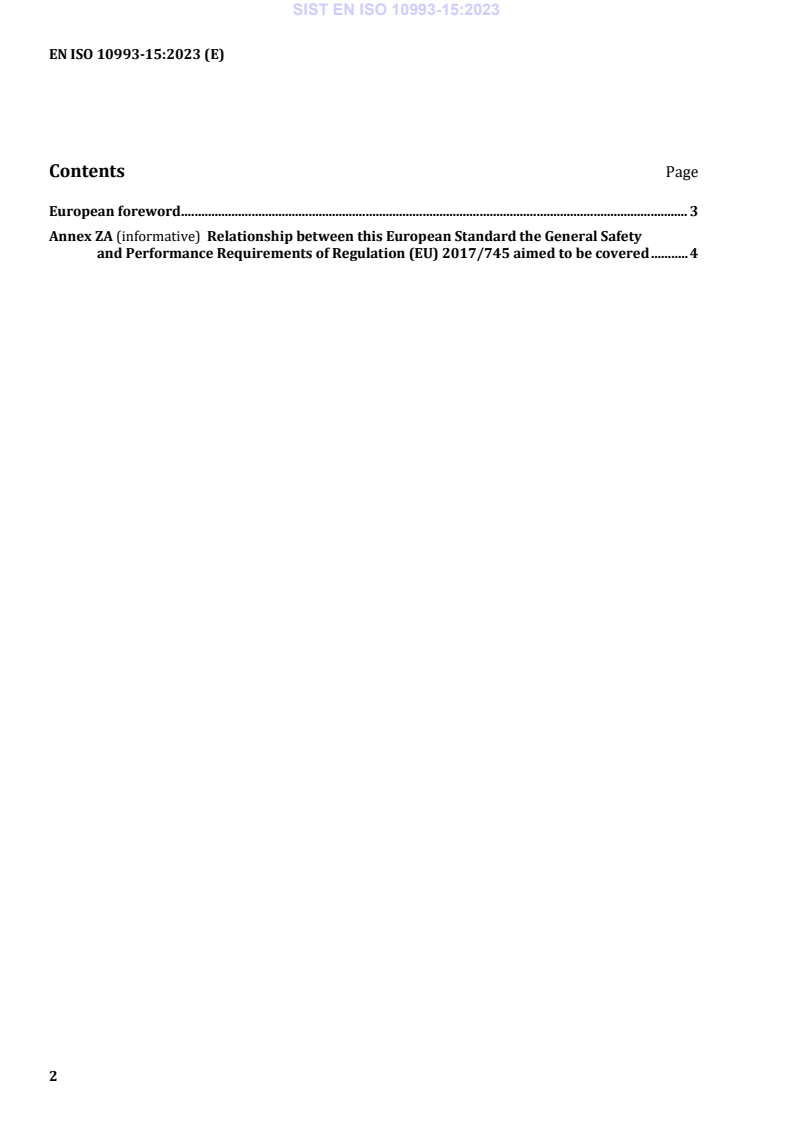
Contents Page
European foreword . 3
Annex ZA (informative) Relationship between this European Standard the General Safety
and Performance Requirements of Regulation (EU) 2017/745 aimed to be covered . 4
European foreword
This document (EN ISO 10993-15:2023) has been prepared by Technical Committee ISO/TC 194
"Biological and clinical evaluation of medical devices" in collaboration with Technical Committee
CEN/TC 206 “Biological and clinical evaluation of medical devices” the secretariat of which is held by
DIN.
This European Standard shall be given the status of a national standard, either by publication of an
identical text or by endorsement, at the latest by November 2023, and conflicting national standards
shall be withdrawn at the latest by November 2023.
Attention is drawn to the possibility that some of the elements of this document may be the subject of
patent rights. CEN shall not be held responsible for identifying any or all such patent rights.
This document supersedes EN ISO 10993-15:2009.
This document has been prepared under a Standardization Request given to CEN by the European
Commission and the European Free Trade Association, and supports essential requirements of EU
Directive(s) / Regulation(s).
For the relationship with EU Directive(s) / Regulation(s), see informative Annex ZA, which is an integral
part of this document.
Any feedback and questions on this document should be directed to the users’ national standards
body/national committee. A complete listing of these bodies can be found on the CEN website.
According to the CEN-CENELEC Internal Regulations, the national standards organizations of the
following countries are bound to implement this European Standard: Austria, Belgium, Bulgaria,
Croatia, Cyprus, Czech Republic, Denmark, Estonia, Finland, France, Germany, Greece, Hungary, Iceland,
Ireland, Italy, Latvia, Lithuania, Luxembourg, Malta, Netherlands, Norway, Poland, Portugal, Republic of
North Macedonia, Romania, Serbia, Slovakia, Slovenia, Spain, Sweden, Switzerland, Türkiye and the
United Kingdom.
Endorsement notice
The text of ISO 10993-15:2019 has been approved by CEN as EN ISO 10993-15:2023 without any
modification.
Annex ZA
(informative)
Relationship between this European Standard the General Safety and
Performance Requirements of Regulation (EU) 2017/745 aimed to be
covered
This European standard has been prepared under M/575 to provide one voluntary means of
conforming to the General Safety and Performance Requirements of Regulation (EU) 2017/745 of 5
April 2017 concerning medical devices [OJ L 117] and to system or process requirements including
those relating to quality management systems, risk management, post-market surveillance systems,
clinical investigations, clinical evaluation or post-market clinical follow-up.
Once this standard is cited in the Official Journal of the European Union under that Regulation,
compliance with the normative clauses of this standard given in Table ZA.1 and application of the
edition of the normatively referenced standards as given in Table ZA.2 confers, within the limits of the
scope of this standard, a presumption of conformity with the corresponding General Safety and
Performance Requirements of that Regulation, and associated EFTA Regulations.
Where a definition in this harmonised standard differs from a definition of the same term set out in
Regulation (EU) 2017/745, the differences shall be indicated in the Annex Z. For the purpose of using
this standard in support of the requirements set out in Regulation (EU) 2017/745, the definitions set
out in this Regulation prevail.
Where the European standard is an adoption of an International Standard, the scope of this document
can differ from the scope of the European Regulation that it supports. As the scope of the applicable
regulatory requirements differ from nation to nation and region to region the standard can only
support European regulatory requirements to the extent of the scope of the European Regulation for
medical devices ((EU) 2017/745).
NOTE 1 Where a reference from a clause of this standard to the risk management process is made, the risk
management process needs to be in compliance with Regulation (EU) 2017/745. This means that risks have to be
‘reduced as far as possible’, ‘reduced to the lowest possible level’, ‘reduced as far as possible and appropriate’,
‘removed or reduced as far as possible’, ‘eliminated or reduced as far as possible’, ’removed or minimized as far as
possible’, or ‘minimized’, according to the wording of the corresponding General Safety and Performance
Requirement.
NOTE 2 The manufacturer’s policy for determining acceptable risk must be in compliance with General Safety
and Performance Requirements 1, 2, 3, 4, 5, 8, 9, 10, 11, 14, 16, 17, 18, 19, 20, 21 and 22 of the Regulation.
NOTE 3 When a General Safety and Performance Requirement does not appear in Table ZA.1, it means that it is
not addressed by this European Standard.
Table ZA.1 — Correspondence between this European Standard and Annex I of
Regulation (EU) 2017/745 [OJ L 117] and to system or process requirements including those relating
to quality management systems, risk management, post-market surveillance systems, clinical
investigations, clinical evaluation or post-market clinical follow-up
General Safety and
Clause(s) / sub-
Performance
clause(s)
Requirements of Remarks / Notes
Regulation (EU)
of this EN
2017/745
10.1 a), b), c) and h) 10.1 a), b), c) and h) are only partly covered by ISO
10993-15, since the standard does not provide
requirements on design and manufacture.
However, this part of ISO 10993 provides
considerations on how to plan a degradation study
of metallic materials intended for use in medical
devices in order to obtain quantitative degradation
data as a basis for the safety evaluation of a medical
4, 6 and 7
device.
Therefore, this standard provides a means to
evaluate degradation risks associated with the
metallic materials which are used.
These tests are not intended to evaluate or
determine the performance of the test sample in
terms of mechanical or functional loading.
For 10.1 a), flammability is not covered.
NOTE 4 This part of EN ISO 10993 refers to ISO 10993-1 which itself refers to ISO 14971. In Europe, it should
be assumed that the reference to ISO 14971 is to EN ISO 14971:2019/A11:2021.
General Note: Presumption of conformity depends on also complying with the relevant parts of the ISO 10993
series.
Table ZA.2 — Applicable Standards to confer presumption of conformity as described in this
Annex ZA
Column 1 Column 2 International Column 3 Column 4
Reference in Standard Edition
Title Corresponding European
Clause 2
Standard Edition
ISO 3585 ISO 3585:1998 Borosilicate glass 3.3 - None
Properties
For applicable standard
edition see Column 2
ISO 3696 ISO 3696:1987 Water for analytical EN ISO 3696:1995
laboratory use - Specification
and test methods
ISO 8044 ISO 8044:2020 Corrosion of metals and alloys EN ISO 8044:2020
- Vocabulary
ISO 10993-1 ISO 10993-1:2018 Biological evaluation of EN ISO 10993-1:2020
medical devices - Part 1:
Column 1 Column 2 International Column 3 Column 4
Reference in Standard Edition
Title Corresponding European
Clause 2
Standard Edition
Evaluation and testing within
a risk management process
ISO 10993-9 ISO 10993-9:2019 Biological evaluation of EN ISO 10993-9:2021
medical devices - Part 9:
Framework for identification
and quantification of potential
degradation products
ISO 10993-12 ISO 10993-12:2021 Biological evaluation of EN ISO 10993-12:2021
medical devices - Part 12:
Sample preparation and
reference materials
ISO 10993-13 ISO 10993-13:2010 Biological evaluation of EN ISO 10993-13:2010
medical devices - Part 13:
Identification and
quantification of degradation
products from polymeric
medical devices
ISO 10993-14 ISO 10993-14:2001 Biological evaluation of EN ISO 10993-14:2009
medical devices - Part 14:
Identification and
quantification of degradation
products from ceramics
ISO 10993-16 ISO 10993-16:2017 Biological evaluation of EN ISO 10993-16:2017
medical devices - Part 16:
Toxicokinetic study design for
degradation products and
leachables
The documents listed in the Column 1 of table ZA.2, in whole or in part, are normatively referenced in
this document, i.e. are indispensable for its application. The achievement of the presumption of
conformity is subject to the application of the edition of Standards as listed in Column 4 or, if no
European Standard Edition exists, the International Standard Edition given in Column 2 of table ZA.2.
WARNING 1 — Presumption of conformity stays valid only as long as a reference to this European
standard is maintained in the list published in the Official Journal of the European Union. Users of this
standard should consult frequently the latest list published in the Official Journal of the European
Union.
WARNING 2 — Other Union legislation may be applicable to the product(s) falling within the scope of
this standard.
INTERNATIONAL ISO
STANDARD 10993-15
Second edition
2019-11
Biological evaluation of medical
devices —
Part 15:
Identification and quantification of
degradation products from metals
and alloys
Évaluation biologique des dispositifs médicaux —
Partie 15: Identification et quantification des produits de dégradation
issus des métaux et alliages
Reference number
ISO 10993-15:2019(E)
©
ISO 2019
ISO 10993-15:2019(E)
© ISO 2019
All rights reserved. Unless otherwise specified, or required in the context of its implementation, no part of this publication may
be reproduced or utilized otherwise in any form or by any means, electronic or mechanical, including photocopying, or posting
on the internet or an intranet, without prior written permission. Permission can be requested from either ISO at the address
below or ISO’s member body in the country of the requester.
ISO copyright office
CP 401 • Ch. de Blandonnet 8
CH-1214 Vernier, Geneva
Phone: +41 22 749 01 11
Fax: +41 22 749 09 47
Email: copyright@iso.org
Website: www.iso.org
Published in Switzerland
ii © ISO 2019 – All rights reserved
ISO 10993-15:2019(E)
Contents Page
Foreword .iv
Introduction .v
1 Scope . 1
2 Normative references . 1
3 Terms and definitions . 2
4 Degradation test methods . 3
4.1 General . 3
4.2 Prerequisites . 3
5 Reagent and sample preparation . 4
5.1 Sample documentation . 4
5.2 Test solution (electrolyte) . 4
5.3 Preparation of test samples . 4
5.3.1 Test samples. 4
5.3.2 Sampling. 4
5.3.3 Sample shape . 4
5.3.4 Sample surface condition . 5
6 Electrochemical tests . 5
6.1 Apparatus . 5
6.2 Sample preparation . 5
6.3 Test conditions . 5
6.4 Potentiodynamic measurements . . 6
6.5 Potentiostatic measurements . 8
7 Immersion test . 9
7.1 Apparatus . 9
7.2 Sample preparation . 9
7.3 Immersion test procedure . 9
8 Analysis .10
9 Test report .10
Annex A (informative) Electrolytes for the electrochemical tests .12
Annex B (informative) Schematic diagram of the electrochemical measuring circuit .13
Annex C (informative) Schematic drawing of an electrolytic cell .14
Bibliography .15
ISO 10993-15:2019(E)
Foreword
ISO (the International Organization for Standardization) is a worldwide federation of national standards
bodies (ISO member bodies). The work of preparing International Standards is normally carried out
through ISO technical committees. Each member body interested in a subject for which a technical
committee has been established has the right to be represented on that committee. International
organizations, governmental and non-governmental, in liaison with ISO, also take part in the work.
ISO collaborates closely with the International Electrotechnical Commission (IEC) on all matters of
electrotechnical standardization.
The procedures used to develop this document and those intended for its further maintenance are
described in the ISO/IEC Directives, Part 1. In particular, the different approval criteria needed for the
different types of ISO documents should be noted. This document was drafted in accordance with the
editorial rules of the ISO/IEC Directives, Part 2 (see www .iso .org/ directives).
Attention is drawn to the possibility that some of the elements of this document may be the subject of
patent rights. ISO shall not be held responsible for identifying any or all such patent rights. Details of
any patent rights identified during the development of the document will be in the Introduction and/or
on the ISO list of patent declarations received (see www .iso .org/ patents).
Any trade name used in this document is information given for the convenience of users and does not
constitute an endorsement.
For an explanation of the voluntary nature of standards, the meaning of ISO specific terms and
expressions related to conformity assessment, as well as information about ISO's adherence to the
World Trade Organization (WTO) principles in the Technical Barriers to Trade (TBT) see www .iso .org/
iso/ foreword .html.
This document was prepared by Technical Committee ISO/TC 194, Biological and clinical evaluation of
medical devices.
This second edition cancels and replaces the first edition (ISO 10993-15:2000), which has been
technically revised.
The main changes compared to the previous edition are as follows:
a) the document now considers materials designed to degrade in the body as well as materials that
are not intended to degrade;
b) the information on test methods has been amended to consider nanomaterials and relevant
material specific standards;
c) the test solution (electrolyte) has been specified more;
d) the sample shape has been specified more;
e) the immersion test procedure has been expanded;
f) the status of Annex C in the previous edition has been changed and now included as Annex A.
A list of all parts in the ISO 10993 series can be found on the ISO website.
Any feedback or questions on this document should be directed to the user’s national standards body. A
complete listing of these bodies can be found at www .iso .org/ members .html.
iv © ISO 2019 – All rights reserved
ISO 10993-15:2019(E)
Introduction
One of the potential health hazards resulting from medical devices can be due to the interactions of
their electrochemically induced degradation products with the biological system. Therefore, the
evaluation of potential degradation products from metallic materials by methods suitable for testing
the electrochemical behaviour of these materials is a necessary step in the biological performance
testing of materials.
The body environment typically contains cations of sodium, potassium, calcium, and magnesium, and
anions of chloride, bicarbonate, phosphate, and organic acids generally in concentrations between
–3 –3
2 × 10 mol/l and 150 × 10 mol/l. A range of organic molecules such as proteins, enzymes, and
lipoproteins are also present, but their concentrations can vary to a great extent. Earlier studies
assumed that organic molecules did not exert a significant influence on the degradation of metallic
implants, but newer investigations indicate that implant–tissue interactions should be taken into
account. Depending on a particular product or application, altering the pH of the testing environment
may also need to be considered.
In such biological environments, metallic materials may undergo a certain degradation, and the
different degradation products can interact with the biological system in different ways. Therefore, the
identification and quantification of these degradation products is an important step in evaluating the
biological performance of medical devices.
INTERNATIONAL STANDARD ISO 10993-15:2019(E)
Biological evaluation of medical devices —
Part 15:
Identification and quantification of degradation products
from metals and alloys
1 Scope
This document specifies general requirements for the design of tests for identifying and quantifying
degradation products from final metallic medical devices or corresponding material samples finished
as ready for clinical use.
This document is applicable only to those degradation products generated by chemical alteration of the
final metallic device in an in vitro degradation test. Because of the nature of in vitro tests, the test results
approximate the in vivo behaviour of the implant or material. The described chemical methodologies
are a means to generate degradation products for further assessments.
This document is applicable to both materials designed to degrade in the body as well as materials that
are not intended to degrade.
This document is not applicable to evaluation of degradation which occurs by purely mechanical
processes; methodologies for the production of this type of degradation product
...